Implications
This study provides new insights on the effect of lameness on the mobility of sows. The results suggest that sow mobility is reduced only when the degree of lameness is rather severe, whereas mildly lame sows may not be as limited in their mobility as generally assumed. Sows with a stiff, uneven and non-fluid stride did not differ in their combined willingness and capability to walk for feed rewards, when compared with sound sows. This highlights the need for further research investigating the ability of (group housed) sows to access resources and express behavioural needs depending on their lameness status.
Introduction
Since January 2013, the EU requires group housing of gestating sows (Sus scrofa) from 4 weeks after insemination to 1 week before the expected farrowing date (EC Directive 2001/88/EC). Properly managed group housed sows can express more exploratory and social behaviour, which is considered beneficial for their welfare. Group housing, however, may also have negative consequences on sow welfare such as feeding competition and aggression, resulting in increased risk for skin lesions, vulva biting and lameness (Harris et al., Reference Harris, Pajor, Sorrells, Eicher, Richert and Marchant-Forde2006; Chapinal et al., Reference Chapinal, Ruiz de la Torre, Cerisuelo, Gasa, Baucells, Coma, Vidal and Manteca2010b).
Lameness negatively affects sow welfare due to the associated discomfort and pain (Nalon et al., Reference Nalon, Conte, Maes, Tuyttens and Devillers2013; Tapper et al., Reference Tapper, Johnson, Karriker, Stalder, Parsons, Wang and Millman2013) and may reduce general activity, social behaviour and exploration (Weary et al., Reference Weary, Huzzey and Von Keyserlingk2009). In addition, lameness has an economic impact as it decreases reproduction performance, longevity, human workload and veterinary costs (Anil et al., Reference Anil, Anil and Deen2005; Ringgenberg et al., Reference Ringgenberg, Bergeron and Devillers2010; Pluym et al., Reference Pluym, Van Nuffel, Van Weyenberg and Maes2013a). The importance of lameness as a welfare and economic problem is shown by its high prevalence: 8% to 15% of sows in group housing is estimated to be lame (Heinonen et al., Reference Heinonen, Oravainen, Orro, Seppä-Lassila, Ala-Kurikka, Virolainen, Tast and Peltoniemi2006; Kilbride et al., Reference Kilbride, Gillman and Green2009).
Group housing of sows implies that individual sows have to cover (considerable) distances to reach feeding and drinking areas and other specific sites where they can perform particular behaviours (Kroneman et al., Reference Kroneman, Vellenga, van der Wilt and Vermeer1993). Lame sows might be less willing or capable to do so. Considering the high prevalence and importance of lameness, it is necessary to know if lame sows are limited in their mobility and behaviour, and at which stage of lameness this occurs.
The occurrence and severity of lameness can be determined by several methods such as visual inspection of the gait (Main et al., Reference Main, Clegg, Spatz and Green2000; Nalon et al., Reference Nalon, Maes, Van Dongen, van Riet, Janssens, Millet and Tuyttens2014) and using kinematic techniques like pressure mats and accelerometers (Grégoire et al., Reference Grégoire, Bergeron, D’Allaire, Meunier-Salaün and Devillers2013; Pluym et al., Reference Pluym, Maes, Vangeyte, Mertens, Baert, Van Weyenberg, Millet and Van Nuffel2013b; Meijer et al., Reference Meijer, Bertholle, Oosterlinck, van der Staay, Back and van Nes2014). However, none of these methods directly evaluates the effects of lameness on the capability of locomotion. Severely lame sows are obviously expected to be restricted in their movement, but for mild and moderately lame sows the extent of restriction in movement is less predictable. In visual gait scoring methods ‘mildly lame’ is often used as border line; however, it is not known if these animals are indeed restricted in mobility (by which we mean the combination of a sow’s willingness and capability to move around).
The aim of this research was to evaluate the relationship between gait score and the mobility of sows. Mobility was assessed by using a feed reward collection test in which the sows had to walk a specific distance to and from two feeders in order to collect successive feed rewards. We hypothesised that sow mobility would be increasingly reduced with deteriorating gait score, and therefore that mildly lame, moderately lame and severely lame sows would collect fewer rewards than non-lame sows.
Material and methods
Experimental design
We used an experimental setup in which sows had to walk back and forth between two locations where they received successive feed rewards. This setup resembles the methods of motivation testing (Kirkden and Pajor, Reference Kirkden and Pajor2006). In motivation tests, an animal’s willingness to work (e.g. walk, push, jump) for a certain reward (e.g. feed, extra space, social contact) is used to assess the reward’s importance to the animal while attempting to minimise the influence of other factors that may affect the amount of work performed (e.g. lameness, BW, age). We applied the opposite approach: in our tests, the differences in motivation were minimised and the influence of lameness was maximised. Feed-restricted sows were used, which allowed us to focus on the association between the degree of lameness and the number of rewards collected by the sows. The number of rewards obtained during a session was used as an indicator of the restriction in animals’ mobility, possibly due to lameness.
Test arena
The test arena consisted of a 25 m2 square wooden pen with a solid concrete floor. The pen was divided into two connected areas using a Y-shaped metal barrier measuring 3.50 m in length (Figure 1). The maximum distance the sows had to walk between successive feed rewards was 9.30 m. In order to train the sows, the length of the barrier could be shortened (to 0 m) by sliding it through the pen wall, thus decreasing the distance that had to be covered between the two feeders to a minimum of 2.30 m. The sows were called to one of the two feeders by means of a sound (recorded rattle box) and a light cue just before delivery of a new feed reward (a combination of pieces of apple, raisins and 15 g feed pellets). As soon as a reward had been eaten, a new sound and light cue was provided and a new reward was presented in the opposite feeding trough, requiring the sow to walk around the barrier. The sows in the test arena were in auditory and olfactory contact with the other sows. To minimise distraction, any faeces and/or urine produced by one sow was removed before the entrance of the following sow.
Feed reward collection test arena. (a) Feeding trough, (b) light, (c) slot for sliding the fence (d) through the pen wall to shorten the distance to be travelled.

Animals and housing
A total of 29 gestating Rattlerow-Seghers sows from the herd of the Flemish Institute for Agricultural and Fisheries Research (ILVO) were selected based on their gait score (see below). The study included sows of parity two to eight with a median parity of four. All sows were approximately in the same gestation stage of 96.6±7.0 days (mean±s.d.) and had a mean weight of 267±33 kg (mean±s.d.). The experiment was conducted using three batches of 8, 9 and 12 animals, respectively. The sows had been housed individually from 1 week before parturition until 4 weeks after insemination. From then on, they were kept in static groups. The group pens (3.34 m2/sow) had a partly slatted concrete floor and solid concrete laying areas. The sows were fed a restricted diet as commonly used in practice, with 2.6 kg of a commercial gestation diet fed from an electronic sow feeder, which satisfies only about 40% to 60% of their ad libitum feed intake (Brouns et al., Reference Brouns, Edwards and English1995; Meunier-Salaün et al., Reference Meunier-Salaün, Edwards and Robert2001). Water was available ad libitum.
Gait score
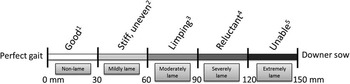
The feed reward collection test was preceded by gait scoring on all test days. To reach the test arena, sows had to walk a 60 m concrete run, at which time the locomotion scoring for the current experiment was performed (i.e. directly before each test session). To encourage the sows to move, a person walked beside them and used sound cues or waved as needed. Gait score was recorded by an experienced observer using the tagged visual analogue scale (tVAS) developed by Nalon et al. (Reference Nalon, Maes, Van Dongen, van Riet, Janssens, Millet and Tuyttens2014). The sows were categorised into five gait score classes: non-lame (0 to 30 mm on tVAS); mildly lame (30 to 60 mm on tVAS); moderately lame (60 to 90 mm on tVAS), severely lame (90 to 120 mm on tVAS); or extremely lame (120 to 150 mm on tVAS) (Figure 2). By using a tVAS with descriptors and different colour shades on the scale, observers are helped to use the total length of the 150-mm bar (Nalon et al., Reference Nalon, Maes, Van Dongen, van Riet, Janssens, Millet and Tuyttens2014).
Lameness classes on the tVAS (adapted from Nalon et al., Reference Nalon, Maes, Van Dongen, van Riet, Janssens, Millet and Tuyttens2014). Explanation of scores. 1. ‘Good’: even stride, ease of movement. Little inducement needed, comfortable on all feet. 2. ‘Stiff, uneven’: movement is not fluid, uneven strides, stiffness. 3. ‘Limping’: lame in one leg, limping. Shortened stride. Compensatory behaviours (dipping of head, caudal swagger, arched back). 4. ‘Reluctant’: reluctant to place weight on affected limb(s). Reluctant to walk. Lame in more than one leg. Caudal swagger. 5. ‘Unable’: does not place affected limb on floor. Very unwilling to move, does not walk. A vertical mark along the tVAS can be placed to score a sow. tVAS=tagged visual analogue scale.

No animals with a gait score >120 mm (extremely lame) participated in this experiment because they were not present in the herd (due to ethical considerations).
Habituation and training for the feed reward collection test
Sows were habituated individually to the test arena for 5 non-consecutive training days before the start of the feed reward collection test. They received one individual 10-min training session per day. The purpose was threefold: to familiarise them with the test arena and procedure, to train them that a feed reward would be available after the sound/light cue and to train them that the reward could be obtained by walking around the barrier. The difficulty of the procedure was increased during training by increasing the barrier length (0, 88, 175, 350 and 350 cm on training days 1 to 5, respectively). Training was considered successful if at least three rewards (i.e. the sow walked around the barrier at least twice) were collected at training at day 5. All animals were successfully trained; no animals were excluded from the experiment.
The sows were already used to being separated from the group because of prior locomotion testing carried out several weeks before this study.
Feed reward collection test
After completion of the 5 training days, sows were tested individually once per day on 3 non-consecutive days. During the 3 test days the barrier length was at maximum length (350 cm), so the distance to cover from feeding trough to feeding trough was 9.30 m (Figure 1). During each 15 min test, we recorded how many times each sow walked around the barrier and collected a feed reward.
All procedures were approved by the ILVO Ethics Committee (Reference 2011/146).
Statistics
The total number of rewards on each test day was analysed using a mixed Poisson regression model with test day and gait class as fixed effects. To correct for repeated measures and clustering within test batch, sow and batch were included in the model as random effects. Post-hoc pairwise testing was used to test the differences between different gait classes and the P-values were corrected with the Tukey–Kramer adjustment for multiple comparisons. All analyses were performed at a significance level of 5% using proc GLIMMIX in SAS 9.4 (SAS Institute Inc., Cary, NC, USA).
Results
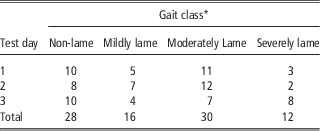
Based on visual gait scoring, sows were classified as shown in Table 1. As intended there was a reasonable variation in gait scores in all available classes (except for the extremely lame category).
The total number of observations in each lameness category as determined by visual scoring

n=29 sows.
* No animals in gait class extremely lame participated due to ethical considerations.
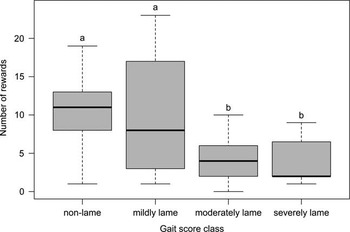
The number of rewards obtained ranged from 0 to 23 per session (mean 8±6 s.d.). No significant difference was found between test days (F 2,53=1.98, P=0.15). Non-lame and mildly lame sows obtained more rewards than moderately lame and severely lame sows (P<0.01) (Figure 3). However, there was no difference between non-lame and mildly lame sows (P=0.69), or between moderately lame and severely lame sows (P=1.00).
Boxplot of the number of rewards obtained by sows in five gait score classes. The box includes observations from the 25th to the 75th percentile; the horizontal line within the box represents the median value. Whiskers represent the 5% and 95% percentiles. Gait score classes with different letters differ significantly (P<0.05). No animals in gait class extremely lame participated due to ethical considerations.

Discussion
The present study evaluated the relationship between gait score and the mobility (i.e. combined willingness and capability to walk) of sows using a feed reward collection test. Moderately lame and severely lame sows obtained fewer rewards than non-lame and mildly lame sows. However, no differences in obtaining feed rewards were observed between non-lame and mildly lame sows, or between moderately lame and severely lame sows. This suggests that sows with a gait score on the tVAS corresponding to moderately lame or severely lame (lame in at least one leg and showing compensatory behaviours) are limited in their locomotory behaviour. The results could be an indication that lameness is either absent or present, instead of present and evolving in different degrees of severity, as assumed in most gait scoring scales, including our tVAS (Main et al., Reference Main, Clegg, Spatz and Green2000; Nalon et al., Reference Nalon, Maes, Van Dongen, van Riet, Janssens, Millet and Tuyttens2014).
In literature, only minimal information is available about distances covered by pigs (Brendle and Hoy, Reference Brendle and Hoy2011). The amount of work that animals are able and willing to do in order to obtain a reward depends on the trade-off between the incentive value of the reward and the amount of work needed to obtain it (Dawkins, Reference Dawkins1990). In this study, we aimed for an equal level of feeding motivation in all sows. We were not so much interested in the sows’ motivation to feed, but rather in how lameness status affects the likelihood that a sow will fulfil this motivation. To achieve this goal, we used a reward that had great incentive value because it was highly palatable and because our sows were fed at commercial feed levels, which satisfy only about 40% to 60% of their ad libitum feed intake (Brouns et al., Reference Brouns, Edwards and English1995; Meunier-Salaün et al., Reference Meunier-Salaün, Edwards and Robert2001). Such commercial feeding levels are known to leave sows hungry (Lawrence et al., Reference Lawrence, Appleby and Macleod1988; Lawrence and Terlouw, Reference Lawrence and Terlouw1993). Both feed deprivation (Robert et al., Reference Robert, Rushen and Farmer1997; Patterson-Kane et al., Reference Patterson-Kane, Kirkden and Pajor2011) and good palatability (Baldwin, Reference Baldwin1976) are known to increase feeding motivation in sows. As a result, the mildly lame sows may have disregarded any discomfort they experienced during the test, leading to no observed differences in mobility in this test between sound and mildly lame sows.
In addition, many farm animal species are known to be stoic, which masks their vulnerability to avoid becoming easy targets for predation or harassment by conspecifics (such as caused by impaired locomotion) (D’Eath et al., Reference D’Eath, Conington, Lawrence, Olsson and Sandøe2010). This aspect can be challenging when trying to recognise behavioural changes, thus sensitive detection methods are required that can notice the subtle changes in behaviour such as changes in locomotion pattern of sows. For example accelerometric devices could be used to detect changes in behaviour as is increasingly the case in cow husbandry (Chapinal et al., Reference Chapinal, de Passillé, Rushen and Wagner2010a).
It is possible that mildly lame sows do experience discomfort; however ignored their potential discomfort simply because of their high desire to reach the reward, the sensitivity of our test may be improved by either using sows that are less hungry or by using a less palatable reward. Alternatively, making sows walk further to obtain their reward or adding a stair, barricade or slope may also increase the feeding test’s sensitivity. An increased workload is likely to have a stronger impact on animals that are more challenged by that particular type of work.
In addition to changing the incentive value of the reward or the workload, assessing lameness at a different gestation state may also affect the test’s success. All tested sows were in the same gestation state (mean±s.d.=96.6±7.0 days), but later in gestation sows become heavier and move less easily (Bos E-J., unpublished results). The possible changes in locomotion induced by gestational state may highlight the differences between non-lame and (mildly) lame sows.
Mild lameness has recently attracted attention, either as a welfare problem in itself or as an indicator of an increased risk of developing into more severe lameness. It is also possible that the mildly lame sows did not behave differently from non-lame sows in the feed reward collection test because they actually experienced relatively little discomfort during walking. Possibly, the group we categorised as mildly lame on the basis of the visual gait scoring was just a group of sows with a rather stiff or less smooth gait, with a negligible impact on their ability or willingness to walk. If so the relevance of a mildly increased gait score for sow welfare is likely to be small. When using these indicators for animal welfare, it is important to determine a threshold to distinguish sows that are likely to experience discomfort and pain due to their condition from animals that have poor gait due to their conformation but are not in any pain. The EFSA Panel on Animal Health and Welfare (2012) reported that broilers with gait scores 4 and 5 on a five-point scale were unable to walk and therefore unable to feed properly. These animals are generally culled regardless of any consideration of the pain they experience. Both McGeown et al. (Reference McGeown, Danbury, Waterman-Pearson and Kestin1999) and Paxton et al. (Reference Paxton, Daley, Corr and Hutchinson2013) showed that broilers can have an abnormal ‘awkward gait’ but these animals did not respond to analgesics; this may suggest they were not actually in pain. This shows that abnormal gait might be due to other causes than pain, even though these animals are often defined as lame when using visual gait scoring methods. Nonetheless, even if not due to pain, abnormal gait may still be an indicator of poor welfare as it may restrict the animal in its pursuit of important resources. In sow group housing systems, conspecifics compete for resources which may exacerbate the condition (Anil et al., Reference Anil, Anil and Deen2009). Free-access stalls (with rear gates), where the resting areas are located directly at the individual feeding places, are the only type of sow housing where the sows do not have to traverse a significant distance in order to eat or drink (Levis et al., Reference Levis, Consultancy and Connor2013).
Severely lame sows did not perform worse in the feed reward collection test as compared with moderately lame sows. We categorised sows as moderately lame when they appeared lame in one leg and showed compensatory behaviours (Figure 2). The test results suggest that the mobility of these sows is reduced to a level comparable of sows we categorised as severely lame because they appeared reluctant to place weight on the affected limb(s). In other gait scoring scales these two categories are often taken together (D’Eath, Reference D’Eath2012; Nalon et al., Reference Nalon, Maes, Van Dongen, van Riet, Janssens, Millet and Tuyttens2014).
Perhaps we ought to downplay the weight allocated to the signs of mild lameness relative to the signs of more severe lameness when interpreting their consequences for sow welfare. In cows it is known that early detection and treatment decreases the prevalence of lameness (Leach et al., Reference Leach, Tisdall, Bell, Main and Green2012). Whether this is also the case for pigs is not clear, because little is known about the transition of mild lameness to more severe lameness in this species. However, if mild lameness predicts future severe lameness, early detection may be beneficial for welfare and economics, as treating mild cases of lameness costs less per case than treating severely lame animals (Willgert, Reference Willgert2011).
Conclusion
In many group housing systems in the EU, gestating sows have to cover distances when moving between feeders, drinkers and lying areas, in contrast to previous housing in individual stalls in which locomotion was neither necessary nor possible for sows during gestation. Although the possibility for locomotion and social interaction are important advantages of group housing, our results suggest that moderately and more severely lame sows are restricted in covering distances. This puts them at risk of behavioural restrictions that may possibly result in reduced feed intake, limited engagement in social interactions and a higher risk of resting in inappropriate places, all of which are likely to reduce their welfare within the group.
Our feed reward collection test revealed differences in mobility between non-lame and mildly lame sows v. moderately lame and severely lame sows, but no differences in total amount of rewards were found between non-lame and mildly lame sows. This may be because the sows that we classified as ‘mildly lame’ on the basis of visual gait scoring actually experience relatively little discomfort during walking, and/or because the test protocol needs improvement. The sensitivity of the test may be improved by decreasing the attractiveness of the rewards or by increasing the workload for each reward.
Acknowledgements
This study was funded by the Institute for Promotion of Innovation through Science and Technology in Flanders (IWT, Grant Number 090938), and co-funded by Orffa, VDV Beton, Boerenbond, AVEVE, INVE and Boehringer Ingelheim. The authors wish to thank Thomas Martens for building the motivation test arena and for his irreplaceable technical help during the experiment and Miriam Levenson for her read-through of the paper as native speaker. The authors also committedly thank the animal caretakers and interns at the experimental farm of ILVO.