INTRODUCTION
Holothuria arenicola (Semper, Reference Semper1868) commonly called the sand cucumber is commercially important, distributed at some localities in the Western Pacific, parts of Asia and the Indian Ocean, including the Red Sea and the Comoros, and along the Pacific coast of Central America (Purcell et al., Reference Purcell, Samyn and Conand2012). This species is found in significant numbers in coastal waters of Pakistan (Tahera & Tirmizi, Reference Tahera and Tirmizi1995). Holothuria arenicola lives in rocky, sandy and muddy bottoms from shallow to deeper waters (Pawson, Reference Pawson1976; Mosher, Reference Mosher1980).
Sea cucumber fisheries have expanded worldwide in catch and value over the last 20 years (Conand, Reference Conand, Lovatelli, Conand, Purcell, Uthicke, Hamel and Mercier2004), which has resulted in the decline of the stocks of more valuable exploited species and inclusion of other less valuable species in the fisheries, one such species being Holothuria arenicola. This species was included among the 18 exploitable species of sea cucumbers in the South China Sea (Li, Reference Li1990) and after the depletion of other species in Egypt, the exploitation of holothurian species was directed to H. arenicola in the Mediterranean Sea (Lawrence et al., Reference Lawrence, Ahmed, Hanafy, Gabr, Ibrahim, Gab-Alla, Lovatelli, Conand, Purcell, Uthicke, Hamel and Mercier2004). Holothuria arenicola is most abundant species in the Mediterranean Sea on the Egyptian coast (Abdel Razek et al., Reference Abdel-Razek, Abdel-Rehman, Mona, El-Gamal and Moussa2007). In the last few years the decreased size of H. arenicola in the Mediterranean Sea may be related to intensive fishing of this species (Abdel Razek et al., Reference Abdel–razek, Mona, Abdel-Rahman, El-Gamal, Moussa and Taha2010). Along with China and Egypt, this species is also fished in Madagascar (Purcell et al., Reference Purcell, Samyn and Conand2012). No traditional sea cucumber fisheries exist in Pakistan. However, the abundance of H. arenicola in coastal waters of Pakistan (Tahera & Tirmizi, Reference Tahera and Tirmizi1995) and high demand for this product in future, may prompt the opening of sea cucumber fishery.
Biological information on H. arenicola is meagre. Mosher (Reference Mosher1980) studied the habitat, behaviour and feeding activity of H. arenicola from Bahamas while Hammond (Reference Hammond1983) studied the foregut content of this species. The population structure and length-weight relationship of H. arenicola was reported from the Alexandria Coast of Egypt (Abdel Razek et al., Reference Abdel–razek, Mona, Abdel-Rahman, El-Gamal, Moussa and Taha2010). This species was also studied for proximate composition from the Persian Gulf and was found to contain higher protein and fibre content than H. parva (Salarzadeh et al., Reference Salarzadeh, Afkhami, Bastami, Ehsanpour, Khazaali and Mokhlesi2012). Keeping in view the importance of H. arenicola and lack of information on the fishery of this species, the present work was initiated to study the population dynamics of the natural stocks of this species focusing on the assessment of population structure, allometric relationships and reproductive status. The present study will provide baseline data for this species in the Arabian Sea, which can be utilized for its development and management purposes.
MATERIALS AND METHODS
Study area
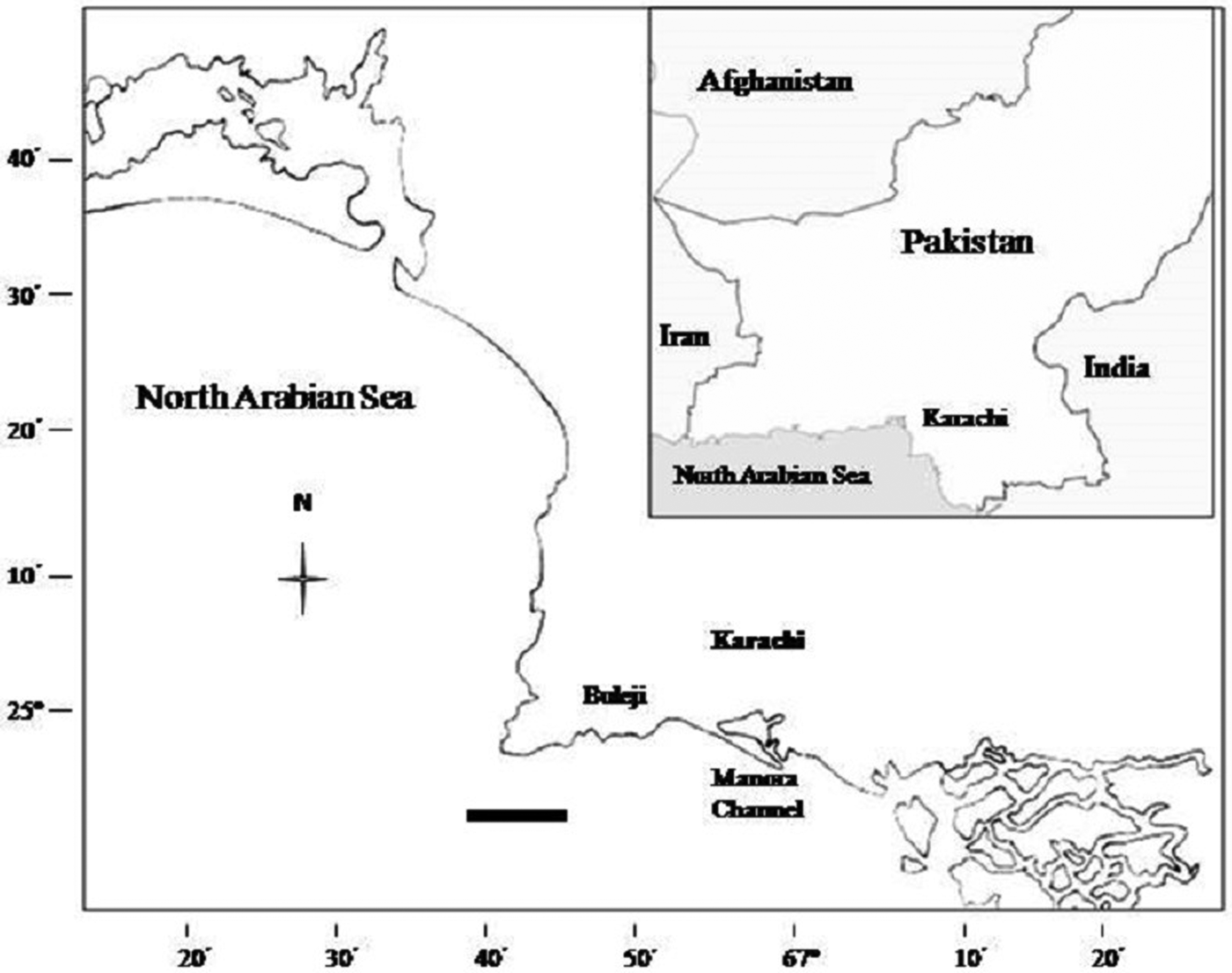
The coastline of Pakistan extends 1050 km in the Northern Arabian Sea (Figure 1). The Arabian Sea experiences reversing summer and winter monsoonal wind patterns which results in reversal of surface circulation during monsoons (Wyrtki, Reference Wyrtki, Zeitschel and Gerlach1973; Banse, Reference Banse1987), as well as seasonality in nutrient distribution (Banse, Reference Banse1987) which has an effect on fisheries production in the Arabian Sea. The coast of Pakistan is for most of the year influenced by high-salinity surface water (36 to 38 ppt) and the surface temperature during summer (May to September) is 28–30°C while during winter (November to February) it is 21–24°C and rainfall <150 mm annually. The study areas, Manora and Buleji are located on the shore of Karachi. The coast of Karachi (24°48′N 66°59′E) is ~90 km long and lies on the north-eastern border of the Arabian Sea (Figure 1). The rocky ledge of Manora stretches about 1000 m in length and 250 m in width. The upper reaches of the rocky ledge of Manora is covered by boulders of varying sizes standing on sand, gravel and pebbles while the mid and lower zone consist of boulders on rocky bottoms. The Buleji rocky shore is gradually sloping, more or less triangular in shape and is 250 m long and 150 m wide. The intertidal zone of Buleji consists of elevated and depressed areas, where the high tidal zone is covered with big rocks and boulders while the mid and low tidal zones of this shore are not consistent and show various habitats such as small boulders, flat rocks, a few sandy pockets and different sizes of tide pools.
Map showing the collection sites. Scale bar = 10 km. Inset shows the coastline of Pakistan.

Sampling and measurements
Preliminary surveys revealed that specimens of Holothuria arenicola were found in the intertidal zone on the rocky shores of Manora and Buleji. The sea cucumbers were found in considerable numbers in rock pools, underneath boulders and within crevices, and were abundant in the low tidal zone. Each month, during the period from April 2011 to November 2012, approximately 40 individuals of H. arenicola were handpicked; however, in certain months due to the strength of the sea, comparatively fewer specimens was collected. The sea cucumbers were transported to the laboratory alive in aerated seawater. In the laboratory the specimens of H. arenicola were kept in aerated seawater with 2.5% MgCl2 and relaxed for 24 h, after which measurements for total length (TL) and width (Wd) were taken to the nearest ±0.1 mm. The wet weight (WW) including the internal organs and coelomic fluid and after dissection the gonad weight (Wg) and gutted weight (Wgt) following removal of gonads, alimentary canal and respiratory trees (Conand, Reference Conand1981) were recorded on an electric balance to the nearest ±0.01 g.
Sexes are separate in Holothuria arenicola but the males and females could not be differentiated externally. The sex can be determined by the appearance and colour of the gonads. On dissection the gonad was observed to consist of several tubules forming a single bunch hanging freely in the coelom from the gonadal base located at the side of the anterior part of the intestine. The macroscopic features of the gonad included in this study were the colour of gonad, weight of gonad and length and diameter of tubules (Gaudron et al., Reference Gaudron, Kohler and Conand2008). For tubule lengths, 15 tubules were randomly measured from the point of attachment. In males and females the colour of tubules changed with maturity. Male tubules were whitish in early developing stage, creamy yellow in late developing stage, dark creamy yellow in mature stage and dull creamy yellow in partially spawned stage. In females the tubules was greenish in early developing stage, light orange in late developing stage, dark orange in mature stage and dull yellow in partially spawned stage.
Based on these criteria, five stages of maturity were identified: undetermined, early developing, late developing, mature and partially spawned stages. These stages were verified by histological examination. For this purpose the tubule was removed from the animal and immediately fixed in Davidson's Fixative (Shaw & Battle, Reference Shaw and Battle1957) for 24 h and transferred to 70% alcohol until further processing. The gonads were dehydrated, embedded in paraffin wax and sectioned at 7 μm. The sections were stained with Delafield's haematoxylin and counter stained with eosin (Humason, Reference Humason1967).
Data analysis
The population structure was studied seasonally, using the Modal Progression Analysis (Gayanilo et al., Reference Gayanilo, Sparre and Pauly2005) by dividing the length of H. arenicola into 20 mm size-classes. The cohorts were separated by using Bhattacharya's method (Bhattacharya, Reference Bhattacharya1967) with the aid of FiSAT software (Sparre & Venema, Reference Sparre and Venema1998).
To compare the data for seasonal variations, the months between November to February and May to September are winter and summer, respectively. The months between March to April and October are the transition periods between the two seasons, referred to as spring and autumn, respectively.
Morphometric relationships were estimated using the equation Y = aXb. The values of a and b were estimated from the log10 transformed values of X and Y, that is, log10Y = a + b log10X applying a linear regression analysis (Zar, Reference Zar1996).
To compare the temporal variations in the morphometric characters (TL, WW and Wgt), one-way ANOVA test was used (α = 0.05) and a Tukey test (multiple comparison test) to see which months were different. Prior to the analysis the homogeneity of variance was tested by Cochran's test and when needed the data were log-transformed.
The reproductive cycle of H. arenicola was assessed by changes in the gonad index. The gonad index (GI) was calculated as (weight of gonad/gutted weight) × 100. The temporal variation in GI was tested with ANOVA. Pearson's correlation between gonad index and temperature and salinity was computed. To determine deviation of sex-ratio from 1:1, a Chi-square test was carried out.
RESULTS
Population structure
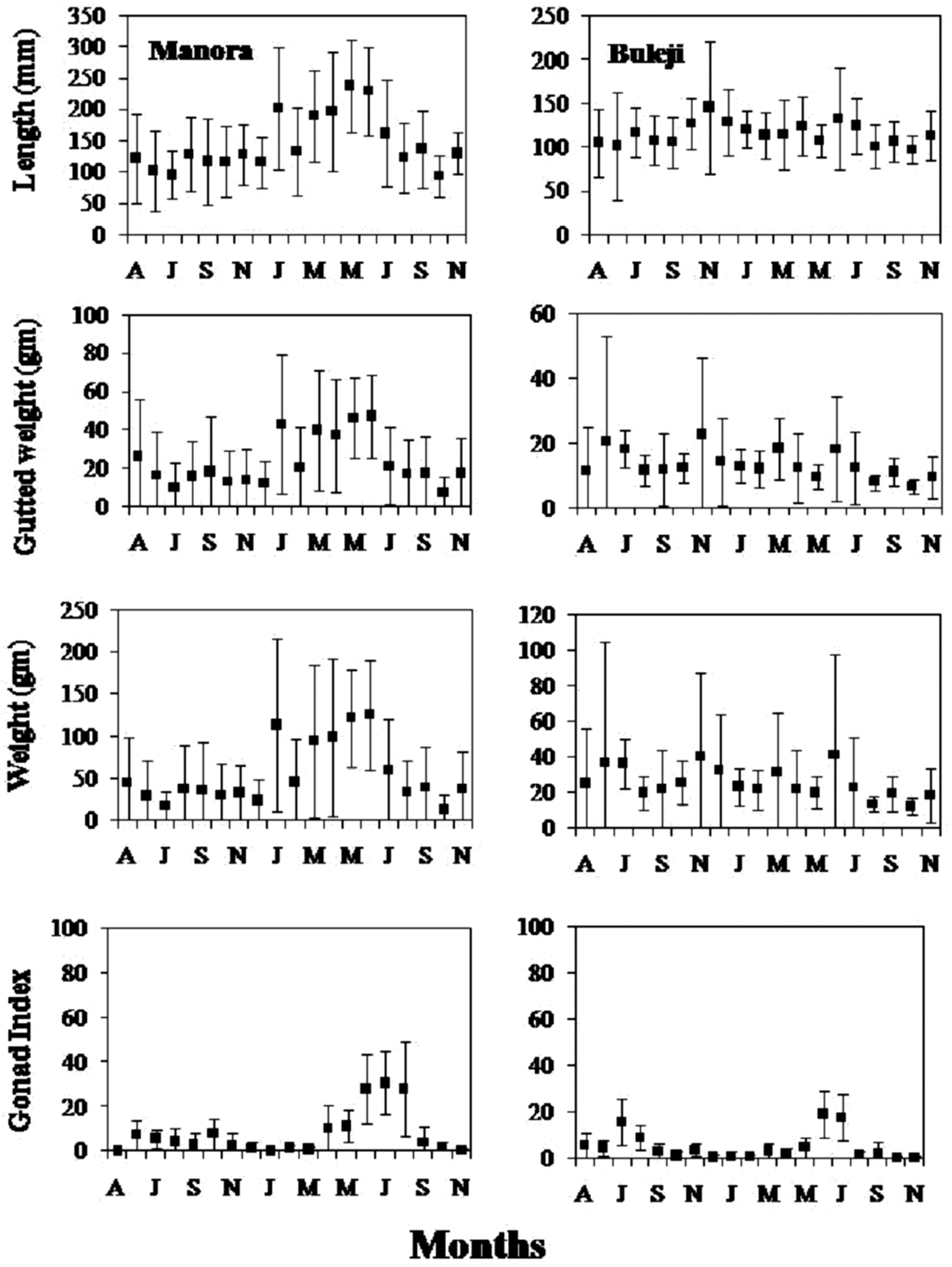
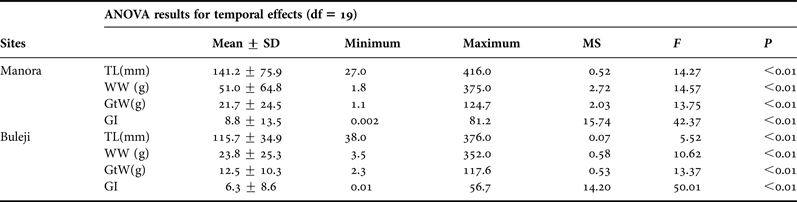
During the study period 748 and 834 specimens of H. arenicola were examined from Manora and Buleji, respectively. All the morphometric characters showed significant temporal variations (Table 1) with increase and decrease in the morphometric characters during different months (Figure 2) at both sites. The length, wet weight and gutted weight of H. arenicola varied significantly (P < 0.001) in January, March, April, May and June from other months at Manora. Gonad index varied significantly (P < 0.001) in May, June and July at Manora. The length and wet weight of H. arenicola varied significantly (P < 0.001) in November, June and October from other months at Buleji. Gutted weight varied significantly (P < 0.001) in May, June, November, March and June during the study period 2011–2012. Gonad index varied significantly (P < 0.001) in June and July at Buleji.
Temporal variability of the measured morphometric characters and the gonad index of Holothuria arenicola population at Manora and Buleji during April 2011 to November 2012.
ANOVA results for the effects of time on the morphometric variables and the gonad index (GI) of Holothuria arenicola at Manora and Buleji.
SD, standard deviation; TL, total length; WW, wet weight; GtW, gutted weight; GI, gonad index.
Length-frequency distribution analysis at Manora was bimodal in both summer and autumn consisting of small- and medium-sized individuals while in winter and spring three modes were found (Figure 3). At Buleji, the population was unimodal in all seasons consisting of small-sized individuals (Figure 3). The small-sized individuals <120 mm were equally abundant at both sites. The medium-sized individuals (120–220 mm) were more (37.7% of the total population) at Buleji than at Manora (20.6%) The larger-sized individuals >220 mm were higher in numbers at Manora (21.2%) than at Buleji (2.4%).
Modal progression analysis of Holothuria arenicola size-frequency data (thick line) based on Battacharya's method at Manora and Buleji.
Morphometric relationships
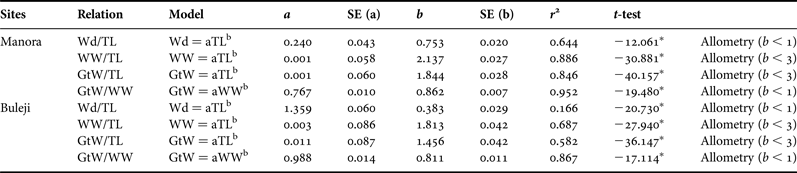
Width/length, wet weight/length, gutted weight/length and gutted weight/wet weight relationships followed negative allometry (Table 2) at Manora. In all these relationships the coefficients of determination were greater than 0.85 with exception in width/length where the r value was 0.64. A negative allometry was also found for these relationships at Buleji (Table 2). In all these relationships the coefficients of determination were greater than 0.60 with exception in width/length where this value was 0.16 (Table 2).
Morphometric relationships between total length (TL), width (Wd), wet weight (WW) and gutted weight (GtW) of the Holothuria arenicola population at Manora (N = 748) and Buleji (N = 843).
a, intercept; b, slope; SE, standard error; r 2, coefficient of determination; * statistically significant values, P < 0.001.
Macroscopic and microscopic examination of gonad development
The five maturation stages described on the basis of macroscopic and histological features included:
1 Undetermined sex: The individuals with undetermined sex either carried undifferentiated gonads or had no visible gonad. The colour of the tubule was translucent, white or green. The tubules were fine thread-like, unbranched and short in length (2–38 mm). The weight of the gonad ranged from 0.01 to 0.46 g and average GI in undifferentiated gonad was 0.22 ± 0.21. On histological examination the connective tissue were observed at the periphery of the tubule and follicle cells were dispersed in the lumen. Germ cells were not detected in these gonads (Figure 4).
2 Early developing stage: The colour of the tubule was white or green. The tubules were thin, increased in length and branched. The tubules length was 3–92 mm, weight of gonad ranged from 0.01 to 1.69 g and average GI was 1.05 ± 0.53. On histological examination the green-coloured gonad showed the initiation of oogenesis with abundant previtellogenic oocytes (Figure 5A). The white-coloured gonad showed the initiation of spermatogenesis with developing spermatocytes and at the periphery of the gonad a layer of spermatogonia was present (Figure 6A). The gonad wall was thick in both females and males.
3 Late developing stage: The colour of tubules was light orange in females and creamy yellow in males. The tubules increased in length and were thicker in diameter than the early developing stage. In females, tubules length was 6–122 mm, weight of gonad ranged from 0.09 to 7.27 g and average GI was 6.17 ± 3.60. In males, tubule length was 4–138 mm, weight of gonad ranged from 0.12 to 9.64 g and average GI was 4.51 ± 1.95. Histological examination of female gonad showed two types of oocytes, early vitellogenic oocytes and late vitellogenic oocytes (Figure 5B). The male gonad showed the presence of abundant spermatocytes and few spermatozoa (Figure 6B). The gonad wall was thick in both females and males.
4 Mature stage: The colour of tubule was dark orange in females and dark creamy yellow in males. The tubules attained their maximum thickness and length. In females, tubule length was 9–238 mm, weight of gonad ranged from 0.90 to 7.27 g and average GI was 27.45 ± 13.23. In males, tubule length was 7–252 mm, weight of gonad ranged from 1.06 to 35.66 g and average GI was 25.37 ± 12.50. The mature ovary on histological examination was found to be occupied by thickly packed polymodal shaped vitellogenic oocytes (mature oocytes) with well-defined nucleus (Figure 5C). The testes were densely packed with spermatozoa (Figure 6C). The gonad wall was thin in both females and males.
5 Partially spawned gonad: The tubules were flaccid and discoloured being dull yellow in females and dull creamy yellow in males. In females, tubule length was 4–135 mm, weight of gonad ranged from 0.21 to 10.93 g and average GI was 8.21 ± 3.09. In males, tubule length was 6–193 mm, weight of gonad ranged from 0.59 to 8.52 g and average GI was 10.07 ± 1.79. Histological sections of female gonads showed drastically reduced oocyte density and empty spaces, due to the release of mature oocytes; some mature and relict oocytes remained (Figure 5D). The male gonads contained lower densities of spermatozoa with empty spaces, due to the release of spermatozoa (Figure 6D). The gonad wall was thin in both females and males.
Microscopic characteristics of undifferentiated gonad. Fc: Follicle cells; Ct: Connective tissue. Scale bar: 50 μm.
Microscopic characteristics of female gonadal stages in Holothuria arenicola. (A) Early developing stage; (B) Late developing stage; (C) Mature stage; (D) Partially spawned stage. Ct: Connective tissue; Pvo: Pre-vitellogenic oocytes; Evo: Early vitellogenic oocytes; Lvo: Late vitellogenic oocytes; Mo: Mature oocytes; Ro: Relict oocytes; Es: Empty space after release of oocytes. Scale bars: A, 50 μm; B, C & D, 100 μm.
Microscopic characteristics of male gonadal stages in Holothuria arenicola. (A) Early developing stage; (B) Late developing stage; (C) Mature stage; (D) Partially spawned stage. Sg: spermatogonia; Sc: spermatocytes; Sz: spermatozoa; Es: Empty space after release of sperm. Scale: 100 μm.
Sex ratio
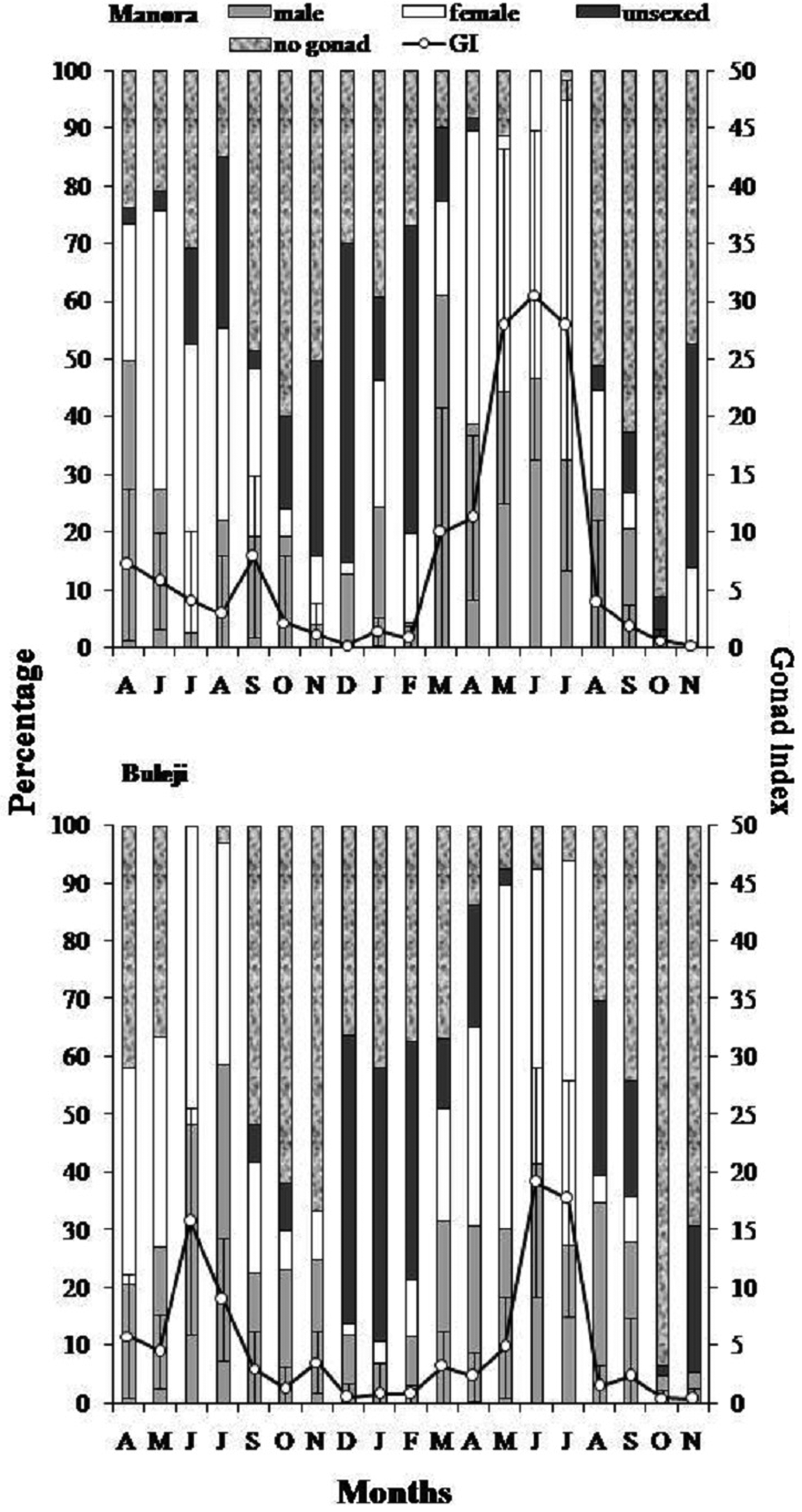
Holothuria arenicola is a gonochoristic species and comprised 22.5% males, 24.1% females and 53.3% unsexed (including with and without gonad) at Manora. The unsexed individuals of H. arenicola were more common during autumn and winter (Figure 7). Overall sex ratio in the population of H. arenicola did not deviate significantly from 1:1 (X 2 = 0.41, df = 19, P > 0.05). At Buleji, H. arenicola comprised 24.3% males, 22.9% females and 52.8% unsexed individuals. Overall, the sex ratio at Buleji was non-significant and followed the 1:1 ratio (X 2 = 0.37, df = 19, P > 0.05).
Temporal variability of sex and gonad index (GI) of Holothuria arenicola population at Manora and Buleji.
Gonad Index (GI)
The GI of H. arenicola showed significant temporal variations at Manora (F = 32.48, P < 0.001) and Buleji (F = 40.08, P < 0.001). The higher GI values were recorded during spring and summer and the lower GI were recorded during autumn and winter showing spawning followed by a resting phase at Manora and Buleji (Figure 7). The GI showed no significant correlation with seawater temperature (Pearson's correlation r = 0.367, P = 0.106), however, there was a significant negative correlation with salinity (r = −0.455, P = 0.050) at Manora. A similar non-significant correlation was observed between GI and temperature (Pearson's correlation r = 0.025, P = 0.920) and a significant negative correlation between GI and salinity (r = −0.596, P = 0.007) at Buleji.
DISCUSSION
Obtaining accurate body measurements of soft-bodied animals is a difficult task but different methods have been adopted to relax the sea cucumber, such as immersion in KMnO4, MgSO4 and MgCl2 solution (Sewell, Reference Sewell1994; Guzman & Guevara, Reference Guzman and Guevara2002; Sulardiono et al., Reference Sulardiono, Prayitno and Hendrarto2012) and measuring length underwater or in situ (Herrero-Pérezrul & Reyes-Bonilla, Reference Herrero-Pérezrul and Reyes-Bonilla2008). Therefore, in the present study the criterion of relaxing the animal for 24 h in MgCl2 was followed to achieve the maximum length. There are several authors who considered sea cucumber lengths for the study of population dynamics (Guzman & Guevara, Reference Guzman and Guevara2002; Herrero-Pérezrul & Reyes-Bonilla, Reference Herrero-Pérezrul and Reyes-Bonilla2008; Sulardiono et al., Reference Sulardiono, Prayitno and Hendrarto2012) while others preferred to record weight (Conand, Reference Conand1981; Bulteel et al., Reference Bulteel, Jangoux and Coulon1992; Tuwo & Conand, Reference Tuwo and Conand1992; Kazanidis et al., Reference Kazanidis, Antoniadou, Lolas, Neofitou, Vafidis, Chintiroglou and Neofitou2010). In present study there was significant positive correlation between length and weight at Manora (r = 0.941, P = 0.001) and Buleji (r = 0.819, P = 0.001) further confirming the reliability of length measurements for estimating the population dynamic of sea cucumbers.
Large-sized (>220 mm) individuals were more abundant (21.2%) at Manora than Buleji (2.4%). The larger-sized individuals of H. arenicola at Manora may be due to the fact that biological diversity is low at Manora as compared with Buleji (Ahmed & Hameed, Reference Ahmed and Hameed1999a, Reference Ahmed and Hameedb; Rahman & Barkati, Reference Rahman and Barkati2012), therefore, probably there is less competition for food and space at Manora. A positive correlation between growth rates and food availability has been reported in other invertebrates (Bosman & Hockey, Reference Bosman and Hockey1988; Brethes et al., Reference Brethes, Ferreyra and De La Vegas1994).
Juveniles less than 30 mm were only occasionally collected during this study which may be due to the fact that juvenile sea cucumbers are cryptic and small individuals migrate to the adult habitat at a later stage of life (Purcell, Reference Purcell, Lovatelli, Conand, Purcell, Uthicke, Hamel and Mercier2004). Alternatively, a fast growth rate during the juvenile stage may be the reason for the scarcity of small-sized specimens (Massin & Jangoux, Reference Massin and Jangoux1976). Earlier studies on holothurian species have reported the presence of few or no juveniles in the populations (Conand, Reference Conand1981; Tuwo & Conand, Reference Tuwo and Conand1992; Despalatovic et al., Reference Despalatovic, Grubelic, Simunovic, Antolic and Zuljevic2004; Kazanidis et al., Reference Kazanidis, Antoniadou, Lolas, Neofitou, Vafidis, Chintiroglou and Neofitou2010).
In the present study the width/length, wet weight/length, gutted weight/length and gutted weight/wet weight relationships showed negative allometry, that is, the two morphometric variables are not changing at the same rate. Negative allometric relationships between morphometric characters have been reported in H. tubulosa from the Mediterranean Sea (Bulteel & Jangoux, Reference Bulteel and Jangoux1989; Bulteel et al., Reference Bulteel, Jangoux and Coulon1992) and from the Aegean Sea (Kazanidis et al., Reference Kazanidis, Antoniadou, Lolas, Neofitou, Vafidis, Chintiroglou and Neofitou2010). Similarly a negative allometric weight-length relationship has been reported in H. arenicola from the Mediterranean Sea (Raouf et al., Reference Raouf, Fatma and Mohamed2000; Abdel Razek et al., Reference Abdel–razek, Mona, Abdel-Rahman, El-Gamal, Moussa and Taha2010). In the present study, wet weight/length and gutted weight/length relationships showed a high coefficient of determination as compared with a low determination coefficient reported for these relationships in H. tubulosa (Kazanidis et al., Reference Kazanidis, Antoniadou, Lolas, Neofitou, Vafidis, Chintiroglou and Neofitou2010). So in this study length appeared to be a positive predictor of biomass in holothurian species, H. arenicola.
Based on gonadal histology the maturity in H. arenicola was divided into five stages including the unsexed stage which carried unidentified gonads or individuals in which gonads were totally absent. Similarly, the maturity in different species of sea cucumber has been described in five stages (Conand, Reference Conand1981, Reference Conand1993; Ramofafia et al., Reference Ramofafia, Battaglene, Bell and Byrn2000) or four stages (Ramofafia et al., Reference Ramofafia, Byrne and Battaglene2003; Abdel-Razek et al., Reference Abdel-Razek, Abdel-Rahman, El-Shimy and Omar2005; Asha & Muthiah, Reference Asha and Muthiah2008). The lack of gonads during certain months has been associated with the resorption of tubules after spawning (Conand, Reference Conand1993). The increased number of individuals with no gonads during the September to November period after spawning showed the resting phase in H. arenicola and suggests that the tubule recruitment model (TRM) for ovarian development in holothurians (Smiley, Reference Smiley1988) may not be applicable to H. arenicola. There are many species of sea cucumber that do not follow the TRM (Despalatovic et al., Reference Despalatovic, Grubelic, Simunovic, Antolic and Zuljevic2004), rather than the evidence for the TRM being provided by only a few species (Sewell et al., Reference Sewell, Tyler, Young and Conand1997).
The sex ratio in H. arenicola was approximately 1:1, as is the case for most species of holothurians (Tuwo & Conand, Reference Tuwo and Conand1992; Conand, Reference Conand1993; Foster & Hodgson, Reference Foster and Hodgson1995, Herrero-Perézrul et al., Reference Herrero-Pérezrul, Reyes-Bonilla, García-Domínguez and Cintra-Buenrostro1999; Despalatovic et al., Reference Despalatovic, Grubelic, Simunovic, Antolic and Zuljevic2004, Rasolofonirina et al., Reference Rasolofonirina, Vaïtilingon, Eeckhaut and Jangoux2005, Asha & Muthiah, Reference Asha and Muthiah2008), but H. whitmaei showed a sex ratio in favour of males (Shiell & Uthicke, Reference Shiell and Uthicke2006) and H. leucospilota in favour of females (Gaudron et al., Reference Gaudron, Kohler and Conand2008).
Increase in gonad index was observed during April to July (spring to early summer), followed by a decrease in GI from October to February (autumn and winter) apparently as a result of spawning followed by a resting phase. The pattern of spawning in H. arenicola followed the same pattern of spawning as reported by Ahmed (Reference Ahmed1980) in marine animals on the coast of Pakistan. According to Ahmed (Reference Ahmed1980) species of marine invertebrates which occur in high and mid tidal zones spawn during summer for a period of 6 months, whereas those found close to the low tidal zone or sub-tidally spawn in winter.
The species studied, H. arenicola has not been commercialized to the same extent as other species, but it is being fished in China, Madagascar and Egypt (Purcell et al., Reference Purcell, Samyn and Conand2012) and is expected to be harvested in other parts of the world after the reduction of other sea cucumber species of higher commercial importance. The present study provides information on certain biological aspects of H. arenicola, which can be utilized for effective management measures in order to avoid the overexploitation of this species.