Introduction
European welfare states in their various and differing ways have developed a range of services designed to meet the social risks encountered in the normal life-course (loss of income due to unemployment, sickness, retirement, ill-health, education for children and so on), with some expenditure on benefits to reduce poverty. The main themes are security and redistribution (Roller, Reference Roller, Borre and Scarborough1998; Kumlin, Reference Kumlin, Dalton and Klingemann2007). More recently, in response to economic, social and political developments, there has been a shift in provision and in the political discourse that surrounds it towards greater emphasis on individual responsibility and proactivity through activation, more choice, voluntary additional pensions and new public management.
State welfare has often been seen as the European solution to the problem of balancing the individualism and inequality of market capitalism with the universalism and shared interest of political democracy (Boix, Reference Boix2003). Many commentators see the welfare state as essentially a class compromise, which owes its success to wide-ranging support for collective provision across middle and working-class groups (Baldwin, Reference Baldwin1990; Korpi, Reference Korpi1983). From this perspective, the development of more individualist approaches alongside those which emphasise security and redistribution between the better and worse-off may erode the solidarity on which the welfare state is based and undermine support for and confidence in the system.
The difficulty is especially salient at a time of growing inequality (Atkinson, Reference Atkinson2007) and of the diminishing of class solidarities (Jessop, Reference Jessop2002; Giddens, Reference Giddens1994). This suggests a problem: reforms have been undertaken to promote social objectives and meet people's needs under difficult circumstances, but may have the longer-term result of undermining popular support for the system which provided social welfare in the first place. An alternative approach argues that greater proactive individual responsibility can be reconciled with continuing support for the welfare state through the assumption that collective interventions are necessary to ensure that equal opportunities are available across all social groups (EU, 2008). This paper considers recent attitude survey evidence on how ordinary citizens think about these issues and whether a proactive approach damages confidence in the welfare state.
The paper falls into four sections examining recent developments in European social provision and the discourses that surround it, discussing the implications of the security/redistribution and opportunity/responsibility approaches for social solidarity and trust in the welfare state, analysing material from the European Social Survey (ESS, 2010), and presenting findings and conclusions.
Recent developments in social provision
The story of the post-war development of European welfare states can be told as a drama in two acts, each with its dominant normative and pragmatic assumptions, followed, perhaps, by the first scene of the uncertain response to the current crisis. This account will be brief and operate at the most general level (for more detailed analyses, see Bonoli et al., Reference Bonoli, George and Taylor-Gooby1999; Pierson, Reference Pierson2001; or Scharpf and Schmidt, Reference Scharpf and Schmidt2001). Most of the discussion identifies different frameworks or regimes of social provision (Esping-Andersen, Reference Esping-Andersen1990; Allan and Scruggs, Reference Allan and Scruggs2004), and emphasises a general trend, in the first act, to expansion within the various regime-types, and, in the second, to constraint, with some limited convergence (Swank, Reference Swank2005).
During the period of assured nation-state-centred growth after the Second World War, governments expanded the range and level of benefits to meet popular demands. Typically, the welfare state operated within assumptions of male breadwinner full employment, so that much care of the elderly and childcare were provided within the family, and the issue of whether the established gender roles promoted a fair distribution of opportunities was low on the political agenda. Different mechanisms of finance (social insurance, various kinds of taxation), entitlement (contribution record, universal allocation, need, dessert) and administration (by central or local state, or insurance agency with various degrees of association with social partners, faith groups and other bodies) developed. In the second act, social political and economic changes called these assumptions into question.
All welfare states were ‘confronted with massive challenges . . . and . . . regardless of the political orientation of their governments, none could fully defend the achievements of their “golden age”’ (Scharpf and Schmidt, Reference Scharpf and Schmidt2001: 335). Globalisation weakened the authority of national governments to control exchange rates and regulate imports and exports. It reinforced pressures to manage national affairs (including social spending) to enhance competitiveness in a freer world market (McNamara, Reference McNamara1998; Bardhan et al., Reference Bardhan, Bowles and Wallerstein2006). The shift towards a post-industrial economy tended to weaken the organised working class who provided the basis for the various corporatist, social democratic and liberal forms of class compromise across Europe (Glyn, Reference Glyn2007; Standing, Reference Standing2009). The demands of emerging political groups, and especially of women, challenged the male worker welfare state and required an expansion of collective care services. Additional pressures from expanding elderly populations, rising health care costs and fluctuations in employment intensified the problem of escalating expenditure. The introduction of new technology threatened to render obsolete or export many of the jobs on which the core working class had relied for security and good living standards (Pierson, Reference Pierson2001, chapter 3). The less deferential more demanding stance of citizens identified by political scientists (Norris, Reference Norris1999) increased the pressure for a policy response.
These changes have led to reforms that proceeded at various speeds in different political contexts. The pace and pattern of change was affected by a number of factors: the collision between the constraints and the popularity of state welfare (Pierson, Reference Pierson2001: 14); the fact that varying constitutional arrangements offered different opportunities to introduce radical changes, which tended to take place more rapidly in majoritarian polities such as in the UK (Bonoli et al., Reference Bonoli, George and Taylor-Gooby1999; Ferrera and Rhodes, Reference Ferrera and Rhodes2000); the influence of different institutional structures on the sense of entitlement and of obligation, especially prominent in corporatist welfare states (Mau, Reference Mau2003); the range of actors involved (levels of government, social partners, the third sector, religious bodies: Castles, Reference Castles1998); and the degree of entrenchment of interests committed to the status quo, with negotiations involving social partners slowing change in more corporatist systems (Palier and Martin, Reference Palier and Martin2008; Swank, Reference Swank2005). Certain common features can be identified, including:
• Reforms to social security to encourage active labour market participation, both through welfare-to-work restrictions on unemployment and early retirement entitlements and through support from advisers, training and make-work-pay wage subsidy (Lodomel and Trickey, Reference Lodomel and Trickey2001; EU, 2008; Van Berkel and Valkenburg, Reference Van Berkel and Valkenburg2007). These reforms include the UK New Deal and Single Gateway Schemes, the German Hartz IV reforms, the French introduction of PARE and related reforms, Clinton's workfare and TANF reforms in the US and flexi-curity reforms in Denmark and the Netherlands (Cebulla et al., Reference Cebulla, Ashworth, Greenberg and Walker2005; Clegg, Reference Clegg2007). Further reforms seek to transfer those dependent on incapacity disability benefits into paid work.
• Work–life balance reforms including changes in employment rights, equal opportunities legislation and the expansion of pre-school and daycare provision in order to increase the availability of parents, particularly mothers, for paid work (Daly and Rake, Reference Daly and Rake2003; Esping-Andersen, Reference Esping-Andersen2009).
• Pension restructuring to limit entitlements in line with demographic change, to increase the required contribution periods, to raise retirement ages and to expand the scope of individual responsibility through supplementary private pensions (Arza and Kohli, Reference Arza and Kohli2008; Bonoli and Palier, Reference Bonoli and Palier2007; Zaidi, Reference Zaidi2009: 5–9).
• New Public Management reforms, directed at cost-efficiency and responsiveness, and concerned to decentralise budgetary responsibility and enhance the scope for competition in internal and sometimes external markets (Palier and Martin, Reference Palier and Martin2008; Lane, Reference Lane2000; OECD, 2005; Barnes and Gill, Reference Barnes and Gill2000; McLaughlin et al., Reference McLaughlin, Osborne and Ferlie2002). Such procedures typically expand consumer choice (for example, the UK and Swedish health and education reforms: Le Grand, Reference Le Grand2007; Enthoven, Reference Enthoven2002; PMSU, 2006). Further examples are National Performance Review in the US, La Rélève in Canada and the Copernicus reforms in Belgium. In continental Europe, developments proceed at a slower pace, but most countries have now introduced elements of competition and of spending constraint (Hassenteufel and Palier, Reference Hassenteufel and Palier2007).
The pace of development among the crowded and diverse welfare states of Europe varies and the pattern of outcomes is necessarily complex. Taken together, reform programmes, in their various ways, have shifted a proportion of responsibility for outcomes in labour market access, pension entitlement and managing work and family life from state to individual, while expanding the range of choices. They render social provision more responsive to individual demands. The reforms also constrain future spending commitments, notably in relation to pensions, although state spending continues to rise.
Whether the international political economy bearing on social provision is entering a third stage of protectionism is unclear (Gamble, Reference Gamble2009: 149–52). This view is strengthened by national finance and manufacturing industries subsidies, labour market support and trade barriers such as ‘Buy American’ clauses. Here we assume these trends will not persist, since awareness of possible economic benefits from globalisation is likely to exceed the concerns about the immediate need for ring-fenced domestic support. Continuation of existing trends within a climate of austerity seems more likely (OECD, 2009; IMF, 2009).
To summarise, European welfare states developed social protection systems which differed substantially in levels of spending, entitlement rules and methods of finance, but centred on providing security against the risk and uncertainties of the typical working-class life-course, with some specifically redistributive welfare. These systems were in large part passive: citizens paid taxes and contributions and were entitled to benefits and services. More recently, economic, social and political changes have created pressures for constraint and reforms have tended to foreground a more proactive individual responsibility for outcomes, through labour market activation, policies that help parents and especially mothers to pursue paid work, a greater role for additional voluntary non-state pensions and new public management.
Proactivity, individualism and support for collective welfare
The net impact of the expansion of services that place greater emphasis on individual responsibility and on the provision of opportunities is twofold:
• At the pragmatic level, it allows government to devote less effort to redistribution and more to support for individuals who are assumed to respond to opportunities and incentives to move from benefits into employment, to supplement their own pensions privately or to take up training opportunities, and are encouraged through subsidies, sanctions and case management to do so. This addresses the twin pressures to curb spending and meet rising demand, a pressure redoubled by the financial crisis.
• At the normative level, it transfers a greater share of responsibility for what happens from government to individuals. This has implications for social citizenship. Passive provision implies duties to accept the benefits and services on offer, pay taxes and follow the rules of entitlement. A more active framework implies a positive responsibility to grasp the opportunities made available because this advances both individual and common good.
An immediate issue is whether the new active approach will tend to undermine collective support for social provision. From one perspective, an individual responsibility agenda conflicts with collectivism: people will tend to focus more on their own capacity to achieve outcomes and guard against the social risks and uncertainties of the life-course for themselves and their family. Their interests are linked more to their own success in managing their affairs and less to reliance on collective state provision (Putnam, Reference Putnam2000; Marquand, Reference Marquand2004). An alternative approach suggests that individual responsibility and support for collective provision are not opposed. From this perspective, government is expected to intervene in the market to ensure that individuals (and especially those from the more vulnerable groups) have access to better opportunities, and to provide services and support to help them progress in society. This argument is advanced by a number of commentators (for example, Van Parijs, Reference Van Parijs1995) and is summed up by the EU in the Renewed Social Agenda (2008, section 1):
Europeans face unprecedented opportunities, more choice and improved living conditions . . . the focus needs to be on empowering and enabling individuals to realise their potential while at the same time helping those who are unable to do so . . . The reality is that economic and social actions at EU and national level are mutually reinforcing and complementary, which links together opportunity, access and solidarity.
The emphasis on solidarity, understood as collective interest (for example, Pope John Paul II, 1987) furnishes a basis for support for state welfare interventions. In this way, the development of more individualist approaches does not risk damaging support for the welfare state. Thus, a more liberal individualism is reconciled with the established welfare state collectivism.
An extensive literature tackles this idea (for example, Sen, Reference Sen1979; Nussbaum, Reference Nussbaum2003; Roemer, Reference Roemer1996, Reference Roemer2005), and it is influential in national (Burchardt and Vizard, Reference Burchardt and Vizard2007a, Reference Burchardt and Vizard2007b; Arndt and Volkert, Reference Arndt and Volkert2006) and international (UN, 2009) policy-making. An important theme has been the limitations placed on the choices people are able to make both through practical obstacles of access and lack of resources and through the assumptions people make about the opportunities that exist and are appropriate for them, and indeed the possibilities that additional opportunities might open up. Sen's work has been path-breaking in developing a comprehensive individual-centred approach to opportunity that does not simply justify inequalities on the grounds that some people may have more extensive imaginations, desires or information so that satisfying their aspirations requires more resources (Osmani, Reference Osmani, Basu and Kanbur2008). It has been criticised for its focus on individual achievement and its failure to address the collective and social democratising nature of the construction of and response to opportunities (Dean, Reference Dean2009).
Recent reforms develop more active, individualised and opportunity-centred approaches to social provision alongside the existing more passive and security/redistribution-centred approach. From one perspective, the discourses associated with these two themes conflict with each other, and the first risks damaging collectivist sentiments by replacing them with a more self-regarding political consciousness. From another, vigorous state involvement in supporting individual pursuit of opportunity can restore collective interest and ensure that the assumptions implicit in the reform programme do not erode support for collective provision. We go on to investigate these issues using recent cross-national attitude survey data. The specific research question is whether endorsement of the principles of proactivity, equal opportunity and individual responsibility, plus supportive state provision, is associated with generally lower support for and confidence in the welfare state, compared with a more passive understanding of security and redistribution.
Other factors that bear on attitudes to welfare and trust in government must also be taken into account. A dominant tradition starts out from class divisions and relates social welfare to stratification and to the various accommodations of differences of interest within welfare state regimes (Korpi, Reference Korpi1983; Esping-Andersen, Reference Esping-Andersen1990). Further work adds gender interests and family relationships and responsibilities in the reproductive sphere as well as those in the productive sphere (O'Connor et al., Reference O'Connor, Orloff and Shaver1999; Lewis, Reference Lewis, Leibfried and Mau2008). In addition, age and education level relate to attitudes (Blekesaune and Quadagno, Reference Blekesaune and Quadagno2003; Gelissen, Reference Gelissen2000). Analysis of the relationship between regime type and attitudes to state welfare indicates that the link is complex and mediated by institutional structure (Linos and West, Reference Linos and West2003: 394–5). If it is to capture the operation of the two sets of assumptions in practice, the analysis must include the variables mentioned here and cover the different kinds of welfare state.
The analysis
In the discussion above, we identified two co-existing discourses on social welfare: a long-established approach that centres on security and redistribution as a major European tradition and a more recently emerging perspective that gives greater weight to a proactive individual responsibility with a role for government in making opportunities available. We wish to examine how these are developing in the contexts of the various welfare states. Analysis that seeks to take into account the influence of the different regime formations in Europe speedily encounters the problem of too many variables and too few cases. For this reason, we select three countries to compare: Sweden, Germany and the UK. These are the leading European examples of the three main regime types identified by Esping-Andersen and include the main representatives of both the co-ordinated and liberal market varieties of capitalism identified by Soskice (Reference Soskice, Kitschelt, Lange, Marks and Stephens1999).
Table 1 gives some recent information bearing on equality of outcome and of opportunity. Sweden is most equal in terms of equality of outcome (poverty, replacement rate and inequality, reported in columns 1 to 3) and equality of opportunity (columns 4 to 8), indicated by education spending, active labour market support and social mobility, followed by Germany and the UK. This pattern reflects the distinction typically made between social democratic Sweden with its universalist and integrative policies and established supportive active labour market, corporatist Germany with more emphasis on the established status order and the more liberal-leaning UK in which the responsibility to take up opportunities rests more firmly with the individual (Esping-Andersen, Reference Esping-Andersen1990, chapter 2). These three countries enable us to consider how citizens respond to policy ideas in the most important European regime types identified in comparative literature. They do not include other forms of welfare state (Mediterranean, post-socialist) or take into account the particular features of other national contexts.
Equality of outcome and opportunity in Sweden, Germany and the UK

Notes: Replacement rate is for a one-earner, two-child family after 60 months unemployment.
Poverty is the Eurostat at risk of poverty rate after social transfers.
Gender pay gap is the gap between women's and men's earnings for full-time workers aged 18–65 as a percentage of male earnings as estimated by Eurostat. It does not include earnings in the informal economy.
Employment protection strictness: OECD index of protection against dismissal, regulation of temporary employment, and regulation of collective action.
Opportunity: Intergenerational partial correlation between sons’ earnings when in their 30s and fathers when children teenagers, see text for further details.
Source: OECD SocX, education, labour market and social policy databases and Eurostat for poverty rates, unemployment and the gender pay gap (Blanden et al., Reference Blanden, Machin and Gregg2005).
Since policy agenda are changing rapidly, it is helpful to use recent data. This study considers material from the 2008 round of the European Social Survey. ESS is a high-quality survey that covers a range of European countries with a questionnaire that includes aspects of welfare and social provision and attitudes to governance (ESF, 2008).
The analysis uses ordinary least squares regression models to examine the relationship between the factors identified in the discussion above and trust in government.Footnote 1 Trust in government is chosen as the dependent variable because it represents general acceptance of the existing political settlement and is a good foundation for society-wide solidarity. The political science tradition that examines legitimacy shows that government welfare activity is an important factor in promoting trust in government (Gilley, Reference Gilley2006; Rothstein and Uslaner, Reference Rothstein and Uslaner2005; Huang et al., Reference Huang, Chang and Chu2007). In this paper, we use recent data to analyse how a well-established welfare state discourse that focuses on security and redistribution relates to trust in government, and to compare it with one which places more emphasis on individual responsibility and opportunity.
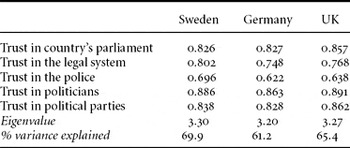
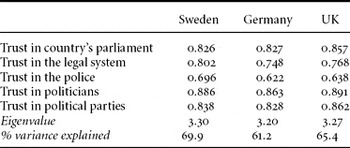
For the dependent variable, trust in government, we carried out a factor analysis of five variables covering trust in parliament, the legal system, the police, politicians and political parties for each country. Factor analysis is a procedure which constructs a new variable representing a common theme that is an important component in the pattern of answers to a number of questions.Footnote 2 It enables us to use a single variable which underlies trust across a number of important areas of government and gives an overall measure less likely to be influenced by particular developments in relation to electoral cycle, current law and order scandals and so on. The fact that the procedure identified a single factor in each case as explaining about two-thirds of the variance (Table 2) suggests that there is a strong underlying common theme to the concept in people's attitudes in the different countries, and provides a good basis for modelling trust in the general political settlement of the welfare state.
Trust in government: factor analyses
The explanatory variables fall into the three groups: those relating to material interests and the political articulation of those interests – social class, perceived inequalities of income and left–right political orientation; to socio-demographic circumstances – age, gender and level of education; and to attitudes to the two policy discourses distinguished earlier. The first two groups of variables follow from the discussion in the previous section and are based on responses to the appropriate questions in the survey (see Appendix). For the third group we selected responses to eight attitude questions, four relating more closely to the security and redistribution discourse of welfare and four to the individual responsibility and opportunity discourse (Table 3).
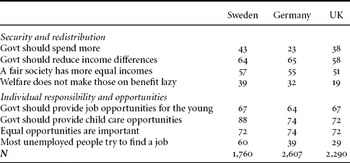
Attitudes to Inequality: % taking pro-welfare position

For the established discourse, which stresses security and redistribution, we used responses to questions on whether government should increase spending, whether it should reduce income differences and, more broadly, whether a fair society has less inequality and, more concretely, whether welfare provision makes recipients more dependent. For the discourse which pays more attention to individual responsibility, with government providing access to opportunities, we used questions about whether government should provide job opportunities for younger people, or should provide childcare to help parents work, and about the importance of equal opportunities in society and whether unemployed people are proactive in seeking work. The table gives the percentage replying to these questions in a way supportive of state welfare intervention.
The responses show that across the three countries, there is a stronger endorsement of the questions that reflect ideas of individual responsibility and government provision of opportunities: the more active approach. However, there is a sharp gradient in responses to the more moralistic question about whether unemployed people are proactive in searching for work. In social democratic Sweden, this is a majority view, but is less accepted in corporatist Germany where the insider/outsider division between those in stable, secure employment and more marginal workers is reinforced by the much greater engagement in social insurance of the former group. In the liberal UK, most people see the unemployed as unwilling to pursue work.
Majorities support redistribution and the idea that equality and fairness are linked, but there is rather less endorsement of more state spending, especially in Germany where the issues of tax burden and the impact of labour costs on competitiveness are high on the agenda. A similar gradient applies to moralism about proactivity to that encountered in relation to welfare dependency. The implication is that a discourse which foregrounds individual responsibility, with the state providing opportunities, has attractions in Europe. Both this discourse and that concerned with opportunity and individual responsibility are accepted in the most social democratic country included. However, elsewhere in Europe and especially in more liberal countries, there is greater likelihood of dissensus between those who are more inclined to support one or the other.
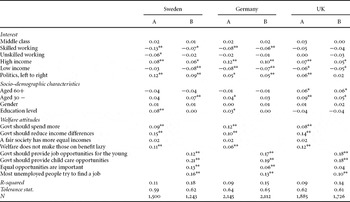
We next examined the contribution of the various factors to trust in government and by implication to social solidarity by constructing two ordinary least squares regression models for each country (Table 4). In the first model, labelled ‘A’ in the table, the four attitude variables relevant to the security and redistribution discourse are included as explanatory variables, as well as the variables representing material interests and socio-demographic circumstances. In the second model for each country (labelled ‘B’), the four attitude variables relevant to the individual responsibility approach, with government providing access to opportunity, are included. As is common in such analyses, R-squared statistics are relatively low indicating that only between 10 and 20 per cent of variance is explained. Collinearity is at acceptable levels, with tolerance statistics in no case lower than 0.59. There are substantial similarities in the patterns of socio-demographic variables between the two models for each country indicating stability.
Interests, socio-demographics, attitudes and trust in government in Sweden, Germany and the UK (OLS regressions, Beta weights)

Findings and conclusions
In all cases, welfare attitudes are more important in explaining general trust in government than the other items, showing that discourse, as well as interests and social circumstances, plays an important role in the relation between welfare reform and trust in government. In relation to social class and self-rated income group, which we argue reflect material interest, and political orientation, which articulates this, it is left–right politics that is most likely to be linked to trust: those on the political right are more trusting and this effect is more marked in Sweden and to some extent Germany. Higher-income people are rather more trusting in all countries and there is a sharp division between higher- and lower-income groups. Middle-class groups have no distinctive views, but skilled working-class and, in Sweden, unskilled working-class people are less trusting.
In relation to socio-demographic differences, better education and membership of a younger age category are associated with trust, and gender has little impact. In the UK, there is a distinctive pattern of the middle-aged being more mistrustful of government. None of these relationships is particularly strong and they follow those established in other work, for example Gilley (Reference Gilley2006). The attitude variables show stronger associations, but again the differences between the A and B models are of degree rather than of kind. Those who adopt pro-welfare attitudes are generally more trustful, and in almost all cases the model B variables representing individual responsibility and state provision of opportunity have the strongest associations. People who think government should provide childcare and job opportunities for young people and who think unemployed people are proactive in job search have greater confidence in government. In Sweden (especially) and Germany, endorsement of an equal opportunities ethic also makes a difference, but not in the liberal UK. This is of interest since a focus on individualism and opportunity is often associated with the liberal regime (Esping-Andersen, Reference Esping-Andersen1990: 26–9). It suggests that what is being supported is the notion of an opportunity approach that provides strong state support to give good access to the opportunities available rather than the more negative approach associated with a market-centred welfare to work strategy.
The pattern of associations in the A models, which focus on attitudes supportive of a welfare state that supplies security and redistributes incomes, is similar but weaker. The findings from both sets of models are clearly complex and reflect the multi-faceted nature of the relationship between welfare discourse, social circumstances and interests and political legitimacy. Four points may be made:
• Differences between regime types exist, but are less marked than might be expected. The greater politicisation of social class differences in the social democratic and corporatist models identified by Svallfors (Reference Svallfors and Svallfors2007) is apparent.
• In general, the differences between social groups in relation to trust in government are real but not strong.
• Attitudinal factors seem to be more important than socio-demographic or material factors in the contribution of welfare discourse to trust in government and social stability.
• Trust is associated with the perception that opportunities are available and that people take them up. To a lesser extent it is also linked to the view that it is the job of government to provide generous benefits and services and redistribute income
In short, pro-welfare discourse contributes to political legitimacy. The responsibility and opportunity discourse, which has been prominent in some discussions of welfare, strengthens rather than damages it, provided it includes a role for government in making sure that equal opportunities are widespread. These findings suggest that the new opportunity-centred approaches in social policy can provide a basis for trust and solidarity just as much as the security/equality approach which has been a strong feature of the European welfare settlement, so long as policies that enhance access to opportunities are included.
Everyone supports better opportunities. Who could be against allowing people the chance to make the best of themselves? However, the new opportunity welfare state has a hard edge, to do with the extent to which it imposes responsibility on the individual. For many people, the failure to take full advantage of what is offered may be seen to merit blame and justify diminished life chances. The analysis indicates that the most effective discourse in generating trust in government is one which includes both responsibility and opportunity. This entails a strong role for government in guaranteeing access to job opportunities and providing services such as child-care. This confirms the argument of the Renewed Social Agenda, that access to opportunities is an essential link between the more individual and proactive opportunity and responsibility approach and support for collective provision. Public attitudes endorse this approach: the proactivity of ordinary citizens requires a corresponding proactivity of government.
Appendix: variables used in the analysis
Variables are scored as dummies: 1 yes, 0 no unless otherwise stated. Scoring is reversed in some cases so that pro-welfare attitudes are positive.

All variables from European Social Survey (4th round, ESS, 2010).