President Bush flew into New Orleans shortly after Hurricane Katrina devastated the city. His staff had to fire up giant generators to bathe St. Louis Cathedral and Jackson Square in floodlights, as a backdrop for his promise that he would “do what it takes” to rebuild New Orleans. “There is no way to imagine America without New Orleans,” he said, “and this great city will rise again.” Then the lights went out, and the president left. Vast swaths of the city have been in darkness ever since.
—Jim Amoss, Editor of the New Orleans Times-Picayune, in the Washington Post, November 27, 2005.
INTRODUCTION
Hurricane Katrina, for reasons that are dramatic and clear, forced the largest population displacement in the United States since the “dust bowl” migrations of the 1930s. In this paper, we discuss some implications that we believe may be drawn from Hurricane Katrina, especially as it affected, and will continue to affect, African Americans. These observations come largely from our ongoing examination of the demography of African Americans, including motivations to leave the South historically, and recent changes generating a significant “return migration” of African Americans to the South (Adelman et al., 2000; Frey 2004; Fuguitt et al., 2001; Falk et al., 2004). Our concern with migration in a macrohistorical context provides important guidelines for examining the specific case of Katrina-related migration, including the light that migration theory may shed on understanding why people leave one place for another. Less obvious are reasons why people might become “return migrants” to the places they were forced to leave—a question that involves examining issues of race and class, including the destinations to which Katrina's victims were displaced, as well as the key features of the place to which they might return.
We limit our discussion to New Orleans, an American city unique in geography, architecture, food, music, cultural norms, and race relations. We do not treat in any detail the ongoing political debates concerning responsibility for who did what, and why. Rather, we focus on New Orleans as a place and assess what prospects exist for reconstituting that place in light of past, present, and prospective demographic trends. Our most general aims are threefold. First, we review recent work on place and identity and describe the general features of past migration patterns of African Americans, both from the South and back to the South. Second, we identify important features of New Orleans as a distinctive place on the American landscape. Third, we assess the prospects of the reconstitution of New Orleans as a place resembling what it was prior to Katrina by examining the intersecting factors of race, class, and ethnicity in shaping how, and by whom, the city may be resettled. Whether, and the degree to which, the “new” New Orleans will resemble what existed in the same geographic location pre-Katrina is an important question.
THE SOUTH AND NEW ORLEANS AS PLACE
Recent theorizing in sociology (Gieryn 2000; Falk 2003, 2004) has focused on the concept of “place” as a geographical unit in which identity is grounded. As such, place is viewed as an important aspect of the self that is simultaneously a physical setting outside of the person and a symbolic presence within the person. Nearly anyone who voluntarily remains for a long time in one area develops a sense of it. As scholars have shown (Hummon 1990; Gieryn 2000; Falk 2004), one's sense of place is grounded heavily in interpersonal social relations, especially those involving family and community. Indeed, a person's social and existential identity is, to some degree, a by-product of where they live. They are in part who they are because of where they are. When families and communities exist in one area for generations, their sense of place may be very strong—keeping them there in good times and bad, and drawing them back after they have moved away (hence the demographic notion of “return” migration). In short, people usually have a place-based identity of some kind. They are Southerners, or New Yorkers, or Texans, or have some similar sense of self and place wherever they are from. Falk (2004) has recently referred to this grounding of identity as being “rooted in place,” finding that African Americans who lived in a rural, historically Black community often chose to stay there rather than migrate away in search of a “Promised Land” in the North. And, even for those African Americans who did pursue new places in the North, while they left the South geographically, the South never left them. This was true for millions of African Americans who moved North; for them, “home” was easy to identify—it was where they came from, not where they lived.
Our recent work on internal migration to the South posits a connection between place and identity as one motivation for African Americans to move back to the South (Falk et al., 2004). That present-day African Americans may have an identity attachment to the region where their ancestors endured slavery and the oppressive Jim Crow system of segregation and inequality is not an often-imagined possibility (Davis 1988; Franklin 1994). However, there are numerous reasons to predict that major changes in the South in recent decades have altered the extent to which African Americans identify with the South as place in ways that affect migration decisions. For African Americans, the long struggle to gain civil rights has resulted in changes in economic and political patterns in the South—changes that may increase the likelihood that they see the South as a place where identity is rooted and can be reclaimed. Whether this general theorizing informs recent population movements, especially any “return migration” of those who were forced to leave New Orleans, is the starting point of our analyses.
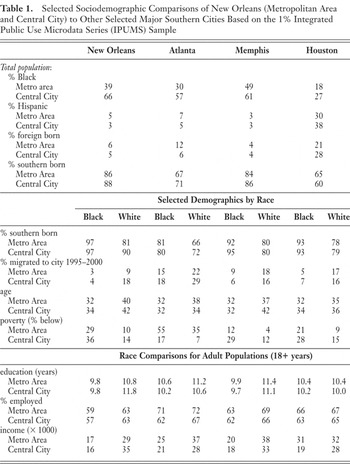
To address this issue, we first empirically locate New Orleans as a special city within the South, identifying features that may make a difference for patterns of return migration. In Table 1, we present a series of sociodemographic comparisons of New Orleans and other cities in the South by identifying features of (1) the broader metropolitan area around a city, and (2) the central city proper. We draw on these data selectively throughout the paper to describe New Orleans, and to locate the city in a comparative context within the U.S. South.
Selected Sociodemographic Comparisons of New Orleans (Metropolitan Area and Central City) to Other Selected Major Southern Cities Based on the 1% Integrated Public Use Microdata Series (IPUMS) Sample

Whether and how New Orleans fits into recent general patterns of African American interregional migration in the U.S. depends on which of the two “cities of New Orleans” one is discussing: the visible city of historic charm defined largely by outsiders and tourists, or a second, even more longstanding city, largely invisible to outsiders until the awakening provided by national media coverage of Katrina's devastation and its aftermath. In a short and intense time frame, two ongoing demographic shifts experienced acceleration, since New Orleans' “two faces” had already been changing in recognizable ways in the decades prior to Katrina. On the one hand, New Orleans has seen growth in the areas of tourism and an entertainment industry serving a disproportionately middle-class White clientele, which has produced sometimes large, but temporary and episodic, “population increases” (e.g., Mardi Gras). On the other hand, New Orleans has witnessed the relative decline of other industries, and a shrinking and reconstitution of its population owing to “White flight.” Thus, in spite of its southern location, the postindustrial shift that has reshaped northern cities (Bluestone and Harrison, 1982; Wilson 1997) was having its way with New Orleans long prior to Katrina. We turn next to a discussion of the dualities that defined New Orleans as a distinctive place.
NEW ORLEANS' PUBLIC FACE: ETHNIC GUMBO AND CULTURAL ICON
New Orleans long represented itself to all outsiders—national and foreign—as a celebration of life.2
We use the past tense in this section and the next, since we are generally describing a “pre-Katrina” reality. While it is true that the French Quarter and other aspects of New Orleans' tourism and entertainment-related “public face” are slowly re-emerging, the future shape and general fate of the city still remain very much in question.
For tourists, the city was usually experienced in a very limited way. The Vieux Carré (the French Quarter) was where most tourists stayed, and many never left except to go home. Bourbon Street was famous for its music, food, drinking, and promiscuity. It was essentially a pedestrian mall where the norms which guide life in most places were momentarily forgotten. Public intoxication was a common, even socially acceptable, pattern across age groups, races, and genders. The same can be said of sexual suggestiveness; strip clubs, drag queens, and open prostitution were commonplace. In short, what would be a violation of norms nearly everywhere else was precisely what drew people to New Orleans—a city mixing historic charm, public spectacle, and theme park qualities.
THE OTHER, LARGELY INVISIBLE, NEW ORLEANS
Before Hurricane Katrina, another New Orleans existed that supplied the labor force upon which its public face depended, but which was also kept largely hidden. It was not often celebrated; indeed, it was largely unseen and unheard until the curtain concealing it was ripped off by Katrina. For tourists, whether in the French Quarter, riding the St. Charles Street trolley past Audubon Park and Tulane University, or going for a ride on a paddle-wheeler out on the Mississippi River, most of the “real” New Orleans remained out of sight. Just outside the visitors' view—wherever they went—was the other New Orleans: largely Black and heavily poor. In the Quarter, it was quite literally across the street (the Louis Armstrong Parkway, on the western side of the Vieux Carré), where a huge public housing project sat; from the St. Charles trolley, it was back only a block or two hidden behind the stately, recently gentrified houses, restaurants, and shops that line the street. From a paddle-wheeler, it was hidden by the levee rendering only rooftops visible from the water. While tourists had a well-defined, delimited sense of place presented to them, for city natives—of all ethnic groups—the sense of place was quite different; it contained tourists, but also remained largely alien to them, as so few residents lived where the tourists spent most of their time.
The general question raised by the effects of Katrina is how much of the duality of the old New Orleans will persist when/if the city “rises again.” To address that question, and the prospects for reconstituting New Orleans in ways similar to the place it was before Katrina, requires a brief review of the history of African American interregional migration within the United States.
AFRICAN AMERICAN MIGRATIONS: PAST, PRESENT, AND FUTURE
The first two-thirds of the twentieth century witnessed a continual exodus of African Americans out of the South, mostly toward northern cities driven by the hope of better employment opportunities and greater personal freedoms of all types (Fligstein 1981; Lemann 1991; Marks 1989). For many African Americans, however, the reality of a “Promised Land” in the North has largely faded away. As some scholars have noted, urban climes in the North had become so hostile, so disappointing, so futile and fatal, that choosing to “return” to a transformed South became a sound decision (Lemann 1991; Tolnay 1998). So, by the late 1960s and early 1970s, the Great Migration out of the South had ended and a newer “return” pattern had started. As was shown in the 1980 U.S. Census, in the decade of the 1970s, more African Americans were migrating into the South than out of it. This pattern continued, albeit at a slower rate, in the 1980s and then mushroomed dramatically in the 1990s—when approximately 700,000 more African Americans moved into the South rather than away from it (Adelman et al., 2000; Fuguitt et al., 2001; Falk et al., 2004). As Frey (2003) has shown, not all Southern places were deemed equally attractive by African American migrants. Some, especially Atlanta, and, to a lesser degree, Dallas, Houston, and Charlotte, among others, saw sizeable increases in their Black populations due to internal migration, but others did not. Key in this latter group was New Orleans.
Although African Americans have lived in New Orleans for generations—indeed, some lived there as “free” persons up to and during the Civil War—the cultural fabric which has held them together and given them a sense of community has, like the city itself, gradually been eroding. While over 627,000 people lived in New Orleans in 1960, only about 485,000 lived there in 2000. And, according to U.S. Census Bureau estimates, another 20,000 left between 2000 and 2004. At the time of Katrina, the city was roughly 27% smaller than it was forty-five years ago.
While the city had been shrinking in total size, the Black population, both in terms of numbers and proportions, increased from 1960 to 2000. In 1960, for example, the city was home to a population of nearly 232,000 African Americans and was about 37% Black. By 2000, the city's African American population had increased to over 325,000 and the Black proportion had increased to about 66%. Comparing the southern cities identified in Table 1 by “percentage Black” shows that, by 2000, New Orleans was a city where a high proportion of Blacks resided. However, this population pattern was not due to New Orleans serving as a population magnet for African Americans. A critical question in any discussion of “place” is whether local residents are indigenous or whether they moved to a city from somewhere else. The data in Table 1 show, when controlling for race, that only about 3–4% of New Orleans Black population had moved to the city between 1995 and 2000; for Atlanta, the comparable figure was nearly 15–18%! Additionally, in terms of regional origins, in New Orleans, nearly all African American residents, whether in the central city or in the more general metropolitan area, were native southerners (97%). In Atlanta, by contrast, only about 80% of African American residents were native southerners.
Clearly, New Orleans was a place that was attracting few African American migrants; its local Black population was essentially reproducing itself anew from one generation to the next. Atlanta, on the other hand, as is widely known, was attracting a huge number of new African American residents. Atlanta fits well with what we have called “the new Promised Land” (Falk et al., 2004); New Orleans clearly does not. Further buttressing this conclusion is our analysis of common socioeconomic variables in Table 1: Atlanta's Black population is better educated, with more people working and making more money, and with proportionally fewer people living in poverty. In general, this is true to a lesser degree when comparing New Orleans with its regional neighbors, Houston and Memphis (two cities which have hardly been huge economic success stories for most Black people). In all such comparisons, New Orleans fares the worst.
INTERSECTIONS OF RACE AND CLASS IN NEW ORLEANS
Given New Orleans' somewhat unusual, homegrown demography, one might expect that native residents would have an unusually strong commitment to the place—even those fleeing the aftermath of a hurricane would be anxious to return. Our sense, though, is that the relationship of large numbers of people to the city is complex. Many African Americans in New Orleans have found themselves increasingly trapped in a place with few economic opportunities beyond service-sector employment offering long hours, low wages, and few if any fringe benefits. African Americans are also disproportionally represented among the very young and very old—i.e., the two neediest and most dependent populations, those least able to fend for themselves. These were the people highly visible in the television coverage of Katrina's aftermath: those waiting to be evacuated—waiting to become refugees or evacuees or homeless—in short, New Orleans' poorest residents. We further believe that those who were disenfranchised and marginalized prior to Katrina are the very people most likely to be scattered far and wide by her winds, and the least likely—both geographically and psychologically—to return.
One reason for believing that the return migration to New Orleans will be heavily selective by race—with the White rate of return greater than the Black rate of return—lies in the kinds of residential places likely to emerge from the rubble. Physics teaches us that “nature abhors a vacuum.” We might fruitfully extend this metaphor to the behavior of real-estate developers—the actors most likely to influence how fallow land will be developed in the future. This is just as true for a devastated place like New Orleans as it is for vast tracts of open space, wherever they lie on the American landscape. When it comes to economic gain, history teaches that—perhaps all too often—one person's (or group's) misfortune is another's perceived opportunity. New Orleans represents just such a situation.
The most easily exploitable tracts of land will likely be those previously held or occupied by large numbers of low-income African Americans. These are the areas most likely to see block after block razed, with insurance settlements going to displaced African American homeowners (nearly half of whom lived in owner-occupied houses; about 15% of all private housing was owned “free and clear,” a pattern, no doubt, reflecting the longstanding intergenerational presence of African Americans in New Orleans). For those who were renting housing space when Katrina arrived, returning to the city seems even less likely. Rental space in New Orleans will shrink for a variety of reasons. There will be fewer economic incentives to rebuild private rental stock, as government aid will go first to homeowners. Hence, private owners who have one house and rent another will be less likely to receive assistance on the latter type of dwelling. Additionally, it seems unlikely that public housing will be rebuilt on any scale resembling what was in place at the time of Katrina. Indeed, the closing down of public housing was already taking place over the last decade. Whether this “closing down” was due to the official goal of reducing concentrations of the poor in selected neighborhoods or to free up space for developers who wanted to expand tourism and the draw of the French Quarter is a matter of considerable local debate. One of the cruder post-Katrina statements on the demise of public housing was offered by Louisiana Congressional representative Richard Baker, who averred that “We finally cleaned up public housing in New Orleans. We couldn't do it but God did” (Harwood 2005). Whatever the realities, Katrina clearly moved the process along in ways that reduce the likelihood that proportionately large numbers of displaced African Americans will return to New Orleans.
There is another factor—less obvious than what will be happening in New Orleans—that will further reinforce the disproportionately White and middle-class shape of the “return migration” of New Orleanians: the kinds of places to which people were displaced by the storm. Most people relocated within the Gulf Coast region, but some traveled to much more distant places. This means that areas in the Gulf Coast region were impacted in major ways by migrants from New Orleans, while more distant places received fewer new residents. Migration theory suggests that both the distance people move, and their concentration in destination places, inexorably shape return patterns. Those who moved to proximate places (e.g., Baton Rouge) created numerous problems in these destinations. New migrants increase population densities, crowd existing labor markets, and put added strain on public resources. Few cities, in the South or the North, have the resources to support a large and immediate population increase. By contrast, where migration was dispersed to more distant places—the very sorts of destinations that were more common among Blacks and lower-class Whites—the capacity of such low-density destinations to absorb migrants is higher, and the odds of people returning are considerably lower.
Although scant hard data exist to demonstrate that it was disproportionately the poor and disenfranchised whose “exodus” pushed them to places from which return is less likely, anecdotal evidence abounds (in numerous newspaper and other media accounts). It seems reasonable to project that those former residents of New Orleans who had the most resources at their disposal would (1) be White; (2) have the least difficulty in relocating (e.g., finding housing and schools); and (3) have moved the shortest distance away (e.g., Baton Rouge, a one-hour drive from New Orleans). Such patterns are precisely what a recent widely circulated analysis of zip-code address changes found (Tizon and Smith, 2005). For relatively affluent residents, the disruption of their lives is more likely to be temporary. More affluent residents are also those most likely to have lived in areas with comparably less flooding and hence to be among the first to return to their former homes—in part because they will have required comparably little repair. Finally, more affluent Whites and Blacks are also the most likely to go back quickly, even if their homes require considerable repair work; they will be able to afford to pay for repairs and find contractors to do the work. This says relatively little about their commitment to New Orleans as place; it speaks volumes, however, about class position in facilitating a possible migration decision to return (or not).
Those with fewer resources, especially low-income and poor African Americans, are simply less able to influence their own migration decision; in their case, it is to a greater degree a matter of default rather than design. Those of lower income are more likely to face a choice of returning to a devastated home, neighborhood, and community, with poor earnings opportunities and access to the poorest of all services (e.g., medical, educational, retail). For many of these people, it is reasonable to predict that they will remain in their new locales which, as time passes, will seem increasingly “home-like” to them. Two nongovernmental factors that may facilitate the generation of a new sense of place are family and church connections. While many who were displaced by Katrina were relocated in a highly chaotic way, landing them almost literally wherever the plane or bus arrived, many sought refuge in the homes of family members or kin. There have been innumerable accounts of this in press interviews of those who have moved—both nearby and far away. In these cases, brothers and sisters, aunts and uncles, and other family members provided a temporary refuge for displaced residents in the aftermath of the storm. Additionally, community-based churches opened their doors and resources to those in need. With the operation of broader supports in destination places, those new places may well become “home” by virtue of the same social dynamics that sustained a prior sense of place through important social relationships that give a sense of permanence. Thus, if people's daily lives have improved in their new locales, and given the often difficult circumstances under which many were living in New Orleans, why should they return?
Predicting with any accuracy which former residents will return, under what circumstances, and when, is nearly impossible; there are simply too many variables. But we are confident that the race and class parameters we have identified serve as good guideposts. This strongly suggests that, at least in the short term—such as by the next census, in 2010—the city will be much more White and middle class. This will enhance the “public” face highlighted earlier in this paper, a prediction supported by the facts that (1) the predominantly White areas of the city were generally the least damaged, whereas many largely Black areas were so damaged that they will need to be razed; and (2) the most comprehensive plan to date for reconstruction (drawn up by the nonpartisan Urban Land Institute) has been praised on the one hand but criticized on the other for giving preference to more affluent areas in the reconstruction queue. Speculation on precisely how reconstruction will proceed has been widespread, both in newspaper accounts (quoting “experts”) and in various columns. The data we have provided here, and our theoretically informed conjectures on place-based identities, suggest that there is good reason for anticipating clear race- and class-based outcomes.
RETURN OR RECONSTITUTION?
The prospects of a differential return migration according to race poses new problems for the future of New Orleans. It was a local Black population that traditionally provided much of the semiskilled labor for New Orleans' heavily service-driven labor market; in their relative absence, questions arise regarding who will perform the countless menial but necessary tasks that form part of the foundation of a “service-based” economy. One possibility, of course, is that people in southern Louisiana and nearby western Mississippi whose lives were disrupted by Katrina will flow to New Orleans in search of employment opportunities. But even more likely to move to New Orleans, we believe, are Hispanics, adding a new ethnoracial element to the historically diverse city.
Houston is a four- or five-hour drive from New Orleans, and nearly 40% of its population is Hispanic (see Table 1). In Texas, a gateway for Mexican immigrants, nearly one-third of the residents are Hispanic. Between the legal and illegal Hispanic immigrant populations, there is a potentially huge pool of workers at New Orleans' doorstep. While many will be unskilled laborers, others will have skills as carpenters, roofers, welders, plumbers, electricians, and others who will be needed to reconstruct and run the city. Indeed, some estimates have placed the Hispanic composition of the labor force cleaning up New Orleans by hauling off debris from what the city was, at around 80%. This leaves open the question of what the city will be. Post-Katrina developments may usher in markedly new migration dynamics, by altering the motivation of many displaced African Americans to return to their former places and increasing the motivation of Hispanics to move there.
For African Americans, returning South has increased over the past several decades and has to some degree been a “call to home” (as Carol Stack [1996] so poetically put it). The South was and is a place of special significance for many, a place made strong by memories, interpersonal ties, and historical-political struggles. Given the often grim circumstances in which African Americans found themselves in New Orleans, will the post-Katrina “call to home” be sufficiently strong to pull back those residents who fled? Beyond the race and class factors that influence the odds of returning, there is the question of the strength of place-based identities and the possible resiliency of those who left and found new places. One possibility is that the people who coped with Katrina will come to terms with their new surroundings in creative ways and elect not to return. Relocation, as we envision it, leads over time to establishing a new sense of place and identity. While we agree that central components of the self are stable across space and time, we also believe that one's identity is fluid and adjusts to changing circumstances, being thus modified and constructed anew as circumstances dictate (Cornell and Hartmann, 1999).
To us, a large-scale return of African Americans, despite a major intergenerational presence, seems problematic given what the city meant to many of the poor and disenfranchised in their everyday lives. It was, in many ways, a tough place to live. The most valued aspects of New Orleans' African American culture—norms, relationships, food, music, and so on—are not tied to New Orleans as a specific place and can, in fact, be transplanted. Such transplantation places an emphasis on what people do, de-emphasizing somewhat where they do it. This process of cultural reconstitution is exactly what happened historically when African Americans fled the South and migrated to the North. Blues music did not die because some people moved away. Rather, it went with them, and later evolved into new forms (e.g., Chicago blues) under novel and changing social circumstances. The same thing is true for foods. The yams on a stick that Ralph Ellison noted in The Invisible Man (1947) when his main character landed in Harlem were not indigenous to that northern place; instead, they had come North with southern migrants. The same possibility of cultural reconstitution applies to those who left New Orleans: people don't need to be in New Orleans to replicate important elements of its life elsewhere.3
This point was demonstrated in the reaction by displaced New Orleanians to New Orleans Mayor Ray Nagin, who, when on a tour of cities with large numbers of evacuees, urged them to “Come on home” and “get back to the red beans and rice and gumbo and all those things that you love.” As Nagin heard back from many to whom he spoke, people can cook red beans and rice wherever they live. The evacuees wanted assurances about all aspects of what the future might hold in New Orleans, assurances that Nagin could not provide. Many newspaper editorials and columns have made this same argument (e.g., Whoriskey and Hsu, 2005).
For some Hispanics, on the other hand, New Orleans will likely offer something of a new start. The present and future New Orleans may offer economic opportunities of a sort that they could not have imagined in Texas, Mexico, Guatemala, or many other places of origin. Necessity will create a demand for workers, and those at hand will be rewarded. In time, new Hispanic migrants to New Orleans will add their cultural traditions to the rich diversity that was New Orleans, establishing their own sense of place—something that can only come with personal investment and sustained relationships. If this occurs, they will become “rooted in place” (Falk 2004), just as other former settlers were. For newly arrived Hispanics, at least for a while, New Orleans may become a land of promise, if not a “Promised Land,” as in the traditional imagery associated with African American migrations to the North.
CONCLUDING SPECULATIONS
In addressing the future of return migration to New Orleans, we have made several major points. First, by describing some of the traits which helped to make New Orleans iconic, we provided a context for what the city has been—the way it has been constituted in most people's sense of it. The distinction between the “cities of New Orleans” as experienced by tourists (a kind of theme park or spectacle involving what postmodern theorist Baudrillard (1994) has termed a “simulated” experience) and that experienced by local African Americans who lived apart from, but served daily, the tourism and entertainment industry, raises important questions about the size and ethnoracial makeup of New Orleans' future citizenry.
When thinking about New Orleans' future, we feel confident that, because Whites lived in the least damaged areas and also control the most resources to influence the outcomes they desire, they are bound to be disproportionately represented among the future New Orleans population. A common estimate for the city's new size is 250,000, about half of what it was before Hurricane Katrina.4
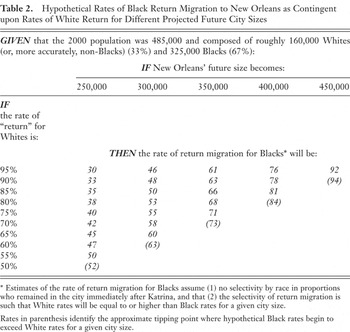
A recent New York Times article (Rivlin 2006) cites a study by Rand Corporation providing a post-Katrina population estimate of no more than 275,000 three years from now. If there is one demographic certainty, it is this: there is no certainty in making these projections! Recognizing this, we provide a range of estimates in Table 2 to give some idea of how size of racial/ethnic group might vary in light of different assumptions.
Table 2 presents some numbers reflecting other possible demographic scenarios for New Orleans, projecting a varying set of future city sizes and varying rates of “return” for Whites and Blacks. Starting with a total population of 485,000 in 2000 as the baseline—a population composed of 160,000 Whites (33%) and 325,000 Blacks (67%)—it is fairly simple to outline possible scenarios. Following from our argument that Whites will find it easier to remain or return owing to the above-outlined forces of race and class, one can estimate the differential rates of return for Whites and Blacks. The estimates presented in Table 2 assume three things: (1) the selectivity of return migration is such that White rates will be equal to or higher than Black rates for a given city size; (2) there was no selectivity by race in proportions who remained residents of the city during and immediately after Katrina; and (3) future rates of primary migration to the city, in the short run, will be low.5
The latter two assumptions likely yield an overestimation of the future size of the Black population in New Orleans. To the extent that there were race differences in the proportions of those who remained residents, favoring Whites who lived in less-affected areas of the city, and to the extent that Hispanics, as primary migrants, move to the city, the resulting size of the Black population would prove lower than the rates project.
Hypothetical Rates of Black Return Migration to New Orleans as Contingent upon Rates of White Return for Different Projected Future City Sizes

These assumptions and resulting estimated rates for African Americans reveal starkly and clearly how improbable anything approaching the return of African Americans to their former numbers and population densities is, unless the city returns to its former size and the rates of return for both groups are quite high. When the hypothetical future size of the city is much lower (e.g., approaching one-half of its former size), we expect that high rates of return for Whites will severely constrain the Black presence in the city, resulting in a much lower rate of return for Blacks, and thus yielding a considerable reduction of the projected Black population.
To estimate possible population loss for either race group, one can simply multiply the hypothetical rate by the 2000 base figure for a race group, and subtract the resulting value from the base figure. For example, assuming a future size of 300,000 (say, by the 2010 Census) and a White return rate of 80%, the hypothetical Black population would be around 172,000, only 53% of its 2000 size, representing a dramatic population loss of 153,000. Alternatively, assuming the same city size and a lower rate of White return, at 70%, the hypothetical Black population would be approximately 189,000—only 58% of its 2000 size, representing a still significant loss of 136,000.
These calculations in “Black and White” are, of course, an oversimplification. We can only guess at the extent of rebuilding, and the rates of return by race. Moreover, the calculations do not include the likely increase in a sizable Hispanic population. Hispanics, as counted in the 2000 U.S. Census, were only 3% of the city population and had a slightly larger presence in the metropolitan area (5%); but given their presence in current efforts to clean up and rebuild the city, as well as in jobs that provide the base of the tourist and entertainment industries, it is hard to imagine that their proportion will not increase dramatically. But the total population estimates of 250,000 or 300,000 are nothing that one expects to happen in the near future; at this point, they are at best guesses—projected outcomes based at least as much on speculation as on demographic technique. In light of this, and especially for the next few years moving towards the 2010 Census interval, it is easy to imagine that the city will be far more than 50% White and relatively affluent.
The demographic changes we project—supported by our limited data, and obviously open to alternative interpretation and conclusions—have enormous implications for what New Orleans may become. It will be smaller, Whiter, more affluent, populated by fewer Blacks and more Hispanics, with a political climate that could gradually reflect these demographic changes, and hence perhaps much more Republican in its politics. Whatever one thinks of President Bush's handling of the Katrina aftermath and the “light and dark show” alluded to in our epigraph, he was no doubt correct in predicting that New Orleans “will rise again.” The newly constituted city will offer some things familiar (especially the general experience for tourists), while others (especially population composition) will be strikingly different. In the past, part of the charm was its sans souci, its music, and other expressions of the vibrancy of African American culture that belonged to the place that was New Orleans. It remains to be seen just how well the desirable qualities that defined New Orleans will be preserved, and whether those least desirable (e.g., nationally high rates of poverty and violent crime) will diminish. Diaspora has long been a feature of the African American experience, creating a symbolic longing for other places. Such sentiment, expressed by some as a residual longing for homeland in Africa and by others as a “return to home” in the South, will likely not be attached to New Orleans if it becomes essentially a tourist destination and adult-centered theme park! Ultimately, one must ask: to what degree and in what important ways will the new New Orleans be New Orleans?