Introduction
Fasciolosis is one of the most important liver diseases of herbivores and is caused by infection with Fasciola spp. Fasciolosis is reported to cause economic losses of about US$29.2 million annually in Egypt (El-Shazly et al., Reference El-Shazly, El-Nahas, Soliman, Sultan, Abedl Tawab and Morsy2006). Moreover, 4% of human patients admitted to hospitals suffering from a fever of unknown origin are infected with Fasciola hepatica (Soliman, Reference Soliman2008). Fasciola hepatica (Linnaeus, 1758) has a wider range than its tropical counterpart, Fasciola gigantica (Cobbold, 1856), but their geographical distribution overlaps in many African and Asian countries (Mas-Coma et al., Reference Mas-Coma, Bargues and Valero2005). In Egypt, both species are present (Lotfy & Hillyer, Reference Lotfy and Hillyer2003; WHO, 2007; Hussain & Khalifa, Reference Hussain and Khalifa2010; Dar et al., Reference Dar, Amer, Mercier, Courtioux and Dreyfuss2012).
The predominant intermediate host of F. hepatica in Europe, Asia, Africa and North America is Galba truncatula (Soulsby, Reference Soulsby1982). However, in Egypt scant records are available incriminating G. truncatula in the transmission of F. hepatica infection (Abd El-Ghani, Reference Abd El-Ghani1976; Brown, Reference Brown1994; El-Kady et al., Reference El-Kady, Shoukry, Reda and El-badri2000; El-Shazly et al., Reference El-Shazly, Nabih, Salem and Mohamed2012). On the other hand, an experimental infection of Pseudosuccinea columella with F. hepatica suggested its role as an important intermediate host for Fasciola transmission in Egypt (Dar et al., Reference Dar, Vignoles, Rondelaud and Dreyfuss2014).
The two main Fasciola species, F. hepatica and F. gigantica, are differentiated by morphological features such as body length and shape (Ashrafi et al., Reference Ashrafi, Valero, Panova, Periago, Massoud and Mas-Coma2006); however, these characteristics are sometimes unclear. Moreover, a form of Fasciola intermediate between the two species has been recorded in different countries, including Egypt (Itagaki et al., Reference Itagaki, Kikawa, Sakaguchi, Shimo, Terasaki, Shibahara and Fukuda2005; Periago et al., Reference Periago, Valero, El Sayed, Ashrafi, El Wakeel, Mohamed, Desquesnes, Curtale and Mas-Coma2008; Ichikawa & Itagaki, Reference Ichikawa and Itagaki2010). These flukes are meiotically dysfunctional, have abnormal spermatogenesis and are considered aspermic, as they have few or no sperm in the seminal vesicles (Terasaki et al., Reference Terasaki, Moriyama-Gonda and Noda1998; Itagaki et al., Reference Itagaki, Kikawa, Sakaguchi, Shimo, Terasaki, Shibahara and Fukuda2005; Ichikawa & Itagaki, Reference Ichikawa and Itagaki2010). Therefore these flukes may reproduce parthenogenetically. In aspermic Fasciola, diploid, triploid and, sometimes, mixoploid flukes are reported (Terasaki et al., Reference Terasaki, Moriyama-Gonda and Noda1998).
The intermediate fluke forms are not identified as either F. hepatica or F. gigantica. The entity of hybrid forms was established when Japanese Fasciola showed ribosomal DNA sequences identical to those of F. hepatica and mitochondrial DNA sequences identical to F. gigantica (Itagaki & Tsutsumi, Reference Itagaki and Tsutsumi1998; Itagaki et al., Reference Itagaki, Tsutsumi, Ito and Tsutsumi1998). As a result, molecular methods using both nuclear ribosomal RNA internal transcribed spacers (ITS1 and ITS2) and mitochondrial cytochrome oxidase 1 (cox1) and NADH dehydrogenase I genes were developed for accurate differentiation (Itagaki et al., Reference Itagaki, Kikawa, Sakaguchi, Shimo, Terasaki, Shibahara and Fukuda2005). Subsequently, a single-step duplex polymerase chain reaction (PCR) based on the mitochondrial cox1 gene was developed for detection and discrimination between F. hepatica and F. gigantica (Le et al., Reference Le, Nguyen, Nguyen, Doan, Le, Hoang and De2012).
The aim of the present study was to investigate Fasciola species in cattle and lymnaeid snails in Dakhla Oasis, El-Wadi El-Gadid, Egypt. Gross and microscopic findings were confirmed by duplex PCR and sequence analysis of the resulting mitochondrial cox1 amplicons.
Materials and methods
Collection and examination of faecal samples
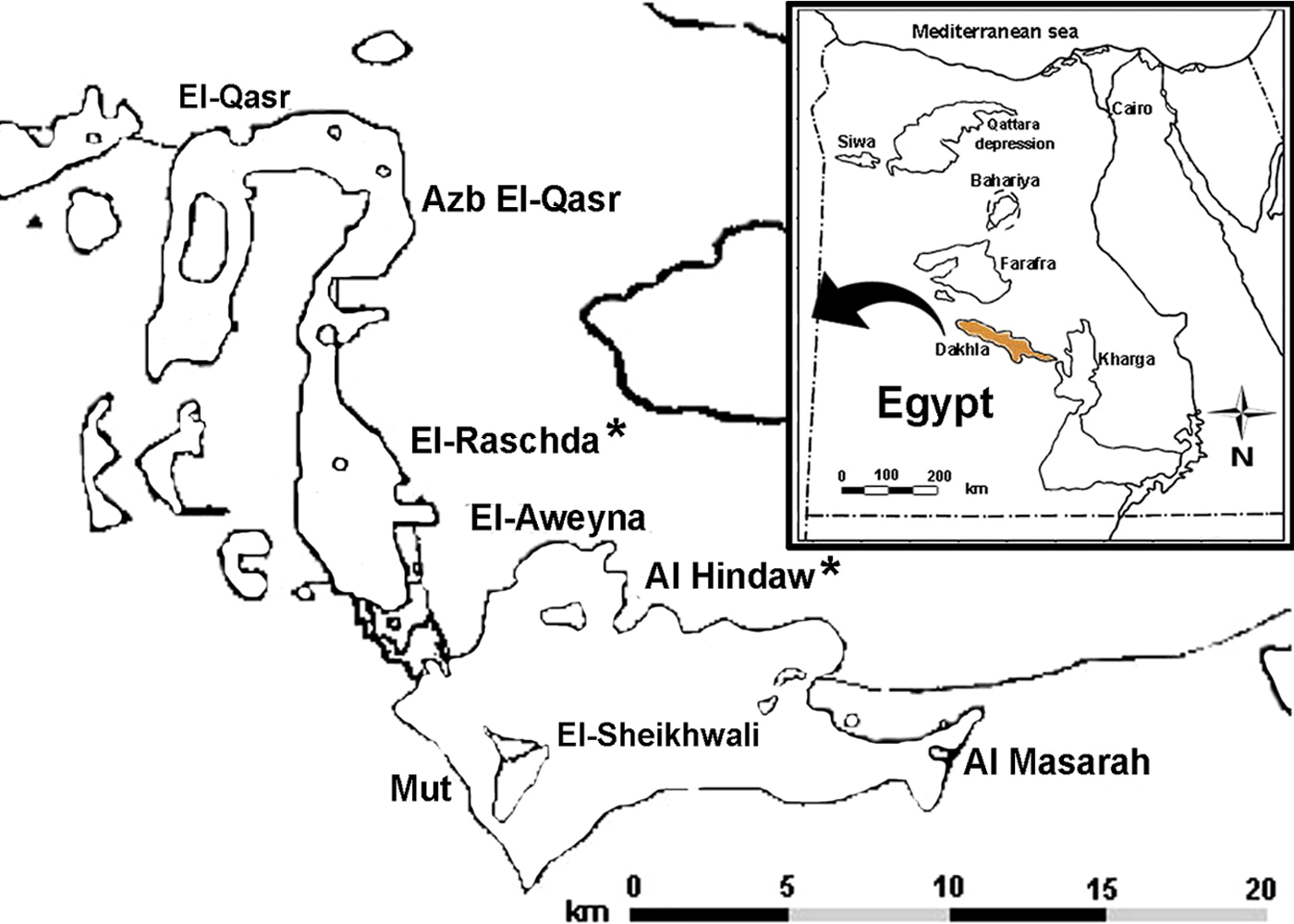
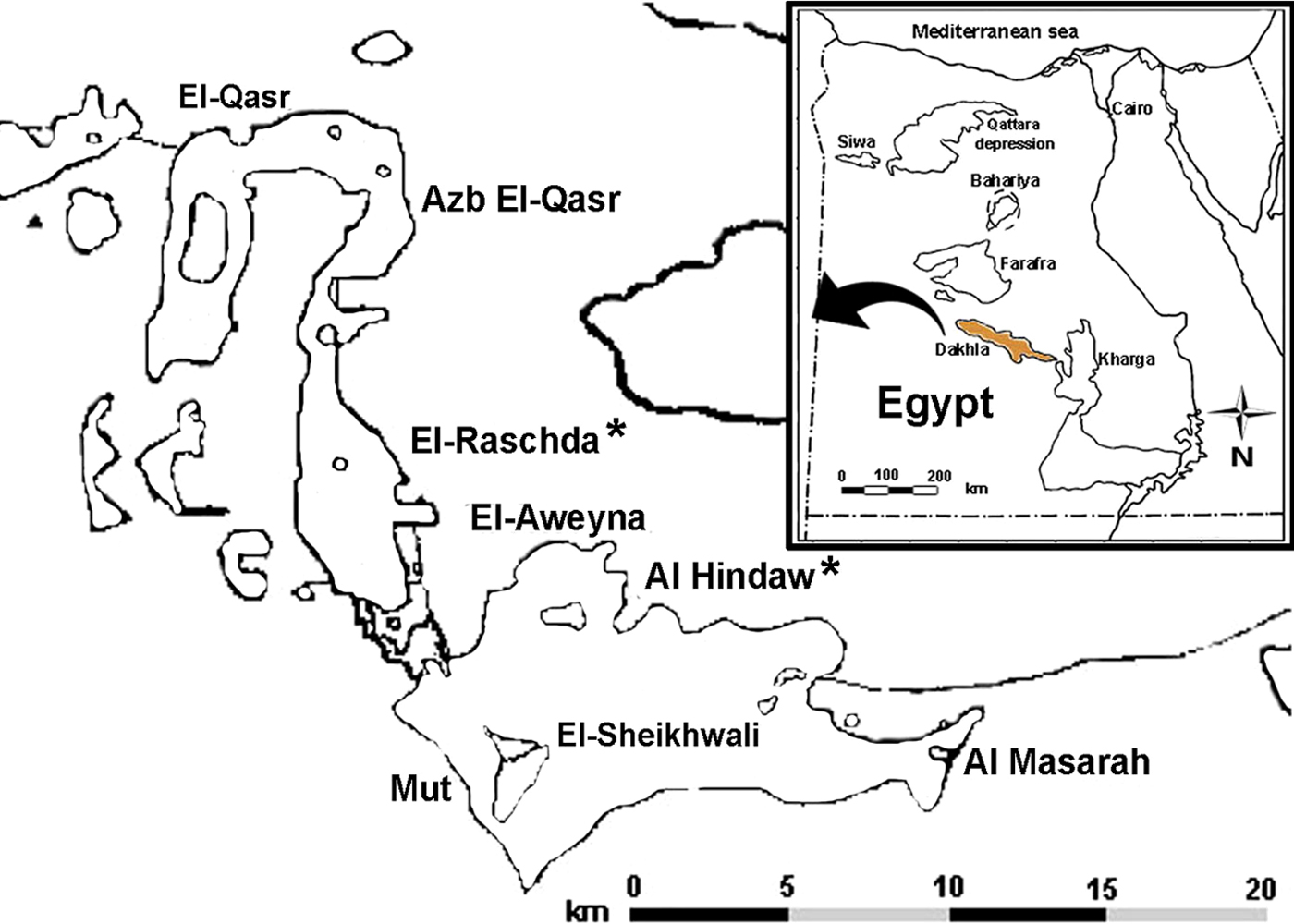
This work was carried out in the Dakhla Oasis, El-Wadi El-Gadid province (coordinates: 25°29′29.6″N, 28°58′45.2″E) in the south-western part of Egypt (fig. 1). In Dakhla Oasis water is derived from 32 wells and springs. The main source of water is the wells. Faecal samples from 503 cattle (214 males <5 years of age, 39 females <5 years of age and 250 females >5 years of age) (table 1) of local breeds were collected from seven districts (El-Raschda, n = 85; Al Hindaw, n = 75; Al Masarah, n = 80; El-Shiekhwali, n = 70; Azb El-Qasr, n = 65; El-Qasr, n = 68; and El-Aweyna, n = 60) in the Dakhla Oasis (table 2). Faecal samples were collected directly from the rectum into plastic bottles which were labelled and brought to Dakhla Animal Health Research Laboratory (AHRL). Coproscopic examination was performed to detect the presence of Fasciola species eggs by the simple sedimentation technique with tap water (Urquhart et al., Reference Urquhart, Armour, Duncan, Dunn and Jennings1996).
A map showing different oases in Egypt. Note seven investigated districts in Dakhla Oasis: El-Qasr, Azb El-Qasr, El-Raschda, El-Aweyna, Al Hindaw, El-Sheikhwali and Al Masarah. Liver inspection (in Mut abatoir), coprological examination and examination of Galba truncatula snails revealed the highest percentage of fasciolosis in both El-Raschda and Al Hindaw districts (asterisks).
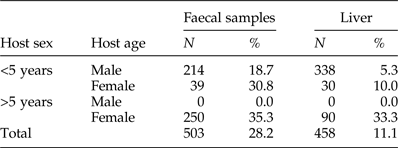
The prevalence (%) of Fasciola hepatica infections in faecal and liver samples from cattle from Dakhla Oasis; N = number of samples examined.

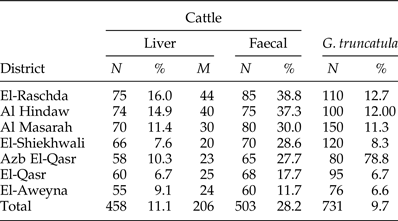
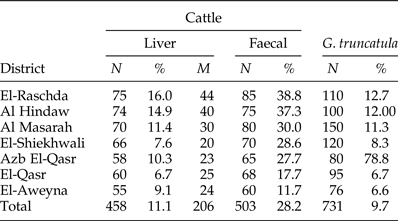
The prevalence (%) of Fasciola hepatica infections in cattle (including mean worm numbers (M) in the liver) and also the freshwater snail Galba truncatula from seven districts in Dakhla Oasis; N = number of samples examined.
Liver samples
Liver samples from 458 cattle (338 males <5 years of age and 120 females (30 <5 years of age and 90 >5 years of age)) were collected during spring 2014 in the abattoir of Mout, Dakhla province (table 2). Mout is the principal slaughterhouse in the Dakhla Oasis, serving the seven districts. Specimens were transported in an ice tank to the Animal Health Research Laboratory (AHRL), El-Dakhla, for further examination. Flukes recovered from livers were collected, counted and washed with normal saline (0.9%). Approximately 20 flukes from each district were fixed and stained (Drury & Wallingten, Reference Drury and Wallingten1980), then morphologically identified, mainly based on non-overlapping features: distance between ventral sucker and posterior end of body (VS–P), distance between the union of the vitteline glands and posterior end of body (Vit–P), and body length/body width ratio (BL/BW), according to Ashrafi et al. (Reference Ashrafi, Valero, Panova, Periago, Massoud and Mas-Coma2006). Approximately 20 F. gigantica adult flukes from Beni Suef governorate were included in the study to compare the morphological findings. For PCR, intact adult flukes were preserved in 70% ethanol and stored at −20°C until DNA extraction.
Snails
A total of 1196 Lymnaeidae snails (≥4 mm) were collected during the morning from the edges of the main wells and their small branches during spring 2014 from the seven districts in Dakhla Oasis (table 2). The snails were either G. truncatula found under the mud or Radix natalensis found attached to grasses in the water stream. The snail collection technique adopted by the Ministry of Health and Population (Snail Eradication Office) was used with the aid of a special net (Diab, 1993). Specimens were placed in bottles with perforated caps and transported to the laboratory for further investigation. Snails were examined for the presence of different stages of Fasciola spp. by direct crushing in saline under a dissecting microscope, where the detected larvae were recorded (Jackson, Reference Jackson1958). Snails were identified according the key provided by Professor Santiago Mas-Coma, WHO, Madrid, Spain (Ibrahim et al., Reference Ibrahim, Bishai and Khalil1999).
Molecular analyses
DNA was extracted from 71 Fasciola-infected and 70 uninfected G. truncatula snails. All infected snails from each district were pooled as one sample representing a specific district, resulting in seven pooled samples of infected snails. Uninfected snails were similarly treated. Furthermore, 7 pooled samples of 10 R. natalensis from each district were prepared. Snails were crushed prior to DNA extraction.
Twenty adult flukes previously isolated from cattle livers were used from each district. The worms were thoroughly washed three times with normal saline. The cone-shaped projections were removed with a sterile scalpel, crushed and homogenized, and then DNA was extracted using a PureLink® Genomic DNA Kit (Invitrogen, Carlsbad, California, USA) according to the manufacturer's instructions. The ability of the duplex PCR to differentiate between F. hepatica and F. gigantica was checked using DNA from 20 morphologically identified F. gigantica adult worms obtained from Beni-Suef province in a previous study (Arafa et al., Reference Arafa, Shokeir and Khateib2015)
Fasciola spp. duplex PCR (Le et al., Reference Le, Nguyen, Nguyen, Doan, Le, Hoang and De2012) was carried out on DNA from both infected and uninfected snails, and from adult worms. The PCR targets mitochondrial nucleotide sequences of the protein-coding cox1 gene (Le et al., Reference Le, Nguyen, Nguyen, Doan, Le, Hoang and De2012). The duplex PCR was performed in a 25-μl total reaction volume containing 1 μl (10 pmol) of both forward primers FHF (5′- GTTTTTTAGTTGTTTGGGGTTTG-3′) and FGF (5′-TGTTATGATTCATTGTTTGTAG-3′), 2 μl (20 pmol) of the reverse primer FHGR (5′-ATAAGAACCGACCTGGCTCA-3′), 3 μl of template DNA, 12.5 μl master mix (Biomatic®; Biomatik Corporation, Ontario, Canada) and 5.5 μl nuclease-free water. Amplification was done using the following conditions: initial denaturation at 95°C for 3 min; followed by 35 cycles of denaturation at 95°C for 30 s, annealing at 52°C for 30 s and extension at 72°C for 2 min. The final extension occurred for 7 min at 72°C. The expected amplicon sizes of F. hepatica and F. gigantica were 1031 and 615 bp, respectively.
For gene sequencing, PCR products of pooled samples selected for adult F. hepatica, F. gigantica and G. truncatula were purified with Thermo Scientific Gene JET PCR Purification Kit (#K0701; Carlsbad, California, USA) according to the manufacturer's instructions. The purified PCR products were sequenced in both forward and reverse directions on an Applied Biosystems 310 Automated DNA Sequencer using cycle sequencing ABI prism Big Dye terminator chemistry (a terminator cycle sequencing ready reaction kit) (Perkin-Elmer/Applied Biosystems, Foster City, California, USA). BLAST® analysis (Altschul et al., Reference Altschul, Gish, Miller, Myers and Lipman1990) was initially performed to establish sequence identity to GenBank accessions. In the current study, all sequences obtained have been submitted to GenBank (accession numbers: KU058263.1, KU058264.1 and KU058265.1). Multisequence alignment of sequences was performed with selected GenBank published sequences (AB020407, AF216697, X07364, NC_024025 and KF543343).
Results
Faecal and liver samples
A prevalence of 28.2% Fasciola spp. eggs was observed from microscopic examination of 503 faecal samples from cattle. Based on sex and age, infection was 35.3% (102/289) in female cattle older than 5 years of age and 30.8% (12/39) in females less than 5 years old (table 1). In males, infection was 18.7% (40/214) in animals less than 5 years old (table 1). No samples of males over 5 years old could be collected as they are fattened and slaughtered before reaching this age. The El-Raschda district had the highest rate of faecal and liver infection among the seven examined districts (table 1).
Adult flukes were found in the bile ducts of 51 of 458 (11.1%) examined liver samples. The mean worm burden ranged from 20 to 44 adult flukes per liver (table 2). The adult flukes were morphologically identified as F. hepatica.
Snails
The snails collected were identified as G. truncatula (n = 731) and R. natalensis (n = 465). Developmental stages of Fasciola spp. were present in 9.7% (71/731) of the crushed G. truncatula (table 2). Of 465 specimens of R. natalensis examined, none were infected.
Molecular analyses
The pooled fluke samples from each of the seven districts revealed the specific 1031-bp amplicon of F. hepatica, as did infected G. truncatula snails of each region. However, F. gigantica (Beni-Suef isolates) PCR products yielded the expected amplicon size of 615 bp. Crushed samples of G. truncatula or R. natalensis with no microscopically detected Fasciola were negative by duplex PCR.
Sequence analysis of selected PCR products of pooled adult Fasciola samples from the different localities and PCR products of pooled infected G. truncatula were found to be closely related to Fasciola isolates in the GenBank database. Egyptian F. hepatica isolates (KU058263.1 and KU058264.1) were found to be identical to the mitochondrial cox1 gene of Fasciola spp. Japanese isolate (AB020407), and shared 99% identity with F. hepatica (AF216697) and 97% identity with F. hepatica large subunit mitochondrial rRNA (X07364). The sequence of the PCR products of control F. gigantica obtained from Beni-Suef governorate, Egypt, (KU058265.1) showed 99% nucleotide identity to the F. gigantica mitochondrial genome (GenBank accessions NC_024025 and KF543342).
Discussion
Faecal examination showed that 142/503 (28.2%) samples from cattle of local breeds in Dakhla Oasis contained Fasciola spp. eggs. A similar finding of 28.6% was reported by Hussain & Khalifa (Reference Hussain and Khalifa2010) in Qena, Egypt. Our finding is also similar to those reported in Debre Zeit, Ethiopia (28.6%) (Abdulhakim & Addis, Reference Abdulhakim and Addis2012) and in Nigeria (25.8%) (Negele & Ibe, Reference Ngele and Ibe2014). However, the prevalence obtained in the current study was higher than the 7.4% and 8.0% in Assiut, Egypt recorded by Abdo (2014) and Kuraa & Malek (Reference Kuraa and Malek2014), respectively. On the other hand, the prevalence in our study was lower than that reported in Ethiopia (35%) (Shiferaw et al., Reference Shiferaw, Feyisa and Ephrem2011).
The prevalence of F. hepatica infection was higher in cattle over 5 years of age (36.0%) than in those aged less than 5 years (30.8%) in the current study. Similar results were reported in Ethiopia by Abdulhakim & Addis (Reference Abdulhakim and Addis2012), who found that the prevalence of fasciolosis was 39.8% in older adult cattle and 23.3% in young cattle. Khan & Maqbool (Reference Khan and Maqbool2012) also noted a higher infection rate in older cattle than in youngsters in Pakistan. Contrary to these results, a previous report from Egypt showed that the prevalence in young animals was higher, at 13%, compared to 5.5% in older animals (Atallah, Reference Atallah2008). Similarly, in Nigeria, Biu et al. (Reference Biu, Paul, Konto and Ya'uba2013) revealed that the incidence in cattle aged less than 5 years was higher, at 16.9% compared to 12.5% in animals over 5 years old. This variation may be associated with lack of veterinary care or exposure to infection.
The present study also found that the infection rate of F. hepatica was higher in cows (36.0%) than in bulls (18.8%). This finding is similar to that of a previous report that cows had a higher rate of infection than male cattle (6.7% versus 2.2%) in Kalyobia, Egypt (Ghoneim et al., Reference Ghoneim, Hassan, El Newishy and Mahmoud2011). This was also documented in Nigeria (18.5% vs. 12.9%) (Biu et al., Reference Biu, Paul, Konto and Ya'uba2013) and in northern Ethiopia (25% vs. 17.3%) (Teklu et al., Reference Teklu, Abebe and Kumar2015). These results were opposite to a reported higher infection rate in male cattle than females in Pakistan (Khan & Maqbool, Reference Khan and Maqbool2012). In north-western Ethiopia, female and male cattle had the same infection rate (Tsegaye et al., Reference Tsegaye, Abebaw and Girma2012).
It is possible that male cattle usually had a lower infection rate than females due to the anthelmintic control programme, which was applied for fattening males but not females. Additionally, males were commonly fed on dry matter during the fattening period and were slaughtered at an early age. On the contrary, females were fed green roughage, thereby increasing exposure to infection. Furthermore, the female life span is longer for breeding purposes. Variations in infection rates could also have been related to geographical distribution, grazing systems and different strategic control of helminths.
It was notable that in the current study El-Raschda district recorded the highest rates of infection in cattle faecal and liver samples. This infection rate may be related to the individual ownership of three animals or fewer, a lack of available veterinary care and dependence mainly on pasture feeding.
The F. hepatica infection rate in cattle livers at the Mout abattoir (11.1%) in this study was lower than those reported in Kafr El-Sheikh, Egypt (18.5%), Punjab, Pakistan (22.6%), Nigeria (42.2%) or in northern Ethiopia (18.4%) (Atallah, Reference Atallah2008; Negele & Ibe, Reference Ngele and Ibe2014; Teklu et al., Reference Teklu, Abebe and Kumar2015). On the other hand, it was higher than those detected previously in Kalyobia, Egypt (6.7%) (Ghoneim et al., Reference Ghoneim, Hassan, El Newishy and Mahmoud2011) and in Kirkuk, Iraq (1.27%) (Kadir et al., Reference Kadir, Ali and Ridha2012). The variation in infection rates might be related to topography, the level of veterinary care, feeding and irrigation systems of animal pastures.
In the current study, faecal examination showed a 28.2% infection rate compared to 11.1% in cattle livers at the slaughterhouse. It was not surprising to record a lower infection rate at the slaughterhouse because the majority (338/458; 73.8%) of the liver samples were from male animals, which are raised under intensive management programmes that include regular deworming with different flukicides. On the contrary, faecal examination revealed a higher Fasciola infection rate because, under the Egyptian field conditions, female animals did not receive proper management and anthelmintics in comparison to the males.
Collected snails were identified as G. truncatula and R. natalensis. In the present study, microscopic examination detected G. truncatula infected with F. hepatica; however, no infected R. natalensis snails were observed. A previous study in Dakahlia, Egypt showed natural Fasciola spp. infection rates of 5.5% for R. natalensis and 3.1% for G. truncatula (El-Shazly et al., Reference El-Shazly, Helmy, Haridy, El-Sharkawy and Morsy2002). However, the latter authors did not identify to species the Fasciola in G. trancatula. In the current study, the microscopic findings of F. hepatica were confirmed by PCR and sequence analysis.
In the current study, a crushing method was utilized to facilitate microscopic detection of Fasciola in the snails, rather than the cercaria release method. The cercaria release method for detection has been negated by several studies, which have shown that prevalence obtained from snail dissection was higher than that from cercaria release (Curtis & Hubbard, Reference Curtis and Hubbard1990; Cucher et al., Reference Cucher, Carnevale, Prepelitchi, Labbé and Wisnivesky-Colli2006; Martínez-Ibeas et al., Reference Martínez-Ibeas, Martínez-Valladares, González-Lanza, Miñambres and Manga-González2011; Lambert et al., Reference Lambert, Corliss, Sha and Smalls2012). Cercaria release only detects mature infections and thus may underestimate the actual prevalence (Studer & Poulin, Reference Studer and Poulin2012), and sometimes snails containing mature cercariae do not shed any (Stunkard & Hinchliffe, Reference Stunkard and Hinchliffe1952). Furthermore, the detection rate of multiple infections was higher by dissection (Curtis & Hubbard, Reference Curtis and Hubbard1990). In fact, Lloyd & Poulin (Reference Lloyd and Poulin2012) found that estimation of double infections by cercaria release is more difficult than that of single infections in the same snail. Consequently, the present study utilized a crushing method for examining the snails for cercaria.
Galba truncatula is the predominant intermediate host for F. hepatica worldwide (Bargues et al., Reference Bargues, Artigas, Khoubbane, Ortiz, Naquira and Mas-CoMa2012). In Egypt, G. truncatula was recorded in various districts, but with scarce data regarding natural infection by F. hepatica (Abd El-Ghani, Reference Abd El-Ghani1976; Brown, Reference Brown1994; El-Kady et al., Reference El-Kady, Shoukry, Reda and El-badri2000; El-Shazly et al., Reference El-Shazly, Nabih, Salem and Mohamed2012). However, G. truncatula naturally infected with F. gigantica was reported (Dar et al., Reference Dar, Rondelaud and Dreyfuss2005, Reference Dar, Djuikwo Teukeng, Vignoles, Dreyfuss and Rondelaud2010) and under experimental conditions various snail species were successfully infected with F. hepatica (Dar et al., Reference Dar, Djuikwo Teukeng, Vignoles, Dreyfuss and Rondelaud2010, Reference Dar, Lounnas, Djuikwo Teukeng, Mouzet, Courtioux, Hurtrez-Boussès, Vignoles, Dreyfuss and Rondelaud2013, Reference Dar, Vignoles, Rondelaud and Dreyfuss2014). It is worth mentioning that in Egypt F. hepatica originated from imported animals (Lotfy et al., Reference Lotfy, El-Morshedy, Abou El-Hoda, El-Tawila, Omar and Farag2002; Mas-Coma et al., Reference Mas-Coma, Bargues and Valero2005; Hussain & Khalifa, Reference Hussain and Khalifa2010) and R. natalensis is considered to be its potential intermediate host (Dar et al., Reference Dar, Djuikwo Teukeng, Vignoles, Dreyfuss and Rondelaud2010). In the current study, no Fasciola-infected R. natalensis were identified among the 465 snails examined.
Morphologically, adult flukes in this study were identified as F. hepatica and this was augmented by the presence of F. hepatica larval stages in its intermediate host, G. truncatula. Several investigations based on morphological criteria, morphometric and chemotaxonomic data showed similar findings (Lotfy & Hillyer, Reference Lotfy and Hillyer2003; Periago et al., Reference Periago, Valero, El Sayed, Ashrafi, El Wakeel, Mohamed, Desquesnes, Curtale and Mas-Coma2008; Hussain & Khalifa, Reference Hussain and Khalifa2010). In this current study, mitochondrial DNA-targeting duplex PCR was used to identify Fasciola spp. obtained from liver samples and snail intermediate hosts. It is worth mentioning that PCR detected F. hepatica in pooled samples of 5–14 infected G. truncatula snails taken from different districts, as well as in pooled DNA samples of adult worms. Previously, F. hepatica DNA was detected in ten pooled G. truncatula snails and in up to 25 lymnaeid snails per pool (Rognlie et al., Reference Rognlie, Dimke, Potts and Knapp1996; Caron et al., Reference Caron, Righi, Lempereur, Saegerman and Losson2011). Detection of F. hepatica by PCR in pooled samples is especially a point of strength because it can detect dead and immature Fasciola stages which might be missed visually.
The sequence analysis of selected cox1 genes amplified from Fasciola spp. isolates and infected G. truncatula from Dakhla Oasis confirmed the presence of F. hepatica DNA. Moreover, cox1 amplicons from adult F. gigantica obtained from Beni-Suef province, Egypt, sequenced in this study, were identical to the Chinese F. gigantica mitochondrial genome (NC_024025 and KF543342). It is of interest to highlight that the selected mitochondrial nucleotide sequences of the protein-coding cox1 could be used as an identification gene for the two main Fasciola species (Le et al., Reference Le, Nguyen, Nguyen, Doan, Le, Hoang and De2012).
The presence of F. hepatica and F. gigantica in the same animal creates an opportunity for cross-fertilization and hybrid formation (Spithil et al., Reference Spithil, Smooker, Copeman and Dalton1999; Amer et al., Reference Amer, Dar, Ichikawa, Fukuda, Tada, Itagaki and Nakai2011). However, in the current study, the morphological features of the collected flukes were clearly identified as consistent with F. hepatica according to the standardized measurements of Ashrafi et al. (Reference Ashrafi, Valero, Panova, Periago, Massoud and Mas-Coma2006) and Periago et al. (Reference Periago, Valero, El Sayed, Ashrafi, El Wakeel, Mohamed, Desquesnes, Curtale and Mas-Coma2008). None of the worms met the morphological criteria for F. gigantica. Moreover, the Fasciola cox1 gene amplified from the samples in this study was identical in sequence to that reported for F. hepatica. As a result, hybrid flukes between F. hepatica and F. gigantica were not taken into consideration in the current study. However, the mitochondrial DNA-targeting duplex PCR used in this study does not differentiate between diploid and triploid Fasciola spp., which differ only in chromosomal, not in mitochondrial, DNA. Karyotyping to determine if sperm are present in the Fasciola seminal vesicle, which is common in triploids and parthenogenetic diploids, or alternative molecular methods, would be needed to identify these forms (Le et al., Reference Le, Nguyen, Nguyen, Doan, Le, Hoang and De2012). Molecular approaches based on the DNA sequences of ITS1, ITS2 or the 28S ribosomal RNA gene, in combination with mitochondrial gene markers, are recommended for precise identification (Itagaki et al., Reference Itagaki, Tsutsumi, Ito and Tsutsumi1998, Reference Itagaki, Kikawa, Sakaguchi, Shimo, Terasaki, Shibahara and Fukuda2005; Marcilla et al., Reference Marcilla, Bargues and Mas-Coma2002).
The current investigation revealed that F. hepatica was the common liver fluke of cattle in the Dakhla Oasis subtropical area. About 2.4 million people in 61 countries are infected with Fasciola (Haseeb et al., Reference Haseeb, EL-Shazly, Arafa and Morsy2002). In Egypt, fascioliasis is endemic in certain villages, but the overall prevalence is unknown because reports show wide variations in infection rates. The existence of infected G. trancatula in the main water sources (wells), the low level of awareness and hygienic measures, and the distance of Dakhla Oasis from Cairo, the main capital, are contributing factors to high Fasciola prevalence in this area. Fasciola hepatica has been recognized by the World Health Organization as a zoonotic neglected tropical disease (WHO, 2015). Therefore, control methods must be considered in Dakhla Oasis.
In conclusion, F. hepatica and its intermediate host, G. truncatula snails, were recorded in seven districts of Dakhla Oasis, El-Wadi El-Gadid province, Egypt, both morphologically and molecularly with single-step and rapid mitochondrial DNA-targeting duplex PCR.
Acknowledgements
The authors express their gratitude to Professor Mas-Coma, Valencia University, Spain for his assistance in the identification of snails. We thank Professor Lotfy, Alexandria University, Egypt, for his advice and consultations during the course of the study. We appreciate and thank Professor Gamal Allam for his advice and help.
Conflict of interest
None.