If you just learn a single trick … you'll get along a lot better with all kinds of folks. You never really understand a person until you consider things from his point of view … Until you climb inside of his skin and walk around in it.
Harper Lee, To Kill a Mockingbird
What is the political significance of difference?Footnote 1 Why are ethnic, racial, or religious differences frequently politically significant while differences in height, hair color, or weight are not? Why are linguistic differences sometimes relevant politically, and other times are not salient? What about age? Gender or sexual preferences? What fosters tolerance of differences judged ethically and politically salient? What encourages respect for these differences, leading some of us to reach out across divides that isolate others? These questions take on a poignant immediacy with reports of continuing prejudice and discrimination; ongoing ethnic, religious, and sectarian violence—even genocidal activities and war; and increasing polarization over issues of race, religion, and ethnicity, at home and abroad. They are questions students need to consider as they go out into a world where they will meet new people, from diverse cultures, religions, and ethnicities. How can we best prepare them for this?
This manuscript describes results from an experimental course program designed to use empathic involvement with the other to help students think deeply about their own attitudes toward people judged different, whether these differences are associated with race, ethnicity, and religion or with age, disability, sexual preference, etc. With funding from the Ford Foundation Program on Difficult Dialogues, we taught the course at the University of California, Irvine (UCI), one of the most ethnically diverse campuses in the U.S.Footnote 2 Subject to many of the same group tensions experienced at other American universities. UCI provided a particularly rich laboratory for our experiment.
The course program followed traditional academic and literary readings on difference with a narrative interview project structured to heighten empathic involvement with at least one member of a group judged different and frequently discriminated against in contemporary American society. Students were asked to measure their own attitudes, using both quantitative and qualitative measures of prejudice, including a series of implicit association tests (IAT) (Greenwald, McGhee, and Schwartz Reference Greenwald, McGhee and Schwartz1998) designed to measure subconscious attitudes toward prejudice. These tests were administered both before and after the intervention, and students were asked to choose a pseudonym and to track the shifts in attitudes of this pseudonymous person over the course of the term. A control group of analogous students, obtained via a respondent-driven nominee sample, participated in the same IAT, minus the course intervention.
This article describes results of the class experiment in three parts. Part 1 describes the underlying premises and how we structured our class experiment to focus on age as a wedge issue that would both tap into our philosophical/theoretical concerns and help detect more politically divisive instances of prejudice. Part 2 describes how we measured prejudice, pre- and post-intervention, using both extensive written work and implicit association tests. Part 3 presents the results from the experimental course that utilizes empathic involvement with the other to effect changes in attitudes toward members of groups frequently discriminated against in American society. A conclusion discusses the limitations in the experiment. While we note the need to expand and refine the program, overall, we found the experimental course offers a useful tool for scholars concerned with group identity, prejudice, and tolerance.
Part 1. Philosophical, Pedagogical, and Theoretical Psychological Premises
We adopted three underlying philosophical premises that distinguish this course experiment from the more traditional treatment of differences: (1) Differences exist. It is not the existence of a difference that is critical politically but rather the ethical significance that is accorded to the difference. (2) The ethical salience of a difference is socially constructed. There is no inherent reason why one difference—race or religion—should be politically significant when other differences—musical ability or weight—are not politically relevant. (3) The key to understanding the politics of difference is to think of cultural differences not as intrinsic and immutable but rather as the result of how differences are shaped and perceived—by one's self and by others—through a cognitive classification of one's self and of one's self in relation to others. Our treatment of others thus results not from a rational calculus of interests that flows naturally from innately derived and immutable differences—such as race, gender, or ethnicity—but rather from our perceptions of others as derived from the moral salience accorded these differences via a cognitive categorization and classification of others in relation to ourselves (Monroe Reference Monroe1996; Reference Monroe2004).
Pedagogically, we assumed that students learn best not by listening to lectures, but by being forced to examine their own preconceptions in the light of empirical evidence, and further that emotions play an important part in permanent shifts in attitudes. Hence, we emphasized narrative interviews designed to tap into emotional ties (McGaugh Reference McGaugh2003).
Theoretically, we adopted the assumptions underlying social identity theory (Tajfel Reference Tajfel1981; Turner Reference Turner1987) concerning psychological origins of intergroup discrimination. People need to classify information and thus frequently put themselves and others into categories. Labeling someone—Christian or Muslim, jock or nerd, or etc.—is a way of saying other things about these people and locating them in our own cognitive landscape. Group identification arises from the human need to associate with certain groups (our in-groups) and relates to our own needs to bolster our self-esteem. Comparison between groups involves a process in which humans compare their groups with other groups and, in doing so, tend to exert favorable bias toward the groups to which they self-identify or belong. Finally, and perhaps most important, every individual has a wide repertoire of individual and group identities and each identity helps inform individuals about who they are and what this identity entails; which aspect of this complex identity will become most salient for an individual at any time will vary depending on the social context. This context will be affected by diverse factors, one of which includes how the individuals see the person they are interacting with. This interaction will be highly dependent on the character traits and any personal relationship existing between the individuals.
Empathic involvement with the other thus can enter the equation and influence ethical treatment because of this psychological process. By emphasizing empathic involvement with the other as a critical part of ethics, we test a longstanding philosophical tradition locating empathy (Smith Reference Smith2002) at the foundation of morality. We thus designed the course to encourage the empathic involvement that leads to seeing the world through the eyes of the other, hoping this process would increase understanding and tolerance of differences.
Age as a wedge issue to test prejudice
We designed the experiment to combine readings about differences with a hands-on experience that combines cognitive analytical skill with the emotional impact psychologists now tell us influences cognition (McGaugh Reference McGaugh2003). We did so by examining a group often omitted in discussions of the politics of difference, a group none of us is born into; that each of us frantically tries to avoid; that most of us eventually move into and out of, depending on chance and situation; and a group that all of us—if we are fortunate—desperately hope to join eventually: the elderly.
Elders are treated differently by various cultures. Many UCI students were first-generation immigrants from Asia or the Middle East, living in extended families, and highly sensitized to the ways elders are treated by different cultures. Our study of these cultural differences attempted to help students disentangle what is intrinsic and immutable about becoming old (the loss of physical vigor, for example) from what is not (decline in financial resources, loss of a spouse), and to focus their attention on both the cultural differences and their own more individualized views of the elderly. We designed the study specifically to help students see that although some attributes exist independently of social construction, many are culturally imposed and hence are neither intrinsic nor immutable. A key goal in the course was to help students understand the normative political importance of categorization and the according of moral salience to other groups in our society.
Before beginning their interviews, students considered what part of the elderly identity relates to differences that are real, such as the declines in health and deaths of a spouse or friends, and which differences exist primarily in the eyes of the beholder, such as those that occur when an otherwise sprightly older person is treated as infirm simply because of having white hair. We intended this exercise to encourage students to ask whether some of the differences other groups are said to have—often considered attributes that are real and that threaten our identity—are socially constructed. Do we have more in common with, and thus less to fear from, others than we realize?Footnote 3 Answering this key question helped students understand the importance of categorization and the according of moral salience to other groups in our society. The importance of approaching differences this way, of course, is normative as well as intellectual. To the extent that such differences are a function of cognitive construction, their ethical and political impact can be muted and reshaped through the kind of contact and understanding we hoped to foster in this course.
The class read traditional material on differences, such as social psychological work on prejudice, discrimination, and identity.Footnote 4 We gave special attention to social identity theory and self-categorization theory and also assigned novels (e.g., Amy Tan's The Joy Luck Club and Ralph Ellison's Invisible Man) to supply the personal link psychologists now tell us provides the emotional clout to change opinions. One typical assignment linked philosophical work in ethics (Kant's categorical imperative), social psychological work on identity, and self-categorization theory to Invisible Man by asking students to describe a time when they were made to feel invisible and a time when they made someone else feel invisible. Students were encouraged—but not required—to share their essays with the class.
Students did extensive writing as part of the course and were trained in interviewing, editing, and the writing of narratives as a tool for understanding the psychology of another (Bar-On Reference Bar-On2006). After training in this technique, each student focused closely on one elderly person to interview. Students independently constructed a list of questions to pose to their elders. These questions were discussed in class and all the questions were compiled and grouped into topical categories to form a master questionnaire that all students could use as prompts. Students were encouraged to be flexible in their interview technique, to treat the interview as a dialogue or a conversation, and to follow the elder's lead, rather than enforcing a rigid interview schedule. In particular, students were told never to press on an issue that seemed unsettling or difficult for the speaker to discuss, such as the death of a loved one. (See Monroe Reference Monroe2004 on the interview technique.) Each student then chose an elder to interview; we encouraged interviews with someone in the students' families, both to strengthen and build on existing familial ties and to provide the student with a historical record of their own past. The professor conducted an in-class interview with her mother to illustrate and discuss the process and the challenges in doing such an interview. Students then conducted and transcribed the interviews with their elders, edited the transcriptions to try to capture the speakers' voices, and developed the interviews into analyses of the speakers' mindsets, emotional terrains, values, beliefs, and worldview in contrast to the students'.
We began with age for several reasons. Age is a relatively noncontroversial difference associated with prejudice. It is a difference that carries both real and socially constructed ethical significance. Age is not a difference that is immutable; elderly are not born old, and most students will themselves someday become old. Age allowed students to interview someone with whom they might already have existing ties of affection that could help bridge any gap associated with difference. It avoided having students stuck into categories—being a Muslim or a Jew, a Hispanic or an Asian—they could not get out of during the rest of the term. We wanted to avoid the uni-dimensionality and rigidity that could occur if we began our discussions of prejudice and difference by identifying any class member as an X or a Y. For all these reasons, we hoped that age would act as a wedge to open broader discussions of prejudice that might be too tough to tackle in a group of students who would not know whether they could trust either the professor or their fellow students. The process worked well, and the general consensus was, as one student remarked, that “old people are just young people who've been around a long time.” Perhaps more important, the exercise helped us have surprisingly frank discussions about the nature of prejudice, which consists—students decided—of denying others their individuality and rights as an individual.
Part 2. Measuring Shifts in Prejudice
We measured changes in prejudice using the IAT, which taps into deep-seated, subconscious, cultural prejudices, plus students' written works and class discussions to detect more conscious shifts in prejudice.
Design and Sample
The study is a quasi-experimental design with one experimental group and one control group. We used repeated measures in the experimental group, before and after the class, and one measure of the control group that we compared with the experimental group. Because the class was structured as a seminar to maximize interaction, the total sample size was 28 subjects, distributed between both the experimental and control groups. The experimental group (n = 15) was composed of students who participated in a class called The Politics of Difference. The experimental group had eight men and seven women; six students were self-identified as Asian, five as Caucasian or white, two as Hispanic, one as African American, and another one as Other ethnicity.
Results for participants in the course were contrasted with comparable students whose names were secured through a respondent-driven nominee sample, a form of snowball sampling in which each student provided the names of friends not enrolled in the course but who corresponded with the student on critical background characteristics, such as age, ethnicity, religion, etc. Nominees took the same IAT, but, of course, did not participate in the course. The control group was composed of eight women and five men; seven self-identified as Asian, five as white, and one as Hispanic.
Implicit association tests
To assess unconscious prejudices, we used the IAT (Greenwald, McGhee, and Schwartz Reference Greenwald, McGhee and Schwartz1998). The IAT measures differential association of two target concepts with an attribute. The two concepts appear in a two-choice task (e.g., Young vs. Old), and the attribute in a second task (e.g., Pleasant vs. Unpleasant words for an evaluation attribute). When instructions require highly associated categories (e.g., Young + Pleasant) to share a response key, performance is traditionally faster than with less associated categories (e.g., Old + Pleasant) share a key. This performance difference implicitly measures differential association of the two concepts with the attribute. Widely utilized in psychology, the IATs have nonetheless been criticized as providing unreliable measures of prejudice (Cunningham, Preacher, and Banaji Reference Cunningham, Preacher and Banaji2001). Available on several web sites, we used tests at http://www://implicit.harvard.edu/implicit/demo/selectatest.html.
The IATs are computed-based tests in which the subject performs a classification task of different stimuli in different categories and the results are generated automatically by the program. There are seven possible results that vary depending on what the specific test is assessing. The possible results—for all the IATs—were coded by the course assistant in a seven-point scale ranging from one to seven, in which one means strong preference toward one group and seven strong preference for the other group. For example, consider race. A one indicated preference for white in comparison to black, two a moderate preference toward white in comparison to black, three a slight preference toward white in comparison to black, four means little or no automatic preference toward any category, five indicates slight preference toward black in comparison to white, six a moderate preference toward black in comparison to white, and seven a strong preference toward black in comparison to white. All the IATs results used this same seven-point scale.
We chose six tests to assess unconscious attitudes concerning a potential prejudice that might affect our sample: race, age, Arab/Muslim, Asian, Judaism, gender-career. These tests were chosen because each one tapped into prejudice for one of the major four discriminators: race, gender, religion, and nationality/ethnicity. Since the logic behind each of these is rather straightforward, we note just one example, the scale for race, to suggest the logic and process for all the tests. Race has long been a divisive issue in the United States and we assumed some students would have few contacts with, but many negative stereotypes of, if not open prejudice toward, African Americans. This IAT requires the ability to distinguish faces of European and African origin, and to associate these faces with pleasant and unpleasant words, thus generating results that we coded using the seven-point scale measuring implicit association of one race with favorable attitudes and the other with negative attitudes. Other tests followed an analogous logic.
To control the effect of the order of administration of the tests over the performance, each of the students took the six tests following a different order. To control for external influences over the student's performance all the tests were administered in the same place, on the same computer, and by the same person. The total time of administration of the six tests was approximately one hour.
Part 3. Results: Experimental Course Program Using Empathetic Involvement with Others
Our results were interesting on several dimensions. Students reported in their written work that they did not begin the course with prejudice. They resented the findings of pre-intervention IATs, which suggested many students did exhibit implicit prejudice toward diverse groups. The IATs were criticized heavily for this. Yet the students' own written reports of shifts in prejudice indicated that the students had undergone changes in their attitudes toward certain groups. The fact that students indicated a seemingly impossible shift—from self-reports of “no prejudice” to self-reports of “less prejudice” as a result of the course—suggests both cognitive dissonance and a desire to please the professor. The post-intervention IATs did not indicate a significant shift in prejudice toward the elderly but did suggest statistically significant shifts in attitudes toward women in careers and the weaker but still statistically significant shift in attitudes toward Asians. We considered several possible explanations for the findings concerning Asians, but found none fully satisfactory. We explain shifts toward women in careers as a function of the gender of the professor and the teaching assistant, both of whom spent extensive time with the students, working closely with them on their written work and the testing. Both participated in emotionally charged class discussions that struck a deep personal chord for many students. Our overall conclusion is that empathic involvement with the other can shift attitudes toward members of that group but that the involvement needs to be more extensive than simply a one to two hour interview. Full findings are below.
Implicit Association Tests
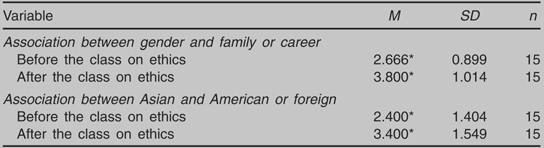
To assess changes in the unconscious prejudices in the experimental group (the class members) after the class intervention, we carried out a paired t test for the equality of means. To our surprise, we obtained statistically significant differences in the gender-career IAT and in the Asian American IAT. The descriptive statistics for these tests are shown in Table 1.
Descriptive Statistics for Associations between Gender and Family or Career, and Asian and American or Foreign before and after the Class on Ethics in Experimental Group

Note. Paired t test for the equality of means were performed.
* Means in the same dependent variable differ at p < .05.
These data show a positive change in prejudices in the students. For the gender-career test, students shifted from a moderate-slight association of women with family and men with career, to a virtually neutral association between gender and family or career (t (14) = −3.199, p = .008). Regarding the Asian American IAT, we also found a shift from moderate-slight to a slight-neutral association of Asian American with foreign and white American with American (t (14) = −2.562, p = .023). No significant association was found between either the gender or ethnicity of respondents with the changes reported, but the N's are small.
To compare the means in these two tests between the experimental and control groups after the class, we performed an unpaired t test for the equality of means. We found statistically significant differences in the gender-career test (t (25) = 3.298, p = .003), showing that whereas the control group shows a moderate-slight association between women with family and men with career, the experimental group shows a practically neutral association between gender and family or career after the class on ethics. (Descriptive statistics for this test are in Table 2.)
Descriptive Statistics for Associations between Gender and Family or Career between Experimental and Control Group after the Class on Ethics

Note: Unpaired t test for the equality of means was performed.
* Means in the same dependent variable differ at p < .05.
Written and Oral Discussions of Shifts in Prejudice
To further detect shifts in prejudice, we contrasted measurements from the IATs with written reports and class discussions of prejudice. This simple methodological contrast provided interesting results. In their written work and class discussions, few students initially identified themselves as having any prejudice. Yet their later assessments, using both class and written measurements, claimed the class had caused them to be more tolerant. This was evident in both comments from class discussion and in written assessments of the students' pseudonymous selves and their shifts in prejudice. Consider just a few of these quotes, using fictitious names, to capture these seemingly contradictory findings and the hostility toward the IAT scores. John: “After this class, I know I have a prejudice towards the Muslims on this campus … I'm not sure how accurate my implicit prejudices were recorded. I mean, it [the IAT] was on a computer, the same pictures over and over, what's accurate about that”? Anna says that “the course affected my attitudes in a positive way … The interview affected me in a way that initially I thought it would … Regarding the IAT, well, I was upset at them.”
Marta typified the other students in claiming not to have any initial prejudices: “I am already aware of how different we all are, but at the same time, we are vastly more similar. I didn't have many, if any, negative prejudicial views before I took this course. In all honesty, I hold most people in too much of a positive light. It was good to come to class and know that it is an open, honest, and safe environment.” Marta's last comment touches on an important finding: the value of using age as a wedge issue. Although age is one of the top four discriminators, it is less controversial for students and focusing on it provided students the time to trust a new professor and fellow students. In discussing their written work on the elderly, students admitted that they enjoyed doing the interviews. One student commented, “My thoughts overall [toward the elderly] were not changed, but rather confirmed by this interview. I don't see other groups very differently now, but I know that everyone is discriminated against in some way. So if anything, what changed is my perspective.” Marta's opinion about the IATs illustrated those of her classmates: “The IAT was an interesting test, but I don't believe that this particular one was accurate in judging/measuring prejudice … Those results should be taken in the context of the setting and the person's fatigue (or other carry-over effects).”
Students claimed that talking with their classmates made them realize that “although different, we all have similar characteristics” (Kelly). Students also claimed the readings and the interview affected the way they saw the elderly and made them appreciate the elderly more. One said:
When I began this course I thought I was a very tolerant and accepting person. I knew I had a few prejudices … but I thought that I was working on these attitudes and that if I tried hard enough I could make myself a good person. I think this class helped with that. The way the course was structured (a small group of people) made it comfortable and easy to talk to classmates and because of that I learned that though we were all different, we had similar goals, dreams and fears. I also enjoyed the readings … especially Pipher's Another Country because it gave me an inside look at the emotions and actions of the elderly. The interview of Maria (the elderly person I interviewed) also added to this. It affected the way I saw the elderly, made me appreciate them a lot more. It also made me more patient and more interested in people different than me. Maria was great and I loved her energy, her attitude, her personality and her stories and it taught me that if I give my time to people and show an interest, people will teach me great things and tell me wonderful stories. This is a lesson I'll apply with other groups as well.
Concerning the IATs, Kelly says, “I want to say that the IAT didn't accurately capture my thoughts but that would be a lie. I think the IAT might have captured something about me that I either refused to see or didn't know about. I can only hope that the second time I take the test the results will be much more preferable.” Kelly was unusually candid in this assessment of her prejudice.
Although most students said they took the course because it fulfilled an upper-division writing requirement, not because of a pre-course concerned with prejudice itself, most students felt the class helped them change their tolerance and appreciation for others: “This course changed my appreciation for other individuals” (Peter). Concerning the IATs, Peter said, “I felt the IAT test was too long where reverse biases were created. We all want to view ourselves as unprejudiced so we counter our true biases.” Peter was in the minority, however, with most students claiming to have been “profoundly affected” by the course and the interview process, which, in Lisa's words:
expanded my intellectual capabilities, but it also helped me reflect on my attitudes and life in general. It shed light on feelings and assumptions that seem to be automatically granted as innate facts, when in reality they can be explained and have unique origins. This class is a reflection of self, environment, and life. It reveals how everything is connected in some way. This course expedites the constant growth and maturation process of humanity … I really enjoyed conducting the interview with my grandmother. We talked about topics that we hadn't touched on before. I was never prejudiced toward the elderly. I am extremely close with my parents and my aunt. I spend quite a bit of time associating with people who are much older than me. I've always enjoyed the profound perspectives prevalent amongst older people and the extreme elderly.
Yet when referring to the IATs, Lisa says, “I don't advocate the IATs as valid evaluations of prejudice. My results were not accurate. They portrayed me as biased towards certain groups. I do not consider myself prejudiced in any way.”
Others echoed Kathy's claim that
this course really made me re-think how I regard others who have had more—or just different—experiences than me. It made me realize that just because I may not have prejudices, I still cannot expect to know what everyone's life experiences have been like. The interview didn't change much of my perception of the elderly because I never really had any prejudices but that may be cause I didn't think much about the elderly at all. So I believe if anything has changed, it has been my belief that the elderly have very much to offer younger generations and should not be treated as if they are on their way out the door. The interview also helped me realize how much I have in common with those generations older than me.
Others shared Kathy's view of the broadening experience of the interview, coupled with negative response to the IATs: “The IATs, they're a unique experiment that talks about prejudice but there are some flaws to it, such as the setup and making people think a certain way … Overall, this class helped me see issues in a broader perspective, and allowed me to be somewhat more critical of relationships” (Griffin).
In general, students felt the class affected them in a positive way. The use of age as a wedge issue provided time to get to know and trust the professor and other students, and was closely related to the students' assessing the class as an open, safe, and diverse environment that fostered candid communication and difficult dialogues. As a consequence of this context and the work carried out, students felt they gained a larger understanding of the nature of prejudice and discrimination, a deeper appreciation and interest for the others, and an awareness of the fact that although different, we all are human beings, with the same “goals, dreams and fears” (Shoshona). However, their opinions regarding the IATs were negative in general. Most students considered the IATs biased and, therefore, not an accurate measure of their own attitudes. But since the majority of the students also claimed to be free of any initial kind of prejudice, one conclusion may be that the students were—not surprisingly—simply uncomfortable being told they held implicit prejudice.
Conclusion
This paper presents results from a class that used a narrative interview technique to foster empathic involvement with the other, in the hope that such involvement would foster more tolerant attitudes and compassionate treatment of others. Students in the class were tested for their attitudes toward diverse groups, both before and after the class intervention, using verbal and written assessments and implicit association tests of tolerance toward these various groups. Results were compared with similar tests for a control group, obtained through a respondent-driven nominee sample. Since our intervention focused on the elderly, we expected a shift in attitudes toward old people. Here we found mixed results. Students' verbal and written assessment of their overall attitudes toward the elderly suggested a change, but the IAT results showed no statistically meaningful change in attitudes toward old people. This gap between the students' qualitative assessment of their overall attitudes toward the elderly and the quantitative measure (IAT) may be due to the effect of power dynamics in the classroom. In order to please the professor and teaching assistant, students may have expressed verbally a change in their attitudes toward the elderly. Nonetheless, the quantitative data, which reflect unconscious attitudes, show no change of these attitudes. This is an issue that may be resolved—or at least addressed—by controlling for social desirability in future studies and assuring the anonymity of the students when writing about their attitudes. (See note 5 on the social desirability index.) But the discrepancy between the quantitative IAT results and the more qualitative measures of shifts in prejudice also may reflect the extent to which conscious attitudes are influenced—however subtly—by desires to please teachers who are respected and in positions of authority.
The IAT measurements certainly did reveal a strong and significant shift in attitudes toward women with careers, a group with whom we had designed no intervention. But the fact that both the professor and the teaching assistant were female, in an intense and well-received seminar setting where students had extensive faculty involvement, also might have inadvertently served as a way to foster empathic involvement with members of a group—in this case, career women—that was heretofore unknown to most students. If so, this would suggest that our initial hypothesis is correct; empathic involvement with a member of a group that is discriminated against can shift attitudes toward such group members. But the involvement required to shift attitudes needs to be more extensive than simply a short (one to two hour) narrative interview.
The weaker but still statistically significant shift in attitudes toward Asians also may relate to the increased involvement with fellow students, half of whom were Asian. Another, more skeptical interpretation, might be that these changes in attitudes toward women with careers and toward Asians as foreigners may be also reflecting the effect of the power dynamics in the classroom since the contact with Asian students constituted more empathic involvement but minus the power differential that accompanied the increased contact with career women. Since there was no power dimension in the shift in attitudes toward Asians—neither the professor nor the TA was Asian—and since the IATs are based on measuring minute shifts in response time, it again would be more likely that any shift related to power in the classroom would surface in the written or oral measures of attitudinal changes, not in the IATs. The lack of shifts in attitudes toward Asian in the qualitative measures of prejudice corresponds with this theory. But the qualitative measures did not indicate shifts in attitudes toward career women. We thus rejected this more cynical view of the shift in attitudes toward professional women in favor of an explanation that attributes the shift to empathic involvement.
Our main substantive finding, then, is that the class had a positive effect on student attitudes in general and reflected a genuine improvement of their understanding and appreciation of members of a group initially judged to be different. Our study raises interesting questions. It deserves further work designed to use critical methodological improvements in the measurement of attitudes.Footnote 5 Even our tentative, initial results, however, shed light on the possible factors that may influence a positive change in attitudes toward the others and represent an important step in developing interventions on ethics in the academic environment.
A Week's Classes