Introduction
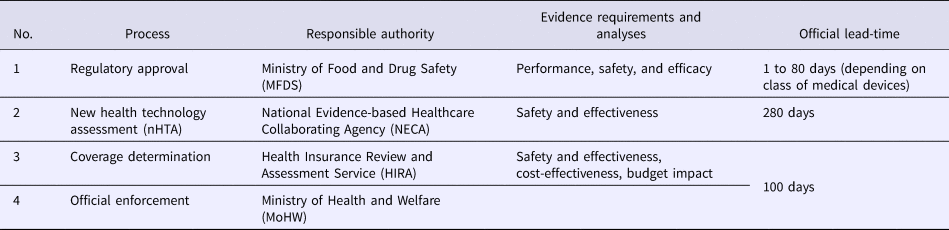
South Korea has a healthcare system characterized by universal funding, and public access to many medical innovations. The pathway by which new medical technologies enter the market and gain reimbursement in South Korea is similar to other developed countries and is characterized by three compulsory processes that are outlined below and also detailed in Table 1 (Reference Lee and Salole1).
Patient Access Process of New Medical Technologies

Regulatory Approval
First, manufacturers must seek regulatory approval for their technology through a submission to the Ministry of Food and Drug Safety (MFDS), formerly known as Korea Food and Drug Administration (KFDA). Depending on the class of the new medical technology (class 1 low risk to class IV high risk), the submission requirements vary. For class IV, high risk technologies which include for example, coronary stents, pacemakers, or implantable cardioverter defibrillators (ICDs), the submission of a Summary TEchnical Documentation (STED) is compulsory. The STED must include evidence of the technology's performance in laboratory / animal testing and high-quality clinical trial evidence of safety and efficacy combined with technical documents such as the Essential Principle (EP) checklist, risk management system, and detailed manufacturing information.
New Health Technology Assessment
Once regulatory approval for a new medical technology has been granted, funding under the National Health Insurance (NHI) universal healthcare scheme in South Korea is not automatic. Rather, the MFDS-approved technology must seek approval for NHI funding in a multi-step process, the first of which is a submission by the manufacturer to the new health technology assessment (nHTA) process coordinated by the National Evidence-based Healthcare Collaborating Agency, known as NECA. The NECA is a national research agency established to study and provide information on new medical devices, drugs, and health technologies through objective and reliable analysis. It is the sole HTA agency in South Korea supervised by the Ministry of Health and Welfare (MoHW). A submission to NECA must demonstrate safety and effectiveness of the new medical technology and all associated medical procedures similar to the regulatory submission. The NECA then conducts a rigorous systematic review of the literature to determine the safety and effectiveness of the technology. The nHTA process is intended to take 280 days for completion as per NECA's guidance document (Reference Lee and Salole1).
Coverage Determination
After nHTA, reimbursement coverage determinations for new medical technologies and associated procedures, including coding and payment decisions are sought by an application to the Health Insurance Review and Assessment Service, known as HIRA. The term “coverage determination,” as used in this analysis, is defined as a positive recommendation for public funding under the NHI scheme and includes a confirmation of codings, payments, and coverage guidelines which specify the detailed conditions of indications for use of the medical technology. The application to HIRA must outline safety and effectiveness of the new technology but should also include a cost-effectiveness and budget impact analysis. The “medical procedure coverage determination” process is among the three-step coverage determination processes at HIRA and is considered the biggest delay for patient access (2;Reference Lee3).
Unlike the case where similar medical technologies are already listed in coverage services and items by NHI, new medical technologies that have gone through the nHTA process are required to undergo three step-wise reimbursement coverage processes: first, coverage determination of medical procedures (including diagnostics); second, coverage determination of medical technologies (e.g., implantable pacemakers, catheters, surgical staples, etc.); and finally, coverage guideline determinations which aim to promote proper usage of new medical technologies by establishing restrictive indications and conditions for use.
The “medical procedure coverage determination” is made by the “Medical Procedure Expert Evaluation Committee (MPEEC),” which consists of twenty-two diverse stakeholders randomly selected from the pool of 326 expert groups including health authorities, medical specialty societies, patient advocacy groups, academia, etc. The determination on both nHTAs and the specifications of the coverage decisions supervised by NECA and HIRA, respectively, are confirmed in the form of official enforcement announcements from the MoHW (Table 1).
Patient access to new medical technologies tends to be delayed particularly since the nHTA system was introduced in 2007. The delays in patient access to new medical technologies are influenced by a series of decision-making processes that appear fragmented as little coordination and collaboration with the engaged authorities and departments within the same entity despite opportunity to remove underlying redundancy in requirement and of potential simultaneous review process, starting from regulatory approval to a nHTA, and to the three step-wise coverage determination processes. In addition to the fragmented processes, various factors such as lack of infrastructure and resources, and inefficient communication among relevant stakeholders have been indicated as potential causes of delayed patient access (2;Reference Lee3).
Despite the addition of these processes, the South Korean government has taken multiple measures to accelerate the patient access of new medical technologies. The MFDS has introduced expedited pathways to reduce the lead-time of regulatory approval and NECA has reduced the nHTA lead-time to 280 days (4–6). In addition, in the face of challenges to delayed patient access, the MFDS and NECA discussed how to build an accelerated patient access pathway through collaboration and coordination between two distinct agencies. They benchmarked a parallel review program, which was originally developed by both the U.S. Food and Drug Administration (FDA) and the U.S. Centers for Medicare and Medicaid Services (CMS) (Reference Richardson7).
A similar program was introduced in August, 2014 entitled the “One-Stop Service” program that aims to run review processes for regulatory applications and nHTA simultaneously, and it is now evolving further (8;9). The MoHW has reduced the lead-time for listing medical technologies under the NHI scheme to 100 days through the operational improvement of review process and coverage determination committees with the aim of promoting rapid commercialization of promising new medical technologies (10). While efforts to improve time to patient access for both regulatory approvals and the nHTA program are being made, the intent of the accelerated coverage determination process has not yet been realized. To gain a more accurate understanding of whether the efforts to implement pathways for expediated patient access to new medical technologies in South Korea have been effective, we analyzed the lead-times, defined as the time taken from the application date to the official enforcement date, for medical procedure coverage determinations over 4-year period (2014–17).
While the medical procedure coverage determination process is considered one of the most important factors contributing to delayed access to new medical technologies, to date, this is the first published analysis performed to investigate the extent of the delays. In addition, the subgroup analyses on medical procedure lead-times according to their coverage determination status (coverage versus noncoverage) were also made to understand whether the coverage determination status impacts the lead-time. Improving these processes presents a direct and feasible solution to accelerate patient access.
Methods
To ensure the quality and reproducibility of this analysis, we referred to the International Society for Pharmacoeconomics and Outcomes Research guidelines for reporting of analyses of healthcare databases V 1.0 (Reference Wang, Schneeweiss and Berger11). Primary data extraction and statistical analyses were performed and checked for quality independently by two authors (S.S.L. and J.E.M.). The medical procedure coverage determination process was analyzed using the open datasets source of “Medical Procedure Expert Evaluation Committee (MPEEC)” meeting results and the medical procedure coverage application information published at the HIRA Web site. The MPEEC meeting result datasets are open information sources operated by HIRA publicizing the meeting minutes for each application including the application dates, meeting dates, official enforcement dates, coverage determination briefs, etc. (12;13).
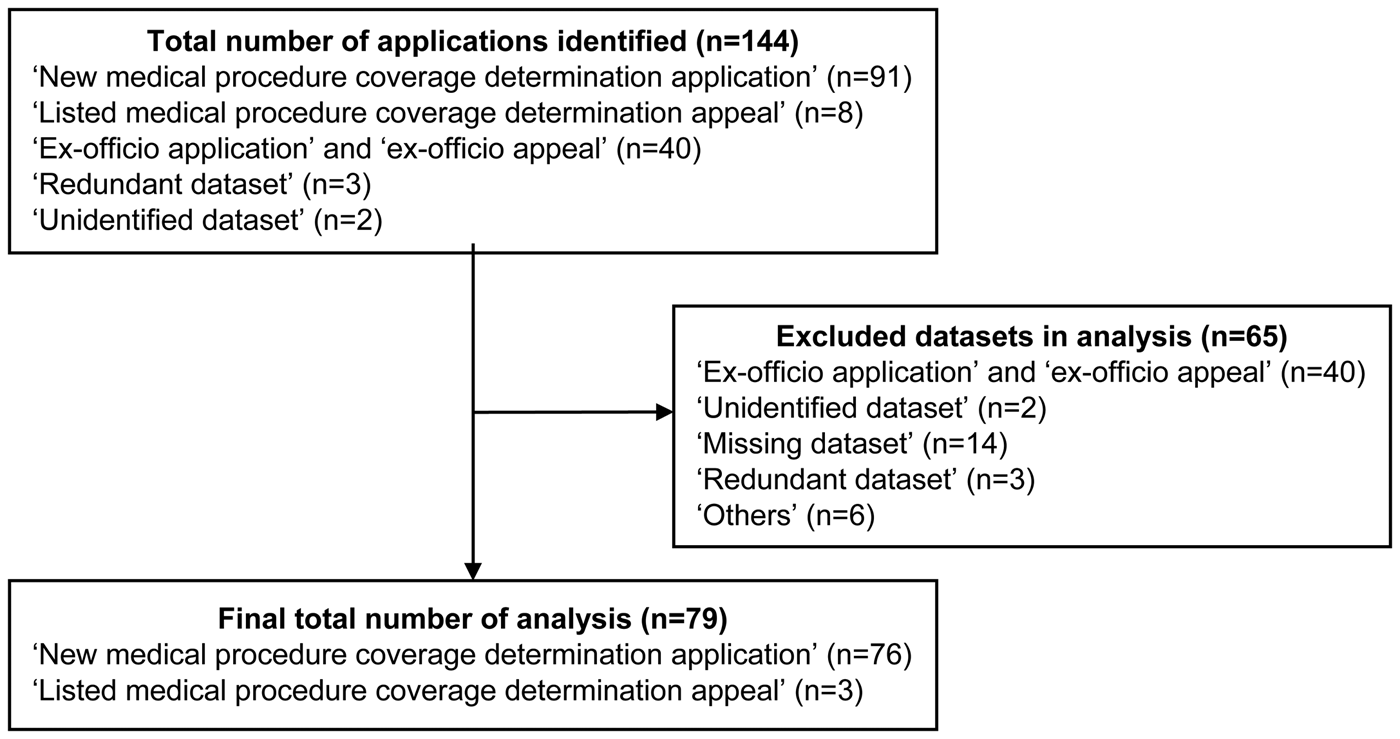
Among the total 144 datasets originally collected, 91 cases of “new medical procedure coverage applications,” which was the process required for creating coverage, coding, and payment of new medical procedures by thoroughly reviewing the aforementioned four main elements from safety and effectiveness to comprehensive aspects; 8 cases of “listed medical procedure coverage appeals,” which was the process required for revising coverage, coding, and payment of listed medical procedures and addressed the demands for payment amount increase and conversion from noncoverage into coverage decision in most cases; 40 cases of “ex-officio applications” and “ex-officio appeals” in determination about coverage, coding, and payments of new or listed medical procedures contrary to usual cases of the applications or appeals made by nongovernmental stakeholders (e.g., clinicians and healthcare providers, etc.); 3 cases were removed in the eligible datasets as they were identical applications; and 2 cases were posted with unidentified datasets. Therefore, as of July 31, 2018, the HIRA posted a total of 141 MPEEC meeting results in the period from the 6th MPEEC meeting in May 2015 to the 5th MPEEC meeting in April 2018 on the Web site.
Of 144 datasets, a total of 79 cases were finally analyzed as detailed in Figure 1; 40 cases of “ex-officio applications” and “ex-officio appeals,” which were made by the MoHW with its own interest were excluded due to unidentified application dates which are essential for calculating the total lead-time; 2 datasets could not be identified with lack of the application category (e.g., new medical procedure coverage applications or listed medical procedure coverage appeals, etc.); 14 datasets had missing information (e.g., unidentified effective date of the official enforcement and unidentified application data); 3 cases with redundancy; and another 6 cases from before 2014.
MPEEC meeting result dataset analysis flowchart.

Variables Analyzed
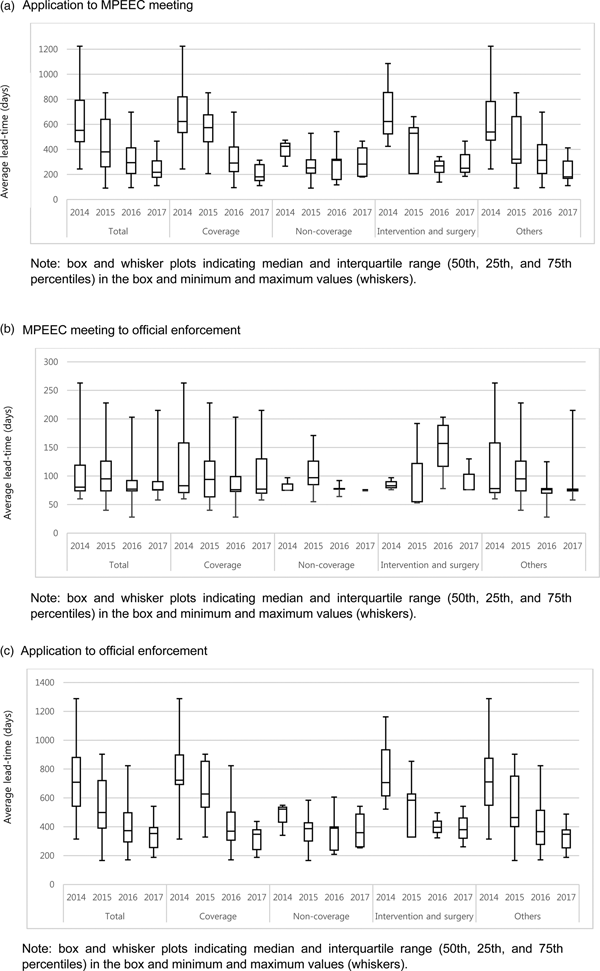
The following variables were extracted from the datasets: (a) “the coverage application category”; (b) “the coverage determination category”; (c) “the medical procedure category”; (d) “the application date”; (e) “the date of the MPEEC meeting”; and (f) “effective date of official announcement” (Supplementary Table 1). The items of medical procedure coverage determination applications identified on the HIRA healthcare provider business portal Web site, which discloses the MPEEC meeting result, was linked to the application date by identifying the official enforcement announcement for this study (13). Based on datasets collected, three types of lead-time were analyzed, as depicted graphically in Figure 2: (i) from application to MPEEC meeting; (ii) from MPEEC meeting to official enforcement; and (iii) from application to official enforcement. To determine if there is a difference in lead-time between coverage or noncoverage determination, a subgroup analysis based on the coverage determination status (coverage or noncoverage) was performed. The lead-time difference based on category of medical procedure (e.g., intervention and surgery versus others including in vitro diagnostics and imaging) was also analyzed.
Lead-time analysis result. (a) Application to MPEEC meeting. Note: box and whisker plots indicating median and interquartile range (50th, 25th, and 75th percentiles) in the box and minimum and maximum values (whiskers). (b) MPEEC meeting to official enforcement. Note: box and whisker plots indicating median and interquartile range (50th, 25th, and 75th percentiles) in the box and minimum and maximum values (whiskers). (c) Application to official enforcement. Note: box and whisker plots indicating median and interquartile range (50th, 25th, and 75th percentiles) in the box and minimum and maximum values (whiskers).

In addition, the lead-time differences between a “new medical procedure coverage application” and a “listed medical procedure coverage appeal” were examined. However, due to the paucity in the number of “listed medical procedure coverage appeals” (three cases over the analysis timeframe), this subgroup analysis was not feasible. To analyze the lead-time difference based on the year of application, a Student t-test was conducted to see if there was a significant difference from the previous year. As the size of sub-groups were small (n < 30), we performed normality testing using the Shapiro-Wilk test. If the subgroup was not normally distributed, then the Wilcoxon rank-sum test was used. All analyses were performed using SAS 9.4 (SAS Institute Inc., Cary, NC).
Results
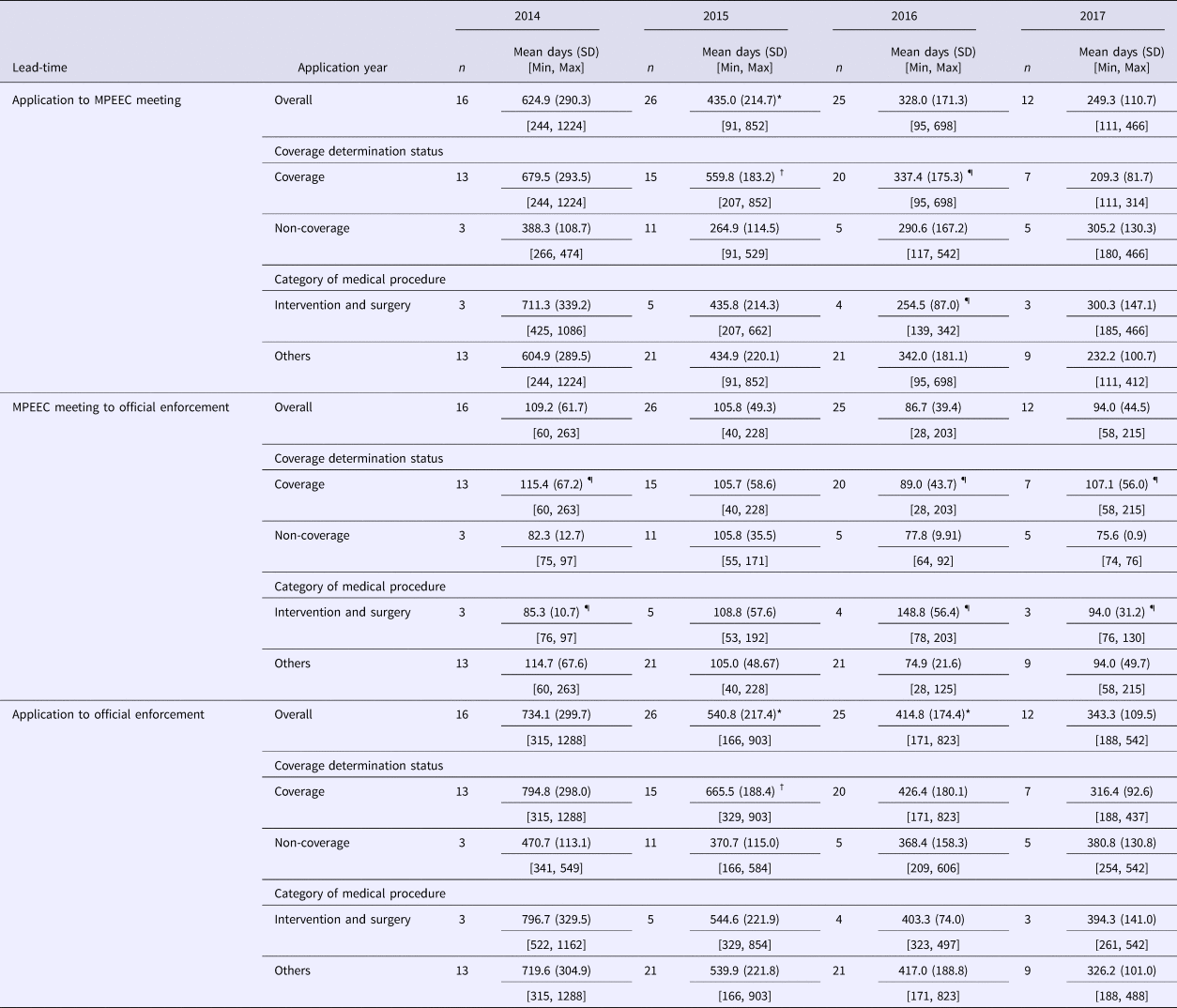
The overall lead-time analysis results are summarized in Table 2. The years described in the analyses were based on the year applications or appeals were made.
Lead-Time Analysis Results

Note. Student t-test result compared with the previous year: *p value < .05. For subgroup analysis with Shapiro-Wilk test (normality test) result within same year: ¶p value < .05. For subgroup analysis with Wilcoxon rank-sum test (for non-parametric distribution) or Student t-test (for parametric distribution) result within same year: †p value < .0001.
Lead-Time from Application to MPEEC Meeting
The average lead-time from the medical procedure coverage application to MPEEC meeting in 2015 (435.0 ± 214.7 days) was significantly shorter than that of 2014 (624.9 ± 290.3 days) (p < .05). There were no significant differences when lead-times were compared for 2016 and 2017, respectively. A subgroup analysis was performed based on the meeting result of the coverage determination status (coverage or noncoverage). In 2015, the average lead-time of a positive coverage determination result was significantly longer than noncoverage determination result (559.8 ± 183.2 days versus 264.9 ± 114.5 days) (p < .0001). The lead-time differences between coverage and noncoverage determination results were not significantly different in any of the other years except 2015. In addition, a further subgroup analysis based on the category of medical procedure (e.g., intervention and surgery versus others including in vitro diagnostics and imaging) did not show any significant difference in each year (see Table 2 and Figure 2a).
Lead-Time from MPEEC Meeting to Official Enforcement
The average lead-time from MPEEC meeting to official enforcement announcement did not show any significant differences in each of the years analyzed. The subgroup analysis for coverage determination status and the category of medical procedures also did not show any significant differences (see Table 2 and Figure 2b).
Lead-Time from Application to Official Enforcement
The average lead-time from application to official enforcement in 2015 was significantly shorter than that of 2014 (540.8 ± 217.4 versus 734.1 ± 299.7 days) (p < .05). In addition, the average lead-time in 2016 was significantly shorter than that of 2015 (414.8 ± 174.4 days versus 540.8 ± 217.4 days) (p < .05). There was also a shorter average lead-time from application to official enforcement for 2017 compared with 2016, but this difference was not statistically significant (343.3 ± 109.5 days versus 414.8 ± 174.4 days). The subgroup analysis found the average lead-time for coverage determination result was significantly longer than noncoverage determination (665.5 ± 188.4 days versus 370.7 ± 115.0 days) in 2015 (p < .0001). The other years did not show any significant difference in average lead-time according to coverage determination status. For the subgroup analysis based on the category of medical procedure, there was no significant difference in average lead-times from application to official enforcement when each year was compared.
Discussion
This analysis highlights that, while there is a trend showing a reduction in lead-time for most coverage determination decisions over the past 4 years, overall lead-times remain long, delaying access to new medical technologies. Indeed, our analysis showed that, from 2014 to 2017, 90 percent (n = 71) of all new coverage determinations analyzed took on average >250 days with almost 20 percent (n = 15) taking more than 2 years (>750 days), which remains substantially higher than the HIRA mandated 100 days. In addition, when we examine the entire patient access process for new medical technologies in South Korea, as outlined previously in Table 1, the real-time taken from regulatory approval of a new medical technology to the official enforcement announcement by the MoHW is substantially longer than the lead-times obtained from our analyses.
For example, when the MFDS's official regulatory lead-time by medical device classification (class 4 devices: 80 days, class 3 devices: 65 days, class 2 devices: 30 days, and class 1 devices: 1 days) (14) is added to the mandated 280 days of the nHTA review process by NECA and the additional 100 days of coverage determination lead-time for new medical technologies is considered, the process of market access for new medical technologies in South Korea appears untenable. In comparison to other countries and regions, these lead-time delays to market access are lengthy.
In a review on variations in market access processes in the United States and Europe, an examination in time to market access for high risk medical technologies ranged from 15.3 months in the United States to 26.3 months in France and 30.8 months in Italy (Reference Basu and Hassenplug15). Considering that those lead-times are inclusive of regulatory and reimbursement approval processes, the time to market access experienced in the United States and Europe are less than what we have shown in our analysis in South Korea. Upon closer examination, the interaction of multiple factors drives complexity and uncertainty in the coverage determination process in South Korea.
In particular, medical procedure coverage determinations that consider several elements such as economic benefit, budget impact, and clinical benefit, which ultimately determine the payment amounts of the medical service and items (e.g., physician fees and hospital fees), are considered laborious and may result in delayed decisions. Despite these factors, it is evident that the medical procedure coverage determination process is the main bottleneck in the current patient access pathway. Various stakeholders have requested process improvement, but there has been little meaningful lead-time reduction in the past several years (2;Reference Lee3).
Delayed patient access weakens the reward for innovation and provides a greater benefit to fast followers or imitators. The importance of accelerated patient access is even greater in medical devices compared with pharmaceutical products, as medical devices are characterized by shorter product life-cycles (e.g., 18–24 months) and their protection against intellectual property is relatively weak (Reference Lee3). Fast-followers are more likely to benefit from the delayed patient access pathways, which were endured and solved by innovation creators because manufacturers that follow innovators are not required to undergo both the nHTA and new medical procedure coverage application processes (Reference Lee16).
In contrast, numerous measures for accelerated coverage determinations of pharmaceutical products were recently announced by the MoHW in South Korea. While the MoHW also announced efforts to accelerate the medical procedure coverage determination process, a lack of concrete solutions was offered, which resulted in a failure to achieve actual expediated performance (17–19). Patient access for pharmaceutical products in particular, has attracted more public attention, especially for drugs used to treat cancer and rare and intractable diseases. Furthermore, medical specialty societies, academics, and patient advocacy groups have been active in the past, advocating for access to pharmaceutical therapies.
Conversely, there is a lack of focused discussion on delayed patient access of nondrug medical technologies and medical procedure coverage determinations (20). In the case of medical procedure coverage determinations, interest is diluted by the large number of medical specialties. The accelerated coverage determination of new medical technologies under the NHI system is critical to the commercialization of the technologies for patient care. While many medical services and items are not funded (noncoverage determination) under the NHI system and the patient's financial burden and co-payment is high (e.g., the overall NHI coverage rates are 63.4 percent in 2015), the MoHW is strengthening its benefit enhancement program to increase this low coverage rate to include medical technologies (Reference Lee, Holbrook and Choi21).
Healthcare providers are usually very reluctant to use new medical technologies until the final coverage determination is made, regardless of the coverage determination status (e.g., coverage or noncoverage). While coverage status, co-payment rates, restrictive coverage indications, and accessibility of medical institutions or healthcare providers are all important factors affecting overall patient access, the coverage determination and its official enforcement announcement made by the MoHW is the most critical factor to patient access in South Korea. As demonstrated by the lead-time analysis of medical procedure coverage determinations, we observed that the actual average lead-times for medical procedure coverage determinations are three to eight times longer than the official lead-time of 100 days, currently mandated by the MoHW. In addition, our analysis failed to show any examples of medical procedure coverage determinations made within 100 days. In essence, the medical procedure coverage determination process requires more diverse stakeholder engagement (e.g., health authorities, medical specialty societies, patient advocacy groups, medical device industry, academia, etc.) and should be streamlined.
Limitations
The information on the time taken to complete regulatory applications and nHTA approvals are not publicly available; therefore, a comprehensive analysis of lead-time from regulatory application of a medical technology to patient access could not be performed. While the datasets on the medical procedure coverage determination applications with limited information can be searched since the year of 2000, the detailed information about the MPEEC meeting results required for the lead-time analysis could not be obtained because only detailed information after 2014 are available. Expectedly, any cases of medical procedure coverage determination applications which had not yet been completed could not be included in this analysis. Lastly, the current information released by the HIRA related to medical procedure coverage determinations is not exhaustive and there is opportunity for the HIRA to enhance information transparency to stakeholders.
Conclusion
In conclusion, timely patient access to new medical technologies that have been deemed safe, effective, and cost-effective compared with standard of care has shown to lead to improvements in patient care and health outcomes and drive continued innovation (Reference Lee16). Recently, the Korean government has introduced various measures to reduce the lead-time for regulatory approval, nHTA, and coverage determination decisions with the aim of improving patient access to new medical technologies. While there has been progress in reducing the lead-time between regulatory and nHTA approval, the coverage determination process continues to be lengthy.
In this analysis of lead-times for the medical procedure coverage determination process of new medical technologies in South Korea, we observed inconsistencies and significant differences of lead-time reduction, despite the general trend of an overall reduction in lead-time. A few measures are recommended to enhance the patient access pathway in medical procedure coverage determinations. Radically, the extended “One-Stop Service” program, which also includes parallel review of coverage determinations, should be considered. This program has significant potential to improve the current problems in the inefficient patient access pathways of new medical technologies in South Korea.
Author ORCIDs
Sang-Soo Lee, 0000-0002-3619-6303
Supplementary material
The supplementary material for this article can be found at https://doi.org/10.1017/S0266462319000357.
Conflicts of interest
The authors declare that there are no conflicts of interest.