As Calero, Choi, and Waisgrais (Reference Calero, Choi and Waisgrais2010) pointed out educational failure is one of the major concerns of the Spanish educational system. These authors defined educational failure as the rate of individuals who do not succeed in finishing the period of compulsory education and who, therefore, do not acquire the basic competences required by the labor market.
In the year 2000, the Organization for Economic Co-operation and Development (OECD) initiated a study that aims to evaluate education systems worldwide by testing the skills and knowledge of 15-year-old students. This study is called the Programme for International Student Assessment (PISA). It is published every three years and is useful for assessing the extent to which students can apply their knowledge to real-life situations at the end of compulsory education. The academic achievement of the Spanish students is below the average of the 34 OECD countries according to the PISA study of 2012. In the year 2009, 25.9% of Spanish children did not obtain the compulsory education certificate (Ministerio de Educación, Gobierno de España). Likewise, the recent study by Fernández-Macías, Antón, Braña, and Muñoz-De Bustillo (2013) showed that the rate of early school leaving in Spain stands at 31.9%, the third highest of the Europe Union countries. This rate might be due to the massive wave of immigration in Spain, because teenagers of immigrant origin have been shown to be considerably more likely to leave school earlier. On the other hand, it was suggested that other factors such as the weaknesses of the vocational system or parent’s educational attainment and socio-economic position were also related to the risk of early school leaving. According to these authors, the concept of early school leaving entails leaving the formal school system before completing the period of upper secondary education, and includes the concept of educational failure. In this regard, low levels of academic achievement probably precede educational failure and early school leaving.
The literature describes a wide variety of factors that are directly or indirectly related to academic achievement or which predict its level. Intelligence, personality and learning or developmental disorders more directly explain educational achievement, but other factors such as gender, parental involvement and educational level, the quality of the teacher-child relationship, the presence of psychopathological symptoms or physical condition are also important (Chamorro-Premuzic & Furnham, Reference Chamorro-Premuzic and Furnham2005; Karbach, Gottschling, Spengler, Hegewald, & Spinath, Reference Karbach, Gottschling, Spengler, Hegewald and Spinath2013; Ly, Zhou, Chu, & Chen, Reference Ly, Zhou, Chu and Chen2012; Pérez-Sánchez, Betancort-Montesinos, & Cabrera-Rodríguez, Reference Pérez-Sánchez, Betancort-Montesinos and Cabrera-Rodríguez2013). Considering that early adolescence is a time of important transitions at the physical and psychological level, and that in this period children have to adapt to many changes in academic routines and be more autonomous in managing their work and social life, it is hardly surprising that some of them experience stress, present emotional and social functioning problems and have trouble maintaining academic standards (Barber & Olsen, Reference Barber and Olsen2004).
Specifically, low academic achievement has been shown to be associated with both depression and anxiety (Aronen, Vuontela, Steenari, Salmi, & Carlson, Reference Aronen, Vuontela, Steenari, Salmi and Carlson2005; Lundy, Silva, Kaemingk, Goodwin, & Quan, Reference Lundy, Silva, Kaemingk, Goodwin and Quan2010; Marcotte, Lévesque, & Fortin, Reference Marcotte, Lévesque and Fortin2006). In this regard, the results of Quiroga, Janosz, Lyons, and Morin (Reference Quiroga, Janosz, Lyons and Morin2012) indicated that depression was a vulnerability factor of low academic attainment that aggravated the risk associated with grade retention although Fergusson and Woodward (Reference Fergusson and Woodward2002) suggested that the effect of depression was limited. Authors studying the relation of anxiety symptoms and academic achievement showed that anxiety was negatively correlated with course grades and interferes with working memory (Christopher & MacDonald, Reference Christopher and MacDonald2005; Keogh, Bond, French, Richards, & Davis, Reference Keogh, Bond, French, Richards and Davis2004). These associations between anxiety and depression symptoms and low academic achievement can be explained by affective, social and cognitive manifestations of the emotional disorders which can result in an inability to concentrate, intrusive thoughts or a disruption of the working memory processes (Christopher & MacDonald, Reference Christopher and MacDonald2005; Ng & Lee, Reference Ng and Lee2010; Visu-Petra, Cheie, Benga, & Packiam-Alloway, Reference Visu-Petra, Cheie, Benga and Packiam-Alloway2011).
In addition, most research on adolescents’ academic achievement now studies behavioural problems and has found that Attention Deficit/Hyperactivity Disorder (ADHD) to be consistently associated with lower academic achievement. Several authors have found that ADHD involves executive functions' problems, attention disturbances, and behavioural problems which have a negative impact on children’s academic outcomes. (Langberg, Dvorsky, & Evans, Reference Langberg, Dvorsky and Evans2013; Scholtens, Rydell, & Yang-Wallentin, Reference Scholtens, Rydell and Yang-Wallentin2013).
In this context, the aim of the present study was to observe whether previous emotional symptoms (depression and anxiety) influence academic achievement in early adolescence. The possible influence of ADHD and socio-demographic factors was also examined. On the basis of the findings of other studies, we hypothesised that academic achievement may be affected by ADHD manifestations, socio-demographic factors, and also anxiety and depression symptoms.
Material and Methods
Participants
A total of 2,023 children in grades four (9–10 years old), five (10–11 years old), and six (11–12 years old) of primary school were invited to participate in a three-phase epidemiological study of anxiety and depression disorders. They came from 13 randomly chosen primary schools (7 state schools and 6 state-subsidized private schools) in Reus (Spanish town of 100,000 inhabitants).
The baseline sample was a group of 1,514 children (720 boys) (mean-age = 10.23; SD = 1.23). A total of 39.5% of the children belonged to low socio-economic status (SES) families, 42.5% to medium SES families and 18% to high SES families. Most of the sample (87.5%) was born in Spain, and 85.9% belonged to a family group consisting of both parents and their children. After this first time (T1) sample had been screened, 562 students (254 boys) (mean-age = 11.25; SD = 1.04) were selected to participate in the second time (T2) either as subjects at risk of anxiety or depression disorders (n = 405; 72.1%) or as members of a control group without risk (n = 157; 27.9%). Two years later all 562 subjects were invited to participate in the third time (T3) follow-up. Of these, 242 subjects (95 boys) (mean-age = 13.52; SD = .94) participated. Parents were asked to respond to a questionnaire about their children’s academic achievement. A total of 170 questionnaires were returned and are reported in the results section.
No differences were found between the LOI-CV, SCARED and CDI scores of subjects who participated in the third phase and subjects who dropped out of the study. Neither were there any differences between these two groups in terms of socio-demographic variables. However, there were differences related to the SES factor: low SES participants were associated with higher dropout rates than medium or high SES participants (χ2 2.561 = 13.557; p = .001).
Measures
Screen for Childhood Anxiety and Related Emotional Disorders (SCARED)
(Birmaher et al., Reference Birmaher, Khetarpal, Brent, Cully, Balach, Kaufman and Neer1997) is a 41-item self-report questionnaire that assesses anxiety disorder symptoms in children and adolescents aged 8 to 18. Subjects are asked the frequency of each symptom on a 3-point Likert-type scale: 0 (almost never), 1 (sometimes), 2 (often). The reliability of the Spanish version is Cronbach’s alpha .86, and consists of four factors: somatic/panic, social phobia, generalized anxiety and separation anxiety (Vigil-Colet et al., Reference Vigil-Colet, Canals, Cosi, Lorenzo-Seva, Ferrando, Hernández-Martínez and Domènech2009). A score of 25 was considered to be the cut-off point for risk of anxiety (Birmaher et al., Reference Birmaher, Khetarpal, Brent, Cully, Balach, Kaufman and Neer1997; Canals, Hernández-Martínez, Cosi, & Domènech, Reference Canals, Hernández-Martínez, Cosi and Domènech2012). SCARED was administered in all three phases.
Children’s Depression Inventory (CDI)
(Kovacs, Reference Kovacs1992) is a 27-item self-report inventory for assessing depression in subjects aged 7 to 15. Children selected the sentence that best described them in the two previous weeks. The reliability of this version has been reported to be good (α = .81 –.85) (Figueras, Amador-Campos, Gómez-Benito, & Del Barrio, Reference Figueras, Amador-Campos, Gómez-Benito and Del Barrio2010) and was shown to be so in the present study (α = .83). A score of 17 was considered to be the cut-off point for risk of depression (Canals, Martí-Henneberg, Fernández-Ballart, & Domènech, Reference Canals, Martí-Henneberg, Ferdández-Ballart and Domènech1995). CDI was administered in T1 and T2.
Leyton Obsessional Inventory-Child Version (LOI-CV)
(Berg, Whitaker, Davies, Flament, & Rapoport, Reference Berg, Whitaker, Davies, Flament and Rapoport1988) is a 20-item self-report questionnaire about the presence (“yes”) or absence (“no”) of a number of obsessive preoccupations and behaviours. For each positive response, a rating of interference in personal functioning must be indicated (range 0–3, no interference-high interference). The reliability found in the Spanish version was excellent (α = .90) and its validity as a screening test was supported (Canals, Hernández-Martínez, Cosi, Lázaro, & Toro, Reference Canals, Hernández-Martínez, Cosi and Domènech2012). A score of 21 was considered to be the cut-off point for risk of OCD (Canals, Hernández-Martínez, Cosi, Lázaro, et al., Reference Canals, Hernández-Martínez, Cosi and Domènech2012). LOI-CV was administered in all phases.
Youth’s Inventory-4 (YI-4)
(Gadow & Sprafkin, Reference Gadow and Sprafkin1999) is a self-report rating scale that evaluates symptoms of emotional and behavior disorders in adolescents. It contains 120 items that correspond to the symptoms of 18 categories of DSM-IV disorders, and it is a valid tool for assessing symptoms in clinically referred youths (Gadow et al., Reference Gadow, Sprafkin, Carlson, Schneider, Nolan, Mattison and Rundberg-Rivera2002). In this study, we examined the following symptoms: depression, conduct disorder, eating disorder, tics, schizoid personality, schizophrenia, substance abuse and ADHD. YI-4 was administered in T3 and demonstrated high internal consistency (α = .95).
Mini-International Neuropsychiatric Interview for Kids (M.I.N.I.-Kid)
(Sheehan et al., Reference Sheehan, Lecrubier, Sheehan, Amorim, Janavs, Weiller and Dunbar1998) is a structured diagnostic interview for children aged 6 to 17 based on DSM-IV and ICD-10 criteria. It is a short instrument assessing 23 axis I disorders. Interrater and test-retest Kappas were substantial to almost perfect (.64–1) for all individual M.I.N.I.-Kid disorders except dysthymia. Recently, the M.I.N.I.-Kid has proven its reliability and validity in a sample of outpatients and controls (Sheehan et al., Reference Sheehan, Sheehan, Shytle, Janavs, Bannon, Rogers and Wilkinson2010). For this study, we used the ADHD diagnoses and took into account all the ADHD subtypes defined in the DSM-IV-TR (ADHD-Inattentive [ADHD-I], ADHD-Hyperactive/Impulsive [ADHD-HI], and ADHD-Combined [ADHD-C]). M.I.N.I.-Kid was administered in T2.
To assess the socio-demographic characteristics of the sample, a socio-demographic questionnaire designed by the authors of this study was used. Children answered questions about age, gender, place and date of birth, family type and parents' occupation. Parents corroborated this information. The SES was established by the Hollingshead index (Hollingshead, Reference Hollingshead2011), which determines the social status of individuals taking into account their occupation and their level of education. For this study, family SES was determined by combining data obtained from the father and the mother. The scores range from 0 to 66, and we divided this range into three categories (low, medium and high). We considered scores lower than 22 to be low, scores between 23 and 44 to be medium, and scores over 44 to be high. This questionnaire was administered in T1.
Academic achievement
Was assessed by asking parents about the academic achievement of their children in language, social sciences, mathematics, and natural sciences. There were four items with four response possibilities: 1 (fail; 0–3), 2 (below average; 4), 3 (average; 5–6) and 4 (above average; 7–10). Apart from the achievement in each subject, we have defined the overall academic achievement variable using the sum of the scores in language, social sciences, mathematics, and natural sciences.
Procedure
Before we began the study, the project was approved by the Universitat Rovira i Virgili ethics committee, and was given permission by the Departament d’Ensenyament de la Generalitat de Catalunya. Then we selected a representative sample of subjects. Cluster sampling was conducted by randomly selecting a set of 13 schools (7 state schools and 6 state-subsidized private schools) from a total of 26 schools (17 state and 9 state-subsidized private schools) and from all 5 districts of Reus. Then, the school boards were contacted, all of whom agreed to participate. Subsequently, a letter was sent to all parents informing them of the study and asking for their written informed consent.
The first phase took place during the 2006/2007 academic year using a representative sample of school-age subjects in primary grades four (9–10 years old), five (10–11 years old), and six (11–12 years old). The selected participants were followed for two consecutive years (T1 and T2) and, after a one-year break, for another year (T3). In the first phase participants answered screening tests for anxiety (SCARED), obsessive-compulsive symptoms (LOI-CV) and depression (CDI). Socio-demographic data was also collected. Over the following academic year, a subsample was selected of subjects who, according to their cut-off scores in the screening tests (SCARED, CDI and/or LOI-CV), were at risk of mood and anxiety disorders. Additionally, controls with the same age and gender characteristics, but without risk scores on any test, were selected. In T2, SCARED, LOI-CV and CDI were re-administered to participants. Psychological disorders were assessed using the M.I.N.I.-Kid. Finally, in the third time, all the subjects from the second time were re-invited to participate and a retest with SCARED and LOI-CV was conducted. The YI-4 was also administered in order to evaluate psychopathology. The parent-reported academic performance defined our variable of academic achievement. The research participants completed the questionnaires in small groups of three or four and the researchers were present to instruct the children on how to answer the surveys or resolve doubts.
Statistical analysis
Multiple linear regression models were performed to identify predictors and variables related to overall academic achievement, and to achievement in language, social sciences, mathematics, and natural sciences using SPSS 20.0. Three regression models were performed for each dependent variable. The variables selected and entered into each model using the ENTER method were the following:
In step 1 the variables collected at Time 1 (T1) were entered: SCARED factor scores, LOI-CV total scores, CDI total scores, and socio-demographic variables (birthplace, family type, age and gender). The model was adjusted for SES.
Step 2, to the variables in step 1 we added: the persistence-at-one-year variables. These variables were created using the first phase risk scores on the SCARED or CDI or LOI-CV and also the risk scores of the second phase. In this model the socio-demographic variables were also entered. The model was adjusted for SES and for ADHD diagnoses.
To observe possible associations between T3 variables and academic achievement, in step 3 a cross-sectional model was performed and the following scores were entered: SCARED factor scores, LOI-CV total scores, and YI-4 scores. Socio-demographic variables were also added. The model was adjusted for SES.
Collinearity between all the selected variables was assessed by computing Pearson correlations and analyses showed that the SCARED total score was collinear with the SCARED factor scores. For this reason, the SCARED factor scores were selected instead of the total score. No collinearity was found between depressive and anxiety symptoms, or between depressive and ADHD symptoms.
Results
Descriptive data of academic achievement showed a mean of 13.05 (SD = 2.79) for overall academic achievement. For the other academic subjects data showed: a language mean of 3.23 (SD = .81); a social sciences mean of 3.26 (SD = .88); a mathematics mean of 3.19 (SD = .86), and a natural sciences mean of 3.36 (SD = .79). On the other hand, the results showed no statistically significant differences in academic performance between subjects from state schools and subjects from state-subsidized private schools.
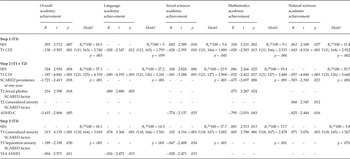
The multiple linear regression models were performed for overall academic achievement, and for academic achievement in each school subject (see Table 1).
Predictors and variables related to overall academic achievement and academic achievement for each school subject

Note: p < .05.
Selected variables to enter into step 1: T1 SCARED factor scores→ somatic/panic, social phobia, generalized anxiety, separation anxiety; T1 LOI-CV (total score); T1 CDI (total score); family type (0: single parent; 1: nuclear); birthplace (0: foreign; 1: native); age (years); and gender (1: boy; 2: girl). The model was adjusted for SES.
Selected variables to enter into step 2: T1 SCARED factor scores→ somatic/panic, social phobia, generalized anxiety, separation anxiety; T1 LOI-CV (total score); T1 CDI (total score); T2 SCARED factor scores→ somatic/panic, social phobia, generalized anxiety, separation anxiety; persistence-at-one-year variables→ SCARED (1: persistence; 0: no persistence), CDI (1: persistence; 0: no persistence), and LOI-CV (1: persistence; 0: no persistence); family type (0: single parent; 1: nuclear); birthplace (0: foreign; 1: native); age (years); and gender (1: boy; 2: girl). The model was adjusted for SES and for ADHD diagnoses (ADHD-I, ADHD-HI, ADHD-C).
Selected variables to enter into step 3: T3 SCARED factor scores→ somatic/panic, social phobia, generalized anxiety, separation anxiety; T3 LOI-CV (total score); YI-4 categories (total scores); family type (0: single parent; 1: nuclear); birthplace (0: foreign; 1: native); age (years); and gender (1: boy; 2: girl). The model was adjusted for SES.
The results show that in step 1 (T1) the best predictors were SES and the CDI total scores for overall academic achievement, mathematics, and natural and social sciences. Lower depression symptoms at T1 predicted higher academic achievement at T3, while higher SES levels predicted higher academic achievement at T3. The models explained 10.5% of the overall academic achievement (F (11, 163) = 2.740, p = .003), and 5.6%, 9.1%, and 11.4% of the academic achievement in social sciences (F(11, 166) = 1.889, p = .045), mathematics (F(11, 166) = 2.515, p = .006), and natural sciences (F(11, 164) = 2.922, p = .002), respectively. In step 2 (T1 + T2) the predictors that were significant for both overall academic achievement and mathematics achievement were SES, T1 CDI, SCARED persistence, T2 social phobia, and ADHD-C. Moreover, results showed that T1 CDI was a consistent and significant predictor of all academic achievement. In spite of the negative influence of the persistence of anxiety on academic achievement, data showed that higher social phobia symptoms at T2 predicted higher overall academic achievement, and achievement in language and mathematics. Also, higher generalized anxiety symptoms at T2 were related to greater achievement in natural sciences. The models explained 37.1% of overall academic achievement (F(21, 125) = 4.510, p < .001), and 27.2%, 23.9%, 19.4%, and 30.7% of the academic achievement in language (F(21, 126) = 3.241, p < .001), social sciences (F(21, 127) = 2.904, p < .001), mathematics (F(21, 127) = 2.460, p = .001), and natural sciences (F(21, 126) = 3.660, p < .001), respectively.
Throughout step 3, results showed associations academic achievements and T3 generalized anxiety, T3 separation anxiety, and ADHD symptomatology. Higher levels of generalized anxiety symptoms at T3 were related to higher academic achievement at T3, and lower separation anxiety symptoms at T3 were related to higher academic achievement at T3. In this regard, results showed that lower ADHD symptoms at T3 were associated with higher academic achievement. Results also showed a significant influence of SES on mathematics achievement. The statistically significant models explained 18.1% of overall academic achievement (F(18, 164) = 3.010, p < .001), and 14.3%, 17.7%, and 13.7% of the academic achievement in language (F(18, 166) = 2.541, p = .001), social sciences (F(18, 167) = 3.002, p < .001), and mathematics (F(18, 167) = 2.478, p = .001), respectively.
Discussion
Given that the rates of educational failure in Spain are high, the purpose of this three-phase prospective study was to assess whether previous emotional disturbances apart from ADHD and socio-demographic variables could influence academic achievement in a developmental transition stage such as the beginning of adolescence. In this regard, it is known that problems of academic achievement are one of the most robust predictors of school dropout (Newcomb et al., Reference Newcomb, Abbott, Catalano, Hawkins, Battin-Pearson and Hill2002) and are therefore also predictors of educational failure.
Overall, results showed that emotional variables play an important role in academic achievement. In fact, these variables presented a stronger relationship with academic achievement than socio-demographic ones, because no conclusive results were found for gender, age, family type and birthplace. Results were only statistically significant for SES and showed that it was a positive predictor of overall academic achievement and achievement in the different school subjects. These findings support a great deal of other research that has found evidence of a positive relationship between a high family SES and high academic achievement (Srin, Reference Srin2005). This may be because the parents of children from high SES environments probably have high levels of education and higher occupational prestige. Therefore, they may value education more, or they might be more demanding with their children, better equipped to help them with school work, more at ease in the school setting or more encouraging. Moreover, as in the present study, Caro, McDonald, and Willms (Reference Caro, McDonald and Willms2009) found that there is a difference in mathematics achievement between students of higher and lower SES, and that this difference is more significant in early adolescence. In agreement with Caro et al. (Reference Caro, McDonald and Willms2009), we suggest that it is likely that educational disparities associated with SES tend to increase as students advance in school. In this regard, Hackman, Farah, and Meaney (Reference Hackman, Farah and Meaney2010) suggested that programs and policies should attempt to alleviate disparities in SES and improve the mental health and academic achievement of children. As in other studies of emotional variables from other countries (Fröjd et al., Reference Fröjd, Nissinen, Pelkonen, Marttunen, Koivisto and Kaltiala-Heino2008), the present results have shown that previous depressive symptomatology is a consistent and statistically significant predictor of poor academic results. It may be negatively correlated with academic achievement because the symptoms of apathy, trouble concentrating, anhedonia, irritability or sadness can lead to a reduction in the cognitive resources available, deficits in working memory, and a reduction in motivational mechanisms (Matthews, Coghill, & Rhodes, Reference Matthews, Coghill and Rhodes2008; Valiente, Swanson, & Eisenberg, Reference Valiente, Swanson and Eisenberg2012). Results have also shown that the persistence of anxiety throughout development has a negative influence on academic achievement. This type of symptom can be chronic and cause such important problems as absenteeism or poor academic achievement (Rapee, Schniering, & Hudson, Reference Rapee, Schniering and Hudson2009). For example, somatic anxiety symptoms can be quite severe and may lead to children missing more school or having trouble paying attention during class (Hughes, Lourea-Waddell, & Kendall, Reference Hughes, Lourea-Waddell and Kendall2008), thus affecting academic achievement. As found by Grills-Taquechel, Fletcher, Vaughn, Denton, and Taylor (Reference Grills-Taquechel, Fletcher, Vaughn, Denton and Taylor2013), results also show that separation anxiety present an inverse relation with academic achievement. We suggest that separation anxiety is an important factor because the third phase coincides with a transition for most of the participants (onset of adolescence), and it is possible that at this moment subjects assess their attachment with their parents. Early adolescents probably need to feel secure, and if they do not they may become vulnerable to developing anxiety disorders (Esbjorn, Bender, Reinholdt-Dunne, Munck, & Ollendick, Reference Esbjorn, Bender, Reinholdt-Dunne, Munck and Ollendick2012). Furthermore, although obsessive-compulsive symptomatology can also cause problems in the school context (Geller & March, Reference Geller and March2012) our results were not conclusive. This could be due to the fact that obsessive-compulsive and anxiety symptoms frequently co-occur (Langley, Lewin, Bergman, Lee, & Piacentini, Reference Langley, Lewin, Bergman, Lee and Piacentini2010). In contrast, it has been found that anxiety has not always proved to have a negative influence on academic achievement. Our results show that generalized anxiety and social phobia symptoms present a positive relation with academic achievement. Therefore, generalized anxiety may produce moderate levels of alertness and tension in students, thus leading to better achievement in tasks that require a lot of attention. These students may also be so concerned about their studies that they spend more time on them than on any other aspect of their lives. Generalized anxiety may also compensate for such other symptoms as conduct disorder manifestations. Social phobia symptomatology may produce high levels of motivation to avoid possible negative opinions from their classmates. In this vein, recent results have suggested that students with good working memories and higher levels of anxiety achieved more than other individuals (Owens, Stevenson, Hadwin, & Norgate, Reference Owens, Stevenson, Hadwin and Norgate2014). The results of Owens et al. (Reference Owens, Stevenson, Hadwin and Norgate2014) extend those of Eysenck and Derakshan (Reference Eysenck and Derakshan2011), who found that highly anxious individuals will be motivated to do their tasks well to avoid negative evaluations. Therefore, subjects with high levels of anxiety and a high working memory capacity have the resources to manage their motivation properly and to achieve more academically. There may be individual differences between those with and without the wherewithal to cope with intrusive thoughts of a negative reaction to failure, such as working memory capacity.
Our data support the hypothesis that the presence of ADHD is related to worse academic achievement, as has been shown in recent studies (Scholtens et al., Reference Scholtens, Rydell and Yang-Wallentin2013).
According to the present results, emotional and behavioral problems at school may need to be detected if low levels of academic achievement are to be prevented. Psychologists should also consider integrating complete mental health education and learning coping strategies in the curriculum (Mychailyszyn, Brodman, Read, & Kendall, Reference Mychailyszyn, Brodman, Read and Kendall2012). Subjects whose academic achievement is low, then, may need possible risk factors to be controlled and preventive intervention to be implemented if unwanted long-term outcomes are to be prevented. The prevention of anxiety and depression, and early intervention programs in schools (for example, cognitive behavioural therapy [CBT] programs) should be encouraged because they can lead to significant improvements in behaviour at school and home, self-control, social skills and self-esteem (Neil & Christensen, Reference Neil and Christensen2009; Yeo & Choi, Reference Yeo and Choi2011). Although Durlak, Weissberg, Dymnicki, Taylor, and Schellinger (Reference Durlak, Weissberg, Dymnicki, Taylor and Schellinger2011) suggested that programs that promote learning of social and emotional competences are associated with greater well-being and better academic achievement, other findings (Stallard et al., Reference Stallard, Taylor, Anderson, Daniels, Simpson, Phillips and Skryabina2012) indicate that classroom-based prevention programs for reducing symptoms of depression may not be effective. Therefore, future research on possible school intervention is needed.
The importance of our findings must be evaluated in the light of some limitations. Firstly, the follow-up sample was small. Despite the efforts we made to ensure the maximum participation possible in the third phase, the study suffered from reduced parental consent and few parents returned the completed questionnaires. Secondly, we had no information on the specific learning disorders or intelligence quotient (IQ) of the children. High or low IQ may have a direct effect on learning ability. Thus, a lower IQ or specific learning disabilities may have an emotional effect on individuals when they see that they cannot do what others can. We have only been able to adjust the analyses for ADHD. Thirdly, the socio-demographic data were only collected at baseline and these data may have changed over the three years. On the other hand, a weakness of our study is that the academic achievement was assessed using the information provided by parents, and it may have been better to use the ratings provided by teachers. We are aware that information from parents may have biases related to memory problems or related to the social desirability factor. In this regard, we encourage other researchers to aim for objective measures of academic performance using data from schools or government departments. Despite these limitations, the study extends our knowledge of the possible causes of the high rates of educational failure that exist in Spain.
In summary, the data show that symptoms of early depression and the persistence of anxiety were closely related to academic difficulties in early adolescence. On the other hand, moderate levels of generalized anxiety and social phobia may be related to responsibility and academic motivation. As has been shown in recent studies, ADHD symptoms interfere considerably in children’s academic life. However, with the exception of SES, no conclusions could be drawn about socio-demographic variables. Finally, we suggest that during the transition period to adolescence it is important to detect emotional problems, in addition to behavioral and learning problems for the prevention of academic difficulties. In the future, more longitudinal studies are needed.
This research was supported by a grant from the Fondo de Investigaciones Sanitarias (PI07/0839), Instituto de Salud Carlos III of the Spanish Ministerio de Sanidad y Consumo and by a doctoral grant from the Departamento de Universidades, Investigación y Sociedad de la Información of the Generalitat de Catalunya and the European Social Fund. The authors are grateful to all the schools and children that participated in our study.