The number of people affected by various kinds of natural disasters is estimated to be 200 million per year in China. Reference Chen, Zhou and Cao1 Both during and after public health disasters, children are vulnerable to injury Reference Acharya, Bhatta and Assannangkornchai2 and less likely to avoid the disaster compared with adults. Different public health disasters can cause different types of injuries. For instance, mud slides can cause fall injuries, and floods can cause several submersion injuries among children. Earthquake injuries result from falling objects and walls, which can trap children. The psychological effects of wars, disasters, terror, and other traumatic life events can almost be as deleterious and far-reaching as physical injury. Posttraumatic stress disorder (PTSD) is the most widely researched consequence of traumatic events and is a central focus of posttraumatic psychopathology. Reference Qi, Gevonden and Shalev3 According to the fifth edition of the Diagnostic and Statistical Manual of Mental Disorders (DSM-5), PTSD is characterized by 4 categories of symptoms, including marked intrusion, avoidance, negative alterations in cognition and mood, and marked alterations in arousal and reactivity symptoms. These symptoms last at least 1 month. 4 It has been widely reported that compared to adults, children have a higher risk of developing PTSD because they are more vulnerable to the negative psychological effects of trauma. Reference Breslau5 – Reference Bal7 A meta-analysis showed that individuals who suffered traumatic events in childhood were the most susceptible to PTSD. Reference Shemesh, Bartell and Newcorn8 Currently, about 10 million children in China suffer different degrees and different types of injury every year. Reference Zhang9 This creates new challenges in protecting children’s mental and physical health.
It is unclear how many children develop PTSD following an injury in China. The incidence rate of PTSD in children varies among different injury types, regions, and populations. Children who experienced animal-induced injuries, road traffic injuries (RTIs), earthquakes, debris flows, or tornados were reported to have PTSD rates of 5.3% to 57.5%. Reference Eli, Cheng and Liang10 – Reference Wang14 PTSD rates can vary solely from different survey times, within 1 population of children exposed to the same injury. For instance, in an earthquake, the child PTSD rate was reported to be 18.9% after 12 months and 11.9% after 18 months. Reference Shi, Zhou and Geng15 The difference in incidence of PTSD in children is mainly related to injury severity, demographic characteristics, geographic location, investigation time, and other factors related to traumatic events. PTSD is associated with numerous adverse developmental consequences for children and adolescents in cognitive, academic, social, emotional, and other functional domains. Reference Dorsey, McLaughlin and Kerns16 In addition, the treatment of children with PTSD brings economic pressure to the family and also places a burden on the whole society.
Considering the need to better understand injured child PTSD rates in China, and to assist them with recovery from PTSD more effectively, this study aims to identify the dangerous factors of PTSD in children exposed to injuries using a systematic meta-analysis of observational studies. Our study can provide essential information to better prepare and implement tailored treatments for injured children with PTSD and aims to reduce symptoms and aid children’s mental recovery.
MATERIALS AND METHODS
Search Strategy, Study Selection, and Quality Assessment
To identify relevant studies, the title and abstract fields of MEDLINE (via PubMed), Science Direct, Google Scholar, CNKI (China National Knowledge Infrastructure), Wanfang Data Resource System, and VIP (Veipu Database for Chinese Technical Periodicals) databases were searched for articles published on or before October 30, 2018. The strategy involved searching for the following key terms in any field within the whole text: “injury”/“injuries” AND “child”/“children” or “0–18 years old” AND “China”/“Chinese” AND “PTSD.” The retrieval languages were Chinese and English. We reviewed the title and abstract of each article to screen for potentially eligible studies.
The inclusion criteria were that (1) study subjects must be Chinese, (2) they must be less than 18 years old, (3) they must have been injured and developed PTSD, (4) there must be a distinct child PTSD questionnaire in the paper, (5) the time and location of the study must be clearly stated, (6) the study method must be explicit and standard, and (7) the total sample size and the number of injured children diagnosed with PTSD must be reported or deducible from the existing data.
Study subjects were excluded if (1) subjects were not Chinese, (2) they were over 18 years old or if their age was uncertain, (3) study region was outside mainland China (special administrative regions such as Hong Kong, Taiwan, and Macau are generally regarded as having different socioeconomic and political situations), (4) children had mental health problems before injury, (5) interventions to the treatment occurred for injured children with PTSD, (6) there were obvious flaws in study design (errors in statistical analyses, investigation time after disaster was unknown, or the information was incomplete), (7) the injury type was unknown, (8) the study was published multiple times or only a summary was published, (9) study subjects were disabled children or orphans, or (10) the study did not involve a PTSD diagnosis.
Data Extraction
The total sample size, document searching, screening, information excerpt selection, and quality assessment were independently conducted by 2 trained personnel. Any issues that arose during the process were solved by central discussion or consulting a third party. Currently, there is not yet a quality standard evaluation for compiling observational studies. The quality evaluation guidelines for disease prevalence studies, as proposed by Loney et al., Reference Loney, Chambers and Bennett17 were used to evaluate this study’s included literature. The quality score of the included literature ranged from 5 to 6 points, as assessed according to the Loney criteria. The aspects taken into consideration included effectiveness of study methods, rationality of explanation, and suitability of scope. The study’s database was established in Microsoft Excel 2007. The following demographic and clinical characteristics were extracted from included studies: (1) study characteristics (ie, author names, year of publication) and (2) participant characteristics (ie, age, gender, grade, registered residence, nationality, children PTSD rate, sample size, and injury type).
Statistical Analyses
Stata 15.0 (StataCorp, College Station, TX) was used for the pooled analysis, subgroup analysis, and publication bias diagnosis. Heterogeneity was tested using Q statistics and I 2. A P value for Q statistics of or greater than 0.05 and I 2 less than 50% reflect homogeneity across studies. Reference Higgins and Thompson18,Reference Higgins, Thompson and Deeks19 Begg’s test and Egger’s test were used to examine publication bias.
SPSS 18.0 (IBM Corp, Armonk, NY) was used for chi-square analysis of the incidence of children with PTSD. All tests were 2-tailed, and a P-value of < 0.05 considered statistically significant.
RESULTS
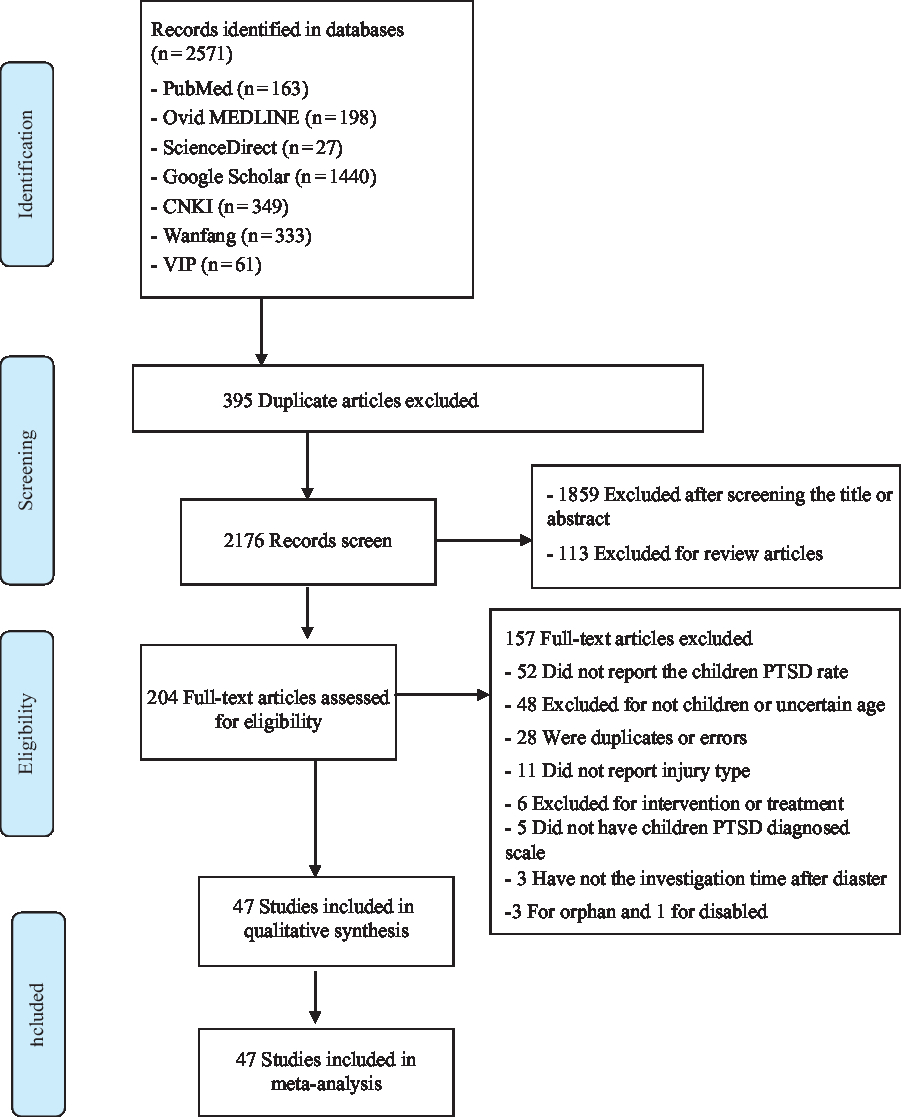
In total, 47 studies Reference Eli, Cheng and Liang10 , Reference Li, Zhang and Wang11 , Reference Xu, Yuan and Liu13 – Reference Shi, Zhou and Geng15 , Reference Cheng, Liang and Fu20 – Reference Zhu, Siti and Zhang61 met the inclusion criteria and were included in the quantitative meta-analyses (Figure 1).
The Flowchart According to PRISMA.

Study Characteristics
The total sample size was 65 298 for the 47 studies. Among the specific disaster categories, 37 studies reported earthquake, 1 reported tornado, 2 reported mudslide, 2 reported flood, 2 reported RTI, 1 reported animal-induced, 1 reported fire, and 1 reported explosion as the cause of injury (see Figure 1). Twenty-four studies reported incidences of PTSD in both boys and girls. Reference Eli, Cheng and Liang10 , Reference Xu, Yuan and Liu13 – Reference Shi, Zhou and Geng15 , Reference Jin, Deng and An22 , Reference Liu, Wang and Shi24 – Reference Tang, Zhao and Lu28 , Reference Zhao, Zhang and Pang37 , Reference Zhou, Zhang and Wei38 , Reference Fan, Liu and Zheng42 , Reference Huang, Zheng and Wang46 , Reference Jiang, Zhu and Zhang47 , Reference Jin49 , Reference Shi53 , Reference Tang, Zhao and Lu54 , Reference Yu57 – Reference Zhou59 , Reference Zhu, Siti and Zhang61 , Reference Yang, Ye and Li62 Five studies reported incidences of PTSD in primary school students, Reference Cheng, Liang and Fu20 , Reference Liu, Wang and Shi24 , Reference Dong, Zhao and Shi39 , Reference Du, Min and Zhu41 , Reference Zhao58 9 studies reported incidences of PTSD in junior middle school students, Reference Xu, Yuan and Liu13 , Reference Wang, Zhang and Armour29 , Reference Wang, Armour and Li30 , Reference Du, Situ and Zhu40 , Reference Jin48 , Reference Wei, Cao and Liao55 , Reference Yu57 , Reference Zhao58 , Reference Yang, Ye and Li62 5 studies reported incidences of PTSD in senior high school students, Reference Zhang, Ran and Li36 , Reference Wei, Cao and Liao55 , Reference Yu57 , Reference Zhou, Wu and Yuan60 , Reference Yang, Ye and Li62 3 studies reported both PTSD rates of urban and rural children, Reference Wang14 , Reference Fan, Liu and Zheng42 , Reference Yang, Ye and Li62 and 1 study reported only PTSD rates of rural children. Reference Tang, Zhao and Lu28 There were 3 studies where the subjects of the study were both Han Chinese and ethnic minorities, Reference Wang14 , Reference Yu57 , Reference Yang, Ye and Li62 3 studies reported the incidence of PTSD in Han Chinese only, Reference Ma, Liu and Hu25 , Reference Tang, Zhao and Lu28 , Reference Zhang, Ran and Li36 and 1 study reported on ethnic minorities only. Reference Liu, Fu and Jing23
Quantitative Data Analysis With All Included Studies
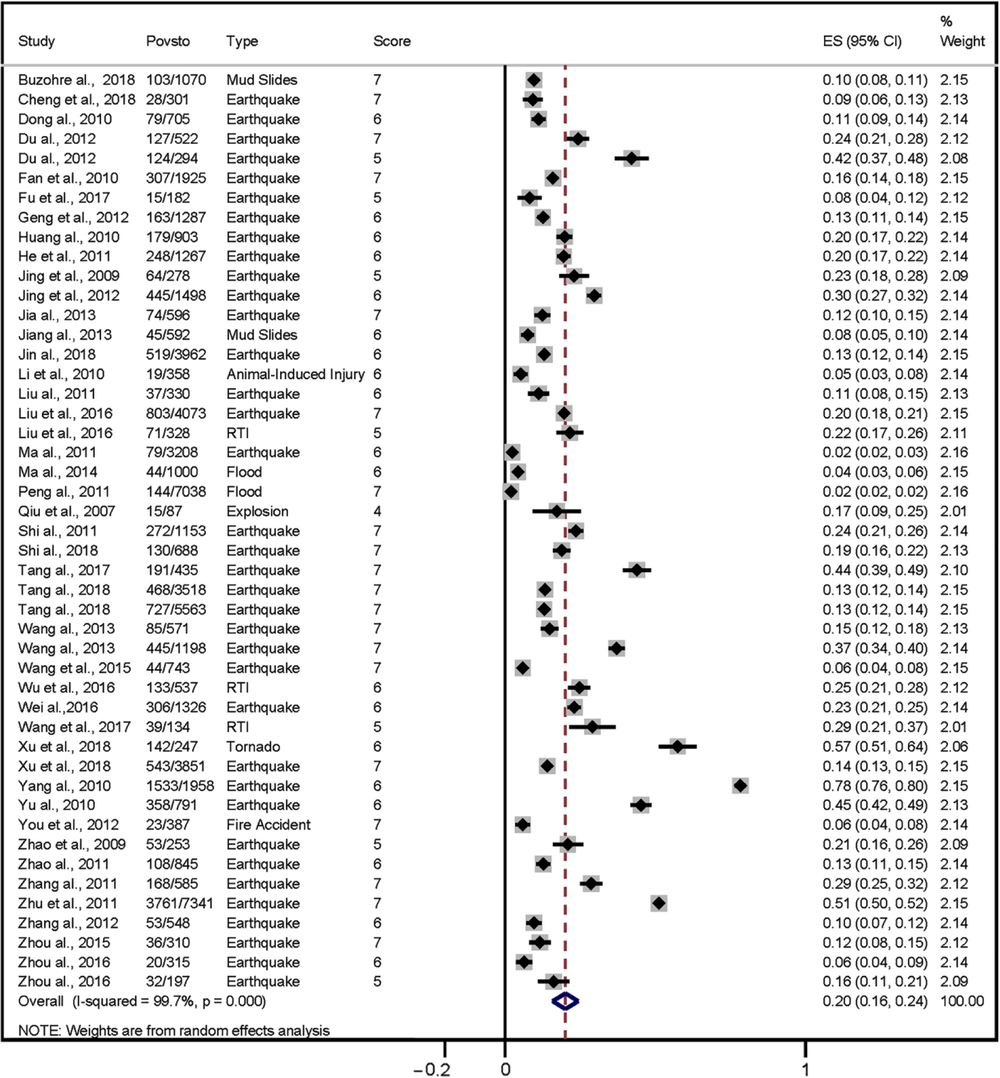
The prevalence of PTSD in children varies depending on the public health disaster category. Our study found that the prevalence of PTSD in children was 23.6% (N = 53 520) after an earthquake, and 8.9% (N = 1662) after mudslides; whereas PTSD rates were 2.3% (N = 8038) and 57.5% (N = 247) after floods and hurricanes, respectively. Figure 2 presents the effect size of the children PTSD rates following injury computed by the meta-analysis. Heterogeneity was significant when compared across the 47 included studies, so a random effect model was used (Q = 16320.71, P < 0.001, I 2 = 99.7%). There were 13 402 injured children diagnosed with PTSD, and the general rate of PTSD was 20.52% (N = 65 298, 95% CI = 17%–23%, P < 0.001).
Forest Plot of PTSD Rate From the Pooled Included Records.

Subgroup Analysis and Sensitivity Analyses
Significant heterogeneity was caused by several different subgroups (gender, grade, registered residence, ethnicity), so a random effect model was also used in subgroup analyses. For the gender subgroup, heterogeneity was reflected (Q = 15 687.92, P < 0.001, I 2 = 99.70). Heterogeneity was also reflected in the grade subgroup, residence, and nationality (Q = 4869.71, P < 0.001, I 2 = 99.60; Q = 2749.26, P < 0.001, I 2 = 99.80; Q = 7237.82, P < 0.001, I 2 = 99.90, respectively).
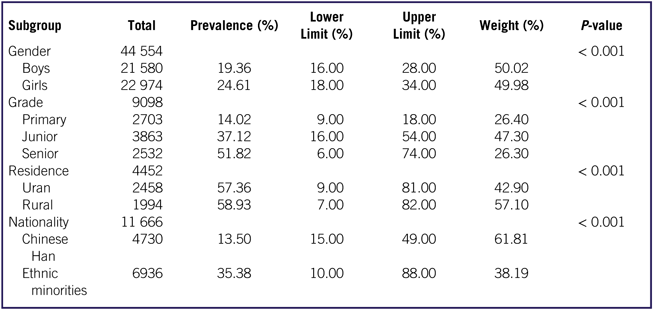
When we conducted incidence of PTSD in children from different subgroups, there were significant differences between subgroups (Table 1). We found that PTSD prevalence in girls was 24.61% (95% CI = 18%–34%), which was higher than the PTSD rate of boys (19.36%, 95% CI = 16%–28%, P < 0.001). Among the different grades of children diagnosed with PTSD following an injury, the senior high school students’ PTSD rate was the highest (51.82%, 95% CI = 6%–74%), followed by junior high school students (37.12%, 95% CI = 16%–54%), and the incidence of PTSD in child pupils was the lowest (14.02%, 95% CI = 9%–18%, P < 0.001). The PTSD rate in ethnic minority students was 35.38% (95% CI = 10%–88%), which was higher than that of Han Chinese students (13.50%, 95% CI = 15%–49%, P < 0.001).
The PTSD Prevalence in Different Children Subgroup

Note: PTSD = posttraumatic stress disorder.
PTSD prevalence in rural students was 58.93% (95% CI = 7%–82%), which was higher than PTSD rates of urban students (57.36%, 95% CI = 9%–81%, P < 0.001). Because the PTSD prevalence of the rural and urban students was notably high, we investigated the potential sources of this finding. After we excluded an outlying study Reference Yang, Ye and Li62 with a much higher PTSD rate than other studies, the results were more rational. PTSD prevalence in rural students was 31.90% (95% CI = 8%–31%), which was higher than urban student PTSD rates (15.16%, 95% CI = 15%–50%, P < 0.001).
Quality Assessment and Publication Bias
Among the 47 studies, according to the document quality score of Loney et al., Reference Loney, Chambers and Bennett17 20 articles had 7 points, 19 articles had 6 points, 7 articles had 5 points, and 1 article had 4 points. They are of medium quality.
Moreover, we also used Begg’s test (P = 0.29) and Egger’s test (P < 0.001) to evaluate publication bias. The results showed that publication bias cannot be thoroughly excluded.
DISCUSSION
Prevalence of PTSD in Injured Chinese Children
It is unclear how many Chinese children develop PTSD following an injury. This is the first meta-analysis study to report the PTSD prevalence in injured Chinese children in a large sample size (N = 65 298). Our study found that the rate of PTSD in injured Chinese children was 20.52%, which was consistent with previous studies; for example, PTSD prevalence was 19.71% after the Yushu earthquake, Reference Liu, Fu and Jing23 18.89% after the Wenchuan earthquake, Reference Shi, Zhou and Geng15 and 24.77% for RTIs. Reference Wu, Meng and Hao33 In the meantime, the PTSD rates in our study are significantly different from several similar studies; these studies reported PTSD rates of 9.30% after the Wenchuan earthquake, Reference Cheng, Liang and Fu20 9.60% after mudslides, Reference Eli, Cheng and Liang10 5.31% after animal-induced injuries, Reference Li, Zhang and Wang11 2.04% after a flood in Hunan, Reference Ma, Liu and Hu25 51.26% after a tornado in Yancheng, Reference Xu, Yuan and Liu13 and 29.10% from RTIs. Reference Wang14 These discrepancies are attributable to differences in age, gender, ethnicity, injury type and degree, study methodology, time of investigation after injury, and variability in PTSD assessment questionnaires. As for publication bias, we found that, for the same data, the Egger’s test is significantly less than the Begg’s test. It seems that diagnosis effect may be affected by many factors, such as data heterogeneity, data normality, I-square values, study quality, and the numbers of original studies included. Reference Shi, Nie and Shi63
Risk Factors Associated With PTSD Following an Injury
Our study also examined PTSD prevalence risk factors in children who had survived an injury, with a focus on the risk factors of developing PTSD. Our findings identified 4 main aspects, suggesting that girls, senior high school children, rural living environment, and ethnic minority status were the main potential risk factors of PTSD in injured Chinese children.
First, our study found that PTSD rates of girls were higher than those of boys after an injury. The result suggested girls to be at greater risk of developing PTSD, which is in agreement with several studies. Reference Eli, Cheng and Liang10 , Reference Peng, Liu and Zhou26 , Reference Tang, Lu and Xu27 Such gender effects may be due to the fact that females are more responsive to stress and have stronger perception of threats than males. Reference Garbarino and Kostelny64 The gender bias may also result from contrasting physiology, personality traits, emotional experiences, and social adaptability between boys and girls. Girls generally are emotional and sentimental. Finally, the traditional culture in China could explain this gender difference, because Chinese families tend to pay less attention to girls than boys. Compared with boys, girls may experience a deficit of parental love and attention, so when they develop psychological problems, they may not take the initiative to seek help from their parents, which may delay the discovery and treatment of psychological problems. Taking this into consideration, the families and society should pay more attention to girls with injuries.
Second, our study also indicated that the rate of PTSD differs across grade age groups, with increased PTSD rates in senior high school students when compared with pupils and junior high school students. This is consistent with a previous study that compared younger adolescents (12 to 14 years) with older adolescents (15 to 17 years), who scored significantly higher on PTSD scales and had significantly higher PTSD prevalence rates. Reference Xu, Yuan and Liu13 , Reference Zhou, Wu and Yuan60 In contrast, another study showed that younger children were more susceptible to the negative consequences of multiple risks than older children. Reference Roussos, Goenjian and Steinberg65 Injuries in these studies were often caused by other people, such as family violence or sexual harassment rather than natural disasters. In the present study, natural disasters accounted for the majority of PTSD cases. This can explain why the prevalence rate of PTSD in junior high school students was higher than that in pupils. There are several possible reasons that can explain why PTSD prevalence rates were highest in senior high school students. Student’s learning stress may increase the risk of PTSD. In China, high school is the most burdensome and stressful period for students. Another reason may be that older youths may engage in maladaptive cognitive coping. Reference Felton, Cole and Martin66 Therefore, the school should pay more attention to the psychological problems of high school students with injuries. Teachers and families should notice psychological problems and anything out of the ordinary from these students and take effective measures to intervene. This would give these students less study-induced stress and facilitate communication with them.
Third, the present study showed that rural students were at a higher risk of developing PTSD following injury compared with urban students. The prevalence of PTSD in ethnic minority students was higher than that in the Han Chinese students. These results are in agreement with 2 similar studies, which showed that psychological problems in ethnic minority children and children from rural areas were significantly higher than urban and Han Chinese students. Reference Fan, Liu and Zheng42 , Reference Yang, Ye and Li62 Several factors may explain the higher PTSD rates in rural students following an injury. One factor is that parents living in rural areas have a lower level of education than their urban counterparts. There are also many left-behind children in rural China, whose parents seek job opportunities in a city, and leave the poorly educated grandparents to take care of their children. Due to a lack of mental illness awareness, elders and parents in rural areas pay less attention to the psychological problems of children compared with urban parents. Furthermore, the cost of treating children with PTSD is also a significant burden to rural families. Another factor that contributes to a lower incidence of PTSD in urban students is that there are more psychotherapy institutions offering treatment in urban areas than in rural areas, allowing urban students to obtain better treatment.
Finally, an international study found that, after experiencing disaster events, the incidence of PTSD differed among ethnic groups. Reference Liu, Cheng and Zhang67 Generally speaking, minorities in a country or region are more likely to develop PTSD or present more severe PTSD symptoms than mainstream ethnic groups in that country or region. General characteristics of national minorities can account for this phenomenon. Minorities are generally vulnerable groups in a society, with low socioeconomic status, low income, low level of education, and minimal social resources, which may be reasons for a higher incidence of PTSD in ethnic minorities.
In summary, the students most at risk for PTSD were female, ethnic minority children, ages 15–17 years, from rural areas. It is suggested that when public health disasters occur, these 4 groups of children should be given more attention. The rescue workers should focus on these 4 groups when conducting early screening for mental health problems after public health disasters in order to reduce PTSD symptoms and aid mental health recovery in children.
Limitations of this Meta-Analysis
There are some limitations to the present study. First, we cannot exclude the publication bias and the heterogeneity of this study’s data. Heterogeneity is high for all included articles due to differences in study region, sample size, investigation time, and PTSD symptom questionnaires. Second, natural disasters account for the majority of injury types, and there are few included studies specifically studying the incidence of child PTSD after injury conducted in urban and rural regions separately. Third, data are mainly obtained from schools, thus recalling bias cannot be avoided in original studies.
CONCLUSION
In conclusion, this meta-analysis suggested that there is a higher risk of PTSD in injured Chinese children for girls, for senior high school students ages 15–17, for rural students, and for ethnic minority students. Parents, schools, and society should attach great importance to these groups to improve recovery from PTSD in injured children.
Conflict of Interest Statement
The authors have no conflicts of interest to declare.
Funding Statement
This study was granted by National Natural Science Foundation of China (Grant No. 81560534, PI: Xiuquan Shi). The funders had no role in the study design, data collection and analysis, decision to publish, or preparation of the manuscript.