Stress is a major factor that influences several areas of our lives, including education, work, family, social settings, and health. In this sense, people with high levels of work stress may see it affect their family, social life and health and vice versa. Lazarus and Folkman (Reference Lazarus and Folkman1984) define stress as a particular relationship between the individual and the environment. An event is stressful when the individual considers his demands to exceed his resources or perceives his well-being as at risk. Therefore, when the individual perceives a situation as threatening (primary assessment), he analyzes the resources available to face it (secondary assessment). These assessments interact and lead to the perception of stress and its subsequent physical and emotional response. The individual then re-assesses the situation, introducing changes in response to the new information from the environment or to his own resources to face the situation.
As a response to stress, our body secretes a number of neurotransmitters and hormones, such as adrenaline, noradrenaline, endogenous opiates, and glucocorticoids, including cortisol. Glucocorticoids remain within the organism for a long period of time, leading to overactivation of several body systems, and, when maintained at high levels, have negative impacts on health and cause a wide range of physical and psychological disorders like autoimmunity disorders, myocardial infarction, ulcers, anxiety and depression (Robles-Ortega & Peralta-Ramirez, Reference Robles-Ortega and Peralta-Ramírez2006; Sapolsky, Reference Sapolsky2004).
Several studies have attempted to demonstrate the relationship between stress and cognitive systems, including attention, processing speed and memory, which includes working memory, somatic memory, and episodic memory (Lupien, Maheu, Tu, Fiocco, & Schramek, Reference Lupien, Maheu, Tu, Fiocco and Schramek2007; Olver, Pinney, Maruff, & Norman, Reference Olver, Pinney, Maruff and Norman2015; Qin, Hermans, van Marle, Luo, & Fernández, Reference Qin, Hermans, van Marle, Luo and Fernández2009). In the same fashion, studies have shown that stress and stress hormones affect executive function. Specifically, McMorris et al. (Reference McMorris, Swain, Smith, Corbett, Delves, Sale and Potter2006) demonstrated that heat-induced stress impairs executive function performance and mood state, which can be predicted by the plasma concentration of cortisol and adrenaline hormones. Starcke, Wolf, Markowitsch, and Brand (Reference Starcke, Wolf, Markowitsch and Brand2008) observed that people performing an anticipatory stress task developed a disadvantageous decision-making process, which was negatively correlated with the salivary cortisol concentration, compared to the control group. Plessow, Kiesel, and Kirschbaum (Reference Plessow, Kiesel and Kirschbaum2012) demonstrate that acute psychosocial stress impairs cognitive control processes of flexible task-goal implementation essential for voluntary goal-directed behavior.
There is controversy about whether the term “executive function” is a unitary concept or an integrated group of skills for behavior control (Jurado & Rosselli, Reference Jurado and Rosselli2007). We consider executive function an integrated process that, according to a recent review by Diamond (Reference Diamond2013) is made up of three cores (Fisk & Sharp, Reference Fisk and Sharp2004): working memory; inhibition, composed of interference control and response inhibition; and cognitive flexibility or shifting. From these components, higher-order executive functions are built such as reasoning, problem solving, and planning. A cognitive process closely related with executive components is the decision-making. This process is linked with emotional processes and develops in tasks with several simultaneous response options related to reward and punishment variables (Bechara, Damasio, Damasio, & Lee, Reference Bechara, Damasio, Damasio and Lee1999). Decision-making is a clear example of the connection between cognition and emotion, as described by the somatic marker hypothesis proposed by Damasio (Reference Damasio1994), who suggests that the decision-making process depends on emotional signs, which are defined as bio-regulatory responses aimed at maintaining homeostasis and ensuring survival. Thus, high stress levels could lead to dysfunctional decision-making due to emotional disturbance at the time the decision is made. Considering these findings, van den Bos, Harteveld, and Stoop (Reference van den Bos, Harteveld and Stoop2009), induced psychosocial stress through a public speaking task, after which the Iowa Gambling Task (IGT) was administered. The IGT is a decision-making task that has been used to investigate the somatic marker hypothesis. van den Bos et al. (Reference van den Bos, Harteveld and Stoop2009) observed that higher cortisol salivary levels led to a poorer performance in men. In contrast, women with slightly high cortisol levels after the speech performed better on the IGT, although very high levels led to poor performance on the task. Furthermore, in a study conducted by our group (Santos-Ruiz et al., Reference Santos-Ruiz, García-Ríos, Fernández-Sánchez, Pérez-García, Muñoz-García and Peralta-Ramírez2012), decision-making was evaluated in women using the IGT before they faced to the public speaking task. We found that women with poor performance on the IGT showed significantly higher cortisol levels against the stressor than the group with good performance. Another line of studies showed that the stress may have negative effects in decision making under risk when the decision task is carried out during the peak of cortisol in response to stress, nonetheless when the decision making is before of the cortisol peak, stress may have neuropsychological benefits in humans (Pabst, Brand, & Wolf, Reference Pabst, Brand and Wolf2013; Pabst, Schoofs, Pawlikowski, Brand, & Wolf, Reference Pabst, Brand and Wolf2013).
Therefore, based on the aforementioned model by Lazarus and Folkman (Reference Lazarus and Folkman1984), in which the individual perceives a potentially stressful situation as threatening (primary assessment) and then evaluates his own resources to face this situation (secondary assessment), we hypothesize that somatic markers are activated in this secondary assessment, influencing the decision-making process. We also hypothesize that, during this secondary assessment, capabilities such as planning, cognitive flexibility, and inhibition of the individual are revised. Then, according to the results, re-evaluating, information from the environment and the individual’s internal resources is incorporated, thus leading to a higher or a lower perception of stress.
To date, most studies on stress have focused on its effects on physical, psychological, behavioral, and interpersonal aspects. Few studies have focused on cognitive dysfunction as a consequence of prolonged stress in humans. However, there are studies focusing on the efficacy of cognitive-behavioral therapies for stress control on psychological variables, such as optimism, personality, anxiety or depression (Erickson, Janeck, & Tallman, Reference Erickson, Janeck and Tallman2007; Linares-Ortiz, Robles-Ortega, & Peralta-Ramírez, Reference Linares-Ortiz, Robles-Ortega and Peralta-Ramírez2014; Navarrete-Navarrete et al., Reference Navarrete-Navarrete, Peralta-Ramírez, Sabio-Sánchez, Coín, Robles-Ortega, Hidalgo-Tenorio and Jiménez-Alonso2010; Peralta-Ramirez, Robles-Ortega, Navarrete-Navarrete, & Jiménez-Alonso, Reference Peralta-Ramírez, Robles-Ortega, Navarrete-Navarrete and Jiménez-Alonso2009). In addition, some studies have connected the effects of stress control therapy with hippocampus size, but no changes in size were found after therapy (Lindauer et al., Reference Lindauer, Vlieger, Jalink, Olff, Carlier, Majoie and Gersons2005). Mohlman (Reference Mohlman2008) found that cognitive-behavioral intervention for generalized anxiety disorder resulted in improved executive function in 50% of participants. Furthermore, cognitive-behavioral therapy (CBT) for depression showed no changes in neuropsychological functions, as verbal learning and memory, visuospatial learning and memory, attention and executive functioning, processing speed, and spatial problem solving (Groves et al., Reference Groves, Porter, Jordan, Knight, Carter, McIntosh and Joyce2015; Porter et al., Reference Porter, Bourke, Carter, Douglas, McIntosh, Jordan and Frampton2016).
However, no research has been conducted on the efficacy of a cognitive-behavioral therapy for stress management on cognitive processes of people with high stress levels. For this reason, this study aims to demonstrate the efficacy of cognitive-behavioral therapy for stress control, not only on personality and emotional variables but also on executive function. Our main hypothesis is that several components of executive function, such as cognitive flexibility and planning, in addition to decision-making processes, may be improved as a consequence of modifying several emotional variables by means of stress control therapy, since this type of therapy includes time planning and management exercises, as well as cognitive restructuring. In contrast, other components of executive function, such as working memory and inhibition are not expected to change, since they are not addressed in this type of therapy.
Methods
Participants
Thirty-one healthy people with high levels of perceived stress (i.e., with scores over 22 in the Perceived Stress Scale, PSS) were divided into two groups: 18 people were included in the treatment group and 13 people were included in the control group. The treatment group (TG: 6 males, 12 females) had an average age of 41.36 (SD = 10.68) and an average education of 16.37 years (SD = 2.27). They were recruited from several departments of the university and participated in cognitive-behavioral therapy for stress management, a program developed at the Clinical Psychology Unit of the same university. Individuals in the control group (CG: 2 males, 11 females), had an average age of 45 years (SD = 11.77) and an average education of 14 years (SD = 3.80). They were matched to the treatment group on sex, age, and education. During the first interview, individuals in both groups were informed of the objectives of the study, after which they signed an informed consent form and agreed to participate in the study. The assessment for both groups was carried out one week before the therapy started (pre-treatment) and one week after the therapy ended (post-treatment). Therapy was conducted on a weekly basis over fourteen weeks.
Inclusion criteria for participants of both groups were: Age between 18 and 65 years; no substance abuse disorders, neurological damage, or psychiatric pathology; and a score on the global scales of the SCL-90 Symptoms Inventory that was less than two standard deviations from the mean. Also, for the treatment group, individuals were required to attend at least 80% of therapy sessions.
All participants gave their informed consent to the study, which was approved by the Ethic Committee of the university, and followed the guidelines of the Helsinki Declaration (World Medical Association, Reference Ferney-Voltaire2015) and the Good Clinical Practice Directive (Directive 2005/28/EC) of the European Union.
Instruments
The instruments used were classified according to the measured variables: psychopathological tests, stress tests, tests on personality constructs related to stress, and executive function tasks and decision-making test. Likewise, executive function tasks were classified according to the relevant components: 1) working memory; 2) cognitive flexibility and inhibitory control; and 3) planning.
Psychopathological test
SCL-90-R Symptoms Inventory, Spanish adaptation by De las Cuevas et al. (Reference De las Cuevas, González de Rivera, Henry Benítez, Monterrey, Rodríguez-Pulido and Gracia Marcos1991). We used this instrument to rule out possible psychopathology in the participants. This self-report questionnaire was developed to assess symptoms of psychopathology. It includes 90 items with five response alternatives (0–4) on a Likert scale. The inventory is scored and interpreted according to nine main dimensions (somatization, obsessive-compulsive symptoms, interpersonal sensitivity, depression, anxiety, hostility, phobic anxiety, paranoid ideation, and psychoticism) and three global indices of psychological distress (Global Severity Index [GSI], Positive Symptom Total [PS], and Positive Symptom Distress Index [PSDI]). This instrument is thought to have satisfactory reliability and validity (De las Cuevas et al., Reference De las Cuevas, González de Rivera, Henry Benítez, Monterrey, Rodríguez-Pulido and Gracia Marcos1991).
Stress tests
Survey of Recent Life Experiences (SRLE), Spanish adaptation (Sandín, Chorot, & Santed, Reference Sandín, Chorot, Santed and Sandín1999). This instrument consists of 51 items which evaluate stressful experiences. Participants must rate to what extent a series of situations have been part of their lives over the previous month, using a Likert scale from 1 (not at all) to 4 (extremely). The stability and validity of this instrument are considered to be satisfactory (Sandín et al., Reference Sandín, Chorot, Santed and Sandín1999).
Perceived Stress Scale (PSS), Spanish adaptation by Remor and Carrobles (Reference Remor and Carrobles2001). This is a self-report instrument used to evaluate perceived stress level and the degree to which people find their lives unpredictable, uncontrollable or overcharged (aspects that contribute to stress). It consists of 14 items with four response alternatives. This scale has adequate reliability (internal consistency = 0.81 and test-retest = 0.73), concurrent validity, and sensitivity (Remor, Reference Remor2006). Here, we have considered that a high level of perceived stress was indicated by scores higher than the average of 22 observed in the Spanish population (Remor & Carrobles, Reference Remor and Carrobles2001).
Stress Vulnerability Inventory (SV), Spanish adaptation, validated by Robles-Ortega, Peralta-Ramirez, and Navarrete-Navarrete (Reference Robles-Ortega, Peralta-Ramírez and Navarrete-Navarrete2006). This instrument consists of 22 items and evaluates the individual’s predisposition to be influenced by perceived stress (α = 0.87).
Personality construct tests related to stress
Life Orientation Test (LOT-R) validated in Spanish by Ferrando, Chico, and Tous (Reference Ferrando, Chico and Tous2002). This test consists of 10 items in a five-point Likert scale that rate the dimension of dispositional optimism (α = .74).
Constructive Thinking Inventory (CTI; Epstein, Reference Epstein2001). This test consists of 108 items whose analysis yields several scales in three levels: a global scale, six main scales measuring the basic forms of constructive or destructive thinking, and more specific subscales describing specific modes of constructive or destructive thinking. This study will deal with the global dimension (Global constructive thinking) and the main six scales (Emotional coping, Behavioral coping, Categorical thinking, Superstitious thinking, Esoteric thinking, Naive optimism). This instrument is highly reliable due to test-retest and split-half methods.
Personality construct tests related to executive function
UPPS-P Impulsive Behavior Scale (Cyders et al., Reference Cyders, Smith, Spillane, Fischer, Annus and Peterson2007). This is a 59-item inventory designed to measure five personality features of impulsive behavior: Negative Urgency, Perseverance, Premeditation, Sensation Seeking, and Positive Urgency.
Sensitivity to Punishment, Sensitivity to Reward SPSR questionnaire (Torrubia, Avila, Moltó, & Caseras, Reference Torrubia, Avila, Moltó and Caseras2001). This test consists of 44 items with Yes/No responses and is used to evaluate two dimensions of personality, anxiety (Sensitivity to Punishment) and impulsivity (Sensitivity to Reward), as proposed by Gray’s psychobiological model of personality. Both sensitivity to punishment and sensitivity to reward scales have a high internal consistency and test-retest reliability.
Executive function test
The executive function tests were classified according to the criteria proposed by Diamond (Reference Diamond2013) in her review.
Working Memory. Letters and numbers (Wechsler, Reference Wechsler1997, WAIS-III) was used to evaluate working memory. Participant read a combined sequence of letters and numbers and then they are asked to reproduce the sequence, placing the numbers in ascending order and then the letters in alphabetical order.
Cognitive flexibility and Inhibitory Control. They were analyzed by means of the Five digit test (Sedó, Reference Sedó2005). The test assesses both components of executive function: cognitive flexibility and inhibition. It includes four parts, which are administered separately and consist of a series of 50 boxes, each of which contains one to five digits (parts 1, 3, and 4) or stars (part 2), organized in patterns similar to those on domino pieces or playing cards. In part 1 (reading), the participant must read the digits as fast as possible. In part 2 (counting), he must count the number of stars in each box. In part 3 (interference), participants have to count the number of digits in each box, while inhibiting the automatic response of naming the digits in each of the boxes. Finally, in part 4 (shifting), the task involves counting or reading, depending on whether the box’s outline is thin (counting, 80% of the stimuli) or thick (reading, 20%). Parts 1 and 2 (reading and counting) are basic attention and speed of processing measures. In contrast, parts 3 and 4 (interference and shifting) are sensitive to the functioning of complex executive processes, such as inhibition and switching. Therefore, the main dependent variables are the difference in performance time between part 3 and the mean performance time of parts 1 and 2 (differential “interference” score); and the difference in performance time between part 4 and the mean of parts 1 and 2 (differential “shifting” score), which corresponds to the cognitive flexibility component of executive function.
Planning. Zoo Map Test (Wilson, Alderman, Burgess, Emslie, & Evans, Reference Wilson, Alderman, Burgess, Emslie and Evans1996), subscale of the BADS to measure planning skills. Participants have to plan a route in order to visit 6 of 12 locations in a section of the zoo.
Decision-making test
Iowa Gambling Task (Bechara, Reference Bechara2004) is a computerized task. Participants must choose between four decks of cards. Unbeknownst to them, two of the decks provide high immediate winnings, but greater future loss (long-term loss), while the other two decks provide lower immediate winnings, but less future loss (long-term gains). Participants receive messages (feedback) about the consequences of each choice they make. The objective of the task is to win as much money as possible and, if winning is not possible, to try not to lose. Therefore, to earn money on the task, the appropriate strategy is to consistently choose cards from the decks associated with long-term gains and ignore the decks that provide immediate winnings and long-term losses. The main dependent variable is the difference between the number of advantageous and disadvantageous choices in each of the five blocks of 20 trials.
Procedure
The two groups in this study were recruited differently. The treatment group was recruited via the Clinical Psychology Unit of the university. An e-mail was sent to all university members, including teaching and administrative staffs, and student body, advertising the stress management program for those who felt they had high stress levels. Twenty-eight people answered this generic e-mail, expressing their interest in enrolling in the stress management program. All interested people were interviewed to verify their levels of perceived stress. For this purpose, we used Meichenbaum’s clinical interview, based on questions about stress (Meichenbaum, Reference Meichenbaum1985). Twenty-seven of the 28 people, who had expressed interest in participating, attended the initial interview. Two of them were excluded due to their ongoing psychiatric treatment and 5 others because theirs were not stress-related problems. Six of the 20 people who were admitted to the treatment program were not able to attend as the treatment schedule was incompatible with their working schedule. The program started with a total of 14 enrolled participants, 3 of which were not able to complete treatment due to family or work-related problems.
Selected participants were administered the questionnaires and the neuropsychological tests described above (pre-treatment evaluation). This first neuropsychological evaluation was performed one week before the program started, lasted approximately two hours, and was administered individually. One week after the therapy was completed; the aforementioned questionnaires and tests were re-administered (post-treatment evaluation).
Participant selection in the control group was accomplished by snowball effect, namely by asking people in the treatment group to refer to the study those individuals in their immediate surroundings with profiles akin to theirs and with high levels of stress. These participants were also interviewed in the same manner as the members of the treatment group, and they were evaluated with the same instruments in the same time period.
The intervention consisted of cognitive-behavioral therapy for stress management based on the stress inoculation training of Meichenbaum (Reference Meichenbaum1985). This therapy, which was conducted by two expert psychologists, has been demonstrated to have a wide efficacy (Navarrete-Navarrete et al., Reference Navarrete-Navarrete, Peralta-Ramírez, Sabio-Sánchez, Coín, Robles-Ortega, Hidalgo-Tenorio and Jiménez-Alonso2010; Peralta-Ramirez et al., Reference Peralta-Ramírez, Robles-Ortega, Navarrete-Navarrete and Jiménez-Alonso2009; Robles-Ortega & Peralta-Ramirez, Reference Robles-Ortega and Peralta-Ramírez2006). It occurred on a weekly basis and consisted of fourteen sessions of 1.5 hours. The contents of the session were the following: 1) Stress Conceptualization; 2) Deactivation Techniques (diaphragmatic breathing and autogenic training); 3) Deactivation Techniques (deep muscle relaxation and thematic visualization techniques); 4) Cognitive Techniques (cognitive restructuring and thinking distortions or errors); 5) Cognitive Techniques (cognitive restructuring irrational ideas); 6) Cognitive Techniques (cognitive restructuring debating thoughts); 7) Other Cognitive Techniques (self-instructions and thought stop); 8) Assertive Techniques (defining assertive behavior and basic assertive rights); 9) Assertive Techniques (how to say no and how to demand a change of behavior); 10) Administration and Time Management Techniques; 11) Personality Characteristics and their Relationship with Stress and Health (type A personality, type C personality and type R personality); 12) Personality Characteristics and their Relationship with Stress and Health (control of anger/hostility); 13) Humor and Optimism; and 14) Application of the Contents developed in the Program.
Statistical variables and analysis
First, to confirm whether there were baseline differences between the two groups, we performed several ANOVAs, with the group (treatment vs. control) as the independent variable and the scores obtained in the different instruments relative to the variables [psychopathology (GSI, PS, and PSDI), stress (stressful experiences, perceived stress, stress vulnerability), personal constructs related to stress (optimism and constructive thinking variables) and executive function (impulsive behavior variables and sensitivity to punishment and reward), decision-making and executive function variables (working memory, cognitive flexibility, inhibitory control and planning)] as the dependent variables.
Second, to confirm the efficacy of the treatment, we conducted a mixed factorial design with two groups (GT versus CT) as a between-subject factor and time (pre versus post-treatment) as a within-subject factor. Finally, the variables with interaction we performed several t tests, taking the different evaluation moments (pre-treatment and post-treatment) as the independent variable and the test scores as the dependent variables.
Finally, we measured the effect size of the treatment for each of the dependent variables.
Results
Descriptive sample analysis
Sociodemographic variables. To confirm that the groups were equal in terms of sociodemographic variables, we performed two ANOVAs, the independent variable being the group (treatment vs. control) and the dependent variables being age and years of education. There were no statistically significant differences for either age or education.
Psychopathology, stress, and personality variables. We verified whether there were differences between-groups in terms of psychopathology, stress and personal constructs related to stress, and executive function personality traits. There were statistically significant differences in the Positive Symptom Distress Index (PSDI). The TG had a higher score than the CG t(1, 30) = 2.658; p = .012. Also, the TG scored statistically higher in perceived stress (t = 2.885; p = .007) and stress vulnerability (t = 2.945; p = .006) than the CG.
Executive function variables and the decision-making process. We verified whether there were differences between-groups in terms of executive functions and decision-making. The results showed that there were statistically significant differences in the response inhibition variable, specifically in the interference on the Five-Digit test t(1, 30)= –3.614; p = .001, corresponding to the inhibition component, in which the CG had higher scores than the TG (16.11 vs. 10.22 ). There were no between-groups differences in the other variables.
Effects of Stress Management Therapy: Modification of the Psychopathology, Stress, Personality, and Executive Function Variables
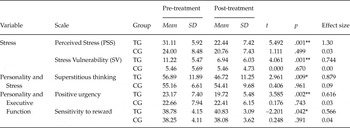
Stress: Repeated-measures ANOVAs revealed significant changes in the TG in terms of the perception of stress F(1, 28) = 4.897; p < .035 and vulnerability to stress F(1, 28) = 10.297; p < .003. The within-group analysis indicated that the TG experienced a significant improvement in both variables at post compared to baseline. No differences were found in the CG.
Personality: The TG made better progress than the CG with regard to Superstitious thinking as indicated by repeated-measures ANOVA F(1, 27) = 4.894; p < .036. A later analysis within-group showed that the TG presented lower levels of superstitious thinking compared to their initial values. In the CG, no differences were found.
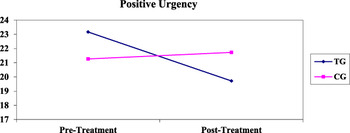
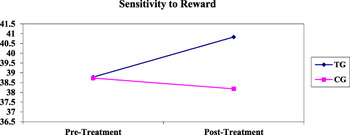
Executive function and the decision-making process: The results of these measures are summarized in Table 1 and Figure 1and 2. With regard to the Positive urgency, the analysis of repeated measured produced significant results F(1, 27) = 5.80; p < .023 and the sensitivity to reward F(1, 27) = 4.053; p < .05. The within-group analysis showed that the TG show a decrease of positive urgency at post compared to their initial values (Figure 1). No differences were found in the CG. With regard the sensitivity to reward the within-group analysis indicated that the TG experienced a significant improvement at post-treatment compared to baseline (Figure 2).
Mean (standard deviation), significance and effect size of the stress and personality variables for the control and treatment groups at pre- and post-treatment (t test)

Note: CG, Control Group; TG, Treatment Group.
* p > .05; **p >.001.
Scores of Positive Urgency of UPPS-P Scale before and after therapy in control group (CG) and treatment group (TG).

Scores of Sensitivity to reward before and after therapy in control group (CG) and treatment group (TG).

There were no significant results in either group after the second evaluation in executive function and decision making.
Effect size estimates for each of the significant variables are providing in Table 1. Moderate to large effect size were found for the TG with regard to vulnerability to stress, perception of stress, superstitious thinking, positive urgency and sensitivity to reward. Effect sizes were less than 0.5 in control conditions for the other variables.
Discussion
The aim of this study was to determine whether cognitive-behavioral therapy for stress management, for highly stressed people, modifies executive function and decision-making processes, based on the implications of stress in these components. As far we know this is the first research that evaluates improvements in executive functions as a consequence of a stress management program.
Both groups were initially equal in most psychological and executive function variables, although TG had higher stress levels and worse scores in cognitive inhibition. After the cognitive-behavioral therapy for stress management changes were observed in several psychological variables and personality tests related to executive function, but not in executive function components.
Our results showed statistically significant differences between groups after the therapy in perceived stress, stress vulnerability superstitious thinking, positive urgency, and sensitivity to reward, with benefits to the treatment group, showing a large effect size of the therapy. These results support the efficacy of the cognitive-behavioral therapy for stress management to improve psychological variables.
Our results regarding stress levels and personality construct variables are similar to those found in other studies (Erickson et al., Reference Erickson, Janeck and Tallman2007; Linares-Ortiz et al., Reference Linares-Ortiz, Robles-Ortega and Peralta-Ramírez2014; Navarrete-Navarrete et al., Reference Navarrete-Navarrete, Peralta-Ramírez, Sabio-Sánchez, Coín, Robles-Ortega, Hidalgo-Tenorio and Jiménez-Alonso2010; Peralta-Ramirez et al., Reference Peralta-Ramírez, Robles-Ortega, Navarrete-Navarrete and Jiménez-Alonso2009), where stress control programs lead to improvements in these variables. However, the modulation of constructive thinking by means of stress inoculation therapy is a novel finding in the field of stress research. In fact, a decrease in superstitious thinking was observed after the therapy. Superstitious thinking measures the extent to which people cling to private superstitions, aiming to defend themselves from threats rather than achieving happiness and perfection (Epstein, Reference Epstein2001). Coping strategies to threatening situations are trained during the therapy sessions and new thinking patterns are taught during the program, providing participants with new perspectives to face different situations (Robles-Ortega & Peralta-Ramirez, Reference Robles-Ortega and Peralta-Ramírez2006), therefore the diminution in Superstitious thinking may be an indicator of the success through the intervention.
As for the personality variables related to executive function, a decrease in the Positive Urgency variable was found in the UPPS-P Impulsivity scale. Previous research has connected impulsivity with decision-making (Zermatten, van der Linden, d’Acremont, Jermann, & Bechara, Reference Zermatten, van der Linden, d’Acremont, Jermann and Bechara2005). Therefore, because this variable is related to executive function, a high score in this aspect may lead to a good executive performance. Our results demonstrate how therapy modifies positive urgency. In other words, people in the treatment group decreased their tendency to give in to impulses under conditions of high positive affect, which would lead to proper performance. These results could be due to specific training of such skills by the cognitive change modules, in addition to the deactivation techniques used in training. Furthermore, Sensitivity to reward was increased after the therapy in the TG, which shows a gain against to stress by the participants, since previous studies indicate a reduced sensitivity to rewards under stress (Bogdan & Pizzagalli, Reference Bogdan and Pizzagalli2006; Porcelli, Lewis, & Delgado, Reference Porcelli, Lewis and Delgado2012). This could mean when the stress levels decrease by mean of the intervention, the responsiveness to rewards (before reduced) increases.
Nonetheless, in this research cognitive-behavioral therapy found no changes in executive function components and decision making. The results are consistent with those found in others studies by mean CBT to depression (Groves et al., Reference Groves, Porter, Jordan, Knight, Carter, McIntosh and Joyce2015; Porter et al., Reference Porter, Bourke, Carter, Douglas, McIntosh, Jordan and Frampton2016), in which other therapies with more focus in flexible control of thinking, such metacognitive therapy, presented more successful effects on neuropsychological components. Moreover, we did not observe the therapy to modify performance in working memory tasks, which was presumably a priori, as previous studies have shown a close connection between stress and working memory (Lupien et al., Reference Lupien, Maheu, Tu, Fiocco and Schramek2007; Olver et al., Reference Olver, Pinney, Maruff and Norman2015; Qin et al., Reference Qin, Hermans, van Marle, Luo and Fernández2009).
Contrary to our expectations, no relevant results were obtained on any of the measures used pertaining to decision-making, i.e., the Iowa Gambling Task (IGT). Nevertheless, different studies have found a connection between stress and IGT (Santos-Ruiz et al., Reference Santos-Ruiz, García-Ríos, Fernández-Sánchez, Pérez-García, Muñoz-García and Peralta-Ramírez2012; van den Bos et al., Reference van den Bos, Harteveld and Stoop2009). Given that high stress levels may cause a poor performance on the IGT and that good decision-making may be a beneficial resource for coping with stress, we expected participants to perform better on the IGT after stress management therapy. However, this effect was not observed. The results obtained herein may have cancelled each other out due to the composition of our sample, which included males and females with distinct response patterns on the IGT (van den Bos et al., Reference van den Bos, Harteveld and Stoop2009). Furthermore, the study of Pabst, Schoofs et al. (Reference Pabst, Brand and Wolf2013) reported benefits in decision making under risk when the task was made before cortisol peak in response to the stressor. In our study, no changes in decision making after the stress management program may explain because acute stress was not evaluated, the intervention was addressed to treat maintained stress and facilitate coping strategies. Future studies that measure acute stress response and executive function before and after a cognitive-behavior therapy to stress management could clarify the efficacy of the therapy to improve decision making processes.
Our study has limitations that need to be taken into account when considering the findings. First, this is a preliminary study with a limited sample size. This was a consequence of the need to apply the therapy to small groups. Also, access to the sample was intrinsically limited because the program was designed for stressed people from a university community, who often complain of lack of time for personal and family activities. For this population, including an additional activity (attendance at therapy for stress management) was perceived as an extra stressor. This aspect also prevented us from forming a wait-list control group, because the size of the groups would have been even lower. However, despite being a reduced sample, the treatment group obtained high effect sizes for both different psychological variables as personality variables related to executive function. This shows, in a preliminary way, the efficacy of the stress management therapy to improve these components.
Moreover, the lack of follow-up does not allow us to know the stability of results over time. Therefore, our future aim is to increase sample size and to include a follow-up assessment. Finally, we would like to add that the results would be more conclusive if we had recruited the two groups in a similar fashion and randomly assigned participants to one group or the other. We felt, however, that we could not ethically postpone the treatment of those people who sought it and needed it at the time.
In conclusion, this is the first study to show that cognitive-behavioral therapy improvement not only psychopathological variables of stress but also personality construct components related to executive function which would be necessary skills for adapting to the environment and successfully facing everyday stress. However, effects of the therapy are not found on performance on the tests of executive function, as presented studies previous, which showed no changes on neuropsychological variables by mean cognitive-behavioral therapy in depression people.