Through the eighteenth century, physicians used the ‘animal spirits’ infused by music to treat ailments like melancholia or ‘spleen’.Footnote 1 Increasingly, though, music seemed no longer a vital part of medical therapy, compared to more materially oriented treatments, such as bloodletting, or long-practiced regimes of diet and exercise.Footnote 2 In an era more and more devoted to the mechanistic view of the human body, the immaterial powers of music seemed increasingly suspect and marginal. Yet by the century's end music played a significant new role in a controversial form of medical therapy, the ‘animal magnetism’ of Franz Anton Mesmer (1734–1815). The vast literature on Mesmer has emphasized the important political and social implications of his work. As Robert Darnton noted, Mesmerism occupied more space by far than any other topic in the French newspapers and journals, especially during the years 1779–84 but also thereafter: as the Mémoires secrets put it in 1784, ‘men, women, children, everyone is involved, everyone mesmerizes’.Footnote 3
Though many studies have noted Mesmer's musical activities, this article tries to go further by investigating the exact ways in which he used music to structure his therapeutic practice and theoretical self-understanding. In particular, music allowed him to control the timing and duration of his patients’ ‘crises’, an important concept about the critical timing of illnesses that medicine previously considered unalterable. Mesmer's practices deeply changed the concept of crisis by extending it to a much larger class of maladies than allowed by ancient medicine and by showing how it could be artificially induced and modulated.
Music's foundational status in Mesmeric practice illuminates the larger structure of what I have called the ‘sonic turn’ in medicine during the long nineteenth century.Footnote 4 As physicians sought to go beyond external indications of illness open to the ‘medical gaze’, sound allowed them new access to the interiority of the body. Further, sound can affect the psyche in ways that bypass reason. Mesmer controlled his patients’ crises in ways that both depended on his preferred musical instruments (especially the recently invented glass harmonica) and (even more significantly) drew on the dramatic structure of Classical music itself.
As Mesmer's successors turned their attention from such spectacular crises to evoking sleep-like states of somnambulism and catalepsy, they turned from the harmonica to the tam-tam, another new instrument in Western musical practice. The contrast between these instruments as modalities of hypnotic induction reflected a change from inducing violent crises to using hypnotic sleep to erase normal consciousness and facilitate the operation of suggestion. In so doing, hypnosis relied on instrumental techniques and dramatic strategies Romantic music used to intensify its crises to levels past what Classical usage allowed. Thus, this article argues that the salient changes from Classical to Romantic music directly informed the nature and structure of hypnotic therapy from Mesmer to Charcot.
From their time to the present, controversy surrounded the work of Mesmer and his followers, including accusations that they relied on suggestion, self-deception, and even outright fraud. Nonetheless, investigating what they themselves thought they were doing requires attending closely to their express terminology and self-understanding, while remaining cognizant of the respects in which their contemporaries and later readers may have differed or even disagreed radically. Accordingly, our emphasis on the actors’ words should not be mistaken for uncritical acceptance of their claims. Adjudicating these controversies go beyond the scope of this historical investigation, which concerns the ways sonic and musical considerations informed Mesmer and Charcot's therapeutic innovations and especially the new directions in medicine they tried to pioneer. Yet even if one judges their work as relying on suggestion or deception, their strategies relied on musical structures and instruments in ways that reflect prior developments in Classical and Romantic music.
Mesmer and the Glass Harmonica
Mesmer began his career as a rather orthodox medical practitioner, according to the standards of his time.Footnote 5 His doctoral Dissertatio physico-medica de planetarum influxu (Vienna, 1766) investigated the possibility of tidal effects of the moon and planets on the human body, within the confines of the natural philosophy and gravitational theory he ascribed to ‘the great Newton’.Footnote 6 This maiden work demonstrated Mesmer's interest in applying the new natural philosophy and its doctrine of forces to medicine, drawing heavily on work by Richard Mead, a friend of Newton's.Footnote 7 As Jessica Riskin observed, ‘Mesmer did not depart from the standard wisdom by relating health to the regulation of imponderable fluids in the body; he merely stated a commonly held belief among natural philosophers’.Footnote 8 By requesting observational trial and approbation from the leading scientific bodies and authorities, Mesmer represented himself as an obedient child of Enlightenment natural science, rather than a rebel against it.
In 1768, Mesmer established himself in Vienna, where he played the cello and the clavichord, but above all the glass harmonica. This instrument, first described by Francis Bacon, involved the excitation of sustained vibrations in musical glasses; Christoph Willibald Gluck played several recitals on them during the years 1746–1751.Footnote 9 In 1761, Benjamin Franklin devised a mechanized improvement, fitting the glasses concentrically around a revolving crank worked by a pedal.Footnote 10 By crafting the glasses to the exact size and thickness needed to sound each pitch, Franklin eliminated the use of water for their tuning. At first, he called the improved instrument a ‘glassy-chord’ but later chose ‘armonica’, alluding to the Italian word for harmony, armonia (though since then ‘harmonica’ became the more frequent spelling). Franklin thought that the tones of the harmonica ‘are incomparably sweet beyond those of any other’, providing ‘an instrument that seems peculiarly adapted to Italian music, especially that of the soft and plaintive kind’.Footnote 11 This new instrument became associated with him, his discoveries, and his political significance as exemplar of the new American nation. As Rebecca Wolf observes, Thomas Jefferson as well as Franklin hoped that the harmonica, ‘a new instrument, easy to copy and to play’, would become ‘an American counterpart to the European pianoforte’; she also notes the harmonica's ‘very close connection to the human voice … often described as having a direct connection to the nerves and soul of the listener’.Footnote 12 Franklin's contemporaries also noted its ‘pure transcendent sound’, suitable for the ‘celestial ravishment’ of the ‘sacred choir’.Footnote 13 Thus, some used musical glasses to accompany religious services.Footnote 14 The eerie ringing of the glasses seems to open a sonic portal on another world. As François-René de Chateaubriand put it, ‘sometimes the ear of a mortal seems to hear the plaintive tones the echoes of the divine harmonica, those vibrations that have nothing of the terrestrial’.Footnote 15
Therapeutic Uses of the Harmonica
Franklin himself used this instrument to alleviate mental distress. In 1772, he treated the melancholia of a young woman by playing the harmonica to induce her cathartic tears.Footnote 16 His protegée Marianne Davies became the first person to give public performances on the harmonica and toured Europe starting in 1768, where she moved in the highest society. Sometime before 1773 she met Mesmer, who acquired a harmonica from her.Footnote 17 In 1768, Mesmer became a close friend of the Mozart family; indeed, some evidence suggests that Mesmer produced in his garden Mozart's first opera, Bastien und Bastienne, K50.Footnote 18 In subsequent years, Mesmer became active as a harmonica player. In 1773, the ever-critical Leopold Mozart wrote his wife ‘did you know that Herr von Mesmer plays the harmonica remarkably well? He is the only one in Vienna who has learnt to do so and has a much finer glass instrument than Miss Davies's. Wolfgang too has learned to play it. How we should like to have one!’Footnote 19 These connections stimulated Wolfgang to compose several important works for the harmonica, including the Adagio and Rondo in C minor, K617 (with flute, oboe, viola, and cello), and the Adagio in C major, K356/617a, both written in May–June 1791, a few months before his death.Footnote 20
More ominously, though, some regarded the glasses’ unearthly ringing as capable of inducing insanity, their high, piercing overtones exciting the nerves very differently than ordinary music.Footnote 21 Davies herself experienced ‘nervous complaints’, which some blamed on the effect of the harmonica. In 1798, though he disagreed with this view, the music critic Friedrich Rochlitz wrote that
there may be various reasons for the scarcity of armonica players … most of all the almost universally shared opinion that its playing is damaging to the health, that it excessively stimulates the nerves, plunges the player into a nagging depression and hence into a dark and melancholy mood, that it is an apt method for slow wasting away … Others say the sharp penetrating tone runs like a spark through the entire nervous system, forcibly shaking it up and causing nervous disorders.Footnote 22
Likewise, Davies advertised the harmonica as ‘the instrument of electrical music’.Footnote 23 As Wolf notes, contemporaries often described the harmonica's ‘etherial, sometimes uncanny sound in a manner similar to the very popular experiments with electricity and the context of mesmerism’.Footnote 24 For Rochlitz, those suffering from any nervous disorder should not play the harmonica; those who are not ill should not play it excessively; those who are melancholy should not play it or should restrict themselves to ‘uplifting’ pieces; those who are tired should avoid playing it late at night. These suspicions apparently led the police in some German towns to ban the musical glasses outright ‘on account of injury to one's health and for the sake of public order’.Footnote 25
Already in his 1766 dissertation, Mesmer had interwoven musical issues with new ways physical forces might affect the human body. He considered the human body to be ‘a musical instrument furnished with several strings, the exact tone resonates which is in unison with a given tone. Likewise, human bodies react to stellar [planetary] configurations with which they are joined by a given harmony’, depending on the time of year, the sex and temperament of the patient, among other factors.Footnote 26 Mesmer was a seasoned physician, aged 40 when he took his first steps toward a new medicine that might take advantage of these unused forces. In 1774, the year after Leopold Mozart praised his harmonica playing, Mesmer began to treat a young woman who was a mutual friend of the Mozarts. ‘Fräulein Franzl’ suffered from ‘continual vomiting, inflammation of the bowels, stoppage of urine, excruciating toothache, earache, melancholy depression, delirium, fits of frenzy, catalepsy, fainting-fits, blindness, breathlessness, lameness, lasting some days, and other horrible symptoms’, as Mesmer recorded in his case study. After drinking an iron preparation and having magnets applied, she reported feeling streams of a mysterious fluid running through her body, which Mesmer described as ‘animal magnetism’.Footnote 27
Mesmer went on to apply these same methods to several more cases, including Maria Theresa Paradis (1759–1824), who had suddenly become blind at age three yet nonetheless went on to become a well-known pianist. She too was part of the circle of friends Mesmer shared with the Mozarts; Wolfgang later wrote for her the Piano Concerto no. 18 in B-flat major, K456 (1784). Paradis's case was especially spectacular and stormy; moved by her condition, the empress had given her a pension to further Paradis's musical education and had her chief physician treat her.Footnote 28 This eminent practitioner tried leeches and even cauterization; following the latest scientific advances, he also experimented with electrical therapy, applying three thousand shocks to her eyes, which did not restore her eyesight but only led to agonizing pain and ‘hysterical fits’.
Using only his hands and a wand, through ‘animal magnetism’ Mesmer was able to restore her eyesight. But Paradis's new-found sight disoriented her at the keyboard, where she now made mistakes and lost her place even in simple pieces. She became depressed and yearned for her former blindness. The whole episode brought forward both the seeming power of Mesmer's methods and their strange overlap, even interference, with musical activity, for in an earlier case he had permanently restored the sight of a girl who did not have Paradis's musical abilities. The ensuing controversy led Mesmer to move to Paris in 1778 in order to bring his new therapy to a more sympathetic capital. The following year, he played for Gluck, who was enchanted by Mesmer's playing and urged him to keep on extemporizing, rather than playing printed music.Footnote 29 Mesmer followed this advice and left no written compositions; to his improvisations on the piano or harmonica, he sometimes sang along when particularly moved.Footnote 30
Musical Factors in Mesmeric Practice
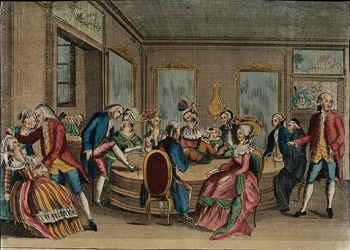
During this period, Mesmer became active in practicing his animal magnetism on the ever-growing crowds of patients that came to his home at the Hôtel Buillon. There, Mesmer perfected what he considered the ideal ambiance for his magnetic cures. In those elegant surroundings, Mesmer used music as an integral part of his therapy, which he now practiced on whole groups, not just single patients.Footnote 31 His rooms were thickly curtained and sombrely lit, shutting out the outside world so as to intensify the subtle sensations within. Several patients would sit in a baquet, a large tub containing bottles of water that could communicate the magnetic influence, as did ropes that joined the patients in a magnetic chain.Footnote 32 Deep silence prevailed, only whispering allowed, so that soft music provided by wind instruments, piano, and especially the harmonica could immerse the patients in all-pervasive musical magnetism. Mesmer used this music both to calm patients, when needed, but also to excite and disturb them when he felt it necessary to bring on the critical state he called a crisis. According to his follower Caullet de Vaumorel, Mesmer's patients responded very sensitively to these changes in the therapeutic music (see Fig. 1).Footnote 33
‘Le magnetisme animal’, coloured etching after Claude Louis Desrais (1746–1816), showing Mesmer's tub (baquet) and violinists in the alcove (upper right). Credit: Wellcome Collection

Consider, for instance, the integration of music with other modes of transmission of animal magnetism in the case of an army surgeon afflicted with gout, recounted by his friend Dr Le Roux, who brought him to Mesmer for treatment:
After several turns around the room, Mr Mesmer unbuttoned the patient's shirt and, moving back somewhat, placed his finger against the part affected. My friend felt a tickling pain. Mr Mesmer then moved his finger perpendicularly across his abdomen and chest, and the pain followed the finger exactly. He then asked the patient to extend his index finger and pointed his own finger toward it at a distance of three or four steps, whereupon my friend felt an electric tingling at the tip of his finger, which penetrated the whole finger toward the palm. Mr Mesmer then seated him near the harmonica; he had hardly begun to play when my friend was affected emotionally, trembled, lost his breath, changed color, and felt pulled toward the floor.Footnote 34
In this account, the effects of Mesmer's harmonica playing were even more spectacular than the tingling magnetism he seemed to project from his finger. When Mesmer treated his associate Charles d'Eslon by playing the harmonica or the piano to convey animal magnetism, d'Eslon begged for mercy because of the extreme intensity of the sensations he experienced.Footnote 35 Because of its intense effect, music seems to have had a more central agency in Mesmer's practice than merely being used ‘to stimulate patients’ receptiveness to their Mesmeric and “magnetic” therapies’, as Hadlock judged.Footnote 36
Alongside his increasingly flamboyant theatrics, Mesmer still thought of himself as a sober scientific investigator who sought to incorporate his practice of animal magnetism into a theoretical framework consistent with Newtonian science. In Paris, he consistently pressed for verification of his theories and clinical results from established scientific bodies; finally, in 1784 a royal commission headed by Franklin himself (and including Antoine Lavoisier) judged the results obtained by d'Eslon (acting as an exponent of Mesmer's methods) to be the product of suggestion. This did not, however, appreciably diminish the tremendous demand for Mesmeric treatments or the cachet of Mesmer himself, for whom Queen Marie-Antoinette arranged a sizable royal pension.
Not content with this extraordinary public éclat, Mesmer continued to press for scientific vindication and produced detailed case studies and theoretical writings that would prove he was no magician or mere purveyor of suggestion alone. For instance, his ‘Dissertation on the Discovery of Animal Magnetism’ (1779) ends with a list of 27 propositions summarizing his findings, particularly that ‘a universal and continuous fluid’ propagates ‘to other animate and inanimate bodies … the action and properties of Animal Magnetism’, which can be ‘intensified and reflected by mirrors, just like light’, and which ‘is communicated, propagated, and intensified by sound’.Footnote 37 In his official report on Mesmer's methods, Franklin noted the common belief that ‘to communicate the [magnetic] fluid to the piano-forté, nothing more is required than to approach to it the iron rod; that the person who plays upon the instrument furnishes also a portion of the fluid, and that the magnetism is transmitted by the sounds to the surrounding patients’.Footnote 38 If so, the transmission of ‘magnetism’ is really dependent on sound. Thus, Mesmer's use of the harmonica and other musical instruments informed his conclusions about the nature and propagation of animal magnetism. Conversely, the harmonica became strongly associated with the practice of mesmerism, so that when Théophile Gautier used an harmonica in his story ‘Avatar’ (1874) to allow a character to see the trembling rays of his heroine's soul, this music implicitly has Mesmeric force.Footnote 39
Composing the Mesmeric Crisis
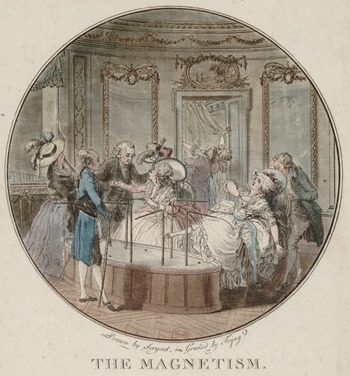
Mesmer used improvised music to prepare and bring on the crisis he considered necessary for each particular patient and case. In the case of the army surgeon quoted above, Mesmer used first his finger, then the harmonica to bring on the crisis, which here involved the patient's physical collapse under the effect of the musical mesmerism. Not all Mesmeric crises were violent; some could involve falling into a deep sleep, the somnambulistic state Mesmer called ‘critical sleep’, a restorative period from which the patient could re-emerge into health after processing the intense mesmeric drama.Footnote 40 In his 1799 ‘Dissertation on His Discoveries’, Mesmer described crisis in terms of the irritability of muscular fibres, expressing ‘a general law, that the activity of movement always requires an effort against resistance, and that this effort must be proportional to the existing state in order to overcome it. This effort is called crisis, and all the effects resulting directly from this effort are called the “critical symptoms”.’Footnote 41 Complementing his dictum that ‘no disease can be cured without a crisis’, next to his regular treatment room Mesmer had a mattress-lined ‘crisis room’ (chambre des crises) into which patients could be carried when they had reached the critical state and might become so violent or convulsive that they might do themselves harm (Fig. 2). Naturally, the sceptical and satirical press made much fun of the ribald possibilities that might lie behind – or be licensed by – the crisis room. By way of comparison, in 1780 Dr James Graham's Temple of Health, a fertility clinic in London, offered a ‘celestial bed’ inside which couples sought to conceive offspring, their coitus arranged as an ‘electrical operation’ influenced by a singer and ‘medical band’ composed of harmonica, organ, flute, and harpsichord.Footnote 42
Different stages of a Mesmeric séance; at the left, a lady is shown composedly conversing with a Mesmeric practitioner. On the right, the lady is shown going into crisis. The background depicts a later stage in her story: seized by convulsions, she is carried into the crisis room. Source: Laurent Guyot (1756–1806), ‘The Magnetism’, engraving after a colour aquatint by Antoine Louis François Sergent; courtesy Bibliothèque nationale de France

Mesmer's terminology located his concept of crisis in relation to the ancient Hippocratic tradition, in which a crisis could be the climax of a fever (for instance) understood as the turning-point of the illness, after which the patient would either recover or die. For a number of diseases, crises seemed to be periodic, as with the tertian or quaternary fevers, which would peak every third or fourth day, respectively.Footnote 43 For the ancient physicians, the crisis was an innate, fixed part of the nature of the disease itself as it unfolded in specific cases; the physician's task was to observe attentively this timing and do whatever might be appropriate when the critical moment came in order to bring about recovery, if possible. Galen and other ancient authorities limited the concept of ‘crisis’ to diseases with fever, which then was measured only by touch and less well-defined measures of heart rate and physical status.Footnote 44 Mesmer, in contrast, was engaged in artificially inducing and regulating crises even in chronic conditions that, left to themselves, might not for long or ever at all lead to such a critical state.Footnote 45 To do so, he also greatly extended the meaning to crisis to include maladies that did not necessarily exhibit fever. Describing Mesmer's practices, d'Eslon observed in 1780 that
if he undertakes to cure a madman, he will only cure him by occasioning fits of madness. The vaporous will have vaporous fits, epileptics fits of epilepsy, &c. The great advantage of animal magnetism thus consists in accelerating crises with no danger. For example, one may suppose that a crisis happening in nine days through Nature, left to its own forces, will be obtained in nine hours with the help of animal magnetism.Footnote 46
Mesmer's therapeutic practice used music in ways that followed the contemporary Classical style in both general structure and dramatic pacing. Baroque music had treated affects rather statically, as states to be contemplated rather than dramatized; its tonal procedures emphasized the ‘solar’ relation of keys to the tonic. In contrast, Classical key relations tended to be ‘polar’ and dramatic.Footnote 47 As Charles Rosen noted, a Baroque aria lessens tension towards its centre, whereas a Classical sonata intensifies it.Footnote 48 Similarly, Franklin used the harmonica not to sooth his melancholic listener but to intensify her sadness and bring her to cathartic tears. Mesmer deployed ‘magnetic’ forces dynamically so as to bring about the needed crisis that a ‘static magnetism’ could not provide. To be sure, Mesmer did not always use music in any given therapeutic session; sometimes merely his glance, touch, or even outstretched finger sufficed; in the judgment of the royal commission, suggestion was the essential element, rather than any putative fluid or magnetism.
Nevertheless, even when he used his hands or eyes without playing a musical instrument, Mesmer's therapy closely followed the same dramatic procedures he would have been familiar with in contemporary music and probably used when improvising at the harmonica. The musical art of his time provided him with the means and the methods by which psychic ‘magnetism’ – even if viewed as suggestion or deception – could be deployed therapeutically. Thus, Anton Reicha (1814) described the highest point of dramatic and musical tension in sonata allegro form as intrigue, ou le noeud [knot] (which later accounts called ‘development’), the moment of ‘catharsis’ according to neoclassical dramatic theory.Footnote 49 Even though none of Mesmer's (primarily improvised) compositions survive, the extant accounts of his playing emphasize its power without noting any stylistic peculiarities, hence implying its general conformity with common musical practices. Accordingly, he would have shaped the intrigue of his musical (and therapeutic) catharses according to the familiar rising dramatic arcs of sonata form or aria.
Opera may provide the clearest and strongest example of this kind of drama; Mesmer was steeped in it as far back as his involvement with Mozart's first opera. Indeed, Mozart's late opera Così fan tutte, K588 (1790) looks back on the astonishing career of his friend, Mesmer, reaching back to his own first opera. At the end of Act I of Così, after the scheming lovers Ferrando and Guglielmo fake suicide to trick their fiancées, the cynical Despina pretends to be a Mesmerist in order to ‘cure’ them. She shakes over their heads the ‘Mesmeric stone … which originated in Germany and then became so famous in France’, whereupon the supposed invalids ‘writhe about, twisting and turning, almost banging their heads on the ground’, seemingly in ‘Mesmeric crisis’. Despina's vocal trill mimes the waving of the magnet, which then causes sympathetic trills throughout the orchestra and in the bodies of the ‘suicidal’ lovers. At the height of the imbroglio, Mozart ironically appropriated Mesmeric trappings in order to precipitate his operatic ‘crisis’.
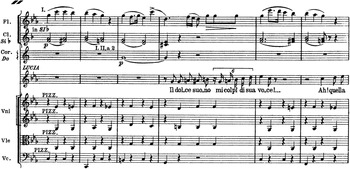
The ultimate expression of Mesmeric procedures might be Gaetano Donizetti's original version of the mad scene from Lucia di Lammermoor (1835), in which the harmonica accompanies Lucia's flight into madness (Fig. 3); though for practical reasons Donizetti later transferred this part to the flute, some performances have restored his original version.Footnote 50 Lucia identifies this instrument as ‘the sweet sound’ – literally the blow or shock (il colpo) – of the voice of Edgardo, her lover, who she imagines has come to wed her, though in her madness she had killed her bridegroom, Arturo.Footnote 51 Much attention has been devoted to this scene, including Hadlock's apt observation that this scene ‘recalls earlier scenes of Mesmeric “crisis”’.Footnote 52 To carry this general resemblance farther, I would add that Donizetti pointedly used the harmonica to lead Lucia to her own crisis, a transformation not induced even during her actual act of murder. What then was veiled in delusion emerges through the mediation of the harmonica, whose eerie sounds seem to act directly through or inside her, rather than as the effect of any external Mesmerist.
The beginning of the mad scene from Act III of Donizetti's Lucia di Lammermoor (1835; scene 5, 10 bars before rehearsal number 24); in the manuscript version, the ‘dolce suono’ was performed by an ‘armonico’ (as Donizetti spelled it), though the published score (shown here) uses a flute. Source: Milan: G. Ricordi, n.d.

Though presumably unfamiliar with Mesmer's theoretical writings, Donizetti's dramatic and musical instincts reflect Mesmeric procedures that had become widely known by 1835. Our understanding of this scene grows through every detail by which the harmonica induces and inflames Lucia's increasingly close absorption in Edgardo's ‘dolce suono’: for her, the harmonica is his voice.Footnote 53 Not only does the harmonica introduce the melody Lucia recognizes as Edgardo's ‘sweet song’ but it first presents the melody she sings at the climactic moment: ‘Alfin son tua, alfin sei mio’ (‘At last I am yours, at last you are mine’). Her complex recognition and transformation have received different interpretations in performance; in the subsequent cadenza, Diana Damrau chose to sing in dialogue with the harmonica, whereas Natalie Dessay sang the same material completely unaccompanied, as if the harmonica had been completely interiorized.Footnote 54 Here, the circle of influence closes: what began as a novel instrument that generated an eerie and sensitive new genre of compositions Mesmer adopted for his practice, now circles back to give Mesmeric overtones to Donizetti's dramaturgy.
From Crisis to Catalepsy
Mesmer's successors moved toward different domains of therapeutic experience and, in the process, recruited other methods for inducing ‘animal magnetism’, a term still in use in the 1880s, though the alternative term ‘hypnotism’, introduced by James Braid in 1843, gained traction during the nineteenth century.Footnote 55 These new methods – and terminology – reflected changing conceptions of the meaning of ‘crisis’. They also bore the clear influence of ways in which Romantic music used new instruments and dramatic procedures to effect ever more shattering dramatic effects.
Though he considered himself one of Mesmer's most faithful disciples, Amand-Marie-Jacques de Castenet, Marquis de Puységur, was troubled by the dangers of convulsive crises.Footnote 56 Writing in 1786, he thought the crisis room, ‘which one should rather call a convulsionary hell [un enfer à convulsions], ought never to have existed’ and was only forced on Mesmer as a makeshift to deal with crowds of patients.Footnote 57 In contrast, Puységur stated,
I do not mean by crisis a convulsive or disordered state: on the contrary, I mean a state of physical sleep, which has to be seen to give any idea: I dread the state of convulsions as much as anyone and believe that the true goal of a magnetizer should be to make them cease when they occur.Footnote 58
In 1784 Puységur had first produced in his Mesmeric patients a sleeplike state he called crise magnétique complette characterized by ‘all the most marked characteristics of somnambulism’.Footnote 59 As noted above, Mesmer considered ‘critical sleep’ just one among many of different sorts of crises that he manipulated. In contrast, Puységur and those who followed him preferred to use somnambulism, which allowed the use of post-trance suggestion without the volatile and possibly dangerous aspects of what he called crise magnétique or crise ordinaire, which he considered ‘incomplete’ by comparison.
Puységur himself tended to use the simplest means to magnetize, such as his voice or touch, even trees he had previously magnetized; he emphasized that the magnetizer's will was the real force at work. Still, in his commentaries he noted the particular efficacy of music and especially of the harmonica. He and Mesmer were always in accord ‘regarding the effect that music could produce on men’, though
this effect is more or less great because of their sensitivity, but all are susceptible of feeling it. There are those who assert they never felt such emotion; I can almost affirm that is more the fault of the musicians they have heard than a defect in their own organization for, in the end, any being whatever is sensitive in its own way and music, above all sung music, is only an emanation of sensitivity. Love, tenderness, gaiety, sadness, all the sentiments are expressed through words and song, and these two means combined must necessarily please all the world. It is beyond doubt that our nerves are the organs of our sensations. Music works therefore immediately on the nerves; and united with the agent of nature can give it a reinforcement that cannot be anything but favorable in the beneficial effect one wishes to obtain.Footnote 60
In one particular case history, Puységur noted that music ‘probably contributed to divide the nervous crises into a good number of periods, greater than had previously presented, and lessened their force in sustaining their duration’, from four seizures a day to only one.
This example well sustains the proceedings of M. Mesmer. The instruments that he played proved to effect the help that he felt could be drawn from music; and the choice of his instrument proves also his profound reflections. In fact, the harmonica can be considered as the reassembly of little electric plateaus [petits plateaux éléctriques] whose accumulated movement is manifested by sound, which, combined with animal movement, should produce very efficacious magnetism.Footnote 61
Indeed, for later nineteenth century practitioners such as Charles Richet (writing in 1884), ‘Mesmer was merely the initiator of magnetism, but not its true founder’, whom he identified as Puységur.Footnote 62 After attending Jean-Martin Charcot's famous clinic at the Salpêtrière, Richet went on to pioneering working in immunology that won him the 1913 Nobel Prize. For our purposes, though, Richet provides insight into the practices and attitudes of Charcot's circle, especially their interest in the extreme form of somnambulism called catalepsy. Richet recalled that
if, at a course at the Salpêtrière, one gives a strong stroke to a tam-tam [a type of gong], immediately three or four patients suddenly will stop, raising their arms in the air (for example) in a pose of fear, their eyes wide open; they will remain thus immobilized, frozen (so to speak) in that pose until one modifies the central innervation in one way or another. Their muscles thus are in catalepsy and one can immobilize them in such a position for an indeterminate time.Footnote 63
Such patients formed an important part of Charcot's investigation of what he and his disciple Paul Richer called la grande hystérie using la grand hypnotisme, part of what Anne Harrington has called ‘neo-mesmerism’.Footnote 64
While studying convulsive patients, beginning in 1870 Charcot and Richer sought to discriminate true epileptic crises from imitative simulations of those crises presented by some of their ‘hysterical’ patients. Indeed, Jules Claretie (director of the Théâtre Français) thought that ‘hysteria is the sickness of our century. One finds it everywhere’.Footnote 65 Here Lucia served as a potent example; Romana Margherita Pugliese has noted that
if it seems likely that Donizetti's opera and other staged representations of female madness informed Charcot's view of hysteria, it is almost a certainty that Charcot's displays in turn had an important impact on the culture of the Parisian operatic stage in the last decades of the century, sparking a resurgence of operas centering on the theme of madness and the creation of new hysterical heroines.Footnote 66
In 1878, partially under Richet's influence, Charcot began a systematic study of hypnotic techniques; using la grande hypnotisme, he found that some of his hysterical patients manifested what he thought an invariable series of stages, successively lethargy, somnambulism, and catalepsy.Footnote 67 In 1882, Charcot wrote that catalepsy ‘can manifest itself in the first instance under the influence of an intense sound, of a bright light placed before the gaze, in consequence of the prolonged fixation of the eyes on whatever object’.Footnote 68
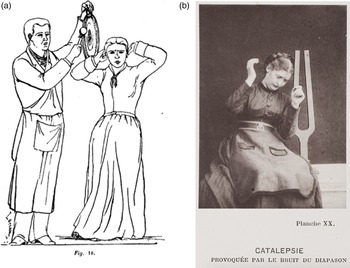
The tam-tam was a perfect source of such an intense sound and seems to have been widely used in Charcot's clinics to induce hypnosis (Fig. 4a).Footnote 69 In addition, Carmel Raz has insightfully discussed Charcot's use of gigantic tuning forks to induce catalepsy (Fig. 4b); though Charcot and his associates may have used (unpitched) tam-tams more commonly because they were more convenient, the tuning fork showed that even a simple octave could induce catalepsy.Footnote 70 One should note also that these manifestations characterized highly suggestible hysterical patients, rather than others, less suggestible and not marked by what Charcot called névroses. His associates Désiré-Magloire Bourneville and Paul Régnard noted that these manifestations
are not so well seen as in subjects already habituated to hypnotism: in fact, habit makes the névrosis much easier to develop. One day, one of our patients, G … , in playing with a tam-tam found in the laboratory let it drop and became cataleptic: no longer hearing it vibrate, one of the assistants found her immobile, fixed, and sleeping.Footnote 71
The ‘sudden and unexpected sound of a tam-tam’ used to induce catalepsy; 4b ‘Catalepsy provoked by the sound of an octave … The stopping of the octave instantaneously stops the catalepsy and ends the hypnotic sleep’. Source: Bourneville and Régnard, Iconographie photographique de la Salpêtrière (1879–80): 176–7.

Other kinds of music could have similar effects: ‘Another time, R … , hearing military music fell into catalepsy at a moment when the brass suddenly began a reprise in the middle of a very soft passage’.Footnote 72 On another occasion at the Salpêtrière, a dance was given to distract the patients but ‘a stroke on the bass drum had the effect of a gong and the dancers fell into catalepsy, frozen in sudden tableaux vivants’.Footnote 73
These uses of the tam-tam took place in a larger musical context. Though some French sources use the general term ‘gong’, most of those we have been considering use the more specific term ‘tam-tam’, which now denotes a broad circular metal percussion instrument that produces no definite pitch, whereas other gongs (often having a raised central boss) can produce a definite pitch.Footnote 74 First found in China during the Western Han period (second century BCE), gongs of various sorts are also found in Japan and Southeast Asia. The tam-tam was first introduced to France via the Jesuit missionaries in China; in 1784, Père Jean Joseph Marie Amiot (1718–1793) described this instrument in a letter to Henri Bertin, ministre sécretaire d’état, to whom he had sent a lo (gong); he had sent another ‘that makes even more sound’ to the duc de Chaulnes. Amiot added that ‘I think that such an instrument could be marvellous in your operas when one wishes to deafen or frighten the audience. It could also serve in studying the theory of sound and in demonstrating that each isolated sound has more or less perceptible harmonics, according to the nature of the instrument and the acuity of the listeners.’Footnote 75 As Gundula Kreuzer noted, ‘Amiot acted as a mediator between Eastern customs and Western science and art. His hope that the gong would be helpful in both operatic and academic contexts proved prophetic.’Footnote 76
The tam-tam entered the Western orchestra during the throes of the French Revolution in François-Joseph Gossec's Marche lugubre, first performed on 20 September 1790 at the Champs de Mars during funeral ceremonies for Revolutionary ‘soldier brothers who died for the maintaining of the law’.Footnote 77 As Raymond Monelle notes, there had been no ‘funeral marches’ as such in eighteenth-century military collections; this work by Gossec ‘set the standard for future funeral marches’.Footnote 78 Kreuzer judges that ‘the instrument could hardly have received a more prominent aural and visual introduction to Parisian society’.Footnote 79 Scored for winds, brass, and percussion, his march begins with muffled drum rolls, followed by disjointed brass and wind phrases. Often broken by dramatic silences, these plaintive semitone moans have scarcely any melody, in the ordinary sense. Suddenly a crash from the tam-tam initiates a fortissimo strain from the band. The sheer power and shock of these unfamiliar musical techniques created an enormous effect on its first audiences.
As contemporary reports noted, the tam-tam played a large part in the unprecedented effect of this music, which was played at a whole succession of grand Revolutionary funerals, including those for Mirabeau and Marat.Footnote 80 For Mirabeau's obsequies (1791), the historian Henri Martin described
an innumerable throng of people [who] followed and pressed around the procession, which filed through the streets until midnight, amid funereal music composed by the musician Gossec and to the sound of strange and terrible instruments heard for the first time in France – the trombone and the tam-tam. Modern history has no record of such funeral rites.Footnote 81
At the time, the official Gazette Nationale, ou le Moniteur Universelle wrote that ‘the lacerating harmonies, broken up by silences and marked by veiled beats of the tam-tam, truly chilled the public and “spread a religious terror in the soul”’. Another pamphlet, the Révolutions de Paris, wrote that ‘the notes, detached from one another, crushed the heart, dragged out the guts’.Footnote 82 When Gossec's Marche lugubre accompanied the ceremonies in which the remains of Voltaire were transferred to the Panthéon, the poet André Chénier wrote that ‘one heard from afar, in the horror of the darkness,/ The prolonged chords of funeral trombones./ The drum muffled for somber rolls,/ And the sad howls of the Chinese cymbal [timbre chinois]’, the tam-tam.Footnote 83 Through the double meaning of its ‘Chinese timbre’, Chénier made the oriental strangeness of the tam-tam, its lamenting howl (hurlement), the crux of this unprecedented outburst of mourning. Paradoxically, this ‘strange and terrible’ Chinese instrument unleashed the deepest patriotic emotions of the French.Footnote 84
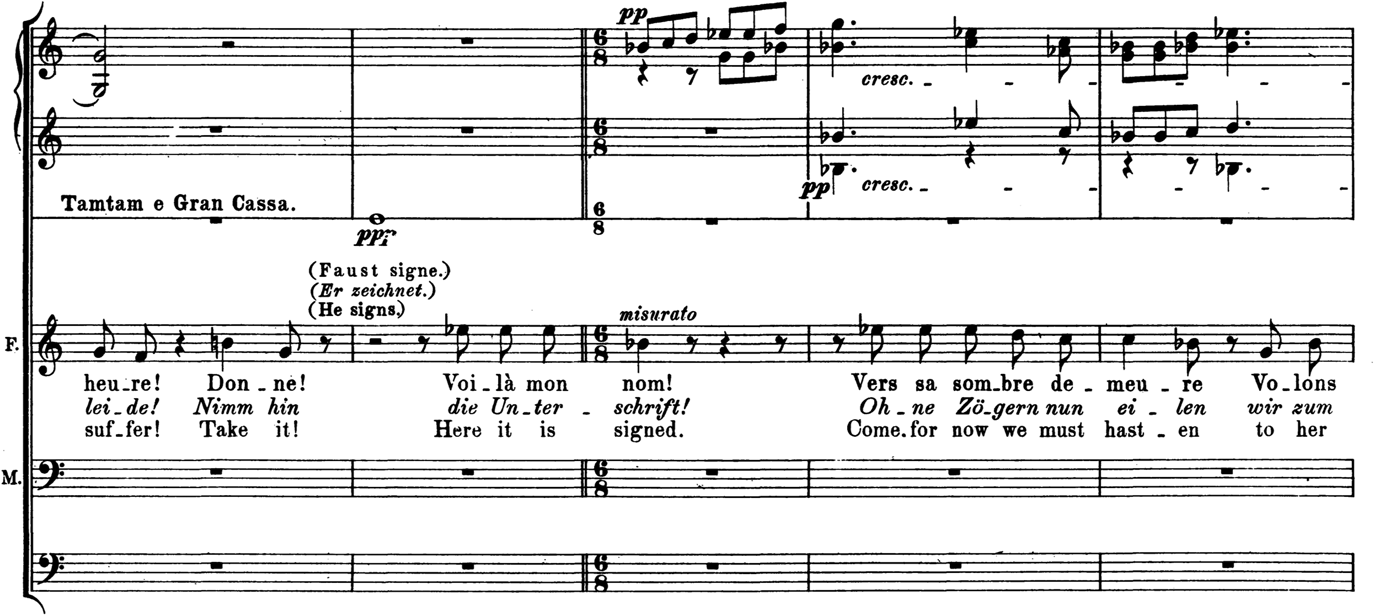
As Père Amiot had anticipated, the tam-tam went on to become a familiar orchestral instrument; indeed, one of the tam-tams he sent home found its way into the orchestra of the Opéra.Footnote 85 In France, the tam-tam would have been well known through its operatic use in Spontini's La vestale (1807), Bellini's Norma and Meyerbeer's Robert le diable (both 1831), and Halévy's La juive (1835). Hector Berlioz often used tam-tams (no less than four of them in his 1837 Grand Messe des morts); his Treatise on Orchestration (first published in 1844) specified that ‘the tam-tam, or gong, is used only for scenes of mourning or for the dramatic depiction of extreme horror. Played forte along with strident brass chords on trumpets and trombones, its tremor can be terrifying and exposed pianissimo strokes on the tam-tam, with their gloomy reverberations, are no less alarming’.Footnote 86 Thus, a tam-tam and bass drum add a pianissimo shudder to the moment in La damnation de Faust (1846) when Faust signs away his soul (Fig. 5), while a tam-tam hidden in Aeneas's shield makes a ‘long lugubrious sound’ when struck by Mercury's caduceus in Les Troyens (1863).Footnote 87
Berlioz's use of the tam-tam and bass drum to underline Faust signing away his soul in La damnation de Faust (Part IV, scene 17, bars 66–70). Source: Hector Berlioz Werke, Serie V, Band 11–12 (Leipzig: Breitkopf und Härtel, 1901).

In light of the many descriptions of the hypnotic effect of such tam-tam strokes, one might wonder how many of the members of Berlioz's audience (or for the other works just instanced) were really rendered cataleptic then and there. Indeed, theatrical representations of somnambulism and other dream states abounded in Paris during the 1820s, including Eugène Scribe and Ferdinand Hérold's ballet-pantomime La somnambule (1827), the source for Vincenzo Bellini's La sonnambula (1831).Footnote 88 As Sarah Hibberd has noted, La somnambule ‘evokes the atmosphere of a magnetic séance’, with the larger implication that ‘magnetism came to be perceived as infiltrating musical practices because both were believed to share an “inexplicable” power and a spiritual dimension’.Footnote 89 Then too, Scribe's theatrical structure for ‘well-made plays’ (pièces bien faites) emphasized the use of cathartic crisis and neo-classical Aristotelian peripetia (reversal) and became standard for grand opera.Footnote 90 The crash of a tam-tam, like such rhetorically charged harmonic devices as half-diminished chords, became staples of Romantic dramaturgy.Footnote 91 Yet even when no tam-tam was used, the ultimate musical response to ever-heightened Romantic music was a collapse into unconsciousness, as when the young composer Guillaume Lekeu fainted during an 1889 performance of the Tristan prelude and had to be carried from the theatre.Footnote 92
Despite the dramatic demonstrations of hypnotic somnambulism that convinced Charcot and many others, his work was surrounded by controversy. Charcot was well aware of what he called ‘intentional and deliberate simulation, in which the patient exaggerates real symptoms or creates an imaginary symptomology from scratch’, especially among hysterics, where ‘we encounter it with every step we take in the clinic of this neurosis and there is no denying that this accounts for the low opinion that is at times attached to the study of hysteria’.Footnote 93 Though he himself seemed unaware of any imposture, toward the end of his life Charcot became pessimistic about the fate of his work. Later it became known that many of his patients were in fact performing to his expectations, sometimes even coached by other patients or his staff.Footnote 94 Full judgment, however, requires weighing complex factors; as Harrington observed, ‘French asylum hypnosis and hysteria researchers exploited and manipulated their patients, but at least some of them were not a little awed by the results they were producing, and not a little susceptible to being manipulated themselves’.Footnote 95 Within a decade after his death in 1893, Charcot's teachings about hysteria were disowned by most of his disciples, among whom Joseph Babinski argued that hysteria was a result of suggestion and could be cured by ‘persuasion’.Footnote 96
From Crisis to Catharsis
Whether animal magnetism, hysteria, or suggestion are used to describe the phenomena we have been considering, their stages and processes have thoroughgoing analogies with the dramatic arc of musico-dramatic tension and crisis. These analogies were not lost on their contemporaries. Already in 1814 E.T.A. Hoffmann had asked: ‘May not the musician then behave towards the natural world surrounding him like the Mesmerist towards his patient, since his active will is the question which nature never leaves unanswered?’Footnote 97 Indeed, in his 1814 story ‘Der Magnetiseur’, Hoffmann's Mesmeric protagonist Alban expresses his disgust at violent crises and praised Puységur's approach, which he uses to exercise his dark mastery over the other characters.Footnote 98 Building on Hoffmann's connection between the musician and the Mesmerist, we conclude by considering the different modalities of hypnotism that span Mesmer and Charcot in terms of contrasting instrumentations and musical techniques.
In Franklin and Mesmer's hands, the harmonica could evoke moods and modulate between them in precisely controllable ways, its penetrating, high-pitched timbre seeming to play directly on the nerves, bypassing and even eclipsing the ability of reason to deal with the instrument's peculiar intensity. Yet even when he was using his hands or gaze without any sound, Mesmer's actions followed the ground-plan of musical dramaturgy, specifically that of the Classical style around him. The accounts of his practice emphasize his gesture and music but do not usually include any verbal instruction. The dramatic power of his actions was sufficient for his therapeutic ends; he used the harmonica directly to intensify or delay the impending crises of his patients without the need of verbal commands. In so doing, he acted so as to bring to a critical point factors already at work in each patient. To that end, the harmonica acted as a kind of psychic amplifier, capable of bringing forward certain themes in each patient, almost as a conductor might bring forward one or another voice within the orchestra.Footnote 99 Here, the dramatic arc of musical form is not just a metaphor but the immediate source on which Mesmer drew.
The tam-tam, in contrast, produces a diffuse, very wide (and generally much lower-pitched) spectrum of sound. The accounts cited above emphasize the surprising quality of its sound, its sudden and unexpected irruption into the subject's awareness, thereby precipitating an abrupt break with the previous state of mind. The sense of horror often associated with the tam-tam's sound in many of the accounts seem connected with its peculiar timbre, blending so many overtones in such a sudden, complex, and unfamiliar way. As Père Amiot had noted, the tam-tam demonstrates the physics of overtones through having a far broader spectrum (both in terms of pitches and their harmonics) than any other known instrument, blended into a single sonic experience. Perhaps the tam-tam might be best compared to a bass drum (with which it was so often paired, as in the Berlioz example in Fig. 5), which also is pitchless, producing a plethora of many low-pitched sounds blended together. Yet whereas the bass drum's boom dies away quickly, the tam-tam can sustain its complex crash for a long time so that the listener's attention cannot escape its surprise. By causing the whole range of hearing to fire simultaneously and sustainedly, the tam-tam evokes a kind of generalized seizure within the nervous system, what the mathematician and astronomer Rodolphe Radau described in 1869 as ‘an explosion of enormous tones’.Footnote 100 This prolonged stimulation can thereby interrupt any preceding state – thus the characteristic gesture of cataleptic arrest – yet render the hearer intensely aware and suggestible. This may be the underlying cause of the tam-tam's extraordinary effect, which is permanently strange not just because of its exotic origins but because of the instrument's innately arresting, disruptive effect. Even the original Chinese context relied on this effect when using a tam-tam as a solemn signal, a warning alerting officials of the exact rank of an approaching visitor.
Yet the contrast between these two hypnotic practices has even larger musical dimensions. Mesmer improvised music calculated to elicit the desired sequence of emotional responses leading to therapeutic crisis, following familiar Classical compositional procedures; Charcot sounded a tam-tam whose sonic effect seemed almost the opposite of musical composition, as understood in his time, disrupting mental states without developing a formal sequence of themes. The sound of the tam-tam rendered its subjects so far from their usual state, so suggestible that one understands anew why Puységur thought catalepsy a ‘complete crisis’ more far-reaching and powerful than purely emotional manipulation. If music was effective, sufficiently intense sound could be even more powerful.
The sounds and sights of his days in the Salpêtrière remained ‘indelible memories’ for Sigmund Freud, whose learned from Charcot ‘the genuineness of hypnotic phenomena and their conformity to laws’.Footnote 101 Freud probably witnessed for himself the dramatic effects in Charcot's clinic aroused by the tam-tam. The concept of therapeutic crisis remained important in Freud and Josef Breuer's ‘cathartic method’, which used hypnotic techniques to give access to hidden traumatic memories (eschewing direct treatment by suggestion).Footnote 102 Their method reflected widespread Viennese interest in the Aristotelian concept of catharsis (stimulated by an 1880 book by Jacob Bernays, the uncle of Freud's wife), as Juan Dalma has shown.Footnote 103 Even when Freud abandoned hypnosis and changed the name of his therapy to psychoanalysis, the essential structure of catharsis through crisis remained intact, though now mediated not by musical instruments, penetrating gazes, or direct suggestion. Still, Freud noted that he retained from hypnotism ‘my practice of requiring the patient to lie upon a sofa while I sat behind him, seeing him, but not seen myself’, a new form of therapy mediated mainly through sound: the ‘talking cure’.Footnote 104 Here, the sounds were those of human speech, not instruments; the therapeutic rapport and its suggestive power were constantly under analysis. To be sure, Freud confessed that he was ‘almost incapable of obtaining any pleasure’ from music because ‘some rationalistic or perhaps analytic turn of mind in me rebels’ when he could not ‘explain to myself what [music's] effect is due to’.Footnote 105 Nevertheless, his therapy retained the musical structure of crisis and catharsis he ultimately inherited from Mesmer and Charcot. If, as E.T.A. Hoffmann suggested, composers act as Mesmerists, so also did Mesmerists – and their successors in psychotherapy – act as composers, giving form to the crises and catharsis of their patients.