1. Introduction
Progress, far from consisting in change, depends on retentiveness . . . Those who cannot remember the past are condemned to repeat it.
George Santayana (Reference Santayana1906: 284)
Most social science approaches to path dependence emphasize the evolutionary dynamics of a social system or institution from a macro-level perspective. While it is recognized that individuals within the system are making decisions that may influence the evolutionary path, the focus of path dependence tends to be on the behavior of the system as a whole. Thus, for example, the ergodic equilibrium approach (Arthur, Reference Arthur1989; David, Reference David, Garrouste and Ioannides2000) focuses on whether perturbations to the evolutionary path of a system are likely to alter its long-run equilibrium outcome. Likewise, approaches that examine the inter-related notions of lock-in effects or of increasing returns to scale (Arthur, Reference Arthur1989; Pierson, Reference Pierson2000; Mahoney, Reference Mahoney2000) emphasize the branch-like structure of evolutionary paths, and the attendant consequences of early events. These concerns are reflected in the literature on institutions and path dependence where, as indicated by Hansen and Hansen (Reference Hansen and Hansen2007), questions of institutional persistence arise in the context of economics (North, Reference North1990), political science (Pierson, Reference Pierson2000), sociology (Mahoney, Reference Mahoney2001), and law.
This paper proposes a rather different approach to the notion of path dependence, one that focuses specifically on the micro-foundations of individual decision makers within a social system. This is essentially an information perspective on decision making, whereby knowledge of historical data (or, more broadly, narratives) may shape the decisions that individuals make. This perspective emphasizes the role (for better or worse), from an information perspective, that historical data may have above and beyond information that is already encoded in existing state variables. From this perspective, if a decision maker were to make the same decision with or without knowledge about the historical path, then we deem that decision to be path independent. This same notion can be articulated in a collective sense by examining the aggregate of decisions made by individuals.
There are many examples where this information perspective on path dependence arises in institutional settings. In the context of jurisprudence, it is common practice for a judge to ‘expunge the record’ of criminal offenders. The legal rationale for this is that public knowledge of the criminal record may be unduly prejudicial to the successful reintegration of a former perpetrator into mainstream society. This is especially common in the case of juvenile offenders who are considered to be deserving of a second chance (Kurlychek et al., Reference Kurlychek, Brame and Bushway2007). Likewise, medical records are commonly held to be private, especially where they might lead to unwarranted denial of health coverage. As yet another example, consider the case of an institution that seeks to fill the position of chief executive officer, and must decide whether to promote someone from within the organization or to hire an external candidate (Datta and Guthrie, Reference Datta and Guthrie1994). In all of these examples, the basic problem structure is the same: how, or to what extent, to incorporate knowledge of the historical path within the context of current decision making. That is the information perspective on path dependence explored here.
This proposed definition of path dependence emphasizes the information content inherent in institutional or societal structures. Such information regarding past paths need not be in the form of explicitly historical archival data or file records. Instead, implicit knowledge from the past may be inscribed, for example, in prevailing norms and practices. From the perspective of this paper, the relevant question is how (if at all) the availability of such historical data would alter decisions taken. That, for our purposes, becomes the appropriate measure of path dependence. The point here is not to argue for or against ‘expungement of records’. Rather, this paper seeks to define path dependency in terms of the degree to which such expungement would alter current decision making. To refer once again to the example of executive succession within a firm, this paper advocates neither for an inside candidate (i.e., one who is intimately familiar with the historical trajectory) nor for an outside candidate. Instead, it defines path dependency in terms of whether the inside–outside choice actually makes a difference, ceteris paribus.
This proposed information perspective on path dependence automatically raises questions of information bias. To the extent that including/excluding historical path data alters decision making, then those additional data would seem to ‘bias’ decision making for better or worse. Indeed, that is clearly the presumption behind several of the examples already discussed, such as privacy of medical records or expungement of criminal records. The notation introduced in this paper enables us to formalize this distinction in a rigorous manner. Moreover, as we demonstrate in some detail, the formal notation used here to define path dependency from an information perspective can also be used to clarify more traditional perspectives – some of which have hitherto been defined only rather vaguely. In this sense, the information perspective introduced here is not at odds with more traditional perspectives. Indeed, the formal framework and notation introduced here actually add clarity to each of these perspectives.
The next section begins with a seemingly simple chess analogy. The pieces on the chessboard comprise the state of the system at any given point in time. While the ‘system’ evolves move by move, one might expect that players typically make their moves based largely or even entirely on the existing configuration, rather than on the path per se. This analogy is worked out in some detail in the next section, where we see that even in such a highly constrained and formalized decision environment, issues of path dependency are not as simple as they might first appear. This chess analogy is then further extended to other institutional examples where similar notions of path dependency arise. Building on these examples, the next section after that introduces a formal notation for defining path dependence in an information-laden decision context. This is done initially for a single ‘player’ game in order to simplify the definitions and concepts as much as possible. Following Page (Reference Page2006), we also introduce a closely related notion of ‘phat dependence’, where knowledge of prior states matters, but not the order in which they appear. That section also describes the evolutionary progression of states that results from a sequence of such decisions.
The section following that expands the notation in a fairly straightforward manner to encompass multiple player ‘games’ that are more akin to collective decision making, including those in an institutional context. The penultimate section compares this micro-oriented decision-making framework for path dependency with other more common uses of the term, including ergodic equilibrium, increasing returns to scale and lock-in effects, and the more generalized notion of ‘history matters’. I re-express each of these using the same notation introduced earlier in the paper in order to enhance the comparability between these distinct notions of path dependency. The final section briefly concludes with a summary of the implications of this decision-based perspective on path dependency, with particular reference to institutions and implications for future research agendas.
2. A chess playing analogy
Suppose that an accomplished player were to enter a room where a game of chess was already well underway, with two opposing players locked deep in contemplation over black's next move. As she stops to watch, she herself begins to ponder what is the best next move for black. She has ample time to take in the location of the pieces on the board and to reflect on the overall position. We assume the game has progressed well beyond any of the routine set opening positions that accomplished players would be familiar with and so the current position is essentially a unique one. Now the question: Would we expect this observer to be able to formulate a better next move for black if she had a complete transcript of how the game had arrived at its current position? This is the information perspective on path dependency that I wish to explore here.
There are several clarifying points to be made. First, in chess (as in life) there is of course generally no clear absolute standard at any moment in the game by which to judge which move is best. Two accomplished players may agree on a wide range of options but may nonetheless hold different views about what single move is best called for in any given situation. Indeed, that is largely what makes chess such an endless source of fascination for many devotees. More to the point, for our purpose, is the meaning of path dependency within the context of this chess analogy. The issue here is whether the current position – as inherited from history – contains all the information our knowledgeable chess observer needs to assess for herself what the best next move is. Or, to restate the problem in equivalent terms, we may ask whether knowledge of how the current position was arrived at would enable her to provide a more satisfactory recommendation (from her perspective) of the best next move for black. That is, does the historical record contain effective informational content above and beyond what is already inscribed in the current position?
There is ample reason to believe, at least for the case of chess, that the relevant history is fully encoded in the existing array of pieces. Indeed, it is common in chess textbooks to see an analysis of a game ending with a statement that the current position is a transposition of some other variation that has already been analyzed at length. The clear implication is that because the two positions are the same, there is no reason to replicate the forward analysis, even though the position was attained via two distinct paths. A similar reasoning holds true in mathematics, where one often sees proofs of theorems obtained by demonstrating that one proposition is equivalent to another which has already been proved. This logic is underlined in the following joke that only a mathematician or kindred spirit would find humorous:
A fire marshall conducts an examination of two would-be deputies, one of whom is a mathematician. Turning first to the other candidate, the marshall poses an examination question:
• Fire Marshall: ‘Suppose there were a bucket of water here on the desk, and a basket of waste paper on the floor. If you saw that the waste paper basket was aflame, how would you respond?’
• Candidate 1 (after reflecting carefully upon the problem): ‘I would pick up the bucket of water from the desk, and I would use the water contained therein to douse the flames in the waste paper basket on the floor.’
• Fire Marshall: ‘Excellent! Your answer is correct, and I hereby appoint you as a deputy. Now, [turning to the mathematician] here is a question for you. Suppose there were a bucket of water on the floor and a basket of waste paper beside it. If you saw that the waste paper basket was aflame, how would you respond?’
• Mathematician (immediately): ‘I would pick up the bucket of water and place it on the desk, thereby transposing this problem into one that has already been solved!’
Now, how might this reasoning apply to questions of history more generally? From the broader social perspective, how important is it for one to know how it is we arrived at any given juncture? Or, to what extent is the necessary information about our next ‘best move’ already codified or inscribed in our current position? Of course, one may be justifiably wary of using a narrow chess metaphor to capture the rich complexity of our social existence. But, in fact, even the chess metaphor is not as straightforward as it might first appear. Additional subtleties are brought out nicely by a reported commentary by the famed Mikhail Botvinnik regarding two of his successors as World Chess Champions in the mid-twentieth century, Tigran Petrosian and Mikhail Tal. Petrosian was known for his cautious and patient style, which emphasized strong defense and waiting for his opponent to err before striking. Tal, on the other hand, was famous for his fiery attacking style, with which he completely overwhelmed lesser opponents. Botvinnik's advice was that if you are playing against Petrosian and he sacrifices a piece, you might as well resign at that moment. The implication, of course, is that Petrosian would not make such a bold move unless he was absolutely certain that it would lead to a win. On the other hand, advised Botvinnik, if you are in a similar position against Tal when he makes a sacrifice, keep playing, for he is sure to make another one soon!
Thus, it would appear that we have introduced a different element into the problem – that of the players’ respective characters. If one is opposing a temperamental player such as Tal, a given configuration of pieces may have a different significance than it would if the opposing player were a patient, careful player such as Petrosian. Even if one were to accept this point, however, it may not be immediately clear how this applies to historical content. The answer lies in the very method by which character is revealed and known. How did Botvinnik make his judgements about his two colleagues if not by an assessment of a transcript (in his case, obtained in large measure through direct competition) of their past play? Thus, the current position has a meaning that may in general be more fully understood through knowledge of the historical transcript. This brings us full circle to the question of path dependency from an information perspective. By this reasoning, path dependency occurs whenever the full meaning of the current situation requires an historical reading that cannot be conveyed through the existing disposition of ‘pieces’ (or ‘artefacts’ or ‘signifiers’) alone. It follows from this that, conversely, a situation is not path dependent whenever the historical record is fully and legibly inscribed in the present. For example, in the chess analogy just described, if it were possible somehow to judge from the current disposition of pieces alone these crucial insights into the players’ characters, then we could claim that the chess game underway is not path dependent. Botvinnik's insight, however, leads one to believe otherwise.
3. Extending the chess analogy to an institutional context
While the chess analogy is useful for illustrating the information perspective on path dependence, for our purposes it is important to extend this same logic to a more formal institutional context. One such example cited earlier is that of criminal record expungement in the context of jurisprudence. As one author describes it:
The accurate recording and maintenance of society's records is commonly thought to memorialize current events for future benefit . . . There are, however, disadvantages to some parties when records of their encounters or deeds are not favorable. In those situations, a party may prefer to suppress, eradicate, or seal those records to make them unavailable in the future. When those records are kept by the United States government, the erasure of those records is generally referred to as record expungement. (Frenkel, Reference Frenkel2000: 1)
The rationale for expungement is the ‘collateral consequences’ that may result from past misdeeds, as the former offender may be denied access to voting rights, school loans, and housing or employment opportunities (Kurlychek et al., Reference Kurlychek, Brame and Bushway2007). These concerns must be weighed against the rights of third parties to be appropriately informed about the past records of those with whom they might engage. Judges are often provided wide discretion over such expungement decisions. The problem, however, is that judges are not given clear guidelines for making such determinations (Funk and Polsby, Reference Funk and Polsby1997). The inevitable result is a lack of consistency in the manner in which such discretion is applied, which in turn raises serious horizontal equity concerns.
Note that this problem context has an underlying structure that is highly similar to the chess analogy just described, yet with some subtle differences. The historical path or record of past ‘moves’ in this case corresponds to the past criminal record in question. The issue is whether to make this past record available to the general public, including for example landlords who might factor such data into their own decisions about whether to lease an apartment or not. In the chess example, the role of ‘general public’ was embodied by the third party who was casually observing the game after it had already begun. In that example, there was no dilemma over whether or not to release the game transcript, as it was not deemed to be important since the observer was not a formal participant in the game. In the case of expungement of criminal records, however, this question is of central importance. In both cases, the information perspective on path dependence is highly pertinent.
Another example already cited is privacy of medical records. Here again we find concerns regarding the extent to which (and to whom, and under what circumstances) medical histories should be made available. On the one hand, incomplete access to fragmented medical records may hamper the ability of examining physicians to completely and accurately diagnose a patient's current state of health (Mandl et al., Reference Mandl, Szolovits and Kohane2001). On the other hand, there are serious concerns regarding a patient's rights to privacy over his/her medical history. For example, Hoffman (Reference Hoffman1991: 590) points to ‘a professional consensus that a significant percentage of cancer survivors are denied job opportunities solely because of their medical histories, regardless of their individual qualifications for the position’. For this reason, federal and state laws prohibit discrimination based on past histories. For example, Section 503 of the Federal Rehabilitation Act of 1973 allows employers to conduct pre-employment medical examinations ‘only to learn job-related information’ (Hoffman, Reference Hoffman1991: 593).
In this case, the nature of path dependency is comparable to previous examples, but with some non-trivial distinctions. Returning to the chess example, the person who begins to observe a game that has already begun is analogous to a medical doctor who examines a patient for the first time. The patient's current observable health characteristics and symptoms (if any) correspond to the position of pieces on the chess board mid-game. Just as there is a sequence of past moves that gave rise to the current game position, there is a prior medical history that results in the ‘body of evidence’ seated in full view. As before, the question arises as to the circumstances under which the past record should be revealed. In the case of expungement of past criminal records, it is a third-party judge who is empowered to make such a determination. In this case of medical records, however, many would argue that it is the patient himself who should make this determination.Footnote 1 The issue of fragmented medical records discussed above, whereby any one physician is able to gain only a partial view of the patient's overall medical profile, is more akin to an observer of a chess game, whose view of the current position is partially obscured. This is less a concern with the historical path, and more an expressed desire to integrate information and perspectives horizontally, or ‘across the board’.
As a final example, consider the case of corporate executive succession. One of the classic problems discussed in the organizational management literature is when to hire an internal versus external candidate for the position of chief executive officer. A standard explanation derives from the ‘adaptive’ view, whereby organizations that are doing well will normally be inclined to seek an internal candidate, while firms doing poorly, and thus in need of adaptation, will opt for an external candidate (Datta and Guthrie, Reference Datta and Guthrie1994). As Cannella and Lubatkin (Reference Cannella and Lubatkin1993) explain, one rationale for firms to behave in this way is that firms are ‘rife’ with implicit contracts, and internal candidates are much more likely to be cognizant of and, perhaps, personally committed to them. By recruiting an external candidate for CEO, a Board of Directors can in effect abrogate these implicit contracts. This raises the issue of the information bias that may be inherent in any record of the historical path. Based on this standard explanation of executive succession, we may say that the Board of Directors is aware of this information bias and, depending on the firm's circumstances, may decide to deploy that information bias strategically through an inside versus outside hire. In terms of the chess analogy, this recalls Botvinnik's insider perspectives on his opponents’ styles of play.
4. Path dependence in a single player game
I now seek to formalize ideas from the chess playing analogy to incorporate notions of path dependence in a purposeful decision-making framework. The objective is to formulate a model that can apply equally well to issues of legal expungement of criminal records, privacy concerns regarding past health conditions, CEO executive succession, and any other institutional situation that display a similar foundational logic. The objective here is not to ‘resolve’ any such issues; for example, it is not necessary to take a stand here either in favor of or against expungement of criminal records. Instead, the aim is to set out a formal model that in turn can provide a rigorous and explicit framework within which further work may be undertaken.
At the core of this model lie decision maker(s) who seek to optimize their respective objective [game] functions in the context of a generalized information environment. In what follows, we begin with a simpler version of the model with only a single decision maker who seeks to carve out an optimal trajectory, where any trajectory is defined by an evolving sequence of values for a given state variable, st, and where the subscript t is a discrete measure of time. We then proceed to the case that corresponds most closely to the chess analogy: that of two interactive players who alternate in adding to the sequence of changes to the evolving state variable. In the case of the two chess players, the relevant values of the state variable must include (but need not be restricted to) the current position of the chess pieces at time t. In our final version of the model, we generalize further to allow for multiple players each contributing through their actions each period to modifying the progressive values of the reference state variable. In each of these three cases, what distinguishes this overview of basic game theoretical precepts is our explicit linkage to the literature on path dependence. This allows us to shed a clearer light on the extent to which ‘history matters’ in the context of generalized decision making over time.
In each time period t, the fundamental decision facing a ‘player’ is to select one ‘move’, m, from among the set of all feasible moves, {m}. This action results directly in a transition from the current value of the state variable, st, to a uniquely determined subsequent value, st +1. That is,

We may infer from this that there exists a set st +1, comprising all possible values of the state variable in the next time period. We assume that m is time invariant, so that m(st) = m(st′) whenever st = st′. In judging which move to make, our player applies an evaluation criterion G(.) to all possible moves, where G(.) may be thought of as a generalized game strategy that incorporates both an objective function and expectations of how the future might evolve. Using a hat (^) here to denote what the player actually judges to be the best next move (and associated outcome) under the assumption of full information regarding the historical path, the decision can be expressed as follows:

where (s 0, s 1, . . ., st −1) indicates a specific time sequence of outcomes for state variables from all prior periods. The right-hand side of equation (2) describes the task facing the decision maker, which is to select the best from among all possible moves. The best move,  , is that which receives the highest valuation, and thus by definition
 for all other possible moves. Also by definition we have
 , which reminds us that evaluating any move m(st) is equivalent to evaluating the future state st +1 that it leads to. The decision in equation (2) is made in the context of complete information about the historical path leading up to this decision point.
Following Page (Reference Page2006), we distinguish between path dependency and phat dependency. As his clever anagram suggests, and as we shall explain below in more detail, phat dependency – unlike path dependency – is not concerned with the particular order in which prior states occurred. We begin first with path dependence, which we define (negatively) in terms of its opposite – path independence. In our context, path independence arises whenever knowledge of prior states would not alter the player's judgement regarding the next best move. Let ṁ be the move that would be selected by the player in the absence of any knowledge regarding the historical path, and likewise denote ⋅t + 1 as the corresponding next state. Then we have:

The right-hand side of the expression above indicates what the player would judge to be the best next move based solely on the current value of the state variable, st, with no reference to past values. Path dependence therefore arises whenever  .Footnote 2
Phat independence is a weaker form of path independence. The key distinction is one of sequence. Let Ht −1 represent the set of all possible paths (where any one such path may be designated as ht −1) of length t that contain the same elements as the given historical path, but in any sequence. Let  denote the move that the player selects given some ht −1 ε Ht −1. Then we have

If  for all sequential variations of the given historical path, then phat independence applies; otherwise the decision context here is phat dependent. Note that path independence implies phat independence, because if any path at all is allowed (as in the case of path independence), then certainly any path that is a ‘temporal anagram’ of some reference historical path would also be allowed. Note also that, because path independence implies phat independence, the negative converse is also true: phat dependence implies path dependence.
It may be instructive here to revisit the fire marshal joke told earlier. The mathematician had observed the other candidate make the right move,  , where st represented a state wherein the bucket of water had already been placed on the desk. The question posed by the fire marshal to the mathematician, however, was cast in a slightly different state, ⋅t, wherein the bucket of water had instead been placed on the floor. The mathematician's response, therefore, was to select a move, ṁ(⋅t) such that st = ⋅t + 1 = ṁ(⋅t)Footnote 3. Thus, the problem was reduced to one that had already been solved. Clearly, his next move would be
 which, because of the time invariance of m, is equal to
 . It is also clear that the decision context here is path (and therefore also phat) independent, because the mathematician was only concerned with st, and not with any prior states.
Returning now to the more general formulation of the single player problem, we may inquire about the value to be derived from knowledge about the historical path. Perhaps history matters, but how much does it matter? And to whom? This is where the explicit decision-making context is most helpful. Our focus in this example is on the lone decision maker, and, if history matters, it should matter to him. The key lies in the evaluation criterion G(.) that comprises the core of equations (2) through (4). In the context of our decision maker, this generalized formulation is the basis for determining what matters. It is not necessary at this point for us to know precisely what the internal structure of G(.) is. It is sufficient for us to acknowledge that the decision maker has some basis for determining how to evaluate all possible moves and attendant outcomes in a generalized decision environment. In this sense, we respect his autonomy.
We have seen already that path dependence manifests itself through the decision process. Recall that, by definition, for all m ε {m}, including ṁ(st) – the move that would be selected by the decision maker in the absence of any information regarding the historical path. This leads immediately to an obvious measure of the extent to which history matters in the context of this decision:

The right-hand side of equation (5) is simply the extent to which is judged by the decision maker to be better than ṁ, where the basis of evaluation is the same game-strategic perspective that underlies the choice of moves in the first place. Thus,  is essentially a measure of the shadow price of information regarding the historical path, and it derives from the purposeful context in which our individual decision maker operates. He is trying to make a good move, and so information about the past has value to the extent that such knowledge helps him to do so (in his eyes). is also a reasonable measure of path dependence in the micro context of this decision. If is small, it tells us that the extent of dependency, or the consequence thereof, is likewise small. And in the limiting case where is zero, the decision is path independent.Footnote 4
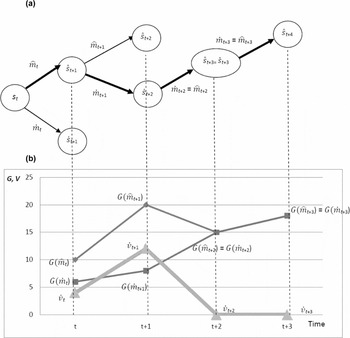
Thus far, we have focused on a single decision mt being made at a particular point in time. It is a sequence of such individual decisions (mt, mt +1, . . . , mt+k, . . .) that leads directly to an evolutionary progression through a corresponding sequence of states (st +1, st +2, . . . , st+k +1, . . .) in a single player game. The heavily shaded line in Figure 1a illustrates one such decision path sequence, beginning at some initial decision state st. The ‘location’ of the various states delineated here are quite arbitrary; the relationships shown are topological only. Note that two distinct moves are shown at the first juncture point,  and ṁt, leading to two respective distinct states, ŝt + 1 and ⋅t + 1. These are not equivalent moves, and so we know (by definition) that path dependency applies in this instance. Also, because the heavily shaded line in this case moves along , we know that the decision maker in this example did have information regarding the historical path that led up to st.
Valuation of historical data in a path sequence

Figure 1b graphs Ĝt from equation (2), Ġt from equation (3), as well as the difference between these two values, t, as defined in equation (5). In the case of a single player, there is a direct correspondence between these values shown in Figure 1b and the sequence of moves in Figure 1a. So, for example, we already know that the first decision point exhibits path dependence, and therefore Ĝt > Ġt and so t > 0. The same conditions apply at the next decision point; however, from Figure 1a we can see that historical data were not available to the decision maker at time t + 1, and so the next move is ṁt + 1, as indicated by the heavily shaded line linking ŝt + 1 to ⋅t + 2. At the next decision point, at time t + 2, we see that  as both lead to the same state (ŝt + 3 = ⋅t + 3), and so this decision event is path independent. It follows immediately that t + 2 = 0 in Figure 1b. The final decision shown in Figure 1a, at time t + 3, is similar in character to the previous decision at time t + 2, and so we need not discuss it further here.
Now we are in a position to define path dependence in terms of an evolutionary progression of states, rather than at only the point of a single decision, as we have done thus far. Let St,k = (st +1, st +2, . . . , st+k) for k ≥ 2 be defined as the sequence of states that results from a corresponding series of k moves beginning at time t. The evolutionary progression encapsulated in the sequence St, k is strictly path independent if and only if the sequence of states is invariate to information the decision maker may (or may not) have about past states. Likewise, the sequence St, k is strictly path dependent if and only if ⋅t ≠ ŝt at each step. In the case of a single player, this is equivalent to the condition that t = 0, as shown in Figure 1b. In this example, we see that the entire sequence St,3 is not strictly path independent, but the final portion of that sequence, St +2,2, is. Likewise, St ,3 is also not strictly path dependent, but the initial portion, St ,2, is. We may thus say that the full sequence, St ,3, is weakly path dependent.
5. Multiple players and path dependency
The previous sections described a single player making moves in isolation. A more general formulation would allow for multiple players acting simultaneously and with possible interactive effects. This can be incorporated into our general formulation with only a few adjustments to the notation and interpretation used above for the single player case. We begin with a modified version of equation (1), defining the process by which players’ moves result in the progression from one state to the next.
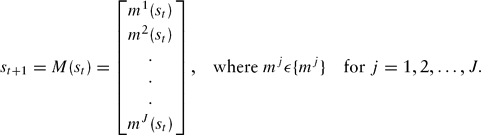
In this general formulation, no single player solely determines what the next state will be, and so we no longer have a one-to-one correspondence between individual moves and next states. For this reason, it is helpful to delineate individual decision path dependence from state path dependence. This distinction will be made clearer in the discussion to follow.
The chess game may be thought of as a special case of the multiple player game, where J = 2, and where

In the chess game, the two players alternate in determining what the next state will be, so in this sense the play is not really simultaneous. Examples of more general multiple player games in simultaneous mode include:
• competing factions within an institution,
• pedestrian movements through a crowded space,
• a market auction where several bidders can vote at once,
• foxes chasing rabbits, or
• discourse at a roundtable forum.
It is no coincidence that these examples are also, at least in principle, conducive to agent-based modeling simulations.Footnote 5 All ABMs are characterized by a progression of states that move forward in discrete timeFootnote 6 as a result of decisions made by the agents populating the model.
Although the multiple player setting is more involved than the single player case, the locus of decision making still resides with individuals. Thus, a modified version of equation (2) can be used to characterize the decision made by any individual agent in a given time period t:

This individual decision for player j may entail complex conjectural variations regarding the likely or presumed behavior of the other players, and those players may be collaborative, competitive, or indifferent in their attitudes towards each other. Any such considerations are all part and parcel of Gj, which encapsulates the jth player's strategic evaluation of the set of possible moves at his disposal. As before, we may also introduce the multiplayer analogue to equation (3), which formulates the same decision, but in the absence of knowledge regarding the historical record:

Then, as before, we define path dependence with reference to an individual decision based on whether that player's move choice differs under these conditions. We may say that decision path independence for player j occurs whenever  . Likewise, analogously to equation (5) we define tj ≡ Ĝtj - Ġj, and as before tj = 0 corresponds to path independence for (in this case) the jth decision maker.
The depiction in figure 1a of an evolutionary progression through sequential states still applies in the multiple player case. One need only replace and ṁt in figure 1a with their multiple player counterparts, and ṁt, respectively. That is, instead of a single player's moves determining the evolutionary progression, the sequence of states is the result of many players’ simultaneous moves each period. As before, the state sequence St +2,2 is characterized by state path dependence, where the progression from st +2 st +3, and then again from st +3st +4, is the same regardless of whether individual decision makers had information about prior states. There is, however, no longer a strict correspondence between state path independence and decision path independence. While the decision path dependent condition tj = 0 for all j is sufficient to ensure state path dependence, it is not a necessary condition. One must allow for the possibility that one or more players might make different decisions in light of information on past states (i.e., we may have
 for some j), yet those individual variations might cancel in the aggregate.
6. Contrast with other definitions
Ergodic equilibrium
It is instructive to compare this definition of path dependence with definitions that have been put forward by others. Paul David defines path independence of an evolutionary progression of states in terms of the long-run equilibrium to which such a sequence ultimately converges. Specifically, he states that path-independent processes include . . .
those whose dynamics guarantee convergence to a unique, globally stable equilibrium configuration; or, in the case of stochastic systems, those for which there exists an invariant (stationary) asymptotic probablity distribution that is continuous over the entire feasible space of outcomes. (David, Reference David, Garrouste and Ioannides2000: 4)
We may use a simple example of a helium filled balloon to convey an intuitive sense of how David's definition may be operationalized. The ‘skin’ of the balloon is heavier than air at sea level, while the helium contents are lighter. Depending upon the ratio of one to the other, we might quickly compute the equilibrium altitude to which the balloon will converge.Footnote 7 We can introduce a stochastic element by recognizing that the atmosphere is full of active molecules that are in constant motion, and so it is appropriate to think of the limiting altitude of the balloon not in terms of a single point of convergence, but instead to an ergodic (or, perhaps, ‘air-godic’) limiting distribution. Now suppose that in a fit of playful glee a young child pokes at the balloon during its initial assent, thereby disrupting its journey somewhat. Eventually, however, the balloon breaks loose and continues to rise. If this diversion somehow causes the balloon to now converge to a different ergodic limit than in the prior example, then by David's definition we would say that this evolutionary process is path dependent. Or, as he aptly puts it, his definition of path independence implies that (in this example) the balloon eventually ‘shakes free’ from the disturbance introduced by the young child. This analogy has obvious parallels in the literature on institutional convergence (Hölzl, Reference Hölzl2006) and determinism (Crouch and Farrell, Reference Crouch and Farrell2004).
David's definition of path dependence is inherently different from ours in at least two important respects. First, his focus is on the long-run equilibrium of a process while ours is on the path itself, or specific segments thereof. From a social science perspective, both have validity. For example, one may be legitimately concerned with the extent to which institutions are robust in their tendency to converge to equilibrium values, and David's emphasis is consistent with such concerns. At the same time, in many cases the main focus of inquiry may be on the day-to-day or year-to-year activities that make up much of life as we know it, with long-run equilibrium being a more peripheral concern.
The second difference between our definition of path dependence and David's is even more fundamental. Ours is specifically linked to institutions or other social systems – the balloon example does not fly, so to speak, in our case because no one is making any decision.Footnote 8 In addressing path dependence in the context of institutions, our premise is that the focal point must be on the people whose activities are being analyzed. There is nothing intrinsically institutional about David's definition of path dependency; it would seem to apply to helium filled balloons as readily as it does to institutions. Likewise, in Scott Page's (2006) highly insightful and instructive use of ball and urn models to describe path dependent processes, there is no need for people other than to have someone pick balls out of urns. The dynamic processes he describes are indeed stochastic, and they display interesting Markov-type behaviors, but they are not intrinsically decision oriented – nor do they purport to be. As a consequence, the micro foundations of such models, to the extent they are explored at all, are those of random events, which may or may not reflect agency or other social behaviors within an institutional context. Our definition, in contrast, rests on the premise that the fundamental focal point for the behavior of institutions is the point of decision for those individuals who are embedded within them. Accordingly, that is precisely where we introduce the notion of path dependence, and we then work up from those micro foundations to provide a definition of path dependency over the evolutionary sequence of an institution or other social system that is thrust forward from one state to the next by the specific path-dependent behaviors at the level of individual decision makers.
Lock-in
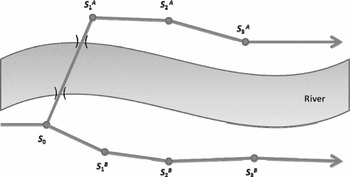
Another common perspective on path dependence is that of the lock-in effect, where QWERTY is the prototypical example. At first glance, there would appear to be some parallels to our definition of path dependence insofar as lock-in manifests itself at the level of decision maker. That is, the vector of payoffs confronting the decision maker has been altered by the historical path that has led to the current QWERTY ‘regime’. Likewise, North (Reference North1991) and others emphasize the institutional constraints upon individuals within those institutions. Upon closer examination, however, it becomes apparent that the lock-in effects attributable to QWERTY do not give rise to path dependence as we have defined it here. To explain this distinction it is helpful to refer to figure 2, which shows two possible historical paths leading up to the current time period, presumed here to be t = 2. A crucial historical juncture is located two periods earlier, at some initial state s 0.
Historical paths and lock-in effects

The lock-in phenomenon described by the QWERTY and similar examples is predicated on a branching decision structure. In figure 2 this is portrayed literally as a fork in the road as one progresses beyond the initial state s 0. At that crucial juncture, our protagonist decided to cross the river, thereby setting out on the ‘A’ path. Following this path for two periods led us to the current position at sA 2. Had the initial decision instead been to proceed along the ‘B’ path (a counter-factual proposition at this point), then we would have likely found ourselves now at sB 2. So, how is the ‘lock-in’ effect represented here? It is evident that the crucial decision at the initial state has fundamentally shaped our traveller's evaluation of the payoffs associated with possible next moves. In particular, the natural best next move would appear to be sA 3 = m(sA 2). A symmetrical consideration applies, however, to the counter-factual case. That is, if one were to find oneself at sB 2, then the natural best next move would be sB 3 = m(sB 2).
This is not path dependence; it is state dependence. The payoff profile at t = 2 is very much shaped by the fact that an early decision was made to embark upon the ‘A’ path. As a direct consequence of that earlier decision, it is certainly true that the state sB 3 is much less attainable from sA 2 than it would have been from the counter-factual position at sB 2. We can formalize these statements a bit using the notation introduced earlier. First, we describe the move, m, by which a voyager at sAt or sBt would normally progress along the indicated path in a routine manner:
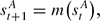
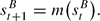
In contrast, we can define an alternative set of moves (μ) that would seem to defy the barrier imposed by the intrinsic branching structure of the decision tree. Namely:


In our example, for the traveller who finds herself at sA 2, this move μ entails the rather costly undertaking implied by sA 2sA 1s 0sB 1sB 2sB 3. So it is in this sense that she is ‘locked in’ to the A path. Note that this has nothing to do with path dependence as defined in this paper. To see this, we can simply observe that


The equality on the left-hand side of the expression(s) above tells us that the perceived payoff to the decision maker of advancing from her current state to the next state along that same path is independent of knowledge about prior states. The inequality on the right-hand side tells us that it is easier to proceed along a given path, once undeway, than it is to try to change paths mid-course. Put another way, what is important for her to realize is that she is on the A (or B) side of the river – that is the relevant consideration for her as she decides how to proceed. It is of course true that she is on that side of the river as the result of past decisions, but that information is of little or no consequence now. It is the lay of the land, and her current position within that terrain at any given moment that matters. Trying to get from sA 2 to sB 3 is not costly because of the past sequence (s 0, sA 1); it is costly because there is a river separating her from that destination and she does not know how to swim! Small wonder that she is locked in to path A, and is ever more so as she proceeds further.
It is the intrinsic branching structure of the decision tree that gives rise to this lock-in phenomenon. Or, as Levi (Reference Levi, Lichbach and Zuckerman1997: 28) puts it:Footnote 9
Perhaps the better metaphor is a tree, rather than a path. From the same trunk, there are many different branches and smaller branches. Although it is possible to turn around or to clamber from one to the other . . . the branch on which a climber begins is the one she tends to follow.
As Pierson (Reference Pierson2000) observes, this phenomenon is essentially one of increasing relative returns. Likewise, one can refer to the definition by Page (Reference Page2006: 99): ‘A dynamic process generates increasing returns if an outcome of any type in period t increases the probability of generating that outcome in the next period.’ Now, Page is referring specifically to a class of problems where colored balls are removed at random from an urn according to some proscribed protocol. Nonetheless, the same idea carries over to our example, because a decision to embark upon path A in the initial period certainly increased the likelihood of our traveller continuing along that path, for the reasons described above.
History matters
In addition to the ergodic equilibrium and lock-in definitions of path dependency, one also encounters with some frequency the more generalized assertion that ‘history matters’. Pierson (Reference Pierson2000: 252) contrasts this broader definition with the more specific lock-in effects arising from increasing returns as discussed above. He quotes Sewell (Reference Sewell and McDonald1996: 262–263) as an example of the broader perspective that history matters, ‘that what happened at an earlier point in time will affect the possible outcomes of a sequence of events occurring at a later point in time’. Clearly, the lock-in definition is included in this broader perspective, as in our earlier example, where crossing the river at one point in time surely affected the shape of later events. However, it is also possible to construct examples of the broader definition of ‘history matters’ that do not include lock-in effects.
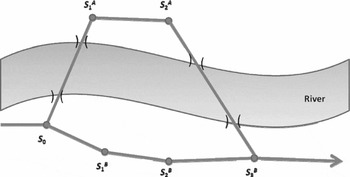
Figure 3 depicts a similar situation to the one we reviewed in Figure 2 with one important difference – the diverging branches of the decision path reconverge at s 3. Thus, we have

History matters here, but not in the long run

That is, applying the same move, m, to either sA 2 or sB 2 yields the same result. Thus, there is no lock-in effect for a traveller who finds herself at sA 2, notwithstanding the fact that the historical decision at s 0 to cross the bridge did indeed matter insofar as it explains how she got there. So, how might we represent this general idea that ‘history matters’ using the notation introduced in this paper? The key is to recognize that the traveller's position at sA 2 is itself the result of an evolutionary process that comprised a crucial bifurcation at some earlier period s 0. Let mA(s 0) and mB(s 0) denote the moves that embark on either path A or B, respectively, and let us presume that G[mA(s 0)] = G[mB(s 0)], indicating that the traveller judges both paths to be equally acceptable. Having set out on path A, she finds herself at sA 2 two periods later. To make the general claim that history matters in this position is simply to assert that her current position is one that she would not likely have reached had she instead set out initially on path B.
Recall that equation (11b) above describes the move, μ, that would bring a traveller from (in our example) sB 1 to sA 2. It is reasonable to expect, however, that G[m(sA 1)] > G[μ(sB 1)] even though both moves lead to sA 2, because the right-hand side entails crossing the river where there is no bridge. We can further expand this inequality expression to refer back to the crucial decision point at s 0.

This inequality tells us that history matters in this context. Having set out on path A, the profile of payoffs from subsequent moves strongly favored eventual arrival at sA 2 via sA 1. This is the lock-in argument in retrospect, so from this perspective there appears to be little operational difference between the generalized assertion that history matters and the more specific lock-in phenomenon. The fact that the two paths in figure 3 reconverge at s 3 does imply ‘ergodic path convergence’, however, as the perturbation caused by taking path A does not alter the long-run equilibrium outcome of the dynamic evolutionary progression described by this example.
7. Implications and conclusions
Institutional path dependence, from the perspective introduced in this paper, is not so much about history as it is about information. The set of state variables at any given time comprises the information context within which decisions today are made. We have explored examples ranging from legal expungement of criminal records, to privacy rights of past medical histories, to insider–outsider candidates in the context of executive succession. To the extent that the relevant history is already fully inscribed in the existing ‘information landscape’ in any of these examples, then by definition additional historical data would be redundant to the decision maker, just as a chess player might not need to know how the current position was arrived at in order to determine what move he wishes to make. Note that this has nothing to do with whether the player's move is a good one or not, and so issues of optimality may be motivated by, yet are distinct from, questions of path dependency.
The issue here is whether current decisions depend upon knowledge of the historical path. This distinction provides a more systematic way to think about issues of information bias intrinsic whenever historical path data are factored into current decision making. It is noteworthy that the notation introduced here to formalize our model can also be used to add clarity and rigor to more traditional and complementary perspectives, such as ergodic equilibria, lock-in effects, and more general notions that history matters. This brings us full circle to the question of institutional memory. In this generalized context, the key challenge becomes one of knowledge management. Indeed, this is a growing concern within the broad rubric of organizational behavior whereby investigators seek to infer the information structures most suited to institutional objectives (Coffey and Hoffman, Reference Coffey and Hoffman2003; Choo, Reference Choo1998; Davenport and Prusac, Reference Davenport and Prusac1998).
Perhaps the key point is conveyed best, however, by a story from the aftermath of the tsunami that hit south Asia in 2004.Footnote 10 Some remote aboriginal tribes living on affected islands escaped wholly unharmed while other tribes were devasted with great loss of life by the sudden arrival of the tsunami. Folklore traditions of the Great Andaman tribe, for example, are credited with sparing that group from any loss of human life. These traditions told of signs to watch for that might signify impending danger, and advised the tribe to relocate immediately to higher ground, which they did. None of these tribal members had previously experienced such a devastating tsunami, so it was only by virtue of this collective or institutional memory that they were saved. This is an outstanding example of how an institution can encode or inscribe relevant historical experiences into an effective decision-making algorithm: ‘When you see these signs, run for the hills!’ This was the essential point behind Botvinnik's advice about how to select suitable chess moves to oppose Tal or Petrosian, respectively. From this perspective, institutional path dependency is not really about history; it is about information. History matters only insofar as it informs institutional capacity for making decisions that draw appropriately on historical knowledge, implicitly or otherwise.