Introduction
Reminiscence, the recall of personally experienced events from one’s past, is a fundamental and ubiquitous process beginning in early childhood and continuing throughout the lifespan (Westerhof et al., Reference Westerhof, Bohlmeijer and Webster2010). However, little is known about how reminiscence affects the reminiscence functions themselves, that is, how these functions typically occur in older adults and how they can be modified over time through an intervention.
The effectiveness of reminiscence intervention has been widely demonstrated in various types of samples to improve different psychological aspects and correct or reduce certain psychological aspects that are considered pathological. It is important to highlight that there are several types of interventions based on reminiscence. Before choosing an intervention, we have to take into account factors such as the context, the objectives of the intervention, the characteristics of the target group, and the skills of the people who will apply the program (Lin et al., Reference Lin, Dai and Hwang2003). According to Westerhof et al. (Reference Westerhof, Bohlmeijer and Webster2010) and Webster et al. (Reference Webster, Bohlmeijer and Westerhof2010), the three basic types of reminiscence interventions are simple or unstructured reminiscence, structured reminiscence or life review, and life review therapy. In the current study, simple reminiscence was used because the target population consisted of high-functioning older adults, and the contents of the sessions focused mainly on retrieving positive memories from the past. The goal of this kind of intervention is usually to enhance social contacts, improve short-term well-being, and promote increased life satisfaction (Bohlmeijer et al., Reference Bohlmeijer, Roemer, Cuijpers and Smit2007).
There is research evidence that reminiscence/life review therapy has a moderate effect on depressive symptoms in older adults (for a review: Westerhof and Slatman, Reference Westerhof and Slatman2019). Moreover, reminiscence intervention has been used to facilitate adaptation to aging (Satorres et al., Reference Satorres, Viguer, Fortuna and Meléndez2018) and improve autobiographical memory (Melendez et al., Reference Melendez, Torres, Redondo, Mayordomo and Sales2017). In addition, moderate effects have been found in people with dementia with a decrease in depressive symptoms and improved psychological well-being, specifically the dimension’s self-acceptance, positive relations with others, autonomy, and environmental mastery (Gonzalez et al., Reference Gonzalez, Mayordomo, Torres, Sales and Meléndez2015). Also, from the systematic review and meta-analysis performed by Park et al. (Reference Park, Lee, Yang, Song and Hong2019), it states that reminiscence therapy produced, in people with dementia, a significant decrease in depressive symptomatology, an increase in the quality of life, and a decrease in behavioral and psychological symptoms of dementia. In addition, simple reminiscence can play an important role in the individual’s ability to adapt to the stressors that are happening as a normal process of aging throughout life (Haight et al., Reference Haight2018; Puentes, Reference Puentes2002). Therefore, these stressful events are related to the use of different reminiscence functions, so it is important that the intervention focuses on techniques that reduce the functions of the self-negative and encourage the greater use of the self-positive functions (Korte et al., Reference Korte, Bohlmeijer, Westerhof and Pot2011).
Over the years, several authors have proposed various ways of categorizing reminiscence functions. Currently, Webster’s (Reference Webster1997) classification of eight reminiscence functions is generally accepted. Research on the functionality of reminiscence has advanced considerably after the development of the Reminiscence Functions Scale (RFS; Webster Reference Webster1993). The RFS was developed by Webster (Reference Webster1993) to assess the different functions or purposes of reminiscence. Initially, the author performed an exploratory principal components analysis that made it possible to retain 43 items distributed in seven factors (identity/problem-solving, death preparation, teach-inform, conversation, bitterness revival, boredom reduction, and intimacy maintenance).
The factorial validity of the RFS was later replicated (Webster, Reference Webster1997), and eight reminiscence components emerged. The factors were the same as those in the original study, but with identity and problem-solving now split into two different factors. The eight reminiscence functions were identity, which refers to the use of memories to identify a pattern of coherence in one’s life and find value and meaning in life; problem-solving, which consists of remembering past experiences to solve present problems; death preparation, which refers to using memories to come to terms with one’s finitude; teach-inform, which entails sharing memories to convey a lesson about life; conversation, which involves communicating personal memories in an interactional context with no evaluative or instructive intent; bitterness revival, which consists of rehashing memories of difficult life circumstances; boredom reduction, which refers to memories used to fill a void of stimulation or interest; and intimacy maintenance, which involves keeping alive the memory of a significant other who is no longer present, typically due to death.
Cappeliez and O’Rourke (Reference Cappeliez and O’Rourke2006) proposed a model that advanced the study of reminiscence functions. This model solved some problems related to overlapping functions. Using a structural equations model, three broad latent constructs were proposed, with the reminiscence functions distributed as follows: self-positive functions (identity, death preparation, and problem-solving); self-negative functions (boredom reduction, bitterness revival, and intimacy maintenance); and prosocial functions (conversation and teach-inform). This tripartite model of reminiscence functions was supported by a growing body of research that provided evidence for its construction and the validity and reliability of the measures (Cappeliez and O’Rourke, Reference Cappeliez and O’Rourke2006; O’Rourke et al., Reference O’Rourke, Cappeliez and Claxton2011; Robitaille et al., Reference Robitaille, Cappeliez, Coulombe and Webster2010; Ros et al., Reference Ros2016). Using the three-factor model, reminiscence has been found to have positive adaptive effects on the mental health of older adults. Self-positive functions have been associated with enhanced levels of well-being, and they have shown a significant negative relationship with symptoms of mental health problems, whereas self-negative functions have shown detrimental effects on physical and mental health. In addition, O’Rourke et al. (Reference O’Rourke, Cappeliez and Claxton2011) reported that self-negative functions longitudinally predicted depressive symptoms in the elderly. Finally, regarding the prosocial functions, no direct relationships were found between this latent variable and mental health parameters in older adults (Cappeliez and O’Rourke, Reference Cappeliez and O’Rourke2006; O’Rourke et al., Reference O’Rourke, Cappeliez and Claxton2011; Ros et al., Reference Ros2016).
Based on the tripartite model of reminiscence functions, the main objective of this study was to investigate how the eight dimensions change over time after an intervention and follow-up based on a simple reminiscence program in a sample of healthy older adults. Because the self-positive functions help us to find meaning by reflecting on life and the way it has been lived, and prosocial functions offer the possibility of experiencing positive emotions in social encounters by sharing and discussing aspects of one’s life with others (King et al., Reference King, Cappeliez, Canham and O’Rourke2019), we hypothesize that the intervention will produce a significant effect in terms of an increase in both the self-positive functions and the prosocial functions on the intervention group. According to Cappeliez and O’Rourke (Reference Cappeliez and O’Rourke2006), the self-negative functions trap the person in a circle of constant rumination about the past. Therefore, taking into account that our intervention focuses mainly on positive memories, we further hypothesize a decrease in the self-negative functions.
Methods
Participants
Participants included 139 elderly adults from Valencia, Spain. They were recruited through four healthcare centers. To evaluate the program’s effects, the experimental design included pretest, posttest, and a follow-up evaluation after 3 months, in an intervention group and a control group. Members of the control group were on a waiting list to participate in the intervention program at the end of the study.
Initially, 160 participants were contacted to participate in a reminiscence workshop, and an in-person appointment was scheduled to determine whether they met the inclusion/exclusion criteria. Inclusion criteria for both groups were age 65 years or older, not under institutional care, and no cognitive impairment, determined by a score of 24 or more on the Mini-Mental State Examination (MMSE; Folstein et al., Reference Folstein, Folstein and McHugh1975), or depression symptoms, determined by a score of 11 or more on the Geriatric Depression Scale (GDS) Spanish version (Izal and Montorio, Reference Izal and Montorio1993).
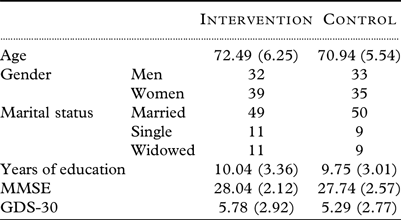
All participants met the criteria and gave informed consent to take part in the study. They were evaluated individually in the first assessment before starting the reminiscence program and always by the same evaluator. After this first evaluation of the 160 people tested, 12 were excluded based on inclusion/exclusion criteria, 3 for presenting MMSE scores below the established cutoff point, and 9 for presenting depressive symptoms. The remaining 148 participants were randomly assigned to the intervention group (74) or the waiting list control group (74). During the intervention, nine subjects dropped out, three in the intervention group and six in the control group. Finally, 139 participants, 71 in the intervention group and 68 in the control group, were evaluated at posttest and again at follow-up 3 months after finishing the intervention. To avoid selection bias and confirm that the groups showed no differences from the beginning, homogeneity analysis was performed. Homogeneity tests were applied between groups at pretreatment: age (t (137) = 1.54, p = .12), gender (χ2 (1) = .58, p = .44), marital status (U = .57, p = .56), and educational level (t (137) = .54, p = .59). No significant differences were obtained (see Table 1).
Sociodemographic data and inclusion/exclusion criteria of groups

Instruments
The RFS was developed by Webster (Reference Webster1993) and then replicated by Webster (Reference Webster1997) and Ros et al. (Reference Ros2016) in Spanish older adults, to measure at which frequency the person reminisces for different purposes. The scale consists of 43 items clustered in 8 dimensions, and its response format analyzes the frequency with which a specific type of reminiscence is used on a 6-point scale from “never uses the memory from the past for this purpose” to “uses it quite often for this purpose.” The eight components are identity, problem-solving, death preparation, bitterness revival, boredom reduction, intimacy maintenance, conversation, and teach-inform. Regarding its psychometric properties, Webster (Reference Webster1993) obtained adequate reliability indices, indicating internal consistencies of the factors ranging between .79 and .89. A subsequent study by Ros et al. (Reference Ros2016) confirmed that the RFS is a useful instrument to assess reminiscence functions.
The MMSE (Folstein et al., Reference Folstein, Folstein and McHugh1975) is one of the most widely used tools for screening cognitive impairment. The items are grouped into five domains: orientation, immediate memory, attention and calculation, deferred memory, language and construction. The score is obtained by adding up the scores on all the domains, and it can range between 0 and 30.
The GDS (Yesavage et al., Reference Yesavage1982) is a 30-item self-report assessment used to determine the intensity of depressive symptomatology in the elderly. The person answers yes or no to statements about how she/he felt during the past week, 1 point being awarded to each affirmative answer. A total score between 0 and 30 is obtained on this scale, with the following cutoff points: (0–10) normal and (11–30) possible depression. In the current study, internal consistency (Cronbach’s) was .92.
Procedure
The intervention consists of a simple reminiscence program, directed by a psychologist. The program, based on Meléndez et al. (Reference Meléndez, Charco, Mayordomo and Sales2013), is structured and contains ten 2-hour sessions administered once a week. The procedure was standardized with self-made guidelines that included specific exercises to perform. In addition, for each session, a list of guiding questions was used to address the topics planned for the session. All the sessions had the same structure: (1) start: the session’s goals and functioning were explained; (2) development: the session always began with a relaxation exercise, followed by the planned activities; and (3) evaluation: each session ended with a registration and an evaluation.
The aims and contents worked on in each session are briefly presented below: (1) inform about the concept of reminiscence and its benefits. In groups, participants answered some questions about their life stages (childhood, adolescence, adulthood, and old age); (2) remember past events to encourage conversation and the emergence of positive feelings. Structured debates were held to discuss their towns, important places, childhood family, and current family; (3) promote integrity, sociability, and openness to interpersonal relationships at both the social and family levels. Friends, love, and family relationships are discussed. Share and discuss experiences with death. Make a drawing of a special person and talk about it, explaining why s/he is special; (4) identify pleasant feelings about past events and how these feelings can improve their current lives. Look at photos of the participants at important celebrations (weddings, baptisms, anniversaries, and birthdays). Each person shares and comments on their experiences with the group; (5) promote personal and social identity through narrative traditions that help them to share past experiences. Information is shared about important holidays, how they celebrated and with whom, and whether this has changed in the present and why; (6) work on adaptation to social and technological changes. Melodies and television commercials are used, as well as movie shorts; (7) talk about the occupations they had throughout life in order to work on their own positive and negative aspects. Talk about the work of men and women and domestic work, what the working conditions were like and how this has changed today; (8) maintain and build self-confidence through the positive elements of memories. For this purpose, toys, games, and typical songs from childhood were used; (9) promote social bonds and semantic memories by remembering typical objects from the past. Memory of objects, furniture, and clothing they used in the past; and (10) awaken positive feelings and experiences using songs and images. Explanation of the importance of music and emotions and their relationship. Listen to different sounds and songs and then comment on the emotions that arise and the memories they evoke.
Throughout the sessions, different materials such as photographs, songs, sayings, tales, everyday objects, movies, advertisements, and childhood games were used. All the participants in the intervention group attended all the sessions. Control group participants completed the same measures at the same time as the intervention group, but they were not exposed to the intervention.
Data analysis
Randomization was evaluated by comparing the intervention and control groups on their pretreatment sociodemographic variables, using t-tests for independent samples, chi-square, and the Mann–Whitney test. To analyze the effects of the reminiscence program, analysis of variance for repeated measures with Bonferroni adjustment was performed, studying the interaction (group × time) and the simple effects of time and group. The partial eta square was used to determine the effect size, considering .01 = small, .06 = medium, and .13 = large. The effect sizes (Cohen’s d) for the mean differences were also included .20–.49 small effect; .50–.79 medium effect; and >.80 large effect (Cohen, Reference Cohen1988).
Results
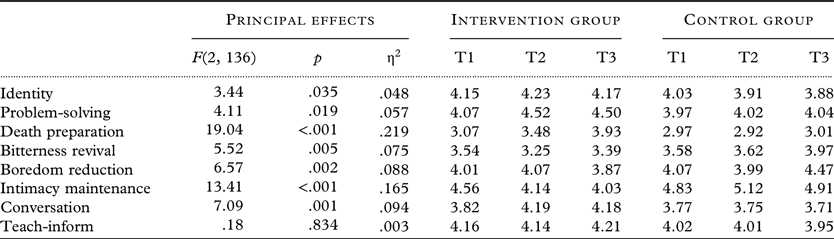
The main effects were significant for identity, problem-solving, death preparation, bitterness revival, boredom reduction, intimacy maintenance, and conversation, but not for teach-inform (see Table 2).
Effects of interaction and group means for reminiscence functions

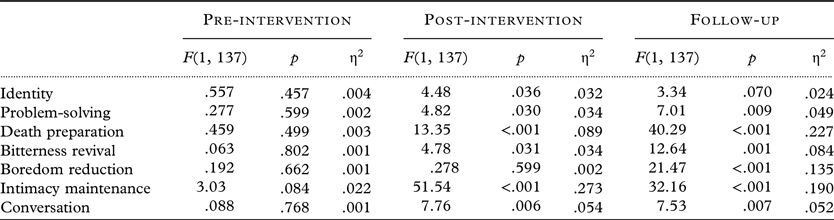
The study of simple effects confirmed that there were no between-group differences in any of the reminiscence function scores at pre-intervention. Significant differences between groups were obtained at post-intervention in all the dimensions, except boredom reduction, with the intervention group obtaining higher scores on identity, problem-solving, death preparation, and conversation, and lower scores on bitterness revival and intimacy maintenance, compared to the control group. Finally, at follow-up, significant differences between the two conditions were obtained in all the dimensions, except identity, with the intervention group obtaining higher scores on problem-solving, death preparation, and conversation, and lower scores on bitterness revival, boredom reduction, and intimacy maintenance (see Table 3).
Simple effects between groups in pre-intervention, post-intervention, and follow-up scores

Finally, the evolution of the groups over time was studied (see Figure 1). Regarding the identity reminiscence function, no significant effects were observed in the intervention group (F(2, 136) = .955; p < .386; η2 = .014) or the control group (F(2, 136) = 2.87; p < .060; η2 = .041).
For the problem-solving dimension, in the intervention group, a significant effect was observed (F(2, 136) = 10.86; p < .001; η2 = .139), resulting in a significant increase from pre-intervention to post-intervention (mean difference = .45, SE = .110, p < .001, d = −.36), and from pre-intervention to follow-up (mean difference = −.43, SE = .166, p = .033, d = −.48). For the control group, the effects were not significant (F(2, 136) = .153; p = .859; η2 = .002).
Regarding the death preparation dimension, a significant effect was observed in the intervention group (F(2, 136) = 37.18; p < .001; η2 = .354), resulting in a significant increase from pre-intervention to post-intervention (mean difference = −.41, SE = .064, p < .001, d = −.44), from post-intervention to follow-up (mean difference = −.45, SE = .129, p = .002, d = −.52), and from pre-intervention to follow-up (mean difference = −.86, SE = .125, p < .001, d = −1.02). For the control group, the effects were not significant (F(2, 136) = .363; p < .696; η2 = .005).
With regard to the bitterness revival function, a significant effect was observed in the intervention group (F(2, 136) = 7.34; p = .001; η2 = .097), resulting in a significant decrease from pre-intervention to post-intervention (mean difference = .29, SE = .076, p = .001, d = .15). In the control group, a significant effect was observed (F(2, 136) = 3.54; p = .032; η2 = .050), resulting in a significant increase from pre-intervention to follow-up (mean difference = −.39, SE = .148, p = .031, d = −.38), and from post-intervention to follow-up (mean difference = −.34, SE = .135, p = .036, d = −.35).
For the boredom reduction reminiscence function, no significant effect was observed in the intervention group (F(2, 136) = 1.28; p = .280; η2 = .019). In the control group, a significant effect was observed (F(2, 136) = 6.31; p = .002; η2 = .085), resulting in a significant increase from pre-intervention to follow-up (mean difference = −.40, SE = .135, p = .011, d = .48), and from post-intervention to follow-up (mean difference = −.38, SE = .135, p = .002, d = −.57).
In the case of the intimacy maintenance reminiscence function, a significant effect was observed in the intervention group (F(2, 136) = 11.85; p < .001; η2 = .148), resulting in a significant decrease from pre-intervention to post-intervention (mean difference = .42, SE = .097, p < .001, d = .41) and from pre-intervention to follow-up (mean difference = .53, SE = .129, p < .001, d = .51). In the control group, a significant effect was observed (F(2, 136) = 4.68; p = .011; η2 = .064), resulting in a significant increase from pre-intervention to post-intervention (mean difference = −.29, SE = .10, p = .011, d = −.42).
Finally, in the conversation dimension, a significant effect was observed in the intervention group (F(2, 136) = 12.75; p < .001; η2 = .158), resulting in a significant increase from pre-intervention to post-intervention (mean difference = −.38, SE = .075, p < .001, d = −.40), and from pre-intervention to follow-up (mean difference = −.37, SE = .150, p = .045, d = −.37). In the control group, the effects were not significant (F(2, 136) = .10; p < .905; η2 = .001).
Effects of intervention on reminiscence functions.

Discussion
The main objective of this study was to investigate how the eight dimensions change over time after an intervention and follow-up based on a simple reminiscence program in a sample of healthy older adults. Thus, the results showed that, in general, after the implementation of the reminiscence program, the intervention group showed an increase in the functions related to the positive self, and a decrease in the functions related to the negative self. By contrast, in the control group, that is, those who did not receive any type of intervention, there was an increase in the self-negative functions.
The analysis of the self-positive function categories showed significant effects in the intervention group. The use of two individual functions increased (problem-solving and death preparation), and these effects were maintained even at follow-up. However, no significant effects of the intervention on the identity function were observed.
The problem-solving function of reminiscence helps us to identify previous situations that were successfully resolved in the past and, therefore, recognize and apply these same coping techniques to current challenges (Cappeliez et al., Reference Cappeliez, Rivard and Guindon2007). Acceptance of death as their own and as inevitable in the life cycle is considered adaptive variables. In fact, reminiscence for coping with thoughts of one’s finitude is a cardinal feature of the existential quest for purpose and meaning (Erikson, Reference Erikson1982). Therefore, developing these functions in reminiscence programs is important in optimal aging. These two functions are highly related to Erikson’s concept of integrity, and the achievement of this developmental goal is proposed as one of the bases of successful aging. To achieve the evolutionary task of integrity, older adults assess their feelings about the way they have lived their lives, they examine their achievements and goals, they assess the losses suffered and how to compensate for them, and they consider what they have left to live for and how to get it. This process of re-evaluation causes the older person to strive for a state of reconciliation and acceptance, that is, to achieve integrity rather than disappointment and discouragement, which would be considered despair. Regarding the identity function, there were no significant changes after the intervention, and so it appears that the intervention had no effect on it. Identity is built progressively throughout the entire life cycle. According to Erikson (Reference Erikson1982), in the last task of development, gerotranscendence, identity is achieved through the integration of the past, present, and future from the feeling and experience of being oneself in a continuous and coherent way, despite internal and external changes throughout life. We must keep in mind that our sample is composed of healthy older adults with no significant psychological problems, and so they do not need to reestablish a positive identity of their own, which would have required an intervention based on life review (Webster et al., Reference Webster, Bohlmeijer and Westerhof2010). Thus, we are not dealing with people with severe psychological distress who need the application of a life review therapy, which would involve the creation of a new life story and significant changes in their identity (Westerhof et al., Reference Westerhof, Bohlmeijer and Webster2010).
Moreover, in the scientific literature, it has been widely demonstrated that the self-positive functions are consistently related to well-being and positive mental health in the elderly (Ros et al., Reference Ros2016; Waters, Reference Waters2014). This suggests that the intervention based on reminiscence can be considered an effective tool for adapting to aging and the accompanying changes.
Regarding self-negative functions of reminiscence, the present study showed that, in the control group, an increase in the functions of bitterness revival and boredom reduction which was maintained at follow-up. In contrast, in the intervention group, a significant reduction in bitterness revival and intimacy maintenance was observed after participating in the reminiscence program.
It is important to highlight that the functions of bitterness revival, boredom reduction, and intimacy maintenance are not negative in the short term, but they can become counterproductive when used in excess and for a long period of time because they keep people from making significant commitments in life (Westerhof and Bohlmeijer, Reference Westerhof and Bohlmeijer2014). In addition, as Cappeliez et al. (Reference Cappeliez, O’Rourke and Chaudhury2005) demonstrated, higher frequencies of reminiscence for the self-negative functions, specifically for bitterness revival and boredom reduction, are associated with lower life satisfaction and greater psychiatric distress in later life. A possible explanation for the reduction in self-negative functions in the intervention group could be the content of our program sessions. When discussing past life situations, but focusing on positive memories, these contents cover more self-positive functions. In fact, these people spend 10 weeks sharing information about habits, customs, and conflicts that occurred in the past, as well as addressing the issue of preparing for death. Therefore, indirectly, the use of memory to ruminate about difficult life circumstances or lost opportunities and the tendency to cling to intimate memories of social relationships that are no longer part of their lives have declined. Regarding the increase in self-negative functions in the control group, we must not forget that older adults are subject to continuous physical, emotional, and social changes, and that they constantly experience critical life events such as the loss of loved ones. As studies have shown, experiencing critical life events can increase the use of specific negative functions of reminiscence (Cappeliez and O’Rourke, Reference Cappeliez and O’Rourke2002; Webster and Haight, Reference Webster and Haight2002; Wong, Reference Wong, Haight and Webster1995). In this regard, people in the control group who have not received any kind of intervention could be misusing reminiscence.
Some people constantly retrieve difficult memories from their past lives that occupy their thoughts and evoke memories of absent friends or relatives, and they use memories from the past to fill a void due to lack of interest in the present. This practice reflects an attitude focused on negative aspects of their lives, with a fixation on loss and a lack of purpose in life due to being caught in a persistent cycle of rumination about the past. All these characteristics are associated with lower well-being in later life (Cappeliez and O’Rourke, Reference Cappeliez and O’Rourke2006; Korte et al., Reference Korte, Bohlmeijer, Cappeliez, Smit and Westerhof2012; O’Rourke et al., Reference O’Rourke, Cappeliez and Claxton2011; Ros et al., Reference Ros2016), a reduction in life satisfaction (Korte et al., Reference Korte, Bohlmeijer, Cappeliez, Smit and Westerhof2012), an increase in depressive symptomatology and anxiety (O’Rourke et al., Reference O’Rourke, Cappeliez and Claxton2011), perception of worse health and more health problems (O’Rourke et al., Reference O’Rourke, Bachner, Cappeliez, Chaudhury and Carmel2015), and indices of psychological distress, including hopelessness in later life (Ros et al., Reference Ros2016). These consequences would affect both physical and mental health, causing the elderly to become increasingly dependent and require the help of another person to perform the activities of daily living (Meléndez et al., Reference Meléndez, Tomás and Navarro2011).
Finally, regarding the prosocial reminiscence functions, our hypothesis was partially supported because, in the intervention group, participation in the reminiscence program produced a significant increase in the conversation function, and this increase was maintained at the follow-up, whereas no significant changes were observed in the control group.
As O’Rourke et al. (Reference O’Rourke, Cappeliez and Claxton2011) proposed, these prosocial functions play an important role in emotion regulation. Because the reminiscence intervention takes place in a group, participants have the opportunity to share emotional experiences socially. In addition, participating in the intervention with the same group of people inevitably creates links between them, which produces a climate of trust and can serve to make new friends with whom they can talk and share their concerns and interests. Therefore, stimulating this prosocial function can be quite beneficial for older adults. On the one hand, their socialization increases, which would be associated with physical health and psychological well-being (Cappeliez and O’Rourke, Reference Cappeliez and O’Rourke2006; O’Rourke et al., Reference O’Rourke, Bachner, Cappeliez, Chaudhury and Carmel2015), and on the other, feelings of loneliness decline, which is a very relevant aspect in the elderly (Elias et al., Reference Elias, Neville and Scott2015).
To conclude, at the clinical level, we believe that when interventions based on reminiscence are carried out, it is important to evaluate the effects not only on the variables of interest, but also on the reminiscence functions. As we have indicated, reminiscence functions influence various variables, such as health perception, successful aging, emotional variables such as anxiety and depression, life satisfaction, and psychological well-being, among others. Therefore, having a vision of the influence of a reminiscence intervention on reminiscence functions can help us to modify the intervention to improve its effectiveness.
Some limitations of this study must be acknowledged. First, in this study, the results were based on the RFS (Webster Reference Webster1993), a self-report measure, which could lead to biased results. Second, although in the present study a follow-up was carried out 3 months after the intervention, a longer follow-up period could have been used to find out whether the results are maintained in the long term. Third, the control group did not receive any type of intervention, but instead they were placed on a waiting list to take part in the reminiscence program after the study ended. However, it would have been more appropriate for the control group to receive some type of placebo intervention. Fourth, the presence of depressive symptomatology was considered an exclusion criterion and it was only evaluated before starting the intervention. However, it might have been interesting to reassess this variable after the intervention to verify the influence of the reminiscence program on depressive symptomatology scores.
Conclusion
To add to previous research on the effects of a simple reminiscence program on well-being and depression, this study examined the influence of such an intervention on individual reminiscence functions in more in detail. Such a program was found, on one hand, to increase the self-positive functions of problem-solving and death preparation and also the prosocial function of conversation, and, on the other hand, to decrease the self-negative functions of bitterness revival and intimacy maintenance.
Conflicts of interest
None.
Description of authors’ roles
Iraida Delhom was responsible for the assessment and data collection. Juan C. Meléndez and Encarnación Satorres were responsible for the statistical analyses performed. Finally, all authors contributed to the writing and revising of the manuscript.