Introduction
While large policy shifts and structural reforms attract the most attention, sustained innovation of a more modest magnitude is a key contributor to long-term public service performance (Vigoda-Gadot & Beeri, Reference Vigoda-Gadot and Beeri2012). In public service organizations, direct and ongoing contact with clientele provides insight into how public services are consumed and therefore how delivery may be improved, and innovation is often generated by frontline staff based on a deep understanding of the context of service delivery. Importantly, then, the empowerment of frontline staff can facilitate the introduction of performance-enhancing innovation where and when it is needed most (Fernandez & Moldogaziev, Reference Fernandez and Moldogaziev2012; Campbell, Reference Campbell2015).
While the studied drivers of innovation in the public sector are diverse (Walker, Reference Walker2006; De Vries, Bekkers, & Tummers, Reference de Vries, Bekkers and Tummers2016), beliefs about appropriate and desirable behavior among frontline employees are known to be in part a function of the dynamics that characterize their interpersonal relationships. Workgroup members interact frequently and tasks and responsibilities tend to be relatively homogenous and interdependent across the workgroup. This intensive interaction and interdependence can produce informal normative constraints based on the potential of each member to observe the behavior and performance of the others (Barker, Reference Barker1993). Such shared norms arise in parallel to the formal structure of the organization and can exert an alternative influence on employee behavior. Accordingly, understanding how workgroup climate shapes member behavior can provide additional insight into public sector change processes initiated at the frontlines.
Change-oriented behavior denotes employee-initiated efforts to introduce micro-level innovation into work routines (Morrison & Phelps, Reference Morrison and Phelps1999; Bettencourt, Reference Bettencourt2004). The interpersonal climate of the organization has played a large role in research on change-oriented behavior, however, most studies have focused on the vertical relationship between employees and managers or leaders (some examples include Ling & Chen, Reference Ling and Chen2016; Li, Chiaburu, & Kirkman, Reference Li, Chiaburu and Kirkman2017; Li, Furst-Holloway, Gales, Masterson, & Blume, Reference Li, Furst-Holloway, Gales, Masterson and Blume2017; Han, Sears, & Zhang, Reference Han, Sears and Zhang2018). On the other hand, fewer have explored the role of interpersonal relationships between workgroup members. This study asks how workgroup accord, defined as sustained positive exchange, cooperation, and consensus among workgroup members, can shape intentions to engage in change-oriented actions. Engaging in change-oriented behavior inevitably involves a level of risk for employees, and accord among workgroup members may help furnish the sense of psychological safety necessary to try out a new approach (Carmeli, Reiter-Palmon, & Ziv, Reference Carmeli, Reiter-Palmon and Ziv2010; López-Domínguez, Enache, Sallan, & Simo, Reference López-Domínguez, Enache, Sallan and Simo2013) and, more generally, positive peer group relations are a well-established predictor of employee creative performance (Hunter, Bedell, & Mumford, Reference Hunter, Bedell and Mumford2007). Generally, positive relational behaviors within the workgroup are related to change and creativity (Nsenduluka & Shee, Reference Nsenduluka and Shee2009; Farh, Lee, & Farh, Reference Farh, Lee and Farh2010), while incivility and distrust among group members undermine change-oriented behavior (Choi, Anderson, & Veillette, Reference Choi, Anderson and Veillette2009; Jehn, Rispens, & Thatcher, Reference Jehn, Rispens and Thatcher2010). In addition, workgroups are a key object of identification (Riketta & Van Dick, Reference Riketta and Dick2005), and workgroup accord may generate positive affectivity about the organization as well as a perceived alignment of interests between the focal employee and their workplace. This alignment can then function as a mechanism underlying the extra effort required to pursue change (Campbell, Reference Campbell2015). This study develops this idea and tests for both a direct link between workgroup accord and change-oriented behavior as well as an indirect link via affective organizational commitment.
Workgroup accord may drive change-oriented behavior by creating both the instrumental and affective conditions for its initiation. However, not all organizations are equally change-oriented, and it is probable that various contextual factors will strengthen or attenuate the impact of workgroup accord. For instance, innovation climate captures the degree to which a given organizational context provides both formal support for innovation as well as a logic of appropriateness for risk-taking behaviors (Scott & Bruce, Reference Scott and Bruce1994). It is probable, therefore, that workgroup accord will have a stronger impact on change-oriented behavior in organizations that have a substantive climate for innovation. At the same time, even in highly change-oriented contexts, if employees lack clear objectives and performance standards to both evaluate and legitimate potential change behaviors, it is less likely that they will act to initiate change (Hunter, Bedell, & Mumford, Reference Hunter, Bedell and Mumford2007), and specific, challenging, and achievable goals stimulate self-efficacy beliefs and a search for strategies to achieve them (Locke & Latham, Reference Locke and Latham2002). To capture this phenomenon in a manner relevant to contemporary public service organizations, this study focuses on performance agreement efficacy as an amplifier of the positive effects of workgroup accord (Campbell, Reference Campbell2015).
This study tests an integrated, theoretically motivated model of change-oriented behavior grounded in the interpersonal workgroup climate. In the following section, a theoretical framework linking workgroup accord to change-oriented behavior is developed and an analytical model is proposed. The operationalization of the model is then described, along with the data used to test it empirically. A large survey of frontline public service delivery employees from the Australian Public Service is used for this purpose. The final section discusses the contributions of this study to the public management innovation literature in detail.
Literature and hypotheses
Change-oriented behavior, organizational performance, and public service employees
In the public sector, the efficacy of organizational rules, standardized procedures, and performance goals are intimately connected with accountability and organizational performance (Brewer & Selden, Reference Brewer and Selden2000; Olsen, Reference Olsen2006; Pollitt, Reference Pollitt2009; Stazyk & Goerdel, Reference Stazyk and Goerdel2010). However, change is fundamental to public service organizations (Fernandez & Rainey, Reference Fernandez and Rainey2006; Kuipers, Higgs, Kickert, Tummers, Grandia, & van der Voet, Reference Kuipers, Higgs, Kickert, Tummers, Grandia and van der Voet2013), and sustained performance over time is a function not only of uniform and mechanical operations but also the capacity to react appropriately to changes and opportunities in the organizational environment (Osborne & Gaebler, Reference Osborne and Gaebler1993). Accordingly, the behaviors delimited by the formal structure of the organization are on their own insufficient to sustain organizational performance, a notion long recognized by organization theorists (Katz, Reference Katz1964; Katz & Kahn, Reference Katz and Kahn1978; Organ, Reference Organ1988). Change-oriented behavior is defined as ‘voluntary and constructive efforts, by individual employees, to affect organizationally functional change with respect to how work is executed within the contexts of their jobs, work units, or organizations’ (Morrison & Phelps, Reference Morrison and Phelps1999: 403). Individuals engaged in change-oriented behavior aim to improve their own or the organization’s performance by strategically modifying how work is done rather than simply working harder within the parameters of existing work routines. Because of this link to flexibility and change, Vigoda-Gadot and Beeri (Reference Vigoda-Gadot and Beeri2012) have singled out change-oriented behavior as a potential (if partial) antidote to the unresponsiveness of and declining trust in the public bureaucracy, suggesting that the construct may form the foundation of a research agenda with significant practical implications.
While change and adaptation over time are necessary to sustain organizational performance, change-oriented behavior nevertheless can in practice carry risks for both the organization and the employee pursuing it (López-Domínguez et al., Reference López-Domínguez, Enache, Sallan and Simo2013; Campbell, Reference Campbell2015). Not all change initiatives will be successful, and failure may damage organizational performance or public trust. Moreover, some organization and job contexts either explicitly or implicitly incentivize the routine execution of formal job responsibilities over change. In other words, the perceived need for change will not be equal in all organizational contexts, and the readiness of employees to engage in change-oriented behavior is expected to vary significantly based on a variety of organizational and interpersonal factors.
Workgroup accord and change-oriented behavior
The determinants of organizational behavior are diverse and interrelated in complex ways, and studies on change-oriented behavior and related constructs have focused on the role of leadership (López-Domínguez et al., Reference López-Domínguez, Enache, Sallan and Simo2013; Li et al., Reference Li, Furst-Holloway, Gales, Masterson and Blume2017), management factors (Campbell, Reference Campbell2015), job characteristics (Marinova, Peng, Lorinkova, Van Dyne, & Chiaburu, Reference Marinova, Peng, Lorinkova, Van Dyne and Chiaburu2015), and individual attitudes (Seppala, Lipponen, Bardi, & Pirttila-Backman, Reference Seppala, Lipponen, Bardi and Pirttila-Backman2012; Campbell & Im, Reference Campbell and Im2016). However, in many of these studies, the interpersonal context wherein such behavior takes place has a privileged theoretical status. Workgroups constitute the most immediate interpersonal workplace setting and interactions among coworkers shape perceptions of the organization and the employee’s place in it. The immediacy of the workgroup makes it a key target of identification for employees (Riketta & Van Dick, Reference Riketta and Dick2005), and workgroup norms exert a powerful force on employee behavior (Barker, Reference Barker1993). Workgroup dynamics, therefore, can shape both the incentives for and normative beliefs about a range of potential performance-related behaviors.
Workgroup accord captures the extent to which the interpersonal dynamics of a given workgroup are characterized by positive interpersonal exchange, cooperation, and broad consensus regarding organizational phenomena, and previous research suggests that the concept may foster change-oriented behavior. For instance, in their seminal paper, Scott and Bruce (Reference Scott and Bruce1994), building on the work of Seers (Reference Seers1989), make high-quality team member-exchange a key component of their model of innovative behavior. From a practical perspective, cooperation and knowledge sharing reduce role ambiguity (Campbell, Reference Campbell2016), and sharing relevant job knowledge among group members is connected to creative behavior (Shalley & Gilson, Reference Shalley and Gilson2004; Hulsheger, Anderson, & Salgado, Reference Hülsheger, Anderson and Salgado2009) as is the possibility of receiving feedback about new ideas, especially from those with relevant knowledge that can help refine a potential idea (Caniëls, De Stobbeleir, & De Clippeleer, Reference Caniëls, De Stobbeleir and De Clippeleer2014). In-group citizenship behavior positively predicts workgroup service innovativeness (Nsenduluka & Shee, Reference Nsenduluka and Shee2009) and employees that identify strongly with their workgroup purse change-oriented behavior as a way to contribute to the organization (Seppala et al., Reference Seppala, Lipponen, Bardi and Pirttila-Backman2012). Conversely, while positive interpersonal relationships should encourage change-oriented behavior, the experience of incivility at work can damage performance on both routine and creative tasks, encourage withdrawal, and generally put strain on the cognitive resources necessary for a high level of job engagement (Porath & Erez, Reference Porath and Erez2009; Porath, Foulk, & Erez, Reference Porath and Erez2015; Schilpzand, Leavitt, & Lim, Reference Schilpzand, Leavitt and Lim2016). Moreover, when individuals perceive higher levels of conflict in their group, they are less likely to engage in creative behaviors (Jehn, Rispens, & Thatcher, Reference Jehn, Rispens and Thatcher2010). In general, mistrust between workgroup members may undermine intentions to engage in change-oriented behavior (Choi, Anderson, & Veillette, Reference Choi, Anderson and Veillette2009), and the quality of exchange between co-workers can help sustain the psychological climate necessary for both idea generation and implementation. These notions suggest that a collegial, collaborative, and coherent workgroup culture will be likely to encourage change-oriented and innovative work behavior by its members. This study, therefore, tests the following hypothesis:
Hypothesis 1: Workgroup accord has a direct, positive relationship with change-oriented behavior.
The mediating role of affective organizational commitment
The psychological and behavioral consequences that derive from the interpersonal experience of the organization are, however, generally understood to either pass through mediating psychological states and/or be moderated by salient aspects of the organizational context. For example, drawing on goal setting theory, Sagnak (Reference Sagnak2016) argues that intrinsic motivation fosters independent learning and creativity and mediates the effect of participatory leadership on change-oriented behavior. Campbell (Reference Campbell2015) argues that organizational identification, or the perception of a coincidence between individual and organizational interests, mediates the relationship between a performance-based managerial and human-resource strategy and change-oriented behavior (see also Lipponen, Bardi, & Haapamäki, Reference Lipponen, Bardi and Haapamäki2008; Li et al., Reference Li, Furst-Holloway, Gales, Masterson and Blume2017). These studies demonstrate that positive attitudes and feelings about the organization can be a significant determinant of efforts to change it.
The present study focuses on the role of affective organizational commitment as a psychological mechanism translating the experience of workgroup accord into individual intentions to engage in change-oriented behavior. Affective commitment is an emotional attachment to the organization as well as a personal identification with its values and goals (Meyer & Allen, Reference Meyer and Allen1991). Scholars have studied a variety of antecedents of commitment (Meyer, Stanley, Herscovitch, & Topolnytsky, Reference Meyer, Stanley, Herscovitch and Topolnytsky2002; Riketta, Reference Riketta2002), and the quality of interpersonal relationships at work has emerged as a critical factor. Due to the frequency of interaction with workgroup members, its quality can have determinative effects for the overall impression and experience of the organization. Leiter and Maslach (Reference Leiter and Maslach1988), for example, demonstrate that pleasant contacts with coworkers both directly and indirectly influence levels of organizational commitment, and Song, Kim, and Kolb (Reference Song, Kim and Kolb2009) argue that interpersonal trust contributes to commitment in various ways. Heffner and Rentsch (Reference Heffner and Rentsch2001) argue commitment to the organization is generated by social interaction among the members of a workgroup. As such, higher levels of workgroup accord are likely to generate commitment to the organization by workgroup members.
The commitment construct has been connected to a diverse set of outcomes of value to the organization (Riketta, Reference Riketta2002), and commitment has strong theoretical and empirical links to change-oriented behaviors (Jafri, Reference Jafri2010; Ng, Feldman, & Lam, Reference Ng, Feldman and Lam2010). Because commitment entails personal identification with the goals of the organization, high levels of commitment are likely to generate intentions to make positive contributions to bring about their realization, including introducing changes to improve performance. As Si and Li write, employees ‘who are committed to the organization will be more likely to work to see it improve…rather than leave the organization or let it decline’ (Reference Si and Li2012: 1708). Because of this vested interest in the success of the organization, commitment is likely to be connected to change-oriented behavior.
The logic of the above argument suggests that affective organizational commitment may act as an intervening emotional conduit linking workgroup accord to change-oriented behavior. The following hypothesis is therefore proposed:
Hypothesis 2: Organizational commitment mediates the relationship between workgroup accord and change-oriented behavior.
The direct and moderating effect of organizational climate for innovation
Organizational climate denotes the contextual and subjective experience of an organization’s values and norms and can refer to various aspects of the organization including communication fluidity, interpersonal trust, risk-taking, and other phenomena (Bock et al., 2005). Importantly, the psychological experience of climate is important as it is translated into relevant attitudes and behaviors. Organizational climate for innovation, which denotes a given organization’s openness to and supportiveness of innovative initiatives, has been linked to change-oriented behaviors and attitudes both in the public and generic management literature (Choi, Reference Choi2007; Campbell & Im, Reference Campbell and Im2016; Campbell, Reference Campbell2017). Organizational innovation climate should be connected with the intention of employees to engage in change-oriented behavior to the extent that it generates a subjective image of the organization characterized by risk-taking, initiative, and valuing creativity and meaningful organizational change. As Choi (Reference Choi2007) additionally points out, innovation climate may be particularly important for change-oriented behavior as it is an organization-level phenomenon and the changes introduced through change-oriented behavior are intended for the organization’s benefit.
Hypothesis 3: Innovation climate is positively related to change-oriented behavior.
While innovation climate is expected to have a direct, positive influence on employee intentions to engage in change-oriented behavior, there is also the possibility that it will amplify the effect of workgroup accord. A climate wherein risk-taking and innovation are prioritized can provide individual employees with an alternative value framework against which they may weigh the potential effects of change-oriented behavior. Moreover, at the group level, an organization with a strong innovation-oriented climate may also directly impact the perception of group norms, facilitating a perceived acceptance of change-oriented behavior that a given member attributes to others in their group. Because of this, I propose that innovation climate can amplify the influence of workgroup accord in the production of change-oriented behavior.
Hypothesis 4: Innovation climate positively moderates the relationship between workgroup accord and change-oriented behavior.
The direct and moderating effect of performance agreement efficacy
Performance-based human resource management is increasingly a reality for public service organizations around the world. An individual performance agreement differs from a traditional job description in that it focuses attention on outputs as opposed to duties and may also link material rewards to the effective attainment of these outputs. However, it is often difficult to effectively translate the work of service agents into concrete and measurable objectives (Osborne, Radnor, & Nasi, Reference Osborne, Radnor and Nasi2013), and therefore it is likely that not every performance agreement will be of equal quality. Accordingly, in this study, performance agreement efficacy captures the extent to which a given employee’s performance agreement provides clear, relevant, and actionable information about their work. It is expected that this construct will be related to change-oriented behavior in several ways.
Generally, performance-based human resource management strategies such as individual performance agreements generate change-oriented behavior by providing employees with concrete standards against which they can judge the relative desirability of potential behaviors. Additionally, such performance frameworks can function as a code against which to justify risk-taking behaviors (Campbell, Reference Campbell2015; Campbell, Lee, & Im, Reference Campbell, Lee and Im2016). More generally, the goal setting literature suggests that specific, challenging, and achievable goals can themselves generate a search for creative strategies to reach them (Locke & Latham, Reference Locke and Latham2002), a pattern that performance agreement efficacy can contribute to. Moreover, to the extent that performance outcomes are linked to tangible rewards, they work to align the goals of the individual with those of the organization and create incentives for individuals to improve their own productivity (Eisenhardt, Reference Eisenhardt1989). Along these lines, Vigoda-Gadot and Beeri (Reference Vigoda-Gadot and Beeri2012) demonstrate a link between transactional leadership and change-oriented behavior (see also Campbell, Reference Campbell2015).
Hypothesis 5: Performance agreement efficacy is positively related to change-oriented behavior.
Like innovation climate, however, the implementation of a clear and effective performance agreement may also play a moderating role with respect to the relationship between workgroup accord and change-oriented behavior. A performance agreement that effectively details goals and objectives provides an employee with an objective, formal, and performance-oriented standard against which potential actions may be judged. When coupled with a supportive and collaborative interpersonal context, such an agreement may encourage change-oriented behavior. Additionally, the existence of a clear performance agreement also provides employees with a degree of autonomy as well as a formal instrument with which to demonstrate the validity of change-oriented actions to other workgroup members. As such, this type of human resource management tool, when appropriately implemented, may encourage change-oriented behavior even when workgroup accord is low, and amplify it when it is high.
Hypothesis 6: Performance agreement efficacy positively moderates the relationship between workgroup accord and change-oriented behavior.
Data and measurements
Data
This study uses data from the 2015 Australia Public Service (APS) Employee Census conducted from May 11 to June 12 in 2015. The survey is commissioned on an annual basis by the Australian Public Service Commission to collect data for the yearly State of the Service report delivered to the Australian Parliament. The survey asks a wide variety of questions concerning different aspects of working for the APS including perceptions of interpersonal relationship quality, performance management, and change-oriented behavior. In this study, the primary interest is with direct service delivery to the public, and therefore a subset of the census consisting of non-executive, permanent, full-time employees that identified their job as involving ‘service delivery to the general public’ is used. The total number of respondents meeting these criteria is equal to 12,032.
Measurements
Like the American Federal Employee Viewpoint Survey, the APS Employee Census is designed for the internal purposes of the Australian government and not academic research. Consequently, in general the questions that are asked were not selected from existing scales validated in previous academic studies. Nevertheless, many of the items have a high degree of face validity as measurements for existing concepts and match closely with their known dimensions.
The original 10-item scale (Morrison & Phelps, Reference Morrison and Phelps1999) used to measure change-oriented behavior focuses on attempts to change work procedures, work methods, rules, and other aspects of the workplace to improve its effectiveness or efficiency. The construct is measured here using two questions (Cronbach’s α=0.871): ‘In the last fortnight, how often did you: offer suggestions to improve how work is done’ and ‘offer suggestions to improve the work environment.’ Although the questions do not capture the full range of behaviors tapped in the original scale, making suggestions is a discretionary task that carries with it all risks associated with change-oriented behavior. The questions are answered on a 5-point scale with the low end capturing the answer ‘Would not normally do this’ and the high end capturing ‘Every day.’
Workgroup accord denotes positive interpersonal interactions, cooperation, and a consensus of opinion about relevant organizational phenomena by workgroup members. In total, four items were selected to measure the construct (α=0.777): ‘The people in my workgroup are honest, open, and transparent in their dealings,’ ‘…cooperate to get the job done,’ ‘…treat each other with respect,’ and ‘In my immediate workgroup there is a high degree of consistency in opinion about how much sick/carer’s leave would be considered “typical”.’
Organizational commitment denotes the extent to which an employee ‘identifies with, is involved in, and enjoys membership in’ their organization (Meyer & Allen, Reference Meyer and Allen1991). This study uses four questions to measure commitment (α=0.887): ‘When someone praises the accomplishments of my agency, it feels like a personal compliment to me’ (identification), ‘I feel a strong personal attachment to my agency,’ ‘I am proud to work in my agency’ (involvement), and ‘I would recommend my agency as a good place to work’ (enjoyment).
Innovation climate refers to a shared perception among employees that the organization is supportive of and ready to experiment with innovative ideas (Scott & Bruce, Reference Scott and Bruce1994). The concept is usually measured by asking if leadership encourages creative solutions to organizational problems, is open and responsive to change, and whether individual employees are encouraged to offer suggestions to improve the workplace (Campbell & Im, Reference Campbell and Im2016). This study uses three questions to capture these dimensions (α=0.822): ‘In my opinion, my agency emphasizes: innovation – finding new solutions to problems is important,’ ‘In my opinion, my agency prioritizes: developing new ideas – employees are encouraged to make suggestions,’ and ‘In my opinion, the employees who get ahead in my agency are: able to generate new ideas.’
The APS has been a leader in the use and development of performance management techniques in the public sector, and employee performance agreements are a key part of its overall performance management initiative (Australian Government, 2018). Studies in the public administration literature have sought to operationalize performance-based human resource management in different ways, including the use of incentives and perception of the fairness of performance appraisals (Cho & Lewis, Reference Cho and Lewis2012; Campbell, Reference Campbell2015). In this study, I focus on the employee performance agreement as the information provided in this document functions as an independent source of authority for employees about what the organization values and requires of them and an effective performance agreement should provide concrete information about how to perform one’s job. Two questions are used to measure performance agreement efficacy (α=0.874): ‘My performance agreement provides me with meaningful and relevant information that enables me to perform my role’ and ‘The individual work outcomes listed on my performance agreement are a clear reflection of what my role involves on a day-to-day basis.’
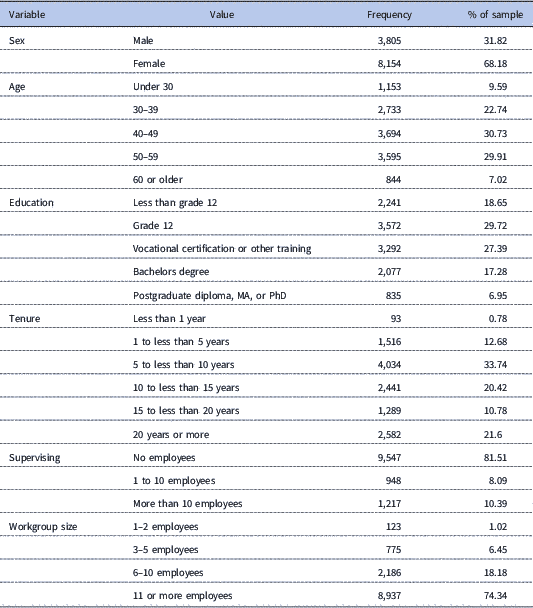
Previous research has found that individual and job characteristics are related to change-oriented behavior (Choi, Reference Choi2007; Vigoda-Gadot & Beeri, Reference Vigoda-Gadot and Beeri2012; Campbell & Im, Reference Campbell and Im2016; Marinova et al., Reference Marinova, Peng, Lorinkova, Van Dyne and Chiaburu2015). In this study, individual and job characteristics included in the model as controls consist of sex (female respondents=1), age (eight 5-year intervals from ‘under 30 years’ to ‘60 years or more’), education (eight levels ranging from ‘Less than Year 12 or equivalent’ to ‘Master’s degree or Doctorate’), government tenure (six levels from ‘less than 1 year’ to ‘20 years or more’), and supervisory responsibilities (the number of employees the respondent is responsible for producing performance reports for), a five-level variable that ranges from ‘None’ (about 82% of the sample) to ‘11 or more’. Additionally, because this study is primarily interested in the effect of workgroup accord, two workgroup-level variables are included: workgroup size (four levels ranging from ‘1–2 employees’ to ‘11 or more employees’) and workgroup instability. The latter captures the number of changes that respondents perceived to have impacted their workgroup in the past 12 months (11 changes were listed, for example, change in supervisor, decrease/increase in staff numbers, relocation to a new city, etc.). The rationale for including this variable is that the opportunities for change-oriented behavior may be greater in less stable work environments, as established processes and routines are in flux. About 40% of respondents reported no major changes in the past 12 months, while the greatest number of changes reported was 5 (about 4% of respondents). A complete breakdown of demographic characteristics of the sample is included in Appendix.
Results
Confirmatory factor analysis
As the APS Census was not designed specifically to test the hypotheses that are of interest here, it is more important in this study than in most to confirm whether the data conforms to the hypothesized latent variable structure implicit in the hypotheses. Stata 14 was therefore used to perform a confirmatory factor analysis, testing the appropriateness of the five-factor model. Excepting the χ2 value, which was significant, all goodness-of-fit indices indicate that the five-factor model is a reasonable fit for the data (a comparative fit index equal to 0.963, a non-normed fit index equal to 0.952, a root mean squared error equal to approximation equal to 0.062, and a standardized root mean squared residual equal to 0.054 (Sharma, Mukherjee, Kumar, & Dillon, Reference Sharma, Mukherjee, Kumar and Dillon2005)). To compare this five-factor structure with alternative models, a series of nine different four-factor models, representing all possible four-factor configurations, were systematically tested. In no case did the fit indices associated with any of these nine models meet the conventional cut off points. Moreover, likelihood ratio tests confirmed that the χ2 value for the five-factor model is significantly (p<.001) lower than that of any of the alternative models, demonstrating the superiority of the five-factor model. Collectively, these statistics provide strong evidence that the five-factor structure is appropriate for hypothesis testing.
Summary statistics
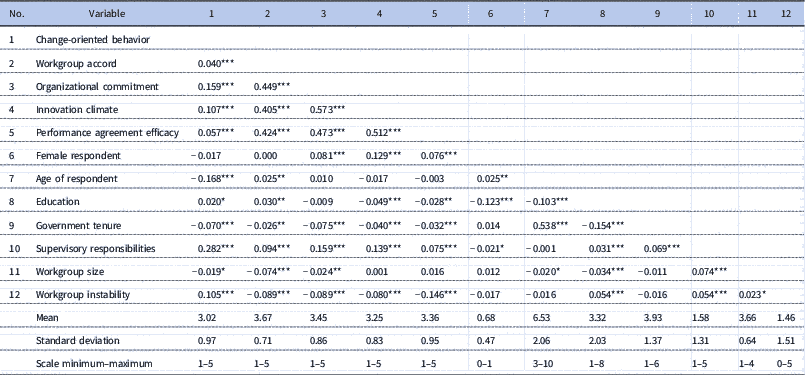
Table 1 shows the summary statistics and correlations for the key variables used in this study. Change-oriented behavior has a mean at the scale midpoint. All other key variables have means above the scale midpoint ranging from 3.25 in the case of innovation climate to 3.67 for workgroup accord.
Summary statistics and correlations

Note: *p<.05, **p<.01, ***p<.001.
Of the key variables, organizational commitment is the most strongly correlated with change-oriented behavior with a coefficient of 0.159 (p<.001) whereas workgroup accord has the weakest correlation with the dependent variable at 0.040 (p<.001). The four independent variables are all positively correlated with one another at p<.001.
Regression analysis
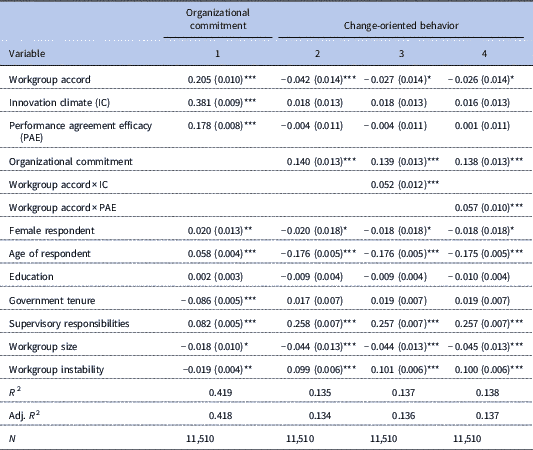
There is consensus in the contemporary methodological literature that independent effects should not be estimated in the absence of mediating variables (Rucker, Preacher, Tormala, & Petty, Reference Rucker, Preacher, Tormala and Petty2011; Aguinis, Edwards, & Bradley, 2017), and, therefore, studies of mediation now typically discard the first step of the famous Baron and Kenny (Reference Baron and Kenny1986) three-step approach to establishing mediation. This study follows this consensus and tests only for a relationship between, first, the independent and mediating variable and, second, the mediating variable and the dependent variable. These tests are shown in Table 2. The third and fourth columns of the table test for interaction effects. Key variables were centered before model estimation.
Predicting change-oriented behavior in public service organizations
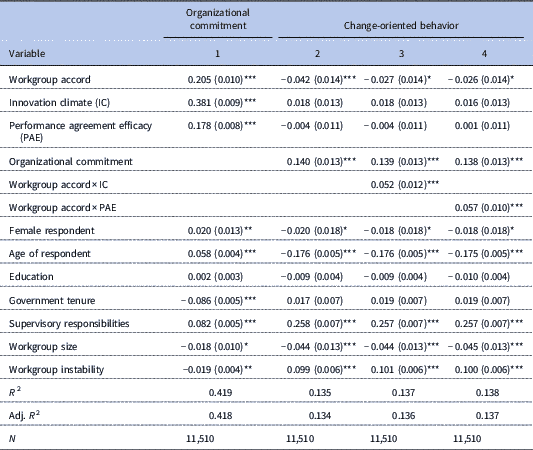
Note: Coefficients are standardized, with standard errors in parentheses.
*p<.05, **p<.01, ***p<.001.
The results suggest that workgroup accord has a positive, statistically significant relationship with organizational commitment, which, in turn, is positively related to change-oriented behavior. However, in the second model, it can be seen that workgroup accord has a negative and statistically significant relationship with change-oriented behavior. This statistic contradicts Hypothesis 1 and moreover places in doubt whether the total effect of workgroup accord on the dependent variable will be statistically significant.
To test this, a Sobel test for mediation was performed (Sobel, Reference Sobel1982) and direct and indirect effects examined. The results of the test suggest that, although both the direct, negative relationship and positive indirect (mediated) relationship are independently statistically significant (p<.001), the total effect of workgroup accord on change-oriented behavior is not (p>.10). The possible reasons for this result are discussed at length in the next section.
Before moving onto the tests for moderation, I note that several control variables are statistically significant. Female respondents report higher levels of organizational commitment than males, however, they also report lower levels of change-oriented behavior. Likewise, respondent age is positively related to commitment but negatively to change-oriented behavior. At the workgroup level, both size and instability are associated with lower levels of organizational commitment. Workgroup size, however, is negatively related to change-oriented behavior, suggesting that employees in smaller workgroups tend to pursue more change-oriented initiatives. Workgroup instability, as predicted, is positively related to change-oriented behavior. I also note that neither innovation climate nor performance agreement efficacy are related to change-oriented behavior at statistically significant levels, results that contradict Hypotheses 3 and 5.
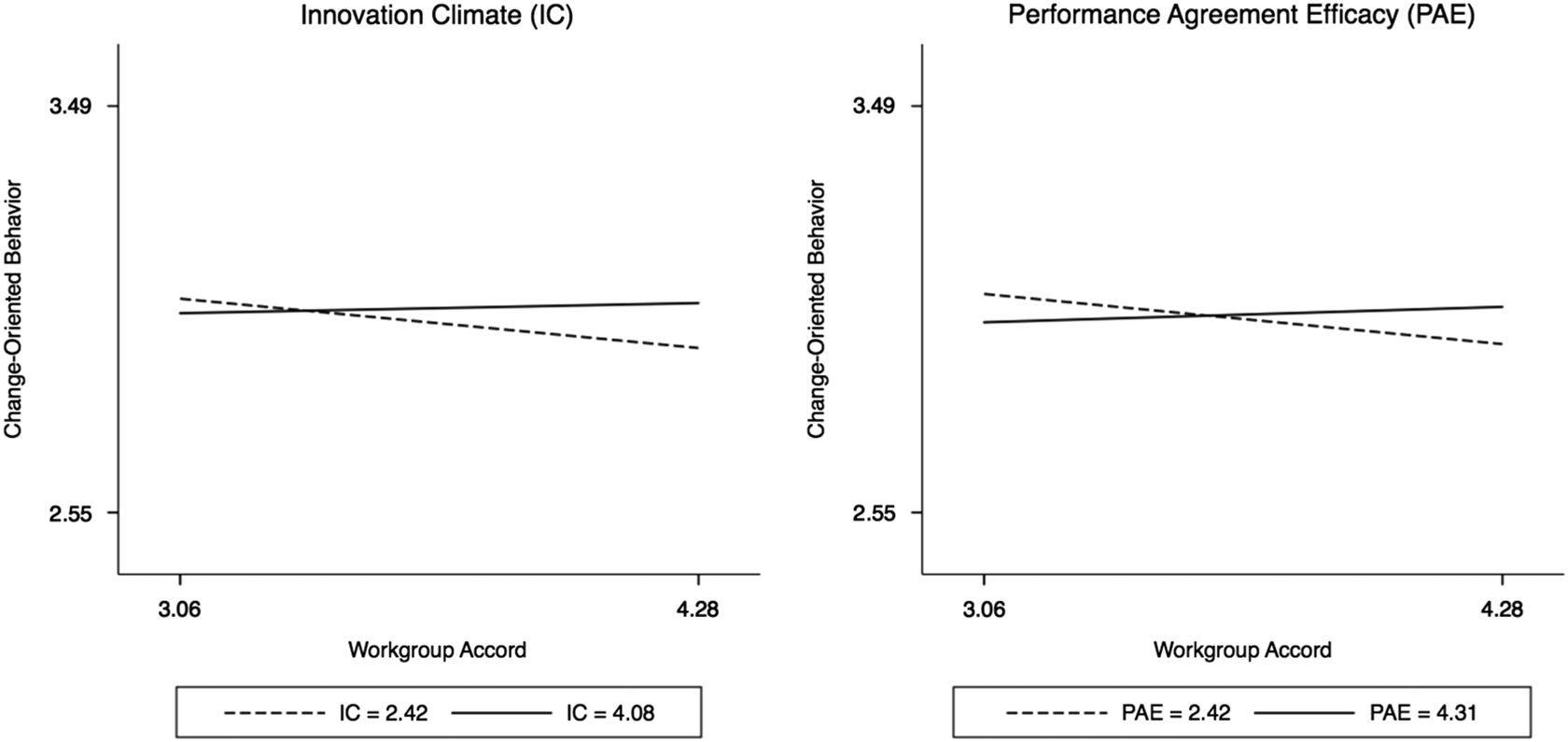
The final two models test whether the relationship between workgroup accord and change-oriented behavior is dependent on contextual factors. Positive, statistically significant coefficients for interaction terms for both innovation climate and performance agreement efficacy suggest that this is indeed the case. Figure 1 depicts the effect of workgroup accord on change-oriented behavior at low and high levels of the moderating variables (defined as one standard deviation below and above the mean, respectively) (Aiken & West, Reference Aiken and West1991). In both graphs, it can be seen that the relationship between workgroup accord and change-oriented behavior is significantly stronger at higher levels of the moderating factor. In both cases, when the moderator is low, the relationship between workgroup accord and change-oriented behavior turns negative.
Moderation effect of innovation climate and performance agreement efficacy

Discussion
Frontline employees in public service organizations can leverage their insight into the implementation process to produce performance-enhancing innovation (Campbell, Reference Campbell2017). However, if these same employees lack the motivation for or otherwise experience incentives against change, they will have many opportunities to undermine it (Fernandez & Rainey, Reference Fernandez and Rainey2006). Because adaptation to changing circumstances is so critical to sustained organizational performance, there is practical utility in understanding experienced barriers to innovation so as to lessen their impact. This study aims to make a contribution to this goal by examining how workgroup dynamics impact change-oriented behavior.
The interpersonal dynamics that characterize the context of innovation can have a decisive impact on its production. Due to the high degree of interdependent goals and processes within a given service delivery unit, workgroup members maintain a constant flow of communication and interaction. As such, the interpersonal workgroup climate should have a powerful effect on individual behavior. Reasoning that workgroup accord would furnish a sense of psychological safety as well as positive affectivity towards the organization, I hypothesized that workgroup accord would be positively related to change-oriented behavior both directly and indirectly via organizational commitment. However, while a statistically significant indirect effect was found, the total effect of workgroup accord on change-oriented behavior was not statistically significant due to a negative direct effect. Although this result is not consistent with the hypothesized positive relationship implied by the theory, several notions in the organization theory literature may contribute to its interpretation.
First, change-oriented behavior differs from other organizationally positive forms of extra role behavior in that its aim is not compliance with existing organizational norms and support of existing systems. Rather, it is precisely existing norms and systems that change-oriented behavior seeks to alter (Choi, Reference Choi2007; López-Domínguez et al., Reference López-Domínguez, Enache, Sallan and Simo2013). In other words, rather than reinforcing the status quo, change-oriented behavior threatens it. At least since Selznick (Reference Selznick1948), it has been known that the routines and processes of an organization, that is, its formal structure, cannot be studied in isolation from its informal, interpersonal dimension. In high-performance organizations, these two dimensions tend to work in a symbiotic way. In other cases, however, the two dimensions can present incompatible incentives for employees, and ultimately undermine the production of behaviors that would benefit the organization. Because the formal and informal dimensions of the organization are so closely linked, behaviors that disrupt work processes inevitably disrupt the social stability of the organization as well. In this sense, a unilateral modification of a work process will place some degree of strain on interpersonal relations, and therefore, given the importance of positive interpersonal relations with workgroup members for individual well-being, it is reasonable for employees to hope to preserve these whenever possible. In this sense, even though change-oriented behavior may lead to higher levels of individual or organizational performance, it also may threaten to damage the positive social context wherein it is implemented, and therefore the preservation of workgroup accord may furnish an incentive against rather than for change-oriented behavior. Indeed, some research suggests that, due to the ease of social and performance comparison within the workgroup, high-performance workgroup members are more likely to experience victimization by workgroup members (Kim & Glomb, Reference Kim and Glomb2014).
Second, it may be the case that a moderate level of conflict has positive effects on the creative process. For example, while outright hostility can damage creativity at the team level (Chen, Reference Chen2006), nevertheless debate among organizational members is positively associated with employee creativity (Isaksen & Ekvall, Reference Isaksen and Ekvall2010). De Dreu (Reference De Dreu2006) demonstrates that while a moderate level of task conflict among team members positively affects team innovation, when task conflict is too low, employees are less likely to pursue innovative behaviors. In another example, Farh, Lee, and Farh (Reference Farh, Lee and Farh2010) show that conflicting understandings about procedures, policies, and other work-related matters is positively related to team creativity (though, at high levels the relationship reverses). Relatedly, Turgut, Michel, Rothenhoefer, and Sonntag (Reference Turgut, Michel, Rothenhoefer and Sonntag2016) show that a high informational team climate can make change more salient, which in turn can activate dispositional resistance to change among some team members. Because of the close and interdependent nature of the work group, a high level of workgroup accord may generate a normative view of performance standards that prescribes a ‘right way’ of doing things based not on an objective evaluation of performance but rather on group consensus. From a practical perspective, this suggests that managers should encourage not only collegiality and solidarity among workgroup members, but also cultivate an atmosphere where debate about methods of service delivery, innovation, and clear performance goals are recognized as fundamental components of team culture.
The moderating factors hypothesized in this study may suggest ways in which managers can accomplish this. Both innovation climate and performance agreement efficacy are potential instruments through which leadership and management, respectively, may help translate workgroup accord into change-oriented behavior. Organizational culture, although diffuse and difficult to change in the short term, is both relevant to a range of employee behaviors and attitudes and is itself at least partly a function of the behavior of organizational leadership (Bass & Avolio, Reference Bass and Avolio1993). While in the present study innovation climate was found to have no direct effect on change-oriented behavior (in contradiction to Hypothesis 3 and other studies, such as Campbell & Im, Reference Campbell and Im2016 and Choi, Reference Choi2007), it was shown that the construct positively moderates the negative relationship between workgroup accord and the dependent variable. Organizations that have a strong climate of innovation implicitly sanction change-oriented behavior, and, although it is likely that change-oriented behavior in such organizations still threatens the social order to a degree, nevertheless high levels of innovation climate may help workgroup members accept that such disruptions are a natural and appropriate part of the service delivery process. The positive interaction effect thus suggests that strengthening innovation climate can have positive effects on change-oriented behavior despite the non-significant direct effect.
This same line of reasoning applies equally to performance agreement efficacy. While this factor had, like innovation climate, no direct relationship with the dependent variable, its moderating effect suggests that middle and lower level managers attempts to impose organizational control through the use of output-oriented instruments may also impact change-oriented behavior. Performance agreements are goal-oriented documents that can provide employees with a framework against which to evaluate potential job behaviors (Campbell, Reference Campbell2015; Kalgin Podolskiy, Parfenteva, & Campbell, Reference Kalgin, Podolskiy, Parfenteva and Campbell2018), and in this case, may provide a counterweight to the non-performance, consensus-based evaluative framework generated through workgroup accord. Additionally, performance agreements are generated at the individual level, and thus, many goals will be relevant at the workgroup level, the commitments stated in a performance agreement fall to the individual employee. Due to this, such agreements may work to individuate employees from the group, as well as provide incentives for the accomplishment of individual goals. Again and unsurprisingly, this suggests that managers need to pay careful attention to the quality of performance agreements their employees sign as they will impact not only behavior but also how employees interpret their place within the organization. However, caution needs to be exercised, as there is also some evidence in the public management literature that a strong reliance on output-based rewards may undermine important group processes such as interpersonal collaboration and helping behavior (Campbell, Lee, & Im, Reference Campbell, Lee and Im2016; Campbell, Reference Campbell2018).
Limitations of this study
The results of this study are suggestive. However, they are not without significant limitations that should be both kept in mind while interpreting them. Importantly, the analysis of the study is based on cross-sectional data gathered from a single informant. Despite its high quality and representativeness, this type of data not only precludes a demonstration of causality, it is also susceptible to common method variance (CMV) and social desirability bias (Podsakoff, MacKenzie, Lee, & Podsakoff, Reference Podsakoff, MacKenzie, Lee and Podsakoff2003). Additionally, and also significantly, the APS Census was not designed to test the hypotheses promulgated in this study and, consequently, it was not possible to use validated scales to measure the constructs of interest. The principal limitations of this study, therefore, relate primarily to the data used to test the hypotheses.
While these limitations are non-trivial, there is at the same time some reason to believe that they should not lead to a hasty rejection of the study’s findings. In the public management literature, while survey-based research is nevertheless the foundation of the discipline’s core and enduring findings over the past two decades, there is nevertheless an increasing concern with CMV (Meier & O’Toole, Reference Meier and O’Toole2013). At the same time, however, some scholars have called for caution, suggesting that evidence of the influence of CMV in the public management literature, while it should not be dismissed lightly, is at the same time itself based on a very limited sample and has perhaps created a reaction disproportionate to its quality (George & Pandey, Reference George and Pandey2017). In this study, while CMV cannot be ruled out conclusively, some evidence of the validity of the results can be provided. First, because workgroup accord has both a negative and positive relationship (via a mediating factor) with the dependent variable, it is not immediately clear which of the two relationships CMV might affect. In other words, either CMV inflated or reduced the true correlation with the dependent variable, but not both. Second, in terms of the moderating relationships studied, there is convincing evidence in the methodological literature that, whatever the effect of CMV on direct relationships, it is not a factor for moderation (Evans, Reference Evans1985; Siemsen, Roth, & Oliveira, Reference Siemsen, Roth and Oliveira2010). To these considerations can be added the fact that a confirmatory factor analysis revealed that a five-factor structure had the relatively best fit for the data, which itself, along with this study’s theoretical foundations, provides a level of confidence in the study’s findings.
This being said, future work should address these limitations in a more head-on fashion. First, validated scales should be used to measure latent constructs. Second, the research design should incorporate time in some manner to more convincingly demonstrate cause and effect. Third, independent and dependent variables should not be measured using a single informant. Finally, there is a growing use of experimental techniques in public management research (James, Jilke, & Van Ryzin, Reference James, Jilke and Van Ryzin2017). This approach is not irrelevant to the hypotheses and model of the present study and should be considered in future work.
Financial Support
This work was supported by an Incheon National University Research Grant in 2016.
Appendix
Sample demographic characteristics