Introduction
Corn is the principal source of energy in many broiler diets worldwide. Differences in corn quality may result in over- or underestimation of nitrogen-corrected apparent metabolisable energy (AMEn), translating into reduced broiler performance or poor feed conversion. In the U.S., corn is graded based on various attributes such as test weight per bushel (U.S. grade 2 = 24.5 kg), percentages of heat-damaged or broken kernels, and foreign material (USDA, 2004). Corn is further evaluated based on the endosperm type or the presence of live insects. Many of the factors that comprise U.S. corn grades are related to both chemical and physical characteristics, but indicators of potential nutrient availability are based on physical attributes only, such as weight or appearance (USDA, 2004). With significant drying damage, the appearance of corn kernels may be altered so that grading captures the associated reduction of nutrient availability. In contrast, corn with milder heat damage may be given the same grade as corn that appears identical but has a higher nutritional value.
Chemical attributes that may distinguish sources of corn that differ in nutritional value include protein solubility, zein content, amylose to amylopectin ratio, and vitreousness. These variables may be better predictors of nutritional value compared with more generalised designations such as bushel weight, which has been shown to be a poor estimator of feeding value (Leeson et al., Reference LEESON, YERSIN and VOLKER1993; Dale, Reference DALE1994). Even though corn is generally regarded as a consistent ingredient, its feeding value can vary significantly (Summers, Reference SUMMERS2001). The AMEn of corn for broilers may vary by more than 400 kcal/kg and is affected by genetics, agronomic conditions, proximate composition, pre- and post-harvest processing variables, and the presence of phytate and insoluble non-starch polysaccharides (Cowieson, Reference COWIESON2005).
All of these factors may alter the ability of the bird to digest and utilise nutrients and may not be accounted for under the current grading system. Sources of corn with similar proximate composition may differ in nutritional value when protein and starch are considered according to their chemical characteristics rather than total content alone. In a study correlating physical and chemical (as total nutrient content) kernel traits with broiler performance, total Lys and Met contents of corn did not affect average daily gain of broilers in the starter phase (Moore et al., Reference MOORE, STALDER, BEITZ, STAHL, FITHIAN and BREGENDAHL2008). These authors inferred that differences in energy availability resulting from vitreousness or amylopectin content may have had a more profound effect than the content of amino acids on feed consumption and utilisation. Thus, a thorough understanding of the kernel and the interrelationships of the starch and protein matrix are needed to identify high or low quality corn.
Corn kernel composition
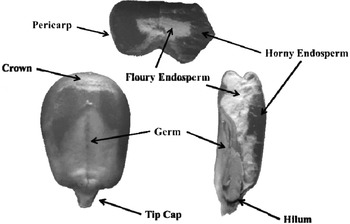
The majority of the corn kernel is comprised of endosperm (~80%) that can be divided into two classes; a central floury endosperm and a peripheral horny endosperm (Earl et al., Reference EARL, CURTIS and HUBBARD1946; Figure 1).
Corn Kernel composition.

Starch granules within the horny endosperm are polygonal and more tightly compressed by the protein matrix compared with the spherical, loosely packed starch granules of the floury endosperm (Whistler and Thornburg, Reference WHISTLER and THORNBURG1957). Starch granules, as well as small protein bodies containing zein, are embedded within an amorphous continuous protein matrix (Duvick, Reference DUVICK1961). Vitreousness or hardness is associated with composition and distribution of endosperm protein. Corn with a higher proportion of horny endosperm is more vitreous or glassy due to increased protein synthesis and more mature protein bodies relative to the floury endosperm (Paiva et al., Reference PAIVA, KRIZ, PEIXOTO, WALLACE and LARKINS1991; Dombrink-Kurtzman and Bietz, Reference DOMBRINK-KURTZMAN and BIETZ1993).
The endosperm contains nearly 80% of the total kernel protein (Wilson, Reference WILSON1987), comprised of 50 to 60% zein (protein bodies), 30% glutelin (matrix proteins), and 10 to 20% albumins, globulins, and free amino acids (Arruda et al., Reference ARRUDA, DA SILVA and TEIXEIRA1978). The content of zein, the primary glutelin-associated protein in dent corn hybrids (Boundy et al., Reference BOUNDY, WOYCHIK, DIMLER and WALL1967), may vary due to variety differences or the extent of maturity at harvest (Bressani and Conde, Reference BRESSANI and CONDE1961). Protein bodies are larger and more abundant within the horny endosperm compared with the floury endosperm (Wolf et al., Reference WOLF, KHOO and SECKINGER1967). Because zein contains very little Lys and high concentrations of Pro, Glu, and Leu, its protein contribution is reflected in the amino acid profile of corn, as Lys content decreases and Leu content increases during kernel development (Bressani and Conde, Reference BRESSANI and CONDE1961). This results in a lower biological value as zein and crude protein content increase with maturity (Mitchell et al., Reference MITCHELL, HAMILTON and BEADLES1952; Bressani and Conde, Reference BRESSANI and CONDE1961). The association of starch with protein bodies and matrix proteins reduces access to starch granules (Rooney and Pflugfelder, Reference ROONEY and PFLUGFELDER1986), and thus, any impairment of protein solubility that limits proteolysis may impact both protein and starch digestion.
Factors affecting the nutritional value of corn
Although protein composition of corn may affect nutrient digestibility, corn with a favourable composition may suffer from adverse pre- or post-harvest processing conditions. In this case, important factors include moisture at harvest, storage time before drying, and the severity of the subsequent drying scheme, the effects of which can be estimated by extractable salt-soluble protein (PS) content. Other factors that may affect nutritional value include vitreousness and phytate content (Cowieson, Reference COWIESON2005). It is much more likely for the aforementioned variables to affect nutritional quality compared with the genetic variety grown in a specific location. Although genetically modified corn varieties with insect-protected and herbicide-tolerant traits have received public attention, several publications have clearly demonstrated no adverse effects of genetic modification on subsequent nutritional value when fed to broilers or layers (Brake and Vlachos, Reference BRAKE and VLACHOS1998; Brake et al., Reference BRAKE, FAUST and STEIN2003; Taylor et al., Reference TAYLOR, HARTNELL, RIORDAN, NEMETH, KARUNANANDAA, GEORGE and ASTWOOD2003a; Reference TAYLOR, HYUN, HARTNELL, RIORDAN, NEMETH, KARUNANANDAA, GEORGE and ASTWOOD2003b, Jacobs et al., Reference JACOBS, UTTERBACK, PARSONS, RICE, SMITH, HINDS, LIEBERGESELL and SAUBER2008).
vitreousness
Vitreousness of corn is related to the proportion of horny to floury endosperm and research has shown that it can negatively affect starch digestion in ruminants (Philippeau et al., Reference PHILIPPEAU, LE DESCHAULT DE MONREDON and MICHALET-DOREAU1999). However, the effect of vitreousness for broilers is ambiguous. Flint-type corn with a harder endosperm and higher vitreousness has a lower starch digestion rate in vitro compared with dent-type corn (Grbesa and Kiš, Reference GRBESA, D and KIŠ2005). However, Kato et al. (Reference KATO, BERTECHINI, FASSANI, GONCALVES DE BRITO and CASTRO2011) observed no effects of type of endosperm (flint, semi-dent, dent, etc.) on AMEn of corn in broilers. From 1 to 42 d of age, the type of corn endosperm in diets fed to broilers did not influence growth performance, although there were some large numerical differences that were not significant but favoured corn with a harder endosperm (Benedetti et al., Reference BENEDETTI, SARTORI, CARVALHO, PEREIRA, FASCINA, STRADIOTTI, PEZZATO, COSTA and FERREIRA2011). Collins et al. (Reference COLLINS, MORAN and STILBORN2001) concluded that the type of endosperm (hard or soft) had little effect on broiler production and effects on feed intake and gain appeared to be influenced more by production environment. Other variables may affect nutritional value of corn on a more consistent basis than vitreousness, because variability is typically low within a country or region due to a favoured type of endosperm, for example, dent corn grown in the United States, dent or semi-flint corn in Europe, and flint corn in Brazil.
phytate
Approximately two-thirds of the total P in plant-derived feed ingredients exists as phytate (myo-inositol-1,2,3,4,5,6-hexakisphosphate) P. Phytate is largely unavailable to monogastric animals when in the presence of Ca, such as in complete diets (Gillis et al., Reference GILLIS, KEANE and COLLINS1957; Paullaf and Rimbach, Reference PAULLAF and RIMBACH1997). Disruption of the digestive and absorptive physiology is facilitated in part by the inhibition of endogenous enzymes (Yoon et al., Reference YOON, THOMPSON and JENKINS1983; Liu et al., Reference LIU, RU, LI and COWIESON2008), chelation of minerals (Maga, Reference MAGA1982), and hypersecretion and repartitioning of Na in the gastrointestinal tract (Cowieson et al., Reference COWIESON, ACAMOVIC and BEDFORD2004b). Because phytate is a polyanionic molecule at gastric pH, it readily chelates mono- and divalent mineral cations, and decreases the digestibility of proteins and starch (Angel et al., Reference ANGEL, TAMIM, APPLEGATE, DHANDU and ELLESTAD2002; Cowieson, Reference COWIESON2005).
Phytate begins to be synthesised in corn kernels approximately three weeks after pollination and increases rapidly with maturity (DeTurk et al., Reference DETURK, HOLBERT and HOWK1933; Early and DeTurk, Reference EARLY and DETURK1944). More than 85% of the phytate in corn is concentrated in the germ (Hamilton et al., Reference HAMILTON, HAMILTON, CONNOR JOHNSON and MITCHELL1951; O'Dell et al., Reference O'DELL, DE BOLAND and KOIRTYOHANN1972). Phytate content of corn can vary considerably and varieties having an abnormally high concentration of phytate could potentially affect nutrient utilisation. Classen et al. (Reference CLASSEN, MAENZ and CARUTHERS2010) reported phytate concentrations from 200 corn samples ranging from 0.2 to 0.9% with the mean of 0.6%. High phytate content in corn may limit nutritional value. Research has examined the effects of low-phytate corn, as these varieties have been developed. Li et al. (Reference LI, LEDOUX, VEUM, RABOY and ERTL2000) observed increased P retention in birds fed diets containing low-phytate corn compared with commercial corn (0.28 vs. 0.74% phytate, respectively), with no effects on growth performance. When non-phytate P concentration was not held constant (by substitution of equal amounts of wild-type and low-phytate corn), birds fed diets containing low-phytate corn grew faster and had higher tibia ash concentration due to a higher proportion of the P from the low phytate corn being of non-phytate origin and hence more available (Jang et al., Reference JANG, FADEL, KLASING, MIRELES, ERNST, YOUNG, COOK and RABOY2003). Effects of phytate concentration on the nutritional value of corn could potentially be exacerbated by other factors affecting nutrient utilisation in corn, particularly where protein and starch digestion are concerned.
The in vitro rate of wheat starch degradation as well as glycemic index in humans were found to be negatively associated with phytate content (Yoon et al., Reference YOON, THOMPSON and JENKINS1983), and, in broilers, Cowieson et al. (Reference COWIESON, ACAMOVIC and BEDFORD2004a) observed reduced digestion of corn starch in the presence of phytate. It may be that phytate interacts with starch via protein due to the close association of these nutrients (starch/protein envelope). Zein is extremely hydrophobic and thus may be more susceptible to interactions with phytate than other proteins. Cowieson and Cowieson (Reference COWIESON and COWIESON2011) determined that phytate is likely to cause aggregation and insolubility of proteins by drawing a hydration shell around itself, competing for hydrating water with other compounds in the water matrix. Thus, the ability of proteins to stay in solution in the presence of phytate is most dependent on surface polarity and hydrophobicity/-philicity, rather than the concentration of basic amino acids as previously thought.
agronomic conditions
Agronomic factors such as growing region and fertilisation have also been evaluated. O'Neill et al. (Reference O'NEILL, LIU, WANG, DIALLO and HILL2012) fed diets to broilers containing a single genetic variant of corn grown in five distinct regions in China and did not observe differences in AMEn or on growth performance. Additionally, increasing soil N fertility did not improve the nutritional value of corn for broilers from 10 to 21 d of age (Cromwell et al., Reference CROMWELL, BITZER, STAHLY and JOHNSON1983), despite a reduction in biological value associated with increased N fertiliser applications due to an increase in synthesis of zein (Wang et al., Reference WANG, LI and MALHI2008).
harvest moisture and drying
Harvest moisture and drying may exert considerable influence on the nutritional value of corn. Improper drying alters the nature and solubility of protein (Peplinski et al., Reference PEPLINSKI, PAULIS, BIETZ and PRATT1994), which may affect nutrient utilisation by decreasing the availability of amino acids and impairing α-amylase and water access to the starch granules (Altay and Gunasekaran, Reference ALTAY and GUNASEKARAN2006). Drying may also affect the composition of myo-inositol esters, as shown by Pontoppidan et al. (Reference PONTOPPIDAN, PETTERSSON and SANDBERG2007) who observed a small but significant shift from phytate to myo-inositol pentakisphosphate following extrusion cooking of corn. Corn dried at temperatures higher than 30°C had reduced protein solubility in 0.5M NaCl (Wall et al., Reference WALL, JAMES and DONALDSON1975). Thermal denaturation of protein permits formation of hydrogen and non-covalent hydrophobic bonds, as well as disulfide bridge formation, which cause protein aggregation and insolubility. Wall et al. (Reference WALL, JAMES and DONALDSON1975) extracted additional proteins with a buffered (pH 10.0) 0.5% sodium dodecyl sulphate solution and 0.6% β-mercaptoethanol, following extraction of saline and alcohol soluble proteins. These reagents disrupt hydrophobic and disulphide bonds, respectively, indicating bond formation with increasing drying temperature.
Changes in starch granule structure represent additional challenges in terms of nutrient digestion in poultry. Annealing may occur with starch granules in high moisture corn (>25% w/w) dried at high temperatures if the onset of gelatinisation temperature is not exceeded (Tester and Debon, Reference TESTER and DEBON1999). The annealing process is a physical reorganisation of starch granules leading to a higher gelatinisation temperature and narrowing of the gelatinisation range (Gough and Pybus, Reference GOUGH and PYBUS1971). Annealed starch, as a result, is less readily digested. Furthermore, gelatinisation enthalpy increases with kernel moisture content up to a threshold of 70% and thus, moisture is a limiting factor for starch gelatinisation in pelleted diets (Altay and Gunasekaran, Reference ALTAY and GUNASEKARAN2006). Gelatinisation of starch radically increases its rate of digestion by amylases and thus would be considered desirable in poultry feeds. Conditioned mash, however, contains only 13 to 15% moisture and although pressure and frictional heat generated at the mash-die interface increase the extent of gelatinisation, it typically does not exceed 25 to 30% (Skoch et al., Reference SKOCH, BEHNKE, DEYOE and BINDER1981; Moritz et al., Reference MORITZ, CRAMER, WILSON and BEYER2003). As a result most corn starch is present as native starch granules which are digested more slowly (Walker and Hope, Reference WALKER and HOPE1963), affecting glycemic and insulin responses. Extent of gelatinisation is highly correlated with the rate of in vitro digestion by α-amylase (r = 0.96) as well as plasma glucose and insulin (r = 0.88 and 0.90, respectively) in rats (Holm et al., Reference HOLM, LUNDQUIST, BJÖRCK, ELIASSON and ASP1988).
A limited amount of research has demonstrated a reduction in energy utilisation in poultry following improper drying of corn. Carvalho et al. (Reference CARVALHO, ALBINO, DE VARGAS, TOLEDO, DE OLIVIERA and DE SOUZA2009) determined that AMEn of corn dried at ambient temperature, as well as at 80, 100, and 120°C in male birds from 21 to 30 d of age decreased quadratically with increasing temperature. Intuitively, corn that is low in AMEn due to artificial drying may impart an overall deficient AMEn to a corn-soybean meal-based diet. This may be particularly troublesome with diets formulated to be marginal in energy due to high cost of energy rich ingredients. The loss in utilisation of energy and most amino acids (Carvalho et al., Reference CARVALHO, ALBINO, DE VARGAS, TOLEDO, DE OLIVIERA and DE SOUZA2009), likely translates to reduced broiler performance. Broilers that were fed corn-soybean meal-based diets formulated to contain corn dried at different temperatures responded in body weight gain and feed conversion (Kaczmarek et al., Reference KACZMAREK, COWIESON, JÓZEFIAK, BOCHENEK and RUTKOWSKI2007) whereby those fed the corn dried at 140°C gained 354 g less from 1 to 35 d of age than their counterparts fed corn dried at 80°C (P < 0.05). The same birds also exhibited a 16 point (1.67 vs. 1.51) increase in feed conversion ratio when fed the high temperature dried versus the control corn. Bhuiyan et al. (Reference BHUIYAN, ISLAM and IJI2010) also evaluated the effects of corn dried at different temperatures on broiler performance. At 21 d of age, birds fed diets with corn dried at 100°C weighed 42 g/bird less than those fed diets with corn dried at 80°C.
Time of harvest may also affect protein solubility and subsequent nutrient utilisation, as early harvested corn has a higher moisture content but a lower proportion of zein and glutelin proteins compared with corn harvested at maturity (Bressani and Conde, Reference BRESSANI and CONDE1961). Despite stabilisation of kernel proximate composition from approximately 37 d after flowering onward (Bressani and Conde, Reference BRESSANI and CONDE1961), early-harvest corn has a higher reducing sugar content and is more susceptible to thermal damage (e.g., Maillard reaction) compared with corn harvested at maturity (French and Kingsolver, Reference FRENCH and KINGSOLVER1964; Rivera et al., Reference RIVERA, PEO, FLOWERDAY, CRENSHAW, MOSER and CUNNINGHAM. P.J.1978a; Reference RIVERA, PEO, MOSER, CRENSHAW and CUNNINGHAM1978b). It is also worth noting that storage time is critical as it generates more reducing sugars and so will result in greater damage during drying. These concepts are apparent from the reductions in Lys content and availability following elevated drying temperatures in corn harvested early with higher moisture content (Wall et al., Reference WALL, JAMES and DONALDSON1975; Rivera et al., Reference RIVERA, PEO, FLOWERDAY, CRENSHAW, MOSER and CUNNINGHAM. P.J.1978a). Such data run counter to the tenet that that heat combined with moisture positively affects enzymatic access to polymers for digestion (Moran, 1985). However, further exceptions to this tenet were provided by Rivera et al. (Reference RIVERA, PEO, FLOWERDAY, CRENSHAW, MOSER and CUNNINGHAM. P.J.1978a) who observed a maturity × drying temperature interaction on total tract Lys digestibility in pigs. Corn harvested at 82% DM and dried at 60°C had a higher Lys digestibility than corn harvested at 63% DM, and the opposite was true when corn was dried at 40°C, which demonstrates that there are exceptions to the rule that higher drying temperatures lead to lower nutrient digestibilities.
extractable salt-soluble protein content
Extractable salt-soluble protein content (PS) is used by the wet-milling industry to monitor starch-extractability of corn (Métayer et al., Reference MÉTAYER, DEBICKI-GARNIER and SKIBA2009). Lasseran (Reference LASSERAN1973) determined that the solubility of salt-soluble and alcohol-soluble proteins decreases as corn is dried at increasing temperatures. This occurs in two phases, as PS decreases rapidly during initial heating followed by a less rapid decrease ultimately reaching an asymptote (Mourad et al., Reference MOURAD, HEMATI and LAGUERIE1996). Reduction of PS proceeds at a more rapid pace as moisture content increases (Odjo et al., Reference ODJO, MALUMBA, DOSSOU, JANAS and BÉRA2012). Thus, corn harvested at a higher moisture content is more susceptible to the loss of PS. Solubility of most kernel proteins is negatively associated with drying temperature, with the exception of zein-like glutelins, which are not affected by drying temperatures up to 140°C (Malumba et al., Reference MALUMBA, JANAS, MASIMANGO, SINDIC, DEROANNE and BÉRA2009). Solubility indexes of albumins, globulins, total salt-soluble proteins, and zein, however, are all highly negatively correlated (r<-0.95) with drying temperature and starch yield from the wet-milling process. As a result Malumba et al. (Reference MALUMBA, JANAS, MASIMANGO, SINDIC, DEROANNE and BÉRA2009) suggested PS as an assessment of corn suitability due its ability to identify processes where temperatures have exceeded those which provide optimal starch recovery in the wet-milling process.
Development of a standard method for determination of PS has provided a rapid and inexpensive assay for evaluating corn (method NF-V03-741; AFNOR, 2008). This method is a colorimetric protein assay similar to the Bradford method, but with a saline extraction step (Bradford, Reference BRADFORD1976). Absorption at 595 nm is compared with a standard curve constructed with bovine serum albumin. For rapid analysis of corn, PS content as well as vitreousness can be determined using near-infrared reflectance spectroscopy (Ngonyamo-Majee et al., Reference NGONYAMO-MAJEE, SHAVER, COORS, SAPIENZA, CORREA, LAUER and BERZAGHI2008; Cowieson, Reference COWIESON2010). This technology may be beneficial for daily assessment of corn to prevent overestimation of corn AMEn, which may negatively affect rate of growth and feed conversion. Additionally, equations may be developed using these and other variables to predict AMEn of corn.
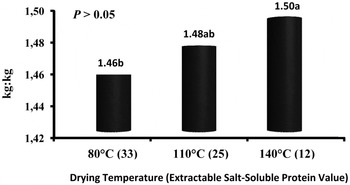
Métayer et al. (Reference MÉTAYER, DEBICKI-GARNIER and SKIBA2009) evaluated AMEn in intact roosters and 1 to 38 d growth performance of broilers fed diets formulated with corn dried at 80, 110, or 140°C. Various drying temperatures resulted in PS values (equivalent mg of bovine serum albumin) of 33, 25, and 12. Diets containing corn dried at 140°C decreased AMEn by 80 kcal/kg and increased feed conversion ratio of broilers by 3% (1.50 vs. 1.46) compared with corn dried at 80°C (Figure 2). Differences in growth performance are probably related to differences in nutritional value among sources of corn varying in PS. However, data are limited on the effects of PS on nutrient and energy utilisation in broilers.
Comparison of drying temperatures and their effects on feed conversion ratio.

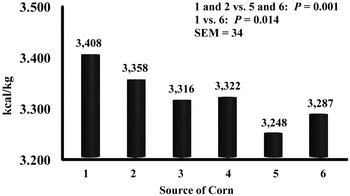
A digestibility trial was conducted to determine the relationship between chemical kernel characteristics and ileal nutrient digestibility in broilers (Gehring et al., Reference GEHRING, BEDFORD, COWIESON, DOZIER and III.2012). Twelve sources of corn were obtained from throughout the U.S. and evaluated for proximate composition, PS, and vitreousness. Six sources were selected that had similar proximate composition but differed in PS or vitreousness (sources 1 and 2 = High PS; sources 3 and 4 = Moderate PS; sources 5 and 6 = Low PS). Extractable salt-soluble protein values varied considerably among the six sources of corn (26 to 49), but small differences in vitreousness were observed among corn sources.
Apparent ileal digestibility of N, crude fat, and starch did not differ (P > 0.05) among sources of corn. The AMEn of the six sources of corn averaged 3298 kcal/kg. Mean ileal digestible energy and AMEn of the high PS corn was 115 and 56 kcal/kg higher, respectively, than that of the low PS corn pair (P < 0.02; Figure 3). Extractable salt-soluble protein content explained 62% of the variation in ileal digestible energy among the sources of corn (P < 0.001). These results indicated that corn with similar composition varied in their digestible energy content and that PS may provide a basis for identifying corn of high and low nutritional value for broilers.
Apparent Metabolisable Energy value of different sources of corn.

Unexpectedly, differences in energy utilisation among sources of corn were obtained without a change in apparent ileal N or starch digestibility and in addition, there was no relationship between ileal digestible energy and AMEn (r = 0.2; P = 0.173). Apparent ileal N digestibility varied by four percentage points but did not differ among sources (P = 0.57). This finding is similar to that of Rivera et al. (Reference RIVERA, PEO, MOSER, CRENSHAW and CUNNINGHAM1978b) who observed no difference in true N digestibility (five percentage point numerical difference) of corn dried at different temperatures and fed to rats, but linear reductions in availability of several amino acids, including Lys, Met, Ile, Val, and Trp, increased with drying temperature. Although Gehring et al. (Reference GEHRING, BEDFORD, COWIESON, DOZIER and III.2012) did not observe differences in starch digestibility measured at the distal ileum, differences in the rate of starch digestion may have altered synchronicity of starch and protein digestion, as well as varied the glycemic and insulin responses (Weurding et al., Reference WEURDING, VELDMAN, VEEN, VAN DER AAR and VERSTEGEN2001).
rate of starch digestion
Corn provides the majority of AMEn in corn-soybean meal-based diets, and thus, it is intuitive that starch digestibility would be associated with utilisation of energy. However, this may not always be the case, as AMEn of wheat fed to broilers has been shown to vary by nearly 500 kcal/kg, without differences in starch digestibility (Wiseman et al., Reference WISEMAN, NICOL and NORTON2000). Additionally, Barrier-Guillot et al. (Reference BARRIER-GUILLOT, ZUPRIZAL, JONDREVILLE, CHAGNEAU, LARBIER and LEUILLET1993) determined that corn dried at high temperatures (>130 or 140°C) had decreased true digestibility of some amino acids (Asp, Thr, Ala, Iso, Leu, Tyr, Lys, Cys, and Met) when fed to roosters compared with corn dried at lower temperatures. Although true amino acid digestibility was significantly altered by drying regimen, there were no differences in true protein digestibility or apparent starch digestibility.
The site of starch digestion may influence the AMEn of corn, since hind gut fermentation may result in less efficient energy extraction. Rate of starch digestion is thought to be a function of surface area, physical characteristics, and extent of crystallinity of the granules (Moran, 1982). Differences in protein solubility among sources of corn with similar proximate composition may affect the rate of starch disappearance in the small intestine. Reductions in starch digestion rate may be caused by a higher content of horny endosperm, which contains starch granules tightly encapsulated by the protein matrix or by heat-damage associated with protein denaturation and intra- and inter-molecular bond formation. In broilers, the rate of starch digestion varies between feedstuffs (Weurding et al., Reference WEURDING, VELDMAN, VEEN, VAN DER AAR and VERSTEGEN2001). Weurding et al. (Reference WEURDING, VELDMAN, VEEN, VAN DER AAR and VERSTEGEN2001) determined that the rates of starch digestion were different between hammer-milled and roller-milled corn (2.6 vs. 3.1 kd) although the extent of digestion was equal (97%). Studies in pigs indicated that starch digestion may occur at different rates independent of ileal digestibility, affecting the utilisation of dietary nutrients (Van der Meulen et al., Reference VAN DER MEULEN, BAKKER, SMITS and DE VISSER1997; Li et al., Reference LI, DAI, LIN, ZHANG, HUANG, RUAN, DENG and XIE2008). Diets containing 65% corn or pea starch were fed to gilts and net portal flux of glucose and amino acids were determined (Van der Meulen et al., Reference VAN DER MEULEN, BAKKER, SMITS and DE VISSER1997). Although starch digestibility of corn and pea starch in pigs were reported to be similar (Everts et al., Reference EVERTS, DEKKER, SMITS and CONE1996), net portal glucose flux was higher for corn starch compared with pea starch, and net portal flux of Val, Ile, Phe, Trp, Arg, Ser, Cys, Tyr, Lys, and His were higher for pea starch, despite a lower ileal amino acid digestibility (Everts et al., Reference EVERTS, DEKKER, SMITS and CONE1996). This effect may occur due to differences in insulin and glycemic responses, as well as the amount of fermentable substrate entering the hindgut (Van der Meulen et al., Reference VAN DER MEULEN, BAKKER, SMITS and DE VISSER1997; Weurding et al., Reference WEURDING, VELDMAN, VEEN, VAN DER AAR and VERSTEGEN2001) and subsequent release of enteric hormones such as peptide YY and glucagon-like peptide-1 that affect gastric emptying (Tatemoto et al., Reference TATEMOTO, CARLQUIST and MUTT1982; Suzuki et al., Reference SUZUKI, NAKAYA, ITOH, TATEMOTO and MUTT1983; Nauck et al., Reference NAUCK, NIEDEREICHHOLZ, ETTLER, HOLST, ØRSKOV, RITZEL and SCHMIEGEL1997).
Synchronicity of starch and protein digestion may be altered by varying rates of digestion. Alteration of the supply of first-pass nutrients and energy to enterocytes may disrupt normal glycemic responses and have nutritional consequences as observed with animals fed different carbohydrate sources (Rerat, Reference RERAT1985). Synchronicity of digestion has received attention in the ruminant nutrition literature (DelCurto et al., Reference DELCURTO, COCHRAN, HARMON, BEHARKA, JACQUES, TOWNE and VANZANT1990; Heldt et al., Reference HELDT, COCHRAN, MATHIS, WOODS, OLSON, TITGEMEYER, NAGARAJA, VANZANT and JOHNSON1999) as it applies to supplying nutrients to rumen microbes and subsequent digestion and volatile fatty acid production. However, there is a lack of similar work focused on poultry.
Weurding et al. (Reference WEURDING, ENTING and VERSTEGEN2003) found that birds fed diets with pea starch (slowly digestible) had higher protein utilisation and lower feed conversion compared with those fed diets with tapioca starch (rapidly digestible) across a range of amino acid densities. These authors noted that a continuous glucose supply is needed for direct utilisation of glucose, with less interconversions between glucose and glycogen or fat. Corn starch fed to pigs resulted in a portal glucose spike compared with the stable appearance of glucose after feeding pea starch (Van der Meulen et al., Reference VAN DER MEULEN, BAKKER, SMITS and DE VISSER1997). Würsch (Reference WÜRSCH1986) determined that the in vitro rate of starch digestion is decreased considerably in legumes after cooking at 115°C. Based on these data, heat-treatment of purified corn starch may be beneficial in terms of stabilising the appearance of portal glucose in poultry. However, the opposite may be true in native cereal grains as demonstrated in wheat, as in vitro rate of starch hydrolysis is higher in high AME compared with low AME wheat meal (Wiseman et al., Reference WISEMAN, NICOL and NORTON2000). Because improper drying of corn negatively affects energy utilisation and growth performance of broilers, it is likely that changes in the protein fraction are primarily responsible.
Conclusions
Sources of corn having similar proximate composition may vary in ileal digestible energy and AMEn for broilers despite no difference in N or starch digestibility. The published literature lacks information on the effects of corn endosperm composition as well as pre- and post-harvest processing variables on nutrient utilisation in broilers. Extractable salt-soluble protein content may vary due to excessive drying or protein composition of the kernel. Significant relationships with energy utilisation and performance in broilers indicate that PS may provide a tool to rapidly evaluate corn for nutritional value. Rapid analysis via NIR and development of prediction equations that incorporate chemical kernel characteristics such as PS content may allow nutritionists to better formulate diets without over- or under-estimating the nutritional value of corn. More research is needed to provide a full understanding of how chemical kernel characteristics of corn affect nutrient digestibility and performance of poultry.