Large-scale research projects have described adolescent internet use in the general population, highlighting potential risks and benefits (Livingstone et al. Reference Livingstone, Mascheroni and Staksrud2015). Some aspects of internet use and related experiences have been associated with mental health concerns, for example cyber victimisation and suicidal behaviours (Kowalski et al. Reference Kowalski, Giumetti, Schroeder and Lattanner2014). There is limited research regarding how young people experiencing mental ill health use the internet in an Irish context, and whether this differs from those without mental health difficulties. Within mental health services, empirical knowledge regarding internet use has become necessary to inform assessment and intervention. Further, the rapidly changing access to and evolving content of the internet may leave clinicians feeling unprepared regarding this aspect of young people’s lives (Rafla et al. Reference Rafla, Carson and DeJong2014). The present exploratory study attempts to address this knowledge gap by measuring and comparing internet use among young people with and without mental health difficulties. internet use is operationalised as how, when and where young people access the internet, what content they access online, online risk and bullying experiences, problematic internet use, and parental monitoring and knowledge of use. We begin by summarising pertinent points from the literature regarding internet use among young people and the risks or benefits it may offer in relation to wellbeing.
Access to the internet
The internet is available to young people on a variety of platforms. The ‘Children Go Mobile’ study found that young people in Ireland access the internet mostly in their home, with 63% reporting daily use (O’Neill & Dinh, Reference O’Neill and Dinh2015). Over a third of participants reported using a smartphone to access the internet, followed by laptops (29%), and tablets (27%). A third report using the internet after 9 p.m., and only 7% report using the internet daily in school. Studies that have offered insight into how young people access the internet have not described how young people with mental health difficulties access the internet, and whether their use differs from those without mental health difficulties.
Popular online content
Social networking, instant messaging, use for entertainment (listening to music, watching video clips), and gaming are reported as the most popular activities for adolescents in Europe (EU Kids Online, 2014). In Ireland there is an increasing trend regarding the use of smartphones (O’Neill & Dinh, Reference O’Neill and Dinh2015). This has contributed to greater use for entertainment and social purposes, but few young people report regular informational, civic and creational uses (O’Neill & Dinh, Reference O’Neill and Dinh2015). In relation to young people’s mental health and wellbeing, it is recognised that for most young people, access can offer both benefits and risks. For example, Best et al.’s (Reference Best, Manktelow and Taylor2014) meta-analysis reported benefits of social networking sites (SNS) to include increased self-esteem, perceived social support, increased social capital, safe identity experimentation and increased opportunity for self-disclosure. They also identified risks of exposure to harm, social isolation, depression and cyber bullying.
Risky online content
There are websites in which there may be a higher risk of harm, such as those that endorse eating disorders, self-harm and suicide. In Ireland 14% of girls aged 13–16 years have reported encountering anorexic or bulimic content; 9% report viewing self-harm sites; and 8% report viewing sites discussing suicide (O’Neill & Dinh, Reference O’Neill and Dinh2015). Websites that endorse eating disorders, sometimes referred to as ‘pro-ed’, ‘pro-ana’ or ‘pro-mia’ sites, may offer visitors opportunities for emotional and esteem support, self-expression and disclosure (Yeshua-Katz & Martins, Reference Yeshua-Katz and Martins2013). However, heavier use of pro-eating disorder sites has been found to predict greater eating disorder symptomology, to be associated with more extreme weight loss behaviours, and harmful post-website usage activities (Peebles et al. Reference Peebles, Wilson, Litt, Hardy, Lock, Mann and Borzekowski2012). Use of such sites may also confer risk for those without an eating disorder (Jett et al. Reference Jett, LaPorte and Wanchisn2010). Similarly, visiting sites where users share text, images and video related to self-harm may offer benefit in reducing harming behaviour through an increase in social support, or risk through reinforcement and triggering of self-harm urges (Lewis & Baker, Reference Lewis and Baker2011; Harris & Roberts, Reference Harris and Roberts2013).
Online sexual content may also pose a risk of harm to young people. Livingstone & Gorzig (Reference Livingstone and Haddon2014) found that adolescents who are older, experience greater psychological difficulties, and show higher sensation seeking and generally risky behaviour (e.g. excessive alcohol, missing school and searching for new friends online) are more likely to receive online sexual content created and shared by other adolescents (often referred to as sexting). Importantly, not all report receiving this content as upsetting. Predictors of experiencing harm as a result of receiving these messages were younger age, female gender, higher psychological difficulties and lower sensation seeking. In Ireland, 47% of 15–16-year olds and 11% of 13–16-year olds have seen sexual images in the past year (O’Neill & Dinh, Reference O’Neill and Dinh2015). Overall, 8% report being bothered by these images. A greater number of girls and younger teens report being bothered by such images (O’Neill & Dinh, Reference O’Neill and Dinh2015). Sabina et al. (Reference Sabina, Wolak and Finkelhor2008) suggest that most young people are exposed to online pornography at some point during adolescence. However, there are few studies that explore its impact. There is concern that it may lead to the development of unrealistic sexual values and beliefs, and that there may be an association between violent online pornography consumption and offline aggressive behaviour (Owens et al. Reference Owens, Behun, Manning and Reid2012). However, further research is needed to clarify the extent, impact and role of online pornography use with young people.
The existing literature on website use has not addressed which websites young people with mental health difficulties regularly visit, relative to those without mental health difficulties. This may be important information for clinicians in understanding the role that online content may play in the development and/or maintenance of a young person’s mental health difficulty.
Risky online behaviours
The concept of online risk has evolved considerably in the literature. Earlier studies focussed on awareness of online safety practices, such as use of privacy settings, and awareness of potential dangers, such as being contacted by threatening strangers. More recently, risky online behaviours have been identified as the following, in order of most encountered by European teens to least: giving out personal information, encountering pornography, seeing violent or hurtful content, being bullied, receiving unwanted sexual comments and meeting an online contact offline (Livingstone & Haddon, Reference Livingstone and Gorzig2009). Boys reportedly experience greater conduct risks, whereas girls experience greater content or contact risks. Young people from lower socio-economic status homes are reportedly more exposed to online risk (Livingstone & Haddon, Reference Livingstone and Gorzig2009).
Cyber victimisation and bullying
Research in the area of cyber bullying and victimisation has focussed on definition, measurement, prevalence and associated constructs or experiences. The definition comes from traditional bullying research, and involves repeated aggression towards an individual who cannot easily defend themselves, using technological means (Smith et al. Reference Smith, Mahdivi, Carvalho, Fisher, Russell and Tippett2008). It is acknowledged that the concepts of power and repetition in bullying may differ online, as power is related to anonymity rather than physical size, and a single act may be re-experienced by the victim in multiple ways, including re-distribution by those other than the original author, or the victim re-visiting the offensive material (Slonje et al. Reference Slonje, Smith and Frisen2013). A lack of consistency in the definition and measurement of cyber bullying, and research methodology, likely contribute to variation among findings. Kowalski et al.’s (Reference Kowalski, Giumetti, Schroeder and Lattanner2014) meta-analysis report between 10% and 40% prevalence. In Ireland, 10% of young people report being bullied on SNS, whereas 6% report being bullied offline and 2% by phone calls. Girls report greater bullying on SNS, whereas boys report greater bullying face to face, by instant messaging and by phone calls (O’Neill & Dinh, Reference O’Neill and Dinh2015).
Strong associations between cyber bullying perpetration, normative beliefs about aggression, and moral disengagement, and between cyber victimisation, stress, and suicidal ideation have been reported (Kowalski et al. Reference Kowalski, Giumetti, Schroeder and Lattanner2014). Identified risk factors to becoming involved with cyber bullying or victimisation include traditional bullying, anger, moral disengagement, risky online behaviour and frequency of internet use. Protective factors identified include school safety, school climate, perceived support and parental monitoring (Kowalski et al. Reference Kowalski, Giumetti, Schroeder and Lattanner2014). It is suggested that those who both bully and are bullied online are at greatest risk of psychological and social problems (Gleeson, Reference Gleeson2014).
Problematic internet use
Excessive internet use that results in negative outcomes for the user has been referred to as internet addiction or pathological, problematic, maladaptive or compulsive internet use. These labels broadly refer to the same experience, a difficulty controlling amount of time spent online, feelings of withdrawal if the internet is unavailable, and related negative consequences (Tokunaga, Reference Tokunaga2012). Some suggest it is a specific pathology in itself, whereas others argue it is a symptom of wider self-regulation difficulties. Varied prevalence has been reported, ranging from 1–13.5%, likely related to inconsistencies in conceptual and methodological approaches (Durkee et al. Reference Durkee, Kaess, Carli, Parzer, Wasserman and Wasserman2012; Smahel et al. Reference Smahel, Helsper, Green, Kalmus, Blinka and Olafsson2012). In Ireland, 30.5% of 13–16-year olds have reported at least two behaviours or emotions related to excessive use, fairly or very often in the past 12 months (O’Neill & Dinh, Reference O’Neill and Dinh2015). A large-scale study across 11 European countries found that suicidal ideation and attempts, depression, anxiety, conduct problems and hyperactivity/inattention were significant independent predictors of problematic use (Kaess et al. Reference Kaess, Durkee, Brunner, Carli, Parzer, Wasserman, Sarchiapone, Hoven, Apter, Calazs, Balint, Borbes, Cohen, Cosman, Cotter, Fischer, Floderus, Iosue, Haring and Kahn2014). Thus, mental health difficulties appear strongly related to problematic use.
Parental input
Research has explored the role parents play in young people’s internet use. Strategies often used by parents include imposing rules and making restrictions, discussing and modelling use, and using technical tools such as filters to block chosen sites (O’Neill & Dinh, Reference O’Neill and Dinh2015). In Ireland, 71% of parents are reported by children to engage in at least two forms of active mediation, such as discussing internet use or showing them how to use the internet. Parents from low and high socio-economic groups (SEG) and parents of younger teens are reported to engage in greater mediation of their children’s use (O’Neill & Dinh, Reference O’Neill and Dinh2015). Some research points to the benefits of parent–child communication regarding use, however, further research is necessary to draw clear implications for parents (Appel, Holtz, Stiglbauer & Batinic, 2012).
Present study
There is limited research regarding how young people experiencing mental ill health use the internet in an Irish context, and whether this differs from those without mental health difficulties. However, there is suggestion that internet use is relevant for some with mental health difficulties (Kowalski et al. Reference Kowalski, Giumetti, Schroeder and Lattanner2014). Such information could offer important information for clinicians in assessment and intervention. Thus, the aim of the present study is to measure and compare internet use across a continuum of young people including those experiencing no mental health difficulties, those experiencing some difficulties but receiving no formal support, and those attending inpatient and outpatient mental health services. Internet use is operationalised as access to the internet, websites visited, and experiences of risk, online bullying, victimisation, problematic use, and parental monitoring and knowledge of use.
Method
Participants
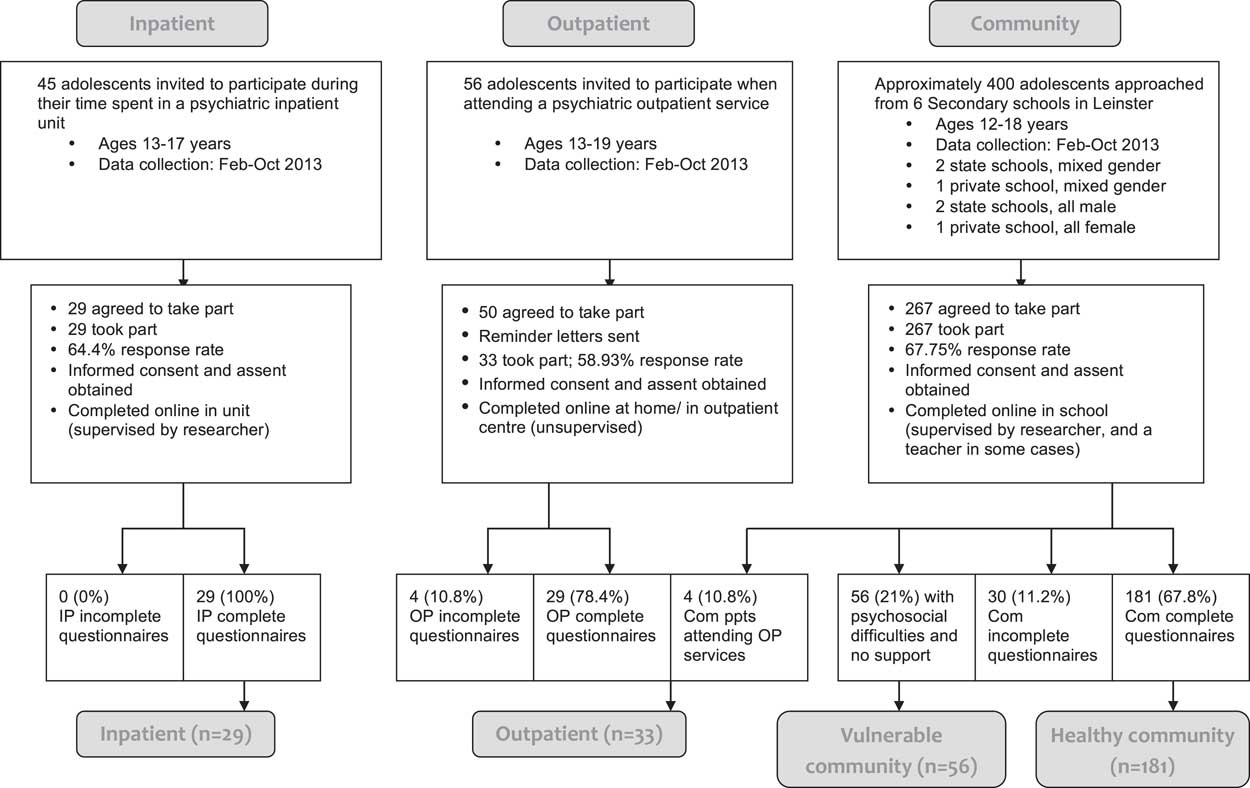
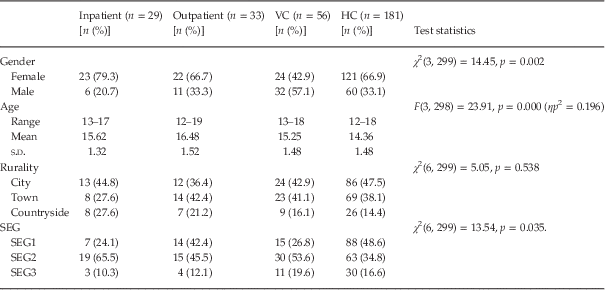
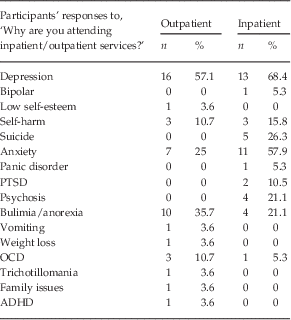
A total of 299 young people aged 12–18 years completed an online survey. In all, 29 young people were attending an inpatient adolescent psychiatric unit and completed the survey in the unit; 33 young people were attending the associated outpatient service and completed it at home; 237 were recruited from secondary schools in Dublin, and completed surveys in school. Of these, 56 reported experiencing psychosocial difficulties, as measured by the Youth Pediatric Symptom Checklist (Y-PSC; Jellinek & Murphy, Reference Jellinek and Murphy2014), but reported receiving no formal support. This group are thus considered the vulnerable community group, and accounted for 23.6% of the total community sample. The remaining 181 young people from the community did not report significant psychosocial difficulties or contact with mental health services, and are thus considered the healthy community group. See Fig. 1 for a flow diagram outlining participation. Table 1 describes and compares these four groups on the variables of gender, age, rurality and SEG. For the purpose of analysis, participants were grouped into three age categories: Age1 (12–13 years), Age2 (14–15 years) and Age3 (16–18 years); and three SEG based on parents’ occupations: SEG1 (employers and managers, and higher professionals), SEG2 (lower professionals and non-manual) and SEG3 (manual skilled and unskilled; Central Statistics Office, 2011). Four participants from the community group were currently attending outpatient services and coded as outpatients for analysis. Table 2 outlines self-reported mental health difficulties for inpatient and outpatient participants.
Participant recruitment and group allocation.

Demographic characteristics of participants

VC, vulnerable community group (those reporting psychosocial difficulties and no formal support); HC, healthy community group; SEG, socio-economic group; SEG1, employers, managers and higher professionals; SEG2, lower professionals and non-manual; SEG3, manual skilled and unskilled.
Participant self-reported mental health difficulty

PTSD, post traumatic stress disorder; OCD, obsessive compulsive disorder; ADHD, attention deficit hyperactivity disorder.
Pearson’s χ 2 analyses show that there were more males than statistically expected in the vulnerable community group compared with all other groups. Those from the healthy community group, were on average 1.3 years younger than other groups. Groups did not differ according to rurality. Less than statistically expected of the vulnerable community group had parents who were ‘higher professionals, employers or managers’. Thus, the vulnerable community group, which emerged from the total community sample due to high levels of reported psychosocial difficulties and no formal support, were over-represented by males and participants from lower SEG.
Measures
An online survey was designed after reviewing existing relevant literature, including EU Kids Online (Livingstone & Haddon, Reference Livingstone and Gorzig2009), and the National Children’s Consultation (Irish Society for Prevention of Cruelty to Children [ISPCC], 2011). The survey was hosted online at www.qualtrics.com and consisted of the following eight questionnaires.
Questionnaire 1 was designed for the present study to collect information regarding participants’ (a) demographic characteristics, (b) access to and time spent online, (c) websites most often used and (d) level of risky online behaviour. In order to address part (c) websites most often used of Questionnaire 1, participants were asked to record up to 10 websites they most often visited (i.e. website name), what they did on these websites (i.e. website content), and why they visited them (i.e. website function). Content analysis was applied, and all participants’ responses regarding website type, content and function were coded (Creswell, Reference Creswell2009). Similar codes were then grouped into eight higher level categories. Category 1 ‘Communication-Verbal’ included sites where the principal function appeared to be verbal communication (e.g. Facebook, Twitter and instant messaging sites). Category 2 ‘Communication-Pictorial’ included sites where the principal function appeared to be communication through image or video (e.g. Tumblr and Instagram); Category 3 ‘Entertainment Sites’ included video sharing platforms (e.g. Youtube) and traditional online games (e.g. Tetris). Category 4 ‘Interest Sites’ were those that offered users information and an online community related to a particular interest (e.g. fantasy football, fan fiction and other online forums). Category 5 ‘Information Sites’ were those that visitors used to gain knowledge, many of which supported offline activities (e.g. school/university websites, Wikipedia, Ultimate Guitar and search engines). Category 6 ‘Online Gaming’ included virtual gaming (e.g. Club Penguin and Final Fantasy XI). Category 7 ‘Potentially Harmful Sites’ were sites containing images, video or written content reflecting a high level of violence towards others (e.g. videos of people inflicting harm on each other), self-harm, disordered eating and suicide. Category 8 ‘Pornography’ consisted of websites that host pornographic content. All named sites were included in the eight categories. Of note, no young people included positive mental health sites in their list.
Questionnaires 2, 3, and 4 were the Revised Cyber Bullying Inventory (Topcu & Erdur-Baker, Reference Topcu and Erdur-Baker2010), the Revised Cyber Victimisation Inventory (Topcu & Erdur-Baker, Reference Topcu and Erdur-Baker2010) and the Positive Attitudes Towards Cyber Bullying scale (ATCB; Barlett & Gentile, Reference Barlett and Gentile2012). Questionnaire 5 was the Generalised Problematic Internet Use Scale (Caplan, Reference Caplan2002). Questionnaires 6 and 7 were adapted versions of the Parental Monitoring and Parental Knowledge scales modified for use with the internet from Fletcher et al.’s (Reference Fletcher, Steinberg and Williams-Wheeler2004) measures for adolescent problem behaviour. Questionnaire 8 was the Y-PSC (Jellinek & Murphy, Reference Jellinek and Murphy2014) completed as a screening measure for psychosocial difficulties by community participants only. Questionnaires 2–8 have previously published data attesting their reliability and validity. In the current study, all measures showed adequate internal reliability (α=0.73–0.91).
Procedure
Ethical approval was received from the Human Research Ethics Committee, University College Dublin and the Research Ethics Committee, St Patrick’s Mental Health Services. Parent’s and young people gave informed written consent and assent, respectively. The community groups completed the online questionnaires in school, the inpatients completed them while on the unit and the outpatient group completed them in their own homes. Suggestion was made for young people to contact their general practitioner or charitable support services available to young people in Ireland if they experienced distress. Written contact information for various support services was distributed to community participants.
Planned data analysis
A series of Pearson’s χ 2 analyses were computed to explore differences in access to the internet and websites visited amongst groups as data were categorical. Thus, results suggest whether more or less than statistically expected in each group experience each type of use or not. Multivariate analysis of variance (MANOVA) was used to test for group differences in hours spent online, risky use, online bullying, online victimisation, problematic internet use and parental knowledge and monitoring. Discriminant functional analysis was applied to significant MANOVA findings in order to distinguish differences between groups. Thus, internet use outcome variables were used to predict participant groups, and so identifying ‘functions’ or linear variates that best differentiated the groups (Field, Reference Field2013). Pearson and Spearman’s ρ correlations were carried out between demographic variables and all dependent variables due to differences in age, gender and SEG among the participant groups, in order to identify any relationships between demographic and dependent variables.
Results
Access to the internet
The inpatient group used the internet less during the evenings/early night compared with the vulnerable and healthy community groups, χ 2(3, 299)=11.92, p=0.008. Inpatients reported more use late at night, compared with all other groups, χ 2(3, 299)=12.43, p=0.006. Outpatients reported less use in the evening/early night compared with the vulnerable and healthy community groups. Less of the vulnerable community group used a family laptop/computer χ 2(3, 299)=13.73, p=0.003, and more reported use during school time χ 2(3, 299)=7.99, p=0.046. Less of the healthy community group reported use of a personal laptop/computer and use late at night, compared with all other groups. It is unlikely that age, gender, and SEG differences among the groups contributed to these findings, as demographic variables were not correlated with access variables.
Websites and content accessed
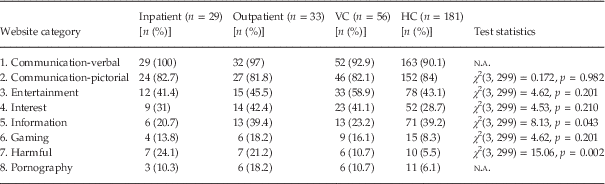
The website Categories 1 and 8 were not included in the analysis, as >25% of cells had an expected count less than five. A significant difference was observed whereby more than expected of the inpatients and outpatients and less than expected of the healthy community used Potentially Harmful Sites (see Table 3). Significantly less from the inpatient and vulnerable community groups used Information Sites. Spearman’s ρ correlations were computed between website categories and demographic variables. Weak correlations were observed whereby lower SEG participants used less Information Sites (p=0.001, ρ=−0.19), males used more Online Gaming sites (p=0.000, ρ=0.23), males reported less use of Information Sites (p=0.001, ρ=−0.19), and the oldest group accessed more Potentially Harmful sites than younger groups (p=0.001, ρ=0.19). Thus, it should be considered that the slightly older age may have contributed to greater use of potentially harmful sites for inpatient and outpatient participants, along with their mental health status. Furthermore, the vulnerable group’s lower use of information sites may have been related to multiple variables in this group, including gender, SEG and mental health status.
Frequency of website type use across participant groups

n.a., not applicable – in cases where over 25% of cells had an expected count of <5, χ 2 analysis are not reported; VC, vulnerable community group (those reporting psychosocial difficulties and no formal support); HC, healthy community group.
Experiences of online risky behaviours, bullying, victimisation, problematic internet use, and parental monitoring and knowledge of internet use
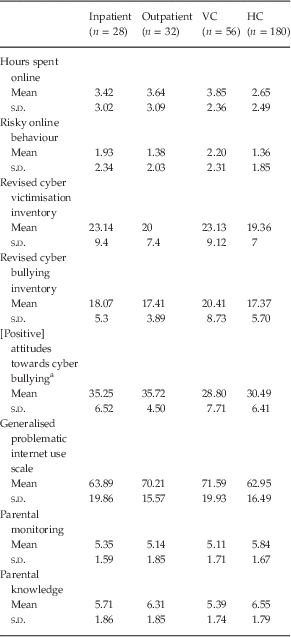
In order to explore differences in online risky, bullying, victimisation, problematic use and parental involvement across the inpatient, outpatient, vulnerable community and healthy community groups, a MANOVA was carried out on the data from Questionnaires 2–7. Using Pillai’s trace, there was a significant effect of participant group membership on internet use variables, V=0.28, F(24, 846)=3.59, p<0.000 (ηp 2=0.092). Discriminant analysis was applied to explore differences between groups. Table 4 outlines means and standard deviations of the four groups on each internet use variable.
Participants’ mean scores and standard deviations on internet use variables

VC, vulnerable community group (those reporting psychosocial difficulties and no formal support); HC, healthy community group.
a Higher scores on the Positive Attitudes Towards Cyber Bullying Scale indicate less positive attitudes.
Discriminant analysis revealed three discriminant functions. The first accounted for 58% of the variance, canonical R 2=0.15, the second explained 31.3% of the variance, canonical R 2=0.09, whereas the third only accounted for 10.7% of the variance, canonical R 2=0.03. In combination all three factors significantly differentiate the participant groups, Λ=0.74, χ 2(24)=83.93, p<0.001. After removing the first factor, factors two and three significantly differentiate groups, Λ=0.88, χ 2(14)=36.19, p=0.001. However, after removing factors one and two, the third factor did not significantly differentiate the groups, Λ=0.97, χ 2(6)=9.4, p=0.152.
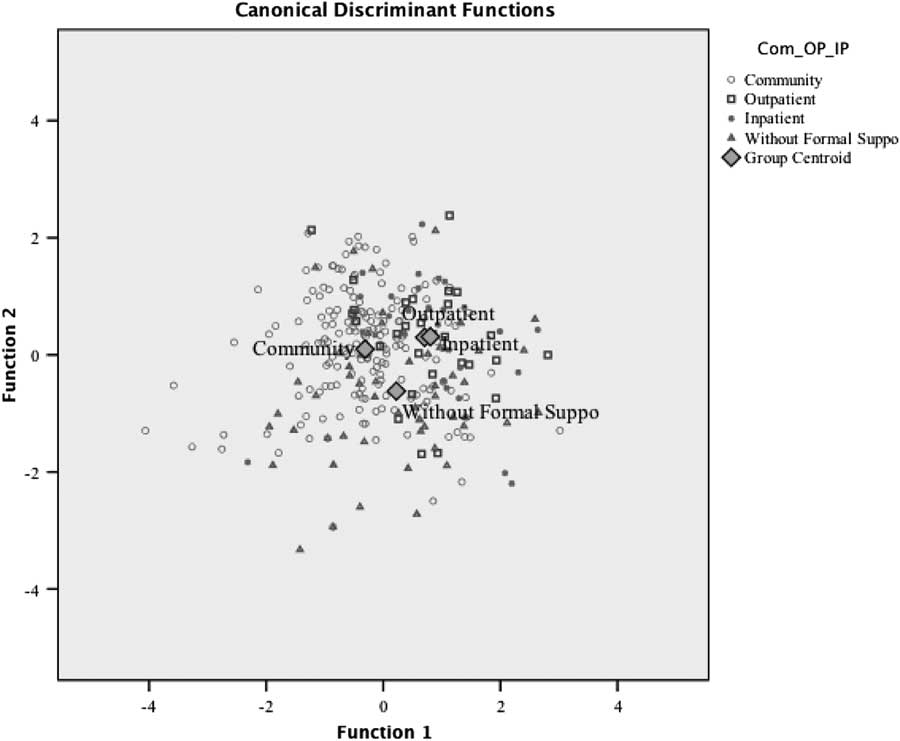
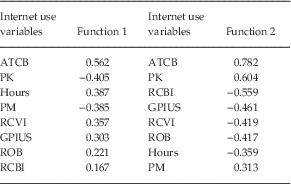
As shown in Fig. 2, the first function maximally differentiated inpatient and outpatients from the healthy community group, whereas the second function separated vulnerable community participants from inpatient, outpatient and healthy community participants. The structure matrix of correlations between predictors and discriminant functions seen in Table 5 outlines the two patterns of internet use that discriminate the groups. Considering only the factors with strong positive correlations (r>±0.40), Function 1 is best predicted by moderate attitudes towards cyber bullying and lower levels of parental knowledge of internet use, whereas Function 2 is best predicted by less ATCB, greater parental knowledge of internet use, and lower levels of online bullying, victimisation, problematic internet use and risky online behaviours. However, given the exploratory nature of this study it may be warranted to interpret, with caution, moderate correlations (r=±0.30 to 0.39). Lower levels of parental monitoring of internet use, more time spent online and greater experiences of victimisation and problematic use moderately correlate with Function 1. Less time spent online and greater levels of parental monitoring moderately correlate with Function 2. The classification procedure for the total sample revealed that 63.2% were classified correctly.
Plots of the four group centroids on two discriminant functions, derived from internet use variables.

Correlations between predictors and discriminant functions

Hours, hours spent online; ROB, risky online behaviours; RCVI, revised cyber victimisation inventory; RCBI, revised cyber bullying inventory; ATCB, Positive Attitudes Towards Cyber Bullying Scale; GPIUS, Generalised Problematic Internet Use scale; PM, parental monitoring; PK, parental knowledge.
Higher scores on ATCB indicate less positive attitudes towards cyber bullying.
A one-way ANOVA of group means on the discriminant functions and multiple comparisons using Gabriel’s method, show that the healthy community group differs significantly from the inpatient, outpatient and vulnerable community groups for Function 1. On Function 2, the vulnerable community group differs significantly from the inpatient, outpatient and healthy community groups. See Table 6 for means and statistics.
Differences in mean classification scores for each group on Functions 1 and 2

VC, vulnerable community group (those reporting psychosocial difficulties and no formal support); HC, healthy community group.
a,b,c,dMeans with the same letter in their superscript are not significantly different, means with a different letter are significantly different. Multiple comparisons are carried out using Gabriel’s method, p<0.001.
Discussion
Comparing internet use between young people with no apparent mental health difficulties and those with difficulties attending inpatient, outpatient and no current services, the present study identified two dimensions that may characterise their experience. One dimension represents more concerning internet use. On this dimension, all three groups of young people with mental health difficulties are similar and higher than the healthy community group. This dimension is comprised of relatively more tolerance of cyber bullying, less parental knowledge of their internet use, less parental monitoring of use, more cyber victimisation, and more problematic internet use. Dimension two reveals a pattern of safer internet use. On this dimension the inpatient, outpatient and healthy community group were higher than the vulnerable community group. This dimension is characterised by more parental knowledge, less tolerance of cyber bullying, and less cyber bullying, problematic internet use, cyber victimisation, risky online behaviour and time spent online. These findings must be considered in light of the demographic differences in the groups, as there was a greater proportion of males and participants from lower SEG in the vulnerable group, and participants in the healthy community group were on average 1.3 years younger than other groups.
Young people attending inpatient and outpatient services also visited more websites potentially harmful to their mental health. Specifically, more pro-eating disorder websites and sites that focus on self-harm. Almost a quarter of young people from the inpatient and outpatient groups reported regular use of such sites, significantly greater than the healthy and vulnerable community groups in this sample. This also appears to be a higher rate than community participants endorsed in previous Irish research (O’Neill & Dinh, Reference O’Neill and Dinh2015). Reasons for seeking out this content and its impact on a young person is likely to be complex. Although they may offer some benefits to young people, such as peer support and opportunity for expression and disclosure (Yeshua-Katz & Martins, Reference Yeshua-Katz and Martins2013), they may also contribute to greater symptomology (Peebles et al. Reference Peebles, Wilson, Litt, Hardy, Lock, Mann and Borzekowski2012).
There were also differences in the use of information sites across groups, with fewer inpatients and those from the vulnerable community group reporting use. Previous research has found that males report less internet use for finding information, as do young people from lower SEG homes (O’Neill & Dinh, Reference O’Neill and Dinh2015). Thus, the greater representation of males and young people from lower SEG in the vulnerable group may have contributed to this finding. However, this does not hold true for the inpatient group and reduced use of information sites is likely related to their mental health status.
The healthy community group generally reported less risky use, whereas the inpatient and outpatient groups showed higher levels of both risky and less risky use. For example, inpatient participants reported high levels of online victimisation, but less ATCB and moderate levels of parental input, whereas outpatients reported highest levels of problematic internet use, but less ATCB and moderate levels of parental input. However, those in the vulnerable community group reported consistently riskiest use, including, high online bullying and victimisation, more ATCB, more problematic use and less parental input. This group appears to be particularly vulnerable, given that it is suggested that those who both bully and are bullied online experience greater levels of psychological and social problems compared with those who are only bullied or bully (Gleeson, Reference Gleeson2014). Furthermore, problematic use is associated with both internalising and externalising symptomology (Kaess et al. Reference Kaess, Durkee, Brunner, Carli, Parzer, Wasserman, Sarchiapone, Hoven, Apter, Calazs, Balint, Borbes, Cohen, Cosman, Cotter, Fischer, Floderus, Iosue, Haring and Kahn2014).
These findings must be considered in light of demographic differences between groups. In this study, the healthy community group were younger than other groups. In addition, there was an overrepresentation of males and participants from lower SEG in the vulnerable community group, which emerged from the total community sample. Younger age of the healthy community may have contributed to their less risky pattern of internet use, as younger age has been associated with greater parental monitoring in previous research (O’Neill & Dinh, Reference O’Neill and Dinh2015). However, Irish research has also found that younger teenagers report more experiences of cyber bulling than older teens (O’Neill & Dinh, Reference O’Neill and Dinh2015). The present findings were that the three, slightly older, mental ill health groups reported greater online bullying and victimisation. This suggests mental health status, among other possible factors, may contribute to these differences. In relation to the vulnerable community group, previous research has found that some adolescents from disadvantaged families may experience more risk online (Paus-Hasebrink et al. Reference Paus-Hasebrink, Sinner and Prochazka2014). It is likely that a number of factors are contributing to this groups’ worrying pattern of internet use and psychosocial difficulties. This group may illustrate how the opportunities and risks of the internet can mirror young people’s offline world, offering similar risks for problematic behaviours and experiences as other aspect of their lives do.
The findings suggest that young people experiencing mental health difficulties may be more likely to experience the risks of the internet, whereas those who are well may be less likely. The presence of high levels of online victimisation in the inpatient group highlights the importance of assessing for cyber victimisation and bullying when developing interventions, particularly given the relationship between online victimisation, stress and suicidal behaviours (Kowalski et al. Reference Kowalski, Giumetti, Schroeder and Lattanner2014). Similarly, the high levels of problematic use among the outpatient group, which has been associated with a number of mental ill health symptoms (Kaess et al. Reference Kaess, Durkee, Brunner, Carli, Parzer, Wasserman, Sarchiapone, Hoven, Apter, Calazs, Balint, Borbes, Cohen, Cosman, Cotter, Fischer, Floderus, Iosue, Haring and Kahn2014), suggests that clinicians should enquire about a young person’s relationship with the internet. Not only does the internet appear to offer greater risk to vulnerable young people, but they may also experience fewer benefits. For example, those that information sites may offer. Consideration should thus be given to how to help vulnerable young people use the internet in a way that will positively enhance their life, both in mental health settings and in a school setting, in order to reach the vulnerable community group.
A strong evidence base is being developed regarding adolescent internet use throughout the EU (EU Kids Online; Net Children Go Mobile). However, the relationship between internet use and mental ill health has received less focus. The present study suggests that internet use will likely differ for those experiencing mental health difficulties. However, further research is needed to confirm these findings in a nationally representative and well-controlled sample. The practical implication for clinicians is to include a routine assessment of internet use when assessing a young person’s mental health difficulty and in developing an intervention plan. Areas of particular note include visiting potentially harmful content, experiences of bullying, victimisation and problematic use.
To our knowledge, no previous study has compared internet use among young people across a continuum of mental health difficulties and service contexts. However, the study has a number of limitations. It is exploratory in nature, the group sizes are small to moderate, there is a potential lack of representativeness, demographic differences between groups and risk of bias due to the self-report measures. However, it offers useful data and suggestions for clinicians who work with adolescents, and points to avenues for future research in this area.
Acknowledgements
The authors thank the young people who took part in this research. They thank the staff at Willow Grove Adolescent Unit, St Patrick’s Mental Health Service, for their support in data collection. The authors also thank the reviewers for their comments on an earlier version of this report.
Financial Support
This research received no specific grant from any funding agency or from commercial or not-for-profit sectors.
Conflicts of Interest
None.
Ethical Standards
The authors assert that all procedures contributing to this work comply with the ethical standards of the relevant national and institutional committee on human experimentation with the Helsinki Declaration of 1975, as revised in 2008. The study protocol was approved by the institutional review board of each participating institution. Written informed consent was obtained from all participating patients.