1. Introduction
The end effector has always been a key factor restricting the interaction between the robot and the environment. As a new generation of effector, the multi-finger robot hand has begun to take shape after decades of development, but its dexterity is still far lower than that of a human hand [Reference Billard and Kragic1–Reference Xu and Wang4]. In order to achieve human-like high degree of freedom (DOF) and grasping flexibility, researchers have developed many dexterous multi-fingered hands such as Robonaut hand [Reference Ambrose, Aldridge, Askew, Burridge, Bluethmann, Diftler and Lovchik5], Shadow hand [6], UBH-3 hand [Reference Lotti, Tiezzi, Vassura, Biagiotti and Melchiorri7], and DLR/HIT hand [Reference Liu, Wu, Meusel, Seitz, Hirzinger, Jin, Liu, Fan, Lan and Chen8]. However, most of these robot hands adopt the full-actuated method to ensure independent movement of each joint, with high flexibility and control accuracy, but inevitably there are problems such as low system integration, poor environmental compliance, and high cost.
In order to solve these problems, researchers have focused their attention to the underactuated robot hand. The so-called underactuation refers to using fewer actuators to control more joint motions, and there is often a coupling relationship between each joint [Reference Laliberté, Birglen and Gosselin9]. The excellent examples are iHY hand [Reference Odhner, Jentoft, Claffee, Corson, Tenzer, Ma, Buehler, Kohout, Howe and Dollar10], SSSA hand [Reference Controzzi, Clemente, Barone, Ghionzoli and Cipriani11], PASA-GB hand [Reference Liang and Zhang12], and BLT hand [Reference Kim, Song and Maeng13]. Due to the use of fewer actuators, the mechanical structure of the underactuated hand is simplified, which has the characteristics of compact structure, light weight, and convenient control. Compared with the full-actuated hand, the passive joint structure makes it easier to achieve self-adaptive grasping in the grasp mode, self-adaptive grasping has higher environmental compliance and grasping stability, and the grasping range is further expanded.
However, the finger phalanxes of the existing underactuated hands are often rigid, and the grasping method adopts rigid contact [Reference Luo, Yang, Zhang, Ren and Liang14,Reference So, Kim, Kim, Seok, Yang, Kim, Park, Hwang, Gong and Choi15]. During the grasping process, the number of contact points or contact area with the object is small, and the contact force distribution is not uniform, which limits self-adaptive grasping ability. Researchers attempt to improve the contact area between the finger and the object by covering the surface of finger with flexible materials that are easily deformed [Reference Tincani, Grioli, Catalano, Garabini, Grechi, Fantoni and Bicchi16,Reference Ren, Zhou, Xin and Tsagarakis17]. But the coverage area and thickness of flexible materials are restricted due to limit sizes of the finger, which affects the stability of grasping. In this case, some soft robot hands came into being. Abondance et al. [Reference Abondance, Teeple and Wood18] proposed a soft hand with dexterous fingers capable of several basic motion, which can robustly perform in-hand manipulation in the presence of uncertainty. Yang et al. [Reference Yang, Vella and Holmes19] presented a soft gripper based on kirigami shells – thin, elastic shells patterned with an array of cuts. Nevertheless, the grasping power of soft hand is relatively limited, and it is prone to irreversible structural deformation. In addition, some underactuated hands drive the flexion of finger joints through chains or wire ropes [Reference Pons, Rocon and Ceres20–Reference Jeong, Kim and Kim23], which can easily cause relaxation, fatigue breakage, and other problems after long-term use.
Therefore, a novel self-adaptive underactuated robot hand with rigid-flexible coupling fingers (SAU-RFC hand) is proposed. The finger motion mechanism is based on the coupling linkage and the flexible belt traction structure. Different from the traditional rigid self-adaptive underactuated hand, the novel finger developed introduces a flexible structure, replacing the inner link of the proximal phalanx with a flexible belt. The flexible belt can be deformed in the inner direction under the action of the traction mechanism and the joint spring, while the outer direction is still a rigid mechanical structure so that it will not be deformed. Due to the rigid-flexible structure, SAU-RFC hand has a higher self-adaptive grasping ability for objects of different shapes, sizes, and hardness. Compared with the high DOF tendon-driven hand, SAU-RFC hand can achieve the same level or even better self-adaptive grasping with lower DOF and simpler mechanical structure by means of the rigid-flexible coupling finger.
In particular, we establish a contact force distribution model of flexible belt to investigate its effect of promoting uniform force distribution. It theoretically indicates that the uniform contact force distribution avoids the stress concentration on a single contact point, which improves the grasping stability. In the end, we perform a series of experiments on different objects to research the grasping performance of SAU-RFC hand. Experiments demonstrate that the novel mechanical design improves the adaptability and stability of dexterous grasping. The main contribution of this paper is the development of a novel rigid-flexible coupling finger and its implement on the self-adaptive underactuated robot hand.
In the reminder of this paper, Section 2 shows the mechanical design of the SAU-RFC hand. The kinematic and kinetic analyses of SAU-RFC hand is given in Section 3. Section 4 presents the experimental results. Finally, the conclusion is summarized in Section 5.
2. Mechanisms and Structure of SAU-RFC Hand
2.1. Design of SAU-RFC finger
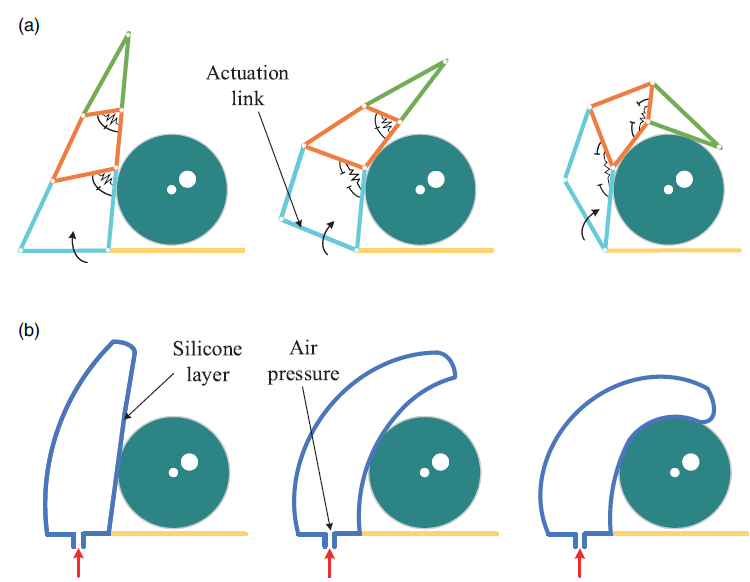
Figure 1 illustrates the representative examples of self-adaptive underactuated finger mechanism. Fig. 1(a) is a simplified illustration of the self-adaptive finger described in ref. [Reference Laliberté, Birglen and Gosselin9], which is composed of multiple four-bar linkage with two DOFs and one actuation. The structure conforms the object and generates discrete contact forces as the actuation link rotates. This finger is suitable for grasping large payload, but its point contacts apply uneven pressure and may limit range of motion. Another approach is to take advantage of the material’s flexibility, as shown in Fig. 1(b), a well-known soft gripper from SRT Co. [24]. This gripper is actuated by air pressure and continuously wraps around the object, distributing the contact force evenly, resulting in a more stable grasp. However, it comes at a cost in terms of grasping position precision and payload capacity. The ideal goal of compliant grasping is to apply uniform force regardless of the size or shape of the object. The concept of typical self-adaptive fingers yields useful inspiration for the development of SAU-RFC finger.
Conceptual examples of self-adaptive underactuated finger mechanism. (a) A self-adaptive underactuated finger made of multiple four-bar linkages and (b) a soft self-adaptive finger made of silicone.

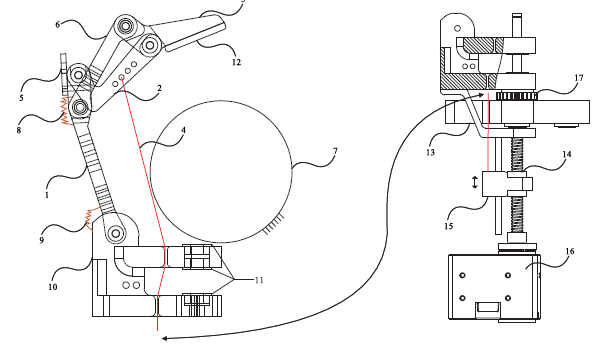
SAU-RFC finger with two DOFs and rigid-flexible coupling structure is shown in Fig. 2. The flexion of finger is achieved by pulling of flexible belt, while the finger is extended by the reverse torque of the proximal and middle springs. In particular, the elastic coefficient of the middle spring is greater than that of the proximal spring to ensure that the relative position of the three phalanxes remains unchanged before the proximal phalanx touches the object. As the key part of the finger, the first end of flexible belt is connected to the auxiliary link, and the second end crosses the inside of the proximal phalanx and passes through the belt guide path to attach to the external traction mechanism. Note that the flexible belt not only acts as the power transmission carrier to achieve the motion of finger but also acts as a contact surface of object to form a large area envelope contact. Furthermore, it is inevitable that the flexible belt will always suffer from a relaxation problem over time because of its material characteristic. However, the possibility of slack or even breakage of a belt is far less than that of a thread/rope because it is made of interwoven threads. We finally select polyethylene fiber material, which not only has low elongation rate with 5% but also has the features of high wear resistance and high strength.
The mechanical structure of SAU-RFC finger. 1,2,3 – the proximal, middle, and distal phalanx; 4 – the flexible belt; 5 – the limit baffle; 6 – the auxiliary link; 7 – the object; 8 – the middle spring; 9 – the proximal spring; 10 – the finger base; 11 – the bearings; 12 – the soft cover; 13 – the upper base; 14 – the threaded lead screw pair; 15 – the fixer; 16 – the servomotor-I; and 17 – the gear pair.

In addition, the surface of the distal phalanx is also covered with soft material. The traction mechanism is mainly composed of a threaded lead screw pair, a fixer, and a servomotor-I, in which the lead screw is fitted together with the output shaft of servomotor-I, the nut attaches to the first end of fixer, and the second end of fixer is connected to the flexible belt. Based on the connection relationship, the rotary motion of servomotor-I is converted to the pulling motion of belt. Benefiting from the underactuated structure and the actuator is far away from the finger, SAU-RFC finger has a greater advantage in compact design. Due to the flexibility of belt, SAU-RFC finger has high resistance to external shocks and grasping stability.
2.2. Design of SAU-RFC hand
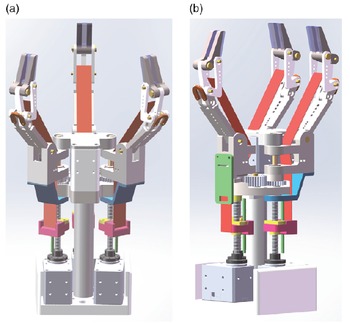
Basing on SAU-RFC Finger, SAU-RFC hand is designed, as shown in Fig. 3. It has three fingers with same structure, a palm base, and four actuators. The palm base has one DOF and is equipped with a side-turning (ST) mechanism. Furthermore, these three fingers can be divided into two ST fingers and one non-side-turning (NST) finger, and the ST fingers can perform synchronous reverse rotation laterally with each other. It is realized by the ST mechanism installed on the palm base, which is composed of a gear pair and a servomotor-II. The gear pair contains an input shaft and two output shafts, and the input shaft is fitted together with the output shaft of servomotor-II, while the output shafts are respectively attached to the corresponding ST fingers. In addition, the rotation angle range of the proximal, the middle, and the distal joint are
 $0^{\circ } \sim 100^{\circ }$
,
 $0^{\circ } \sim 75^{\circ }$
, and
 $0^{\circ } \sim 90^{\circ }$
, respectively. The lateral rotation angle range of ST finger is
 $0^{\circ } \sim 60^{\circ }$
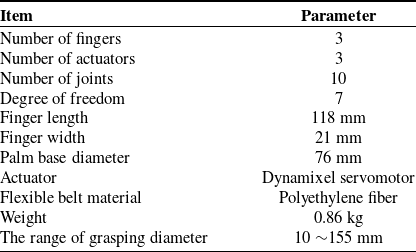
. In the interest of matching to the outline of most objects, structural parameters are selected and modified based on the size of human finger and the extreme position of phalanxes, which are shown in Table I.
The structure parameters of SAU-RFC hand.

The SAU-RFC hand. (a) Front view and (b) side view.

2.3. Analysis of grasping process
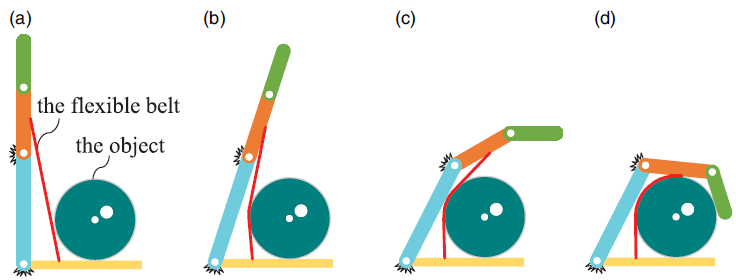
Figure 4 shows the interaction between a single SAU-RFC finger and the object over the grasping process. Fig. 4(a) is the initial state of the finger, when the grasping action is started, and the flexible belt starts to pull the finger under the action of the traction mechanism. On the one hand, due to the restriction of the middle spring, the middle phalanx will not rotate around the middle joint, and under the influence of the four-bar linkage, the distal phalanx also will not rotate around the distal joint. On the other hand, the elastic coefficient of the middle spring is greater than that of the proximal spring, causing the proximal phalanx rotates around the joint shaft and other phalanxes keep the relative position unchanged.
The grasping process of SAU-RFC finger.

Therefore, before the finger or the flexible belt touches the object, the entire finger will rotate around the proximal joint to form a larger grasping range, as shown in Fig. 4(b). After the flexible belt contacts the object for the first time, it will automatically deform according to the shape of the object to form an envelope contact with the object. At the same time, due to the obstacle of the object, the proximal phalanx no longer rotates around the proximal joint, but the flexible belt will continue to pull the finger and gradually overcome the resistance of the middle spring. Then, under the effect of the four-bar linkage, the middle and the distal phalanxes are driven to rotate around their joint shaft, respectively, as shown in Fig. 4(c). When the flexible belt continues to pull, each phalanx will automatically adjust its grasping angle according to the shape of the object until the finger reaches a more stable grasping posture, and finally completing the grasping action, as shown in Fig. 4(d), the automatic adjustment of grasping angle also happens to reflect the SAU-RFC finger’s self-adaptive effect.
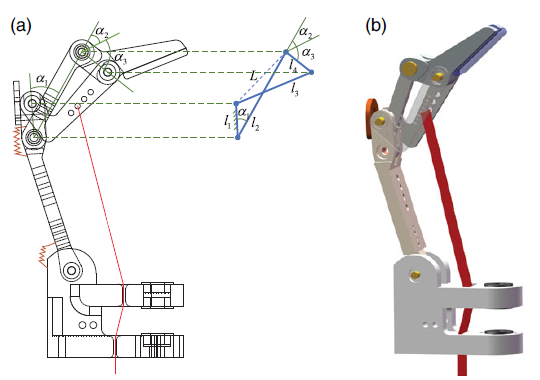
In particular, Fig. 5 presents the coupled four-bar linkage between the middle and distal joints, which has the following relationship:
 \begin{equation} \begin{cases} \begin{aligned} L&=\sqrt{l_{1}^{2}+l_{2}^{2}-2l_{1}l_{2}\textrm{cos}\alpha _{1}} \\ \\[-9pt]A&=\textrm{arccos}\left (\frac{L^{2}+l_{4}^{2}-l_{3}^{2}}{2Ll_{4}}\right ) \\ \\[-9pt] B&=\textrm{arccos}\left (\frac{L^{2}+l_{2}^{2}-l_{1}^{2}}{2Ll_{2}}\right ) \\ \\[-9pt] \alpha _{2}&=\pi -\alpha _{3}-A+B.\\ \end{aligned} \end{cases} \end{equation}
where,
 $l_{1}$
,
 $l_{2}$
,
 $l_{3}$
, and
 $l_{4}$
are the length of each bar in the four-bar linkage, respectively,
 $\alpha _{1}$
is the rotation angle of the middle joint,
 $\alpha _{2}$
is the rotation angle of the distal joint, and
 $\alpha _{3}$
is the fixed angle determined by the mechanical structure of the distal phalanx.
The four-bar linkage of SAU-RFC finger. (a) 2D view and (b) 3D view.

The motion ratio of
 $\alpha _{2}$
to
 $\alpha _{1}$
and the angle
 $\alpha _{3}$
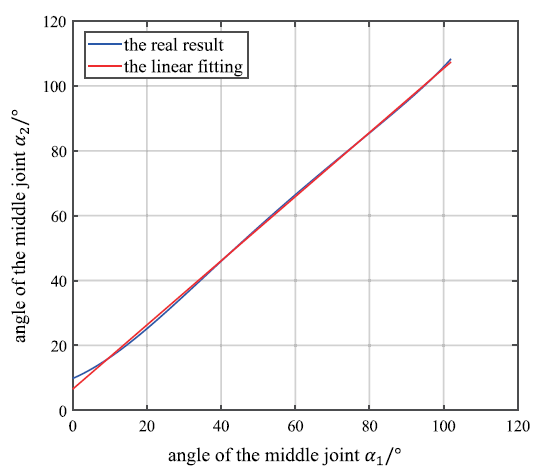
of the distal phalanx are designed according to the average grasping posture of the human hand. In this way, the change curve for the rotation angle of the distal joint with respect to that of the middle joint is drawn, which have an approximate linear relationship, as shown in Fig. 6. For the convenience of the calculation of inverse kinematics, linear fitting is performed on them (with
 $R^2 = 0.993$
), which is expressed as:
 \begin{equation} \alpha _{2}=0.99\alpha _{1}+6.5. \end{equation}
In order to simplify the calculation, the relationship between and can be approximately replaced by Eq. (2).
The grasping process of SAU-RFC finger.

Moreover, note that the flexible belt forms a large area of contact with the object and has more contact points, which promotes uniform contact force distribution. Under the combined action of the joint spring and the flexible belt, the SAU-RFC finger produces a good self-adaptive grasping effect, which means that it can achieve the enveloping grasp for objects of different shapes and sizes.
3. Kinematic and Kinetic Analyses of SAU-RFC Hand
3.1. Kinematics
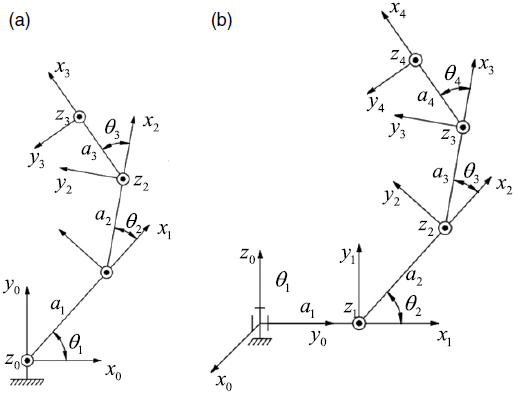
As depicted in Fig. 7, the reference frames of each phalanx is established by the Denavit−Hartenberg method.
 $x_{0}y_{0}z_{0}$
is the fixed coordinate
 $\{0\}$
and the others are moving coordinates system. The homogeneous transformation matrix
 $^{1}A_{i}^{i-1}(i=1,2,3)$
of the phalanxes for NST finger can be obtained:
 \begin{equation} ^{1}A_{i}^{i-1}= \begin{bmatrix}\textrm{cos}\theta _{i} &\quad -\textrm{sin}\theta _{i} &\quad 0 &\quad a_{i}\textrm{cos}\theta _{i} \\ \\[-8pt]\textrm{sin}\theta _{i} &\quad\textrm{cos}\theta _{i} &\quad 0 &\quad a_{i}\textrm{sin}\theta _{i} \\ \\[-8pt]0 &\quad 0 &\quad 1 &\quad 0 \\ \\[-8pt]0 &\quad 0 &\quad 0 &\quad 1 \\ \end{bmatrix}. \end{equation}
D-H reference frames of SAU-RFC finger. (a) NST finger and (b) ST finger.

And the transformation matrix
 $^{2}A_{i}^{i-1}(i=1,2,3,4)$
of the phalanxes for ST finger are determined by:
 \begin{equation} ^{2}A_{1}^{0}= \begin{bmatrix} -\textrm{sin}\theta _{1}&\quad 0 &\quad\textrm{cos}\theta _{1} &\quad -a_{1}\textrm{sin}\theta _{1} \\ \\[-8pt] \textrm{cos}\theta _{1} &\quad 0 &\quad \textrm{sin}\theta _{1} &\quad a_{1}\textrm{cos}\theta _{1} \\ \\[-8pt] 0 &\quad 1 &\quad 0 &\quad 0 \\ \\[-8pt] 0 &\quad 0 &\quad 0 &\quad 1 \\ \end{bmatrix} \end{equation}
and
 \begin{equation} ^{2}A_{i}^{i-1}= \begin{bmatrix} \textrm{cos}\theta _{i} &\quad -\textrm{sin}\theta _{i} &\quad 0 &\quad a_{i}\textrm{cos}\theta _{i} \\ \\[-8pt]\textrm{sin}\theta _{i} &\quad \textrm{cos}\theta _{i} &\quad 0 &\quad a_{i}\textrm{sin}\theta _{i} \\ \\[-8pt]0 &\quad 0 &\quad 1 &\quad 0 \\ \\[-8pt]0 &\quad 0 &\quad 0 &\quad 1 \\ \end{bmatrix}\;i=2,3,4. \end{equation}
Then, the transformation matrix
 $^{1}T_{3}^{0}$
of NST finger’s fingertip relative to the coordinate
 $\{0\}$
is expressed by:
 \begin{align} ^{1}T_{3}^{0} & ={^{1}A_{1}^{0}}\;{^{1}A_{2}^{1}}\;{^{1}A_{3}^{2}} \nonumber\\[3pt]& = \begin{bmatrix} \textrm{cos}\sum \limits _{i=1}^{3}{\theta _{i}} &\quad -\textrm{sin}\sum \limits _{i=1}^{3}{\theta _{i}} &\quad 0 &\quad \sum \limits _{i=1}^{3}{\left (a_{i}\textrm{cos}\sum \limits _{j=1}^{i}{\theta _{j}}\right )}\\ \\[-7pt]\textrm{sin}\sum \limits _{i=1}^{3}{\theta _{i}} &\quad \textrm{cos}\sum \limits _{i=1}^{3}{\theta _{i}} &\quad 0 &\quad \sum \limits _{i=1}^{3}{\left (a_{i}\textrm{sin}\sum \limits _{j=1}^{i}{\theta _{j}}\right )}\\ \\[-7pt]0 &\quad 0 &\quad 1 &\quad 0 \\ \\[-7pt]0 &\quad 0 &\quad 0 &\quad 1 \\ \end{bmatrix}. \end{align}
Moreover, the transformation matrix
 $^{2}T_{4}^{0}$
of the ST finger’s fingertip relative to the coordinate
 $\{0\}$
is calculated as:
 \begin{equation} \begin{aligned} ^{2}T_{4}^{0} &={^{2}A_{1}^{0}}\;{^{2}A_{2}^{1}}\;{^{2}A_{3}^{2}}\;{^{2}A_{4}^{3}} \\ &= \begin{bmatrix} -\textrm{sin}{\theta _{1}}\textrm{cos}\sum \limits _{i=2}^{4}{\theta _{i}} &\quad \textrm{sin}{\theta _{1}}\textrm{sin}\sum \limits _{i=2}^{4}{\theta _{i}} &\quad \textrm{cos}{\theta _{1}} &\quad -\textrm{sin}{\theta _{1}}{\left (\sum \limits _{i=2}^{4}{\left (a_{i}\textrm{cos}\sum \limits _{j=2}^{i}{\theta _{j}}\right )}+a_{1}\right )}\\ \\[-7pt]\textrm{cos}{\theta _{1}}\textrm{cos}\sum \limits _{i=2}^{4}{\theta _{i}} &\quad -\textrm{cos}{\theta _{1}}\textrm{sin}{\sum \limits _{i=2}^{4}{\theta _{i}}} &\quad \textrm{sin}{\theta _{1}} &\quad \textrm{cos}{\theta _{1}}{\left (\sum \limits _{i=2}^{4}{\left (a_{i}\textrm{cos}\sum \limits _{j=2}^{i}{\theta _{j}}\right )}+a_{1}\right )}\\ \\[-7pt]\textrm{sin}\sum \limits _{i=2}^{4}{\theta _{i}} &\quad \textrm{cos}\sum \limits _{i=2}^{4}{\theta _{i}}&\quad 0 &\quad \sum \limits _{i=2}^{4}{\left (a_{i}\textrm{sin}\sum \limits _{j=2}^{i}{\theta _{j}}\right )}\\ \\[-7pt]0 &\quad 0 &\quad 0 &\quad 1 \\ \end{bmatrix}.\\ \end{aligned} \end{equation}
Specifically, for the NST finger, the matrix
 $^{1}T_{3}^{0}$
is the function of joint variables
 $\theta _{i}(i=1,2,3)$
(Eq. 5), and the pose of fingertip in the coordinate
 $\{0\}$
is expressed as the first three values in the last column of
 $^{1}T_{3}^{0}$
. Hence, the pose of fingertip is solved by measuring the value of variables
 $\theta _{i}(i=1,2,3)$
, as mentioned in Section 2,
 $\theta _{2}$
and
 $\theta _{3}$
have a linear relationship (Eq. 2), so it is determined by the variables
 $\theta _{i}(i=1,2)$
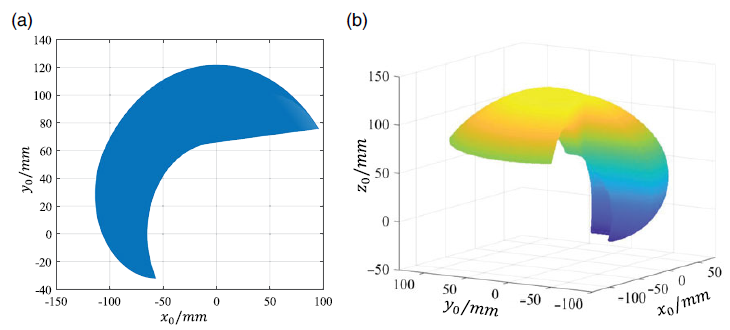
. Similar analysis can be done for ST finger. Figure 8 presents the workspaces of NST and ST fingers’ fingertip, and it is observed that the SAU-RFC hand has a large workspace.
The workspace of SAU-RFC fingers’ fingertip. (a) NST finger and (b) ST finger.

3.2. Kinetics
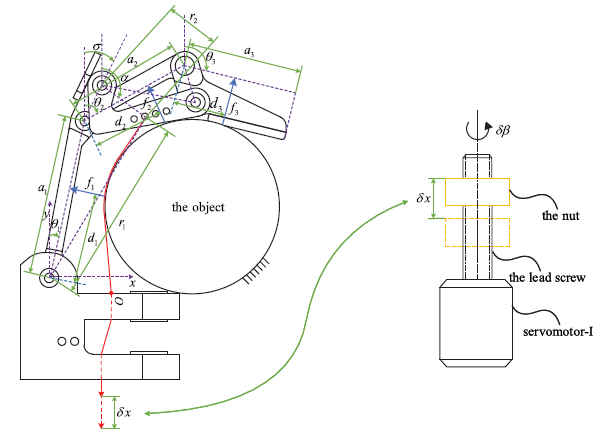
Once the flexible belt of SAU-RFC finger touches the object, it will cause several contact forces in different orientations and sizes. It is complicated to analyze these forces one by one. Therefore, the composition of forces is adopted to make all the component forces of object to the flexible belt synthesize an equivalent force at the midpoint of the flexible belt. For the convenience of analysis, assuming that the outline of the object being grasped is cylindrical. The grasping force diagram of SAU-RFC finger is shown in Fig. 9, where,
The grasping force diagram of SAU-RFC finger.

 $f_{1}$
– the equivalent external force on the proximal phalanx (or the flexible belt),
 $\textrm{N}$
;
 $f_{2},f_{3}$
– the external force on the middle and distal phalanxes,
 $\textrm{N}$
;
 $\theta _{1},\theta _{2},\theta _{3}$
– the rotation angle of the proximal, middle, and distal phalanxes,
 $^{\circ }$
; note that
 $\theta _{2}$
and
 $\theta _{3}$
are associated with
 $\alpha _{1}$
and
 $\alpha _{2}$
in Eq. 2:
 $\alpha _{2}=\theta _{3}-\theta _{2},\alpha _{1}=\theta _{2}-\sigma$
.
 $a_1,a_2,a_3$
– the length of the proximal, middle, and distal phalanxes,
 $\textrm{mm}$
;
 $d_1,d_2,d_3$
– the distance between the joint shaft and the force contact point of the proximal, middle, and distal phalanxes, respectively,
 $\textrm{mm}$
;
 $T_m$
– the output torque of servomotor,
 $\textrm{N}\cdot \textrm{mm}$
;
 $\beta$
– the rotation angle of servomotor,
 $^{\circ }$
;
 $\alpha$
– the rotation angle of
 $l_{3}$
-bar in the four-bar linkage relative to the proximal phalanx,
 $^{\circ }$
;
 $r_1,r_2$
– the distance between the first end of the flexible belt and the proximal phalanx joint shaft, and the
 $l_{3}$
-bar shaft, respectively,
 $\textrm{mm}$
;
 $M_1,M_2$
– the initial torque of the proximal and middle spring,
 $\textrm{N}\cdot \textrm{mm}$
;
 $k_1,k_2$
– the stiffness coefficient of the proximal and middle spring,
 $\textrm{N}\cdot \textrm{mm}/^{\circ }$
.
The middle and the distal phalanxes are coupling connected by the four-bar linkage, then
 $f_{2}$
and
 $f_{3}$
are determined by:
 \begin{equation} f_{2}d_{2}=f_{3}\left (d_{3}+a_{2}\textrm{cos}\theta _{3}\right ). \end{equation}
Then the expression between the force and position is calculated from the principle of virtual work:
 \begin{equation} \begin{bmatrix} f_{1}& f_{2} \\ \end{bmatrix} \begin{bmatrix} -d_{1}& 0 \\ \\[-9pt] K & N \end{bmatrix} \begin{bmatrix} \delta \theta _{1} \\ \\[-9pt] \delta \theta _{2} \\ \end{bmatrix}= \begin{bmatrix} k_{1}\theta _{1}+M_1& k_{2}\theta _{2}+M_2 & -T_m\\ \end{bmatrix} \begin{bmatrix} \delta \theta _{1} \\ \\[-9pt] \delta \theta _{2} \\ \\[-9pt] \delta \beta \\ \end{bmatrix}. \end{equation}
where,
 $K=-a_{1}\textrm{cos}{\left (\theta _{2}-\theta _1\right )}-\dfrac{d_{2}a_{1}\textrm{cos}{\left (\theta _{3}-\theta _{2}-\theta _1\right )}-d_{2}d_3}{d_{3}+a_{2}\textrm{cos}\theta _3}$
and
 $N=-d_{2}-\dfrac{d_{2}a_{2}\textrm{cos}{\left (\theta _{3}-\theta _{2}\right )}+2d_{2}d_3}{d_{3}+a_{2}\textrm{cos}\theta _3}$
.
In addition,
 $\delta \beta$
,
 $\delta \theta _{1}$
, and
 $\delta \theta _{2}$
have the following conversion relationship:
 \begin{equation} \begin{cases} \begin{aligned} {} {} {}\delta\beta/360&=\delta x/s \\ \\[-10pt] {} {} {}\delta x&\approx r_{1}\delta\theta_{1}+r_{2}\delta\alpha \\ \\[-10pt] {} {} {}\alpha-\theta_{1}&=-0.007\left(\theta_{2}-\theta_{1}\right)^2+1.7\left(\theta_{2}-\theta_{1}\right)+21 \\ \\[-10pt] {} {} {}\delta\alpha&=\left(-0.014\left(\theta_{2}-\theta_{1}\right)+1.7\right)\delta\theta_{2}+\left(0.014\left(\theta_{2}-\theta_{1}\right)-1.7\right)\delta\theta_{1}.\end{aligned} \end{cases} \end{equation}
where
 $\delta x$
is the tiny reduction of flexible belt and
 $s$
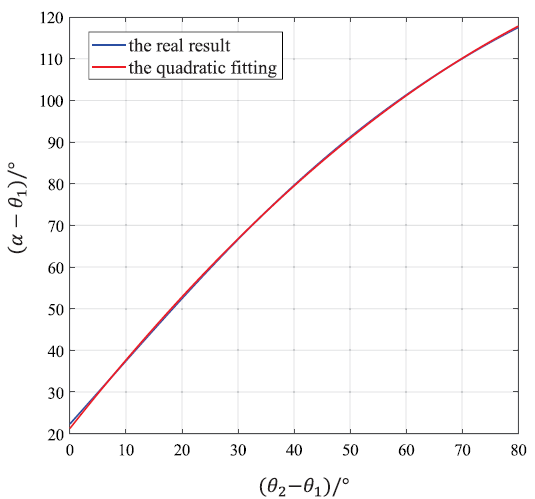
is the lead of the lead screw pair. Function
 $\alpha (\theta _2)$
is obtained by quadratic fitting based on the geometric parameters, as shown in Fig. 10. Then the right half of Eq. (8) is expressed as:
 \begin{equation} \begin{bmatrix} k_{1}\theta _{1}+M_1&\quad k_{2}\theta _{2}+M_2 &\quad -T_m\\ \end{bmatrix} \begin{bmatrix} 1& \quad 0 \\ \\[-8pt]0&\quad 1 \\ \\[-8pt]P&\quad Q \\ \end{bmatrix} \begin{bmatrix} \delta \theta _{1} \\ \\[-8pt] \delta \theta _{2} \\ \end{bmatrix}. \end{equation}
where
 $\left. P=360\left (r_{1}+r_{2}\left (0.014(\theta _{2}-\theta _1)-0.7\right )\right ) \middle/ s \right .$
and
 $\left. Q=360r_{2}\left (-0.014(\theta _{2}-\theta _1)+1.7\right )\middle/s \right .$
. Substitu-ting Eq. (10) into Eq. (8) yields
 \begin{equation} \begin{bmatrix} f_{1}&\quad f_{2} \\ \end{bmatrix}= \begin{bmatrix} k_{1}\theta _{1}+M_1&\quad k_{2}\theta _{2}+M_2 &\quad -T_m\\ \end{bmatrix} \begin{bmatrix} -\dfrac{1}{d_1} &\quad 0 \\ \\[-7pt] \dfrac{K}{d_{1}N} &\quad \dfrac{1}{N} \\ \\[-7pt] \dfrac{KQ}{d_{1}N}-\dfrac{P}{d_{1}}&\quad \dfrac{Q}{N} \\ \end{bmatrix}. \end{equation}
Finally, assuming the necessary parameters:
 $k_{1}=0.05\,\textrm{N}\cdot \textrm{mm}/^{\circ }$
,
 $k_{2}=0.14\,\textrm{N}\cdot \,\textrm{mm}/^{\circ }$
,
 $a_{1}=51 \,\textrm{mm}$
,
 $a_{2}=36 \,\textrm{mm}$
,
 $d_{1}=25 \,\textrm{mm}$
,
 $d_{2}=22 \,\textrm{mm}$
,
 $d_{3}=14 \,\textrm{mm}$
,
 $T_{m}=1 \,\textrm{N}\cdot \textrm{mm}$
,
 $M_{1}=0.2 \,\textrm{N}\cdot \textrm{mm}$
,
 $M_{1}=0.54 \,\textrm{N}\cdot \textrm{mm}$
,
 $r_{1}=59 \,\textrm{mm}$
, and
 $r_{2}=16 \,\textrm{mm}$
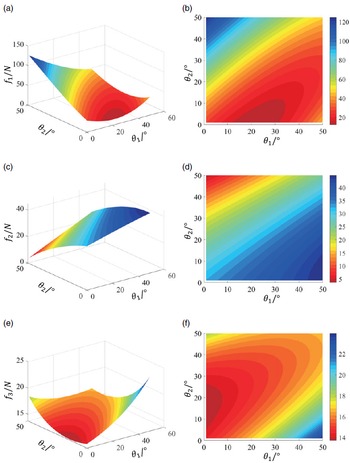
. The relationship between the grasping force and the rotation angle of the proximal, middle, and distal phalanxes is illustrated in Fig. 11, in which the left column is the 3D view and the right column is the corresponding 2D view. In this figure, the first row is the 3D view of the grasping force, while the second row is the corresponding 2D view. Figure 11 indicates that when
 $\theta _1$
increases, the grasping force of
 $f_1$
the proximal phalanx decreases, while the grasping forces
 $f_2$
of the middle phalanx and
 $f_3$
of the distal phalanx increase. When
 $\theta _2$
increases, the grasping force
 $f_1$
gradually increases, while the grasping forces
 $f_2$
and
 $f_3$
gradually decrease. This is because the elastic force of the spring will increase with the increase of joint angle, and the three phalanxes share the power of the servomotor-I, while its output torque is constant.
The relationship between
 $\alpha$
and
 $\theta _{2}$
.

The relationship between the grasping force and the rotation angle of joints.

3.3. Contact force distribution model of flexible belt
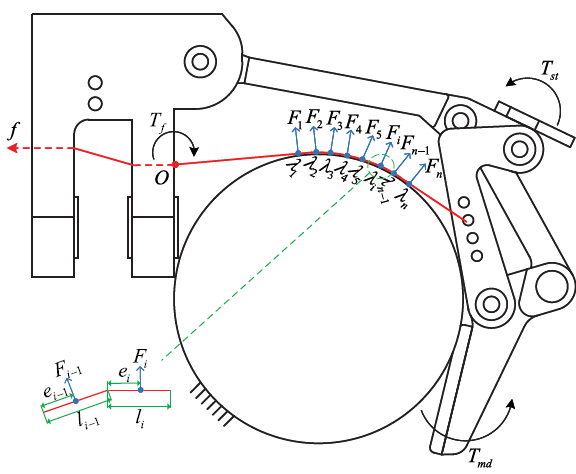
In order to further study the change in the contact force distribution caused by replacing the rigid proximal phalanx with the flexible belt, a contact force distribution model is established. As shown in Fig. 12, the flexible belt is regarded as a rigid serial multilink with
 $n$
joints, which is cut and subdivided into
 $n+1$
phalanx units. The joints are numbered in the order from 1 to
 $n$
, and the phalanx units are numbered in the order from 0 to
 $n$
. The joint
 $i$
connects the unit
 $i-1$
and the unit
 $i$
and drives the unit
 $i$
. The phalanx unit 0 is fixed, which is equivalent to the “base” of the flexible belt, while each of the remaining phalanx units forms a contact force with the object, that is,
 $F_1,F_2,F_3,\cdots,F_n$
.
The model of contact force distribution.

To simplify the calculation, let each force form a torque at point
 $O$
and define some parameters of the finger as follows:
 $T_i$
– the moment caused by the contact force
 $F_i$
on phalanx unit
 $i$
,
 $\textrm{N}\cdot \textrm{mm}$
;
 $T_f$
– the equivalent moment caused by the tension
 $f$
of flexible belt,
 $\textrm{N}\cdot \textrm{mm}$
;
 $T_{md}$
– the equivalent moment caused by the contact force on middle and distal phalanxes,
 $\textrm{N}\cdot \textrm{mm}$
;
 $T_{st}$
– the equivalent moment caused by the elastic force of proximal and middle springs,
 $\textrm{N}\cdot \textrm{mm}$
;
 $l_i$
– the length of phalanx unit
 $i$
,
 $\textrm{mm}$
;
 $e_i$
– the distance between acting point of contact force
 $F_i$
and joint
 $i$
,
 $\textrm{mm}$
;
 $\lambda _i$
– the rotation angle of joint
 $i$
relative to joint
 $i-1$
,
 $^{\circ }$
.
Then, establish the moment equilibrium of flexible belt:
 \begin{equation} \begin{aligned} T_{f}&=T_{md}+T_{st}+F_{1}e_{1}+F_{2}\left (e_2+l_{1}\textrm{cos}\lambda _2\right )+F_{3}\left (e_{3}+l_{2}\textrm{cos}\lambda _{3}+l_{1}\textrm{cos}\left (\lambda _{3}+\lambda _2\right )\right )\\[3pt] &\cdots +F_{n}\left (e_{n}+l_{n-1}\textrm{cos}\lambda _{n}+l_{n-2}\textrm{cos}\left (\lambda _{n}+\lambda _{n-1}\right )+\cdots +l_{1}\textrm{cos}\left (\lambda _{n}+\lambda _{n-1}+\cdots +\lambda _{2}\right )\right ).\\ \end{aligned} \end{equation}
By introducing
 $T_i$
, the above equation is further expressed as:
 \begin{equation} \begin{cases} \begin{aligned} T_f&=\sum \limits _{i=1}^{n}{T_i}+T_{md}+T_{st} \\ \\[-8pt] T_i&= F_{i}\left (e_{i}+l_{i-1}\textrm{cos}\lambda _{i}+l_{i-2}\textrm{cos}\left (\lambda _{i}+\lambda _{i-1}\right )+\cdots +l_{1}\textrm{cos}\left (\lambda _{i}+\lambda _{i-1}+\cdots +\lambda _{2}\right )\right ).\\ \end{aligned} \end{cases} \end{equation}
The value of
 $n$
is close to infinity and the material of flexible belt is uniform, then the length of each phalanx unit can be regarded as the same. Meanwhile, assuming the contact point of each phalanx unit
 $i$
to the object is at the joint
 $i+1$
, and the flexible belt takes an arc-shaped grasping posture, that is,
 \begin{equation} \begin{cases} \begin{aligned} l_1&=l_2=\cdots =l_n \\ e_i&=l_i\\ \lambda _1&=\lambda _2 = \cdots =\lambda _{n}. \end{aligned} \end{cases} \end{equation}
Thus, Eq. (13) is calculated as:
 \begin{equation} T_i=F_{i}\left (e_{i}+l_{i}\textrm{cos}\lambda _{i}+l_{i}\textrm{cos}(2\lambda _i)+\cdots +l_{i}\textrm{cos}\left (\left (i-1\right )\lambda _{i}\right )\right ). \end{equation}
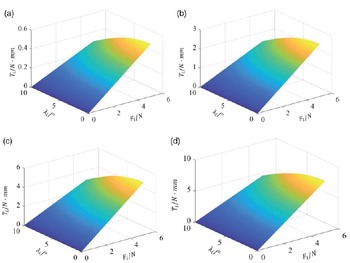
Aiming at the four cases where
 $l_i$
is
 $0.01$
,
 $0.05$
,
 $0.10$
, and
 $0.15 \textrm{mm}$
, respectively, the relationship between
 $T_i$
and the parameter
 $F_i,\lambda _i$
is plotted in Fig. 13. For the length parameter
 $l_i$
of phalanx unit, Fig. 13(a)−(d) show that
 $T_i$
increases when
 $l_i$
increases from
 $0.01$
to
 $0.15\,\textrm{mm}$
, and its maximum value increases from about
 $0.5$
to
 $8\,\textrm{N} \cdot \textrm{mm}$
. Therefore, when
 $l_i$
is small enough, the contact moment of flexible belt can be lower than
 $0.5\,\textrm{N} \cdot \textrm{mm}$
, and the difference in contact force among phalanx units is also smaller, which means that the flexible belt has a more uniform force distribution than the traditional rigid finger structure.
The relationship between the parameter
 $T_i$
and
 $F_i,\lambda _i$
. (a)
 $l_i=0.01\,\textrm{mm}$
; (b)
 $l_i=0.05\,\textrm{mm}$
; (c)
 $l_i=0.10\,\textrm{mm}$
; and (d)
 $l_i=0.15\,\textrm{mm}$
.

Meanwhile, every subgraph in Fig. 13 shows that
 $T_i$
increases with the increase of
 $F_i$
, while
 $T_i$
decreases with the increase of
 $\lambda _i$
. It indicates that a higher flexible belt contact moment is required when grasping the large-mass and large-volume object than grasping the small-mass and small-volume object, which means that enveloping grasp (power grasp) requires a higher driving torque than pinching grasp (precise grasp).
4. Experiments and Discussion
4.1. Experiments of grasping mode
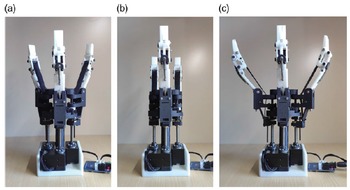
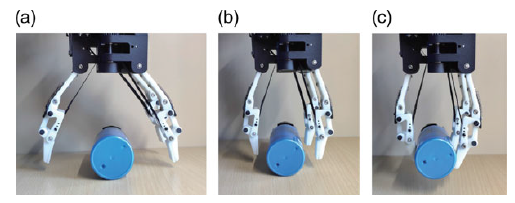
In order to illustrate the rationality of the mechanical structure, a series of grasping experiments on SAU-RFC hand are performed. The prototype of SAU-RFC hand and its various grasping configurations are shown in Fig. 14. SAU-RFC hand is made of mixed materials such as resin (white part) and nylon (black part). Remark that it can automatically select the grasping mode according to the distance of objects from the palm: enveloping grasp or pinching grasp.
The prototype and grasping configuration of SAU-RFC hand. (a) configuration-I; (b) configuration-II; and (c) configuration-III.

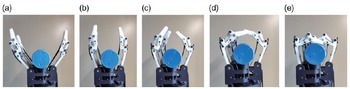
When the object is close to the palm, enveloping grasp is performed, which is shown in Fig. 15. As is to see, before touching the object, the three phalanxes rotate around the proximal joint at a constant relative angle, after the proximal phalanx touches the object first, the middle and distal phalanxes start to rotate under the action of the self-adaptive mechanism until they contact the object. Note that each phalanx automatically adjusts its angle according to the contour of object until the fingers reach a more stable grasping posture, which just reflects the self-adaptivity.
The enveloping grasp process of SAU-RFC hand.

When the object is far from the palm, consecutive snapshots of pinching grasp are given in Fig. 16. The middle spring makes the middle and distal phalanxes remain upright, so that SAU-RFC hand can pinch the object tightly. Meanwhile, the soft cover on the surface of the distal phalanx increases the friction.
The pinching grasp process of SAU-RFC hand.

4.2. Experiments of grasping objects
The grasping versatility of SAU-RFC hand is verified on set of objects to include the flexible belt affects grasping performance, considering the grasping benchmark from other studies. It is mainly based on the Yale-CMU-Berkeley (YCB) object set [Reference Calli, Walsman, Singh, Srinivasa and Abbeel25], which comprises 60 objects in 5 categories, including food items and tools.
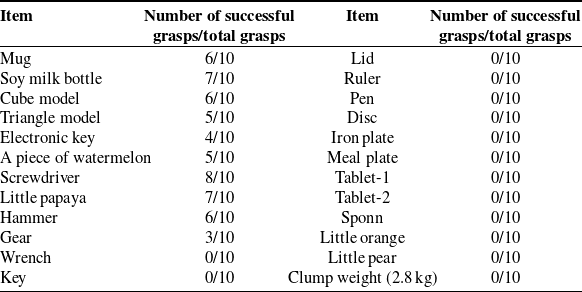
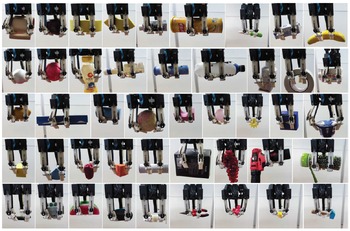
Often, there is variation added to the object position and orientation in the realistic pick-and-place environment, which is more representative of practical applications. Therefore, experiment is conducted with YCB benchmark involving 60 unique objects grasped 10 times in random object orientation, as shown in Fig. 17. This figure also presents how the rotation of ST fingers and the grasping mode (pinching grasp/enveloping grasp) is employed to help grasp objects depending on their geometry. During the 10 times of grasping, the random placement of objects will cause some unsuitable orientations, resulting in the grasping failure, and the unsuccessful results are summarized in Table II.
Statistics of unsuccessful grasping results of SAU-RFC hand.

Examples of SAU-RFC hand grasping various objects from the YCB object set.

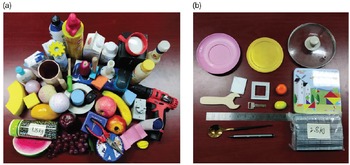
SAU-RFC hand successfully grasped the majority of the objects only failing on the smaller flat objects and the heavier ones, and the successful/ unsuccessful objects are shown in Fig. 18. The effectiveness of pinching grasp is proved on small objects, and enveloping grasp can hold the object tightly for large objects. Overall, SAU-RFC hand has the ability to grasp objects of various shapes self-adaptively benefiting from the compliance of belt. But the flat objects prove a significant challenge for this hand, because it is no suitable grasping posture to match the narrow edge of flat objects. Similarly, the flexibility of the flexible belt results in power grasp being more subject to failure when facing sharp or heavy (more than
 $2.8\,\textrm{kg}$
) objects. Nevertheless, it does show the physical properties of objects that the SAU-RFC hand is likely to struggle with, indicating limitations in the design.
(a) Items from the YCB object set that the SAU-RFC hand was able to grasp in 10 times and (b) items from the YCB object set that the SAU-RFC hand was unable to grasp in 10 times.

4.3. Validation of grasping stability
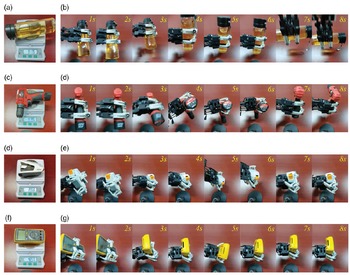
Stability is an important indicator to measure the grasping capability of the robot hand; thus, disturbance experiments are carried out after grasping by introducing random perturbations in the hand pose and external collision. The hand pose is perturbed by shaking the object to the same degree from random directions. Figure 19 shows the snapshot of perturbation in the hand pose after grasping different objects. The left column is the selected four objects, which are cylinder bottle, electric drill, stapler, and multimeter from top to bottom, while the right column is the video sequence of the object state. The tests show that object weighing below
 $2.8\,\textrm{kg}$
can be grasped without sliding even when disturbed by random hand pose, which demonstrates good stability.
Disturbance experiments after grasping different objects with SAU-RFC hand.

The external collision is caused by a bottle falling freely at different heights and hitting the fixed position of the hand in a positive direction. Specifically, SAU-RFC hand holding the object is placed horizontally, a
 $400\,\textrm{g}$
bottle is freely fallen within a height of
 $20-80\,\textrm{cm}$
above it, and the initial height is recorded when the object slips off. Experiment presents that the fingers are severely deformed and the object slips off when the bottle falls freely about
 $45\,\textrm{cm}$
above the hand and calculate the impulse value as
 $1.19\,\textrm{kg} \cdot \textrm{m/s}$
by momentum theorem, indicating SAU-RFC finger has high resistance to external shocks. If the fingers are fabricated by stronger material, the impulse will be higher. Overall, the experiments demonstrate that the novel mechanical design of the SAU-RFC hand has a good adaptability and stability of grasping.
4.4. Discussion
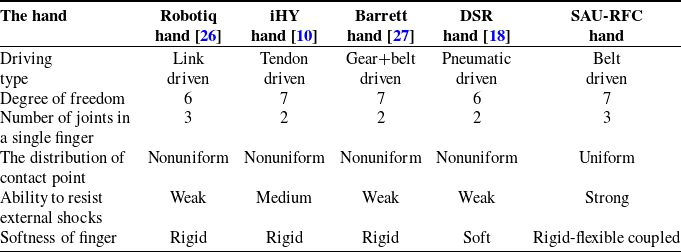
The famous three-finger underactuated hands in the robot hand community include Robotiq hand [26], iHY hand [Reference Odhner, Jentoft, Claffee, Corson, Tenzer, Ma, Buehler, Kohout, Howe and Dollar10], Barrett hand [27], DSR hand [Reference Abondance, Teeple and Wood18], and so forth, SAU-RFC hand is different from them in technical characteristics such as driving type, which are compared in Table III. It is worth noting that the SAU-RFC hand is belt-driven and rigid-flexible coupled. This enables remarkable robustness and grasping stability in the face of external impact at the expense of a certain level of precision, which is in stark contrast to the design philosophy of other hands. Additionally, when the rigid-flexible coupling finger is deployed, SAU-RFC hand provides a uniform contact force across a surface, rather than concentrating it on a point or line, which is a desirable property for grasping that is compliant.
Comparison of SAU-RFC hand with other designs.

However, SAU-RFC hand has some limitations in its application, which include
-
1. The small flat, the heavier, or the sharp objects. The small flat objects present a significant challenge for this hand, as there is no grasping posture that corresponds to the narrow edge. The heavier objects (more than 2.8
 $\textrm{kg}$
) will exceed the load-bearing limit of the fingers. Additionally, the belt’s flexibility makes the power grasp more susceptible to failure when confronted with sharp objects, as sharp objects such as knives may pierce the belt.
-
2. Within-hand manipulation. The design of SAU-RFC hand focuses on grasping, not manipulation. SAU-RFC finger is driven by a flexible belt, performs self-adaptive grasping using the elastic difference between the proximal and middle joint springs, and adaptively adjusts the joint angles to the contour of the object. Due to the difficulty of precisely controlling the angle of each joint, SAU-RFC hand is not particularly adept at manipulating objects.
-
3. Fatigue damage. Due to the material characteristics of the flexible belt, it is unavoidable that it will suffer from a relaxation problem over time. However, because a belt is made of interwoven threads, the possibility of slack or even breakage is significantly less than that of a thread/rope.

5. Conclusion and Future Work
The development of a novel self-adaptive underactuated robot hand named SAU-RFC hand has been presented, and its flexible grasping operation has been achieved. In the design of mechanical structure, the finger mechanism is based on the rigid-flexible structure and the coupling four-bar linkage. Specially, different from the traditional robot hands with rigid phalanxes, a flexible belt is introduced so that the nonuniformity of force distribution is refined. Due to the self-adaptive mechanism, SAU-RFC hand can efficiently coordinate the modes of enveloping grasp and pinching grasp. Moreover, the kinematic and kinetic analyses of SAU-RFC hand are given. Furthermore, a contact force distribution model is also established to evaluate the grasping stability. Physical experiments are conducted to verify that SAU-RFC hand has great self-adaptive grasping performance and strong grasping versatility.
In the future, we will increase the DOF of robot palm to enrich the grasping posture, develop and integrate a fingertip visuotactile sensor to perceive tactile information, and ultimately realize human-like dexterous grasping in unstructured environments. In addition, representation learning methods to extract features from visual and tactile spatiotemporal sequences will also be researched.
Acknowledgement
This work was supported in part by the National Key Research and Development Program of China under Grant 2019YFB1311901, in part by the National Natural Science Foundation of China under U1913201, in part by the Beijing Nova Program under Grant Z211100002121152, in part by the Beijing Natural Science Foundation under Grant 4222056, and in part by the Youth Innovation Promotion Association CAS under Grant 2020137.
Authors’ Contributions
Congjia Su: conceptualization, methodology, investigation, data curation, and writing – original draft. Rui Wang: software, resources, project administration, supervision, funding acquisition, writing – review, and editing. Tao Lu: visualization, investigation, and validation. Shuo Wang: software, supervision, funding acquisition, writing – review, and editing.
Conflict of Interest
Authors have no conflict of interest to declare.
Ethical Standards
Authors have no ethical considerations to declare.