Introduction
Young people aged 10–24 years constitute approximately one-third of Africa’s population (UNESCO, 2013). Given the high fertility rates on the continent, this group is expected to continue to grow (Bongaarts & Casterline, Reference Bongaarts and Casterline2012) and if Africa is to reap the ‘demographic dividend’, there is need to harness its potential. The first step in doing so is to understand the obstacles to young people’s health and well-being. Of interest to the present study is adolescent sexual behaviour. In many countries, rates of sexual debut during adolescence are either on the increase or they remain unchanged (Kothari et al., Reference Kothari, Shanxiao, Head and Abderrahim2012; Guo et al., Reference Guo, Wu, Qiu, Chen and Zheng2012).
Globally, an estimated 100 million acts of sexual intercourse occur every day among adolescents, resulting in over 1 million pregnancies, most of which are unplanned or unwanted (Rosen, Reference Rosen2010). Commenting on the United States, Greenwood and Guner (Reference Greenwood and Guner2010) noted that only about 6% of teenage girls were engaged in premarital sex in 1900 yet by 2002 about 75% had experienced coital sex. In other words, premarital sex has become socially acceptable and this, coupled with the availability of contraceptives, has enabled adolescents to engage in premarital sex before they complete high school with partners who are not necessarily their future spouses (Frisco, Reference Frisco2008).
Despite the social acceptability of premarital sex, it cannot be disputed that adolescent sexual behaviour is one of the major humanitarian and developmental challenges of the 21st century, given that it can have lifelong and deleterious consequences. This is largely due to the health and social problems that may result when young people have unprotected sexual intercourse (Marteleto et al., Reference Marteleto, Lam and Ranchhod2008; Guo et al., Reference Guo, Wu, Qiu, Chen and Zheng2012). In a world beset by widespread transmission of HIV and AIDS, adolescent sexuality further escalates the crisis (Ayalew et al., Reference Ayalew, Abreha, Shumey and Berhane2015). It is estimated that in 2012 there were 2.6 million young people aged from 15 to 24 years of age living with HIV in the eastern and southern African regions (UNESCO, 2013). This status quo is worsened by the ‘feminization’ of the crisis. For instance, the UNAIDS GAP report noted that 15- to 24-year-old females have a much higher risk of contracting HIV than their male counterparts (UNAIDS GAP Report, 2014). Reporting on Africa, Mojola (Reference Mojola2011) observed that young women experience HIV infection rates that are 2–9 times higher than those of their male counterparts. These statistics are not only worrisome but also an indication that adolescent sexual behaviour has reached epidemic proportions and continues to be a matter of concern post the United Nations’ Millennium Development Goals.
Clearly, there are numerous social complexities related to adolescent sexual behaviours and there is a plethora of literature that has examined the antecedents and immediate effects of early sexual debut, such as pregnancy, sexually transmitted infections (STIs) and HIV and AIDS (Stephenson et al., Reference Stephenson, Simon and Finneran2014; Ayalew et al., Reference Ayalew, Abreha, Shumey and Berhane2015). However, the present inquiry argues that within the diverse analyses of adolescent sexual behaviours lies a neglected area. For instance, little is known about the long-term effects of sexual behaviours initiated in adolescence on important academic milestones (i.e. completion of high school and transition to post-secondary education). This is especially so in South Africa, where the focus has been on school enrolment and dropout rates (Marteleto et al., Reference Marteleto, Lam and Ranchhod2008), household income and risky sexual behaviours (Dinkelman et al., 2007), sexual risky behaviours (Thurman et al., Reference Thurman, Brown, Richter, Maharaj and Magnani2006), the health effects of early sexuality (Beksinska et al., Reference Beksinska, Pillay, Milford and Smit2014) and early sexual debut and sexual coercion (Ritchter et al., Reference Richter, Mabaso, Ramjith and Norris2015). Even within the sub-region, the focus has been mainly on risky sexual behaviours and the effects on health outcomes (Stephenson et al., Reference Stephenson, Simon and Finneran2014) and the effect of education on sexual behaviours and contraceptive use (Ndyanabangi et al., Reference Ndyanabangi, Kipp and Diesfeld2004).
With HIV and AIDS ranking among the most critical issues in demographic and health research, it is not surprising that the research focus has been on the health implications of adolescent sexual behaviour. The study by Clarke and Mathur (2012), which explored the effect of dating and family formation on high school completion, is an exception. Internationally, studies by Frisco (Reference Frisco2008) and Parkes et al. (2009) have explored American and UK adolescents’ sexual behaviours and their association with the transition to post-secondary schooling. Other studies within the life course tradition that have explored this association have been undertaken in developed countries (Johnson et al., Reference Johnson, Crosnoe and Elder2011). Hence, while these studies have shed some light on this interaction, there is an apparent gap in knowledge in Africa on how sexual behaviours initiated in early adolescence affect key educational transitions. Driven by these concerns, this study sought to explore the association between adolescent sexual behaviours and the long-term consequences in relation to education. The study focuses on one academic attainment milestone in particular: the completion of high school.
Conceptualizing adolescent sexual behaviours
Research on adolescent sexuality is robust. A number of studies have emphasized the importance of contextual factors such as socioeconomic status (SES), school attendance and family structure as the determinants of adolescent sexual behaviour (Vuković & Bjegović-Mikanović, Reference Vuković and Bjegović-Mikanović2007; Marteleto et al., Reference Marteleto, Lam and Ranchhod2008). Udigwe et al. (Reference Udigwe, Adogu, Nwabueze, Adinma, Ubajaka and Onwasigwe2014) noted that sexual risk behaviour is influenced by factors at three levels: within the person, within the proximal context (interpersonal relationships and physical and organizational environment) and within the distal context (cultural and structural factors). Physical development of secondary sex characteristics occurs more rapidly during adolescence than at any other stage of development (Ross, Reference Ross2013; Hidata et al., Reference Hidata, Worku and Urgessa2015). While the sequencing of these changes is universal, deviation in the age at which they occur has been observed (Downings & Bellis, Reference Downing and Bellis2009). For instance, although menarche is expected to occur at least two years after the onset of puberty (Ross, Reference Ross2013), in some cases it occurs as early as age 9 or as late as 16 years of age (Cromer, Reference Cromer2011). These physical changes, particularly in girls, who tend to reach puberty at a younger age than boys (Kastbom et al., Reference Kastbom, Sydsjö, Bladh, Priebe and Svedin2015), often lead to pre-teens becoming aware of their sexuality at an age when they are still relatively cognitively and emotionally immature; a factor that may drive them to establish intimacy without fully understanding the consequences thereof.
Within the proximal context, factors such as socioeconomic status and family structure are considered important determinants of adolescent sexuality. Numerous studies in South Africa have investigated the relationship between adolescent sexual behaviour and poverty (Madise et al., Reference Madise, Zulu and Gera2007; Dinkelman et al., Reference Dinkelman, Lam and Leibbrendt2008; Shisana et al., Reference Shisana, Rehle, Simbayi, Zuma, Jooste and Pillay-van Wyk2009). Madise et al. (2008) found a correlation between low SES and risky sexual behaviours such as casual sex and multiple partnering (Madise et al., Reference Madise, Zulu and Gera2007). Dinkelman et al. (Reference Dinkelman, Lam and Leibbrendt2008) examined the effect of income shocks related to death, illness and job loss of household providers. They found that adolescents who experienced these shocks in their households were more prone to debut sexually during the period of the income shock. Reporting on Nigeria, Udigwe et al. (Reference Udigwe, Adogu, Nwabueze, Adinma, Ubajaka and Onwasigwe2014) found that poor women were more likely to engage in transactional sex relative to those from better-off households. Implicit in the understanding of this relationship is that low SES often results in low educational attainment and, by extension, limited earning and economic power (O’Sullivan et al., Reference O’Sullivan, Harrison, Morrell, Monroe-Wise and Kubeka2006; Udigwe, 2014): ‘These factors will in turn lead to transactional sex in search of income, transgenerational sex or pursuit of multiple sexual partners’ (Udigwe et al., Reference Udigwe, Adogu, Nwabueze, Adinma, Ubajaka and Onwasigwe2014, p. 988).
Despite such compelling arguments in support of the link between sex and SES, other researchers (see for instance, Booysen, Reference Booysen2004, in South Africa) found no correlation between SES and risky sexual behaviours. Berhan and Berhan (Reference Berhan and Berhan2015) found that in sub-Saharan Africa, risky sexual behaviour was prevalent among urban male adolescents who had completed secondary school and came from middle- to high-income families. These conflicting findings indicate that there is no consensus on the effect of SES on adolescent sexual behaviour. This has been partly attributed to the weak and inconsistent measurements of wealth status/poverty across populations (Madise et al., Reference Madise, Zulu and Gera2007).
Regarding family structure, the evidence suggests that adolescents from traditional households with one or both parents present are more likely to delay their sexual debut and by consequence are less likely to report STIs or teenage pregnancies (Sturgeon, Reference Sturgeon2008). This is attributed to the fact that there is parental supervision and guidance in intact families. There is also research that has conceptualized education attainment as a determinant of adolescent sexual behaviours (Marteleto et al., 2007; Frisco, Reference Frisco2008). Education attainment has been conceptualized as both a consequence of sexual risky behaviour as well as an antecedent (Ndyanabangi et al., Reference Ndyanabangi, Kipp and Diesfeld2004; Marteleto et al., 2007; Parkes et al., Reference Parkes, Wight, Henderson and West2010). Consequently, school dropout has been conceptualized as a causal effect of teenage pregnancy (Grant & Hallman, Reference Grant and Hallman2006). At the same time, higher prevalence of pregnancies has been reported amongst girls who are out of school than those who are in school (Marteleto et al., Reference Marteleto, Lam and Ranchhod2008).
If the ramifications of adolescent sexual debut as highlighted in the research are accurately stated, one might expect a cascade of negative consequences into young adulthood (Spriggs & Halpern, Reference Spriggs and Halpern2008). Undisputedly, high school completion is an important indicator that marks the nature of transition into adulthood (Frisco, Reference Frisco2008). It shapes an individual’s entire career pathway and life course as it is the entry requirement for post-secondary education. The survey by Statistics South Africa (2014) found that an estimated 66% of South Africans with no schooling were living in poverty in 2011, as compared with 60% of those with some primary education, 55% who had completed primary school, 44% with some secondary schooling and 23.6% who had completed high school. In comparison, only 5% of those with a tertiary education lived in poverty during the same period. Considering the prevalence of sexual intercourse among adolescents, this study sought to investigate whether the timing of sexual initiation influences high school completion.
Drawing from the literature discussed in this section, Fig. 1 depicts the correlation of adolescent sexual debut with the likelihood of completing high school. At the same time, individual characteristics such as sex, place of residence and race are also linked to adolescent sexual debut and the completion of high school. In consistency with the literature, factors such as family structure, place of residence and household income are used as controls to partially account for the relationship between adolescent sexual behaviour and the completion of high school.
Conceptual framework of study.

Methods
Data and variables
The data for this study were derived from the Cape Area Panel Study (CAPS) – a longitudinal survey that was designed to investigate young people’s (aged 14–22 years) education attainment and sexual behaviours in Cape Town, South Africa. Wave 1 was initiated in 2002 with a random sample of 4752. Wave 5 data were collected in 2009. This dataset is well suited to investigate the effect of sexual debut on educational outcomes and allows for an exploration of educational attainment after adolescence years. To date, available analyses using the same dataset have focused on topics such as HIV risk perceptions and knowledge (Anderson & Beutel, Reference Anderson and Beutel2007), educational expectations, linking poverty and income shocks to sexual behaviours (Beutel & Anderson, 2008; Dinkelman et al., 2009) and sexual behaviour and effect on schooling (school enrolment and dropout, Marteleto et al., Reference Marteleto, Lam and Ranchhod2008). The present inquiry is therefore unique in that it adds to the existing body of knowledge and explores the long-term effects of sexual debut during adolescence on one important academic milestone: high school completion. The main research question was: Does the timing of sexual initiation influence high school completion in South Africa?
The sample was constituted from 3213 individuals who had successfully answered the question regarding their age at sexual debut. All these individuals made their sexual debut during adolescence (including pre-adolescence). The dependent variable was whether an individual had completed high school or not. This was derived from the question that asked about the highest level of education as recorded during the fifth wave of the CAPS. Hence, the education information used was recorded when the youngest cohort was aged 21 years. The age of a child entering grade 1 in South Africa is age five turning six by 30th June in the year of their admission (Education Laws Amendment Bill, Section 5 of Act 50, 2002). Thus, if a child does not repeat a grade, he or she should be 17 or 18 years old upon matriculation (Strassburg et al., Reference Strassburg, Meny-Gilbert and Russell2010). In South Africa, the final year of high school is commonly referred to as the ‘matric’ level. The main control variable was age at sexual debut. This was re-coded into three categories as early debut (9–14 years), normative debut (15–17) and late debut (18–19 years). Previous studies (see Sandfort et al., Reference Sandfort, Orr, Hirsch and Santelli2008; Kothari et al., Reference Kothari, Shanxiao, Head and Abderrahim2012) also used such categories. The relationship between sexual debut and educational attainment is influenced by a few consequential processes. For instance, contraceptive non-use could lead to early and unwanted pregnancy and by consequence the dropping out of school (Hidata et al., Reference Hidata, Worku and Urgessa2015). Frisco (Reference Frisco2008, p. 4) also noted that, for those who have sexual intercourse, contraceptive use ‘marks the ability to plan for the future’. Thus, teenage pregnancy, the outcome of contraceptive non-use, is an inability to plan. In line with this thinking, the analysis included both parenthood and contraceptive non-use as conditional probabilities related to the decision to initiate sex during adolescence and the effect on academic achievement in terms of matriculation.
Other socio-demographic controls included population group and place of residence. In the dataset, the categories Coloured and Asian were merged into one category: Coloured. In South Africa, the term Coloured is used to refer to people of mixed racial ancestry (Spaull, 2013). The other population groups surveyed were African and White. Family structure, maternal and paternal education as well as household income were used as the explanatory variables. Family structure was derived from two questions: a) residence with parents and b) whether the father or the mother was alive. This was further categorized into three groups: i) not resident with parents; ii) resident with one parent and iii) resident with both parents. Both maternal and paternal education were recorded in terms of number of years and should be read as no schooling or primary education (0–7 years), lower secondary education (8–10 years), upper secondary education (11–12 years) and post-secondary/tertiary education (13–16 years). The last explanatory variable considered was annual household income. In the dataset, this was recorded as a continuous variable with income ranging from approximately R7000.00 to R700,000.00. As was to be expected, in its continuous form the income variable was left-skewed. Hence, to normalize the distribution, the mean annual income variable was transformed into a logarithm of income.
Analysis
Logistic regression was used to explore the likelihood of completing high school. The outcome of interest, matric completion, was constructed using the information on the highest level of education attained. The dependent variable, namely high school completion, was coded as an outcome of either 1 (the respondent had matric/completed high school) or 0 (the respondent did not have matric/had not completed high school). Consequently, the specific model that was used was a binary logistic model due to the fact that the dependent variable was binomial (Khan & Raeside, 1997; Sperandei, 2014; Khan & Rahman, Reference Khan and Rahman2016). Age, gender, race, place of residence, parental education family structure and household income were the covariates considered.
Ethical considerations
Access to the dataset was given by the University of Cape Town’s Southern African Labour and Development Research Unit. Ethical clearance was also secured from the University of KwaZulu-Natal and Birmingham City University’s FAEC within the Faculty of Health, Education and Life Sciences.
Results
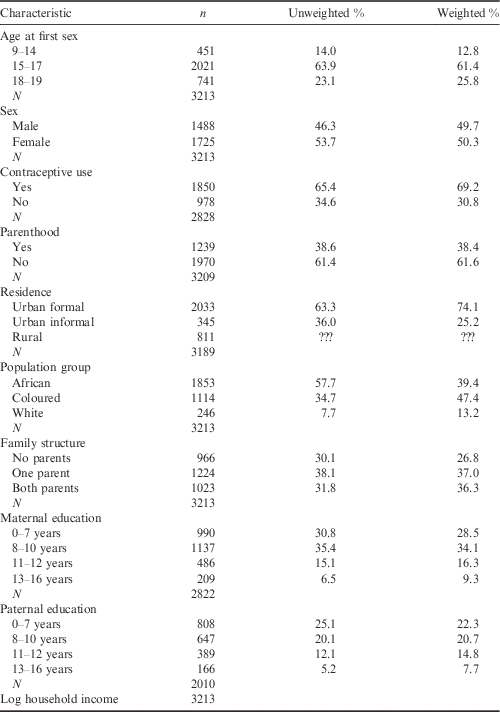
Table 1 presents the distribution of the sample with weighted and unweighted percentages. Lam et al. (Reference Lam, Cally, Branson, Case, Leibbrandt, Menendez, Seekings and Sparks2008) noted that the CAPS survey design oversampled Africans, hence it was important to apply the weights. There were 3213 individuals who had their sexual debut during adolescence (including pre-adolescence).
Descriptive statistics of study sample

Exploratory data analysis
Of the total sample population, the majority had their sexual debut between the ages of 15 and 17 (61.4%). Males constituted 53.7% of the sample population and females 46.3%. Coloured made up 47.4% of the population, while Africans constituted 39.4%. Whites were the least represented at 13.2% of the sample population. Approximately 63.3% of the total sample population lived in urban areas at the time of the survey, 25.2% in rural areas and 10.7% in other areas such as farms or hostels. The variable ‘family structure’ was re-coded from the question that asked whether or not respondents resided with their parents. About 36.3% had co-resident parents, 37% had one parent while 26.8% did not reside with either parent. Regarding maternal education, 34.1% of individuals who initiated sex during adolescence had mothers with a lower secondary education (8–10 years). In comparison, only 9.3% of individuals whose mothers had some post-secondary education (13–16 years) had their sexual debut during their adolescent years. Approximately 8% had fathers who had tertiary education, while there was a 2-percentage point difference in the proportion of individuals whose fathers had lower secondary education (20.7%) and primary or no education (22.3%).
Table 2 describes the sexual behaviour of the subjects by gender and population group. The subjects were classified into three sexual behaviour groups: early starters, normative and late starters. Across all population groups, the normative age at first sex was 15–17 years. The mean age at first sex was 13.44 years for the early starters, 16.08 for the normative and 18.32 for the late starters. African males had the highest rate of sexual debut at ages 9–14 (26.9%), followed by Coloured males (13.9%), while most White youths (both male and female) were either in the normative group or late starters. Significantly, fewer African females (9.8%) and female Coloureds (5.4%) were in the early starter group compared with their male counterparts (26.9% and 13.9% respectively). White females were in the normative group (54.9%), while White males were in the late starter category (54.0%). The data revealed that African males were less likely to use contraception (49.6%) at first sex relative to White males (91.6%), while there was no substantial difference between African and Coloured females in reported contraceptive usage. Coloured females were the most likely to be mothers (71%) if they had sex during their adolescent years, followed by African females (46.5%). Although the results show that males across all racial categories were less likely than their female counterparts to be parents, it must be noted that they (males) tended to under-report parenthood (Forste, Reference Forste2002; Frisco, Reference Frisco2008). Hence, this caution must be considered when interpreting the results.
Percentage of respondents by age at sexual debut and racial group

High school completion differed significantly by age at first sex for both males and females. Figure 2 shows that approximately 60% of both males and females who had their sexual debut in their late teens were more likely to complete high school than those who had early sexual debut (26% males; 23% females with high school completion).
Proportion of individuals who completed high school according to their age at first sex.

Logistic regression analysis
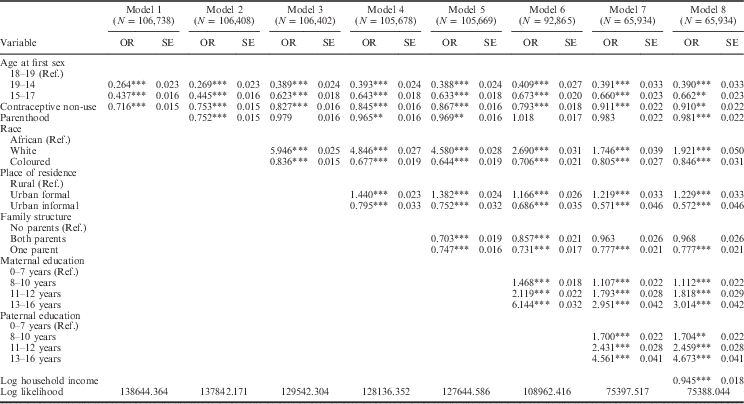
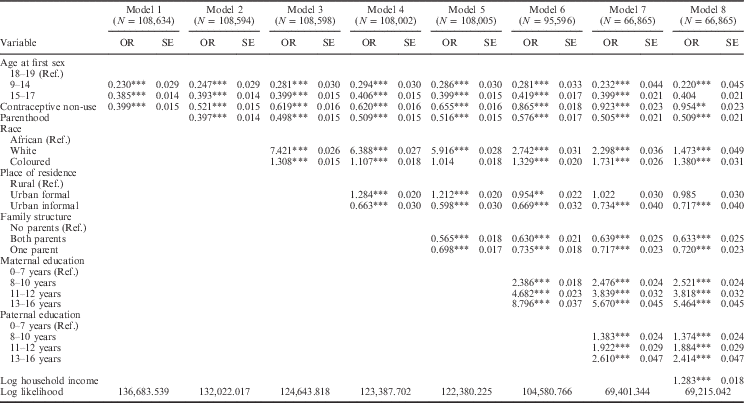
Tables 3–5 present the binary logistic regressions models from independent and nested models. The regression results are presented in terms of odds ratios. The results are presented separately for males and females. This is based on the understanding that sexual debut is more problematic for females than for males since the former may experience more negative consequences from early debut, such as social stigma, depression, unwanted pregnancy and abortion (Guo et al., Reference Guo, Wu, Qiu, Chen and Zheng2012; Kastbom, 2015). Moreover, options and decisions regarding access to education have been shown to differ significantly by gender. The analysis used the pooled weight of all models by default control for ‘ever having sex’ in adolescence since the sample was constituted from those individuals who had initiated sex during adolescence or pre-adolescence.
Odds of completing high school from independent models for individuals who initiated sex during adolescence, CAPS 2002–2009

*p<0.10; **p<0.05; ***p<0.005.
Nested models of high school completion for the male respondents who initiated sex during adolescence, CAPS 2002–2009

*p<0.10; **p<0.05; ***p<0.005.
Nested models of high school completion for the female respondents who initiated sex during adolescence, CAPS 2002–2009

*p<0.10; **p<0.05; ***p<0.005.
For the female population, the relative odds for completing high school were approximately 70–80% lower for the early sexual initiators, while for those in the 15- to 17-year-old age group the odds decreased by about 60% relative to those who initiated sex in their late teens. Not using any form of contraceptive reduced the odds by about 60% and in Model 8 there was a borderline difference of 4.6% less likelihood. In other words, contraceptive use had a lesser effect on completion of high school when SES-related factors were included in the model. Parenthood reduced the odds of matriculating by 66% in the independent model and approximately 50% when nested with other variables. White females had higher odds of completing high school than Coloured and African females, although Coloured females had better odds than African females in the independent models. This effect was reduced when age at sexual debut, place of residence and family structure were controlled for. Living in an urban area also increased the odds of having matric across all models relative to living in an informal or farm area or rural area. Surprisingly, residence with one or both parents had a negative effect on high school completion. The effect of parental education (both maternal and paternal) was very significant and increased the most by a factor of up to 23 for females whose parents had a tertiary education in the independent model. However, this effect was significantly reduced when other factors were controlled for. In the nested model, maternal tertiary education had a strong positive effect with a factor of 8.796 and the lowest effect of 2.386. Paternal education also exhibits similar effects and patterns for the female population, which are greatly reduced when nested in other models. The log of household income shows that for every unit increase in annual household income, the odds of completing high school increased by 2.205 (independent) and 1.283 (nested).
Likewise results from the logistic regression for high school completion among males in the CAPS study show that early sexual debut was negatively correlated with high school completion. White males were up to 9 times (independent effects) or 6 times (nested effects) more likely to matriculate relative to African and Coloured males. Contraceptive non-use reduced the odds of completing matric by the least factor of 28%, and as in the female-only model, the effect became borderline when SES-related factors were controlled for (8% less odds in Model 8). A similar trend was also observed for parenthood, which had borderline effects when nested with other variables. However, as mentioned earlier, this interpretation needs to be taken with caution as males are less likely than females to report paternity.
Males who lived in formal urban areas were up 1.5 times more likely to complete high school than their counterparts in rural and urban informal/farm areas. Although having co-resident parents had a significant effect on high school completion, this effect was found to be lower for males relative to females and seemed to disappear when paternal education was added to the model. Both maternal and paternal education had similar effects as in the female-only model, which only seemed to differ in terms of magnitude. A unit increase in household income increased the odds of completing matric by up to 2 times in the independent model, an effect that was reduced to 5.4% less likelihood when all factors were controlled for.
Discussion
The aim of this study was to examine the association between the timing of sexual debut and high school completion rates in South Africa. The sample was constituted from young people who had their sexual debut during adolescence. The assessment was done when the youngest subjects were approximately 21 years old. This allowed for an exploration of the long-term effects of sexual behaviours initiated in adolescence on high school completion.
It is well documented that adolescent sexual behaviours correspond with negative health, psychosocial and educational outcomes. However, there has been little if any exploration of the association between sexual debut and the completion of high school. In a country where socioeconomic opportunities are stratified by educational level attained (Statistics South Africa, 2014), high school completion is a barometer for adult socioeconomic opportunities. Analysis of the CAPS data patterns (Waves 1–5), a longitudinal representative study in Cape Town, confirmed previous findings on age at sexual debut. Previous studies have defined early sexual debut as having sexual intercourse before the ages of 14 (Sandfort et al., Reference Sandfort, Orr, Hirsch and Santelli2008) or 15 (Kothari et al., Reference Kothari, Shanxiao, Head and Abderrahim2012), while typical or normative sexual debut is regarded as occurring between the ages of 16 and 18. The South African youth sample in this study appear to fit this classification as the majority seemed to have their sexual debut between the ages of 15–17 years. Taking age at sexual debut as a correlate for health and educational outcomes, the findings reveal that there are already sizeable inequalities by race given that White males and females generally have a higher age at sexual debut than Africans and Coloureds. A surprising finding was that more boys (African and Coloured) had the lowest sexual debut (before or at age 14) than girls. Generally, girls tend to have an early onset of puberty and research has shown a positive correlation between onset of puberty and early sexual debut (James et al., Reference James, Ellis, Schlomer and Judy2012; Kastbom, 2015). Supplementary analysis of age at puberty using the CAPS dataset (available on request) also confirmed the assumption that girls indeed have a lower age at puberty than boys. Thus, these findings seem to deviate from the norm and indicate that there are other factors at play in influencing sexual debut.
Regarding high school completion, the findings revealed that the timing of first sex had both a negative independent and joint effect on high school completion. Initiating sex at an early age reduced the chances of finishing secondary school for both males and females. Several explanations can be provided for this. For instance, early sexual debut increases the time period during which young people are sexually active whilst still in school (Baumgartner et al., Reference Baumgartner, Geary, Tucker and Wedderburn2009). Early sexual debut has the potential to distract young people from their educational goals. Frisco (Reference Frisco2008) commented further on this and proved through the analysis of data that early sexual debut is inconsistent with educational ambitions and aspirations. Studies have also shown that early sexual debut is often accompanied by other risky behaviours such as delinquency, drug abuse, alcoholism and having multiple partners (Fatusi & Blum Reference Fatusi and Blum2008; Sandfort et al., Reference Sandfort, Orr, Hirsch and Santelli2008; Baumgartner et al., 2008). These factors are all negatively associated with persistence in school as they intersect with health, general well-being and educational aspirations (Frisco, Reference Frisco2008). For girls, early sexual debut increases the risk of pregnancy, which has consistently been linked to school dropout (Zaba et al., Reference Zaba, Pisani, Slaymaker and Boerma2004; Madise et al., Reference Madise, Zulu and Gera2007; Clark & Mathur, Reference Clark and Mathur2012). The health risks are also very high for young women with higher risks of birth complications and maternal mortality (UNESCO, 2013) if the pregnancy happens during adolescence. Hence, adolescent childbearing works against not only the rights-based argument, but indeed also escalates the long-term consequences that might prevent young women from enjoying the protective effect of education. The findings in the present study also seemed to confirm this as parenthood had a greater effect on girls than boys. This points to an inequality in sexual behaviour outcomes and confirms findings from previous studies, which have shown that early sexual initiation is more problematic for males than females. However, since boys are hypothesized to under-report paternity, and in the absence of supplementary information on parenthood, these findings must be taken and interpreted with caution. Adolescent pregnancy often brings detrimental social and economic consequences for a girl, her family and the broader community (Marteleto et al., Reference Marteleto, Lam and Ranchhod2008), especially if it leads to a girl dropping out of school.
Contraceptive non-use had a strong negative association with matriculation only when SES-related factors were excluded from the models. The effect became very marginal especially when paternal education and household income were included. While this could be interpreted to mean that contraceptive non-use at first sex is not an important indicator for educational attainment, it must also be acknowledged that this variable alone could have been inadequate to explain sexual behaviours. There is a body of research that has established that contraceptive use is more common among early sexual initiators (Baumgartner et al., 2008). Therefore, there is a possibility that individuals change their patterns of contraceptive use as they become more comfortable with having sex. The fact that contraceptive non-use could be more prevalent than reported or captured in the ‘contraceptive use at first sex’ variable is also substantiated by the high rate of pregnancies, especially for African and Coloured females (Table 2). A better measure to capture the association would be consistency of contraceptive use (Frisco, Reference Frisco2008).
Residence in urban or rural areas is complicated by racial and socioeconomic stratification reflecting South Africa’s history. In general, the rural population of South Africa is overwhelmingly African, while most White and Asian or Coloured people live in urban areas (Griffith & Zuberi, 2015). The available evidence shows that rural residents fare significantly worse on many indicators such as education, income, school accessibility and even household responsibilities relative to those who live in urban areas (Seekings, Reference Seekings2011). In this study, residence in non-urban areas was associated with failure to complete high school on time. Hence, differences in education attainment between rural and urban dwellers who have initiated sex during adolescence are attributed to racial and socioeconomic differences discussed in the ensuing sections.
Race is also a contentious issue in South Africa, especially considering its multicultural nature. Research into the ‘race effects’ on academic achievement in South Africa is robust and suggests that pervasive racial disparities in education seem to follow a pattern in which non-White South Africans consistently underperform relative to White South Africans. Moreover, race effects in South Africa are often decentred by their intersection with other forms of inequality. This is because education, which is key to leading a productive life, has a history of disadvantage orchestrated by the apartheid system. Under the apartheid system, education policies were weighted in favour of the White minority, while Blacks, Coloureds and Indians received an education that was inferior (Timaeus et al., Reference Timaeus, Simelane and Letsoalo2013). By extension, this education disadvantage relegated all non-White racial groups, particularly those of African origin, to the bottom of the income and wealth distributions (Seekings, Reference Seekings2011). The results from the present inquiry appear to also lend support to this and showed that both White and Coloured females were more likely to complete high school relative to African females. However, the magnitude of the race effect was much higher in favour of the White population; an effect surpassed in magnitude only by parental post-secondary education. Race effects for the male population behaved differently between the Coloureds and Africans, with African males having better odds of completing high school than the Coloureds.
Residence with both or one parent had a protective effect on high school completion in the independent only model. This effect was significantly reduced when nested with all the other variables. The family structure variable did not function as expected. Both dual and lone parent family structures were negatively correlated with high school completion when other control and explanatory variables were included. This finding was surprising as the literature suggests that children from intact families have better academic outcomes (Martin, Reference Martin2012; Wamoyi et al., 2015). This could be an indicator that early sexual debut can disrupt the influence of family intactness on adolescents’ educational outcomes.
Parental education exhibited the strongest influence of all the familial variables. Young males whose parents had matriculated from high school were up to six times more likely to complete their own matric and young females with matriculated parents were 2.5 times more likely to complete high school. This effect remained consistent in the nested models when other factors were included. The positive effect of parental education reinforces previous research both locally and internationally. For instance, Bernadi and Requena (Reference Bernardi and Requena2010) (Spanish study), Tieben and Wolbers (Reference Tieben and Wolbers2010) (Netherlands study) and Dubow et al. (Reference Dubow, Boxer and Huesmann2009) (American study) found that parents’ levels of education were linked to their offspring’s academic success, while Cherian (Reference Cherian2001) found a significant relationship between academic achievement and parental education amongst Xhosa children from South Africa, regardless of whether their families were polygamous or monogamous. Another South Africa study by Mutodi and Ngirande (Reference Mutodi and Ngirande2014) established that parental education levels, especially maternal, had a direct effect on mathematics achievement. The findings of the present inquiry extend this body of knowledge by establishing the effects of parental education on high school completion rates of young people who had their sexual debut during adolescence.
There are several reasons why parental education might have a strong influence on high school completion. For instance, parental education is an index of SES, which potentially leads to better outcomes in children (Mayer, Reference Mayer2010; Martin, Reference Martin2012). Thus, the cultural capital previously invested in the child, through the parent’s educational attainment, ultimately redounds his or her educational opportunities. Put simply, more educated, and richer parents can provide a better environment for their children’s educational achievement (Martin, Reference Martin2012). At the same time, their children feel the familial pressure of having to pass and feel obligated to not waste the money being invested in their education. These children are also influenced by ‘aspirational effects’, in that when they observe a better life around them (cultural and social capital), they are incentivized to invest in their own human, and by extension economic, capital by staying in school (Bernadi & Requena, Reference Bernardi and Requena2010).
Another household characteristic measured in this study was household income. This measure consistently showed that individuals from financially better-off families have better odds of completing high school (apart from the female population when parental education was included). This finding raises the question as to whether having more money in the household produces better child outcomes over time, and if this is the case, then the most intuitive explanation for this difference is that because rich parents can spend more than poor parents on their children, these ‘investments’ lead to better outcomes for their children (Mayer, Reference Mayer2010). Taking South Africa’s history of disadvantage into consideration, poor parents are likely to be African. Thus, if household income has direct effects on academic achievement and high school completion, then the South African education system is implicated in the reproduction of circles of privilege (Ramphele, Reference Ramphele1996) because it favours those from better-off families. This is a speculative point and it would be interesting to examine through longitudinal studies whether there is a cumulative and inter-generational effect of household income on matric completion.
The findings reported in this study should be considered in light of the study’s weaknesses. The study population was limited to the Cape Town area in South Africa. The socioeconomic dynamics in this province are different from other provinces in South Africa. Further, the analysis was limited to observable factors such as parental education, family structure and household income. There are other factors that could have led to a richer analysis and there were also substantial missing values on the parental education variables that may have led to potential bias on the parameter estimates.
Overall, the findings revealed that early sexual debut was correlated with long-term negative educational outcomes. Individuals who had early sexual debut were less likely to matriculate than their counterparts who had later sexual debuts. This effect was worse for non-Whites, indicating perhaps a multiple jeopardy where sexual debut intersects with other forms of inequality. This was most evident for African females, who despite having a lower rate of pregnancy than Coloureds (Table 4), were still less likely to complete high school than Coloured females were. Parental education was consistent and had a protective effect on high school completion for individuals who initiated sex during adolescence. In summary, the results indicate that sexual debut adds another layer of inequality and worsens the plight of Africans, females, those living in rural areas and those who come from low-income families.
Acknowledgments
The authors would like to thank the University of Cape Town’s Southern African Labour and Development’s research unit for permission to use the survey data. The authors have no conflicts of interest to declare.