INTRODUCTION
The (potential) role of Islamic organizations as welfare providers in Western democracies has started to attract an increasing interest from researchers. This rather new focus can be traced back to two recent developments more and more affecting Western European societies: First, religious pluralization has been growing after immigrants particularly from Muslim majority countries have settled in European countries. Second, the decentralization of welfare states and tendencies of marketization in social policy have established new opportunities for civil-society organizations—principally also including Islamic associations—to fill the gap public providers have been leaving. Whereas many research projects have had a rather explorative character sketching development and status quo of Islamic welfare in the Western world, other, mostly comparative studies have tried to show relations between specific (national) context factors such as regimes of religious governance or systems of welfare delivery and the role Islamic social service provision is able to play.
This paper not only wants to build on these comparative institutionalist studies analyzing the role Islamic welfare in two countries with divergent traditions of both church–state separation and welfare delivery: Germany and the Netherlands. It also tries to explain the empirical phenomenon that—despite cross-nationally different opportunity structures—in both countries, Islamic organizations are rarely involved in welfare delivery. To do so, the study examines discourses on Islamic delivery in the two countries against the background of Jonathan Fox's concept of conflicting ideas of political secularism.
On the one hand, the results of the paper show that decision-makers in the two countries in general hold different views within the “secular–religious competition” (Fox Reference Fox2015); that is, the support of the Christian majority religion in Germany and the focus on equal treatment of all religions in the Netherlands. This difference can be particularly explained by the divergent regimes of religious governance prevailing. On the other hand, when it comes to Islam in particular, a shift in the Dutch discourse toward strong secularism can be observed which, in the end, implies the same exclusivist perspective for Islamic welfare as the partial endorsement of Christianity in Germany.
The paper is structured as follows: In the next section, the state of the art on the welfare role of Islamic organizations will be presented and the focus of this research project illustrated. Subsequently, Fox's “secular–religious competition perspective” will be discussed (section “Political secularism, the secular–religious competition perspective, and Islam”) and the methodological approach of the study, the qualitative discourse analysis, presented (section “Methodology: qualitative discourse analysis”). In the following section “Context factors for Islamic welfare in Germany and the Netherlands”, the most relevant national contextual factors influencing the discourse are presented: church–state regimes and the governance of Islam. After focusing on the status quo of Islamic welfare and central issues being debated regarding the subject in the two countries compared, empirical results will be discussed which originate from the comparative discourse analysis in Germany and the Netherlands (section “Comparative discourse analysis: Islamic welfare in Germany and the Netherlands”). Thereafter, the empirical results are embedded in and interpreted against the background of the “secular–religious competition perspective” (section “Debates on Islamic welfare in Germany and the Netherlands against the background of the secular–religious competition perspective”). The paper finishes with a conclusion (section “Conclusions”).
STATE OF THE ART AND OWN FOCUS
When it comes to faith-based welfare in Western countries, earlier studies have mostly dealt with the role of Christian organizations as agencies of hospitals, kindergartens, nursing homes, and hospices. In this context, recent analyses have asked how this role might have changed against the background of increasing secularization (Hien Reference Hien2014). In contrast, research on the (potential) function of Islamic organizations as providers of social services and, therefore, the impact of the process of religious pluralization on welfare delivery in Europe or the United States have been scarce. Insights into Islamic welfare can be particularly found in studies on Northern Africa, the Middle East, or South East Asia. These studies show how the welfare commitment of Islamic parties or movements not only forms a crucial pillar of welfare systems in countries within these regions but is also used for the attraction of voters and supporters, respectively (cf., for instance, Cammet's and Issar's (Reference Cammet and Issar2010) comparative study on welfare activities of Shiite (such as Hezbollah in Lebanon) and Sunni (such as the Muslim Brotherhood) movements, Clark's (Reference Clark2004) research on Islamic charity groups in Egypt, Jordan, and Yemen, or Göçmen's (Reference Göçmen2014) work on religious welfare in Turkey).
When it comes to Islamic welfare in the West, the few existing studies have tried to figure out its (possible) contribution for established systems of welfare delivery. Particularly considering the theological background of Islam authors principally see a high potential of Islamic actors in welfare. Banfi (Reference Banfi and Roberto2015, 308) argues that “Islam shares much of the Christian theology and social doctrine”, whereas Dean and Khan (Reference Dean and Khan1998, 400) relate to the “moral principle which embodies the Islamic commitment to welfare and social justice”. Both analyses refer to the Islamic concept of Zakat, that is, the religious duty of all Muslims to give to those in need. However, as May (Reference May2017) remarks, Zakat “has strict injunctions concerning the correct beneficiaries” implying that contributions mostly ought to be given to fellow Muslims. Nevertheless, in practice, as May elaborates on the basis of Islamic welfare in the UK, Zakat unfolds an ethos that prompts believers to turn toward all indigent members of their community regardless of faith.
Authors have not only emphasized the lack of awareness toward Islamic welfare by researchers but also the ignorance of public authorities (Banfi Reference Banfi and Roberto2015, 305). However, if (mostly local) authorities notice social activities by Islamic organizations, they, frequently, approve hoping that they may address hard to reach groups more successfully than earlier efforts and, as a result, strengthen the social cohesion of society (Dean and Khan Reference Dean and Khan1998; Davelaar, Martins, and van Troostwijk Reference Davelaar, Martins and van Troostwijk2012; Banfi Reference Banfi and Roberto2015).
Elisa Banfi is one of the few authors who tries to find causalities between contextual factors and the role Islamic organizations (are able to) play as providers of social services in Western countries (cf. Banfi Reference Banfi and Roberto2015; Banfi Reference Banfi2017). She particularly refers to the way models of church–state separation influence the “degree of cooperation among institutions and private religious actors providing social services” Banfi (Reference Banfi2017, 7). The author argues that these church–state traditions not only influence Christian welfare provision but are also likely to have an impact on “the role and function of Islamic welfare agency in European states” (Banfi Reference Banfi and Roberto2015, 312). For instance, Banfi contrasts the “UK model of religious integration” and “the [French] republican model of excluding religious organizations from the public sphere” (Banfi Reference Banfi and Roberto2015, 310) suggesting that these context factors influence not only Christian but also Islamic welfare in the two countries divergently. Whereas Islamic organizations in Britain are encouraged to establish charity organizations and cooperate with other civil-society organizations, their counterparts in France are “not integrated into the public framework of social policy” (Banfi Reference Banfi and Roberto2015, 310).
Employing a qualitative discourse analysis, this paper seeks to uncover the (potential) role of Islamic organizations as welfare providers in Germany and the Netherlands. The paper, first, takes up Banfi's institutionalist approach, expecting national contextual factors such as church–state regimes and traditions of welfare delivery, which differ in the two countries, to have a divergent impact on discourses and, consequently, political measures with regard to Islamic welfare. Second, since the discourse analysis reveals prevailing narratives of exclusion in both countries, explanations for this empirical finding are tried to be found in the literature on political secularism, the “secular–religious competition perspective” and the role Islam plays therein (see following section “Political secularism, the secular–religious competition perspective, and Islam”).
POLITICAL SECULARISM, THE SECULAR–RELIGIOUS COMPETITION PERSPECTIVE, AND ISLAM
Fox (Reference Fox2015, 2) defines political secularism as “an ideology or set of beliefs advocating that religion ought to be separate from all or some aspects or politics or public life (or both)—competing with religion over this aspect of the public agenda”. His definition includes a “secular–religious competition perspective” implying that different secular as well as religious ideologies compete for space in the public sphere (Fox Reference Fox2015, 17). When it comes to political secularism, Fox (Reference Fox2015, 32) distinguishes different versions that diverge regarding the way political actors define state neutrality toward religion. Whereas for some political secularists, neutrality implies an equal (positive) treatment of all religions, others prefer “strong secularism”, thus the total restriction of religion in the public (or even private) sphere. Fox (Reference Fox2015, 37) concludes that any government is prompted to take decisions on a couple of questions:
• “whether to support religion and, if so, to support all of them, some of them, or only one;
• whether and to what extent to restrict, regulate, and control religion in general in the public sphere as well as the private sphere;
• whether to treat minority religions the same as the majority or differently”.
Buckley (Reference Buckley2017, 4) speaks of “benevolent secularism” if governments decide to keep equal distance from all religious communities and, therefore, “balance majority participation with minority rights”. However, according to Gill (Reference Gill2008, 18), in Western countries, this model appears to be rather scarce. Instead, he observes, on the one hand, state actors pursuing a sort of “favoritism” by positively endorsing one specific denomination, that is, (one of) the Christian majority church(es). On the other hand, he perceives governments that privilege secularism over religion in general preferring the strict separation of church and state which is likely to cause the exclusion of religion from the public sphere (Gill Reference Gill2008, 21). The latter can be said for both cases when it comes to minority religions and, even more so, the religion of Islam. Mavelli (Reference Mavelli2012, 69) emphasizes that Western decision-makers have conceived of secularism mostly as “an exclusive civilizational achievement of Europe and the West” which has its roots not least in Christianity. Against this background, secularism has been described as a tradition alien to Muslims and, therefore, being incompatible with Islam.
METHODOLOGY: QUALITATIVE DISCOURSE ANALYSIS
Hajer (Reference Hajer1995, 44) defines a discourse “as a specific ensemble of ideas, concepts, and categorizations that are produced, reproduced, and transformed in a particular set of practices and through which meaning is given to physical and social realities”. Discourse analysis examines politics as a competition between political actors involving interpretations of a political phenomenon in a certain policy field. These political actors are mostly collective entities such as political parties, interest groups and social movements, which may form advocacy coalitions based upon fundamental basic convictions about a political issue (Nullmeier Reference Nullmeier, Keller, Hirseland, Schneider and Viehöver2006, 290–299).
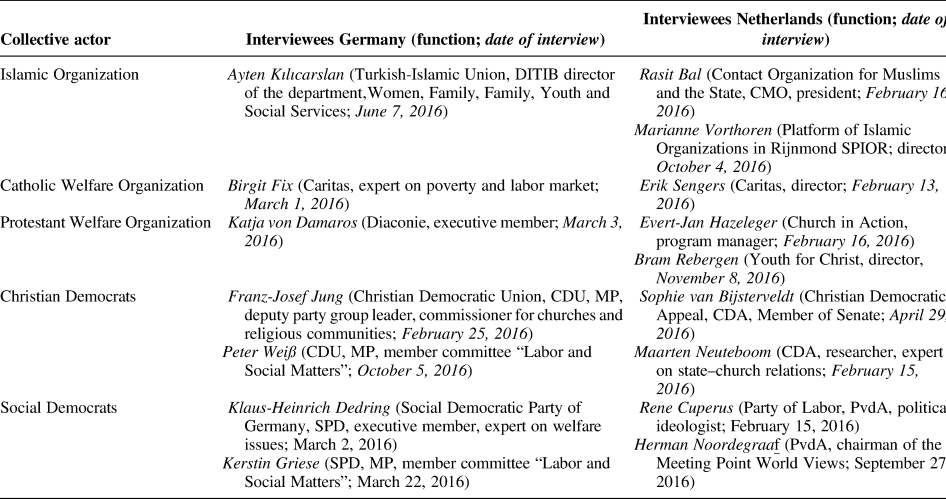
Discourse analyses suggest the use of content analysis which can be defined as a modification of hermeneutic procedures (Nullmeier Reference Nullmeier, Keller, Hirseland, Schneider and Viehöver2006, 306). The aim is to select relevant characteristics of texts and summarize them along theory-driven categories. This paper tries to uncover the discourses by examining the documents that reveal the positions of important actors involved in the national political debate on the (potential) inclusion of Islamic organizations in welfare. These actors include left- and right-wing mainstream parties, Catholic and Protestant (welfare) organizations and, finally, Islamic (welfare) organizations themselves. The most important documents used in this study were transcripts of 16 semi-structured interviews the author conducted with representatives from these collective actors in 2016. Interviewees were selected that were expected to be both (relative) experts on the issue of Islamic welfare and on the positions of their organization on this issue, respectively. This included representatives from Christian welfare organizations responsible for contacts with other civil-society organizations, Islamic representatives with a focus on welfare issues and party representatives with expertise regarding religious and/or social policy (see list of interviewees in Table 1).
Selected Interviewees in Germany and the Netherlands

During the interviews, a “narration-generating” technique was used, that is, only a small number of questions were asked that were rather vague to encourage interviewees to elaborate on their views as unbiased as possible.Footnote 1 In addition, the analysis accounted for documents published by actors themselves, such as press releases, position papers, and websites. However, since the information these documents provided were rather limited, the analytical focus was particularly on the interviews. Finally, statements by actors that could be found in the media were exploited as well.
CONTEXT FACTORS FOR ISLAMIC WELFARE IN GERMANY AND THE NETHERLANDS
Church–State Relations and the Governance of Islam
According to article 140 of the constitution, in Germany, there is no state church; however, religious organizations may be recognized as public corporations and as such levy a church tax on their members, administrated by the fiscal authorities (Fox Reference Fox2011, 129). Although all religious communities in principle may benefit from the regulations of article 140, it is above all the Christian churches and the Jewish community that have so far done so. With the exception of one Ahmadi organization in the state of Hesse claims by Islamic organizations to be recognized have failed; they have the status of registered associations instead (Kortmann Reference Kortmann2012).
The Dutch constitution does not refer to relations between state and religion or a public role of religious organizations; consequently, there is also no system of registering or recognizing religious organizations. Nevertheless, the state has provided opportunities for faith-based organizations as a way to establish the principle of religious pluralism in the country. According to the civil law religious organizations are merely described as legal persons; however, they differ from associations or foundations due to a right of self-determination with regard to their internal structures. Since there is no official system of recognition, it is the responsibility of the religious communities to define themselves as such (Davelaar et al. Reference Davelaar, de Witte, Swinnen, Beaumont, Danielle, Vranken and Kerstens2009).
In both countries, governments have established advisory boards for consultations with representatives from (organized) Islam “in sync with constitutional and state church norms” (Laurence Reference Laurence2012, 164). The German Islam Conference (Deutsche Islam Konferenz, DIK) was established in 2006 by Wolfgang Schäuble, then Federal Minister of the Interior. In reaction to this, the four largest Islamic organizations established the common umbrella organization Coordination Council of Muslims in Germany (Koordinationsrat der Muslime in Deutschland, KRM) in order to create a central organized representative of Muslims in Germany (Friedrichs and Klöckner Reference Friedrichs, Klöckner, Danielle, Vranken and Kerstens2009).
In the Netherlands, the Inter-Islamic Platform for Governmental Matters (Inter-islamitisch Platform Overheidszaken, IPO) was established in 2006 to create an arena for consultations between the Dutch government and two newly established Islamic umbrella organizations, CMO and CGI, which were funded publicly. The responsible government representative was the Minister of IntegrationFootnote 2 and not the Minister of JusticeFootnote 3, who is usually responsible for the government's relationships with religious organizations. However, in recent years, Laurence (Reference Laurence2012, 187) has observed “an inopportune climate for the accommodation of Islam” in the Netherlands which has ministers made “less willing to engage in these negotiations”. Consequently, in 2011, the government defunded the two umbrella organizations which have depended on membership fees and donations ever since.
Welfare States and Traditions of Welfare Delivery
In his pioneering study, “The Three Worlds of Welfare Capitalism” Gøsta Esping-Andersen (Reference Esping-Andersen1990) differentiated between three welfare state traditions within the Western world: liberal, conservative, and social democratic. Esping-Andersen defined Germany as an example of a conservative type; however, Schmid (Reference Schmid2010, 131) observes a deviation from this model in favor of a liberal system since the 1970s in order to decrease costs that have resulted from lasting high unemployment rates and economic difficulties. The Dutch welfare state system which was not covered by Esping-Andersen has been described as a hybrid. Van Oorschot (Reference van Oorschot, Schubert, Hegelich and Bazant2008) understands the welfare state in the Netherlands as a compromise between liberal and social democratic forces since both state and market have been granted an important role. Although there was an active, extended welfare state until the 1990s, the distribution of social services was a private task. On the other hand, characteristics of a conservative welfare state are apparent, for instance, in the context of the “Bismarckian social insurance for employees” (van Oorschot Reference van Oorschot, Schubert, Hegelich and Bazant2008, 459).
In both countries, there has been a trend of transferring competencies in social policy to lower levels which has been accompanied by an upgrading of non-governmental agencies as providers of welfare services. Particularly in Germany, the subsidiarity principle has promoted corporatism in social policy, thus the integration of independent, self-governed welfare organizations into all realms of healthcare and social care. According to subsidiarity as a guiding principle—but not as a legal norm—these private non-profit welfare organizations are given precedence over public (local) service providers. The 1961 Federal Act on Social Aid encourages the municipalities to cooperate with voluntary welfare organizations respecting their independence. In child and youth care, the municipalities are even instructed to step back if voluntary organizations are able to guarantee sufficient supply (von Campenhausen and de Wall Reference von Campenhausen and de Wall2006, 166–168).
In the Netherlands, in recent years, a “shift in balance from government to market” (Platinga and Attollenaar Reference Platinga and Attollenaar2007, 1) in welfare policy can be observed which is, by way of privatization, supposed to increase the system's efficiency and effectiveness. Platinga and Attollenaar (Reference Platinga and Attollenaar2007) speak of a Dutch “regulatory welfare state” that grants much space to private initiatives as the state has been retreating—while still guaranteeing “public safeguards”.
COMPARATIVE DISCOURSE ANALYSIS: ISLAMIC WELFARE IN GERMANY AND THE NETHERLANDS
Germany
The Status Quo of Islamic Welfare and Central Issues
In Germany, current debates with regard to Islamic welfare have first and foremost focused on the question if an incorporation of (an) Islamic welfare organization(s) into the corporatist welfare system might be both possible and desirable. According to recent investigations, Islamic communities and their organizations provide at least 6,000 services for children, youths, and—particularly—the elderly. In this context, organizations with about 10,000 volunteers and 900 professional employees support roughly 150,000 persons (Halm and Sauer Reference Halm and Sauer2015). However, social services provided by Islamic organizations have rarely been accompanied or supported by the state's efforts or by the recognized non-state welfare organizations (Charchira Reference Charchira, Peter and Ceylan2017). On the other hand, a couple of Islamic social agencies have been supported by local authorities with project funding. Unlike their Christian counterparts, the welfare commitment of Islamic organizations is primarily focused on their own communities, thus Muslim children, youths, and families in need. Principally, Islamic organizations are eligible for involvement in the corporatist welfare system due to the Code of Social Law (Sozialgesetzbuch, SGB). SGB VII which includes the “principle of variety of welfare organizations” (§ 3) demands to adapt the system of welfare delivery to a religiously and culturally changing society in order to guarantee the freedom of choice between providers of different world views (Halm and Sauer Reference Halm and Sauer2015).
The debate on the role of Islamic organizations particularly gained momentum in the beginning of 2014 when then Minister of the Interior, Thomas de Mazière (Christian Democratic Union; Christlich Demokratische Union, CDU), announced at a meeting of the German Islam Conference that his aim was to establish a national Islamic welfare organization in Germany. As recognized counterparts to the Christian and Jewish welfare organizations, the Islamic welfare organization would permanently receive financial subsidies from the state (Raissi Reference Raissi2015). However, to date state representatives have been rather reluctant when it comes to including an Islamic organization in the corporatist welfare system, criticizing missing quality standards, organizational structures and professionalism (Monsma and Soper Reference Monsma and Soper2009, 200; Charchira Reference Charchira, Peter and Ceylan2017). Furthermore, the perception has been prevalent that Islamic organizations do not have a separation of religious and social activities, a division which in Christian organizations is seen as the consequence of a long process of social differentiation (Halm and Sauer Reference Halm and Sauer2015). In November 2015, the DIK published a paper summarizing results of the meeting of the steering committee “welfare work” which consisted of governmental actors from different federal levels, representatives from 10 Islamic organizations as well as the president of the Federal Working Group of Voluntary Work (Bundesarbeitsgemeinschaft der Freien Wohlfahrtspflege). The document describes the inclusion of Islamic organizations as a means of both equal treatment and integration since a recognized Islamic welfare organization would need to be open for Muslims as well as non-Muslims. However, the establishment of such a counterpart to the Christian welfare associations is seen as a long-term goal as Islamic facilities need to be both qualified and professionalized and so be in a position to send representatives to a variety of boards at different regional levels where welfare issues are being discussed. Before Islamic organizations will be able to meet these challenges, already existing organizations and administrations—particularly at the local level—are required to cooperate with Islamic associations in order to better fulfill the needs of the Muslim community. Finally, (public) funders are asked to make sure that an Islamic welfare organization could be subsidized as well without creating a situation of competition with already existing welfare organizations (Deutsche Islam Konferenz 2015).
The German Discourse on Islamic Welfare: “Christian Favoritism”
German decision-makers comment on Islamic welfare not least against the background of the example of the traditional Christian welfare delivery in the country. (Implicitly) Comparing ambitions of Islamic organizations with the Christian model both Christian and Social Democrats in Germany express skepticism about the very idea of building an Islamic welfare organization; however, Social Democrats show themselves slightly more positive.
Peter Weiss, Member of Parliament for the Christian Democrats and, at the same time, working as a volunteer for the Catholic Bishop's Conference, argued in an interview that social services were not rooted as much in the tradition of Islam as Caritas and Diaconie were in the Christian Churches. Therefore, in his view, it was rather unlikely that Islamic welfare initiatives, which mostly operate as registered associations, would be able to achieve the status of a public corporation which Christian welfare organizations already enjoy. Either way, he placed the responsibility upon the Islamic organizations themselves which were supposed to become active in order to establish a welfare delivery service (interview P. Weiß, 10/05/16). Franz-Josef Jung, representative for churches and religious communities of the parliamentary group of CDU and CSU (Christian Social Union; Christlich Soziale Union), only perceived a potential role of Islamic organizations in welfare as first points of contact for the high number of Islamic refugees that have come to Germany since 2015 (interview F.-J. Jung, 02/25/16). In November 2015, then Federal Minister of the Interior Thomas de Mazière expressed his fear of an excluding and disintegrating effect of an Islamic welfare organization contradicting his own announcement of 2014 when he had described the establishment of such an agency as an option. Consequently, he now preferred the inclusion of Muslim personnel in the existing (Christian) welfare organizations and the cooperation of these with local Muslim initiatives instead of incorporating a newly established Islamic welfare organization into the German welfare system (Dernbach Reference Dernbach2015).
Representatives from the Social Democratic Party (Sozialdemokratische Partei Deutschlands, SPD) have also shown themselves rather pessimistic about the establishment of an Islamic welfare organization. In an interview, Klaus-Heinrich Dedring, then a member of the party's executive board, did not oppose to the idea principally. However, he was rather doubtful if Islamic organizations were able to keep up with the example of Christian welfare organizations and to manage full participation in self-organization and decision-making structures as well as recruiting the necessary personnel resources. Furthermore, he argued that, in his view, already existing (Christian) welfare organizations were also able to meet the needs of Muslims in the country (interview K.H. Dedring, 03/02/16). Kerstin Griese, the party's spokesperson with regard to politics and religion, also recommended this option against the background of organizational problems arguing that “Islam is a religion but not a church” which implies that “it cannot organize according to the [German] state church law”. Like Christian Democrats, she also perceived Islamic organizations themselves as primarily responsible for achieving the conditions for the status of a public corporation. In this context, she referred to “a whole lot of work” Islamic organizations might be confronted with before being able to establish—bottom-up—a welfare organization with democratic structures and with open doors for “people of all confessions as well as without any”. Furthermore, she showed herself skeptical about the willingness of already existing welfare organizations to accept another officially recognized partner and, consequently, renounce shares of their own public funds. Finally, she warned of the possibility that an Islamic welfare organization might be “exploited by extremist organizations”. However, she did not exclude the option of an Islamic welfare organization altogether: “In 10 years, structures might be established that enable an Islamic welfare organization” (interview Kerstin Griese, 03/22/16).
In contrast to party representatives, Christian welfare organizations in Germany themselves have clearly supported Islamic organizations’ claims for an own welfare association. On the one hand, interview statements by representatives from Diaconie and Caritas reflect the hope of enhancing the legitimacy of their prominent position in welfare delivery by granting Islamic organization a similar status. On the other hand, Christian welfare organizations express the fear of endangering their Christian character when extending their services to Muslims in need.
In an interview, Katja von Damaros, member of the executive of the Protestant Diaconie, argued that the establishment of an Islamic welfare organization might even “strengthen the religious side in welfare” vis-à-vis the secular welfare organizations. Furthermore, she argued that it was a question of fairness to allow the growing number of Muslims to establish a welfare organization of their own (interview K.v. Damaros, 03/03/16). Thorsten Nolting from the local Catholic Caritas organization in the capital of North-Rhine Westphalia, Dusseldorf, argued that Christian organizations were only able to meet Muslims’ needs to a certain degree without losing their own identities (Stoldt Reference Stoldt2014). However, both Diaconie and Caritas have also perceived a couple of hurdles and pre-conditions—particularly against the background of requirements they have fulfilled themselves. Diaconie representative von Damaros referred to the missing representative of Islamic organizations for all Muslims in Germany and also underlined that an Islamic welfare organization needed to be open to non-Muslims, as well (interview K.v. Damaros, 03/03/16). Furthermore, Birgit Fix, expert on poverty and labor market questions at the federal Caritas organization, noted in an interview that the “present German welfare system has grown over centuries” (interview B. Fix, 03/01/16), indicating that its reconstruction by means of including an Islamic organization may not be managed at short notice. Although representatives from both Diaconie and Caritas have offered their help and advice when it comes to establishing a welfare organization, they also emphasized that it was the Islamic organizations themselves which needed to build it up bottom-up (interviews K.v. Damaros, 03/03/16; B. Fix, 03/01/16).
Islamic organizations in Germany themselves explicitly strive for the prominent status in welfare delivery their Christian counterparts have held. Zekeriya Altuğ, head of the largest Islamic organization in Germany, the Turkish-Islamic Union for Religious Affairs (Türkisch-Islamische Union der Anstalt für Religion, DITIB) anticipated an integrative effect, whereas Erol Pürlu from the—also Turkish—Union of Islamic Cultural Centers (Verband Islamischer Kulturzentren, VIKZ) hoped for a step toward “further equal treatment of Islam and the churches” by such an establishment (Dernbach Reference Dernbach2015). In order to emphasize the need for Islamic welfare work, Ayten Kılıcarslan, a representative from DITIB's peak organization in Cologne, referred in an interview to the hundreds of thousands of “Islamic refugees” who have recently come to Germany. In her view, her organization might be able to establish a welfare organization over the next 5 years if it received “much more support from politics” instead of making things more complicated when, for instance, requiring the preparation of reports after granting public funding for welfare activities. Finally, she also tried to refute the argument of a potentially exclusive effect of an Islamic welfare organization underlining that, it would, “of course, take care of everyone” and not for Muslims or DITIB-members only (interview A. Kilicarslan, 06/07/16).
The Netherlands
The Status Quo of Islamic Welfare and Central Issues
Since the Dutch welfare system has traditionally been based on the principles of pluralism and competition, providers of different (both religious and non-religious) ideologies have principally been welcome. Furthermore, as religion has been perceived as a matter of civil society rather than of the state, religious organizations have also been seen as legitimate actors in welfare despite of recently growing support for a clear separation of religion and state (Canatan, Popovic, and Edinga Reference Canatan, Popovic and Edinga2015). Particularly since the implementation of the Social Support Act (Wet Maatschappelijke Ondersteuning, WMO) in 2007, it has been primarily the local levels that have been responsible for welfare work. Therefore, when it comes to the involvement of Islamic organizations, the focus has been first and foremost on local mosques. An analysis of 120 mosques in the Netherlands, conducted by Canatan, Popovic, and Edinga in 2015, shows that almost half of them are societally active in different fields of welfare and one-third showed at least limited societal commitment. Only 22% of these mosques were merely religiously oriented. In this context, Turkish mosques were considerably more active than Moroccan ones. According to Banfi (Reference Banfi and Roberto2015, 312), social activities provided by Turkish-Islamic organizations “are complementary (rather than parallel) to institutional policies”.
The Social Support Act explicitly requires the inclusion of civil-society organizations in (local) welfare work. In order to guarantee this, yearly local WMO councils meet where local administrations and civil-society organizations including religious associations discuss welfare issues. However, local administrations have differed considerably when it comes to involving and supporting Islamic organizations. Whereas some administrations have showed themselves positive toward the welfare work potential of mosques in their community, others are rather reluctant. In this context, the latter ones have missed the organizational stability of mosque organizations when it comes to professionalism, personnel, and finances. Furthermore, they have doubted the separation of religious and welfare activities of mosques, which they perceive as mere houses of prayer. Finally, some local administrations question the willingness of mosques to fulfill the WMO's demand for providing services for different religious and non-religious communities and not for their own religious community only (Dautzenberg and van Westerlaak Reference Dautzenberg and van Westerlaak2007). Dautzenberg and van Westerlaak (Reference Dautzenberg and van Westerlaak2007) conclude that the WMO in principal may stimulate cooperation between mosques, welfare organizations, and local administrations and may provide for new funding options for Islamic welfare players. However, they also see the need at the national level to encourage local communities to involve mosques in welfare, as, in their view, Islamic organizations claim a role in welfare because of and not despite their ideology. Nevertheless, they see the same fundamental problem as in Germany: a potentially intensified competition in welfare for the same amount of money provided by the state.
The Dutch Discourse on Islamic Welfare: Between “Benevolent” and “Strong Secularism”
In general, the Dutch discourse on religious welfare has reflected a “benevolent” form of secularism that accepts religious organizations in social service delivery the same way as contributions by secular providers. However, when it comes to a possible public (social service) role of Islamic organizations in particular, policy-makers have rather shown skepticism and have made statements that rather echo a secularist stance in its “strong” version.
A “benevolent” form of secularism can be found in statements by Christian Democrats in the Netherlands. Both Christian Democratic Appeal (Christen-Democratisch Appèl, CDA) and the Christian Union (Christen Unie, CU) have explicitly supported the involvement of religious organizations when applying the Social Support Act explicitly referring to both churches and mosques (Christen Unie Hengelo 2014). In an interview, Sophie van Bijsterveldt, CDA member of the Dutch Senate (First Chamber; Eerste Kamer) argued that she did not see any reason why Islamic organizations might not be able to play a role in welfare “in theory”. However, she perceived practical problems due to the fact that the Islamic community was rather “self-absorbed” which, in her opinion, complicated the establishment of structures for Islamic welfare activities (interview S.v. Bijsterveldt, 04/29/16).
Reservations toward Islamic welfare uttered by Social Democrats have been of more fundamental nature. Herman Noordegraaf, chairman of the Meeting Point World Views within the Social Democratic Party of Labor (Partij van de Arbeid, PvdA), argued in an interview that mosque organizations were rather busy with internal matters while not being part of the public debate—not least due to the “hardened discourse” on Islam in the Netherlands. Furthermore, he pointed to internal frontiers within the (Turkish) Islamic community which also weakened the role of their organizations in the public realm (interview H. Noordegraaf, 09/27/16). In another interview, Rene Cuperus, a political ideologist from the PvdA, argued that the recently increased emphasis on the separation of religion and state in the Netherlands was particularly due to the growing relevance of Islam in the country. Since, in his view, fundamentalist Islamic organizations had used social work as a means of recruitment, their inclusion should be handled with particular caution. Furthermore, he remarked that Islamic welfare work was primarily for the Muslim community and not for the society as a whole. Therefore, he concluded that Islamic commitment in welfare might even increase tensions between Muslims and the majority society (interview R. Cuperus, 02/15/16).
For representatives from Christian welfare organizations, (cooperation with) Islamic welfare initiatives have hardly been an issue. In an interview, Evert-Jan Hazeleger, program manager of the Protestant welfare organization Church in Action (Kerk in Actie), only referred to lose cooperation with Islamic organizations within the policy for the poor (interview E.-J. Hazeleger, 02/16/16). The director of the Amsterdam-based Protestant organization Youth for Christ, Bram Rebergen, also mentioned occasional discussions with Islamic representatives in governmental advisory boards on “topics and problems”, but indicated that there were “no relations in the sense of working closely together” (interview B. Rebergen, 11/08/16). When it comes to the idea of establishing an Islamic welfare organization, Eric Sengers, director of the Dutch Catholic Caritas, principally saw no legal obstacles. However, he showed himself pessimistic about the practical feasibility arguing that there was, on the one hand, disagreement within the Islamic community on how to implement such an organization and, on the other hand, missing acceptance within the Dutch society with regard to public Islamic welfare (interview E. Sengers, 02/13/16).
Representatives from Islamic organizations themselves have referred to a shift toward stronger secularism within the Dutch discourse on religious welfare. Marianne Vorthoren, director of the Islamic organization Foundation Platform of Islamic Organizations in Rijnmond (Stichting Platform Islamitische Organisaties Rijnmond, SPIOR), argued in an interview that both Islamic and Christian welfare initiatives were challenged by this shift. She referred to the growing popularity of the definition of church–state separation in a strict sense although “in the Netherlands, there has always been a different model than in France” (interview Marianne Vorthoren, 10/04/16).
However, Islamic organizations have also expressed the feeling of being disrespected in their role as (potential) welfare providers and disadvantaged compared with Christian organizations. Rasid Bal, head of the peak Islamic organization CMO, complained in an interview about Islamic charity initiatives frequently not being recognized as actors in welfare since they are not as well-known as Christian ones. On the other hand, he also referred to a lack of knowledge about methods, access, and normative basics with regard to welfare delivery within the Muslim community itself (interview R. Bal, 02/16/16). Local mosque organizations that have been asked about their experience with the WMO for a study conducted by Dautzenberg and van Westerlaak (Reference Dautzenberg and van Westerlaak2007) have complained about general mistrust of the local administrations toward mosques which had to prove again and again their opposition to extremism and their rejection of missionary goals. If, however, they are funded publicly, they also expressed the fear that local communities might interfere with their internal matters. Finally, they also accused the local administrations of merely using them in order to get access to the Muslim community instead of really being interested in their contribution to welfare work. Nevertheless, the head of the CMO, Rasid Bal, showed himself optimistic that future Muslim generations might be able to build up an own Islamic welfare organization. Before this would be realized, he encouraged Muslims to take the initiative and participate in existing non-Muslim societal organizations in order to show that Muslims were not active “as troublemakers anymore but as the ones that help solving problems” (interview R. Bal, 02/16/16).
DEBATES ON ISLAMIC WELFARE IN GERMANY AND THE NETHERLANDS AGAINST THE BACKGROUND OF THE SECULAR–RELIGIOUS COMPETITION PERSPECTIVE
In Germany, the question of involving Islamic organizations in welfare is primarily perceived as the challenge of including them in structures first and foremost shaped by Christianity. This is in line with the overall favoritism toward Christianity shown by recent German governments which have defined the religion as the culture that has characterized the country fundamentally. This is also reflected in a statement by then Federal Minister of the Interior, Thomas de Maizière, who argued in 2011: “It is for sure that juridical neutrality is not a synonym for equidistance. This derives from the preamble of the Constitution. We are shaped by Christianity culturally, spiritually and politically.”Footnote 4 Consequently, the question if Islam is “a part of Germany”, too, has been a controversial issue for years. Recently, Horst Seehofer (CSU), Minister of the Interior since March 2018, explicitly denied this only days after being sworn-in, whereas chancellor Angela Merkel (CDU) contradicted him shortly after.Footnote 5
In contrast, in the Netherlands, the issue of Islamic welfare is particularly seen in the context of separation between religion and state—a principle which has gained relevance in the light of—publicly increasingly visible—Islam. This appears counterintuitive in a country where governmental representatives have repeatedly emphasized religious pluralism and equal treatment of all religions and world views explicitly including Islam—mostly defending the religion against the right-wing populist Party for Freedom (Partij voor de Vrijheid, PVV) of Geert Wilders who has repeatedly defined Islam as an “evil ideology” which is “probably [even] more dangerous than National Socialism”Footnote 6. Nevertheless, when it comes to Islam, Dutch politicians particularly from liberal and left parties have also moved away from the equal treatment perspective in favor of a view that restricts religious activities in the public sphere generally. To conclude, “subtle, often ‘silent’ political agreements”, as observed by Davelaar et al. (Reference Davelaar, de Witte, Swinnen, Beaumont, Danielle, Vranken and Kerstens2009, 222), that have recently formed the basis for stricter secularism can be interpreted as a response to the increasing visibility of the Islamic religion in the country. Finally, this shift might also be due to negative attitudes toward Islam prevalent in the Dutch society where—according to a survey conducted by the Pew Research Center in 2016—35% of the population hold an “unfavorable view” of Muslims compared with 29% in Germany.Footnote 7 As a result, the Dutch discourse with regard to Islamic welfare has proved to be as exclusive as it has been in Germany.
Increasing strong secularism in the Netherlands and the biased support for Christianity in Germany also explains why there are different cleavages between Conservatives and Social Democrats in the two countries. Whereas German Social Democrats show themselves more optimistic about the feasibility or sense of including Islamic organizations in welfare than Christian Democrats, in the Netherlands, the situation is the other way around. Unlike Dutch Social Democrats who perceive a threat for the separation of religion and the state, Christian parties—which in the Netherlands are far less dominant than their German counterparts—see welfare work of mosques—as well as of churches—as a means of strengthening the role of religion in the public sphere—and, by that, the equal treatment perspective—again.
The reason why Christian welfare organizations in Germany support Islamic charity organizations can be understood against the organizations’ fear of losing their own (religious) identities when taking care for Muslims as well. On the other hand, in the Netherlands, Christian organizations show little interest in cooperating with or supporting Islamic organizations possibly due to their own fight against a lack of relevance, a trend which—unlike in Germany—has been going on for decades.
Positions represented by the Islamic organizations themselves quite clearly reflect the dominant discursive perspectives with which they are confronted. In Germany, Islamic representatives emphasize their efforts to establish welfare organizations that meet the conditions set in the State Church Law. On the other hand, they accuse politicians of disrespecting these efforts because of a missing will to really incorporate an Islamic organization into the corporatist welfare system dominated by the Christian welfare organizations. In the Netherlands, Islamic representatives primarily complain about politicians defining church–state separation in their disfavor and—by that—blocking their commitment in welfare work.
CONCLUSIONS
The discourse on Islamic welfare in the Netherlands analyzed in this paper not only reflects the different possible perceptions of secularism Fox and others have introduced reaching from (positive) neutrality toward all religions to the total restriction of religion from the public sphere. It also illustrates that perspectives dominant can vary dependent on the concrete issue at stake. Whereas the country's regime of religious governance generally supports religious pluralism, a more secularist approach prevails against the background of discourses around Islam. Therefore, the Dutch case shows that political secularism can serve as a key component of inter-religious discord and contention the same way as the biased favoritism in Germany does. All in all, the views Dutch and German political decision-makers have expressed with regard to the role of religion(s) in the public sphere and the public role of Islamic (welfare) organizations in particular reflect all options Fox (Reference Fox2015) has accounted for: support for all religions (in the Netherlands), support for only one religion (Christianity in Germany), restriction of all religions (in the Netherlands), same treatment of minority religions as the majority (in the Netherlands) or different treatment of minorities (Islam in Germany).
To generalize, the results of the study imply that—at least—when it comes to Islamic welfare, political decisions (in this case: excluding Islamic social service initiatives from public welfare delivery) can be better explained by the influence of a discourse than the impact of institutions. Even though institutional contextual factors principally may not bar the way to the establishment of Islamic welfare organizations, exclusivist discourses seem to prevent corresponding political measures. Therefore, in studies on the role of religious minorities in public policies, it appears to be fruitful to account for the secular–religious competition perspective in discourse analyses.
The negative discourse on Islam is also likely to hamper relationship building between governmental actors and Islamic representatives which would be crucial in order to achieve cooperation patterns in the field of welfare. The significance of “trusting partnership” has also been emphasized by Euchner (Reference Euchner2018) who has shown how in the German state of Hesse, Islamic religious education was successfully implemented in public schools after consensus-oriented actors in both the state's Ministry of Education and Islamic organizations had established a stable dialogue forum. Admittedly, the causal link might also be the other way around, that is, missing relationships of decision-makers with Islamic actors might have had a negative impact on the discourse on Islam and, consequently, inhibited the political action that would path the way to the establishment of Islamic welfare.
In any case, the political ramifications of skeptic views on Islam in Western democracies become visible when looking at the minor role the religion is being granted in the public spheres. Not only with regard to opportunities of Islamic welfare, European discourses imply difficult conditions as long as the fear of Islamic organizations being organizationally deficient, exclusive, disintegrating, or even extremist prevails. Moreover, the fact that Islamic organizations themselves feel that they are confronted with general suspicion and treated unequally makes it rather unlikely that they are motivated to meet the requirements, for being included as equal players in welfare delivery or other realms of public policy. Particularly in Germany, these requirements which include professional organizational structures, sufficient human and financial resources as well as specific membership structures are indeed considerable challenges for most of the Islamic organizations. However, as Charchira (Reference Charchira, Peter and Ceylan2017, 340) argues, if German authorities were more inclined to acknowledge already professionalized structures in, for instance, Islamic youth and geriatric care and to reduce entry barriers disfavoring new (minority) welfare actors, Islamic organizations might be both more willing and enabled to make the necessary efforts in order to meet the relevant criteria. Nonetheless, in Germany, the Netherlands, and elsewhere, such political goodwill to recognize the potential of Islamic welfare would, again, require the abandonment of both biased favoritism and strong secularism.