Introduction
Lymph node involvement and distant metastasis are two of the most significant pathological factors that influence the prognosis of patients with oral cancer. Therefore, regulating metastasis has been a major aspiration for head and neck surgeons. Invasion and metastasis of cancer cells are associated with proteolytic degradation of the basement membrane and the extracellular matrix. The invasive potential of cancer cells is determined by the co-ordinated balance between the activity of proteases and protease inhibitors.
Cathepsin L is a lysosomal protease which is involved in the degradation of collagen and elastin within the basement membrane.Reference Lankelma, Voorend, Barwari, Koetsveld, Van der Spek and De Porto 1 Cathepsin L expression is related to cancer cell invasion and metastasis, and has been reported to be involved in the progression of multiple types of cancer including head and neck squamous cell carcinoma (SCC).Reference Macabeo-Ong, Shiboski, Silverman, Ginzinger, Dekker and Wong 2 , Reference Xu, Yuan, Liu, Zhang and Chen 3
Headpin was initially identified as a head and neck serpin that showed constitutive expression in normal oral mucosa but profoundly reduced messenger RNA (mRNA) expression in oral SCC.Reference Spring, Nakashima, Frederick, Henderson and Clayman 4 , Reference Nakashima, Pak, Silverman, Spring, Frederick and Clayman 5 Jayakumar et al. demonstrated that the serpin headpin possessed specificity for inhibiting the lysosomal cysteine proteinases cathepsin K and cathepsin L.Reference Jayakumar, Kang, Frederick, Pak, Henderson and Holton 6
The objective of this study was to investigate the prognostic value of determining expression levels of cathepsin L and its inhibitor headpin in patients with oral SCC progression. We evaluated the relationship between cathepsin L and headpin expression, determined immunohistochemically, and patients' clinicopathological factors and survival.
Patients and methods
Patient and tumour characteristics
The tumour specimens examined for cathepsin L and headpin expression were obtained from 56 patients with SCC of the oral tongue. All patients underwent curative resection of their carcinoma.
Clinical disease staging was determined using the International Union Against Cancer tumour-node-metastasis (TNM) system. The numbers of patients classified as being in stages I, II, III and IV were 12 (21 per cent), 26 (46 per cent), 2 (4 per cent) and 16 (29 per cent), respectively.
All tumours were graded histopathologically according to the second edition of the World Health Organization system. 7 Of the 56 cases, 30 were defined as grade I and 26 as grade II.
Immunohistochemistry and evaluation
Formalin-fixed, paraffin-embedded materials were routinely processed. Four micrometre thick sections were cut and transferred onto 2 per cent organosilane coated slides. Tissue sections were deparaffinised and dehydrated in a graded series of alcohol. They were then digested in 0.05 per cent trypsin for 10 minutes, and blocked in 0.3 per cent hydrogen peroxide in methanol for 30 minutes and normal goat serum for 10 minutes.
The slides were incubated for 1.5 hours at room temperature with either anti-cathepsin L antibody (1:400; Sigma-Aldrich, St Louis, Missouri, USA) or anti-headpin antibody (1:200; Fitzgerald, Acton, Massachusetts, USA). After extensive washing with phosphate-buffered saline, the slides were incubated for another 30 minutes at room temperature with biotinylated secondary antibody. The streptavidin-biotin peroxidase method (Histofine Sabpo Kit; Nichirei, Tokyo, Japan) was used for detection, using 3,38-diaminobenzidine as the chromogen. The sections were counterstained slightly with haematoxylin.
A tumour was considered to be positive for cathepsin L or headpin when more than 20 per cent of the tumour cells exhibited strong, diffuse, cytoplasmic staining.
Two investigators evaluated staining independently. These investigators were blinded to patients' clinical information.
Statistical analysis
Statistical analyses were performed using the Mann–Whitney U test. The Kaplan–Meier method was used for analysis of survival data. The significance of differences in survival plots was analysed using the log-rank test. Differences with a p value of less than 0.05 were considered statistically significant.
Results
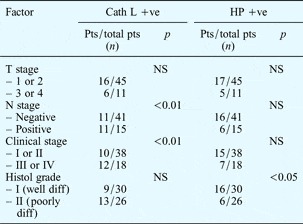
Table I summarises the relationship between the expression of cathepsin L and headpin and the patients' clinicopathological factors.
Relationship between cathepsin L and headpin expression and clinicopathological factors

Cath L +ve = cathepsin L expression positive; pts = patients; HP +ve = headpin expression positive; T = tumour; NS = not significant; N = node; Histol = histological; diff = differentiated
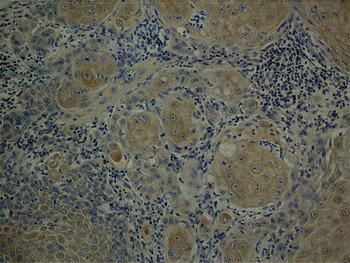
Cathepsin L expression was also observed in the cytoplasm of the oral tongue SCC cells. Twenty-two (39 per cent) tumours were considered positive for cathepsin L expression (Figure 1). Cathepsin L was not expressed in normal oral mucosa cells. There was a significantly greater proportion of cathepsin L positive cases amongst N-positive patients compared with N-negative patients, and also amongst patients with stage III–IV disease compared with stage I–II disease (Table I).
Photomicrograph showing immunohistochemical staining for cathepsin L in oral tongue squamous cell carcinoma. (Original magnification ×400)

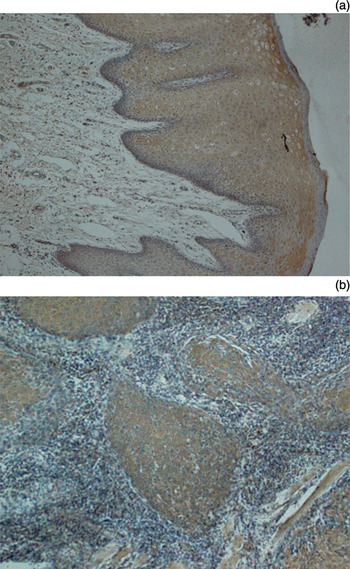
Headpin expression was observed in the cytoplasm of normal tongue epithelial cells and oral tongue SCC cells (Figure 2). Expression in normal epithelium was much more intensive than in SCC cells. Of the 56 tumours, 22 (39 per cent) were considered positive for headpin expression. There was no correlation between headpin positivity and patient T stage, N stage or clinical stage. However, headpin positivity was found in a significantly greater proportion of specimens from patients with well differentiated SCC cells, compared with patients with poorly differentiated SCC (Table I). No correlation was found between headpin expression and cathepsin L expression, using the immunohistochemical methods described.
Photomicrographs showing immunohistochemical staining for headpin in (a) normal oral epithelium and (b) oral tongue squamous cell carcinoma. (Original magnification ×100)

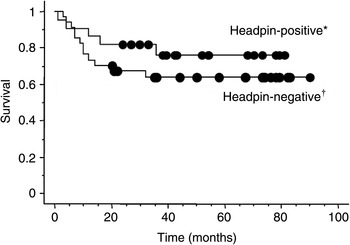
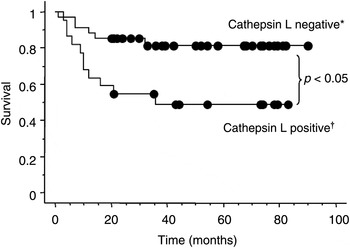
There was no statistically significant relationship between headpin expression and overall patient survival (Figure 3). However, patients whose tumours were immunohistochemically negative for cathepsin L had improved survival, compared with those with cathepsin L positive tumours (Figure 4).
Overall survival in headpin-negative and headpin-positive cases. *n = 22; † n = 34.

Overall survival in cathepsin L-negative and cathepsin L-positive cases. *n = 34; † n = 22

Discussion
Oral tongue SCC is the most common head and neck cancer and has a high incidence of lymph node metastasis. The invasive potential of the cancer cells is likely to affect patient prognosis; furthermore, understanding these cells' metastatic potential may help guide the choice of multimodality treatment.
Tumour growth and invasion are profoundly affected by endoproteases (e.g. cysteine, aspartate, serine, metallo- and threonine proteases), at both primary and metastatic sites. In cancer cells, loss of balance between proteases and their inhibitors leads to unregulated progression of disease.
In the present study, we used immunohistochemical methods to examine the expression of cathepsin L and its cross-class inhibitor headpin, within oral SCC tissue. Cathepsin L expression positivity correlated significantly with nodal metastasis and poor prognosis, suggesting that its over-expression may be a prognostic factor for metastasis. Headpin expression positivity was much greater in normal mucosa, and was also greater in well differentiated versus poorly differentiated oral SCC. These observations suggest that headpin expression is down-regulated during cancer de-differentiation, consistent with previous reports.Reference Spring, Nakashima, Frederick, Henderson and Clayman 4 However, there was no correlation between cathepsin L expression and headpin expression in this study.
Proteases and their inhibitors play an important role in cancer cell invasion and metastasis; however, the relationship between cathepsin L and headpin is not a simple, one to one correspondence. Multiple factors may be involved in cathepsin-mediated promotion of head and neck SCC cells.
Cathepsin L has been considered a potential target for cancer treatment, as its activity is exclusively elevated in many types of malignant cells.Reference Lankelma, Voorend, Barwari, Koetsveld, Van der Spek and De Porto 1 The role of cathepsin L in oral cancer progression has been previously discussed but is not fully understood. Macabeo-Ong et al. found that cathepsin L mRNA and protein levels were significantly lower in non-progressive oral dysplasia, compared with oral cancer, but not in progressive dysplasia, suggesting that dysplasia which over-expresses cathepsin L has the potential to progress to oral cancer.Reference Macabeo-Ong, Shiboski, Silverman, Ginzinger, Dekker and Wong 2 On the other hand, Kawasaki et al. reported that cathepsin L expression had no relationship with oral cancer progression.Reference Kawasaki, Kato and Mizuno 8 Our present results suggest that over-expression of cathepsin L (determined immunohistochemically) is related to lymph node metastasis and poor oral cancer prognosis, suggesting a potential role as a prognostic marker.
-
• This study assessed the prognostic value of cathepsin L and its inhibitor headpin in oral squamous cell carcinoma (SCC)
-
• Expression of these proteins was assessed immunohistochemically
-
• Cathepsin L over-expression was related to lymph node metastasis and poor prognosis
-
• Headpin expression was down-regulated in SCC cells, but was unrelated to prognosis
-
• Cathepsin L could be a potential biomarker for oral SCC prognosis
In the current study, although headpin expression was down-regulated in oral SCC compared with normal oral tissue, it had no relationship with patient prognosis. Shellenberger et al. reported that headpin inhibited angiogenesis, and that loss of headpin expression could result in an imbalance of mediators, which favoured angiogenesis and tumour growth.Reference Shellenberger, Mazumdar, Henderson, Briggs, Wang and Chattopadhyay 9 The role of headpin expression in oral SCC progression remains unclear.
Conclusion
Our results suggest that cathepsin L may be a useful marker for cervical lymph node metastasis and oral SCC prognosis. Cathepsin L expression is significantly associated with the metastatic potential of oral tongue SCC. However, headpin, the cross-class inhibitor of cathepsin L, was not a useful marker.
Regulation of the invasion and metastasis of oral cancer cells remains an important treatment goal, and targeting proteases and their inhibitors may be an attractive approach.