Introduction
The lady beetles (ladybird beetles, ladybugs) are one of the most iconic families of insects in North America, the subject of countless photos, poems, and lore. Consequently, this is one of the best-known families of insects, especially the species in the tribe Coccinellini, which contains the larger and more colourful varieties. There are more than 450 species of lady beetles in North America (Gordon Reference Gordon1985). Brunke et al. (Reference Brunke, Bouchard, Douglas and Pentinsaari2019) reported 162 species for Canada, and Langor (Reference Langor2019) added one additional species. The Canadian ladybug fauna includes 10 nonnative species, most of which were inadvertently introduced. One notable exception, the harlequin lady beetle, Harmonia axyridis (Pallas) (Coleoptera: Coccinellidae), was intentionally introduced to North America multiple times, starting in 1916, as a biocontrol agent for aphids in greenhouses, subsequently establishing in the wild in the United States of America in 1988 (Chapin and Brou Reference Chapin and Brou1991; Hoebeke and Wheeler Reference Hoebeke and Wheeler1996) and spreading to natural ecosystems in Canada by 1994 (Corderre et al. Reference Corderre, Lucas and Gagné1995). Although the seven-spotted lady beetle, Coccinella septempunctata Linnaeus (Coleoptera: Coccinellidae), was also intentionally introduced to North America as a biocontrol agent on numerous occasions between 1956 and 1971, it did not establish as a result of these introductions (Gordon Reference Gordon1985). The first established population of C. septempunctata in North America, found in Bergen Co., New Jersey, United States of America, in 1973, was the result of an accidental introduction (Gordon Reference Gordon1985). Nonnative species are often the most common species encountered in many natural habitats, especially C. septempunctata and H. axyridis.
During examination of undetermined specimens of Coccinellidae from the Canadian province of Newfoundland and Labrador between 2015 and 2018, specimens of Adalia with unusual elytral colour patterns were encountered. These were thought to represent colour morphs of the Palaearctic species, the ten-spotted lady beetle, A. decempunctata (Linnaeus) (Coleoptera: Coccinellidae), which has an elytral colour pattern that is highly variable throughout its native range (Pope Reference Pope1953). Furthermore, the putative A. decempunctata specimens possessed pale mesepimera, a key diagnostic character for this species in its native Palaearctic range, whereas mesepimera of the sympatric A. bipunctata (Linnaeus) are typically black (Pope Reference Pope1953). However, as A. bipunctata populations elsewhere in North America include specimens exhibiting colour morphs similar to those reported for A. decempunctata, and a small proportion of specimens also exhibit paleness of the mesepimera, it was thought prudent to do a detailed morphological and molecular study of the specimens to gather additional evidence to support its identity and to find characters to discriminate among the two species of Adalia. Subsequently, fresh specimens of A. decempunctata were hand-collected from vegetation from the island of Newfoundland for study and preserved as pinned specimens or in 95% ethanol; some of the collected specimens were DNA barcoded. Furthermore, an extensive survey of the Coccinellidae of the island of Newfoundland was conducted in August 2022 and August 2023 (Langor, unpublished data) to, in part, ascertain the distribution of the putative A. decempunctata. We report herein the results of these morphological and molecular studies and provide information on the distribution of this species in North America.
Materials and methods
Collection codons
Specimens of putative A. decempunctata and A. bipunctata were examined from the following insect collections:
BHC – Barry Hicks Collection, Carbonear, Newfoundland and Labrador, Canada [A. decempunctata]. Note: Within about two years, this collection will be transferred to either The Rooms (Newfoundland and Labrador Provincial Museum) or Agriculture and Agri-Food Canada, both in St. John’s, Newfoundland and Labrador, Canada.
CNC – Canadian National Collection of Insects, Arachnids and Nematodes, Agriculture and Agri-Food Canada, Ottawa, Ontario, Canada. [A. decempunctata specimens were donated by the senior author.]
NLC – Newfoundland and Labrador Collection, The Rooms, St. John’s, Newfoundland and Labrador [A. bipunctata, A. decempunctata]. This collection consists of most insect material from the former Memorial University of Newfoundland (MUN) Collection, most material from the collection of David Langor, and material from Newfoundland donated by other collectors. The MUN collection was shipped to David Langor Canadian Forest Service, Northern Forestry Centre, Edmonton, Alberta, Canada for safe keeping when the last curator (David Larson) retired in 2005 because the institution no longer wished to retain the collection. From 2023 to 2025, this collection will be relocated to The Rooms (the provincial museum of Newfoundland and Labrador), located in St. John’s. It is expected the specimens of Coccinellidae will be transferred in 2023.
NFRC – Canadian Forest Service, Northern Forestry Centre, Edmonton, Alberta, Canada. [A. bipunctata and A. decempunctata specimens were donated by the senior author.]
UASM – Strickland Entomological Museum, Department of Biological Sciences, University of Alberta, Edmonton, Alberta, Canada. [A. decempunctata specimens were donated by the senior author.]
Morphological studies
For morphological studies, 52 specimens of A. bipunctata and 24 of A. decempunctata from Newfoundland and Labrador were examined using stereoscopic microscopy. Dirty specimens were first cleaned by sonication in soapy water for 15 minutes, followed by a rinse in distilled water and immersion in 95% ethanol for two minutes before being either preserved in 70% ethanol or pinned. Following cleaning, two specimens of each sex were disarticulated (head, prothorax, meso/meta thoraces, abdomen, legs, wings, elytra), and body parts were closely examined from all aspects to locate diagnostic characters. The genitalia were dissected and examined for two males and females of each species. Body parts and habitus photos were taken using a Leica M80 stereoscopic microscope with a Leica EC3 camera (Leica, Wetzlar, Germany) attached.
DNA studies
For DNA barcoding, initially five specimens of putative A. decempunctata were chosen from among specimens that had been dried and pinned between 1995 and 2001 and represented several elytral colour morphs. Because these specimens posed challenges for obtaining sequence for the entire Folmer barcoding region of the cytochrome c oxidase 1 (CO1) gene of mitochondrial DNA using existing primers, additional three specimens collected in 2020 were later amplified using polymerase chain reaction and sequenced. Also, specimens of A. bipunctata from Newfoundland (three from 2021) and Alberta (one from 2020) were barcoded. A leg was removed from each specimen, and DNA was extracted using a DNeasy Blood and Tissue Kit (Qiagen, Hilden, Germany) according to the manufacturer specifications, with minor modifications during DNA elution, which was performed in multiple rounds of 50 uL to maximise drawdown. The Folmer region (5P) of CO1 was amplified using two different overlapping pairs of primers. The outside primers were CLepFolF (5´-ATT CAA CCA ATC ATA AAG ATA TTG G-3´) and CLepFolR (5´-TAA ACT TCT GGA TGT CCA AAA AAT CA-3´). In addition, to improve amplification of the 3´ end of the DNA barcode region, a pair of custom internal primers was constructed based on publicly available A. decempunctata sequence data. The primers were designated FolIntDecF (5´-CCA GAT ATG GGC ATT TCC ACG TC-3´) and FolIntR (5´-GGG TGG ATA TAC TGT TCA TCC TG-3´).
After amplification, DNA was first visualised on a 1% agarose gel and then sequenced at the Molecular Biology Services Unit at the University of Alberta (Edmonton, Alberta, Canada). Sequence data were aligned using the Multiple Alignment using Fast Fourier Transform programme and manually checked in Geneious Prime, version 2020.0.5 (Kearse et al. Reference Kearse, Moir, Wilson, Stones-Havas, Cheung and Sturrock2012; Katoh et al. Reference Katoh, Misawa, Kuma and Miyata2022). Specimens with good-quality sequences for both the 5´ and 3´ fragments were joined and trimmed to 658 bp. Other databased barcode sequences from A. bipunctata (19 specimens) and A. decempunctata (23) were retrieved from GenBank, as were three sequences for Anatis mali (Say) (Coleoptera: Coccinellidae), which were used as an outgroup.
Distribution survey
To determine the current distribution of A. decempunctata on the island of Newfoundland, a survey was conducted in August 2022 and in August 2023. The survey method consisted of a 15-minute timed sweep of vegetation at each locality using an 18-inch (46-cm) diameter insect net with a 3-foot (91-cm) handle. The different strata and major groups of vegetation (i.e., trees, shrubs, forbs, grasses, ferns) were swept at each locality in rough proportion to their relative abundance. About 0.1–0.2 ha of vegetation was swept over a 15-minute period. Sampling occurred on rain-free days with air temperatures above 15 °C and with average daytime wind speed below 40 kph. General sample localities were mostly preselected to cover as much of the island of Newfoundland as possible, but specific sites were selected upon arrival, considering accessibility, exposure to wind, and the presence of a wide variety of plants. Rain or high wind prevented some localities from being sampled, and when time allowed, additional localities were sampled. The contents of the sweep net were emptied into a large white plastic pan, and the number of adults of each lady beetle species counted and released, except that all A. decempunctata and a few A. bipunctata were saved in 95% ethanol for future study. Geographic coordinates were determined with a GPS for each site. All specimens of A. decempunctata were databased, as were specimens in various insect collections and online records.
Results and discussion
Morphology
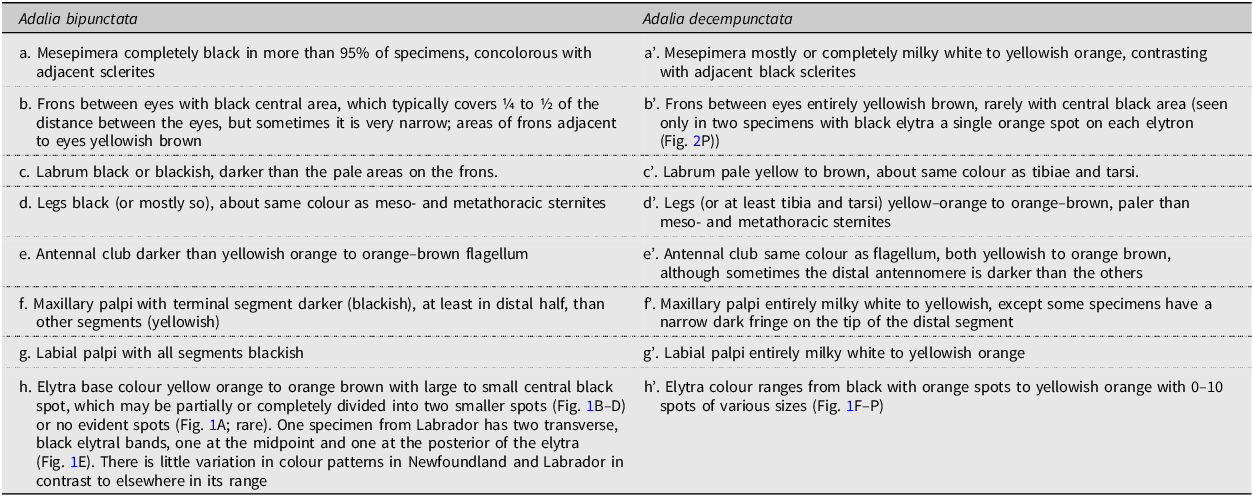
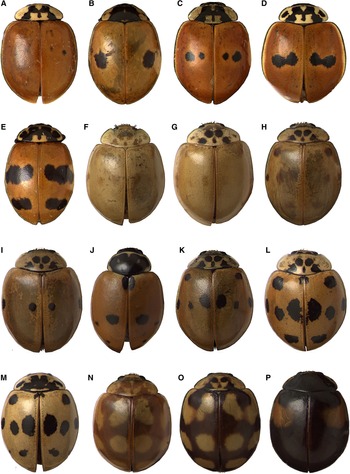
There appears to be no published comprehensive study from the Palaearctic region comparing the morphology of A. decempunctata and A. bipunctata in detail. A morphological examination of specimens of both species from Newfoundland revealed several characteristics that are of use for discriminating among the two species (Table 1). In contrast to elsewhere in its native range, in Newfoundland, A. bipunctata has very low variation in elytral colour patterns. For 50 of 52 specimens studied, the elytron base colour is yellow–orange to orange–brown with a central black spot, which may be partially or completely divided into two smaller spots (Fig. 1B–D). One specimen from Labrador had no evident black spots (Fig. 1A), and one specimen from Labrador had two transverse black bands (Fig. 1E). Any other colour morph of Adalia in Newfoundland and Labrador should be suspected to be A. decempunctata and examined for other character states (Table 1). Eleven colour pattern morphs of A. decempunctata have been documented thus far in Newfoundland (Fig. 1F–P), ranging from orange with faint spots on the elytra and pronotum (Fig. 1F) to black pronotum and elytra with an orange patch in the anterior half of each elytron (Fig. 1N). One variant (Fig. 1I) looks somewhat like an A. bipunctata morph, except that the black elytral spot is smaller and closer to the suture in A. decempunctata than in A. bipunctata.
Summary of morphological characters useful for discriminating among Adalia bipunctata (Linnaeus) and A. decempunctata (Linnaeus) in Newfoundland.

Dorsal habitus photos for colour variants of Adalia bipunctata (Linnaeus) and Adalia decempunctata (Linnaeus) in Newfoundland and Labrador; A–E, A. bipunctata; F–P, A. decempunctata.

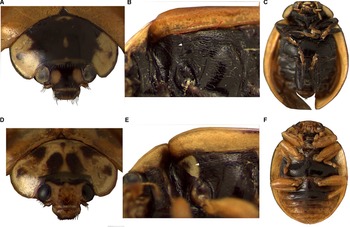
The head and ventral aspect of A. decempunctata is typically much lighter in colour compared to A. bipunctata, as evident with the antennal club, labrum, mouthparts, gular area, propleura, mesepimera, abdominal sternites, and legs (Fig. 2). These structures range from pale yellow to orange–brown in A. decempunctata to black, partially black, or near black in A. bipunctata (Table 1). Diagnostic characters used to discriminate between these two species in European populations are as follows: the colour of the mesepimera (A. decempunctata: pale and contrasting in colour with adjacent sclerites; A. bipunctata: concolorous with adjacent sclerites, black to blackish on almost all specimens observed); anterior margin of mesosternum between coxae (A. decempunctata: slightly emarginate; A. bipunctata: entire); and external border of abdominal plates (A. decempunctata: sinuate; A. bipunctata: not, or scarcely, sinuate; Pope Reference Pope1953; Bienkowski Reference Bienkowski2018). Among these, the only character useful for discriminating between the two species in Newfoundland is the colour of the mesepimera. Bienkowski (Reference Bienkowski2018) observed that A. decempunctata has a transverse fold at the apical declivity that is absent in A. bipunctata; however, this character state of the apical declivity seems to be uncommon in A. decempunctata specimens from Newfoundland. Examination of genitalia revealed no diagnostic characters, which concurs with the findings of Salehi et al. (Reference Salehi, Pashaei, Mehrnejad and Shokri2011).
Photos of morphological structures and character states for two species of Adalia in Newfoundland: A, A. bipunctata labrum, B, mesothorax, and C, ventral habitus; D, A. decempunctata labrum, E, mesothorax, and F, ventral habitus.

If A. decempunctata becomes established on the Canadian mainland, it may spread widely, so it is important to know whether the character states used to discriminate among the two Adalia species in Newfoundland will be useful in other parts of the range of A. bipunctata in North America, especially where there is high variation in elytral colour patterns. Specimens of adult A. bipunctata, including colour morphs other than those found in Newfoundland, were examined from most Canadian provinces, the northeastern United States of America, and from Washington state to California, United States of America. The elytral colour morphs of those specimens range from yellow–orange with no spots to orange–brown with two transverse black bands to black with one reddish-orange spot on each elytron. About 300 specimens of A. bipunctata were examined, mostly in the UASM and NFRC collections, including about 210 specimens of the common ‘one black spot per elytron’ variety typical of Newfoundland populations and 87 of other colour morphs. All but 13 of these specimens had black mesepimera that were concolorous (or nearly so) with adjacent sclerites. Thus, 95.6% of A. bipunctata from this sample can be separated from A. decempunctata by mesepimera colour alone. Of the 13 specimens of A. bipunctata with light mesepimera (seven from Alberta, Canada, five from New Jersey, United States of America, and one from Minnesota, United States of America), 12 were readily distinguishable from A. decempunctata by the presence of a medial black area on the frons (between the eyes). The remaining specimen (Medicine Hat, Alberta) had black legs, dark antennal club, and dark mouthparts, all character states that have not been seen to date in A. decempunctata in North America. Thus, it appears the suite of characters useful for discriminating among these two Adalia species in Newfoundland will also be useful elsewhere in Canada. Care must be taken with teneral specimens because the venter, including mesepimera, may be pale, but in these cases, the pale mesepimera are concolorous with adjacent sclerites.
A key to separate the two Adalia species in North America
-
1. Mesepimera dark, black on most specimens, lighter in teneral specimens, AND concolorous with adjacent sclerites (Fig. 2B)…………………………………………………………… Adalia bipunctata
-
–. Mesepimera milky white to yellowish orange AND contrasting with dark/black adjacent sclerites (Fig. 2E)…………………………………………………….……………………… 2
-
-
2. Frons between eyes with a medial black area that separates the lighter patches adjacent to each eye (Fig. 2A) AND legs are black or piceous, about same colour as thoracic sternites (Fig. 2C) AND labrum is black or blackish (Fig. 2A); mouthparts (Fig. 2C) and entire antennal club are blackish ………………………………………………… Adalia bipunctata
-
–. Frons between eyes pale and lacking medial black area on almost all specimens observed (Fig. 2D); if frons has medial black area, then legs (at least tibiae and tarsi) yellow–orange to brownish, lighter than thoracic sternites (Fig. 2E), AND labrum is not black or partly black, about same colour as tibiae and tarsi (Fig. 2D); mouthparts (Fig. 2F) and antennae mostly pale, terminal antennal segment may be darker than other antennomeres ………………………………………………………………………………… Adalia decempunctata
-
DNA
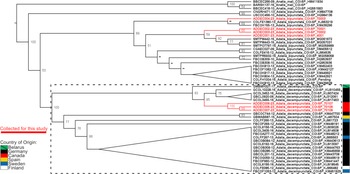
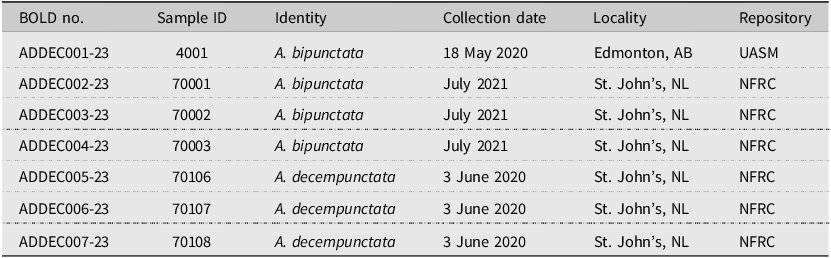
It was not possible to sequence the entire Folmer barcoding area of CO1 for the older specimens of pinned A. decempunctata using existing primers that have worked for Adalia elsewhere, likely indicating that the mitochondrial DNA was somewhat denatured. Interestingly, the 5´ end of the barcode region did amplify well for these specimens, but the 3´ end did not. The three fresh specimens of putative A. decempunctata from Newfoundland amplified well, and DNA sequence from the barcode region confirms the identity as A. decempunctata (Fig. 3; Table 2). In addition, the four fresh specimens of A. bipunctata amplified, and the DNA sequences confirm their identities. These sequences were submitted to the Barcode of Life Datasystems (BOLD) database (https://www.boldsystems.org; Table 2).
Maximum likelihood tree of Adalia spp. using 658-bp mitochondrial DNA from the 5´ barcode region of CO1. Bootstrap values generated by Ultrafast (Hoang et al. Reference Hoang, Chernomor, von Haeseler, Minh and Vinh2018) bootstrapping with 1000 replicates, with values greater than 50 reported and values less than 50 replaced by a hyphen (-). Dashed box contains all A. decempunctata sequences. Coloured branches represent specimens barcoded for this study (Table 1). Coloured bar indicates country of collection for all A. decempunctata specimens. Collapsed nodes represent polytomy due to zero sequence divergence. The tree was generated in IQ-Tree with substitution model determined by ModelFinder (Trifinopoulos et al. Reference Trifinopoulos, Nguyen, von Haeseler and Minh2016; Kalyaanamoorthy et al. Reference Kalyaanamoorthy, Minh, Wong, von Haeseler and Jermiin2017): Transversion model with empirical base frequencies and gamma-distributed rates among sites across four categories (TVM + F + G4). The tree was edited with FigTree, version 1.4.4 (Rambaut Reference Rambaut2007), and Affinity Photo (Serif 2023).

Barcode of Life Datasystems (BOLD) accession numbers, sample identification numbers (sample ID), and collection data for specimens of Adalia bipunctata (Linnaeus) and Adalia decempunctata (Linnaeus) DNA barcoded for this study. AB, Alberta; NL, Newfoundland and Labrador.

UASM, University of Alberta Strickland Entomological Museum, Edmonton; NFRC, Northern Forestry Centre Insect Collection, Edmonton.
Distribution and spread
All collection localities for A. decempunctata in Newfoundland are on the northern third of the Avalon Peninsula, ranging from St. John’s (the site of the earliest record, 1995) along the shore of Conception Bay to as far north as Carbonear. During a survey of Coccinellidae of Newfoundland in 2022 and 2023, no specimens were found at eight sampling sites further south on the Avalon Peninsula or elsewhere in Newfoundland (approximately 70 localities).
Collection localities
Some records are based on photos posted online on three web sites:
-
(1) IoN – Insects of Newfoundland Facebook group (https://www.facebook.com/groups/717236451733098/)
-
(2) iNat – iNaturalist (https://inaturalist.ca/observations?place_id=67128&subview=table&taxon_id=130414)
-
(3) BG – Bugguide (https://bugguide.net/node/view/1825243/bgpage)
NEWFOUNDLAND: Bay Roberts (124 Conception Bay Highway), 47.58° N, 53.28° W, 4 September 2022, sweep of trailside plants, B. Hicks [2, BHC]; Bell Island, 31 December 2020, S. Boone [1, IoN photo]; Ibid., 10 January 2021; Ibid., 10 October 2022; Carbonear (8 Bond St.), 47.74° N, 53.22° W, 12 August 2021, B. Hicks [1, BHC]; Ibid., 15 August 2021, B. Hicks [1, NLC; MUN Accession No. 08-4516]; Carbonear (10 Chapel Place), 47.740° N, 53.238° W, 8 April 2021 [1, BHC]; Conception Bay South, 17 July 2019 [1, iNat photo]; Ibid., 21 July 2020, K. Earle [1, IoN photo]; Ibid. 13 February 2021, N. Kelley [1, IoN photo]; Conception Bay South, Manual’s River, September 2002 [2, NLC; MUN Accession Nos 08-4473 and 08-4474]; Harbour Grace, 47.69° N, 53.21° W, 4 September 2022, B. Hicks [1, BHC]; Logy Bay, 2 July 2020, M. Erbland [1, IoN photo]; Ibid., 30 July 2020; Logy Bay, 31 July 2020 [1, iNat photo]; Mount Peart, 26 July 2020, A. Garrison [1, IoN photo]; Mount Pearl (16 Mundon Dr.), 7 July 2021, R. Parks [1, BHC]; Paradise, 7 February 2021, L.A. Payne [1, IoN photo]; Paradise (18 Hudsonberry Lane), 7 February 2021, B. Hicks [1, BHC]; South River (Love Lane), 47.540° N, 53.271° W, 4 September 2022, sweep of roadside plants, B. Hicks [2, BHC]; Spaniard’s Bay (89 Seymour’s Rd.), 47.629° N, 53.625° W, 5 September 2021, B. Hicks [1, BHC]; St. John’s, 47.5658° N, 52.7253° W, 12 September 1995 [1, NFRC]; St. John’s, 16 August 2019 [1, iNat photo]; Ibid., August, 2019; Ibid., 31 July 2020; Ibid., 3 August 2020; Ibid., 7 November 2020; Ibid., 5 October 2022; Ibid., 23 July 2023; Ibid., 13 August 2023; St. John’s (11 Parson’s Place), 20 June 2020, B. Hicks [1, BHC]; St. John’s (116 Quidi Vidi Rd.), 8 August 2020, D. Foley [1, BHC]; St. John’s (20 Vinnicombe St.), 3 June 2020, J. Clarke [5, BHC; 1, CNC; 1, NFRC; 1, NLC – MUN Accession No. 08-4503; 4, iNat photos; 3, BG photos]; St. John’s (3 Ross Rd.), 6 June 2021, B. Hicks [1, BHC]; St. John’s, Botanic Garden, 23 August–4 September 1999, D. Larson [1, NLC; MUN Accession No. 08-4506]; St. John’s, Bowering Park, 17 June 2018, T.L. Rimmer [1, IoN photo]; Ibid. site 2, 47.5278° N, 52.7480° W, 16 August 2022, sweep of park vegetation, D. Langor [1, NFRC; 2 UASM]; Ibid., site 1, 46.5273° N, 52.7517° W, 2 August 2022 [5, NLC; 1, CNC]; Ibid., 19 October 2019 [1, iNat photo]; St. John’s (downtown), 31 May 2021, S. Gallant [1, IoN photo]; St. John’s, Kilbride (26 Lannon St.), 3 August 2022, B. Hicks [1, BHC]; St. John’s, Long Pond, 14 October 1997 [1, NFRC]; Ibid., September 2000 [1, NFRC]; St. John’s (MacDonald Drive), 12 June 2020, K. Oliver [2, IoN photo]; St. John’s (MUN), 31 July 2020, R. Maddigan [1, IoN photo]; St. John’s (Topsail Rd.), November 2001 [1, NLC; MUN Accession No. 08-4507); St. John’s (Wadland Cres.), 28 July 2022, C. Baggs [1, IoN photo]; Torbay, 22 November 2020, D. Peyton [1, IoN photo]; Torbay, 23 September 2022 [1, iNat photo].
Acknowledgements
The authors thank Felix Sperling, University of Alberta, for the use of his laboratory for DNA work. This article was improved by the careful review of two anonymous reviewers. This work was funded by Natural Resources Canada (Canadian Forest Service), the Newfoundland and Labrador Department of Forestry and Wildlife, and a Natural Sciences and Engineering Research Council Discovery grant (RGPIN-2018-04920; PI – Felix Sperling).