Introduction
It is well established that women have higher rates of depression than men, especially during the childbearing years (O'Hara & Swain, Reference O'Hara and Swain1996; Almeida & Kessler, Reference Almeida and Kessler1998; Evans et al. Reference Evans, Heron, Francomb, Oke and Golding2001; Kessler, Reference Kessler, Keyes and Goodman2006). Prevalence of maternal depression can range between 6.5 and 12.9% for major and minor depression at various times during the first year postpartum (Gaynes et al. Reference Gaynes, Gavin, Meltzer-Brody, Lohr, Swinson, Gartlehner, Brody and Miller2005). Moreover, research demonstrates that nearly half of mothers who have depression in the early postpartum period will continue to experience depression at 1-year postpartum, and that half of that group of mothers will still be experiencing depression when the child is in kindergarten (Horwitz et al. Reference Horwitz, Briggs-Gowan, Storfer-Isser and Carter2009). Studies also indicate higher rates of postpartum depression among women who are immigrants, refugees or asylum seekers compared with non-immigrant women (Ahmed et al. Reference Ahmed, Stewart, Teng, Wahoush and Gagnon2008; Falah-Hassani et al. Reference Falah-Hassani, Shiri, Vigod and Dennis2015).
Impact of maternal depression on child outcomes
The National Institute of Clinical Excellence (NICE, 2014) guidelines highlight the impact of postpartum depression on child outcomes. For example, the parenting of depressed mothers is more likely to be emotionally distant, inconsistent and punitive (Lovejoy et al. Reference Lovejoy, Graczyk, O'Hare and Neuman2000; Hammen, Reference Hammen, Goodman and Gotlib2002; Chung et al. Reference Chung, McCollum, Elo, Lee and Culhane2004). Therefore, children of depressed mothers are less likely to be securely attached, and more likely to show patterns of avoidant and disorganised attachment (Van IJzendoorn et al. Reference Van IJzendoorn, Goldberg, Kroonenberg and Frenkel1992; Martins & Gaffan, Reference Martins and Gaffan2000), which in turn can be risk factors for higher levels of externalising behaviour problems (Renken et al. Reference Renken, Egeland, Marvinney, Mangelsdorf and Sroufe1989; Lyons-Ruth et al. Reference Lyons-Ruth, Alpern and Repacholi1993; Moss et al. Reference Moss, Cyr and Dubois-Comtois2004; Fearon et al. Reference Fearon, Bakermans-Kranenburg, Van IJzendoorn, Lapsley and Roisman2010).
Impact of co-occurring parental depression on child outcomes
The impact on child health in the immediate and longer term is especially marked in households where both parents are depressed. For example, Joutsenniemi et al. (Reference Joutsenniemi, Moustgaard and Martikainen2013) found a twofold increased risk of mental health problems in offspring who were raised in households where both parents were taking antidepressants. Children of depressed parents are also at increased risk of substance use and anxiety disorder (Lieb et al. Reference Lieb, Isensee, Höfler, Pfister and Wittchen2002; Nomura et al. Reference Nomura, Warner and Wickramaratne2001).
Depression in the later postpartum period
The majority of studies have examined depression in the early postpartum period (e.g. 1 week to 6 months postpartum), often among small, non-representative samples, but there are a number of reasons why it is important to have a better understanding of depression in the later postpartum period. For example, recent research has demonstrated that whilst the rates of depression were highest in the first month postpartum and diminished at 2, 4 and 6 months, the prevalence at 9 months was double that shown at 6 months, and very similar to the prevalence at 0–1 month (i.e. 10.2% at 9 months; 12.5% at 0–1 month) (Gjerdingen et al. Reference Gjerdingen, Crow, McGovern, Miner and Center2011). Moreover, from 9 months onwards is a peak period for infant language acquisition and more active and intentional social interaction between infant and caregivers, all of which are vital for the development of cognitive skills and healthy socio-emotional behaviour (e.g. Trevarthen & Hubley, Reference Trevarthen, Hubley and Lock1978; Harris et al. Reference Harris, Jones and Grant1983; Harris et al. Reference Harris, Barlow-Brown and Chasin1995a, Reference Harris, Yeeles, Chasin and Oakleyb; Carpenter et al. Reference Carpenter, Nagell, Tomasello, Butterworth and Moore1998).
Healthcare access and unmet need in depressed mothers
Research indicates that mothers experiencing postpartum depression may be reluctant to seek professional help. Reasons for this include fears that they will be considered unfit mothers (Turner et al. Reference Turner, Sharp, Folkes and Chew-Graham2008); reluctance to disclose depression when their children accompany them to general practitioner (GP) appointments (Zink et al. Reference Zink, Levin, Wollan and Putnam2006); and an unwillingness to take antidepressants, with fears that this is the only type of treatment that will be offered to them (Dennis & Chung-Lee, Reference Dennis and Chung-Lee2006). Women from non-white ethnic groups may be particularly vulnerable: Ahmed et al. (Reference Ahmed, Stewart, Teng, Wahoush and Gagnon2008) found that immigrant, refugee, and asylum-seeking mothers with depression identified factors such as insufficient knowledge of what services were available, stigma and embarrassment associated with depression and help-seeking, language problems or judgement from healthcare staff as being obstacles to seeking help. Financial constraints may also influence access to healthcare systems. For example, GP care in the Republic of Ireland is free at point of contact to only a minority of the population who are deemed eligible on account of low incomes, and previous studies have established reduced GP contact among those who have to pay for GP care (O'Reilly et al. Reference O'Reilly, O'Dowd, Galway, Murphy, O'Neill, Shryane, Steele, Bury, Gilliland and Kelly2007; Layte & Nolan, Reference Layte and Nolan2015).
The aims of the present study were threefold: (i) to examine the prevalence of, and factors associated with depressive symptomatology among a large, nationally representative sample of mothers of 9-month-old infants in the Republic of Ireland, including the prevalence of co-occurring depressive symptoms within couples; (ii) to examine the extent of unmet need in treatment of depression in mothers; and (iii) to examine factors associated with healthcare access in mothers who exhibit depressive symptomatology.
Methods
Respondents
Respondents were 11 089 mothers of 9-month-old infants recruited to wave 1 of the Growing Up in Ireland (GUI) study, a nationally representative prospective cohort study commissioned by the Irish Government to examine factors associated with the health and well-being of children living in the Republic of Ireland (see http://www.growingup.ie/index.php?id=9 and Thornton et al. Reference Thornton, Williams, McCrory, Murray and Quail2013 for detailed information about the GUI study and study design). The sample response rate was 64.5% of all families who were approached to take part in the study (see Supplementary Files 1 and 2 for details of sampling and derivation of analytic sample). Responses from 9735 partners of mothers were also included in the present study, specifically in order to establish the number of depressed couples in the sample, and to examine associations between partners' and mothers' depression. Individual data for each respondent were collected during a single computer-assisted personal interview. Ethical approval was granted by an independent Research Ethics Committee that was organised by the Department of Health and Children (Dublin, Republic of Ireland).
Outcome variable
The primary outcome variable was the eight-item Center for Epidemiologic Studies Depression Scale (CESD; Melchior et al. Reference Melchior, Huba, Brown and Reback1993), which was designed to screen for depressive symptomatology among a population during the 7 days preceding assessment. In the present study, the CESD demonstrated satisfactory internal reliability among mothers (α = 0.87) and their partners (α = 0.81). Scores on the eight-item CESD can range from 0 to 24, with higher scores indicative of a higher incidence of both the presence and duration of symptoms. Melchior et al. (Reference Melchior, Huba, Brown and Reback1993) recommend a ‘caseness’ threshold score of ≥7 on the total scale score in order to classify respondents as depressed.
Explanatory variables
Mothers provided demographic information about themselves, including age (16–24, 25–29 [ref], 30–34, 35–49), ethnicity (white [ref], non-white), educational level (higher education [ref], secondary education), employment status at time of interview (working [ref], not working) and region where they were living at time of interview (rural [ref], urban).
The models were also adjusted for mother's self-reported previous mental health problems (ever treated for clinical depression, anxiety, or ‘nerves’; not treated [ref], treated), whether the pregnancy of the cohort child had been an intended pregnancy (no [ref], yes, missing) (self-report), and the parity of the pregnancy with the cohort child (later born [ref], first born) (self-report).
Mothers provided information on their infant's characteristics, including gestational age (preterm [25–36 weeks], not preterm [37+ weeks; ref]), and general health, including developmental issues (healthy [ref], unhealthy).
Information on household characteristics was also collected from mothers, and included: whether there was a partner living in the household at time of interview (yes [ref], no); equivalised household income (0 [highest, ref] through 4 [lowest], missing); housing tenure (owner [ref], tenant); and whether the mother had any family living in the area at time of interview (yes [ref], no). The mental health status of the mother's partner (not depressed [ref], depressed) was assessed using the eight-item CESD, and was scored in the same way as for the mothers. This variable was included in the regression model as an explanatory variable of mothers' depression.
Data analysis plan
Weighted frequency analyses were conducted for the percentage of mothers who were classified as depressed (i.e. CESD score ≥7), and were cross-tabulated with all explanatory variables included in the regression analyses.
Univariate and fully adjusted multivariate binary logistic regression models were conducted, with mothers' CESD caseness status as outcome variable. Explanatory variables were entered in three blocks (1. Mother characteristics; 2. Infant characteristics; 3. Household characteristics), with the third block representing the fully adjusted multivariate model.
A further series of univariate and fully adjusted multivariate binary logistic regression models were conducted with the sample of mothers who had a CESD score of ≥7. The outcome variable was whether or not the mother had seen a medical professional for depression/anxiety/nerves since the birth of the baby (yes [0]/no [1]). The explanatory variables for these analyses were the same as those included in the analysis examining odds of scoring ≥7 on the CESD, but with the addition of the mothers' healthcare access (GP cover [ref], hospital only cover, no healthcare cover), and the exclusion of ‘pregnancy intention’ (a priori, there was no reason to hypothesise that this variable would be associated with unmet need) and ‘previous mental health problems’ (as this represented an over-adjustment owing to the association between previous and current mental health problems). Variables were entered in three blocks (1. Mother characteristics; 2. Infant characteristics; 3. Household characteristics), with the third block representing the fully adjusted multivariate model.
Results
Descriptive statistics and factors associated with depression
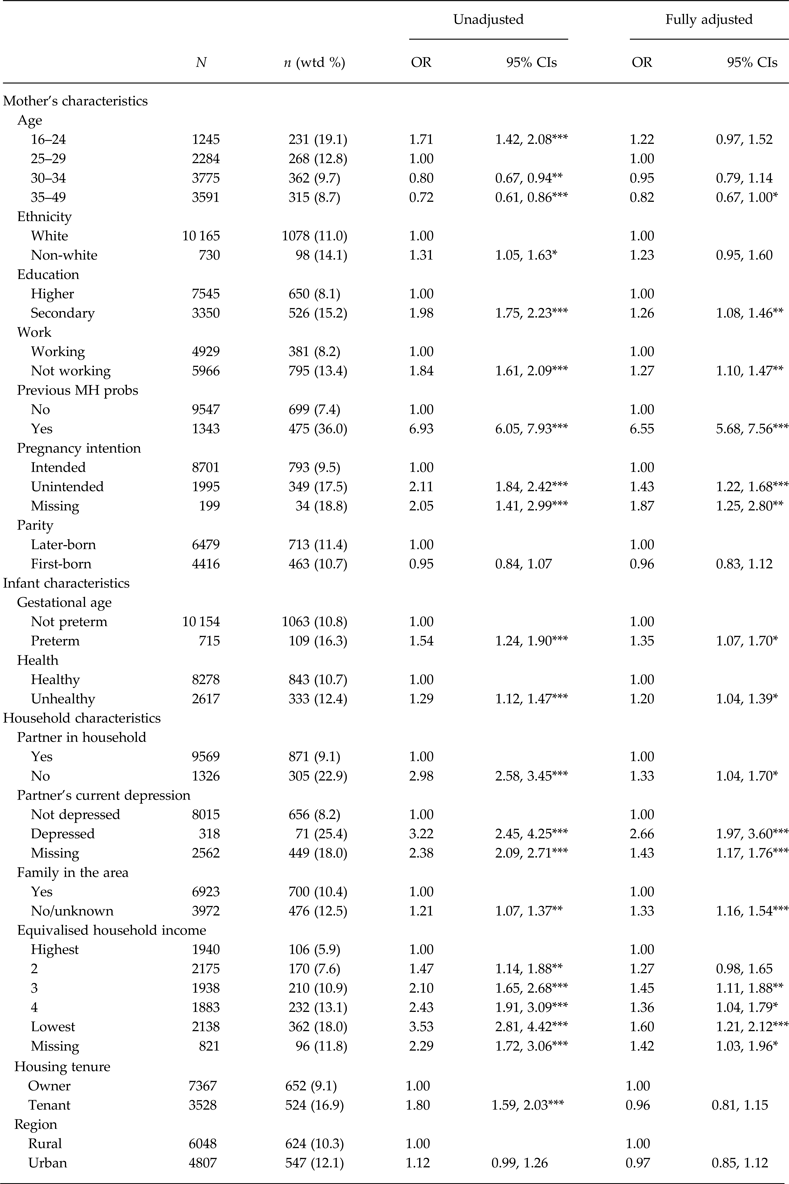
From a total sample of 11 089 mothers, 10 895 had valid data on the CESD and 1176 (11.1%) of these scored ≥7 on the CESD. There were large proportions of missing data for pregnancy intention, partner's current depression and equivalised household income, therefore ‘missing’ categories were retained for these variables. Missing data for previous treatment for mental health, gestational age and region were excluded as inclusion of ‘missing’ categories for these variables would have violated statistical disclosure control stipulations (i.e. no cell counts <30 to be reported), thus leaving a sample of N = 10 827 for regression models. The sample characteristics and results of logistic regression models are presented in Table 1.
Results of unadjusted and fully adjusted logistic regressions examining odds of scoring ≥7 on the CESD in mothers of 9-month-old infants in Ireland

*p < 0.05; **p < 0.01; ***p ≤ 0.001.
About two-thirds of the mothers were aged 30 or over, with one-third aged 35 or older. Depression prevalence was highest in younger mothers, and reduced linearly with age. However, in absolute terms most depressed mothers were aged over 30 owing to larger numbers of mothers in this age group. Younger mothers (16–24 years) comprised 11.4% of the cohort but had a higher prevalence of depression (19.1%) and also a higher prevalence of social and socio-demographic difficulties: almost half (47%) did not have a partner, two-thirds had only secondary-level education (compared with 31% overall), and 80% lived in rented accommodation, compared with 33% overall. Non-white mothers contributed 6.7% of the cohort and as expected, given the known distribution and characteristics of migrant populations, 70% were living in urban areas (compared with 42% for white mothers), 77% lived in rented accommodation (compared with 30% for white mothers) and 80% of non-white mothers had no family living in the area. The slightly higher prevalence of depression amongst non-white mothers (14 v. 11%) seems to be largely due to socioeconomic factors as their likelihood of depression was not significantly different from zero after adjustment for housing tenure and household income (odds ratio (OR) 1.02; 95% confidence intervals (CIs) 0.81, 1.28: models available on request). However, in the models adjusted for previous mental health problems their risk appears higher (Table 1: OR 1.23; 95% CIs 0.95, 1.60).
Overall, 12% of mothers reported a previous diagnosis of mental health problems and there was a strong relationship between previous and current mental health problems, with 36% of those with a previous diagnosis scoring above the threshold on the current CESD (compared with 7.4% for the rest). The approximately sevenfold increased risk associated with previous mental health problems remained after adjustment for all other factors. About 80% of mothers confirmed their pregnancy with the cohort child as intentional and in 40% of cases this was their first child. Unintended pregnancy was associated with twice the prevalence of depression (18% compared with 10%) and a higher risk of depression in the fully adjusted model (OR 1.43, 95% CIs 1.22, 1.68).
Less than 7% of pregnancies were preterm, and 23% of infants had at least one of ten possible health problems (e.g. asthma, eczema and developmental delay). In the unadjusted models, preterm delivery and health issues (which included developmental problems) with the infant were associated with increased prevalence of maternal depression.
Most mothers (64%) had family living in the area, but those without had an elevated risk of depression (OR 1.33; 95% CIs 1.16, 1.54). Over 12% of mothers were not living with a partner and 23% of these mothers were depressed. However, there was a strong relationship between partnership and disadvantage, therefore the risk of depression for mothers with no partner in the fully adjusted model was only modestly raised at 1.33 (95% CIs 1.04, 1.70). However, the mental health of the partner was also important. Of the 9735 fathers, 8333 (85.6%) had valid data on the CESD and 318 (3.8%) of these scored ≥7. Mothers with a depressed partner had a 2/3-fold increased likelihood of being depressed. While the number of depressed dyads was small (n = 71), this equated to 10.0% of depressed mothers and 25.4% of depressed fathers who were living with a depressed partner.
There was a strong relationship between material disadvantage, as assessed by housing tenure and equivalised household income, and the prevalence of depression: tenants were almost twice as likely to be depressed as owner occupiers (OR 1.80; 95% CIs 1.59, 2.03); and those in the lowest income quintile were over three times as likely to be depressed as their more affluent peers (OR 3.53; 95% CIs 2.81, 4.42). The likelihood of depression was also higher for mothers who had only secondary-level education or who were unemployed. There was no significant difference in the prevalence or likelihood of depression between urban and rural areas.
Factors associated with not seeking treatment for depression
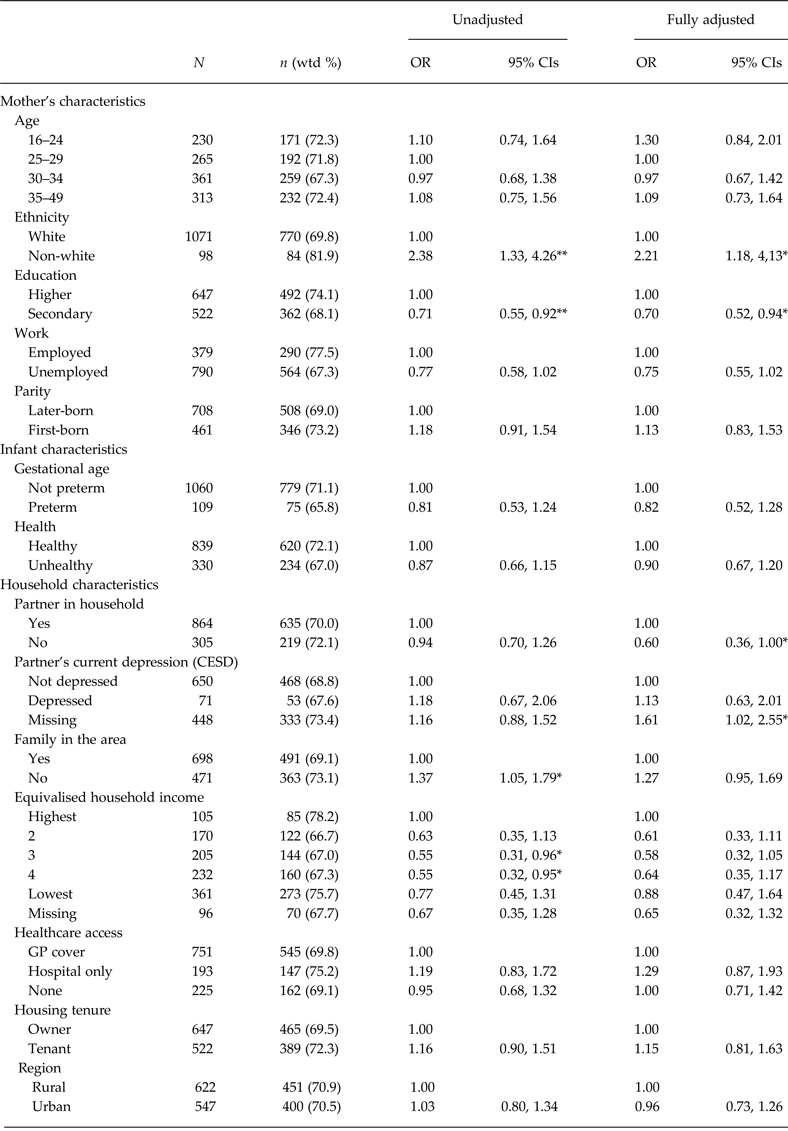
A total of 1176 mothers scored ≥7 on the CESD, thus meeting the threshold of caseness for depressive symptomatology, and of these 1174 had valid data on whether or not they had been treated for mental health problems since the birth of the baby. Table 2 shows the characteristics of this sub-group of mothers, and results of analyses examining the likelihood of not attending a health professional for a postpartum mental health problem. These data are based on 1169 cases with full data for all the variables included. The numbers are smaller than in the previous analysis and the confidence intervals are correspondingly wider.
Results of unadjusted and fully adjusted logistic regressions examining likelihood of not attending a health professional for mental health problems since the birth of the cohort child in mothers who scored ≥7 on the CESD at 9 months postpartum

*p ≤ 0.05; **p < 0.01.
Overall, 854 (73%) of these mothers had not attended a health professional for mental health problems since the birth of the cohort child. Although the number of non-white mothers with depression was small it is evident that very few (18.1%) were receiving treatment, and in fully adjusted models they were more than twice as likely not to be under treatment (OR 2.21; 95% CIs 1.18, 4.13). There is also some evidence that single mothers, mothers with lower educational levels, and those who were unemployed were more likely to be under medical management for their depression. There is little evidence that access to health insurance or levels of income were a significant deterrent to accessing appropriate healthcare.
Discussion
Results indicated that 11% of mothers and 3.8% of fathers scored above the established CESD threshold for depression. The point prevalence for mothers was at the upper end of the range cited in a systematic review of 28 international studies (in developed countries) between 1980 and 2004 (Gavin et al. Reference Gavin, Gaynes, Lohr, Meltzer-Brody, Gartlehner and Swinson2005) and comparable with the 9-month rates reported by Gjerdingen et al. (Reference Gjerdingen, Crow, McGovern, Miner and Center2011), but higher than rates shown in studies among women in the later postpartum period in the Gavin et al. (Reference Gavin, Gaynes, Lohr, Meltzer-Brody, Gartlehner and Swinson2005) review, possibly on account of their exclusion of any studies that relied on self-reported depression. Depression among ethnic minority mothers was higher (14.1 v. 11.0% for white mothers – see Table 1), but within the range of those identified in a recent systematic review and meta-analysis of postpartum depression in immigrant mothers (Falah-Hassani et al. Reference Falah-Hassani, Shiri, Vigod and Dennis2015). Father/partner depression prevalence was substantially less than Paulson & Bazemore's (Reference Paulson and Bazemore2010) 10.4% meta-estimate; however, they highlighted considerable heterogeneity in paternal depression rates, and an apparent peak period in paternal depression rates from 3 to 6 months postpartum.
We have also shown evidence of co-occurring parental depression: though the overall number of depressed dyads was small (<1% of the overall sample with valid CESD data), perhaps as a result of the relatively low prevalence of paternal depression, the proportions were notable, with 10% of depressed mothers and 25.4% of depressed fathers having depressed partners. Given the risk of the intergenerational transmission of mental health problems in children being raised by two depressed parents (see Nomura et al. Reference Nomura, Warner and Wickramaratne2001; Lieb et al. Reference Lieb, Isensee, Höfler, Pfister and Wittchen2002; Joutsenniemi et al. Reference Joutsenniemi, Moustgaard and Martikainen2013), there is an imperative to identify at-risk families and intervene at an early stage. Greater exploration of the associations between paternal depression and the mental health and well-being of both mother and child were beyond the scope of the present study but merit further investigation.
Results of the initial regression analyses highlighted that mothers with lower levels of education, who were unemployed, and who had lower household incomes were all at higher risk of depression, which is consistent with previous research (e.g. O'Hara & Swain, Reference O'Hara and Swain1996; Beck, Reference Beck2001). The association between depression and compromised social support (i.e. no partner in the household or a depressed partner, no family living in the area) is also consistent with previous research (e.g. O'Hara & Swain, Reference O'Hara and Swain1996; Brugha et al. Reference Brugha, Sharp, Cooper, Weisender, Britto, Shinkwin, Sherrif and Kirwan1998). The data did not allow us to examine to what extent (or how) family living in the area enhances the mother's mental health; however, recent research suggests that poor health behaviours relating to being a parent of a young child (e.g. lack of sleep and exercise; poor diet) may mediate the association between lack of support and psychological well-being in the postpartum period (e.g. Beck et al. Reference Beck, Gable, Sakala and Declercq2011).
Of particular concern was the fact that over 73% of mothers who scored above the CESD caseness threshold reported that they had not received any treatment for depression since the birth of the cohort child. Although this represents a substantial proportion of unmet need within this sample, the prevalence is on a par with similar studies. For example, Huang et al. (Reference Huang, Wong, Ronzio and Yu2007) found that 74% of depressed mothers (9 months postpartum) had not consulted a healthcare professional for depression during the previous year. Similarly, Flynn et al. (Reference Flynn, Davis, Marcus, Cunningham and Blow2004) found that 78% of mothers of young children had untreated depression. Regressions examining determinants of healthcare access among depressed mothers indicated that the characteristics associated with increased likelihood of depression (i.e. lower educational and income levels; unemployment) were paradoxically associated with an increased likelihood of accessing healthcare. A possible explanation is the inherent vulnerability of these mothers, meaning they have more contact with healthcare professionals and therefore are more likely to receive diagnosis and treatment. There was no indication that mothers in depressed dyads were less likely to access healthcare for their depression which suggests an increased awareness of mental health and the need for treatment among depressed dyads, and that either they are already in contact with healthcare professionals for their mental health issues, or that the depressed partner of a depressed mother will recognise and be aware of her vulnerability and encourage her to seek help.
Depressed ethnic minority women in our study had a more than twofold likelihood of not seeking medical help compared with their depressed white counterparts. Such findings highlight the need for awareness among those providing maternity care to ensure that mothers from ethnic minority groups are supported and are given the means to access the appropriate healthcare. Healthcare professionals also need to be aware that ethnic minority mothers may not have the same levels of social support as they would experience in their own countries, therefore pregnancy, childbirth and child-rearing in their new host country may represent a particular challenge (Teng et al. Reference Teng, Robertson Blackmore and Stewart2007). Conversely, those ethnic minority mothers who have family living nearby may be reluctant to access healthcare because of cultural differences in the perception of depression and help-seeking outside of the immediate family (Templeton et al. Reference Templeton, Velleman, Persaud and Milner2003).
Qualitative research indicates many reasons why mothers (including those from minority ethnic groups) either cannot or do not seek help for postpartum depression (see Dennis & Chung-Lee, Reference Dennis and Chung-Lee2006; Zink et al. Reference Zink, Levin, Wollan and Putnam2006; Ahmed et al. Reference Ahmed, Stewart, Teng, Wahoush and Gagnon2008; Turner et al. Reference Turner, Sharp, Folkes and Chew-Graham2008). However, the design of the present study did not allow us to expand upon these findings. Interestingly, Huang et al. (Reference Huang, Wong, Ronzio and Yu2007) found that nearly 60% of their sample of depressed postpartum mothers reported that they did not believe that they needed to seek help, which suggests a necessity to promote awareness of the symptoms of postpartum depression, and the importance of maintaining good psychological health.
Strengths and weaknesses
The present study has a number of strengths including: the size and representativeness of the sample; a rich data source which allowed us to examine the co-occurrence of depression among couples and unmet need in mothers with depression, and to include a large number of covariates in our analyses; adjustment for previous treatment for psychological problems; and the inclusion of partner's depression. However, the cross-sectional design did not allow us to determine direction of associations between mother and partner depression, and while most of the covariates were current at the time of interview (e.g. current age, employment, income and family in the area), there were other covariates that were more distal to the outcome variable (e.g. educational level, pregnancy intention, child health and development).
There have been suggestions (e.g. Matthay, Reference Matthay2010) that prevalence rates of depression in the perinatal period have been overestimated, especially when assessed using self-report instruments such as the CESD, and that repeat testing plus diagnostic interviews would provide a more realistic estimate of persistent depressive symptoms as opposed to transient depressive episodes. We acknowledge that we were unable to establish the severity of depression in the present study owing to the absence of a clinical diagnosis of depression in either mothers or fathers. Nonetheless, the CESD provides an estimate of the individual's mental state over the previous week, and as such presents a meaningful approximation of those parents who are experiencing some degree of psychological difficulty. Furthermore, (NICE, 2014) stress the importance of considering sub-threshold levels of postpartum depression, especially if prolonged.
Additionally, our findings in relation to unmet need may not extrapolate to populations of postpartum women who have no restrictions on healthcare access. Although the second regression model (i.e. Table 2) was adjusted for a range of socioeconomic factors and the respondent's level of healthcare access, this may not be sufficient to ensure the generalisability of our findings to other populations.
Implications
A recent systematic review (Gaynes et al. Reference Gaynes, Gavin, Meltzer-Brody, Lohr, Swinson, Gartlehner, Brody and Miller2005) found that point prevalence rates for postpartum depression in the studies included were not significantly different to those in the general population of non-childbearing women and therefore may be not be considered any more a public health problem than depression in the general population. However, what makes this a public health concern is the fact that maternal depression is detrimental to the child's emotional, psychological and physical development, especially in the first year, and when there are recurrent depressive episodes during the early years. Mothers have more opportunity than fathers/partners to engage with healthcare professionals, especially in the first year postpartum, and as such there are greater possibilities for screening and where necessary, referrals for diagnosis and treatment. In cases where a mother is identified as experiencing depression, fathers/partners (where appropriate/applicable) should be routinely screened. Even if partners of depressed mothers are not themselves depressed, this provides an opportunity for healthcare professionals to advise on how to provide appropriate support to their partner. A recent qualitative study in the Republic of Ireland (Higgins et al. Reference Higgins, Tuohy, Murphy and Begley2016) has recommended investment into additional specialist perinatal mental health services, with increased training and education for healthcare professionals working within maternity services, and enhanced connection between maternity units and mental health services. It is hoped that such specialist services will consider the family as a unit and incorporate support for partners where necessary.
Supplementary material
The supplementary material for this article can be found at https://doi.org/10.1017/S2045796017000026.
Acknowledgements
We acknowledge the Central Statistics Office (Ireland), the Department of Health and Children (Ireland), and the Economic and Social Research Institute (ESRI) (Ireland) for facilitating data access.
Financial Support
This study forms part of a larger project funded by the Health Research Board, Ireland (grant reference number HRA_PHS/2010/26). The GUI data are funded by the Government of Ireland through the Office of the Minister for Children and Youth Affairs, and have been collected under the Statistics Act, 1993, of the Central Statistics Office. The GUI project has been designed and implemented by the joint ESRI-TCD GUI Study Team.
Conflict of Interest
None.
Ethical Standards
The authors assert that all procedures contributing to this work comply with the ethical standards of the relevant national and institutional committees on human experimentation and with the Helsinki Declaration of 1975, as revised in 2008.
Availability of Data and Materials
The current study involved secondary data analysis of Wave 1 GUI infant cohort study data, and used data from the Anonymised Microdata File (AMF) and the Researcher Microdata File (RMF). Information about accessing GUI study data is available at: http://www.growingup.ie/index.php?id=223