Introduction
Acute pain is a common chief complaint among patients who present to emergency departments (EDs); an estimated 50% to 80% of children include pain as a part of their presenting concern.Reference Todd, Ducharme and Choiniere 1 - Reference Tanabe and Buschmann 3 While short-term sequelae of acute pain include behavioral changes, tachycardia, hypertension, and increased intracranial pressure,Reference Williamson and Williamson 4 - Reference Hennes and Kim 6 permanent effects may include altered immune function and neurophysiology, as well as changes in health care behavior that potentially pose substantial economic burden.Reference Buscemi, Vandermeer and Curtis 7
There are many safe and effective options for pediatric analgesia in the field, ranging from cognitive–behavioral therapies, such as distraction, to medications, such as inhaled nitrous oxide and opioids.Reference Hennes and Kim 6 In addition to reducing physiological and psychological stress, facilitating extrication from wreckage, and assisting therapeutic maneuvers,Reference Albrecht, Taffe, Yersin, Schoetker, Decosterd and Hugli 8 efficient analgesia is a top indicator of family satisfaction in EDs.Reference Pagnamenta and Benger 9 In fact, the Joint Commission states that “each and every patient has a right to the assessment and management of pain.”Reference Fein, Zempsky and Cravero 10 For many patients experiencing acute pain, initial contact with the health care system is with an Emergency Medical Services (EMS) provider. This moment is a unique opportunity for the introduction of timely and adequate analgesia. Studies have demonstrated, however, that EMS providers underuse analgesic agents,Reference Williams, Rindal, Cushman and Shah 11 and despite evidence that a child's experience of pain is comparable to that of an adult,Reference Rogovik and Goldman 12 children's pain remains disproportionately under-treated.Reference Fein, Zempsky and Cravero 10
The American Academy of Pediatrics (Elk Grove Village, Illinois USA) recommends eliminating barriers to the administration of emergency analgesia to children and taking every opportunity to use available methods of pain management.Reference Rogovik and Goldman 12 Encouragingly, improvements in the recognition and treatment of children's pain have led to greater support for analgesia and sedation within the EMS system as a whole.Reference Fein, Zempsky and Cravero 10 Still, a paucity of research remains in pediatric prehospital pain management, particularly in Canada. This is the first study to elucidate barriers to EMS analgesia administration for children in Canada. The objectives for this study were to evaluate techniques and methods for evaluating pain in adults, adolescents, and children; to describe medication choices for common clinical scenarios; and to identify barriers to optimal pediatric pain management.
Methods
Study Population and Setting
This study included both Primary Care Paramedics (PCPs) and Advanced Care Paramedics (ACPs), while nonclinical staff and EMS administrators were excluded. The scope of practice for PCPs in the Edmonton area includes trauma immobilization, external defibrillation, 4-lead electrocardiogram interpretation, and administration of basic medications (such as oxygen, dextrose, intravenous fluids, and nitrous oxide). 13 At the time of study, a PCP was able to administer inhaled nitrous oxide, only, for pain management. An ACP's expanded scope of practice in Edmonton includes the PCP span, plus advanced airway management, 12-lead electrocardiogram interpretation, and provision of more advanced pharmacological pain relief, including intravenous opioids. 13 At the time of study, an ACP was able to administer inhaled nitrous oxide, intravenous fentanyl, intravenous/subcutaneous/ intra-muscular morphine, and intravenous ketorolac (for headache only) for pain management. While acetaminophen was available, its use was limited to fever. In 2008, the Edmonton EMS catchment region was comprised of metropolitan Edmonton, with a population of approximately 950,000. 14 , 15 It received over 68,000 requests for medical assistance and transport during that time.Reference Hickey 16
Study Design
This study was a descriptive, cross-sectional survey of all EMS providers in the city of Edmonton. Two hundred and two personnel were practicing in Edmonton EMS during the study period and were approached for participation during one of four mandatory educational seminars from September through December 2008.
Study Tool
A novel paper-based survey was developed using knowledge derived from currently existing literature and expert opinion. The survey took approximately 20 minutes to complete and was piloted amongst a sample (n = 5) of Edmonton EMS providers prior to its implementation, in order to ensure readability, face and content validity, and clinical sensibility.
The survey consisted of a series of multiple-choice and short-answer questions assessing the following domains: (1) demographic information; (2) techniques and methods for evaluating pain in adults (>17 years), adolescents (7-17 years), and children (0-7 years); (3) medication choices for various clinical scenarios; and (4) identification of barriers to optimal pain management. The survey package included an information letter explaining the study, and allowed each participant the opportunity to opt out. Study approval was obtained from the University of Alberta Health Research Ethics Board prior to implementation.
Data Analysis
Descriptive statistics were used to characterize respondent demographics. With the aid of a statistician, survey responses were analyzed in the aggregate using StatXact (Cytel Inc, Cambridge, Massachusetts USA) and SAS (SAS Institute Inc, Cary, North Carolina USA) software. Correlations were made between responses and patient age category, as well as with respondent age, sex, and experience. Nonrelated binomial variables were compared using Fisher's exact test, while related binomials were compared using McNemar's test. Ordinal data were analyzed using the Cochran-Armitage trend test. Results were considered significant at P < .05. Thematic analysis of comments was also performed; responses were topic-analyzed and coded by two independent investigators, with coding discordance resolved by a third author. Inter-rater reliability for the thematic analysis demonstrated a strength of agreement that was considered to be “good” (Kappa = 0.653; 95% CI, 0.567-0.739).
Results
Demographic Characteristics
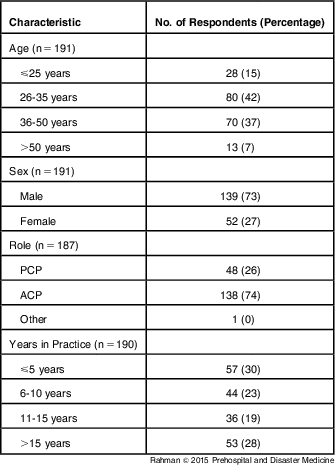
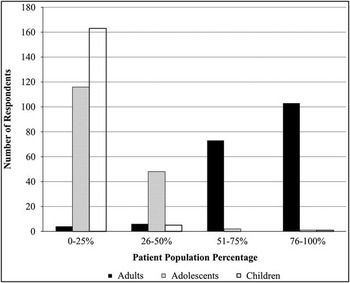
One hundred and ninety-one of 202 EMS personnel completed the survey, for an overall response rate of 94%. Seventy-three percent of respondents were male (139/191), 42% were aged 26-35 (80/191), and 53% had less than 10 years of EMS experience (101/191). Seventy-four percent (141/191) of those surveyed were ACPs and 26% (50/191) were PCPs. Table 1 includes a full description of the demographic characteristics of the respondents. Figure 1 illustrates EMS self-reported distribution of their patient population age.
EMS Provider Respondent Demographics

Abbreviations: ACP, Advanced Care Paramedic; EMS, Emergency Medical Services; PCP, Primary Care Paramedic.
Self-reported Distribution of Patient Population, by Age (n = 186).

Protocol Use and Pain Measurement
Sixty-two percent (118/191) of respondents reported always using pain protocols when treating children. The most common pain scale used for adults (97%, 186/191) and adolescents (96%, 184/191) was the Verbal Numerical Pain Scale (rating pain from 0 to 10). The Non-Communicating Children's Pain Checklist, an evaluation based on physical signs, facial expressions, and behaviors, was the scale most frequently used for children (57%, 108/191). Although the majority of respondents reported using both pain scales and clinical judgement to assess pain for adults (85%, 162/191) and adolescents (86%, 165/191), children were six times more likely than adults (31%, 59/191) to be assessed by clinical judgement alone.
Self -reported Comfort Level and Analgesic Administration Practices
Emergency Medical Services personnel were significantly more comfortable treating adults than children (P < 10-5). Ninety-nine percent (188/189) of respondents reported feeling comfortable or somewhat comfortable treating adults’ pain versus only 61% (115/189) treating children's pain. Reported comfort with treating children's pain increased with practitioner age (P = .001) and experience (P = .00001), and reported comfort was higher for PCPs than for ACPs (P = .004).
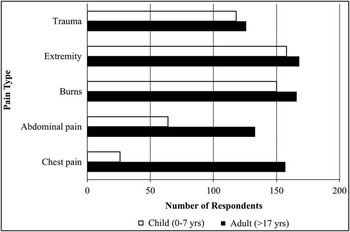
Respondents were significantly less likely to report treating children versus adults with the same types of pain (Figure 2). The most marked disparities in treatment between patient ages were seen in chest pain (children treated 68% less often than adults (P < .00001)) and abdominal pain (children treated 36% less often than adults (P < .00001)). Compared with PCPs, ACPs administered analgesia to children more often for burns (P < .00001), musculoskeletal injuries (P = .00001), trauma (P = .04), and abdominal pain (P = .01), but not chest pain (P = 1.0). Despite increasing comfort treating children's pain with greater experience (P < .00001), the likelihood of reporting analgesia administration to children was not affected by years of experience (P = .11 to .78). Twenty-five percent (37/147) of respondents (17/35 (49%) PCPs and 20/112 (18%) ACPs) assumed children required less analgesia due to immature nervous systems.
Self-reported Analgesia Administration, by Pain Type: Child vs Adult (n = 191).

Specific Pharmacologic and Nonpharmacologic Interventions
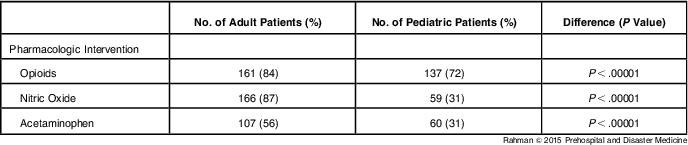
The most commonly reported pharmacological analgesics used for children and adults are listed in Table 2. The most frequently reported nonpharmacologic pain-management techniques for children were presence of a family member (85%, 162/191) and toys (84%, 161/191), while verbal reassurance (71%, 135/191) and distraction (69%, 131/191) were most frequently reported for adolescents.
Reported Use of Pharmacologic Interventions for Adults/Children (n = 191)

Perceived Barriers to Analgesia Administration
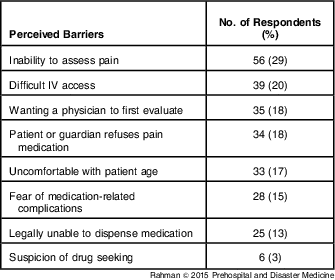
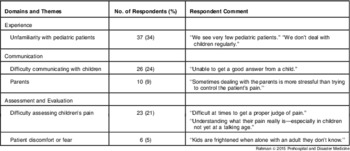
Table 3 summarizes respondents’ reasons for their decisions not to administer analgesia to children. Survey respondents were also asked to specifically comment on what barriers to treating pediatric pain they felt existed. Thematic analysis of free-text responses uncovered three major domains: (1) experience; (2) communication; and (3) assessment and evaluation. Six themes were elucidated within these domains and are presented in Table 4.
Factors that “Often” or “Always” Contribute to the Decision Not to Administer Analgesia to Children (n = 191, multiple responses permitted)

Perceived Barriers to Pediatric Analgesia (n = 110)

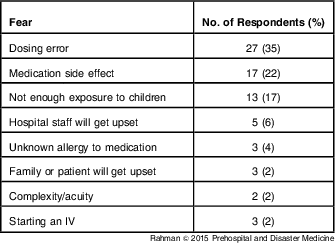
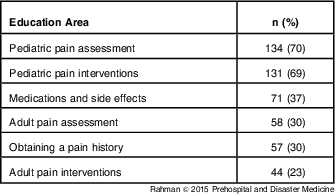
When asked what fears they had regarding treating pediatric pain, respondents identified dosing errors, medication side effects, and not enough exposure to pediatric patients as primary concerns (Table 5). One respondent summarized treatment apprehension with the poignant comment, “People are so afraid to treat pain [that they] will come up with as many excuses [as possible] not to do it.” Pediatric pain assessment and interventions were identified as the two key areas for further education. Further educational needs of EMS providers are summarized in Table 6.
Fears About Treating Pediatric Pain (n = 78)

Areas Identified as Requiring Further Education (n = 191, multiple responses permitted)

Discussion
Few studies have previously examined barriers to prehospital analgesia specifically in children.Reference Williams, Rindal, Cushman and Shah 11 , Reference Swor, McEachin, Seguin and Grall 17 This study of 191 EMS providers is the largest inquiry into prehospital pediatric analgesia practice to date and the first of its kind in Canada. It has highlighted a number of previously unidentified barriers to optimal pain management for children, and suggests that there may still be an issue with prehospital pediatric oligoanalgesia, based on respondent self-reports.
Despite a growing emphasis on the importance of adequate pain management, EMS literature continues to report prehospital oligoanalgesia—the undertreatment of pain—in both adult and pediatric populations.Reference Hennes and Kim 6 In a recent observational study of 310 children with extremity injuries, almost two-thirds of patients with moderate to severe pain did not receive any prehospital pain medication.Reference Rogovik and Goldman 12 Another prospective study of 45 children with limb fractures or burns revealed that no child under five years old received prehospital analgesia; 70% of these children required opioids on arrival to hospital.Reference Watkins 18 Finally, in a large retrospective chart review of 696 children with trauma, there were no documented pain interventions by EMS providers for 86.6% of all patients, including the 85% with documented pain.Reference Izsak, Moore, Stringfellow, Oswanski, Lindstrom and Stombaugh 19 This current study highlights striking discrepancies between analgesia provision to children and adults. Respondents were significantly less likely to report treating children with the same type of pain as adults, less likely to administer similar analgesics to children as adults, and less likely to use pain scales for children, rather than clinical assessment alone. Education surrounding the identification and quantification of pain in children, therefore, is crucial to include and expand in the EMS curriculum.
Treatment of children's pain in the prehospital setting may lead to improved pain treatment in the ED. One pediatric study found mean time to first ED analgesic dose for children with traumatic injury was 22 minutes if EMS had already administered an analgesic in the field, versus 88 minutes if the first dose was given in the ED.Reference Watkins 18 This would suggest that EMS provision of analgesia influences how quickly ED practitioners recognize and treat a child's pain, and further highlights the importance of prehospital provision of analgesia as a key part of a child's emergency medical care experience.
Limited exposure to pediatric patients and pediatric-specific education have been related to suboptimal prehospital pediatric pain management.Reference Zempsky and Cravero 20 Other variables include younger patient age and ethnicity,Reference Zempsky and Cravero 20 difficulty in accurate pain assessment, as well as fear of inflicting pain with skin puncture, over-sedation, and side effects.Reference Hennes and Kim 6 , Reference Williams, Rindal, Cushman and Shah 11 , Reference Watkins 18 Williams et al have recently described previously unrecognized barriers, including unwanted attention from authority figures and an overall “culture of stinginess” in medication administration.Reference Williams, Rindal, Cushman and Shah 11 This current study, too, has observed that difficulty assessing pediatric pain and lack of adequate experience with pediatric patients are key self-reported obstacles to provision of adequate analgesia for children. This current study expands on earlier work, however, in multiple ways: EMS providers are more comfortable treating adults than children, communication challenges are a significant barrier to pediatric analgesia provision, and the misconception amongst providers that children require less analgesia than adults due to immature nervous systems is still prevalent.
With over one-third of respondents feeling somewhat uncomfortable or uncomfortable treating children's pain, this study has shown that EMS providers feel significantly more comfortable treating adult pain, and that comfort with children increases with more clinical experience. However, this study has also shown that PCPs report greater comfort treating children's pain than their ACP colleagues with more training, suggesting that education alone is not the sole determinant of comfort. One hypothesis for this finding is that ACPs may have less clinical experience with pediatric patients, given that their advanced skills make them more likely to be called to acute care medicine calls, such as adult myocardial infarction. Primary Care Paramedics, in contrast, may be triaged to noncardiac (and therefore potentially more pediatric) EMS calls.
This study has also shown that although provider comfort increases with more clinical experience, it surprisingly does not affect the reported likelihood of analgesia administration. In other words, children in pain are no more likely to be given analgesia with increasing provider experience (and therefore comfort). One can hypothesize that further factors, unrelated to provider comfort, must also present a significant barrier to optimal pediatric analgesia. Perhaps this study's findings of self-reported communication challenges (such as nonverbal children or parent/guardian interference) and concern over children's fear might limit analgesia provision despite provider experience and comfort.
Finally, this study highlights a significant misconception not previously identified amongst EMS personnel: one-quarter of respondents mistakenly assumed children required less analgesia than adults due to immature nervous systems. The myth that children do not feel pain or suffer less from it than adults has been identified by the American Academy of Pediatrics and the American Pain Society (Chicago, Illinois USA) as a primary misconception leading to the under-treatment of pain, and must be dispelled in any setting where it is identified. 21 It is imperative, therefore, that EMS provider curriculum be designed to address such common myths surrounding children's pain.
While prior studies have highlighted provider factors such as anxiety, fear of punishment by authority, and short transport distance as factors influencing the decision not to treat pain,Reference Williams, Rindal, Cushman and Shah 11 these were not prominent concerns in this study. Similarly, while others have identified patient factors such as age less than five yearsReference Watkins 18 and symptom maskingReference Walsh, Cone, Meyer and Larkin 22 as further barriers to pain treatment, these were not identified as factors in this study.
Respondents requested more education primarily in pediatric pain assessment, pediatric pain interventions, and medication side effects. However, as this study has demonstrated, discomfort treating children, unfamiliarity with children, communication difficulties, and provider misconceptions create significant barriers to optimal pediatric analgesia provision. These barriers could potentially be alleviated through better trainee education surrounding children's pain and greater trainee exposure to pediatric patients.
Limitations
There are some limitations to this study. First, the results may reflect regional bias, and as such, the results may not be generalizable to all EMS systems. However, the large sample size of this study provides a much more comprehensive assessment of EMS perceptions than examined previously. Second, all responses were subjective, which by nature limits the accuracy of results. Finally, it is likely that perspectives from ACPs were under-reported for the questions pertaining to children's immature nervous systems and areas benefitting from further education; an error in question placement resulted in these questions being interpreted by some ACPs as not meant for their response.
Conclusions
Pediatric oligoanalgesia remains prevalent in the prehospital setting; this study has reaffirmed previously identified barriers to adequate analgesia while identifying the following new ones: lack of comfort treating children, communication challenges, and misconception regarding children's need for analgesia. Reassuringly, EMS providers are generally aware of the need for adequate pediatric pain management and wish to acquire effective education and pain-management strategies. However, this study has shown that EMS providers appear significantly less likely to treat children versus adults with the identical type and intensity of pain. Therefore, a number of educational changes to address provider fears and misconceptions must be made to decrease disproportionately under-treated pain in children.
Acknowledgements
The authors would like to thank Ms. Lisa Chambers for administrative support for this study, and Mr. Ben Vandermeer of the Alberta Research Centre for Health Evidence for statistical support.