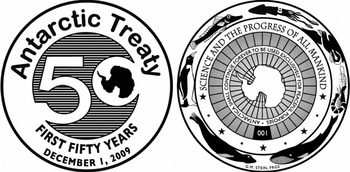
The meeting of the International Board of the Antarctic Treaty summit (http://www.atsummit50.aq) celebrating the 50th anniversary of the treaty, signed on 1 December 1959, provided an opportunity to design a medal based on the theme of science ‘in the interest of all mankind,’ as expressed in the treaty's preamble.
The author presented the first design in January 2009 for a bronze medal, between 62–76 mm in diameter with a 7 mm thickness. The medal eventually went through five design changes before it was approved on behalf of the International Board for the Antarctic Treaty summit.
In the autumn of 2009, 125 medals, measuring 62 mm in diameter and a thickness of 3 mm were struck by Maxwell Medals, Traverse City, Michigan. Each of the medals was numbered and a master list of the recipients was maintained. Specific numbered medals were provided to each of the speakers and panelists at the Antarctic Treaty summit along with the benefactors, patrons and sponsors. Medal recipients included HSH Prince Albert II of Monaco, Ban Ki-moon, Secretary-General of the United Nations, and Dr. G. Wayne Clough, 12th Secretary of the Smithsonian Institution.
The obverse is based on the summit's logo featuring a central design of a large number ‘50’ upon a circle of horizontal lines, and a silhouette of Antarctica within the number zero (Fig. 1a). It is noteworthy that, for aesthetic purposes, the designer omitted the Ronne, Filchner and Ross Ice Shelves from the continent's image. Above is ‘Antarctic Treaty’ and below ‘FIRST FIFTY YEARS/December 1, 2009’, to reflect the treaty's continuance into the future.
Antarctic Treaty summit medal (a) obverse and (b) reverse.

The inspiration for the reverse (Fig. 1b) sprang from the main emblem of the Australian National Antarctic Research Expeditions (ANARE), created circa 1949 by Nel Law, wife of Dr. Phillip Law, AC, CBE, noted Australian scientist and explorer. Law considered that this main ANARE emblem was, too complex for reproduction (Law Reference Law1983) and consequently, a simplified symbol using a leopard seal was eventually adopted.
In a series of circles (much like latitudes), the overall reverse design reflects human activity surrounded by the Antarctic ecosystem. The outermost circle teems with an array of Antarctic marine fauna: emperor penguin, ice fish, giant squid, skua, krill, blue whale and leopard seal.
Inward, the next circle features the wording, ‘SCIENCE AND THE PROGRESS OF ALL MANKIND’ (from the treaty's preamble) and five stars separated by dots, representing five decades. The next circle reflects an array of longitude lines with a blank space at six o'clock, where the medal numbers from 001 to 125 were impressed. Progressing poleward, the next circle reflects the vision of the Antarctic Treaty, as expressed in its preamble: ‘ANTARCTICA SHALL CONTINUE FOREVER TO BE USED EXCLUSIVELY FOR PEACEFUL PURPOSES’. At the centre of the reverse is the Antarctic continent, as source of hope and inspiration for all humanity.