Introduction
Concurrent chemoradiotherapy is the standard of care in the non-surgical management of locally advanced (T3/T4N0 or T1-T4 N1-3) squamous cell carcinoma of the head and neck (SCCHN).Reference Pignon, le Maître and Maillard1 Virtually, all patients (97%) undergoing concurrent chemoradiotherapy develop oral mucositis (OM).Reference Trotti, Bellm and Epstein2 OM is a dose-limiting toxicity with the potential to impact on cure rates and can predict for long-term toxicity.Reference Bensinger, Schubert and Ang3
The significant detrimental clinical sequelae associated with OM include pain, xerostomia, altered taste, need for enteral feeding, bleeding, altered body image and treatment interruptions.Reference Bensinger, Schubert and Ang3 Concurrent myelosuppression from chemotherapy can render patients more prone to systemic infections that can occasionally prove fatal.Reference Pico, Avila-Garavito and Naccache4 In addition, established risk factors for SCCHN, namely, smoking and high alcohol intake, may compound the problem if a degree of malnutrition or immunosuppression is present at diagnosis.
OM is challenging to manage, and current products to treat symptoms are of limited efficacy. Given the radiotherapy treatment volume in SCCHN, the majority of the oral mucosa will receive a significant dose of radiation; OM is realistically an inevitable toxicity rather than preventable consequence of head and neck radiotherapy. Despite Cochrane reviews and independent meta-analysis there remains no consensus on the optimum standard mouth care regimen and institutions vary throughout the United Kingdom.Reference Clarkson, Worthington and Eden5–Reference Stokman, Spijkervet and Boezen7
Newer products: MuGard™, Caphosol® and Episil® have been recently introduced. MuGard™ is a viscous mucoadhesive rinse that provides a protective coating to the oral mucosa.Reference Baud, Colon and Gerberich8 Caphosol® is a supersaturated calcium phosphate oral rinse designed to moisten, lubricate and clean the oral cavity.Reference Haas, Mercedes and Manyak9 Episil® is a lipid based oral spray that spreads onto the oral mucosa and transforms into a strongly bioadhesive ‘fluid crystal’ film that mechanically protects mucosa and aims to reduce the pain associated with OM.Reference Tiberg, Cavallin-Ståh and Linden10
In a historical control comparison, 43% of patients using MuGard™ experienced no mucositis compared with 7% in two historical control groups (graded using the oral mucositis assessment scale (OMAS); no mucositis was defined as the OMAS not exceeding 0·5).Reference Baud, Colon and Gerberich8, Reference Sonis, Eilers and Epstein11–Reference Epstein, Gorsky and Guglietta12 An open-label observational study reported that 49% of patients experienced OM of grade ≤1, with only one patient (2%) experiencing grade 4 mucositis with Caphosol®.Reference Haas, Mercedes and Manyak9 A multicenter, randomised double blind, cross-over single-dose trial involving 32 patients undergoing radiotherapy Episil® was reported to have a 40% mean reduction of intra-oral pain in patients with grade 2–3 OM (World Health Organization (WHO) grading).Reference Camurus13
This prospective audit aims to record mucositis and dysphagia toxicity and the level of analgesia prescribed when recent products: MuGard™, Caphosol® and Episil® are compared with our standard departmental mouth care regimen: a sequential strategy of a ‘cocktail’ of aspirin, glycerin and sucralfate first line, followed by GelClair® second line.
Methods
One hundred and four consecutive patients undergoing concurrent chemoradiotherapy for locally advanced SCCHN at University Hospital Birmingham, UK were prospectively audited for 8 consecutive weeks starting from week 1 of chemoradiotherapy from June 2009 until January 2011.
Patients received either standard oral care regimen of aspirin, glycerin and sucralfate, or were sequentially allocated MuGard™ (Access Pharmaceuticals), Caphosol® (EUSA Pharma (Europe) Limited) or Episil® (IS Pharma Ltd) before commencement of chemoradiotherapy.
Radiotherapy dose was 55 Gy in 20 fractions over 25 days using conformal radiotherapy (CFRT) or intensity-modulated radiotherapy (IMRT). Chemotherapy was given with intravenous carboplatin, area under curve 4·5 during weeks 1 and 4.Reference Sanghera, McConkey and Ho14, Reference Madhava, Hartley and Wake15 Patients with a contra-indication to carboplatin received cetuximab, loading dose 400/mgm−2 1 week before commencing radiotherapy followed by 250 mgm−2 weekly for 4 weeks.Reference Bonner, Harari and Giralt16, Reference Chan, Teoh and Sanghera17
Patients were reviewed weekly during the 4 weeks of chemoradiotherapy and for 4 weeks after completion in outpatient clinic by their consultant clinical oncologist or specialist registrar in clinical oncology. Mucositis, dysphagia and nausea toxicity were prospectively recorded using the Common Toxicity Criteria (CTCAE v3·0).18
Analgesia regimen was escalated as shown below with adjustments made where clinically appropriate, for example, allergies, renal impairment:
Step 1: Mouth Care (standard, Mugard™, Caphosol® or Episil®).
Step 2: Co-Codamol 30/500 mg PO QDS (soluble).
Step 3: Oramorph 10 mg prn (PO or via PEG).
Step 4: Fentanyl 12 mcg topically every 72 hours (or opioid equivalent).
Step 5: Fentanyl 25 mcg topically every 72 hours (or opioid equivalent).
Step 6: Fentanyl 37 mcg topically every 72 hours (or opioid equivalent).
Step 7: Fentanyl 50 mcg topically every 72 hours (or opioid equivalent).
Analgesia score was recorded according to which step patients required, that is, patients on step 1 had an analgesia score of ‘1’ recorded. This is an amended scoring system from previous published work.Reference Sanghera, Arnfield and McConkey19
Results
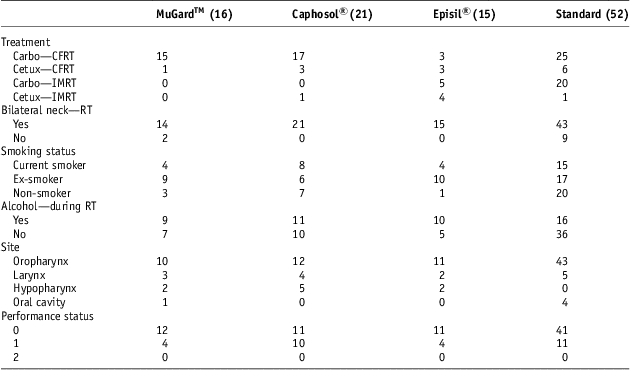
One hundred and four consecutive patients were identified undergoing radical chemoradiotherapy with CFRT or IMRT. Of those, 16 patients received MuGard™, 21 patients received Caphosol®, 15 received Episil® and 52 received standard first-line mouth care.
Table 1 illustrates their demographic details.
Demographics
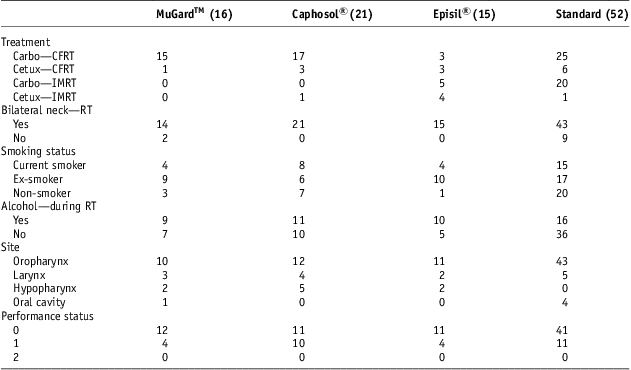
Abbreviations: CFRT, conformal radiotherapy; IMRT, intensity modulated radiotherapy; RT, radiotherapy.
Average grade of mucositis per week for each of the four groups is plotted in Figure 1. No significant difference was seen between the groups (p = 0·82, χ 2-test).
Average grade of mucositis.

Average grade of dysphagia per week for each of the four groups is plotted in Figure 2. No significant difference was seen between the groups (p = 0·99, χ 2-test).
Average grade of dysphagia.
Each analgesia step as detailed above represents the analgesia score for that week.
Figure 3 shows the average analgesia score per week for each of the four groups. No significant difference was seen between the groups (p = 0·61, χ 2-test).
Average analgesia score.
The average nausea grade was consistently below grade 1. This was not felt to be clinically significant.
Five (31%) of the patients receiving MuGard™ developed oral candida, 5 (24%) of the patients receiving Caphosol®, 3 (20%) of the patients receiving Episil® and 21 (40%) of the patients receiving standard mouth care. There was no pattern to when the candida was diagnosed in relation to duration of treatment.
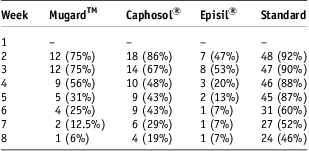
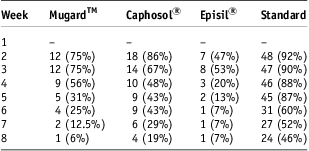
Table 2 shows patient compliance with the mouth care regime. Compliance was noted to be better in the standard regimen.
Compliance with mouth care regime
There was no significant difference in the grade of mucositis, dysphagia or analgesia score between patients undergoing CFRT or IMRT regardless of their mouth care regimen.
Discussion
This prospective audit has not shown a significant difference in the average grade of mucositis, dysphagia or analgesia score between the mouth care regimens in patients undergoing chemoradiotherapy for SCCHN. Interestingly, compliance appeared higher in our standard departmental mouth care regimen—92% in week 2. The relatively small number of patients limits this validity and randomised trials are required to evaluate these products further to detect any clinically meaningful benefit.
The development of OM has been shown to be related to the total radiation dose, use of concurrent chemotherapy and type of radiation treatment.Reference Elting, Cooksley and Chambers20, Reference Narayan, Lehmann and Coleman21 Cumulative doses of <32 Gy are associated with minimal OM and doses over 39 Gy are associated with a longer degree of OM.Reference Narayan, Lehmann and Coleman21 Hartley et al.Reference Hartley, Sanghera and Kazi22 observed a trend towards correlation between biologically effective dose and grade 3 mucositis (p = 0·06 Pearson weighted product–moment correlation) using standard head and neck mucosal parameters. Altered fractionation radiotherapy is associated with universal mucositis (100%) with more grade 3 or 4 mucositis (57%) compared with conventional radiotherapy (34%).Reference Trotti, Bellm and Epstein2 While concomitant chemotherapy improves survival, it also increases acute toxicity.Reference Pignon, le Maître and Maillard1, Reference Trotti, Bellm and Epstein2 A recent study examined the effect of concomitant chemotherapy with IMRT following two cycles of platinum-based induction chemotherapy.Reference Bhide, Gulliford and Schick23 Using individual patient dose–volume histograms, Bhide et al.Reference Bhide, Gulliford and Schick23 reported a 0·6% linear dose gradient for oral mucosa versus 2·4% for pharyngeal mucosa. This dose–response model should prove useful for future modeling using IMRT.
In SCCHN, human papilloma virus (HPV) infection confers a significantly better prognosis, more so in non-smoking patients.Reference Ang, Harris and Wheeler24 For this sub-group of patients, treatment de-escalation may soon be appropriate and one would therefore expect less grade 3 and 4 toxicity. However, for the non-HPV-associated tumours and heavy smokers, prognosis is significantly worse.Reference Ang, Harris and Wheeler24 The 3-year overall survival for HPV negative tumours treated with chemoradiation within the RTOG 0129 was only 57·1% compared with 82·4% (p < 0·001) for HPV positive tumours.Reference Ang, Harris and Wheeler24 Treatment intensification could confer more acute toxicity and robust management strategies need urgent consideration.
Numerous treatment strategies to manage OM have been adopted. Recent preventative strategies include 0·15% benzydamine mouthwash, one randomised controlled trial involving 100 patients reported that 10 ml of 0·15% benzydamine mouthwash four times per day for the duration of radiotherapy reduced the frequency of grade ≥3 mucositis from 78·6% to 43·6% (p = 0·001).Reference Kazemian, Kamian and Aghili25 A randomised placebo controlled trial involving 173 patients reported 0·15% benzydamine reduced erythema and ulceration by 30% (p = 0·006), however, benzydamine was not effective in those receiving accelerated radiotherapy (more than 220 cGy/day).Reference Epstein, Silverman and Paggiarino26 There are no randomised controlled trials in the chemoradiotherapy setting to our knowledge.
There has been interest in the protective effects of honey on the oral mucosa. A trial of 40 patients reported that smearing 20 ml of pure honey onto the oral mucosa 15 minutes before and after chemoradiotherapy reduces the incidence of grade 3–4 OM.Reference Rashad, Al-Gezawy and El-Gezawy27 However, no significant difference in OM was observed in a recent randomised trial comparing Manuka honey with placebo (golden syrup) in 131 patients undergoing radiotherapy for SCCHN, although compliance after the onset of mucositis was noted to be an issue, which could undermine results.Reference Bardy, Molassiotis and Ryder28
The topical antiseptic chlorhexidine has not been shown to confer any benefit on radiation-induced mucositis and is not recommended, although it may have beneficial effects on controlling plaque levels and hence improving oral hygiene.Reference Peterson, Bensadoun and Roila29 Sucralfate as a single agent has been trialed in double-blind studies that have failed to confirm efficacy.Reference Franzen, Henriksson and Littbrand30, Reference Epstein and Wong31 Our center has historically used sucralfate in combination with aspirin and glycerin.
More recently, growth factors, for example, granulocyte-colony stimulating factor (G-CSF), granulocyte-macrophage colony-stimulating factor, and transforming growth factor-β 3 have been used, however, there remains concern that in SCCHN growth factors may potentially encourage proliferation of tumor cells following the publication of a randomised multicentric trial in 2001 comparing hyperfractionated accelerated chemoradiotherapy with hyperfractionated accelerated radiotherapy.Reference Gutschalk, Herold-Mende and Fusenig32, Reference Staar, Rudat and Stuetzer33 In this trial, prophylactic G-CSF resulted in a reduced level of local control (log-rank test p = 0·0072).Reference Staar, Rudat and Stuetzer33 Palifermin, a human recombinant keratinocyte growth factor, was found to reduce the duration of OM (median 4·5 versus 22 days) and prolonged time to develop severe OM (median 45 versus 32 days)—defined as WHO grades 3–4 in patients undergoing postoperative chemoradiation.Reference Henke, Alfonsi and Foa34
In contrast to this study, a recent retrospective review from the Beatson Oncology Centre, Glasgow, compared Caphosol® with departmental standard mouth care in patients receiving chemoradiotherapy or radiotherapy that included a large part of the oral cavity.Reference Thomson35 Sixty patients were included. Statistical significance in the reduction of overall grade of OM and a reduction in the use of analgesia associated with Caphosol® was reported, although further investigation was recommended.Reference Thomson35
In our current study, compliance with standard mouth care regimen appears superior. Compliance generally decreases from weeks 1 to 8. In the latter weeks (weeks 7 and 8), this may be due to the improvement of OM. Admittedly, clinicians and radiographers are more familiar with the departmental standard regimen and may therefore promote this practice more.
Average analgesia score from weeks 4 to 8 is higher in the Mugard™ group. One patient required step 7 of our analgesic scale for this time period, this could account for the higher score. A larger sample size for future work would help to remove this source of bias.
Interventions thus far have proved disappointing and supportive care within the context of a multidisciplinary team remains the mainstay of treatment. Dental work should be carried out by an appropriate specialist before the commencement of radiotherapy.Reference Scully and Epstein36 Dentate patients should continue good hygiene regimens using ‘baby’ toothbrushes and edentulous patients should remove dentures when not in use. The dietician, clinical nurse specialist and speech and language teams should be involved in care from diagnosis to maintain weight, promote self-care and ensure adequate hydration.
Regular clinic review and escalation of analgesia is paramount as pain from mucositis can be severe often requiring strong opioid analgesia. Attention to non-oral routes of administration should be considered as appropriate.
Rates of candida were similar among the four mouth care regimes. Candida is the most common oral fungal infection during cancer treatment.Reference Epstein, Freilich and Le37 Patients with SCCHN may be predisposed to candida infections due to dental prosthesis, alcohol, tobacco and immunosuppression. Fluconazole has been shown to be superior to amphotericin B in the treatment of oropharyngeal candidosis in SCCHN,Reference Finlay, Richardson and Robertson38 however, prophylaxis is not currently recommended.
Conclusion
From this audit, there is no evidence that Mugard™, Caphosol® or Episil® improves mucositis and dysphagia toxicity or the level of analgesia prescribed compared with our standard departmental mouth care regimen. New products should be subject to rigorous clinical and financial evaluation before introduction to clinical practice. Well-designed phase 3 studies are required to detect any meaningful clinical difference.
OM is associated with significant detrimental clinical sequelae. There is current interest in stratifying patients with SCCHN into good prognostic groups that may benefit from treatment de-escalation and poorer prognostic groups that may benefit from treatment intensification according to HPV and smoking status. Robust mucositis care strategies are urgently required, particularly with future dose escalation strategies to address the management of OM.