INTRODUCTION
The importance of affective disorders following childbirth is demonstrated by the tragic findings of the two most recent confidential enquiries into maternal deaths, which report that suicide is now the leading cause of maternal death in the UK (CEMD, Reference Lewis and Drife2001, Reference Lewis and Drife2004). The term postnatal (postpartum) depression (PND) has become in widespread use over the past quarter of a century and has had a positive impact in a number of areas including the recognition of depression at this time and the fight for clinical services for women and their families. The status of depressive episodes occurring in the puerperium, however, remains controversial. It has been argued that the concept of PND ‘does not emerge from 30 years of research with much scientific credit’ (Brockington, Reference Brockington1996) and the prevailing view is that these episodes represent depression that happens to occur following childbirth acting as a non-specific life event (Murray, Reference Murray, Cox, Paykel and Page1989).
Although the weight of evidence does not support PND as a distinct nosological entity to be classified separately from depression occurring at other times, important questions remain regarding the scientific status of PND. This is an important issue clinically as it impacts decisions about childbirth made by women with a history of major depression, but also has important implications for research as the existence of a perinatal trigger may give important clues about the causes of mood disorders more generally. There are at least three avenues of research that may establish a specific relationship between childbirth and depression: (1) epidemiological, examining whether depression is more common in the postpartum period; (2) aetiological, attempting to identify specific childbirth-related triggers for depressive symptoms; and (3) phenomological, asking whether there are there important clinical differences in the presentation of depression at this time. It is the latter question we address in this study.
A number of previous reports have identified differences in the clinical presentation of PND and non-postnatal depression (NPND). Brice Pitt (Reference Pitt1968) in a groundbreaking study suggested that certain symptoms he termed ‘atypical’ (e.g. anxiety, irritability and phobias) were more common in postnatal episodes and subsequent studies have concluded that PND episodes are less likely to present with symptoms such as suicidality, insomnia, lack of interest and worthlessness (Whiffen & Gotlib, Reference Whiffen and Gotlib1993; Eberhard-Gran et al. Reference Eberhard-Gran, Tombs, Opjordsmoen, Skrondal and Eskild2003). Other studies have proved contradictory, however, finding that PND episodes present similarly to episodes not occurring in relationship to childbirth (Cooper et al. Reference Cooper, Campbell, Day Kennerley and Bond1988; Whiffen, Reference Whiffen1992; Wisner et al. Reference Wisner, Peindl and Hanusa1994; Evans et al. Reference Evans, Heron, Francomb, Oke and Golding2001). The study of Wisner and colleagues for example, although finding significant differences between psychotic episodes in the postpartum and at other times did not show any differences in the presentation of non-psychotic episodes of depression (Wisner et al. Reference Wisner, Peindl and Hanusa1994). To add to the confusion, some studies have found PND episodes to be more severe (O'Hara et al. Reference O'Hara, Zekowski, Phillips and Wright1990; Hendrick et al. Reference Hendrick, Altshuler, Strouse and Grosser2000) and some less severe (Pitt, Reference Pitt1968; Whiffen & Gotlib, Reference Whiffen and Gotlib1993) than NPND episodes.
This lack of consensus may, at least in part, be due to differences between studies in how participants were recruited and in how depression was assessed and defined. In particular, studies recruiting both women with PND and a distinct comparison group of women with NPND may find differences in presentation merely due to ascertainment bias.
In the current study, in a sample of parous women with a lifetime diagnosis of recurrent major depression, we examine differences in clinical presentation between postnatal and non-postnatal episodes of major depression, using both between-subject and within-subject comparisons. This design has two important advantages over the previous literature. First, the women were recruited only on the basis of suffering recurrent major depression rather than specifically on the basis of having PND or NPND. Second, we are able to add the unique perspective of comparing postnatal and non-postnatal episodes within individual women.
METHOD
Sample
The participants were parous women recruited for clinical and molecular genetic studies of unipolar depression within the Department of Psychiatry, University of Birmingham and the Department of Psychological Medicine, Cardiff University. Participants were recruited through systematic and non-systematic procedures. The systematic approach consisted of working with local Community Mental Health Teams (CMHTs) to screen all clients for suitable participants. The non-systematic approach involved placing advertisements in local general practitioner waiting rooms, local newspapers, and patient support literature (Depression Alliance). The studies received all necessary Multi-Region and Local Research Ethics Committee approval.
Participants were included if they met the following criteria: (i) were UK/Eire white ethnicity (as they were them being recruited in part for genetic studies); (ii) capable of giving voluntary written informed consent; (iii) aged 18 years or over; and (iv) met DSM-IV (APA, 2000) and ICD-10 (WHO, 1993) criteria for major depressive disorder, recurrent (MDDR). They were excluded if they: (i) had a positive family history in their first- or second-degree relatives of bipolar disorder, schizophrenia, schizo-affective disorder or any other psychotic disorder; (ii) had experienced mood incongruent psychotic symptoms or psychotic symptoms outside of mood disturbance; (iii) had only ever experienced depression due to alcohol or substance abuse or dependence; (iv) had only experienced depression due to a medical illness or medication; (v) were intravenous drug users; or (vi) were biologically related to another study participant.
Assessments
The participants were interviewed using the Schedules for Clinical Assessment in Neuropsychiatry (SCAN; Wing et al. Reference Wing, Babor, Brugha, Burke, Cooper, Giel, Jablensky, Regier and Sartorius1990). Detailed SCAN ratings were conducted for two episodes of depression – the participants' worst and second-worst episodes of depression based upon subjective recollection of severity of symptoms and impact upon daily life. In addition, women were asked pregnancy by pregnancy about episodes of depression occurring in relationship to childbirth, and although a complete SCAN interview was not carried out for each perinatal episode, questions were asked about depressive symptoms to establish whether the episode met DSM-IV criteria for major depression and to establish the week of onset in pregnancy or following delivery.
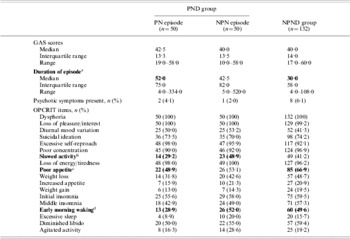
Psychiatric and/or general practice case-notes were summarized and combined with the interview data to form a written case-vignette. Best-estimate lifetime diagnoses were made on the basis of all available information according to DSM-IV and ICD-10 criteria. A range of clinical variables were also rated for each of the two worst episodes of depression, using the Global Assessment Scale (GAS; Endicott et al. Reference Endicott, Spitzer, Fleiss and Cohen1976) and clinical descriptors such as duration of episodes and presence of psychosis; and a range of individual depressive symptoms (see Table 1) were rated with the modified version of the Operational Criteria Checklist (OPCRIT; McGuffin et al. Reference McGuffin, Katz, Watkins and Rutherford1996 – available from the authors on request). Symptoms were rated positively if present for at least 2 weeks during a depressive episode.
Clinical characteristics of postnatal (PN) and non-postnatal (NPN) episodes of depression

PND, Postnatal depression; NPND, non-postnatal depression; GAS, Global Assessment Scale; OPCRIT, Operational Criteria Checklist.
a PND group PN episode >NPND group rated episode (p=0·036).
b Less frequent in PND group PN episode than in PN group NPN episode (p=0·021).
c Less frequent in PND group PN episode than in NPND group rated episode (p=0·032).
d Less frequent in PND group PN episode than in NPND group rated episode (p=0·017), and less frequent in PND group PN episode than in PN group NPN episode (p=0·008).
All diagnoses and ratings were made independently by at least two members of the research team and consensus was reached. Inter-rater reliability was high. This was formally assessed using 20 cases and resulted in mean κ statistics of 0·85 and 0·83 for DSM-IV and ICD-10 diagnoses respectively.
Mean κ statistics for categorical clinical variables were in the range 0·81–0·99. Mean intra-class correlation coefficients (ICCs) for quantitative clinical variables were in the range 0·91–0·97. The mean ICC for the GAS was 0·85 for both the worst and second-worst episode of depression. The mean κ statistics for OPCRIT symptoms ranged from 0·76 to 0·99.
Definition of postpartum episodes
Only parous women, and therefore those who had had an opportunity to experience an episode of postnatal depression, were included in the analysis. An episode of postnatal depression was defined as an episode of DSM-IV major depression with onset within 4 weeks of delivery – corresponding to the DSM-IV postpartum onset specifier. We identified those women with postnatal depression in whom the postnatal episode was either the worst or second-worst episode and for whom therefore a detailed SCAN assessment was available (PND group). Because of the essentially arbitrary definition of postpartum onset used in DSM-IV, a wider definition of perinatal depressive episode was used in defining the group of women who had not suffered with an episode of postnatal depression. Women in the non-postnatal group (NPND), therefore, had given birth but had not experienced the onset of a major depressive episode in pregnancy or within 6 months of delivery.
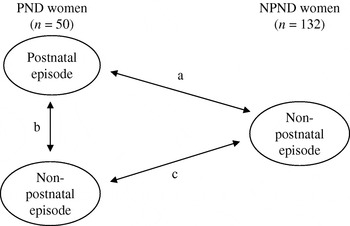
We therefore identified three groups of episodes on which we had comprehensive SCAN ratings: (i) PND episodes, with onset within 4 weeks of delivery (n=50); (ii) the NPND episodes of those women who had also suffered PND episodes (n=50); and (iii) NPND episodes in women who, despite having given birth, had experienced no perinatal affective episodes (n=132). The three groups of episodes and the comparisons made between them are illustrated in Fig. 1. Comparisons were made between the postnatal episodes and two different non-postnatal episodes: (i) episodes of depression in women in the NPND group, that is a between-subjects comparison (Fig. 1, comparison a); and (ii) episodes of depression not related to childbirth in the PND women themselves, that is a within-subjects comparison (Fig. 1, comparison b). In addition, comparisons were made between the non-postnatal episodes of the PND women with the episodes of depression in the NPND group (Fig. 1, comparison c). We were therefore able to explore whether differences between postnatal and non-postnatal episodes are accounted for by differences in the nature of the depressive illness between women vulnerable or not vulnerable to episodes of illness following childbirth (which would give differences in both comparisons a and c in Fig. 1), or alternatively if differences are accounted for by the puerperal context in which the episodes occur (which would give differences in both comparisons a and b in Fig. 1).
Comparisons of postnatal and non-postnatal episodes of depression in the postnatal depression (PND) and non-postnatal depression (NPND) groups of women.

Statistical analysis
There were substantial deviations from a normal distribution in the continuous data, therefore non-parametric statistical analyses were undertaken and medians, interquartile ranges, and ranges are reported. Between-subjects comparisons (PND versus NPND women) were undertaken using Mann–Whitney U tests or χ2 tests for categorical data (if expected values were small, Fisher's exact tests were reported). Wilcoxon tests or McNemar tests for categorical data were used to examine within-subjects comparisons of PND versus NPND episodes. SPSS version 10.0.7 (SPSS Inc., Chicago, IL, USA) was used for all analyses.
RESULTS
Of the 498 females interviewed, 379 (76%) had given birth. Over 50% (n=195) of these parous females had experienced an episode of major depression within 6 months of childbirth and over 30% (n=116) had experienced an episode of major depression with onset within 4 weeks of delivery. Detailed SCAN ratings were available on both postnatal and non-postnatal episodes in 50 women.
Of the remaining 184 women who had given birth, 132 had never experienced episodes of depression in pregnancy or within 6 months of delivery (the NPND group). The remaining 52 women, despite not meeting our narrow criteria for postnatal depression (onset within 4 weeks), had experienced an episode of depression during pregnancy or within 6 months of delivery and were therefore excluded from the NPND group.
Comparison of postnatal and non-postnatal episodes
Between-subjects comparisons
A postnatal episode was identified as the worst depressive episode by 25 of the 50 women (50%) in the PND group. Therefore, in order to make unbiased comparisons between the PND women and the NPND group, we ensured that a similar proportion (50%) of worst and second-worst depressive episodes in the NPND group was selected for analysis. For each subsequent woman in the NPND group we therefore alternated between including the worst and second-worst episodes. Table 1 shows the clinical characteristics of the PND women's PN and NPN episodes compared to the NPND group's rated episode (comparisons a and c in Fig. 1). The PND group's postnatal episode was significantly longer in duration than the NPND group's rated episode (z=−2·100, p=0·036). The symptoms of poor appetite and early morning waking were significantly less common in the PND group's postnatal episode compared to the NPND group's rated episode (χ2=4·600, p=0·032; χ2=5·704, p=0·017 respectively). There were no significant differences in comparison of the PND women's non-postnatal episodes and the NPND group's rated episode (Table 1).
Within-subjects comparisons
Within-subjects analyses of the PN and NPN episodes in the women with postpartum episodes (comparison b in Fig. 1) revealed the symptoms of slowed activity and early morning waking to be significantly less common in the PN episodes (χ2=4·9, p=0·021; χ2=6·13, p=0·008 respectively).
CONCLUSIONS
Although the link between affective disorders and childbirth has been made for hundreds if not thousands of years and the clinical importance of mood disorders occurring at this time is not in doubt, the status of postpartum affective disorders remains controversial. Although the weight of evidence suggests that postnatal mood disorders do not represent a distinct nosological entity, it is likely that there are specific childbirth-related triggers for at least a proportion of women with a vulnerability to perinatal affective disturbance.
In the case of the severest forms of affective disorder occurring in the postpartum period (puerperal/postpartum psychosis), considerable evidence points to a specific vulnerability to puerperal triggering in some women (Jones & Craddock, Reference Jones and Craddock2001, Reference Jones and Craddock2005). The first 2 weeks following childbirth are a period of greatly increased risk for women with a history of bipolar disorder and studies have provided compelling evidence that a vulnerability to postpartum episodes in women with bipolar disorder is familial (Jones & Craddock, Reference Jones and Craddock2001, Reference Jones and Craddock2002).
For episodes of non-psychotic depression, however, the link to childbirth is less clear. A number of controlled studies have not found depression to be more common in the postpartum period (e.g. Cooper et al. Reference Cooper, Campbell, Day Kennerley and Bond1988; O'Hara et al. Reference O'Hara, Zekowski, Phillips and Wright1990; Troutman & Cutrona, Reference Troutman and Cutrona1990; Cox et al. Reference Cox, Murray and Chapman1993) and studies examining the role of hormonal factors have not provided consistent evidence of abnormalities in women who develop postnatal depression (Hendrick et al. Reference Hendrick, Altshuler and Suri1998). In recent years, however, studies have provided evidence of a more specific relationship between childbirth and depressed mood. Eberhard-Gran et al. (Reference Eberhard-Gran, Eskild, Tambs, Samuelsen and Opjordsmoen2002) found that although rates of depression appeared to be lower in the postpartum period, when other risk factors for depression were controlled for, the risk was in fact higher than at other times. Despite negative results from studies examining hormonal levels, it has been suggested that women with PND show an abnormal response to the normal physiological changes of pregnancy and empirical data have been reported in support of this hypothesis (Bloch et al. Reference Bloch, Schmidt, Danaceau, Murphy, Nieman and Rubinow2000). Finally, we have recently reported significant evidence that a vulnerability to postnatal depression with onset within 8 weeks of delivery is familial (Forty et al. Reference Forty, Jones, Macgregor, Caesar, Cooper, Hough, Dean, Dave, Farmer, McGuffin, Brewster, Craddock and Jones2006).
In this study we have followed another path for investigating the relationship between childbirth and depression, examining the differences and similarities in the presentation of postnatal and non-postnatal episodes. As discussed above, the existing literature is contradictory, with a number of studies reporting marked differences and others finding consistency of presentation.
Presentation of postnatal and non-postnatal episodes
In the current study, in comparison to the episodes of depression in women with no perinatal mood disorder (Fig. 1, comparison a), postnatal episodes were of significantly longer duration but there were no differences in the severity of episodes as rated on the GAS. An examination of the individual symptoms of depression did not reveal great differences in presentation, although women described a significantly greater frequency of poor appetite and early morning wakening in non-postnatal episodes.
Using a within-subjects analysis enabled us to look at potential differences in the postnatal and non-postnatal episodes of the same women (Fig. 1, comparison b). The benefits of this analysis are that it removes the potential bias of other differences between the PND and NPND groups and addresses the issue of whether differences are due to the postpartum context. We found that again there were no significant differences in the severity of episodes as rated by the GAS score but two symptoms were significantly less frequent in postnatal episodes – early morning wakening (consistent with the between-subjects analysis) and slowed activity.
Finally, we did not demonstrate any significant differences between the presentations of the non-postnatal episodes in the two groups of women (Fig. 1, comparison c). This might indicate that the differences we have described above do not reflect differences in the nature of depression in women vulnerable and not vulnerable to postnatal episodes. Consistent with the existing evidence, these data do not support postnatal depression as a distinct nosological entity.
What, then, might account for the differences we have found? If the nature of depression is not different between women vulnerable or not to postnatal episodes, then childbirth must be modifying the depressive episode in some way. It is possible that this influence may be biological; for example, the immense fluctuations in the hormonal milieu occurring at this time may influence the expression of the psychopathology. Alternatively, external influences may play an important role. The differences in duration of episode, for example, may be accounted for by a number of factors, such as reluctance in women to seek help at this time or reluctance in both women and their doctors to use antidepressant medication while breastfeeding. Differences in individual symptoms may also be explained by the specific postpartum context. Women whose sleep is continually disrupted by a new baby will not necessarily have the opportunity to experience early morning wakening and are therefore, perhaps, less likely to attribute sleep disruption to depression. In a similar vein, many women who are breastfeeding experience an increase in appetite and this may account for the reduced frequency of reduced appetite in postnatal episodes. Finally, the difference in slowed activity may be due to differing expectations of activity level in women with a new baby.
Limitations
Although in this study we have found significant differences in the presentation of postnatal and non-postnatal episodes, a number of important limitations need to be borne in mind when interpreting these findings. First, we have conducted a number of comparisons and the statistical significance of these findings would not stand up to correction for multiple testing. Using the conservative Bonferroni correction, for example, would result in no corrected p values lower than 0·33. Second, although detailed information was obtained for multiple episodes on a range of depressive symptoms, there are several related symptoms that may occur in depressive episodes that we did not examine. It is possible that differences exist in the frequency of obsessional thoughts, anxiety or irritability for example. Third, the assessments of the postnatal and non-postnatal episodes were retrospective. Although large-scale prospective studies would be the ideal, a sample of this size would be costly to recruit and it would take a considerable amount of time to obtain the amount of longitudinal data available for our analysis. Moreover, in addition to the women's own retrospective description of the episodes, we were able to consult contemporary case-note records with excellent agreement between the two accounts. Fourth, although our study included almost 500 women with major depression, for a number of comparisons the sample sizes were considerably smaller; SCAN data on a postnatal episode were available in only 50 women for example. Although these sample sizes may be adequate to detect moderate to large differences in clinical presentation – those that might be considered to be clinically relevant – larger samples would be required to detect smaller effects. Finally, our inclusion criteria specified women who had experienced at least two episodes of major depression and the majority of episodes were moderate to severe. It is possible that greater differences between postnatal and non-postnatal episodes would emerge if women with single or less severe episodes were included or if women who had only suffered postnatal onsets were compared with women who had only suffered non-postpartum onsets.
SUMMARY
The current study benefits from a well-characterized sample of parous women with recurrent major depression recruited independently of their history of postnatal episodes. Unlike previous studies that may have included women with single episodes of depression, comparisons were made between women with recurrent major depression according to DSM-IV criteria.
A number of differences were found in the clinical presentation of postnatal and non-postnatal depressive episodes but these could be accounted for by the effects of having a baby on the reporting and interpretation of individual symptoms. The postpartum context is important in identifying and diagnosing depression following childbirth, a fact reflected in the development of specific scales such as the Edinburgh Postnatal Depression Scale (EPDS; Cox et al. Reference Cox, Holden and Sagovsky1987), for use at this time.
As outlined above, the possibility of a specific link between childbirth and depression has received support from several recent studies (Bloch et al. Reference Bloch, Schmidt, Danaceau, Murphy, Nieman and Rubinow2000; Eberhard-Gran et al. Reference Eberhard-Gran, Eskild, Tambs, Samuelsen and Opjordsmoen2002; Forty et al. Reference Forty, Jones, Macgregor, Caesar, Cooper, Hough, Dean, Dave, Farmer, McGuffin, Brewster, Craddock and Jones2006). However, our findings with regard to the phenomenology of episodes do not add to this body of evidence. The data presented add support to the hypothesis that women who have postnatal episodes do not have a different type of depressive illness to women who are not vulnerable to illness at this time, but rather the postpartum context may influence the clinical presentation of the underlying depressive diathesis.
ACKNOWLEDGEMENTS
We thank the Medical Research Council for financial support and Dr George Pelios for database programming. We also thank the mental health professionals who were involved in recruiting participants and all the participants who gave up their time and provided support in contributing to our research.
DECLARATION OF INTEREST
None.