INTRODUCTION
The increasingly elevated CO2 that results from fossil fuel emissions and other human activities is leading to ocean acidification, which has become a serious issue for the ecological environment, because of its detrimental effect on marine organisms, the ocean carbonate system, the marine biogeochemical balance and the marine ecosystem (Turley et al., Reference Turley, Blackford, Widdicombe, Lowe, Nightingale, Rees, Schellnhuber, Cramer, Nakicenovic, Wigley and Yohe2006; Andersson et al., Reference Andersson, Mackenzie and Gattuso2011; Kroeker et al., Reference Kroeker, Kordas, Crim, Hendriks, Ramajo, Singh, Duarte and Gattuso2013).
It has long been established that elevated CO2 levels could enhance the photosynthesis, facilitate cell growth and increase cell density of various types of aquatic primary producers in the absence of photoinhibition (Beardall & Raven, Reference Beardall and Raven2004; Giordano et al., Reference Giordano, Beardall and Raven2005; Sobrino et al., Reference Sobrino, Neale and Lubián2005, Reference Sobrino, Ward and Neale2008). However, high CO2 levels could also result in a significant reduction in CO2 uptake, suppress cell growth, and enhance respiration by decreasing ambient pH (Sobrino et al., Reference Sobrino, Neale and Lubián2005; Collins et al., Reference Collins, Sueltemeyer and Bell2006; Crawley et al., Reference Crawley, Kline, Dunn, Anthony and Dove2010). Thus, whether high CO2 levels in oceans would promote phytoplankton productivity remains an open question.
Solar ultraviolet radiation (UVR) is usually defended and absorbed by stratospheric ozone. However, depletion of ozone by industrial activities allows increased UVR irradiance to reach the earth's surface (Häder et al. Reference Häder, Kumar, Smith and Worrest2007). It has been well-defined that as a natural stress factor for phytoplankton, solar UVR could impair the structure and function of DNA and proteins of phytoplankton (Boelen et al., Reference Boelen, de Boer, Kraay, Veldhuis and Buma2000; Xiong, Reference Xiong2001), and inhibit the photosynthetic activity (Guan & Gao, Reference Guan and Gao2008; Sobrino et al., Reference Sobrino, Ward and Neale2008; Guan & Lu, Reference Guan and Lu2010; Guan et al., Reference Guan, Li, Jian, Wang and Lu2011), nutrient uptake (Behrenfeld et al., Reference Behrenfeld, Lean and Lee1995) and growth of phytoplankton (van Rijssel & Buma, Reference van Rijssel and Buma2002; Liang et al., Reference Liang, Beardall and Heraud2006; Guan & Gao, Reference Guan and Gao2010). Furthermore, there is accumulating evidence of the synergistic effect of solar UVR and elevated CO2 on the growth, composition and productivity of marine primary producers (Beardall et al., Reference Beardall, Sobrino and Stojkovic2009; Wu et al., Reference Wu, Gao and Riebesell2010; Chen & Gao, Reference Chen and Gao2011). However, the interaction between CO2 and UVR on aquatic photosynthetic organisms has yet to be fully understood.
Chaetoceros is known as one of the largest genera of marine planktonic diatoms, including more than 400 species. Chaetoceros curvisetus is characterized with curved, spiralling chains. Its cell size and growth rate is associated with concentration of petroleum hydrocarbon, an environmental pollutant (Wang et al., Reference Wang, Yang and Zhu2004). Notably, a recent study has reported that red tide alga C. curvisetus is sensitive to UV radiation, and could produce UV-absorbing compounds and accelerate the repair process of D1 protein so as to acclimate to UV radiation rapidly (Guan et al., Reference Guan, Li, Jian, Wang and Lu2011). Thus, C. curvisetus was used as a model organism in this research. Many factors may influence the interactions between UVR and CO2, such as species-specificity, the acclimation period, light conditions and experimental methods, thus making research pertaining to the interactions a great challenge. In this study, high CO2 concentration (HC, 1000 ppmv CO2) was chosen following previous studies reporting that pH levels will drop to 7.8–7.9 within the following 100 years (Caldeira & Wickett, Reference Caldeira and Wickett2003). Chaetoceros curvisetus cells were exposed to HC or low CO2 air concentrations (LC, 380 ppmv) and then treated with solar UVR. We examined the performance of C. curvisetus after it had been grown under HC and solar UVR in order to predict the response of this to global climate change.
MATERIALS AND METHODS
Species and culture conditions
Chaetoceros curvisetus was isolated from Tolo Harbour, Hong Kong, China (22°30′N 114°20′E) on 28 February 2009. It was maintained at 20 °C in f/2 medium (Guillard & Ryther, Reference Guillard and Ryther1962) in a growth chamber (XT5401-CC275TLH, China) at 80 µmol photons m−2 s−1 under cool-white fluorescent lights (12L: 12D). Cells in exponential phase (2 × 10⁶ cells ml−1) were diluted to 2.2 × 10⁴ cells ml−1 with fresh medium for experiments which were conducted in large quartz tubes (5.9 cm in diameter, 35 cm long) maintained in a water bath (20 ± 0.5 °C; CAP-3000, Rikakikai, Tokyo, Japan).
Acidification treatments on cells in the carbon system
Long-term exposure to high CO2 concentration (HC, 1000 ppmv CO2) was used to investigate the effect of acidification on C. curvisetus cells. Cells were grown in 1 l flasks with HC continuously (300 ml min−1), and cultured in a CO2 growth chamber (Model EF7, CONVIRON, Canada). Low CO2 concentration (LC, 380 ppmv CO2) was considered to be control. LC and HC represented the atmospheric pCO2 at present and the years around 2100 (pCO2 800–1000 ppmv, pH 7.8–7.9), respectively (Hughes, Reference Hughes2000; Caldeira & Wickett, Reference Caldeira and Wickett2003). To evaluate alterations in the carbon system, a range of parameters were measured, including pHNBS (National Bureau of Standards), dissolved inorganic carbon (DIC), HCO3 −, CO3 2− and CO2. Cells were counted every 2 days by a hemocytometer under light microscopy (BX50F4, Olympus Optical, Japan). After 14 days, chlorophyll a (Chl a) was extracted by absolute methanol (5 ml) overnight at 4 °C, and measured with a scanning spectrophotometer (DU530 DNA/Protein Analyzer, Beckman Coulter, USA). The content of Chl a was calculated by the formula of Porra (Reference Porra2005). Triplicate cultures were set for each treatment.
Solar radiation treatment on acidified cells
After 14 days of acclimation to HC or LC, the cells were used to evaluate the effect of solar UVR on C. curvisetus. Outdoor experiments were conducted at Shantou University (23°26′N 116°42′E). Incident solar radiation was continuously monitored using a broadband ELDONET filter radiometer (Real Time Computer, Möhrendorf, Germany), which has three channels, consisting of photosynthetically active radiation (PAR, 400–700 nm), ultraviolet-A (UV-A, 315–400 nm), and ultraviolet-B radiation (UV-B, 280–315 nm) (Häder et al., Reference Häder, Lebert, Marangoni and Colombetti1999). This device is universally recognized (certificate No. 2006/BB14/1) and is calibrated regularly. Acidification cells were exposed to the following treatments: (1) PAB (PAR + UV-A + UV-B), tubes covered with 295 nm cut-off filters (Ultraphan, Digefra, Munich, Germany), transmitting irradiances above 295 nm; (2) PA (PAR + UV-A), tubes covered with 320 nm cut-off filters (Montagefolie, Folex, Dreieich, Germany), transmitting irradiances above 320 nm; (3) P (PAR), tubes covered with 395 nm cut-off filters (Ultraphan UV Opak, Digefra, Munich, Germany). The transmission spectra of these filters has been reported previously (Zheng & Gao, Reference Zheng and Gao2009). The mean irradiances during 60 min exposure were 172.1 (PAR), 24.8 (UV-A) and 0.7 (UV-B) Wm−2. After exposure to solar P, PA or PAB for 60 min, photochemical efficiency and rapid light curve were measured. Determination of photochemical efficiency (ΦPSII) was carried out under the condition of 10 µmol photons m−2 s−1.
Determination of photochemical efficiency
The ΦPSII was measured with a Pulse Amplitude Modulated fluorometer (PAM-Water-ED, Walz, Germany) (Genty et al., Reference Genty, Harbinson and Baker1990). ΦPSII was calculated as:
 $$\Phi _{PSII}=\Delta F/F_m^{\prime}=\lpar F_m^{\prime} - F_t \rpar /F_m^{\prime}$$
where F m ′ represents the instantaneous maximum fluorescence, F t represents the steady-state fluorescence of light-adapted cells. Saturating light pulse was 5300 µmol photons m−2 s−1 with 0.8 s duration. Light at measurement was about 0.3 µmol photons m−2 s−1, and the actinic irradiance was 10 µmol photons m−2 s−1.
UVR-induced inhibition rate of ΦPSII was calculated as:
 $${\rm Inh}\, \lpar \% \rpar =\lpar Y_{{\rm PAR}} -Y_{\rm X} \rpar \times Y_{{\rm PAR}} ^{ - 1} \times 100$$
where Y PAR is the ΦPSII after 1 h exposure to solar PAR, and Y X is the ΦPSII after 1 h exposure to PA or PAB.
Measurement of relative electron transport rate (rETR)
The protocol of rapid light curve (RLC) measurement included 10 s actinic light steps in 84, 125, 183, 285, 410, 600, 840 and 1200 µmol photons m−2 s−1, respectively. This was followed by a 0.8 s saturation light pulse at the end of each light step to record ΔF/F′ m (ΦPSII). The RLCs were performed before and after 60 min of exposure to P, PA and PAB. The rETR was calculated as:
 $${\rm rETR}=\Delta F/F_{m}^{\prime} \times 0.5 \times E$$
where E represents the actinic light (incident PAR), 0.5 means 50% incident PAR energy was distributed to PSII (the other 50% assigned to PSI). ΔF/F′ m represents the photochemical efficiency of PSII.
RLC was arranged to a hyperbolic tangent function (Jassby & Platt, Reference Jassby and Platt1976) in order to compare the initial slope and maximal rETR in each treatment.
 $$y=P_m \times {\rm tanh}\, \lpar \alpha \times x/P_{\rm m} \rpar$$
where P m represents the maximal rETR, and α represents the initial slope of rETR curves.
Data analyses
One-way or two-way analyses of variance followed by post-hoc Tukey's test were used to determine significant differences among different treatments, at significance level P < 0.05.
RESULTS
The effects of acidification on C. curvisetus cells
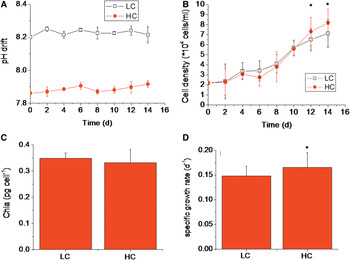
Several parameters of the carbon system equilibrated by HC and LC were measured at the beginning of the experiment (Table 1). As shown in Figure 1A, pH under HC and LC remained steady. The pH under HC decreased to 7.9, which simulated ocean acidification. Following that, C. curvisetus cells were grown under HC or LC. As shown Figure 1B, the cell density under HC and LC remained constant in the first 6 days, and then began to exponentially increase. In the last 2 days, the cell density under HC was significantly elevated compared with that under LC. As shown in Figure 1C, no significant difference was observed in the content of Chl between the simulated ocean acidification (HC) and LC (P > 0.05), whereas the specific growth rate under HC was higher than that under LC (Figure 1D).
The effects of acidification on cells and medium during 14 days acclimation to high (pH 7.89) and low (pH 8.22) CO2 conditions. (A) pH drift of the cultured medium (N = 5); (B) cell density of C. curvisetus (N = 8); (C) the content of chlorophyll a in C. curvisetus (N = 8); (D) specific growth rate of C. curvisetus (N = 8). * represents significant difference (P < 0.05).

Parameters of the carbon system equilibrated with 380 and 1000 ppmv CO2, respectively.

Values followed by different superscript letters are significantly different (P < 0.05, N = 5).NBS, National Bureau of Standards; DIY, dissolved inorganic carbon.
The effect of solar UVR on acidified cells
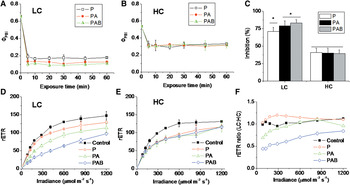
After 14 days of acclimation, the ΦPSII (0.54, time zero) of cells in HC was 19% lower in comparison with that in LC (0.68, time zero). In order to further explore the relationship between acidification and solar radiation, outdoor experiments were also performed. In these, the ΦPSII of cells was lower in LC than in HC. When exposed to solar P, PA and PAB, the ΦPSII in LC declined to the lowest level after 5 min, and then remained constant until 60 min (Figure 2A). Besides, significant differences was observed in the inhibition rates of ΦPSII among the three radiation treatments, of which inhibition rates were 71, 79 and 83%, respectively (Figure 2C). On the other hand, the decreasing trend of ΦPSII in HC was similar to that in LC. It dropped to 0.31 after 5 min exposure, and then remained steady (Figure 2B). However, there were no significant differences in the inhibition rates of ΦPSII under HC among the three radiation treatments (Figure 2C).
ΦPSII alterations in C. curvisetus during 60 min of exposure to P, PA or PAB after 14 days acclimation to (A) low (LC) and (B) high (HC) CO2 conditions. (C) The inhibition rate of cells exposed to P, PA, or PAB, N = 8. Rapid light curve of (D) LC and (E) HC cells were measured before (control) and after exposure to P, PA or PAB for 60 min, respectively. (F) The rETR ratio between LC and HC was calculated by the mean data, N = 3. * represents significant difference (P < 0.05).

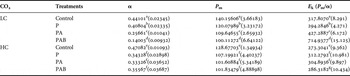
In order to evaluate the effect of solar radiation on rETR of cells grown under HC and LC, the rapid light curve was measured. A decreased maximal electron transport rate (P m) and a slope of the rETR curve (α) were observed in both LC and HC when exposed to solar P (Figure 2D, E, Table 2). Specifically, when compared with controls, P m declined by 10% (LC) and 27.7% (HC), and α decreased by 14.7% (LC) and 16% (HC), respectively. Moreover, exposure to PA and PAB further enhanced LC or HC-induced decrease of Pm and α, with a more evident decrease in LC than that in HC (P m: 22.1% vs 28.6%; α: 41.8% vs 68.2%) (P < 0.05) (Table 2). Conversely, rETRs in LC and HC were further elevated in response to solar irradiation. When exposed to PA and PAB, rETRs were significantly lower in LC than in HC. For cells grown under HC, no significant difference was observed in rETRs among the treatments of P, PA and PAB (P > 0.05) (Table 2, Figure 2D–F).
The photosynthetic parameters of the rapid light curve (α, Pm, Ek) in LC and HC acclimated cells.

The values followed by different superscripts indicate significant difference (P < 0.05), N = 3. The data in parentheses are the SD.
ΦPSII recovery
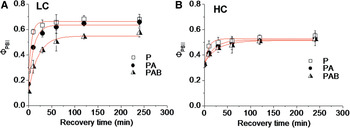
After exposure to solar P, PA or PAB for 60 min, ΦPSII recovery was carried out under 10 µmol photons m−2 s−1. As shown in Figure 3, the recovery curve was considered to be an exponential function with time (R 2 > 0.95). The initial slope of the fitted curves could be used as an estimate of ΦPSII recovery rate, with a higher initial slope indicating a faster recovery. For cells grown under HC and LC, exposure to P led to faster recovery of ΦPSII than exposure to PA and PAB within 30 min. The ΦPSII in HC achieved the maximum at 60 min and then remained steady. For cells treated with HC, no significant differences were found in ΦPSII among P, PA and PAB. However, accompanied with HC treatment, the ΦPSII of cells exposed to PAB was significantly lower than that of cells exposed to P and PA (Figure 3).
ΦPSII recovery in C. curvisetus cells under 10 µmol photons m−2 s−1 after 60 min exposure to solar P, PA or PAB (N = 8). Cells were acclimated in (A) LC and (B) HC CO2 conditions for 14 days in advance of exposure to solar radiation.

DISCUSSION
Increasing solar UVR caused by decreased thickness of the ozone layer, and ocean acidification caused by elevations of CO2, have become a threat to marine ecosystems and may seriously impact marine primary producers. It has been established that ocean acidification affects photosynthesis and respiration in phytoplankton, and solar UVR is well known as a natural stress factor (Häder, Reference Häder2011; Flynn et al., Reference Flynn, Blackford, Baird, Raven, Clark, Beardall, Brownlee, Fabian and Wheeler2012). Recent research reveals complicated interactions between acidified oceans, elevated temperatures and solar UV radiation with unpredictable results (Davis et al., Reference Davis, Coleman, Broad, Byrne, Dworjanyn and Przeslawski2013). Examining the effect of ocean acidification on marine primary producers needs to take into consideration light exposure, a warming environment and other factors such as nutrient availability (Gao et al., Reference Gao, Helbling, Haeder and Hutchins2012a). This study focused on the interaction between CO2 and UVR in C. curvisetus. Specifically, the results showed that HC could promote the growth of C. curvisetus cells in medium in comparison with LC. In the context of exposure to solar UVR, ΦPSII and rETR was much lower in LC than in HC. These differences indicate that the deleterious effects of UVR on C. curvisetus might be counteracted by ocean acidification if the effect is not beyond cell tolerance.
In this study, high concentrations of CO2 led to increased growth of C. curvisetus in the absence of photoinhibition. Similar results were also found in different species by multiple previous studies. For instance, it has been reported that UV-B-induced harm on Phaeodactylum tricornutum photosynthesis is ameliorated by increased pCO2 and lower PH (Li et al., Reference Li, Gao, Villafañe and Helbling2012). Consistently, higher CO2 in the air could give rise to an increase in the photosynthesis rates of Nannocloris atomus exposed to photosynthetically active radiation (Sobrino et al., Reference Sobrino, Neale and Lubián2005). UVR pre-treatment could partly counteract elevated CO2-induced photoinhibition in Thalassiosira pseudonana (Sobrino et al., Reference Sobrino, Ward and Neale2008). This phenomenon may be caused by the lower concentration of CO2 (1% DIC, 5–25 µM) (Millero, Reference Millero1995) than the Michaelis constant (Km(CO2)) (20–70 µM) of Rubisco in the water (Badger et al., Reference Badger, Andrews, Whitney, Ludwig, Yellowlees, Leggat and Price1998), which inhibited photosynthesis, but did not slow down growth (Riebesell et al., Reference Riebesell, Wolf-Gladrow and Smetacek1993; Rost et al., Reference Rost, Riebesell, Burkhardt and Sültemeyer2003). Lower E k and higher α in HC might be another reason responsible for the higher growth rate compared with that in LC. However, the photosynthetic rhythms of Skeletonema costatum are not affected by CO2 enrichment during light periods (Chen & Gao, Reference Chen and Gao2004).These conflicting results may be due to discrepancies in species studied and radiation levels. Conversely, negative effects on marine primary producers by ocean acidification have also been reported (Mathis et al., Reference Mathis, Cross and Bates2011; Gao et al., Reference Gao, Xu, Gao, Li, Hutchins, Huang, Wang, Zheng, Jin, Cai, Häder, Li, Xu, Liu and Riebesell2012b). Consequently, accumulating studies lead to a conclusion that whether the acidified ocean has positive or negative effects depends on the species specificity of marine primary producers, and the balance between faster photosynthesis by increased CO2 and enhanced respiration by decreased ambient pH (Crawley et al., Reference Crawley, Kline, Dunn, Anthony and Dove2010; Chavez et al., Reference Chavez, Messié and Pennington2011; Koch et al., Reference Koch, Bowes, Ross and Zhang2013).
Positive interactions between acidified conditions and UVR were also found in this study. Ocean acidification appeared to inhibit the UVR-induced photoinhibition in C. curvisetus cells, consistent with previous research on P. tricornutum (Li et al., Reference Li, Gao, Villafañe and Helbling2012) and Nannochloropsis gaditana (Sobrino et al., Reference Sobrino, Neale and Lubián2005). Moreover, there is evidence that the net effect of an acidified ocean on red tide alga Phaeocystis globosa might be dependent on solar radiation exposure to a large extent (Chen & Gao, Reference Chen and Gao2011).The positive effect induced by HC may be attributed to lower σPSII due to less UV energy, and other biochemical and physiological alterations occurring in cells, such as decreased rETR (P m) (Wu et al., Reference Wu, Gao, Giordano and Gao2012). It indicates that a proportion of UVR energy was not consumed for emitting pigments, but for repairing damaged protein or DNA. Apart from that, faster non-photochemical quenching could also protect cells against UV radiation (Li et al., Reference Li, Gao, Villafañe and Helbling2012). Therefore, UVR exposure could lead to alleviated photoinhibition in HC. As expected, a faster recovery rate was also observed when HC-acclimated cells were transferred into low light conditions. However, the physiological recovery of cells in the current environment could be delayed by shallow mixed layers resulting from global warming.
CONCLUSIONS
Ocean acidification could inhibit the UVR-induced photoinhibition in C. curvisetus which might counteract the detrimental effects of both ocean acidification and solar UVR if the effect was not beyond the tolerance of cells.
ACKNOWLEDGEMENTS
We thank anonymous reviewers' comments and suggestions that greatly enhanced our manuscript.
FINANCIAL SUPPORT
This study was funded by the National Natural Science Foundation for Young Scholars of China (grant number 41306106), Research Program of Science Technology Department of Zhejiang Province (grant number 2014F10005), Zhejiang Key Lab of Exploring and Protecting Coastal Bio-resource (grant number J2013001), The College Students' Science and Technology Innovation Activities of Zhejiang Province (grant number 2014R413026).