




No CrossRef data available.
Article contents
Cost-effectiveness analysis of fecal occult blood screening for colorectal cancer
Published online by Cambridge University Press: 01 November 2004
Abstract
Objectives: Clinical trials have demonstrated that fecal occult blood screening for colorectal cancer can significantly reduce mortality. However, to be deemed a priority from a public health policy perspective, any new program must prove itself to be cost-effective. The objective of this study was to assess the cost-effectiveness of screening for colorectal cancer using a fecal occult blood screening test, the Hemoccult-II, in a cohort of 100,000 asymptomatic individuals 50–74 years of age.
Methods: A decision analysis model using a Markov approach simulates the trajectory of the cohort allocated either to screening or no screening over a 20-year period through several health states. Clinical and economic data used in the model came from the Burgundy trial, French population-based studies, and Registry data.
Results: Modeling biennial screening versus the absence of screening over a 20-year period resulted in a 17.7 percent mortality reduction and a discounted incremental cost-effectiveness ratio of 3,357 € per life-year gained among individuals 50–74 years of age. Sensitivity analyses performed on epidemiological and economic data showed the strong impact on the results of colonoscopy cost, of compliance to screening, and of specificity of the screening test.
Conclusions: Cost-effectiveness estimates and sensitivity analyses suggest that biennial screening for colorectal cancer with fecal occult blood test could be recommended from the age of 50 until 74. Our findings support the attempts to introduce large-scale population screening programs.
Information
- Type
- GENERAL ESSAYS
- Information
- International Journal of Technology Assessment in Health Care , Volume 20 , Issue 4 , November 2004 , pp. 434 - 439
- Copyright
- © 2004 Cambridge University Press
Colorectal cancer is a major public health problem. It is one of the most frequent cancers in both sexes in France, with 36,300 new cases and 16,000 deaths in 2000 (24). Despite advances in diagnostic techniques and treatment, the 5-year survival rate remains poor (10). Case-control studies (7;19;25;31;34) and controlled studies (8;14;17;22) have demonstrated that screening with a fecal occult blood test can reduce colorectal cancer mortality. However, evidence of mortality reduction is not sufficient to justify the implementation of a national mass screening program. It is necessary to assess its cost-effectiveness and to compare it with other health-care screening or therapeutic interventions already evaluated. Two European studies based on randomized trials, performed in Denmark and the United Kingdom, have already reported the cost-effectiveness of fecal occult blood test screening (13;33). Given differences between countries in stage at diagnosis of colorectal cancers and costs, it is not known whether the findings of these studies can be extrapolated to other countries, such as France. Thus, the aim of this study was to evaluate the cost-effectiveness of colorectal cancer screening using biennial fecal occult blood test with epidemiological and economic data mainly issued from a French controlled trial (8). Another objective was to estimate whether variations in epidemiological and economic parameters modified the cost-effectiveness of colorectal cancer screening.
MATERIAL AND METHODS
General Description of the Decision Analysis Model
The model has been described in a previous article (20). Based on a Markov process, it simulates a biennial screening program using fecal occult blood test in a population of 100,000 individuals aged 50 to 74. The age and sex distribution of the French population was applied to the cohort of the model. The population is monitored over a 20-year period or until the age of 85 or until death through five health states: absence of colorectal cancer or adenoma, colorectal cancer, adenoma larger than 1 cm diameter, death from colorectal cancer, and death from another cause. After successive iterations, the model estimates the number of life-years gained (LYG), defined as the difference between the number of life-years lost due to colorectal cancer in the screening group and the number of life-years lost due to colorectal cancer in the control group, cumulative costs in both populations, and a cost-effectiveness ratio.
Epidemiological Parameters
Most epidemiological parameters required by the model were issued from a controlled study, initiated in Burgundy (France) to evaluate the effect of fecal occult blood screening on colorectal cancer mortality. Results of the study demonstrated that colorectal cancer mortality was significantly lower in the screening population compared with the control population over an 11-year period (mortality ratio=0.84; 95 percent CI [0.71–0.99]) (unpublished data, 2004). The general design of the study has already been described (28). Briefly, all residents from twelve administrative districts in Burgundy 45 to 74 years of age were invited to participate in biennial screening for colorectal cancer using the fecal occult blood test, the Hemoccult-II test (n=45,642). The control group was composed of all residents from seventeen administrative districts with comparable age and sex distribution as well as similar health-care facilities (n=45,557). As a first step, the Hemoccult-II was provided free of charge by primary care physicians over a 4-month period. If the screening test was not performed during the medical phase, the test was then mailed. If after 1 month the test was not returned to the central analysis center, a reminder letter was sent. The entire screening group was invited to participate in each screening campaign. Individuals who accepted the test took two samples from each of three consecutive stools and sent the completed test cards, with a postage paid reply envelope, to the central analysis center. No diet restriction was required. The completed tests were processed without rehydration according to a standardized procedure. In the case of a positive test, the subject was offered a full colonoscopy.
The trial provided data concerning the acceptability rate of the test, which varied between 52.8 percent and 58.3 percent according to the screening campaign, the acceptability of colonoscopy (87 percent on average), the proportion of positive tests (2.1 percent initially and 1.4 percent on average in the successive rounds), and the positive predictive value for adenoma >1 cm in diameter (17 percent). Indeed, it was assumed that colorectal cancers, which develop from adenomas, would arise only from adenomas larger than 1 cm. The trial also provided the distribution of colorectal cancer by stage in screen-detected cancers, interval cancers, cancers in nonresponders and in the control population, as well as survival rates in the screening and control groups. The age- and sex-specific incidence rate for colorectal cancer was issued from the Cancer Registry of Côte d'Or, an administrative area not concerned by the trial. The number of cancers arising in adenomas was provided by the study by Stryker et al. (27). The sensitivity of the screening test had been estimated by a previous work carried out using the data of the Burgundy trial (15). The following parameters were estimated by the model: the sojourn time (time period during which the cancer is asymptomatic but detectable by the screening test), the lead time (part of the sojourn time by which the diagnosis of cancer has been brought forward by screening), and the prevalence of detectable colorectal cancers (20).
Costs
Assessment of costs was performed from the Burgundy trial. They were calculated from the point of view of the French health-care insurance system (2002 prices). Only direct costs were considered: (i) the cost of the structure organizing the screening program, including labor costs and equipment (1.26 € per target individual); (ii) the cost of inviting the population (0.65 € per target individual), including conception and printing of the invitation letter and of the information leaflet sent at the beginning of each screening campaign, the labor costs for preparing the mailing, the cost of postage, the cost of training the general practitioners and informing the entire medical profession; (iii) the mean distribution cost of the screening test (12.52 € per test performed), including the cost of the test, remuneration of general practitioners for offering the test, and the cost of mailing the test or the reminder letter; (iv) The cost of the test analysis performed in a centralized analysis center (4 € per test), including overhead costs, capital expenditure, running costs, and labor costs; (v) the cost of a colonoscopy in case of a positive screening test was 526 € on average. In the case of polypectomy, the cost was 641 €. Some other costs were obtained from published sources. The cost of treatment of colorectal cancer by stage came from a population-based study in Normandy (4). On average, this cost was 15,579 € for stage 1, 21,858 € for stage 2, 31,110 € for stage 3, and 17,384 € for stage 4. The cost of follow-up of treated colorectal cancers, 843 € per patient, was issued from a French follow-up study (3), including costs of examinations performed over a 5-year period and recommended by the French Consensus Conference (5).
The cost incurred in the screening group was calculated as the sum of all the costs described above. The cost in the control group was defined as the sum of the cost of diagnosis, treatment, and follow-up of incident cases of colorectal cancer. The net cost of the screening program was defined as the difference between the cost incurred by the screening group and the cost in the control group. The cost-effectiveness analysis was based on the calculation of an incremental cost-effectiveness ratio (ICER), discounted at an annual 3 percent rate. ICER was calculated by dividing the net cost of the screening program by the number of life-years gained. Uncertainties relative to inputs were handled using sensitivity analyses.
RESULTS
Cost-Effectiveness Analysis
Table 1 shows the estimations of mortality reduction, LYG and ICER of biennial screening with fecal occult blood test in a population of 100,000 individuals 50 to 74 years of age over a 10- and 20-year period. After 20 years, the estimated mortality reduction was 17.7 percent and the estimated ICER was 3,357 € per LYG.

Sensitivity Analyses
Impact of the Acceptability Rate of the Fecal Occult Blood Test
Effectiveness and ICER were strongly related to the acceptability rate (Table 2). With a 10 percent absolute increase of the acceptability rate, the colorectal cancer mortality reduction increased from 17.7 (baseline acceptability rate) to 22.3 percent and the number of LYG increased by 28.6 percent. The ICER was consequently reduced by 20.1 percent. On the other hand, a decrease of the acceptability rate of 20 percent resulted in an increase of the ICER by 86.0 percent.

Impact of Diagnostic Performances of the Fecal Occult Blood Test
Baseline results of the cost-effectiveness analysis were slightly positively correlated to the increase in fecal occult blood test sensitivity. When the sensitivity increases from 60 to 70 percent, the ICER decreased from 3,357 € per LYG to 3,203 € per LYG. On the other hand, there was a negative association between the ICER and specificity. With a reduction in specificity from 99 to 90 percent, the number of LYG and the net cost of the screening markedly increased, leading to an increase in the cost-effectiveness ratio by 19.3 percent (Table 2).
Impact of Economic Parameters
Variation in economic parameter values induced variable changes in ICER (Table 3). Colorectal cancer treatment costs did not influence the ICERs. On the contrary, changes in the costs of fecal occult blood test kit and colonoscopy had a stronger impact. A decrease in the cost of fecal occult blood test kit from 3.20 € to 1.60 € led to an 11.1 percent reduction in the ICER. According to the lowest and highest value of the colonoscopy costs, ICERs ranged from 2,929 to 3,817 € per LYG.

Age at Screening
A starting age of 50 was defined for the baseline cost-effectiveness analysis. Table 4 shows ICERs for several starting and end ages. Very close ICERs were found in the 50–74 and 55–74 age groups, whereas the 60–74 and 65–74 age groups showed higher ICER values. However, the number of LYG was higher for a starting age of 50 than for a starting age of 55. Several end ages were tested under the hypothesis of a screening program starting either at 50 or at 55 years old. The 55–64 age group presented the lowest ICERs but a very small number of LYG compared with the 50–64, 50–69, or 50–74 age groups.

DISCUSSION
The main interest of our study was to demonstrate that biennial screening for colorectal cancer with fecal occult blood test within the French health system over a 20-year period resulted in an ICER of 3,357 € per LYG. This result is largely below the lowest commonly accepted threshold of $20,000 per QALY (18). Furthermore, this cost-effectiveness ratio of colorectal cancer screening appears attractive in comparison with the cost-effectiveness ratio of other cancer screening strategies (2;11).
In a previous study, we found an excellent concordance between the values of colorectal cancer mortality predicted by our model and those observed in the Danish trial, supporting the reliability of our mathematical model (20).
Two other previous cost-effectiveness analyses used data provided by general population trials, in Denmark and United Kingdom (13;33). Both studies resulted in a slightly lower net cost of screening, a slightly lower number of life-years gained, and a slightly lower cost-effectiveness ratio. The British study presented a cost per QALY gained of 2,572 € and the Danish study an ICER of 2,533 € per LYG. Differences in the results between the three models could be explained by the values of some epidemiological parameters. However, there were only minor differences between the three studies concerning the incidence rates of colorectal cancer (32), the proportion of positive tests, the positive predictive value of the test, its specificity (14;17), and its estimated sensitivity (12;15;23). Acceptability rates were only slightly higher in the Danish study than in the British and French studies. One explanation of the difference in results between the three models may lie in the lower estimated value of mean sojourn time in the Danish model (2.1 years) and the British model (2 years) than in ours. This result was expected because it is well-known that colorectal cancers are often diagnosed at a later stage in Denmark and United Kingdom than in France, owing to a longer delay between the appearance of symptoms and the treatment. A shorter sojourn time contributes to a higher proportion of cancers assumed to develop in symptomatic cancers in less than 2 years in the first two models and, thus, to a higher number of interval cancers. It also contributes to the lower estimated number of LYG in the Danish and British studies compared with ours. Differences between the cost-effectiveness results could mainly be explained by the values of economic parameters. The fecal occult blood test, the colonoscopy, and the treatment costs were clearly higher in Burgundy than in Denmark and United Kingdom. The fecal occult blood test cost was 1.20 € in Denmark, 1.67 € in United Kingdom, and 3.20 € in our study. The cost of the diagnostic colonoscopy was, respectively, 135 €, 167 €, and 526 €. The results of our sensitivity analyses showed the importance of both the cost of the fecal occult blood test and of colonoscopy. The colorectal cancer treatment cost by stage was also lower in the British study than in ours. When we introduced the British costs of fecal occult blood test, colonoscopy, and colorectal cancer treatment into our model, an ICER of 2,462 € per LYG was obtained over a 20-year period using a 3 percent discount rate. This result is quite similar to the 2,572 € per QALY estimated by the British model. Conversely, variations in the treatment cost by stage have no impact on the cost-effectiveness ratio. One explanation could lie in the distribution of colorectal cancer stages among the screening and control groups. The incidence of stages 2 and 3 was similar in both groups. But the incidence of stage 4 was lower in the screening group than in the control group, and the proportion of stage 1 was higher in the screening group than in the control group. Because the range of variations in treatment costs was similar in stage 1 and stage 4, the impact of such variations on the net cost of the screening campaign was canceled, thus explaining the absence of impact on the ICER.
Other cost-effectiveness analyses have been reported (6;9;16;21;26;29;30). The main weakness of these studies is that they are based on epidemiological and economic assumptions provided by a variety of sources. Generally, the cost per LYG was higher in the United States than in Europe, suggesting that the underlying cost of health care can play a major role.
Several sensitivity analyses were performed in this work. These analyses clearly showed the importance of a high acceptability rate of the test, which improved effectiveness because of better detection of early stage cancer and resulted in a decrease in the cost-effectiveness ratio. They also emphasized the impact on the ICER of the diagnostic performances of the fecal occult blood test, especially its specificity. A decrease in specificity induced very high costs of investigation of true- and false-positive findings, leading to an increase in the ICER. Given the size of the population targeted by a mass screening program, this cost-effectiveness analysis confirms that it is essential that screening test specificity be as high as possible to avoid unnecessary colonoscopies. We also studied the influence of starting age on cost-effectiveness results. At present, the implementation of a biennial fecal occult blood test is recommended in Europe in asymptomatic individuals 50 to 74 years of age (1). Our results showed that the 55–74 age group presented the best cost-effectiveness ratio. However, starting at 50 would improve the effectiveness of screening by preventing more cancer deaths. It would result also in a higher number of LYG. This result was expected because the decrease in the number of LYG with age systematically favors the youngest age groups. Another important debate is the end age at screening, which was rarely tackled in previous publications. In the sensitivity analysis, we considered two scenarios of variations in end age depending on whether the starting age was 50 or 55. The lowest cost-effectiveness ratio was observed in the 55–64 age group. However, the number of LYG was much lower in this group than in groups including older individuals, especially the 50–74 age group. The contrasted results regarding the effectiveness and cost-effectiveness of screening show that it may be difficult to define a screening policy that is acceptable from both economic and public health points of view.
In conclusion, our results are consistent with previous published studies in showing that biennial fecal occult blood testing for colorectal cancer could be recommended in a 50- to 74-year-old population. The time has come to implement well-organized population-based fecal occult blood screening. Our simulation model seems to be a reliable tool for evaluating the cost-effectiveness of a colorectal cancer screening program. Other analyses aimed at simulating other screening strategies for colorectal cancer in the general population are now made possible using our mathematical model. Especially, the modeling of mass screening using other fecal occult blood tests, endoscopic procedures such as flexible sigmoidoscopy, colonoscopy or virtual colonoscopy, or DNA testing in stools could represent an interesting perspective to this work.
POLICY IMPLICATIONS
Colorectal cancer represents an important public health problem by its frequency and its severity. There is unequivocal evidence that repeated fecal occult blood tests with unrehydrated Hemoccult-II reduces colorectal cancer mortality in asymptomatic subjects over 50. However, evidence of mortality reduction is not sufficient to justify the implementation of a mass screening program. It must prove its efficiency in relation to other alternatives. In the French health system, biennial screening for colorectal cancer with fecal occult blood test over a 20-year period corresponded to an ICER of 3,357 € per LYG. The present results, along with those of previous studies, were considered as sufficiently convincing by the French health authorities to decide to start a pilot program in France in subjects 50 to 74 years of age covering approximately 25 percent of the population as the first phase of a national policy.
This work was supported by the Ministry of Health (PHRC), the Burgundy Regional Council, and INSERM.
References
Advisory Committee on Cancer Prevention.
2000
Recommendations on cancer screening in the European Union.
Eur J Cancer.
36:
1473–
1478.
Arveux P,
Wait S,
Schaffer P.
2003
Building a model to determine the cost-effectiveness of breast cancer screening in France.
Eur J Cancer Care.
12:
143–
153.Google Scholar
Borie F,
Daures JP,
Millat B, et al.
2001
Follow-up of patients with colorectal cancer resected for cure in the Herault area. A medico-economical study.
Gastroenterol Clin Biol.
25:
881–
884.Google Scholar
Bouvier V,
Reaud J,
Gignoux M,
Launoy G.
2003
Cost of diagnostic and therapeutic management of colorectal cancer according to stage at diagnosis in the Calvados department, France.
Eur J Health Econom.
4:
102–
106.Google Scholar
Conférence de Consensus.
1998
Prévention, dépistage et prise en charge des cancers du colon.
Gastroenterol Clin Biol.
22:
S275–
S288.
Faivre J,
Tazi MA,
El Mrini T, et al.
1999
Faecal occult blood screening and reduction of colorectal cancer mortality: A case-control study.
Br J Cancer.
79:
680–
683.Google Scholar
Faivre J,
Tazi MA,
Milan C, et al.
1999
Controlled trial of faecal occult blood screening for colorectal cancer in Burgundy (France). Results of the first 9 years.
Gastroenterology.
116:
A400.Google Scholar
Frazier AL,
Colditz GA,
Fuchs CS,
Kuntz KM.
2000
Cost-effectiveness of screening for colorectal cancer in the general population.
JAMA.
284:
1954–
1961.Google Scholar
Gatta G,
Capocaccia R,
Sant M, et al.
2000
Understanding variations in survival for colorectal cancer in Europe: A EUROCARE high resolution study.
Gut.
47:
533–
538.Google Scholar
Gyrd-Hansen D.
1999
The relative economics of screening for colorectal cancer, breast cancer and cervical cancer.
Crit Rev Oncol Hematol.
32:
133–
144.Google Scholar
Gyrd-Hansen D,
Sogaard J,
Kronborg O.
1997
Analysis of screening data: Colorectal cancer.
Int J Epidemiol.
26:
1172–
1181.Google Scholar
Gyrd-Hansen D,
Sogaard J,
Kronborg O.
1998
Colorectal cancer screening: Efficiency and effectiveness.
Health Econ.
7:
9–
20.Google Scholar
Hardcastle JD,
Chamberlain JO,
Robinson MH, et al.
1996
Randomised controlled trial of faecal-occult-blood screening for colorectal cancer.
Lancet.
348:
1472–
1477.Google Scholar
Jouve JL,
Remontet L,
Dancourt V, et al.
2001
Estimation of screening test (Hemoccult®) sensitivity in colorectal cancer mass screening.
Br J Cancer.
84:
1477–
1481.Google Scholar
Khandker RK,
Dulski JD,
Kilpatrick JB, et al.
2000
A decision model and cost-effectiveness analysis of colorectal cancer screening and surveillance guidelines for average-risk adults.
Int J Technol Assess Health Care.
16:
799–
810.Google Scholar
Kronborg O,
Fenger C,
Olsen J, et al.
1996
Randomised study of screening for colorectal cancer with faecal-occult-blood test.
Lancet.
348:
1467–
1471.Google Scholar
Laupacis A,
Feeny D,
Detsky AS,
Tugwell PX.
1992
How attractive does a new technology have to be to warrant adoption and utilization? Tentative guidelines for using clinical and economic evaluations.
Can Med Assoc J.
146:
473–
481.Google Scholar
Lazovich D,
Weiss NS,
Stevens NG, et al.
1995
A case-control study to evaluate efficacy of screening for faecal occult blood.
J Med Screen.
2:
84–
89.Google Scholar
Lejeune C,
Arveux P,
Dancourt V, et al.
2003
A simulation model for evaluating the medical and economic outcomes of screening strategies for colorectal cancer.
Eur J Cancer Prev.
12:
77–
84.Google Scholar
Lieberman DA.
1995
Cost-effectiveness model for colon cancer screening.
Gastroenterology.
109:
1781–
1790.Google Scholar
Mandel JS,
Church TR,
Ederer F,
Bond JH.
1999
Colorectal cancer mortality: Effectiveness of biennial screening for fecal occult blood.
J Natl Cancer Inst.
91:
434–
437.Google Scholar
Moss SM,
Hardcastle JD,
Coleman DA, et al.
1999
Interval cancers in a randomized controlled trial of screening for colorectal cancer using a faecal occult blood test.
Int J Epidemiol.
28:
386–
390.Google Scholar
Remontet L,
Esteve J,
Bouvier AM, et al.
2003
Cancer incidence and mortality in France over the period 1978-2000.
Rev Epidemiol Sante Publique.
51
(pt 1):
3–
30.Google Scholar
Selby JV,
Friedman GD,
Quesenberry CP,
Weiss NS.
1993
Effect of fecal occult blood testing on mortality from colorectal cancer. A case-control study.
Ann Intern Med.
118:
1–
6.Google Scholar
Sonnenberg A,
Delco F,
Inadomi JM.
2000
Cost-effectiveness of colonoscopy in screening for colorectal cancer.
Ann Intern Med.
133:
573–
584.Google Scholar
Stryker SJ,
Wolff BG,
Culp CE, et al.
1987
Natural history of untreated colonic polyps.
Gastroenterology.
93:
1009–
1013.Google Scholar
Tazi MA,
Faivre J,
Dassonville F, et al.
1997
Participation in faecal occult blood screening for colorectal cancer in a well defined French population: Results of five screening rounds from 1988 to 1996.
J Med Screen.
4:
147–
151.Google Scholar
Vijan S,
Hwang EW,
Hofer TP,
Hayward RA.
2001
Which colon cancer screening test? A comparison of costs, effectiveness, and compliance.
Am J Med.
111:
593–
601.Google Scholar
Wagner JL,
Tunis S,
Brow M.
1996:
Cost-effectiveness of colorectal cancer screening in average risk adults.
In: Young GP,
Rozen P,
Levin B, eds.
Prevention and early detection of colorectal cancer.
London:
Saunders;
321–
341.
Wahrendorf J,
Robra BP,
Wiebelt H, et al.
1993
Effectiveness of colorectal cancer screening: Results from a population-based case-control evaluation in Saarland, Germany.
Eur J Cancer Prev.
2:
221–
227.Google Scholar
WHO.
2003.
Cancer incidence in five continents. Age-specific and standardized incidence rates.
Vol. 8.
Lyon:
IARC Sci Publ
Whynes DK,
Neilson AR,
Walker AR,
Hardcastle JD.
1998
Faecal occult blood screening for colorectal cancer: Is it cost-effective?
Health Econ.
7:
21–
29.Google Scholar
Zappa M,
Castiglione G,
Grazzini G, et al.
1997
Effect of faecal occult blood testing on colorectal mortality: Results of a population-based case-control study in the district of Florence, Italy.
Int J Cancer.
73:
208–
210.Google Scholar

Estimated Effectiveness and Cost-Effectiveness Ratios of Biennial Screening With Hemoccult®-Ii Compared to the Absence of Screening According to the Length of the Screening Campaign in A 50- to 74-Year-Old Population
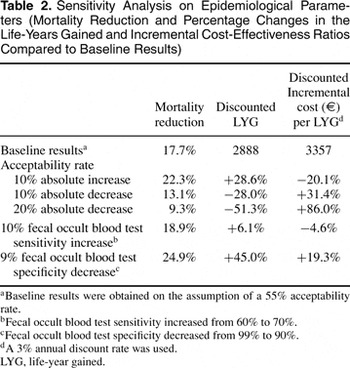
Sensitivity Analysis on Epidemiological Parameters (Mortality Reduction and Percentage Changes in the Life-Years Gained and Incremental Cost-Effectiveness Ratios Compared to Baseline Results)

Sensitivity Analysis on Economic Parameters (Percentage Changes in Incremental Cost-Effectiveness Ratios Compared to Baseline Results)
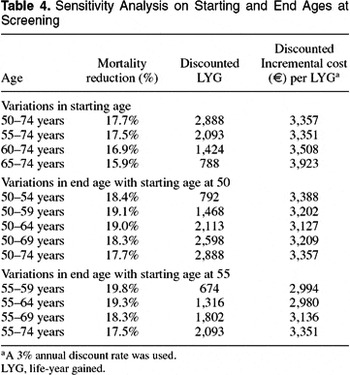
Sensitivity Analysis on Starting and End Ages at Screening
 You have
Access
- 35
- Cited by