Introduction
Aims of this article
Traditional land use systems and the respective cultural (= traditional rural) landscapes of high biocultural diversity are under great pressure due to technological and socio-economic changes and in many parts of the world are not economically viable anymore. If the market fails, some kind of action is needed to preserve this biocultural diversity. Thus, mobilization and motivation of volunteers to participate in the management of traditional land use systems become important factors. During field research into the biodiversity of a rural paddy landscape in Central Japan (see subsection ‘Study site’) the first author became aware that hard scientific facts, such as the conservation of species, were not enough to motivate people to engage in such activities. Esthetic and spiritual values might be even stronger motivators. In this article, we compare a group of mainly urban volunteers who invest personal time, money and manual labor to contribute to the conservation of a terraced rice landscape in Japan with a group of visitors ‘passively’ admiring the same terraced landscape. Both groups might appreciate the beauty of the landscape; however, those actively contributing to conservation and agricultural management might be driven by additional motivations. Knowledge about the factors triggering readiness to participate actively in activities can be helpful in developing effective conservation strategies.
Satoyama and biocultural diversity
As in many parts of the world, most of the Japanese landscape has been shaped by man. In the hilly and mountainous regions, which cover more than 70% of the total land area1, small-scale agriculture, adapted to the topographic situation, formed the 1000-year-old cultural ‘satoyama’ landscape2, Reference Takeuchi3, consisting of villages at the foot of the mountains, paddies and other arable crop fields mainly on terraces, secondary grasslands, and coppiced forests on the slopes, conifer plantations, bamboo groves, water reservoirs, ponds, streams, shrines, temples and graveyards. For the Japanese, satoyama is often the symbol of the last remnants of a natural environmentReference Takeuchi, Takeuchi, Brown, Washitani, Tsunekawa and Yokohari4. The FAO has included satoyama sites in its list of Globally Important Agricultural Heritage Systems, which are defined as ‘Remarkable land use systems and landscapes which are rich in globally significant biological diversity evolving from the co-adaptation of a community with its environment and its needs and aspirations for sustainable development’5. Paddy fields play a key role. In total 54% of Japan's farmlands are paddy fields6; of these, 14.9% are terraced rice fields (‘tanada’ in Japanese)7. Apart from food production and their relevance for other ecosystem services, e.g., prevention of floods and erosion, water purification or ground water protection1, Reference Aizaki, Sato and Osari8, paddies are important biotopes for a rich and specialized fauna and flora. A recent study, presented at the 10th UN Convention of Biodiversity, lists 5668 animal and 2075 plant species that are connected to the rice field ecosystem in JapanReference Iwabuchi, Kurechi and Kashiwagi9. Also, from a cultural and religious perspective, rice played and continues to play a prominent part in Japanese daily lifeReference Eder10–Reference Oyadomari13. Lately, an increased awareness can be found in Japanese society regarding rice terrace landscapes, also called ‘senmaida’ (1000 rice fields), which are perceived by many people as the ‘nature’ most close to them14, a place to which they feel a strong attachment. Tanada is the landscape of their ancestors, representing culture, tradition, (spiritual) homeland and national identity—all in all, a landscape loaded with emotions. Besides that, it is considered to be attractive due to its esthetic value14.
Satoyama and biocultural diversity at risk
Currently, 40% of the land area is estimated in the Fourth National Biodiversity Strategy of Japan to be satoyama 2. Its continued existence, however, is at a great risk, due to serious demographic and economic upheavals. Declining birth rates, an aging society (nearly one-quarter of the Japanese are 65 years or older15), small average farm size16, high costs of farm laborReference Kobori and Primack17, and thus high production costsReference Fukuda, Dyck and Stout18 in combination with falling rice consumption19, result in a decrease of agricultural income1, and consequently in the migration of the younger population to the cities. This, in turn, leads to ‘retirement farming’ (70% of Japanese agriculture rests on the shoulders of retired peopleReference Nakamichi20) and finally to the abandonment of agriculture and farmland and to depopulation of the rural areas1, 21.
Rise of collective action
Initiatives for a revival of rural areas started in the late 1980s–early 1990s in the form of local citizens' movements as well as in government programs, and are increasing continuouslyReference Nakamichi20, Reference Nakagawa, Takeuchi, Brown, Washitani, Tsunekawa and Yokohari22–Reference Takeuchi, Takeuchi, Brown, Washitani, Tsunekawa and Yokohari24. Thus, the Ministry of Agriculture, Forestry and Fisheries of Japan registered joint projects between farmers and non-farmers involving 19,514 organizations nationwide operating over an area of 1.43 million ha, i.e. 31% of the Japanese cultivated land area1, 25. Several activities introduced by the Japanese government are targeted specifically at the conservation of the tanada landscape, such as, the yearly tanada summit to strengthen the local economy14, Reference Kobayashi and Harada26, the nationwide award of the country's 100 most beautiful rice terraces27 in order to increase their popularity and to bring citizens to engage in their protection27, or the support of the legal implementation of the Tanada Ownership SystemReference Kieninger, Yamaji and Penker28. The Tanada Ownership System is a land tenure system, where non-farmer volunteers (‘the tenants’), often city dwellers, rent a piece of land (mostly rice terraces, but also other arable land) against a certain rental fee and cultivate it under the guidance of the landowners or other experienced supervisors (mainly locals)14, 19, Reference Kieninger, Yamaji and Penker28.
The link between esthetics and spirituality—the Japanese concept of nature
The esthetic appreciation of nature has a long tradition in JapanReference Saito29 and often also has a religious meaningReference Kalland, Asquith, Asquith and Kalland30, Reference Saito31. This becomes evident in the Shintoistic deification of impressive natural phenomena in literature and poetry, in the visual arts or in the garden design of monasteries, where idealized and refined images of nature are reproduced in miniature format, sometimes reaching a maximum of abstraction and reduction and arranged in a scenic composition. In Japanese ‘religious understanding’—resulting from mythology, the ‘ “Buddha-nature” in all things’Reference Kalland, Bruun and Kalland32 and Shintoism with its proverbial myriad kami-sama—all creatures in nature have a soul, even natural phenomena and inorganic objects (kami-sama are divine powers, which are inherent in all things that give the onlooker a feeling of awe, such as the sun, moon, rocks, rivers, old trees, caves, flowers, animals, and even people with an outstanding personality)Reference Kagawa-Fox12, Reference Kalland, Asquith, Asquith and Kalland30, Reference Kalland, Bruun and Kalland32. Moreover, mythical creatures also animate nature. Man and nature are perceived as a union, inseparable from the spiritual worldReference Kalland, Asquith, Asquith and Kalland30, Reference Kalland, Bruun and Kalland32. This could be one of the reasons why Japanese people do not make the same sharp distinction between ‘man-made’ and ‘natural’ as Westerners doReference Kalland, Bruun and Kalland32–Reference Kieninger, Holzner, Bergmann and Eaton35. This attitude, however, does not automatically imply that Japanese people have a more heedful and harmonious relationship with nature (which is a common stereotype), but merely indicates that they appreciate the formative human hand in nature. Japanese have a preference for semi-natural rural sceneriesReference Kellert36, Reference Kellert37, while many Westerners long for untouched primary natureReference Saito29, Reference Saito31, Reference Kieninger, Holzner, Bergmann and Eaton35–Reference Kohsaka and Flintner42.
At this point it must be noted that Japanese religious understanding should not be viewed from a Western point of view. ‘The word, religion, is historically and culturally constructed’Reference Tanaka43. A large percentage of Japanese people define themselves as ‘unreligious’, although they regularly conduct religious rituals, festivals or other religious eventsReference Tanaka43–Reference Manabe46. To the Japanese ‘religion’ means to be a member of a religious institution, but it does not refer to religious feelings or valuesReference Tanaka43–Reference Mullins and Lyon45. Furthermore, the Japanese do not make a sharp distinction between faith and superstition (the latter of which for them has no derogatory connotations) as Westerners do (Dr Bernhard Scheid, Department of Japanese Studies, University Vienna, Institute for the Cultural and Intellectual History of Asia, personal communication, December 16, 2011). Thus, it did not present a problem to ask a question concerning ‘the belief in spirits in nature’ for the purpose of this study (see subsection ‘Sense of spirits in nature’).
State-of-the-art of esthetics and spirituality as motivators for collective conservation activities
Studies on examples of collective conservation activities related to rural landscapes in Japan are rareReference Kobori and Primack17, Reference Primack, Kobori and Mori47–Reference Horiuchi, Fukamachi and Oku49. Publications on the (Tanada) Ownership System pertain to its general structure, sustainability and procedural implementation and its role in conservation, but are available almost solely to the Japanese-speaking scientific communityReference Kobayashi and Harada26, Reference Kieninger, Yamaji and Penker28, Reference Shibata and Masuda50–Reference Yamaji55. Several publications can be found dealing with the Japanese concept of nature and landscape preferences of different land usersReference Saito29, Reference Saito31, Reference Kieninger, Holzner, Bergmann and Eaton35–Reference Asquith and Kalland39, Reference Hayashi41, Reference Kohsaka and Flintner42, Reference Motonaka, Sasaki and Aso56–Reference Iwata, Fukamachi and Morimoto64, and with the link between nature, esthetics and religionReference Kagawa-Fox12, Reference Oyadomari13, Reference Saito29, Reference Saito31, Reference Asquith and Kalland39, Reference Omura65. To our knowledge no international literature that discusses the connection between the esthetic and spiritual dimension and the motivation of people participating in collective activities for the conservation of traditional land use systems exists to date. This article follows a previous paper, where the general profile of the ‘Ōyamasenmaida Ownership System’, the major motivation of the volunteers and the transferability of this Japanese type of voluntary farm work activity to Western countries have already been discussedReference Kieninger, Yamaji and Penker28. In this article, we focus on the role of esthetic appreciation and attitude toward spirits in nature and compare tenants and visitors (tourists just staying for a relatively limited time period). By means of an integrative research approach, we wish to provide not only an original contribution to science but also recommendations for the practical mobilization of volunteers for collective action aiming at the conservation of rural landscapes and their biodiversity. The volunteers in the Ownership System in Ōyamasenmaida call themselves ‘ōnā’, derived from the English word ‘owner’. As the Ōyamasenmaida Ownership System is a land tenure system, we have decided for the sake of clarity to use the term ‘tenant’ instead of ‘ōnā’.
Research Design, Methods, Data and Study Site
Research design, research questions and hypotheses
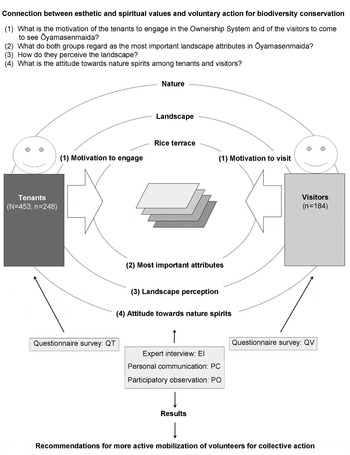
The research design (see Fig. 1) shows the overall research question which encompasses four questions:
(1) What is the motivation of tenants to engage in the Ownership System and of the visitors to see Ōyamasenmaida?
(2) What do both groups regard as the most important landscape attributes in Ōyamasenmaida?
(3) How do they perceive the landscape?
(4) What is the attitude toward nature spirits among tenants and visitors?
These questions will be answered by a comparison of the ‘active’ (tenants) and ‘passive’ (visitors) land users in Ōyamasenmaida. Their motivations and the underlying values will be surveyed based on two similar questionnaires (including photo-based landscape assessments for the tenants). We have four hypotheses:
(1) The attractiveness of the rice terrace landscape scenery plays a key role in the readiness of the tenants to engage in conservation activities and of the visitors to see the site.
(2) The attractiveness of the rice terrace landscape scenery is an important landscape attribute for the tenants and visitors.
(3) The traditional rural landscape (satoyama) is often perceived as (untouched) nature.
(4) Visitors and tenants imagine differently how this ‘nature’ is inhabited by spirits.
A case study approach was determined for this study, as the research is of an exploratory nature and addresses a contemporary phenomenon within its real-life context without clear borders between phenomenon and contextReference Yin66.
Research design.

Data collection
For this study, in total more than 50 days (December 2004–May 2006) were spent by the corresponding author on the site, taking part in various general and tenant meetings, tenants' working days (e.g., rice planting, weeding and harvesting), traditional cultural events, festivals and everyday life. It was by no means simple to become acquainted with the local people on site. As they were not accustomed to a foreign woman researcher, not only did general communication difficulties present an obstacle, but it also took nearly 1 year until they trusted her and lost their reservations to talk. After this warming-up phase, however, the ‘Ōyamasenmaida people’, particularly those from the Preservation Association, supported the study wholeheartedly.
The focus of this article lies in the information collected with structured questionnaires. The questionnaire survey is a cross-sectional comparison of two groups at a single point in time. Additional qualitative data are the results of the expert interview (EI), personal communication (PC), and participatory observation (PO).
Based on PC, PO and first explorative interviews with tenants and representatives of the local Ōyamasenmaida Preservation Association (PA), two questionnaires were designed in English for the two groups of ‘tenants’ (QT) and ‘visitors’ (QV), discussed with colleagues from the University of Tōkyō and then translated into Japanese. As e-mail addresses were mostly unknown, the questionnaires were distributed and collected directly on site (visitors and tenants at meetings) or sent by post, together with a stamped envelope for reply. Names and postal addresses of the tenants were provided by the PA. In a cover letter, the head of the PA motivated the tenants to participate in the study.
The questionnaires include questions on attitude, behavior and classification in an open, semi-closed and closed style. The open answers were transcribed and translated from Japanese into English. Direct quotations by the tenants or visitors recorded in the questionnaires or the statements from the EI with the director of the PA are therefore, in most cases, translations from Japanese into English. The translation from Japanese into English (particularly of the open statements in the questionnaires) was at times difficult, as Japanese is a very context-dependent language and the meaning of single short sentences is not always easy to grasp.
Study site
The case study looks into the (Tanada) Ownership System of Ōyamasenmaida, a traditional rice terrace landscape covering an area of 3.1 ha67 in the midst of the hills on the Bōsō peninsula, around 15 km west of Kamogawa City and 100 km south-east of Tōkyō . In 1999, the rice terraces of Ōyamasenmaida were designated by the government as one of the ‘Top 100 Terraced Paddy Fields of Japan’27. Before this designation, the landowners were already aware of the particularity of their rice terraces and in 1997, together with the locals, founded the NPO Ōyamasenmaida PA (PC: director, June 18, 2005). In order to secure the future management—eight of the 11 proprietors were already at retirement age—the PA drew up an Ownership System, which started officially in 2000 (PC: director, June 18, 2005).
The Ownership System of Ōyamasenmaida offers five different programs for rice, soybean, cotton/indigo and rice wine, respectively, and also organizes traditional dancing, cooking, and handicraft events and nature experience ‘classes’ (e.g., firefly watching) open to everyoneReference Kieninger, Yamaji and Penker28, 68.
Through its closeness to Tōkyō as well as through the popularity of Ōyamasenmaida, nurtured not least through documentaries and advertising campaigns (PO: April 2005 and November 2010; PC: informant A and B September and November 2010), the run on it is enormous (EI: director, June 18, 2005). Even the Emperor of Japan has already been there69. This is why the Ownership System gradually increased to more than 4.5 ha67, partly adjacent to the main area, partly also on other sites around 1 km away (unpublished data; PO: October 16, 2005).
Principal Findings
In this section, we seek to compare the motivation of the 248 tenants and 184 visitors to engage in the Ownership System or to visit Ōyamasenmaida, and their underlying esthetic and spiritual values.
Motivations
The conservation of the traditional rural landscapes is of great importance for visitors and tenants alike. Of the 241 tenants, 238 (98.8%) believe that traditional rural landscapes such as Ōyamasenmaida have to be maintained (n=248, n.a.=7). Agreement in favor of maintenance among the visitors lies at 97.6% (164 persons) (n=184, n.a.=16).
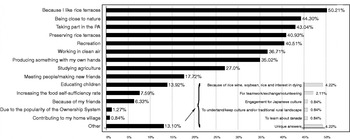
The main motivations for participation in the Ownership System (Fig. 2) are simply ‘love’ for the rice terraces (119 affirmations, 50.2%), ‘being close to nature’, and ‘taking part in the PA’ (105 and 102 affirmations). The conservation of the rice terraces itself lies in fourth place. From an economic point of view, the Ownership System has no real relevance as a straight food production system, since the size of the fields is relatively small and the self-produced food altogether comparatively costly—it would be cheaper to buy the rice in the supermarket. This is possibly also an explanation for why only 10 persons indicate that their participation is directly due to the production of rice, soybean or rice wine and dyeing. Even if the self-produced goods are not the key impetus for participation, it can be assumed that they are an important ‘by-product’ with an ideal value, which the tenants are proud of: ‘They eat the harvested products themselves or give them to friends on special days, e.g. on commemoration days or for their friends' party.’ (EI: director, November 14, 2010).
Tenants' motivation for participating in the ownership system (897 valid answers from 237 persons) given in average numbers (figure based on Kieninger et al.Reference Kieninger, Yamaji and Penker28). The question is semi-open (the indication of a maximum of five reasons for participating was allowed). Apart from the 14 preformulated answer categories, there was also the possibility to provide an individual answer. These open answers were coded and are shown together with the respective percentages on the right-hand side of the figure.

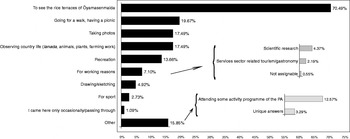
The main reason (70.5%) why the visitors come to Ōyamasenmaida is to see the rice terraces (Fig. 3). Almost all of the other reasons have some connection with the rice terraces too. Among the open answers the attendance of traditional cultural events such as sushi-, tofu- or miso-producing festivals prevails. These ‘festivals’ are traditional events related to the cultivation of rice and soybeans (on some of the rice terraces soybeans are grownReference Kieninger, Yamaji and Penker28), and the visitors come to experience them in the authentic ‘environment’. In summary, 92.6% of the visitors come to Ōyamasenmaida because of the terrace landscape.
Visitors' motivation to come to Ōyamasenmaida (312 valid answers from 183 persons) given in average numbers. The question is semi-open (the indication of a maximum of five reasons for participating was allowed). Apart from nine preformulated answer categories, there was also the possibility to provide an individual answer in the category ‘other’ and ‘for working reasons’. The open answers are shown together with the respective percentages on the right-hand side of the figure.

Esthetics
Attractive attributes of Ōyamasenmaida deserving protection
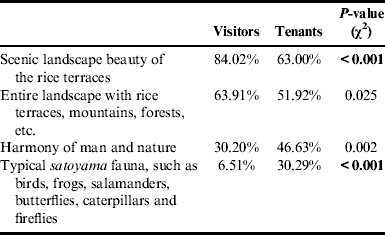
In order also to obtain an insight into the local attributes most attractive to visitors and tenants, they were asked to select from a list of predetermined answers what they regard as most impressive (visitors) or most important to conserve (tenants). A maximum of three answers was allowed. Visitors could choose from nine, and tenants from eight possibilities (Table 1). Additional personal comments were provided by 10 visitors and one tenant.
Important traditional rural landscape attributes from the viewpoint of visitors (n=184; 17 persons chose one attribute, 32 two and 120 three; n.a.=15) and tenants (n=248; six persons chose one attribute, 72 and 195 three; n.a.=40). P-values given for the Pearson's chi-squared test with Yate's continuity correction; P-values for significant terms at the 0.001-level are given in bold.
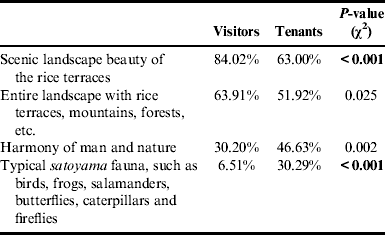
Other arguments: ‘To activate regional economy’ (QT 95); ‘Croaking of the frogs’ (QV 54 & 92); ‘Culture’ (QV 19); ‘That Ōyamasenmaida is in good condition’ (QV 31); ‘Mr. Ishida [annotation: the director] is hard working and cheerful’ (QV 51); ‘Rain and the rice terraces’ (QV 55); ‘Company, meeting people, talking, community, making friends’ (QV 72); ‘Miso-making experience’ (QV 117); ‘Rice terraces prevent landslides’ (QV 170); ‘The activity to vitalize this area’ (QV 179).
For both visitors and tenants the ‘scenic landscape beauty, particularly the rice terraces’ is the most attractive attribute [142 visitors (n=184, n.a.=15) and 131 tenants (n=248, n.a.=40); see also Table 1]. Also the ‘entire landscape’ (108 visitors and 108 tenants) and, thirdly, the ‘harmony of man and nature’ are very often mentioned, the latter, however, with a reverse weighting, as this attribute seems to be more relevant for the tenants. Clearly visible is the differing importance of the ‘typical satoyama fauna, such as birds, frogs, salamanders, butterflies, caterpillars and fireflies’ between tenants and visitors. For 63 tenants, the fauna belongs to the most important things to conserve in Ōyamasenmaida, but only 11 visitors regard it as the most impressive part of this landscape. This difference is highly significant.
Landscape perception
From Figure 4 it is clear that both groups perceive the landscape as beautiful: 223 tenants (97.81%) and 146 visitors (91.25%) describe the landscape of Ōyamasenmaida as ‘beautiful’ or ‘very beautiful’; the tenants, however, give slightly higher, albeit significant, valuations, as they perceive ‘their’ landscape, the place where they work with their hands, as significantly more beautiful than the visitors just passing by. Significant differences can also be identified between the two groups regarding the ‘inspiring quality’ and the ‘uniqueness’ of the landscape. Very high agreement in numbers and on average (Fig. 4) can be detected on the landscape parameters ‘harmony of man and nature’ and ‘traditional (landscape)’.
View of tenants and visitors regarding different landscape parameters, measured with the semantic differential on a 5-scale barReference Paier70. In a t-test, significant differences in the landscape perception of Ōyamasenmaida between visitors and tenants can be found for the parameters ‘boring–inspiring’, ‘standard–unique (landscape)’ and ‘ugly–beautiful’. Significant differences between mean values are marked with *, if significant at the 0.05 level, and with **, if significant at the 0.01 level.

A very surprising result from a European point of view, and confirming our hypothesis that nature and cultural landscape (traditional rural landscape) are comprehended by Japanese people as a union, is that even though Ōyamasenmaida—a 1000-year-old rural landscape formed and shaped by humankind—is characterized by 83.78% of the tenants (n=248; n.a.=26) and 87.74% of the visitors (n=184; n.a.=29) as a traditional/very traditional landscape, it is described by a comparatively high number of tenants (27.95%; 64 of 248, n.a.=19) and visitors (29.75%; 47 of 184, n.a.=26) as a ‘very untouched’/‘untouched’ landscape. The director of the Ōyamasenmaida Ownership System says this: ‘The nature of Ōyamasenmaida is not the ‘real nature’. People created it. … It is not a mountain or a virgin forest without human influence, but a rice field made by humankind. … In Minamiboso, Chibaken, Kamogawa there is no … forest, which one can call a virgin forest. What the tenants define as nice nature is cultural landscape.’ (EI: director, November 14, 2010).
Overall both groups perceive the landscape similarly.
Photo-based landscape evaluation
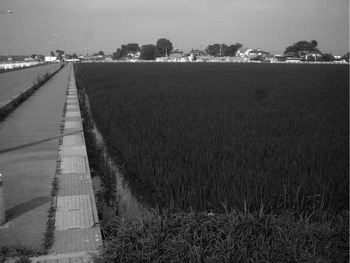
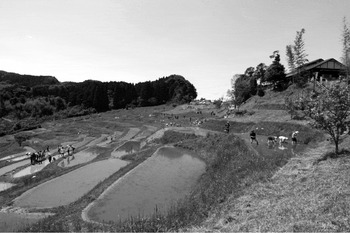
A photo of an ‘ordinary’ contemporary Japanese paddy field (Fig. 5) was inserted in the questionnaire. The tenants were asked in a closed question (yes/no) whether they would participate in the activities of the PA if the Ōyamasenmaida landscape (Fig. 6) resembled that shown in Figure 5; in a second step they were asked to explain their decision in an open answer with ‘why yes/why no’.
In contrast to the rice terraces of Ōyamasenmaida (Fig. 6) this paddy field (Chiba prefecture) is comparatively large. It lies in the plain and is located adjacent to a bicycle/footpath and a straight single lane road.

The tanada landscape of Ōyamasenmaida is located in the midst of the hills (80–150 m above sea level). The size of the terraces ranges from 20 to 900 sqm67. Forest and bamboo groves are in the background. The road skirts the terraces on the right.

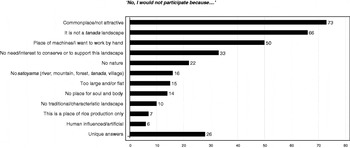
Of the 225 respondents (n=248, n.a. 23), 82.22% would cease their participation in Ōyamasenmaida if the landscape resembled Figure 5, while 17.77% (13 female and 27 male) would continue. The open answers were translated and coded (Figs. 7 and 8). The most frequent category (36.17%) of ‘Yes, I would participate because…’ (Fig. 7) is: ‘I would like to experience and/or support agriculture’. For these interviewees, the agricultural activity itself has priority rather than the environment or landscape, e.g., ‘I think the agricultural activity would be the same’ (QT 28). ‘The main purpose was to experience farming activities for myself’ (QT 34). ‘It is still connected to agriculture’ (QT 204). ‘My interest is in agricultural production. If the area is large, I will participate [by cultivating] a part of it’ (QT 219).
Reasons for continuing the ownership system on a paddy field such as the one shown in Figure 5 (47 arguments from 35 people).

Reasons for ceasing participation if Ōyamasenmaida resembled the plain paddy field shown in Figure 5 (340 arguments from 168 people).

The second most frequent categories expressing acceptance were: ‘This landscape is also nice and/or it is also nature’ and ‘My main focus is not tanada and/or nice scenery’ (each with eight answers). These tenants regard the rice field shown in Figure 5 as a good place of nature or rather state directly that the main focus of their participation in Ōyamasenmaida is not nice scenery or tanada: ‘Yes, I would participate because’: ‘I am interested in agriculture and nature, even if it is not tanada.’ (QT 36), ‘Landscape is great.’ (QT 127), ‘I want to get in touch with nature.’ (QT 146) or ‘I would like to experience agriculture itself rather than merely enjoying the scenery’ (QT 153), etc.
Most prevalent among ‘No, I would not participate because…’ (Fig. 8) is with 21.47% of the category ‘Common place and/or not attractive’, followed by, and often linked to ‘It's not a tanada landscape’ (19.41%), e.g., ‘I can see this kind of landscape anywhere. If it were not tanada, there would be no special reason to visit Ōyamasenmaida.’ (QT 17), ‘In my neighborhood there are paddies, but I am attracted by tanada.’ (QT 71), ‘Such scenery can be seen in my neighborhood. One of the main reasons why I am participating in the activity is that tanada has the most attractive landscape.’ (QT 76).
The third most important point for the tenants is handwork (14.71%). As they want to experience agricultural work manually, large and industrialized fields such as that in Figure 5, where machines can be used for work, are of no interest to them, e.g., ‘The charm of tanada is to experience nature without machines.’ (QT 94), ‘This field can be cultivated by machines and the agricultural environment can therefore be maintained.’ (QT 173), ‘I wanted to obtain experience in agricultural handwork in a rice field, where animals and plants live together.’ (QT 200), ‘This area is more suitable for machines. Tanada can only be cultivated by hand. It is important to protect the heritage of our ancestors and the cultural landscape. I could bring my children and grandchildren to learn to work with their hands. It is very important that children see that handwork is exhausting.’ (QT 211), ‘Tanada landscape is important. Working with machines is no fun. To become active in agriculture is not my goal.’ (QT 221).
The evaluation of the picture clearly shows that beautiful scenery is a highly relevant motivator for the tenants. Scenic beauty is thereby tightly linked to tanada, cultivated in the traditional way by hand. Plain, large and mechanized fields are neither accepted nor are they considered by most of the tenants as something worth protecting or supporting: ‘The tanada landscape seems to me the archetypal scenery of Japan. I am not attracted to places like the one on this photo, which is not satoyama.’ (QT 163), ‘Different from tanada, the scenery is flat and not interesting.’ (QT 206), ‘I didn't just want to engage in agriculture/farming but I was also very interested in the unique scenery of senmaida and its protection.’ (QT 226). Also, the director of the Ownership System confirms a certain preference of the tenants for a rice terrace landscape: ‘… they want to participate [in the Ownership System] in a nice landscape, such as Ōyamasenmaida. Thus … as the city dwellers themselves partake in the Ownership, as they become tenants and take part, thus, the magnificent beautiful landscape is conserved. That is joyful for the city dwellers, for the tenants' (EI: director, November 14, 2010).
Spirituality
In the last question in the questionnaires we asked tenants (n=248, n.a.=14) and visitors (n=184, n.a.=18) whether they have a certain ‘feeling’ for spirits in nature: ‘Do you ever have the feeling that in certain parts of nature such as, for instance, in the mountains, valleys, rice terraces, orchards, streams, lakes, plants, and trees, some kind of spirits live?’ We use the term ‘spirituality’ for the ‘belief’ in spirits (deities or other immaterial, mystical or mythological beings/powers) inherent in nature. It could be questioned, whether ‘to feel spirits’ means to believe in them (PC: Dr Brigit Staemmler, Department of Japanese Studies, University Tübingen, January 13, 2012). We use ‘belief’ in the sense defined by Merriam-Webster, which is: ‘belief is a mental acceptance but may or may not imply certitude in the believer’71.
Two hundred and thirty-four tenants and 166 visitors gave an answer to this question on a five-point scale from ‘always’, ‘often’, ‘sometimes’, ‘rarely’ to ‘not at all’. Additionally, even if not intended, three tenants and one visitor added personal annotations e.g., ‘Everything is divine.’ (QT 223), ‘All nature's workings are divine secret.’ (QT 215), ‘I believe in spirits in the mountains, valleys, terrace fields, little rivers, plants and trees, but not in lakes and orchards.’ (QV 94).
More than half of the tenants (133 persons, 56.84%) have an impression of spirits in nature (18.8% always, 14.53% often, 23.5% sometimes), while 19.66% rarely and 23.5% do not believe in them at all. If we compare this result with the visitors’ sample, we can see that in this group the feeling of spirits in nature (always–sometimes) is a bit lower, by 50%. A significant difference can be identified regarding ‘I always have the feeling of spirits in nature’ between tenants (men and women, 18.8%) and visitors (men and women, 9.64%) (P=0.017) and a highly significant difference between tenantwomen (25.86%) and visitorwomen (8.43%) (p=0.010).
With these results, our hypothesis of a link existing between ‘spirituality’ and participation in voluntary nature conservation activities such as the Ownership System can be partly confirmed. Partly, because the differences are apparent only in the category ‘I always have the feeling of spirits in nature’. The reason, therefore, cannot be explained completely. The director of Ōyamasenmaida argues that the belief in the ‘great nature’ (spirits) is a result of their own food production: ‘Not necessarily only tanada, but the villages and the whole rice culture (in general) have a religious meaning. In the Japanese religion the whole of nature, everything, is kami-sama. The sun, the stones, the trees, the earth, the water, everything is kami-sama. Since the idea of nature as kami-sama is in the hearts of the Japanese people, it is not necessarily the case that particularly rice terraces have such a connotation. … People who live in the cities (don't know) that food is influenced by nature, from nature. … People who participate in the Tanada Ownership System understand this. If you live in the city and you buy food with money, you don't realize it. But if you participate here, you understand that food is cultivated in nature while it is influenced by nature. And then they perhaps think that nature in this sense is magnificent.’ (EI: director, November 14, 2010). However, a connection between duration of participation in the Ownership System and an increased belief in spirits among the tenants cannot be found in our results. Also, concerning age there is only a slight difference between tenants and visitors (52.25 years tenants versus 47.8 years visitors) in the category ‘I always have the feeling of spirits in nature’.
The above-mentioned highly significant difference between tenantwomen and visitorwomen in the category ‘I always have the feeling of spirits in nature’ is remarkable. Regarding age, no difference can be found between these two groups (tenantwomen 47.46 years, visitorwomen 45.17 years). An age difference can therefore also be excluded as a reason here.
Discussion
‘From beauty to duty’Reference Carlson72
It has often been proved that esthetically appealing ‘objects’ such as landscapes, animals or plants create a deeper attachment and greater respect toward nature, influencing people to act in an environmentally friendly manner and to engage in nature conservationReference Saito29, Reference Saito31, Reference Carlson72, Reference Lintott, Carlson and Lintott73. This is the case in many countries, not only in Japan. For example, in the USA, the designation of national parks and wilderness protection in the 19th and 20th centuries was based mainly on esthetic nature appreciationReference Saito31, Reference Carlson72. The esthetic quality of a certain site can even be increased by a ‘label of scenic designation’Reference Anderson74. This happens easily in countries with a collectivist worldviewReference Carlson, Lintott, Carlson and Lintott75. In our study, we asked about the motivation of the tenants to engage in the Ownership System and about the motivation of the visitors to see the site, as well as about the most important landscape attributes. We hypothesized that the attractiveness of the rice terrace landscape scenery played a key role and was an important landscape attribute. Both of these hypotheses could be confirmed.
As Ōyamasenmaida, after its designation to the ‘Top 100 Terraced Paddy Fields of Japan’, was advertised in audio-visual and print media, the number of visitors, often in organized groups, increased rapidly. With a relatively limited length of their stay, their main motivation is to visit the site in order to appreciate the terrace landscape scenery. For the tenants, the situation, however, is a bit different. Even if the catalyst to engage as tenant possibly originates from the landscape beauty of Ōyamasenmaida—HettingerReference Hettinger, Carlson and Lintott76 calls this ‘aesthetic protectionism’—the initial stimulus for participation in the Ownership System changes later from a pure ‘scenery obsession’Reference Carlson72 to a larger environmental view. Although for both, tenants and visitors, the landscape scenery ranges in the first rank, tenants consider the protection of the typical satoyama fauna significantly more important than the visitors do (30.29% versus 6.51%).
For the visitors, Ōyamasenmaida might ‘only’ be one destination among many (3/4 of the visitors know or have already visited similar landscapes before). The tenants, however, through their working commitment, their emotions, social contacts, the sounds and scents of the site, and their memories and thoughts became emotionally attached to this place. That is why they perceive Ōyamasenmaida as significantly more beautiful, more unique and a more interesting place. This finding was also observed by other scientistsReference Ryan, Kaplan and Grese77, Reference Brady, Carlson and Lintott78: ‘When we care about an object of appreciation, we become interested in it. Accordingly, this interest motivates us to look for the object's aesthetic value’Reference Lintott, Carlson and Lintott73. The benefits and disadvantages of esthetically grounded environmentalism are discussed controversially in the scientific communityReference Saito29, Reference Saito31, Reference Lintott, Carlson and Lintott73, Reference Hettinger, Carlson and Lintott76, Reference Brady, Carlson and Lintott78, Reference Brady79, whereby it is often maintained that for sound environmentalism, nature appreciation needs to be serious and morally based and has to change from subjectivism to objectivism, from ego- or anthropocentrism to acentrism, from a scenery (and flagship-species) focus to an environmental focusReference Saito31, Reference Carlson72. However, we think that in order to attract people unconcerned with environmental issues, a less scientific but more emotional approachReference Kieninger, Holzner and Kriechbaum80 would be a more promising way, also outside of Japan. ‘Frequently, one of the main reasons for supporting environmental causes is to preserve beauty. Average citizens wish to preserve scenic landscapes, flowering plants, and attractive animals and will donate their money and sometimes their time to working toward such ends’Reference Lintott, Carlson and Lintott73. This can also be shown in our study: 82.22% of the tenants would cease their participation, if the landscape of Ōyamasenmaida were a large, plain, mechanized paddy field. From this point of view, the bias for nature's beauty should not be dismissed as superficial, but rather seen as an opportunity to attract the interest of potential activists first. Later on, their esthetic appreciation could expand to ecological aspects. This has been successfully demonstrated in Ōyamasenmaida. Starting with a rural–urban exchange of people, collective cultivation and production of rice, soybeans, rice wine, arts and crafts lectures, and common feasting, the PA also tries to arouse the tenants' interest in ecological issues, e.g., the life cycle of fireflies.
Reflecting on the motivations driving voluntary activities for nature conservation, we can state that the tenants were motivated rather by needs belonging to Alderfer's categoriesReference Alderfer81 of growth (including the need for self-development and personal growth and advancement) and relatedness (interpersonal relationships and getting public recognition) than by the actual existence needs, such as quality food or food security.
Taming and cultivating is natural
The Japanese understanding of nature, a result of the interconnection between esthetics and religion since ancient times, has formed the conception of nature and man as a unityReference Nagasawa34, where human influence is hardly viewed as an intrusion into nature. ‘Only when nature is brought into the realm of the known, e.g. tamed, and there are some immediate personal gains, do most Japanese become interested in protecting nature’Reference Kalland, Bruun and Kalland32. Accordingly, we assumed that the Japanese might consider a cultural landscape as untouched nature (hypothesis 3). We could verify this hypothesis, as more than one-quarter of the tenants and visitors perceive the terraced rice terraces of Ōyamasenmaida as untouched/very untouched nature. For this result, we also get support from the literature. Takeuchi reports that the traditional rural landscape in Japan (satoyama) is often regarded as original or untouched natureReference Takeuchi, Takeuchi, Brown, Washitani, Tsunekawa and Yokohari4.
Sense of spirits in nature
‘Measuring’ religiosity or spirituality, particularly in a different cultural context, is difficult and can lead to wrong conclusions. As already mentioned in the Introduction, religiosity and/or spirituality have a different meaning in Japan as opposed to the Western world. In order to avoid this problem, our research question centered on the attitude of tenants and visitors toward nature spirits and we cautiously asked ‘only’ about the general acceptance of the existence of spirits in nature. It can be considered as a main result that 94.35% of the tenants and 90.22% of the visitors did not hesitate to answer this question—a sign that this query did not seem strange or non-sensical to them.
Most of what has been written by different authors up to now about Japanese religiosity reflects their own insights or imaginationReference Manabe46. Empirical studies are still rather fewReference Manabe46. Nevertheless, a Japanese scholar found out that out of 1800 respondents, 30.8% agreed ‘…that souls inhabit everything, such as mountains, rivers, grass, and trees’Reference Manabe46. Our research question is very close to this. Also, in the Tenth Annual Japanese Character Study from 2000, cited by Stark et al., 59% of the interviewees answered that they feel that rivers and mountains have spiritsReference Stark, Hamberg and Miller44. In our study, 56.84% of the tenants and 50% of the visitors (always, often and sometimes) have the feeling that spirits exist in the mountains, valleys, rice terraces, orchards, streams, lakes, plants and trees. If we add the number of persons who have this feeling ‘rarely’, we even reach as much as 76.5% among the tenants and 72.89% among the visitors. This high rate of belief in nature spirits is surprising. However, the limitation of a cross-sectional study, namely the impossibility to distinguish between cause and effect due to a lack of observation over time, becomes particularly evident here, as we have no distinct explanation for the causality of the belief in spirits in nature among tenants and visitors. It could be possible that the special atmosphere (peace, silence, nature, nice landscape and, in the case of the tenants, handwork) of Ōyamasenmaida had an influence on the respondents’ answers and that questioning of the same people, but in the loud and hectic conurbation of Tōkyō, would have led to different results (PC: Dr Birgit Staemmler, January 26, 2012).
Our hypothesis that tenants and visitors imagine differently the way in which nature is inhabited by spirits can be partly confirmed, as significant differences appear only in the category ‘always’. Our assumption that, in contrast to the visitors, who just passed through, the feeling of nature spirits had developed more strongly among the tenants through their long-term involvement could not be confirmed in our research. With respect to age, tenants and visitors do not differ significantly, so that age difference as a reason for this phenomenon can also be excluded. One interpretation for our study could be that the tenants participate because they already have a certain tendency toward traditions and the will to return to nature, to the roots of Japanese culture (PC: Dr Birgit Staemmler, January 26, 2012). Cultivating rice is a good possibility to satisfy these feelings and the belief in nature spirits, in transcendence and otherworldliness is very close to this mental attitude (ibid.). The director of Ōyamasenmaida argues that the tenants became more receptive to kami-sama on account of producing their own food in the midst of ‘great nature’.
Also unanswered is the reason for the highly significant difference between female tenants and female visitors in the category ‘I always have the feeling of spirits in nature’. It can be assumed that among women a high spirituality appears more strongly in direct action (e.g., in participation in the Ownership System) than it is among men, so that the significant differences in our case become obvious only between the female tenants and female visitors.
Conclusions
The case of the Japanese Ownership System indicates that esthetic landscape appreciation can help mobilize an involvement in nature conservation activities. The interviewed volunteers in Ōyamasenmaida are rather more motivated by intrinsic reasons (most of all by the landscape esthetics, but also by nature experience, learning, hand work and socializing with like-minded) than by extrinsic ones (e.g., physical need to produce food, social pressure or approval from outside). Through able guidance (such as that provided by the PA in our case study) which also addresses emotion and fun—through traditional music, theatre and dance festivals, photo awards (for the yearly Ōyamasenmaida calendar), sport events (e.g., ‘mud’ volleyball competition in the rice fields), feasting (karaoke singing and harvest festivals), local food or handicraft workshops, renovation of old traditional houses for common purposes or collective nature experiences (fireflies, autumn moon and torch illuminated rice fields)—the volunteers could develop a broader ecological awareness. In consequence, their interest would also extend to other less attractive places. In Western countries (mainly in Central Europe or North America), nature conservation still works on a more scientific level, mobilizing volunteers through scientific evidence on, for example, losses of species or biodiversity. To also address the motivation of the volunteers on an emotional, esthetic or social level could be a promising way forward.
The extent to which spirituality is the cause for or an effect of active involvement in nature conservation activities cannot be derived from this survey. The subject of future studies could therefore be the question concerning the connection between spirituality (and religiosity) and the engagement in nature conservation activities. Even if a lot of international literature can be found related to the attitudes of religious persons in different fields of life—also those including environmental concerns—none of it addresses the question as to whether spiritual/religious motivation is the reason for engaging in nature conservation activities or whether the engagement itself results in spiritual/religious awareness.
Acknowledgements
The studies in Japan were financed by the German Academic Exchange Service (DAAD) and the Ministry of Education, Culture, Sports, Science, and Technology of Japan (MEXT). We wish to express our heartfelt gratitude to the Ōyamasenmaida Preservation Association, and in particular to Mitsuji Ishida, Yoshiko Sudo and Hitomi Taira, for their contribution and support during and after the fieldwork, as well as to all the tenants and visitors who completed the questionnaire survey. Special thanks are due to the persons who assisted in the translation process, namely to Kentaro Aoki (UNIDO/IIASA, Vienna), Nobuko Morishita (Institute of Oriental Manuscripts, Russian Academy of Sciences), Isabelle Prochaska (Department of Japanese Studies, University of Vienna), Nobuhiko Sawai (Gunma University, Graduate School of Medicine), Ayako Toko (WWF Japan) and Yuko Yoneda (Kyoto Prefectural University). We also wish to extend many thanks to Katharina Bardy of the Institute of Integrative Nature Conservation Research (BOKU-University) for her help with statistical analysis. We very much appreciated the advice of Birgit Staemmler (Department of Japanese Studies, University Tübingen) on Japanese religion and the kindness of Naoki Amako (Assistant Director, Biodiversity Policy Division, Nature Conservation Bureau, Ministry of the Environment, Japan) in allowing us to consult him on environmental data. In addition, we are indebted to Vivien Landauer for taking the time to edit the manuscript, and to the anonymous reviewers for providing their very helpful comments. Last, but not least, the corresponding author particularly would like to express her sincere thanks to Wolfgang Holzner (BOKU-University) for his kind suggestions, unwavering support and continual encouragement.