Introduction
The life cycle of species of Gordiida consists of two free-living phases inhabiting freshwater environments (adult and larva) and a phase parasitizing arthropods.
The morphology and taxonomy of Gordiida are well known (Camerano, Reference Camerano1897; Schmidt-Rhaesa, Reference Schmidt-Rhaesa, Schwoerbel and Brauer1997; De Villalobos et al., Reference De Villalobos, Zanca and Schmidt-Rhaesa2004, Reference De Villalobos, Zanca, Schmidt-Rhaesa and Achiorno2006, Reference De Villalobos, Zanca and Salas2008; De Villalobos & Zanca, Reference De Villalobos and Zanca2005; Schmidt- Rhaesa et al., Reference Schmidt-Rhaesa, De Villalobos and Zanca2008), as are their life cycles (De Villalobos & Ronderos, Reference De Villalobos and Ronderos2003; De Villalobos et al., Reference De Villalobos, Rumi, Núñez, Schmidt-Rhaesa and Zanca2003; Hanelt & Janovy, Reference Hanelt and Janovy2003, Reference Hanelt and Janovy2004; Schmidt-Rhaesa et al., Reference Schmidt-Rhaesa, Biron, Joly and Thomas2005; Zanca et al., Reference Zanca, De Villalobos and Rumi2007) and distribution (Miralles & De Villalobos, Reference Miralles and De Villalobos1993a, Reference Miralles and De Villalobosb). However, this is not the case for their general ecology and few studies on seasonality in these animals have been published. Outstandong among these are Bolek & Coggins (Reference Bolek and Coggins2002) on Gordius difficilis from Wisconsin, and Schmidt-Rhaesa et al. (Reference Schmidt-Rhaesa, Biron, Joly and Thomas2005) on Paragordius tricuspidatus and Spinochordodes tellinii. Reports on sex ratios of adult gordiids are often contradictory (Wu & Tang, Reference Wu and Tang1933; Pennak, Reference Pennak1978; Chandler, Reference Chandler1985; Valvassori et al., Reference Valvassori, Scarì, De-Eguileor, Lernia, Magnetti and Melone1988; Poulin, Reference Poulin1996; Cochran, Reference Cochran1999; Thomas et al., Reference Thomas, Schmidt-Rhaesa and Poulin1999; Bolek & Coggins, Reference Bolek and Coggins2002; Cochran et al., Reference Cochran, Newton and Korte2004, Hanelt, Reference Hanelt2009).
This paper presents new information on sexual size dimorphism, sex ratios, and the relationship between seasonal occurrence and physicochemical variables of water in Chordodes brasiliensis Janda 1894, Noteochordodes cymatium (De Villalobos, Zanca and Salas, Reference De Villalobos, Zanca and Salas2008), Noteochordodes talensis (Camerano, Reference Camerano1897) and Pseudochordodes dugesi (Camerano 1898) from El Simbolar stream, Argentina.
Materials and methods
Specimens of C. brasiliensis, N. cymatium, N. talensis and P. dugesi were collected during spring (4 November and 5 November), summer (3 January and 4 January), autumn (20 March and 21 March) and winter (1 July and 2 July) 2008 at El Simbolar stream (28°40′37.6″S–66°03′18.0″W). This stream flows east of the Ambato-Manchao mountain range, in the Precambrian Pampean Ranges Domain (Capayán, Catamarca Province), Argentina (Nullo, Reference Nullo1981). It flows within the arid climatic belt; annual precipitation there ranges from 200 to 350 mm. The most rainy months are December, January and February.
Collecting stations stretched along 200 m of the stream, which at the site measured from 3.95 to 4.40 m wide. Horsehair worms were detected by visual inspection and collected by hand. Outstretched worms were measured with a ruler. The sex of the worms was determined under a stereomicroscope.
All specimens collected were washed and cleaned ultrasonically for 3 min in water with rinse-off eye make-up solvent (Clinique®, Clinique Laboratories, New York, USA). Three rounds of rinsing with distilled water were followed by dehydration in an increasing ethanol series. From the middle region of the body, one piece of cuticle of each specimen was cut longitudinally (2 mm long) using a scalpel with a pointed blade (Schmidt-Rhaesa, Reference Schmidt-Rhaesa2002). Internal tissue was removed by soaking in lactophenol for 3 h. Cuticle was observed under light microscopy. Specimens were identified as in previous reports (De Villalobos et al., Reference De Villalobos, Zanca and Schmidt-Rhaesa2004, Reference De Villalobos, Zanca and Salas2008).
Specimens were fixed in 70% alcohol and then deposited in the Invertebrate Collection of the Natural Science Museum at the University of La Plata (Argentina) under the following catalogue numbers: Chordodes brasiliensis (MLP 5762, MLP 5763, MLP 5761, MLP 5760, MLP 5758, MLP 5759, MLP 5757); Noteochordodes cymatium (MLP 5764, MLP 5765, MLP 5766, MLP 5767, MLP 5768, MLP 5769); Noteochordodes talensis (MLP 5708, MLP 5789, MLP 5791, MLP 5792, MLP 5793) and Pseudochordodes dugesi (MLP 5776, MLP 5777, MLP 5778).
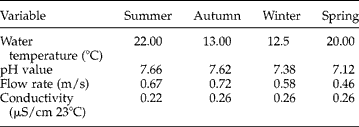
In situ physicochemical characteristics such as water temperature, pH and conductivity (Jenco multimeter, Jenco Incego Systems Inc., San Diego, California, USA) and flow rate (Gurley digital 1100, Gurney Precision Instruments, New York, USA) were recorded during each sampling event, which were, in all cases, during the morning.
Data were subjected to a series of analyses including contingency table, goodness of fit, binomial and t-test, using SPSS v. 1.10 (SPSS Inc., Chicago, Illinois, USA), and canonical correlation analysis (CCA) using Multivariate Statistical Package (Kovach Computing Service, Anglesey, UK).
Results
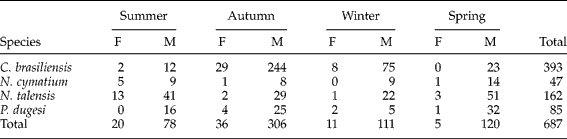
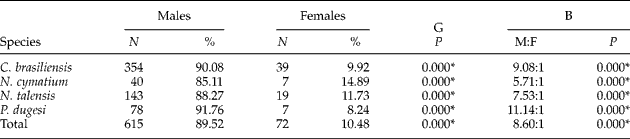
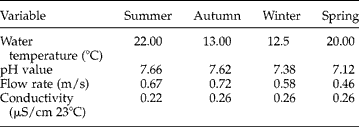
A total of 687 free-living specimens of C. brasiliensis, N. cymatium, N. talensis and P. dugesi were collected during a period of 1 year from El Simbolar stream (table 1). Although this stream carries water throughout the year, a moderate increase in water volume was observed in summer and early autumn. Flow rate decreases in winter and spring (see table 8).
Seasonal abundance of males (M) and females (F) of Gordiida species in the El Simbolar stream.
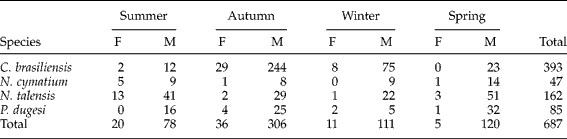
Total number of worms of these four species was higher during autumn (49.78%), decreasing in spring (18.20%) and the lowest counts were during winter (17.76%) and summer (14.26%) (tables 1–3). Chordodes brasiliensis was the dominant species in the stream mainly during autumn (table 1). Also, we observed that all four species, i.e. C. brasiliensis, N. cymatium, N. talensis and P. dugesi, were sympatric all year round.
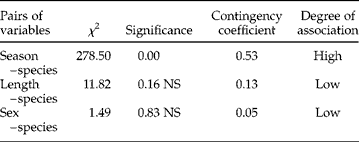
Contingency coefficient values between variables.
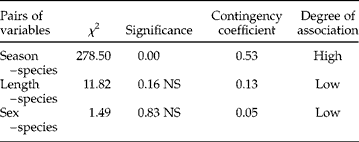
NS, non-significant.
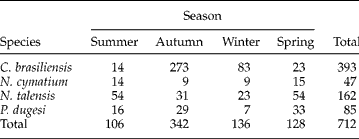
Contingency table between species–seasons.
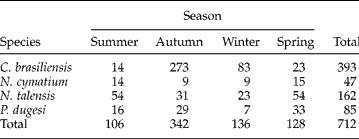
χ2 278,50; P < 0.000; C, 0.53.
Tests of association between variables (contingency coefficient): species–seasons showed that C. brasiliensis, N. cymatium, N. talensis and P. dugesi are strongly associated with seasons (χ2, P < 0.000; C, 0.53), while length–species and sex–species associations were low (table 2). A contingency table shows that a higher frequency of C. brasiliensis occurred in autumn, N. talensis in summer and spring, while P. dugesi and N. cymatium occurred more frequently in spring (table 3).
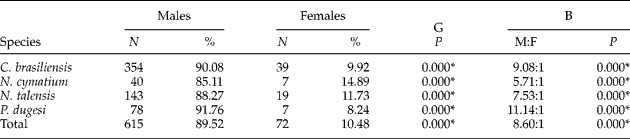
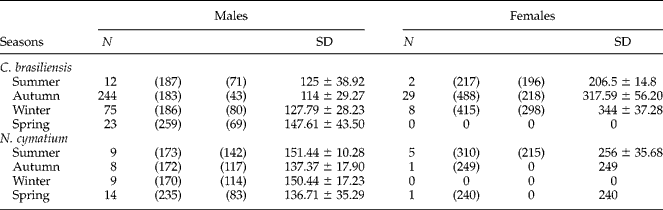
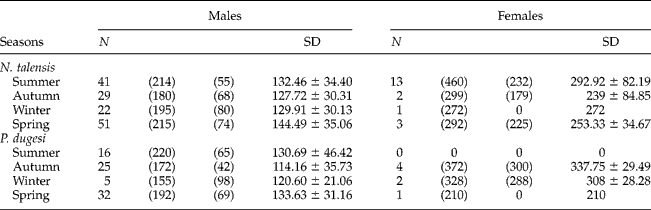
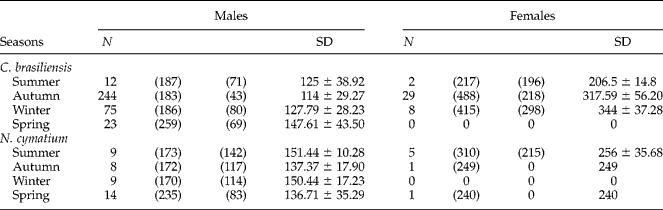
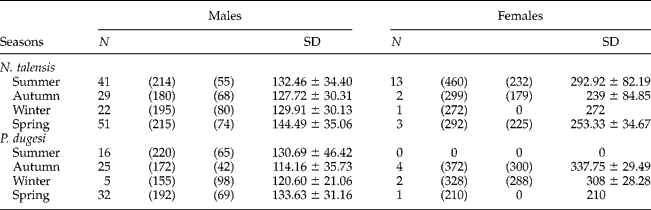
Males were significantly more abundant than females in all cases (χ2, P < 0.000). Male:female sex ratio differs significantly from a 1:1 ratio (B, P < 0.000) in all species studied (tables 1, 4 and 5). Dimensions by sex revealed that female average length was greater than male average length. Differences observed between body length of males and females of each species were statistically significant (t, P < 0.000) (table 5). Females of C. brasiliensis showed the longest (488 mm) length in autumn followed by a female of N. talensis (460 mm) in summer, and the shortest was a female of N. talensis in autumn (tables 6 and 7). One male of C. brasiliensis was longer (259mm) than the males of the other species studied in all seasons (table 6). The shortest was P. dugesi (42 mm) in autumn (table 7).
Abundance and sex ratio of males (M) and females (F) of Gordiida species in the El Simbolar stream. N, number examined; P, P value; *, indicates that differences were statistically significant; G, goodness of fit; B, binominal test.
Number (N) and length of males and females of Gordiida species in the El Simbolar stream. Mean length in brackets; P, P value; D, mean difference; SL, superior limit; IL, inferior limit; CI, confidence intervals.

Number (N), length of males and females of C. brasiliensis and N. cymatium in the El Simbolar stream. Maximum and minimum length in brackets; SD, standard deviation.
Number (N), length of males and females of N. talensis (a) and P. dugesi (b) in the El Simbolar stream. Maximum and minimum length in brackets; SD, standard deviation.
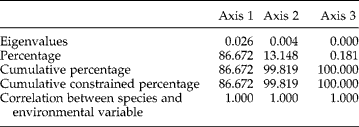
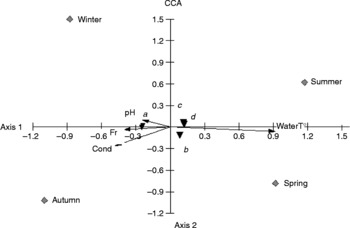
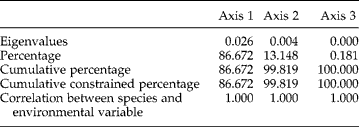
For canonical correlation analysis we studied four species: C. brasiliensis, N. cymatium, N. talensis and P. dugesi; and four environmental variables: water temperature, pH, electrical conductivity and flow rate (tables 8 and 9, fig. 1). Axis 1 and Axis 2 explained 99.8% of the variance between abundance of species in the four seasons and in the four environmental variables. Noteochordodes cymatium, N. talensis and P. dugesi are located in the positive and negative sectors of axis 2 and are the three species that better correlate with water temperature. They were more abundant in spring and summer, while C. brasiliensis correlates better with pH and flow rate. This species showed the highest values of abundance in autumn and winter.
Physicochemical characteristics of water in different seasons in the El Simbolar stream.
Canonical correlation analysis (CCA) between environmental variables (i.e. pH, flow rate, conductivity and water temperature) and seasonal occurrence of C. brasiliensis, N. cymatium, N. talensis and P. dugesi in the El Simbolar stream.
Canonical correlation analysis (CCA) between environmental variables: pH; flow rate (Fr); conductivity (Cond) and water temperature (WaterT°), and seasonal occurrence of Chordodes brasiliensis (a), Noteochordodes cymatium (b), N. talensis (c) and Pseudochordodes dugesi (d) in the El Simbolar stream.

Discussion
Until present, studies on seasonal occurrence and sex-related size dimorphism of nematomorphs have been few. Wu & Tang (Reference Wu and Tang1933) pointed out that females of Chordodes moutoni are longer than males. Similar results were obtained by Poinar (Reference Poinar, Thorp and Covich1991) for Euchordodes nigromaculatus, Gordionus diblastus and Gordius robustus; by Chandler (Reference Chandler1985) for Chordodes morgani; by Degrange & Martinot (Reference Degrange and Martinot1996) for Gordius valnoxius; by Cochran et al. (Reference Cochran, Newton and Korte2004) for Gordius difficilis, and by Schmidt-Rhaesa et al. (Reference Schmidt-Rhaesa, Biron, Joly and Thomas2005) for Paragordius tricuspidatus and Spinochordodes tellinii. Results of the present study agree with those studies, as all analysed males (n = 615) of C. brasiliensis, N. cymatium, N. talensis and P. dugesi measured less than females. It is important to note that females of C. brasiliensis rendered the longest body average length in autumn (488 mm).
Published studies on seasonal occurrence are also scarce. Chandler (Reference Chandler1985) pointed out that adults of C. morgani in Tennessee were found during spring and early autumn. Poulin (Reference Poulin1996) reported that females of Gordius dimorphus in New Zealand were more numerous in spring, but that the male proportion was higher in summer. These results contradict those of Bolek & Coggins (Reference Bolek and Coggins2002), who stated that occurrence of males and females of G. difficilis in Wisconsin varied according to season. Females were generally more abundant in summer while males were so in spring. Schmidt-Rhaesa et al. (Reference Schmidt-Rhaesa, Biron, Joly and Thomas2005) stated that P. tricuspidatus and S. tellinii show differences in their seasonal occurrence in southern France. Paragordius tricuspidatus was found from June to early August while S. tellinii was found in August and September. The present investigation showed that the highest occurrence of C. brasiliensis was during autumn followed by winter, N. cymatium and N. talensis in spring and summer, while P. dugesi occurred at highest levels in autumn and spring. All of these species were also collected in winter (122 specimens, 17.76%). Although this fact is interesting considering that in previous studies specimens were not recorded in this season, it should be noted that these previous studies were carried out in temperate regions of the world where water bodies inhabited by the worms freeze solid for many months. The present study was carried out in a subtropical region, where climatic and biotic variations are far less dramatic. This last point – together with our field observations – suggests that occurrence of the studied gordiids throughout the year (and especially in winter) would be associated with the presence of potential paratenic and definitive hosts in all seasons (unpublished data). Relatively stable temperatures in the study area during different seasons (average maximum temperature 27.3°C and average minimum temperature 15.2°C; National Weather Service, Argentina, http://www.meteofa.mil.ar) support ecological relationships of these species and their hosts.
Several studies have dealt with sex rates, although most results are contradictory. Analysis of collections assembled by Pennak (Reference Pennak1978) and Valvassori et al. (Reference Valvassori, Scarì, De-Eguileor, Lernia, Magnetti and Melone1988) reveals that the two sexes appear in the same proportion. Chandler (Reference Chandler1985) reported that in four consecutive collecting years in Tennessee the number of male specimens of Paragordius varius captured was almost twice the number of females. Thomas et al. (Reference Thomas, Schmidt-Rhaesa and Poulin1999) studied E. nigromaculatus in New Zealand, where they collected 61 males but no female specimen. Cochran (Reference Cochran1999) pointed out that the quantity of females of G. robustus surpassed that of males. Cochran et al. (Reference Cochran, Newton and Korte2004) reported that the male ratio of G. difficilis in Wisconsin and Minnesota was higher than the female one. Laboratory experiments by Hanelt (Reference Hanelt2009) revealed that male and female ratios are equal for P. varius. The present analysis of C. brasiliensis, N. cymatium, N. talensis and P. dugesi shows that in all seasons males were more frequent than females, but especially in autumn. Ecological causes – which can influence the sex ratio in nature – have never been empirically investigated. The present observations indicate that males are much more active than females, as they develop movements; thus they are easy to spot and capture. Once females mate they hide under rocks or debris and hardly move. They also die shortly after oviposition, which could explain why they are found in lower numbers.
Our field observations indicate that male specimens of all species studied are found in groups of 3–6 individuals; few worms occur alone. It may be possible that, as proposed by Poulin (Reference Poulin1996), the difference between the number of male and females collected could be attributed to accumulation of males towards the end of the mating season. Likewise, if males do not copulate, they can live for long periods, i.e. 2–3 months (Dorier, Reference Dorier1930), a fact increasing their chances of being collected.
Schmidt-Rhaesa et al. (Reference Schmidt-Rhaesa, Biron, Joly and Thomas2005) reported that P. tricuspidatus and S. tellinii are sympatric species. Our study shows that C. brasiliensis, N. cymatium, N. talensis and P. dugesi are also sympatric species, and that they showed a relationship between seasonal occurrence and physical variables of water (water temperature and flow rate) of El Simbolar stream, Argentina.
Acknowledgements
We would like to thank two anonymous reviewers for constructive comments on the manuscript.