


Introduction
Exposure-based interventions belong to the most effective therapeutic approaches concerning the treatment of pathological anxiety, such as panic disorder with or without agoraphobia (Mitte, Reference Mitte2005; Sanchez-Meca et al., Reference Sanchez-Meca, Rosa-Alcazar, Marin-Martinez and Gomez-Conesa2010), generalized anxiety disorder (Hoyer et al., Reference Hoyer, Beesdo, Gloster, Runge, Hofler and Becker2009), specific phobia (Wolitzky-Taylor et al., Reference Wolitzky-Taylor, Horowitz, Powers and Telch2008), but also post-traumatic stress disorder (PTSD; McLean and Foa, Reference McLean and Foa2013) or obsessive compulsive disorder (OCD; Foa et al., Reference Foa, Liebowitz, Kozak, Davies, Campeas and Franklin2005). Consequently, in the USA (American Psychiatric Association, 2011; National Institute for Clinical Excellence, 2011) as well as in Germany, exposure forms one of the core elements of cognitive behavioural therapy (CBT)-based treatment protocols and is recommended as first-line treatment with regard to anxiety disorders (Bandelow et al., Reference Bandelow, Lichte, Rudolf, Wiltink and Beutel2015), OCD (Hohagen et al., Reference Hohagen, Wahl-Kordon, Lotz-Rombaldi and Muche-Borowski2015), and PTSD (Flatten et al., Reference Flatten, Gast, Hofmann, Knaevelsrud, Lampe and Liebermann2011).
The application of exposure derives from models of extinction learning and can therefore be considered as its clinical representative. Behavioural treatments use experimentally established learning principles in order to eliminate irrational fear responses. Therefore, the patient is usually confronted with the phobic stimulus or situation without the occurrence of anticipated aversive consequences. Repeated and prolonged exposure is expected to result in decreasing anxiety responses, which has been conceptualized as a habituation process (Wolpe, Reference Wolpe1958). Others have pointed out that a central mechanism during extinction is inhibitory learning. This implies that the learned association between phobic stimulus and aversive consequence is not erased, but kept intact as new secondary inhibitory learning develops (Bouton, Reference Bouton1993), i.e., the person learns that the phobic stimulus does not lead to the feared consequence, and therefore the originally association learned during fear conditioning is inhibited (Craske et al., Reference Craske, Treanor, Conway, Zbozinek and Vervliet2014). Cognitive theories have postulated that anxiety disorders result from distorted beliefs focusing on physical and psychological threat (Beck et al., Reference Beck, Emery and Greenberg1985). In this sense, exposure interventions are considered as a method to challenge threat beliefs and to help patients to identify and correct these cognitions to reduce their fear.
The role of the therapist during exposure mainly involves accompanying the patient, which implies to motivate the patient to encounter the phobic stimulus, and to support the realisation of exposure according to the rationale, i.e., to prevent the employment of safety behaviour or (cognitive or behavioural) avoidance by the patient (Gloster et al., Reference Gloster, Wittchen, Einsle, Lang, Helbig-Lang and Fydrich2011; Salkovskis et al., Reference Salkovskis, Clark, Hackmann, Wells and Gelder1999). Ideally, during exposure, the therapist should illustrate that he/she can handle the situation and is able to tolerate and endure patient's fear reaction or even panic attacks that might occur (Lang et al., Reference Lang, Helbig-Lang, Gloster, Richter, Hamm and Fehm2012). Accordingly, it is conceivable that also for therapists the application of exposure interventions is potentially challenging. Indeed, the challenging nature of exposure sessions has been shown in two studies reporting increased psychological and physiological stress responses in novice psychotherapists when performing exposure compared with regular therapy sessions (Schumacher et al., Reference Schumacher, Gaudlitz, Plag, Miller, Kirschbaum and Fehm2014, Reference Schumacher, Miller, Fehm, Kirschbaum, Fydrich and Ströhle2015).
Despite its well-established effectiveness, exposure seems to be poorly disseminated in clinical practice (Powers and Deacon, Reference Powers and Deacon2013). This notion is mainly supported by studies from the USA (Becker et al., Reference Becker, Zayfert and Anderson2004; Freiheit et al., Reference Freiheit, Vye, Swan and Cady2004; Gunter and Whittal, Reference Gunter and Whittal2010; Hipol and Deacon, Reference Hipol and Deacon2013). Evidence regarding dissemination of exposure in Germany is scarce with only few existing studies, however, pointing into the direction of insufficient usage (Böhm and Külz, Reference Böhm and Külz2008; Roth et al., Reference Roth, Siegl, Aufdermauer and Reinecker2004; Schulte et al., Reference Schulte, Künzel, Pepping and Schulte-Bahrenberg1992). A recent study among Dutch cognitive behavioural therapists revealed that the majority of therapists reported to apply exposure in the treatment of anxiety disorders and OCD (Sars and van Minnen, Reference Sars and van Minnen2015).
Current lines of research focus increasingly on the considerable gap between exposure, as an effective, empirically supported method on the one hand, and the interventions that therapists actually use in their treatments on the other hand. Various factors are discussed which might contribute to therapists’ reservations regarding the execution of exposure, such as negative attitudes (Deacon et al., Reference Deacon, Farrell, Kemp, Dixon, Sy, Zhang and McGrath2013), limited training opportunities (Harned et al., Reference Harned, Dimeff, Woodcock and Skutch2011) or ethical concerns (Olatunji et al., Reference Olatunji, Deacon and Abramowitz2009). Farrell and colleagues (Reference Farrell, Deacon, Dixon and Lickel2013a) proposed that specifically three different domains of negative concerns could be identified in therapists regarding employment of exposure: first, exposure is considered as potentially harmful; second, therapists are afraid that patients might not tolerate it; and third, exposure is regarded as unethical. These reservations might impact the application of exposure and contribute to the fact that exposure is not performed when indicated (underutilized) and that it is delivered in an inappropriate way (e.g. overly cautious, see also Farrell et al., Reference Farrell, Deacon, Kemp, Dixon and Sy2013b). Given the therapist's role during exposure, it is furthermore conceivable that therapists’ own fears and insecurities and the experience of stress in unpractised therapists (Schumacher et al., Reference Schumacher, Gaudlitz, Plag, Miller, Kirschbaum and Fehm2014, Reference Schumacher, Miller, Fehm, Kirschbaum, Fydrich and Ströhle2015) might be associated with the under-usage of exposure.
In order to empirically examine the distribution and extent of negative practitioner beliefs about exposure, Deacon and colleagues (Reference Deacon, Farrell, Kemp, Dixon, Sy, Zhang and McGrath2013) developed the Therapist Beliefs about Exposure Scale (TBES). With 21 items, the scale was suggested as a reliable and valid measure for therapists’ concerns and reservations regarding the employment of exposure. The authors reported a single-factor structure of the scale and significant correlations with reservations about the application of exposure in the context of hypothetical cases presented in the form of case vignettes. Due to the presumed under-usage of exposure interventions in Germany and potentially existing reservations towards exposure on the side of German cognitive behavioural (CB) therapists, an available measure in the German language for investigation of negative practitioner beliefs is indicated. Hence, the present study aimed at translating and validating a German version of the TBES in a sample of licensed CB therapists in Germany. Accordingly, it is intended to examine (1) the item characteristics, (2) the factor structure, as well as (3) the concurrent validity of the German TBES. It is hypothesized that the German version of the TBES shows (a) appropriate psychometric properties, (b) a single-factor structure, (c) significant correlations with reservations towards the application of exposure presented in case vignettes, and (d) significant correlations with therapist characteristics, such as age, education (master's degree vs PhD) or specialization in the treatment of anxiety disorders.
Method
The study was implemented as a web-based survey and was part of a larger project investigating dissemination of exposure in the treatment of panic disorder, phobic disorders and PTSD among licensed CB therapists in Germany. The survey was created using the software Unipark (www.unipark.de).
Participants
In Germany, licensed psychological psychotherapists and child and youth psychotherapists have to become members of the Psychotherapist Chamber of their home state. Similarly, there is an obligatory membership of licensed medical doctors in the state's Medical Chamber. Therefore, we first approached Psychotherapist and Medical Chambers of all German states and asked them to forward an invitation letter for our web-based survey via electronic mailing lists to all members registered as CB therapists. Furthermore, eligible participants were recruited via the freely accessible online database therapie.de (www.therapie.de/psyche/info), a directory of practitioners providing psychotherapy in Germany. In four German states (Berlin, Hesse, North Rhine-Westphalia and Baden-Wuerttemberg), we circulated an extended version of the survey including two additional case vignettes, which were used for validation purposes. We decided to distribute the extended version only in a subgroup of the sample in order to keep time required for participation in the survey at a reasonable level for most participants. A follow-up e-mail requesting participation was forwarded to all therapists approximately one week after the initial enquiry. All those contacted were asked to transfer the e-mail invitation to colleagues that might be interested in taking part in the study. Due to the unknown number of subjects who received invitations for participation, it is not possible to calculate a precise response rate.
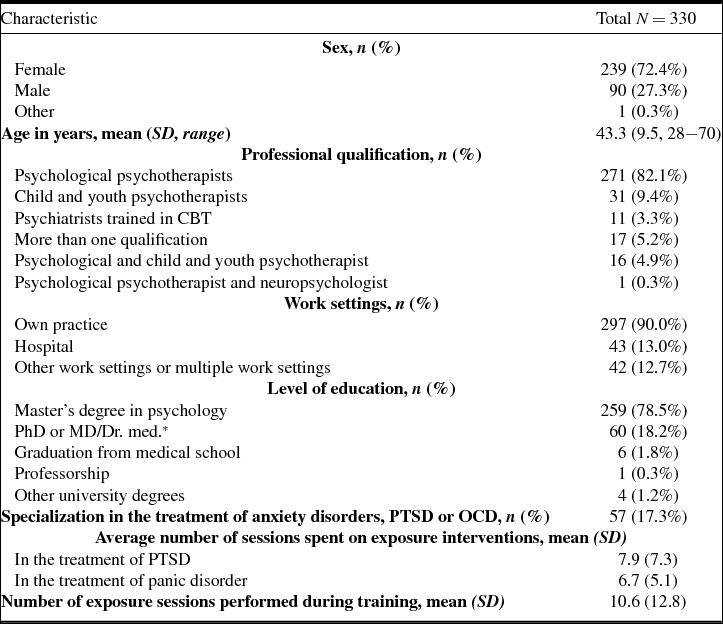
Overall, n = 1307 subjects accessed the link to our survey page; 632 people initiated the survey, while n = 333 completed it. Drop-out occurred mainly during the first part of the survey where participants were asked to provide personal details (e.g. education, clinical training) and information regarding the frequency of application of exposure sessions and cognitive restructuring in clinical practice. However, drop-out during completion of the TBES (1.3%) or the case vignettes (1.7%) was rather low. Three participants had to be excluded (n = 1 did not complete the TBES, n = 1 was still in clinical training, n = 1 stated at the end of the survey that he/she was interested in having a look at the questions but did not answer the items seriously), accordingly n = 330 comprised the final sample. 207 of the 330 (62.7%) participants additionally completed the case vignettes (extended version). Sample characteristics are summarized in Table 1.
Sample characteristics

*In Germany, completion of a doctoral thesis is compulsory for using the title MD/Dr. med. However, doctors can graduate from medical school without completion of a doctoral thesis.
Measurements
Therapist Beliefs about Exposure Scale – German version
In order to generate a German version of the TBES, two members of our research group (author S.S. and S.B.; see Acknowledgements) translated the 21 items of the original version independently into German. Both versions differed marginally. Discrepancies were discussed and a preliminary version of the German TBES was developed. Then, a bilingual native English speaker back translated the items into English. Slight deviations that emerged between the back translated version and the original version were debated until consensus was reached (the German version of the TBES is given in Appendix B).
The TBES assesses negative attitudes towards exposure that can be rated on a 5-point Likert scale from 0 (‘disagree strongly’) to 4 (‘agree strongly’). Higher scores present more pronounced concerns and negative attitudes regarding exposure with a maximum total score of 84.
Case vignettes
To ensure comparability between the validation of the German version of the TBES and the original version, we applied case vignettes that were also employed in the validation study of the English version (Deacon et al., Reference Deacon, Farrell, Kemp, Dixon, Sy, Zhang and McGrath2013). However, as the validation of the German version of the TBES was part of a larger survey, we only used two instead of four case vignettes in order to keep the time required for participation in the survey at a reasonable level. Moreover, as the focus of our larger study was on the treatment of panic disorder, phobic disorders and PTSD, we chose the two case vignettes dealing with a PTSD patient and the one presenting a patient with panic disorder.
Case vignettes are thoroughly described in Deacon et al. (Reference Deacon, Farrell, Kemp, Dixon, Sy, Zhang and McGrath2013). In short, each vignette provides background information on the patient and his/her diagnosis, and a typical exposure session is presented. With regard to the PTSD patient, the exposure session consisted of a repeated and detailed description of the traumatic situation (a rape) to her therapist. In the case of the patient with panic disorder, the exposure session involved walking up and down a stairwell while the medically healthy patient feared to experience a heart attack. After each vignette, participants were asked to rate seven items measuring potential concerns, such as risk of harming the patient, discomfort of the therapist, willingness to provide the presented exposure session, requirement of the task for therapy success, insecurity if the patient would tolerate exposure, ethical concerns or a potential negative impact on the therapeutic relationship, with regard to the exposure session described in the vignette. Participants expressed agreement or disagreement with each item on a 5-point Likert scale ranging from 0 (‘disagree strongly’) to 4 (‘agree strongly’). Total scores ranged from 0 to 28, with higher scores indicating more negative concerns regarding application of exposure.
Again, we followed the same translation procedure that was used for the TBES items (two independent versions translated into German, back translation into English by a native English speaker) to obtain a German version of the two case vignettes. Internal consistency of the items used to assess the vignettes was high, indicating that all answers were highly comparable across all items (case vignette PTSD: Cronbach's α = .91, 95% CI [.90, .93]; panic disorder: Cronbach's α = .92, 95% CI [.90, .93]).
Performance of exposure sessions
In the survey, participants were asked to report the average number of sessions they usually spent on therapist-assisted exposure interventions in the treatment of PTSD and of panic disorder, i.e., average number of session per patient.
Procedure
Data collection took place between February and May 2017. By following the link to the survey, the aim of the study and criteria for eligibility were presented. Then, the policy statement of confidentiality was shown and respondents were given the choice to proceed. The average time that was needed for completion of the survey was: median = 21.6 min (interquartile range [IQR] = 16 min) and median = 25.3 min (IQR = 18 min) for the extended version, including the case vignettes. At the end of the survey, an e-mail address was provided. Participants were instructed to send a notification to this address for entering the lottery to win a voucher for an online shopping website. Hence, it was impossible to trace back participants’ e-mail addresses to the data collected through the survey.
The study protocol was approved by the ethics committee of Freie Universität Berlin, Germany (reference number: 127/2016).
Statistical analyses
First, item-level analyses were conducted. Variables were treated as ordered categorical. Inter-item polychoric correlations (correlations between the ordered-categorical items) and corrected item-total correlations (correlations between the item score and the sum score of the remaining items, polyserial correlation, r it) were computed (small effect: ≥.10; medium effect: ≥.30 and large effect: ≥.50 according to Cohen, Reference Cohen1992). In addition, item difficulties were determined (pi). It should be noted that item difficulty does not refer to answering items in a correct or wrong way, but rather giving more or less symptomatic answers. Low values close to 0 indicate that more participants selected the categories indicating disagreement (more positive attitude) and values close to 1 indicate that more individuals agreed to the corresponding statement (more negative attitude). The item difficulty is closely related to the mean item score (mean divided by k – 1, where k is the number of response categories) (Eid and Schmidt, Reference Eid and Schmidt2014; Kelava and Moosbrugger, Reference Kelava, Moosbrugger, Moosbrugger and Kevala2012). In addition, the relative information content (H) was computed to characterize the dispersion of received answers. While the standard deviation takes a maximum value when both extreme categories are selected equally often with no individual selecting the middle categories, H takes the maximum value of 1 when all categories are selected equally often (optimal situation to depict differences between individuals) (Eid and Schmidt, Reference Eid and Schmidt2014). H was therefore favoured.
In a second step, a confirmatory factor analysis (CFA) was performed to test the single-factor solution proposed by Deacon and colleagues (Reference Deacon, Farrell, Kemp, Dixon, Sy, Zhang and McGrath2013). Model fit was evaluated using the root mean square error of approximation (RMSEA) with the corresponding 90% confidence interval (0 ≤ RMSEA ≤ .05 indicating good fit, .05 < RMSEA ≤ .08 acceptable fit) and the comparative fit index (CFI; .97 ≤ CFI ≤1.00 very good fit, .95 ≤ CFI < .97 indicating good fit; Schermelleh-Engel et al., Reference Schermelleh-Engel, Mossbrugger and Müller2003) as well as the χ2-test of exact model fit. Modification indices were assessed to identify sources of misfit. As the one-factor CFA showed an inappropriate fit, according to fit indices, we decided to use an exploratory factor analysis (EFA) to explore the factor structure in more detail. The EFA was used as the factor structure had not been assessed in a German-speaking sample before and no alternative models were defined a priori. Otherwise, CFAs testing these models would have been a reasonable alternative. The EFA was conducted using an oblique rotation method (goemin) allowing the factors to be correlated. Numbers of retained factor were determined taking the scree plot, the number of eigenvalues > 1, and the model fit indices into account. Furthermore, the interpretability of the retained factors was considered as important criteria (Wang et al., Reference Wang, Watts, Anderson and Little2013). Items were treated as ordered categorical using the weighted least squares means and variance adjusted (WLSMV) estimation procedure as implemented in Mplus 8.0.
Normal distribution of the TBES sum score was examined by inspecting skewness and kurtosis. Cronbach's α was used as an index of internal consistency. To assess the convergent validity of the scale score, correlations with ratings of reservations towards the application of exposure presented in case vignettes were computed as well as with therapist characteristics. Depending on the distribution of the relevant outcome measure, Pearson correlations (r) or Kendall's tau-b were computed (τb). Differences between group means were analysed using t-test for independent groups. Effect sizes are reported as Cohen's d (small effect: ≥.20; medium effect: ≥.50 and large effect: ≥.80 according to Cohen, Reference Cohen1992).
Results
Item characteristics
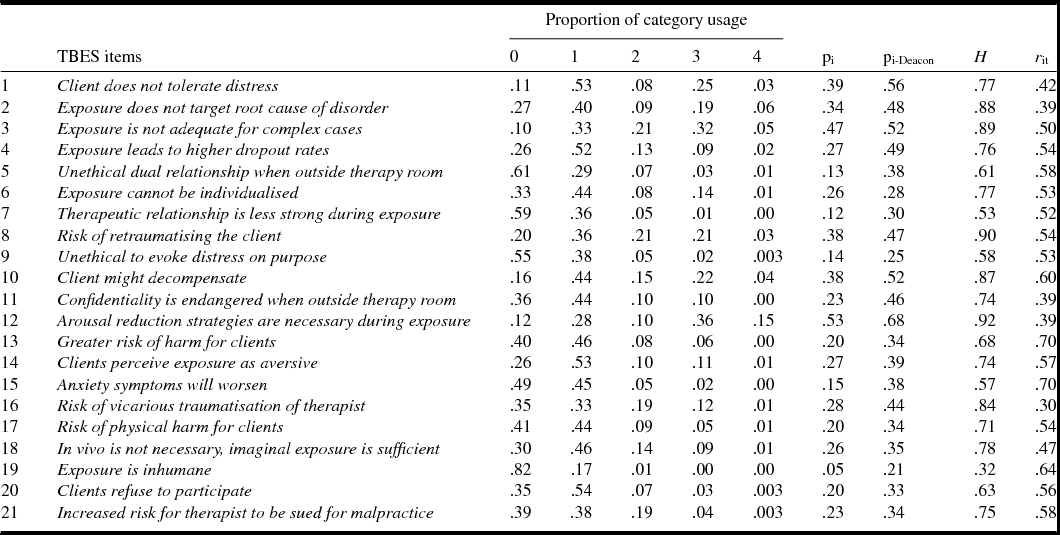
Item characteristics are summarized in Table 2. Item difficulties ranged between pi = .05 (item 19: Exposure is inhumane) and pi = .53 (item 12: Arousal reduction strategies are necessary during exposure), with a mean of .26. The correlation between the item difficulties reported in the current study and those reported by Deacon (Reference Deacon, Farrell, Kemp, Dixon, Sy, Zhang and McGrath2013) was high, r = .85, p < .001. The relative information content ranged between H = .32 (item 19: Exposure is inhumane) and H = .92 (item 12: Arousal reduction strategies are necessary during exposure) with a mean of .73. For n = 5 (23.8%) items the category agree completely was not used at all. In general, the mean relative frequency of using categories indicating agreement was low (6.9%). The item-total correlations ranged between r it = .30 and .70 with a mean of .52. The polychoric inter-item correlations ranged between r = .04 (item 2: Exposure does not target root cause of disorder and item 11: Client's confidentiality is endangered when outside therapy room) and r = .72 (item 14: Clients perceive exposure as aversive and item 20: Clients refuse to participate), with a mean of .33. Overall, 60.5% of these correlations were >.30.
Item characteristics of the German adaptation of the Therapist Beliefs about Exposure Scale (TBES)

TBES, Therapist Beliefs about Exposure Scale (German adaptation); all TBES items were rated on a 5-point Likert scale ranging from 0 (‘disagree strongly’) to 4 (‘agree strongly’); pi, item difficulty; pi-Deacon, item difficulty in the original study from Deacon et al. (Reference Deacon, Farrell, Kemp, Dixon, Sy, Zhang and McGrath2013); H, relative information content; r it, item corrected item-total-correlation.
Factor structure
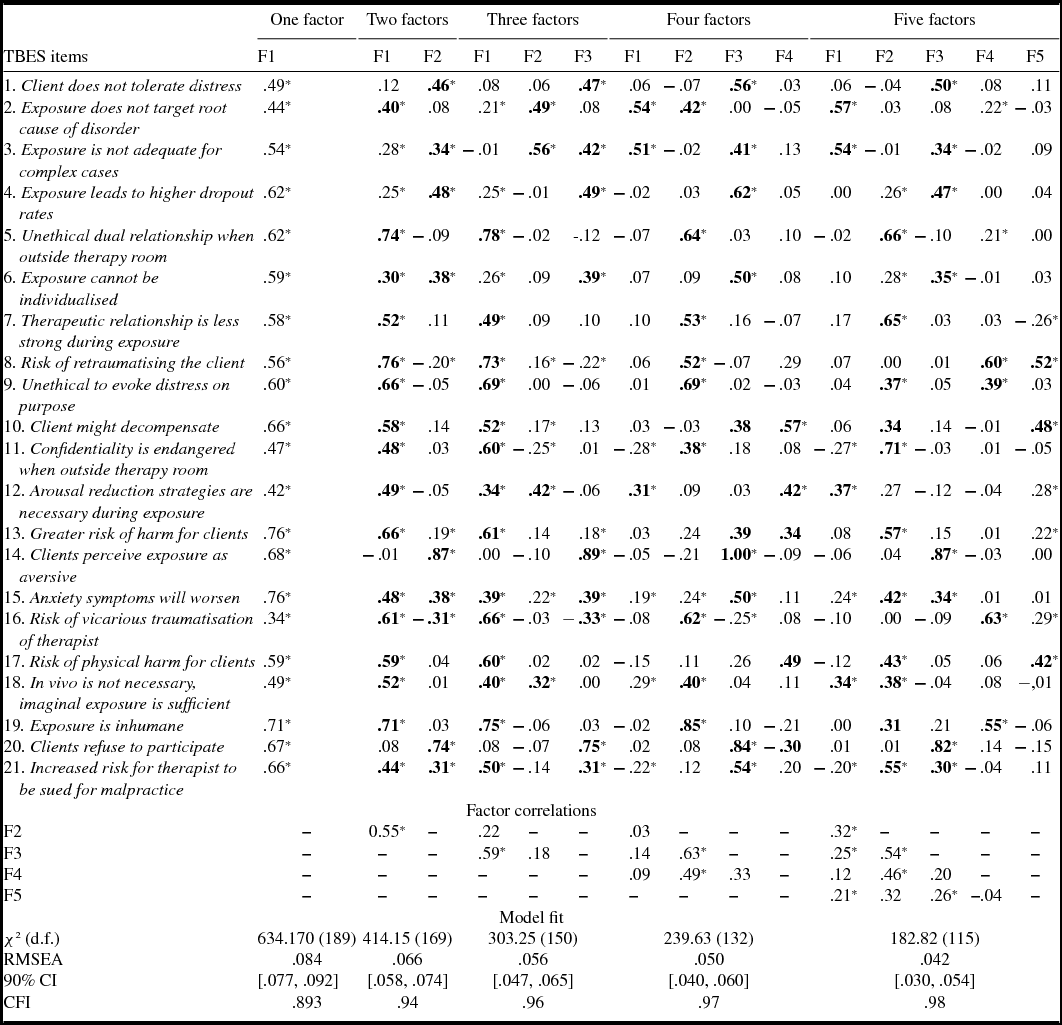
The CFA revealed a poor model fit for the single-factor solution, χ2 (189) = 634.17, p < .001, RMSEA = .084, 90% CI [.077, .092], CFI = .89. Modification indices indicated meaningful residual correlation between item 20 (Clients refuse to participate) and 14 (Clients perceive exposure as aversive), item 16 (Risk of vicarious traumatisation of therapist) with 8 (Risk of retraumatising client) as well item 3 (Exposure is not adequate for complex cases) and 2 (Exposure does not target root cause of disorder). As all residual correlations are theoretically plausible we released these constraints, however, the model fit was still unsatisfactory, χ2 (186) = 493.67, p < .001, RMSEA = .071, 90% CI [.063, .078], CFI = .93. This indicates some heterogeneity in the content of the items. Consequently, an EFA was conducted.
Overall, five eigenvalues were >1 (eigenvalues: 7.80, 1.73, 1.44, 1.14 and 1.05), while the scree plot indicated a single-factor solution. Fit indices revealed an adequate model fit for the three-, four- and five-factor solutions. As the conclusions drawn based on the different criteria were inconclusive, the interpretability of the loading matrix of the different factor solutions was assessed. Items were seen as representative for a factor when showing a primary factor loading >.30 and no cross-loading >.30. In the two-factor solution, items reflecting expected negative reactions of clients showed the strongest loadings (items 1, 3, 4, 14, 20) on one factor (F2, see Table 3), while a second factor (F1) consisted of items assessing expected unethical and harmful consequences of using exposure (items 2, 5, 7, 8, 9, 10, 11, 12, 13, 17, 18 and 19). In the three-factor solution, one factor (F3, see Table 3) consisted of items assessing expected negative reactions of clients (items 1, 4, 6, 14, 20) and one factor (F1) assessing expected unethical and harmful consequences of using exposure (items 5, 7, 8, 9 10, 11, 13, 17, 19). Item 2 (Exposure does not target root cause of disorder) showed the highest loading without an additional cross-loading on the third factor (F2). In the four-factor solution, again one factor consisted of items assessing expected unethical and harmful consequences of using exposure (F2, see Table 3) and one factor reflecting expected negative reactions of clients (F3) emerged; however, the remaining factors were difficult to interpret as nearly all items that made up this factor showed considerable cross-loadings. The factors for the five-factor solution were difficult to interpret (all factor loadings are summarized in Table 3).
Factor loadings of the 21 items of the TBES regarding the 1-, 2-, 3-, 4- and 5-factor solutions

TBES, Therapist Beliefs about Exposure Scale (German adaptation); factor loadings ≥.30 are printed in bold; CFI, comparative fit index; RMSEA, root mean square error of approximation; *p < .05.
Overall score
The mean total score of the TBES was 22.0 (SD = 10.2, range: 0–53) and therefore lower than in the original study (mean = 34.0, SD = 17.5, range = 0 – 84), d = 0.78, 95% CI [0.64, 0.93]. Internal consistency for the total scale was good: Cronbach's α = .86, 95% CI [.84, .88]. The distribution of TBES scores approximated normality (skewness = 0.24; kurtosis = –0.02).
Concurrent validity
With regard to the case vignettes, a significant and large-sized correlation was determined between the TBES total score and the scores of the PTSD vignette, r (205) = .55, p < .001, and the panic disorder vignette, r (205) = .50, p < .001.
Moreover, small but significant negative correlations were found between the TBES total score and average number of sessions spent on exposure interventions in the treatment of PTSD, τb = –.20, p < .001, and panic disorder, τb = –.10, p = .012.
Associations between TBES total score and therapist characteristics
Female (mean = 22.4, SD = 9.8) and male therapists (mean = 21.0, SD = 11.1) did not differ with regard to their mean TBES scores, t (327) = 1.1, p = .135, d = –0.14., 95% CI [–0.38, 0.11]. However, there was a significant association between age and the TBES score, indicating more negative attitudes when age increases, r (328) = .22, p < .001.
In addition, therapists holding a doctorate (PhD or MD) reported significantly fewer negative beliefs about exposure (mean = 17.8, SD = 10.5) than therapists with a master's degree (mean = 22.9, SD = 9.9), t (314) = 3.5, p < .001, d = 0.51, 95% CI [0.23, 0.80]. Moreover, a small but significant negative correlation was observed between TBES scores and the number of exposure sessions that therapists had performed during their clinical training, τb = –.16, p < .001. Therapists who had specialized (self-report) in the treatment of anxiety disorders, PTSD or OCD displayed lower TBES scores (mean = 19.8, SD = 10.5) compared with therapists without specialization (mean = 22.4, SD = 10.0), t (328) = –1.8, p = .037, d = .26, 95% CI [0.04, 0.47].
Discussion
The current study reports on the translation and validation of the German adaptation of the Therapist Beliefs about Exposure Scale (TBES).
Item analysis revealed that, despite the large and representative sample, all items had a high difficulty, e.g. most participants completely disagreed or disagreed with the statement and showed in general a more positive attitude towards exposure. In addition, in some items the most extreme category was not chosen at all and for all other items this category was not used very often. First, this could be considered as an indication that the response categories are too insensitive to depict differences between CB therapists. However, this could be a special characteristic of our sample. Consequently, it might be worth adding another category to differentiate more fine grading within the disagreeing individuals. This might be beneficial for differentiating between samples with generally more positive attitudes towards exposure like the one in the present study. In such populations, items like Exposure is inhumane might be inappropriate. Most individuals deciding to become CB therapists know that exposure will be a part of their work and it is likely that these individuals do not assume that techniques of the clinical training they selected are inhumane. A particular strength of the items is that they assess specific exposure-related knowledge. The therapists’ scores might be used to derive strategies or to clarify irrational worries about applying exposure. On the other hand, some items like Arousal reduction strategies are necessary during exposure assess the attitude rather than being implicit, and might depict knowledge about applying exposure and not about the negative attitude per se. We would encourage that further scale development might add items assessing the attitudes more directly (e.g. I think that exposure is an ineffective strategy for reducing anxiety). In addition, the usage of the middle category ranged between 1 and 21%, however, providing little information about the participant's attitudes. Further test development might remove this category to force participants to take position.
Contrary to the original validation study (Deacon et al., Reference Deacon, Farrell, Kemp, Dixon, Sy, Zhang and McGrath2013), the suggested one-factor solution could not be confirmed in the current study. The fit-indices indicated that a one-factorial model did not describe the data well. In addition, although the internal consistency of all items can be considered as high according to common rules of thumb, it is probably lower than expected for a 21-item scale, which aims to assess a uni-dimensional construct. This might be considered as an additional hint that the TBES is not described well by only one factor. The EFA was inconclusive, however, suggesting that at least two factors might be necessary to explain the factor structure of negative attitudes towards exposure. There are several potential explanations for the observed discrepancies. First, the samples differed in size and general attitude. Overall, the current sample showed, on average, a less negative attitude as marked by lower overall mean scores and high item difficulties (e.g. there was an overall low proportion of individuals using the categories indicating agreement). The lower variability might explain some of the observed misfit in addition to the rather low factor loadings. When interpreting the results of the factor analysis, it should be taken into account that participants were experienced CB therapists with a differentiated view on exposure. Therefore it seems plausible that a one-factorial model describing simple positive and negative attitudes might not fit. Further studies could address this issue by comparing the factor structure within therapists with the factor structure obtained in professional health workers who do not use exposure. In addition, another important aspect would be to address the cross-cultural comparability of the TBES. The large mean differences between the current sample and the sample of Deacon et al. (Reference Deacon, Farrell, Kemp, Dixon, Sy, Zhang and McGrath2013) might be considered as a first indication that sampling seems to be critical and that a one-size-fits-all measure could be difficult to achieve.
Second, the scale consists of several items assessing different aspects of negative attitudes towards exposure (e.g. expected negative consequences for the therapist, potential negative effects on the client, ethical concerns). These domains (unethical, potentially harmful and patients might not tolerate it) have also been identified as relevant factors in a literature search of therapists attitudes towards exposure (Farrell et al., Reference Farrell, Deacon, Dixon and Lickel2013a). Unfortunately, not all facets are represented with a comparable number of items and might therefore not emerge in factor analysis. Research in other areas has shown that it might be worth looking at different facets of attitudes in general and negative attitudes in particular (Talepasand et al., Reference Talepasand, Alijani and Rezaie2010). Although the TBES overall score is a valuable proxy for therapist's negative attitudes, further scale development could address these aspects by developing several items assessing one facet to receive a reliable estimate of a certain aspect of the negative attitude. Such scales would help to assess, for example, if ethical consideration, the therapist's experience of stress or expected negative consequences for the patient actually prevent therapists applying the technique frequently and would therefore allow finer graded insights into therapists’ reservations.
In line with Deacon et al. (Reference Deacon, Farrell, Kemp, Dixon, Sy, Zhang and McGrath2013), the presented findings reveal strong correlations between higher TBES and more pronounced negative attitudes towards exposure sessions presented in two case vignettes. However, as stated previously (Deacon et al., Reference Deacon, Farrell, Kemp, Dixon, Sy, Zhang and McGrath2013), the correlation might also be explained by the similar composition of TBES items and items that were rated in the context of the case vignettes. In addition, it remains unclear if the case vignettes reflect treatment decisions and actual behaviour in the context of psychotherapy. Therefore, we used another proxy potentially reflecting therapist's tendency to apply exposure sessions in daily routines, namely, the reported average number of sessions spent on exposure in the treatment of PTSD or panic disorder. Small negative correlations were found between TBES total scores and the average number of sessions spent on exposure with regard to PTSD and panic disorder treatment. This implies only a weak association between reservations towards exposure and the frequency of its (self-reported) application in clinical practice.
In addition, we report a significantly lower TBES total score than Deacon et al. (Reference Deacon, Farrell, Kemp, Dixon, Sy, Zhang and McGrath2013). This might have been due to the characteristics of the investigated sample. As we included only licensed CB therapists, it is conceivable that overall reservations towards exposure were generally lower compared with a more diverse sample examined by Deacon and colleagues. As exposure is clearly an intervention that derived from cognitive behavioural theories, it is likely that therapists trained in psychodynamic or humanistic orientations are not confronted with the rationale of exposure during their clinical training. Therefore, it cannot be expected from these therapists to know about exposure, be convinced of its effectiveness, or even apply it to patients. Hence, it is possible that they might display more pronounced reservations towards this intervention. We included only CB therapists as the validation of the TBES was part of a larger study in which we intended to examine the dissemination of exposure in clinical practice in Germany. Hence, we focused on the group of therapists who are expected to perform exposures in their daily routine based on their orientation and training, that is, CB therapists. Generally, the average TBES score points in the direction of less pronounced reservations in German CB therapists. However, it is possible that participants responded in a way which they assumed to be appropriate and expected of CB therapists (e.g. not revealing reservations towards an effective intervention as exposure). Therefore our results need to be interpreted with caution.
As reported by Deacon et al. (Reference Deacon, Farrell, Kemp, Dixon, Sy, Zhang and McGrath2013), significant associations between TBES scores and therapist characteristics were observed, namely higher TBES scores in older therapists, in therapists with a master's degree (vs a PhD), in therapists not specialized in the treatment of anxiety disorders, PTSD or OCD, and in therapists who reported less experience with application of exposure sessions during clinical training. However, no differences in mean TBES scores were observed between female and male therapists. It is tempting to speculate that during clinical training the foundation is laid for later employment of exposure in clinical practice. Possibly, the hands-on experience of exposure application during training is associated with less pronounced reservations and might be correlated with more frequent employment of exposure in later practice. Moreover, it is conceivable that regular performance of exposure due to specialisation in treatment of anxious patients prevents concerns and negative attitudes towards this intervention.
Limitations
The results of the current study have to be considered in the light of some shortcomings. First, the validation of the German TBES was part of a larger study focusing on dissemination of exposure among German CB therapists. On the welcome page of our web-based survey, participants were informed about the aim of the study, namely, collecting information about the use of two CBT interventions, that is, exposure and cognitive restructuring, in daily practice. Therefore, it is possible that our sample selection was biased and only therapists that were interested in exposure actually completed the survey. Second, our study relied on data received by self-report. Naturally, self-reports can be subject to bias. Third, only licensed CB therapists were invited to participate in the survey in order to receive a realistic picture of dissemination of exposure in German clinical practice, although, if participants dropped out of the study, they tended to do so during the section reporting their training and the frequency of their use of exposure in clinical sessions. This might have further skewed the sample in the direction of being more positively disposed towards implementing exposure techniques. However, for validation of the TBES a more diverse sample would have been ideal to counteract against limited variance. Fourth, as already highlighted, the correlations with the case vignettes should be seen as weak support for the external validity as the items used to assess the case vignettes were closely related to the TBES itself. Therefore, further studies should assess the utility of the TBES with more ecological criteria like prospective, real-therapy behaviour, effect of interventions on attitudes towards exposure and their changes in attitudes caused by actual performance of exposure sessions.
Conclusions
With the German translation of the TBES, an internal consistent instrument with reasonable psychometric properties is provided for CB therapists in Germany. Although the factor structure is not completely clear, the sum score provided by the TBES is a valuable proxy for the therapist's negative attitudes towards exposure. Further studies will show if different facets of negative attitudes towards exposure exist and if forming subscales provide additional valuable information. It might be worthwhile to improve the assessment of specific attitudes by further differentiating the response categories and by using several items for measurement of one facet in order to receive a reliable estimate of a certain aspect of the negative attitude. In addition, further studies should address the validity of the TBES using more ecological criteria like prospective, actual behaviour of therapists during therapy, as well as effects of interventions on attitudes towards exposure, and changes in attitudes caused by actual performance of exposure sessions or by undergoing specific training. The German TBES could be employed for identifying the degree of therapists’ reservations regarding application of exposure and for deriving clarification and training strategies for concerned therapists ensuring adequate dissemination of this effective intervention in the long term.
Acknowledgements
We are grateful to Sebastian Burchert for assistance in translating the TBES items and the case vignettes from English into German, and to Sarah Mannion for the back translation of the German version into English. We also thank Dr Brett Deacon for his support and for providing the case vignettes used in the original validation study of the scale.
Funding: This research did not receive any specific grant from funding agencies in the public, commercial, or not-for-profit sectors.
Ethical statement: The authors declare that the study was conducted in accordance with the Helsinki Declaration of 1975, as revised in 2000. The study protocol was approved by the ethics committee of Freie Universität Berlin, Berlin, Germany (reference number: 127/2016).
Conflicts of interest: The authors report no conflicts of interest.
Supplementary material
To view supplementary material for this article, please visit https://doi.org/10.1017/S1352465818000371




Comments
No Comments have been published for this article.