INTRODUCTION
There are many preserved medieval buildings made of stone in the mountainous part of Ingushetia, Caucasus, Russia, including Christian churches, crypts, temples, sanctuaries, battle towers, and living buildings. The chronology of their construction period is still a matter of question, as there were no radiocarbon (14C) and/or dendrochronological studies conducted, and their age was estimated by architectural features, some historical records and sometimes accompanying archaeological materials. The age estimated by different specialists varied in the range of several centuries. In some cases the researchers denote certain chronological periods without any supporting evidence, or the dating is based mainly on the local legends. Meanwhile, the chronology of construction activity is crucial to understanding of the dynamics of human settlements and migrations in Ingushetia and in the entire Caucasus region. This information might also reveal new evidence on climate and environmental conditions of the Caucasus, which could be a factor defining construction activity and human adaptation.
Thus the application of radiocarbon and dendrochronological methods is vital to refine age estimations of medieval buildings with well-preserved wooden components. The aim of this study is to perform a precise dating of the most prominent medieval buildings in the mountainous part of Ingushetia containing timber using radiocarbon and wiggle-matching techniques. Wiggle-matching is used for a more precise dating of tree-ring sequences, where dendrochronology does not have a good master dendrochronological scale (Galimberti et al. Reference Galimberti, Bronk Ramsey and Manning2004) and allows 14C data to be fitted to the shape of calibration curve taking into account real (tree-ring) time span between the samples (Bronk Ramsey et al. Reference Bronk Ramsey, van der Plicht and Weninger2001). Application of this methodology for medieval objects in Russia is rather new, but it was successfully applied for medieval archaeology (Oleynikov and Dolgikh Reference Dolgikh, Matskovsky, Voronin and Solomina2017) and fine art objects in European Russia (Dolgikh et al. Reference Dolgikh, Matskovsky, Voronin and Solomina2017), including comparison of wiggle-matched AMS dates with precise dendrochronological dating (Voronin et al. Reference Voronin, Dolgikh, Matskovsky, Cherkinsky, Skripkin and Alexandrovskiy2015; Matskovsky et al. Reference Matskovsky, Dolgikh and Voronin2016). We had also attempted to date the sampled wooden elements by means of dendrochronology, but did not succeed, either because of the lack of master tree-ring chronologies of corresponding species, or because of an insufficient period covered by the master chronologies, or due to the insufficient length of the chronologies developed for each of the buildings. That is why this study is focused on the results achieved by accelerator mass spectrometry (AMS) radiocarbon dating of wooden material and wiggle-matching of the acquired dates. Below we first introduce the studied objects and review corresponding published ages, then describe methodology of the study, and finally report the results for each of the 10 studied buildings.
Studied Objects
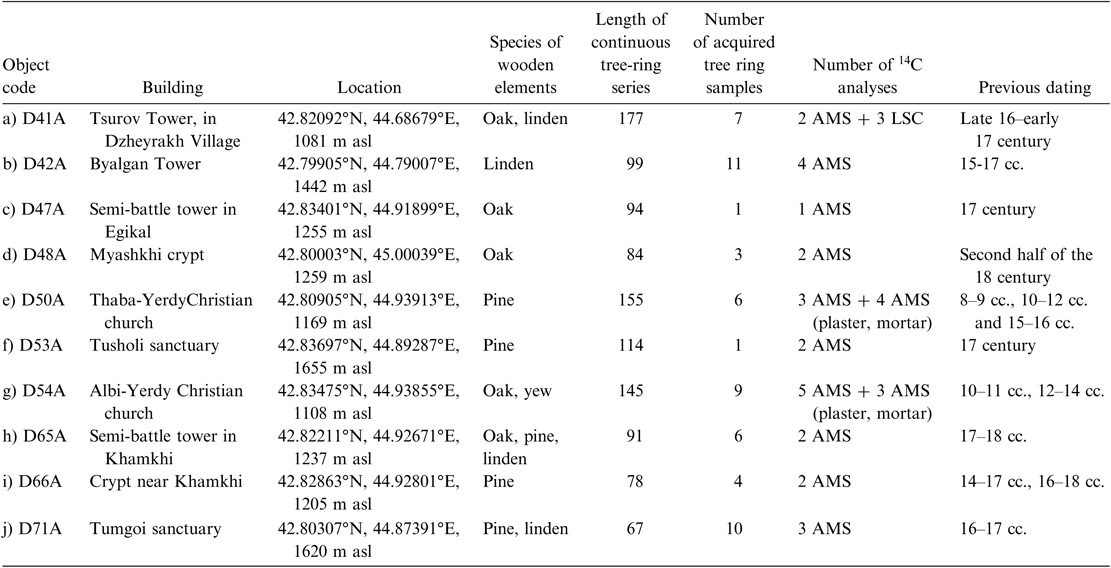
The study region is situated in the mountainous part of the Ingushetia Republic on the northern slope of the Caucasus Mountains, in the valleys of Armkhi and Assa rivers and between them. All the studied buildings are situated on the altitude between 1080 and 1700 m above sea level (asl). For this study samples were collected during two field campaigns in autumn of 2014 and 2015. Around 100 stone buildings were inspected for wooden construction elements, and we were able to acquire wood samples from 40 buildings. About 30 more buildings had wooden elements, but they were either unreachable with our equipment, or were reachable but some problems with equipment did not allow us to sample. In some cases, there is no doubt that the sampled elements were placed at the time of construction, and such in-situ cases will be mentioned additionally. In other cases, the sampled wooden elements were most probably introduced during the time of construction, but the possibility of later replacement cannot be completely excluded. In total, 135 wood samples were collected, however, two of them were lost. The 10 most prominent buildings representing specific architectural features were finally selected to be dated by the radiocarbon method. According to funding limits, we were able to make 8–9 14C analyses for wooden samples each year from 2015 to 2017, which resulted in a total of 26 samples (Tables 1 and 2). Initially the samples were selected to allow wiggle-matching of at least two 14C dates per building, but then for some of the buildings additional analyses were made according to unsatisfactory initial results. From two of the 10 buildings, mortar and plaster samples were taken for 14C AMS analyses for comparison with the dates of wood.
Studied objects. Letters a), b), … i) as in Figure 1.

Description of the samples for 14C analyses. Letters a), b), … i) as in Figure 1.

* Numeration of floors is given as 0 – ground, 1 – first, etc.
** For oak only.
+ Information about cross-dating is shown where it is crucial for wiggle-matching.
In this section, short descriptions of the selected buildings are given together with the information on their dating available in the literature. The photographs of the buildings are given in Figure 1.
Photographs of the dated buildings: (A) Tsurov tower D41A, (B) Byalgan tower D42A, (C) semi-battle tower in Egikal D47A, (D) Myashkhi crypt D48A, (E) Thaba-Yerdy Christian church D50A, (F) Tusholi sanctuary D53A, (G) Albi-Yerdy Christian church D54A, (H) semi-battle tower in Khamkhi D65A, (I) Khamkhi crypt D66A, (J) Tumgoi sanctuary D71A.

Tsurov Battle Tower, Dzheyrakh Village (D41A)
Tsurov battle tower is located in Dzheyrakh village on the left bank of the Armkhi River. It has a square base of 5.75 × 5.75 m, 6 floors and a pyramidal-stepped roof made of 12 slate slabs. Walls of the 1st–3rd floors contain gun slots. Under the embrasures of the 6th floor, mashikuli (small stone protective balconies) are situated and the structure ends with a large conical stone. The total height of the building is 28 m. According to the existing verbal tradition, Tsurov battle tower was built in the late 16th–early 17th century by the master Chula. As a reward for hiswork he received 80 cows, one horse, and a shirt (Chakhkiev Reference Chakhkiev and Bliev1985).
Byalgan Battle Tower (D42A)
Byalgan battle tower occupies the northern part of the castle complex of Byalgan village. The tower has 4 floors and a square base of 5.10 × 5.05 m. The construction is completed with a flat roof with battlements at the corners. A characteristic feature of the tower is the absence of a quadripartite stone ceiling between the second and third floors, protective balconies on the outer perimeter of the walls, and gun slots. In a previous report, it was asserted without any justification, in our opinion, that Byalgan battle tower was built no earlier than the middle of the 17th century (Chakhkiev Reference Chakhkiev2003). This assertion contradicts a number of facts. Namely, the walls of Byalgan tower do not contain gun slots. This indicates that the tower was built during a period when firearms were not yet in use among Ingush people. The first documented cases of the use of firearms by Ingush highlanders correspond to 1604 AD (Krupnov Reference Krupnov1971). At the same time, it is possible that Ingush highlanders were already familiar with them. For example, in neighboring Georgia, the army was already equipped with firearms in the 16th century (Goldstein Reference Goldstein1975). The archaic construction of Byalgan tower can also be attested by the lack of stone floor decks with false ceiling and protective balconies on the facades. In this regard, we can connect this tower to the neighboring Georgian and Ossetian towers dated from the 15th to 17th centuries that also do not have stone ceilings between floors (Tmenov Reference Tmenov1996). In addition, mashikuli appear on Georgian towers only in the 17th century, and later they were widely spread in the architecture of the Northern Caucasus (Zachariah Reference Zachariah1969).
Semi-Battle Tower (D47A), Egikal Complex
The studied semi-battle tower, which is a transitional type of battle tower adapted for living, is located in the southeastern part of the medieval Egikal complex, on the left bank of the Arkhi river. The tower had four floors and a flat roof with parapet. The main facade of the tower is facing southward. It has a window and a door opening at every floor of the building. There are the slot-like openings for conducting firearms combat. Around the perimeter of the entrance to the first floor of the tower there are square holes, intended, apparently, to accommodate the wooden beams of the balcony. It is possible that the semi-battle towers of Egical complex could have been erected in the 17th century, as suggested by accompanying archaeological material and by the legends of the Ingush people (Chakhkiev Reference Chakhkiev2003).
Myashkhi Crypt (D48A)
Myashkhi (Ozditinskij) crypt with the memorial chamber is located on the southern edge of tower village Ozdite (also known as the village of Myashkhiin literature). The rectangular base, 3.20 × 4.70 m of the crypt is recessed into the slope and extended from north to south. The roof is a pyramidal-stepped gable, with nine slate plates and a comb-ridge. Over the manhole of the ground floor on the southern wall, two large stone consoles for ascending into the memorial chamber are situated. The top funeral chamber, with an open southern façade, has an arched shape. Along its walls П-shaped stone seats are situated. The memorial chamber at the level of the arch features three thick wooden rafter ties. According to the legend, in this tomb the elders would gather to address critical life issues, “consulting with the souls of dead ancestors.” According to Chakhkiev (Reference Chakhkiev2009) the crypt date to the second half of the 18th century.
Thaba-Yerdy Christian Church (D50A)
Thaba-Yerdy (“Temple of two thousand saints” in Ingush) is the biggest medieval Christian church in the central and eastern North Caucasus. It is located in the neighborhood of the tower village Khayrakhon on the right bank of the Assa River. The building has one apse with the altar part hidden in its volume. The interior of the temple (16.2 × 7.6 m) is divided by four high lancet arches into four parts: the narthex, the inner narthex, the refectory, and the altar. According to Chubinashvili (Reference Chubinashvili2002), who conducted general research of the temple, the monument refers to the Georgian culture and has some local Ingush features. He distinguished three construction periods: 8th–9th centuries, a turn of 10th–11th centuries and the later middle ages, from the 15th–16th centuries. Similar opinion concerning the chronology of Thaba-Yerdy construction is held by Miller (Reference Miller and Uvarova1888) and Papuashvili (Reference Papuashvili1982). The oldest part of the building is its eastern half including the ambo, the Solea, the altar, the apse, the conch, and the double altar window. The western part of the building is related to 15th–16th centuries with its arched vaults and big wooden rafter ties (Chubinashvili Reference Chubinashvili2002). However, there are other opinions on this issue. Krupnov (Reference Krupnov1947) and Semenov (Reference Semenov1951, Reference Semenov1963) attributed Thaba-Yerdy to the period no earlier than the 12th century. In other studies, Beletsky and Ghazarian (Reference Beletsky and Ghazarian2009) believe that the temple Thaba-Erdy could have been built between the end of 10th to the beginning of 12th century.
Tusholi Sanctuary, Kog Village (D53A)
The Tusholi Sanctuary is located at the southern edge of the tower village of Kog. It has a rectangular base 3.40 × 4.09 m and a gable-step slate roof with 10 plates, culminating in the crest of the ridge. In the interior, the sanctuary is divided by a transverse wall into two parts. There is a thick wooden beam over a doorway. Previously, the sanctuary was used to keep a wooden image of the idol Tusholi—an anthropomorphic symbol of fertility. The building is dated to the 17th century, nevertheless, it was functioning until the beginning of 20th century (Semenov Reference Semenov1963; Chakhkiev Reference Chakhkiev2003).
Albi-Yerdy Christian Church (D54A)
Albi-Yerdy is one of the largest Christian churches in the mountainous part of Ingushetia. It is located on the high left bank of the Assa river, opposite the tower settlement of Targim. The central area of the church is rectangular (7.90 × 14.28 m). The preserved walls are up to 7 m high. Doorways are found in the western and southern walls. Over the doorways, thick wooden lintels are situated, which hold the stone construction above them. The front facade and the walls inside were previously plastered. Until recently, some fragments of wall paintings were preserved in the interior. Based on the artifacts discovered, archaeologist Muzhuhoev (Reference Muzhuhoev1998) attributed the church to the 12th to the beginning of 13th centuries. Meanwhile, architect Pishchulina (Reference Pishchulina2006, Reference Pishchulina2009) dated Alby-Yerdy as related to 10th–11th centuries. Beletsky and Ghazarian (Reference Beletsky and Ghazarian2009) referred the monument to the 12th–14th centuries.
Semi-Battle Tower (D65A), Khamkhi Village
The semi-battle tower is located within the castlelike complex Khamkhi in the center of the mountain basin Assinsky on the left bank of the Assa river. The base of the tower is rectangular, the tower has five floors and a flat roof with parapet. The fifth floor was a loggia with a big, full-width opening in the wall, the bottom of which is still preserved. The façades of the building contain mashikuli balconies, windows, doors, and auditory openings. Originally the tower reached the height about 16 m. According to the architect Goldstein (Reference Goldstein1975) this tower may be dated to the 17th–18th centuries.
Crypt Near Khamkhi Village (D66A)
The over ground crypt at Khamkhi village is located on the Eastern edge of the Khamkhi tower complex. It is notable for its rather impressive size. The tomb has a rectangular base (3.25 × 11.75 m), two floors and a stepped gable roof (nine slate slabs with longitudinal grooved ridge). Each floor (chamber) is divided by lancet arches into three parts. The roof of the second floor is reinforced with transverse arch, edge, and two levels of wooden horizontal beams and struts. Muzhuhoev (Reference Muzhuhoev1977) dated the crypt to the 14th–17th centuries based on the discovered artifacts. However, Chakhkiev (Reference Chakhkiev2009) dated this construction and other tombs of Khamkhi to the 16th–18th centuries.
Tumgoi Sanctuary (D71A)
The sanctuary of Tumgoi-Yerdy is situated on the northern edge of the tower village Tumgoi, on a cliff ledge. The temple has a rectangular base measuring about 10 × 4.5 m. It has a gable pyramidal-stepped roof with 13 shale plates, culminating in the crest of the ridge. The interior of the building is divided into four conventional cameras by three stone arches. The walls contain niches, the crankshaft recesses, and window and door openings. Hooks, bovine and goat horns, are embedded into the stones. Numerous wooden cross beams-struts are located at different heights on the walls of the sanctuary. Various wooden platters, bowls, three-legged benches, and troughs were discovered in the building. The monument dates back to the 16th–17th centuries (Semenov Reference Semenov1963; Chakhkiev Reference Chakhkiev2009).
METHODS
Wooden cores were collected using battery-operated drill and a specialized borer. Later they were glued to a wooden base with polyvinyl acetate glue, sanded, marked, and tree-ring widths were measured on Lintab semi-automatic equipment. Cross-dating was performed in TSAPWin software (Rinn Reference Rinn1996), and the accuracy of measurements and cross-dating was checked using the COFECHA program (Holmes Reference Holmes1983). Samples were first cross-dated among other samples of the same species from the same building. Then, we attempted to cross-date them with the samples of the same species from other buildings and (for pine samples only) with master chronologies. There are very few forests in Ingushetia, most of them very young, and it is difficult to develop local tree-ring chronologies long enough for dendrochronological dating of medieval buildings. For this reason, we used master chronologies of pine from western sites KYZ (43.428°N, 41.3035°E, 2392 m asl; AD 1550–2006, ~300 km away), KHTP (43.4472°N, 41.7056°E, 2394 m asl; AD 1678–2005, ~270 km away), and KUB (42.8944°N, 43.5907°E, 2356 m asl; AD 1737–2008, ~100 km away) (Solomina et al. Reference Solomina, Dolgova and Maximova2012, Reference Solomina, Bushueva, Dolgova, Jomelli, Alexandrin, Mikhalenko and Matskovsky2016; Dolgova Reference Dolgova2016).
To identify the tree species for each sample, radial and tangential sections of the wood were prepared using a microtome and analyzed with a microscope in back light (250× and 400× magnification).
The samples for AMS analysis were collected from distinct tree rings (3–10 rings each) to allow wiggle-matching of the acquired dates. Samples 17–34 (Table 3) were prepared by the cellulose extraction using the BABAB technique (Gaudinski et al. Reference Gaudinski, Dawson, Quideau, Schuur, Roden, Trumbore, Sandquist and Wasylishen2005), graphitized and pressed on targets in the Laboratory of Radiocarbon and Electronic Microscopy of the Institute of Geography of the Russian Academy of Sciences (IGAN) using an AGE3 graphitization system (Ionplus) (Wacker et al. Reference Wacker, Nemec and Bouquin2010). They were marked with the IGANAMS laboratory numbers.
Results of radiocarbon dating. Letters a), b), … i) as in Figure 1.

* As reported by D_Sequence function in OxCal v4.3.2. Results are shown only for converged wiggle-matching. For the other results please see the supplementary materials.
** Carbonates (no wiggle-matching).
+ Gaps in the square brackets show the number of tree rings between 14C samples, sampled either within one wooden sample or from cross-dated wooden samples.
++ Separate wooden samples (no wiggle-matching).
Preparation and graphitization of samples 9–16 (Table 3) were performed in the Centre of Cenozoic Geochronology (CCG), Institute of Archaeology and Ethnography SB RAS, Novosibirsk, Russia using the same technique. These samples have the laboratory index NSK. 14C dates for the samples 9–34 prepared both in IGAN and NSK laboratories were obtained by AMS at the Center for Applied Isotope Studies (CAIS), University of Georgia (Cherkinsky et al. Reference Cherkinsky, Culp, Dvoracek and Noakes2010).
The mortar was extracted from the outside stone blocks and the plaster covering the stones from the innerpart of the buildings. For sample ALB-1, material has been sampled from outer and inner parts of the piece, resulting in two different dates. The mortar and plaster samples were prepared and dated at CAIS. They were treated in ultrasound bath for 30 min, then the fine fraction less than 50 μm was collected by sieving through a nylon screen, centrifuged and dried at 60°C. This fraction was reacted with 100% phosphoric acid in a vacuum at a temperature of 0°C for 10 min to recover carbon dioxide. To examine the degree of contamination with old carbon, for the samples THA-1 and THA-2 two separate gas fractions were collected, corresponding to reaction time of 10 and 30 min, and each gas fraction was then dated separately. The resulting carbon dioxide was cryogenically purified from the other reaction products and catalytically converted to graphite using the method of Vogel et al. (Reference Vogel, Southon, Nelson, Brown, Wolfli, Polach and Anderson1984).
Graphite 14C/13C ratios were measured using the CAIS 0.5MeV accelerator mass spectrometer. The sample ratios were compared to the ratio measured from the Oxalic Acid II (NBS SRM4990C) standard. The quoted uncalibrated dates have been given in 14C years (yr BP) before AD 1950 using the 14C half-life of 5568 yr. The error is quoted as 1 standard deviation and reflects statistical error of measurement. The 14C dates were calibrated using OxCal v. 4.3.2 (Bronk Ramsey Reference Bronk Ramsey1995) and the IntCal13 atmospheric curve (Reimer et al. Reference Reimer, Bard, Bayliss, Beck, Blackwell, Bronk Ramsey, Buck, Cheng, Edwards, Friedrich, Grootes, Guilderson, Haflidason, Hajdas, Hatté, Heaton, Hoffmann, Hogg, Hughen, Kaiser, Kromer, Manning, Niu, Reimer, Richards, Scott, Southon, Staff, Turney and van der Plicht2013). Wiggle-matching was performed in the same program using the “D_Sequence” function (Bronk Ramsey et al. Reference Bronk Ramsey, van der Plicht and Weninger2001; Bronk Ramsey Reference Bronk Ramsey2009).
14C dating of samples 1LSC, 2LSC, and 3LSC was conducted at IGAN (laboratory index IGAN). Approximately 10 g of wood was cut from the wooden slices taking into account the borders of tree rings (13–19 rings for each sample). Cellulose was extracted from the samples using the BABAB technique (Gaudinski et al. Reference Gaudinski, Dawson, Quideau, Schuur, Roden, Trumbore, Sandquist and Wasylishen2005). The activity of 14C was determined using a Quantulus 1220 liquid scintillation counter. All the calibrated dates are given with 95.4% probability intervals.
RESULTS AND DISCUSSION
For some of the buildings some samples were successfully cross-dated to acquire a floating tree-ring chronology for them (e.g. Tsurov tower, Thaba-Yerdy, Albi-Yerdi). However, we did not succeed in cross-dating of any of the floating chronologies between the buildings, or against Western master chronologies (even after taking into account the results of 14C dating). That is why we focused solely on 14C dating, while the efforts to find more dendrochronological material in the region will help to strengthen the chronologies and finally to approach calendar dating by means of dendrochronology.
For most of the samples, it was impossible to identify the underbark ring, though all the dates are given as terminus post quem, including uncertainties of how long before the construction the tree was cut and how many outer tree rings were lost during the preparation of construction elements from the beams.
We prepared 26 wooden samples from 10 buildings for AMS 14C analysis. These samples were collected from distinct tree rings that allowed us to use a wiggle-matching procedure to enhance the precision of the dating results. In cases when cross-dated samples were used to acquire time intervals for wiggle-matching, the supporting cross-dating information is included in Table 2. Four samples of plaster and mortar from two buildings were additionally collected for AMS analysis for dating purposes.
Tsurov Battle Tower, Dzheyrakh Village (D41A)
In total, seven wooden elements were sampled in the tower: three of them were dated by the LSC method and two by the AMS method.
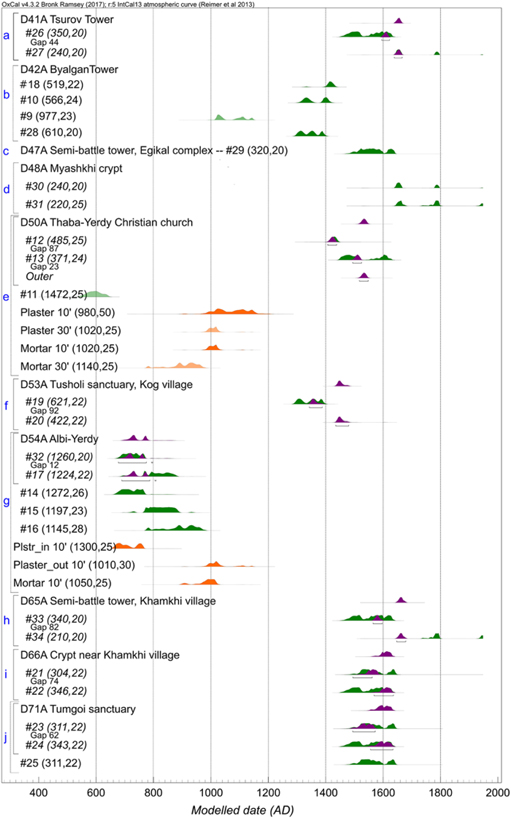
The oak beams from the upper floor were used as a base for mashikuli-balconies. However, the tower reveals traces of renovation in its upper floor. In addition, a common practice was to construct these base elements out of stone and not out of wood. We were therefore not surprised to obtain fraction of 14C higher than 100% in the samples from the upper floor, IGAN-4706—101.00 ± 2.73 pMC, IGAN-4707—104.01 ± 2.87 pMC, IGAN-4708—102.79 ± 2.75 pMC (all dated by the LSC method). The only linden element originated from the second floor; wiggle-matching of the two AMS samples from it was calibrated to the period AD 1641–1669 for the outermost rings of the timber (Figure 2a, Tables 2 and 3). This result is in contrast to existing oral tradition, which refers this building to the end of the 16th to the beginning of 17th century.
Results of 14C dating. Green color shows the probability intervals for wooden samples, orange – for carbonates, purple – for wiggle-matched D_Sequences. Semi-transparency denotes unreliable dates (see text). Letters a), b), … i) as in the Figure 1. (Please see electronic version for color figures.)

Byalgan Battle Tower (D42A)
Four AMS dates were acquired for the two out of 11 sampled wooden elements—one from the first floor and another from the second floor. The calibrated dates are plotted on the Figure 2b. Wiggle-matching procedure for the three AMS dates for the wooden sample from the second floor did not converge. In addition, one date (9, Table 3) had a significantly older age than the three other dates. We consider this date to be improperly prepared, but we show this result together with the others for comparison. We believe contamination with polyvinyl acetate glue has altered the dates. The other two dates from this tower 10 and 18 (Table 3) also did not converge but showed a more consistent period of the 14th to first half of 15th centuries. Sample 28 from the first floor also showed a result consistent with the calibrated date AD 1298–1372 (0.758) and 1378–1400 (0.196), plus 29 years to the outermost ring (Table 2). These results support the hypothesis of early construction date of the tower in the 14th to first half of the 15th century.
Semi-Battle Tower (D47A), Egikal Complex
One sample was analyzed from this tower. The calibrated age for it is AD 1492–1643, plus 91 years to the outermost ring (Table 2) and it is consistent with the dating of archaeologists and with the legends of the local people (Chakhkiev Reference Chakhkiev2003).
Myashkhi Crypt (D48A)
Three wooden samples were collected from the crypt and two AMS dates were acquired for one of them. There is no convergence for them, but both dates are late—according to the calibrated dates the crypt was constructed no earlier than the second half of the 17th century, but also probably later than the end of the 18th century. The second probable period is in correspondence with the opinion of Chakhkiev (Reference Chakhkiev2009).
Thaba-Yerdy Christian Church (D50A)
We dated two beam-struts from the ceiling of the church from the later western part of the building, and mortar and plaster samples from altar wall of the ancient eastern part of the building. One of the wood dates is significantly older than the others due to possible contamination by synthetic preservative. The other two wood dates converged in the wiggle-matching procedure to the interval AD 1519–1550, taking into account the number of rings to the outermost ring of the timber (Table 2). This date is consistent with the opinion of Chubinashvili (Reference Chubinashvili2002) on the dating of the western part of the building to which the wooden elements belong.
Results of the mortar and plaster dating are different for the different time of reaction. For 10 min of reaction the dates for both materials are in a good agreement between themselves and historical data. The prolongation of the reaction time to 30 min increases 14C age due to contamination with old carbon (Van Strydonck et al. Reference Van Strydonck, Dupas, Dauchot-Dehon, Pachiaudi and Marechal1986, Reference Van Strydonck, Dupas and Keppens1989). The calibrated ranges for mortar (AD 974–1040 [0.949]) and plaster (972–1170 [0.949]) dates are in a good agreement with historical data (Beletsky and Ghazarian Reference Beletsky and Ghazarian2009).
Tusholi Sanctuary, Kog Village (D53A)
There is only one wooden element in the building. Two dates converged in wiggle-matching and the resulting date interval is AD 1437–1482, plus 4 years to the outermost ring (Table 2). This is much earlier than its dating by historians, which attributed the building to the 17th century (Semenov Reference Semenov1963; Chakhkiev Reference Chakhkiev2003).
Albi-Yerdy Christian Church (D54A)
Nine wooden elements, all of them in situ, were sampled in the building, three of them were analyzed and five AMS dates were obtained. Also, plaster and mortar were sampled from the eastern part of the building (altar) and three AMS dates were acquired for them. These plaster and, especially, mortar dates should be in correspondence with the dates acquired from timber, because the timber is located in situ as a lintel of the doorway located at the same space where the mortar and plaster were collected. The dates from the both laboratories are in relatively good agreement for wood samples, except sample 16. The wiggle-matched dating interval has showed generally the 8th century (AD 692–811 for the outermost rings of the timber; Tables 2 and 3). This interval is also in correspondence with the dating obtained for the yew beam (14, AD 668–774). The dates for the inner (AD 662–762 [0.643] and 738–768 [0.311]) and outer (AD 973–1049 [0.824] and 1085–1124 [0.104]) parts of the plaster sample were surprisingly different. The latter is in better correspondence with the age of the mortar sample (AD 901–921 [0.057] and 961–1025 [0.897]), while the former is in better correspondence with the obtained D_Sequence interval. Additional AMS dates are clearly necessary to define the exact age of this building.
Semi-Battle Tower (D65A), Khamkhi Village
Two AMS dates were obtained for an oak window lintel. Wiggle matching for these dates converged to AD 1649–1681 for the outermost rings of the timber (Tables 2 and 3). This date agrees with the dating by Goldstein (Reference Goldstein1975) but gives more precise understanding of the construction period.
Crypt Near Khamkhi Village (D66A)
In the two crypts, wooden elements were sampled, four samples in each crypt, and for one of the samples two AMS dates were acquired. Wiggle-matching for these dates converged to the period AD 1571–1638 for the outermost rings of the timber (Tables 2 and 3). This date agrees with the dating by Muzhuhoev (Reference Muzhuhoev1977), but the period obtained by wiggle-matching is much narrower.
Tumgoi Sanctuary (D71A)
Ten wooden elements were sampled in the sanctuary, including one of them embedded in the stone laying. For this and for another one in situ element three AMS dates were acquired. Wiggle-matching of the two dates converged to the period AD 1558–1637 for the outermost rings of the timber (Tables 2 and 3). The calibrated date for the in situ element is also in correspondence with this period—AD 1494–1602 or 1616–1646, plus 31 years to the outermost ring (Table 2). Also, it is in correspondence with the historical data (Semenov Reference Semenov1963; Chakhkiev Reference Chakhkiev2009).
Inconsistencies in Dating Results
Most of outliers were analyzed in Novosibirsk laboratory, e.g. the samples taken from the same core with the span of 40 tree rings were dated with almost 1000 14C year difference. It is possible that this difference was a result of contamination by synthetic preservative and lack of appropriate pretreatment. The dating value of the mortar and plaster samples is limited as well, mainly because there is still no consistency in the methodology of dating of mortar and plaster, and mortar studies are still under development (Hajdas et al. Reference Hajdas, Trumm, Bonani, Biechele, Maurer and Wacker2014; Ringbom et al. Reference Ringbom, Lindroos, Heinemeier and Sonck-Koota2014). However, these dates can be used for future comparison of the results and for the establishment of the methodology.
Six of the 10 buildings were successfully dated and the probability intervals for them are rather narrow, as the wiggle-matching procedure was successful. Some studies, however, demonstrated that wiggle-matching of short tree-ring series can be less accurate than the quoted precision (Bayliss et al. Reference Bayliss, Marshall, Tyers, Bronk Ramsey, Cook, Freeman and Griffiths2016), and this should be taken into account, especially for Tsurov tower D41A and Thaba-Yerdy Christian church, which have less than 50 years between wiggle-matched dates.
CONCLUSION
This study is the first attempt to date medieval stone buildings in Ingushetia by means of dendrochronological and 14C methods. We found that dendrochronology is limited in the study region, either by the availability of the master tree-ring chronologies of different species covering the appropriate period or by the length of the chronologies developed for each of the buildings. However, we were able to use AMS 14C dating in combination with wiggle-matching to narrow the presumed construction interval of these buildings.
Six of the 10 buildings were successfully dated and the probability intervals for them are rather narrow, as the wiggle-matching procedure was successful. The other four buildings supplied wider dating intervals due to some inconsistencies in the 14C dates (Byalgan tower D42A, Myashkhi crypt D48A, Albi-Yerdi D54A), or limited results. For example we only have one AMS date for the semi-battle tower D47A from Egikal. Nevertheless, these dates are of high importance and clearly improve our understanding of the chronology of their construction.
The obtained dates may be used as benchmarks for comparison of architectural features of similar buildings in the neighboring regions and for drawing implications from accompanying archeological material. The developed floating tree-ring chronologies can be used in the future research to extend the existing absolutely dated tree-ring chronologies in the region. The time period covered by the samples is more than one millennium. These chronologies are essential for the high resolution climatic and environmental reconstructions in the region, as well as for the dating of past human activity supported by wooden artifacts.
ACKNOWLEDGMENTS
We thank Aslan Malsagov for his help in the field. Radiocarbon dating was funded by the Russian Federation President’s grant no. MK-1351.2017.6. Dendrochronological sampling and measurements were funded by the Russian Foundation for Basic Research according to the research project no. 17-05-00771-a. A. Dolgikh worked with the support of the State assignment project 0148-2019-0006 (Institute of Geography RAS, Moscow). We are grateful to Timothy Jull and the anonymous reviewers for their valuable comments, which helped to improve the manuscript immensely.
SUPPLEMENTARY MATERIAL
To view supplementary material for this article, please visit https://doi.org/10.1017/RDC.2019.33