Introduction
A small fern from northern Thailand has consistently been identified as a species originally described from Guangdong, South China: Polypodium cruciforme Ching and synonyms based thereon (Tagawa & Iwatsuki, Reference Tagawa, Iwatsuki, Smitinand and Larsen1989; Fraser-Jenkins, Reference Fraser-Jenkins2008; Lindsay & Middleton, Reference Lindsay and Middleton2009). During a visit to the herbarium of the Academia Sinica in Beijing (PE) I was able to study the type of this species (To Kang Peng, Ts’ang Wai Tak & Ts’ang Un Kin 420 (holo PE), China, Kwangtung [Guangdong], Lung Tau Mt.) and came to the conclusion that it is not conspecific with the plants from northern Thailand which, accordingly, need to be described as a new species. The same species is also cited for northern Vietnam in the Flore Générale de l’Indo-Chine (Tardieu-Blot & Christensen, Reference Tardieu-Blot, Christensen and Gagnepain1941: 475) based on two collections from Tonkin, probably Pételot 4973 and 6456 (Muséum National d’Histoire Naturelle Paris (P) specimens P01629170, P01629171 and P01629172, consulted online on 22 February 2011). These two collections (in three specimens), currently identified as Crypsinus oxylobus (Wall. ex Kunze) Sledge, are not conspecific with the specimens from northern Thailand, but possibly with the species from Guangdong.
Species Description
Selliguea pui Hovenkamp, sp. nov.
A Polypodio cruciformi Ching differt lamina distincte longiore quam latiore, lobis basalibus triangularibus, textura herbacea vel membranacea in sicco. – Type: Chiang Mai, Doi Pui, open dry evergreen forest, epiphytic, c.1600 m, 28 xi 1965, Hennipman 3142 (holo L; iso BKF).
Rhizome creeping, 1–2 mm thick, densely covered with scales; rhizome scales peltate, slightly spreading, 4–5 × c.1 mm, above the base rather abruptly contracted into a narrow, sparsely dentate acumen. Fronds 0.5–1 cm spaced, stipe 1–4 cm long, fully developed lamina usually trilobed, 5–12 × 4–8 cm, 1.2–2× as long as wide, lateral lobes slightly ascending, ± triangular, to c.2× as long as wide, a second pair of lateral lobes sometimes present, these distinctly narrower than the basal ones and more strongly ascending, apical lobe usually much longer than the basal lobes. Lamina glabrous, herbaceous to membranous, often translucent when dry, main veins very distinct, veinlets anastomosing with free veinlets pointing to all directions, margin pale but hardly thickened or cartilaginous, regularly notched with one notch between each pair of main veins. Sori often on the apical lobe only, in a single row between midrib and margin, single between each pair of main veins, round, c.1 mm in diameter, distinctly sunken and visible as protrusions on the upper surface.
Distribution. Thailand: Chiang Mai (Doi Suthep/Doi Pui); Chiang Rai (Doi Dohn Luang). Endemic.
Ecology. Mixed primary evergreen and seasonal forest, often with fire damage, on sandstone or granite bedrock, epiphyte on tree trunks, 1600–1850 m.
Etymology. The name refers to the type locality.
Additional specimens examined. Thailand. Chiang Rai: Khun Chae National Park, Doi Dohn Luang, east of Doi Lahnggah, Maxwell 97-1409 (L). Chiang Mai: Doi Suthep, Iwatsuki et al. T 9397 (L), Navakitbumrung 4 (L), Palee 243 (L), Phuakam 4 (L), Vongkujum 5 (L); Doi Pui, Van Beusekom & Phengkhlai 1262 (L).
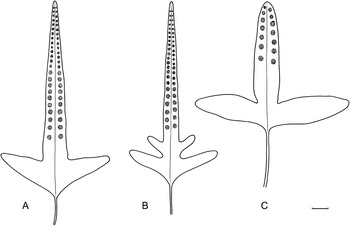
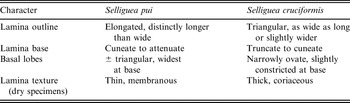
Selliguea pui keys out and is distinguished from other Thai species as Crypsinus cruciformis (Ching) Tagawa if one follows the key and description in Tagawa & Iwatsuki (Reference Tagawa, Iwatsuki, Smitinand and Larsen1989: 554, 559, fig. 56,4–5). It can be distinguished from Selliguea cruciformis (Ching) Fraser-Jenk. by the characters given in Table 1 (see also Fig. 1).
Lamina outline of Selliguea pui and S. cruciformis. A–B. Selliguea pui: outline of 3- and 5-lobed lamina (Hennipman 3142, type, L). C. Selliguea cruciformis: outline of lamina (To et al. 420, type, PE). Scale bar = 1 cm.

Characters distinguishing Selliguea pui from S. cruciformis

Acknowledgements
I thank the Flora of China organisation for enabling me to visit Beijing, and Ms Gong Xiaolin and Zhang Xianchung and his students for their hospitality during my visit. France Rakotondrainibe was very helpful in locating the specimens in P. The drawing was done by Esmée Winkel.