Introduction
Schizophrenia is a psychotic disorder associated with positive symptoms such as hallucinations and delusions (Owen, Sawa, & Mortensen, Reference Owen, Sawa and Mortensen2016). Among others, failure in self-recognition abilities (i.e. recognition of own thoughts and actions) has been proposed as a cognitive mechanism that underlies these symptoms. According to this theory, defective internal labeling of own thoughts/actions associated with their misattribution to an external source may lead patients to experience their thoughts as coming from external agents (i.e. auditory hallucinations) or their acts as arising from alien control (i.e. delusion of control) (Frith, Blakemore, & Wolpert, Reference Frith, Blakemore and Wolpert2000; Frith & Done, Reference Frith and Done1988). Supporting this assumption, schizophrenia studies have repeatedly demonstrated that misidentification of internal and external sources of events is a consistent trait of the disorder (Brookwell, Bentall, & Varese, Reference Brookwell, Bentall and Varese2013; Waters, Woodward, Allen, Aleman, & Sommer, Reference Waters, Woodward, Allen, Aleman and Sommer2012). Self-recognition deficits have been investigated through self-monitoring paradigms, in which patients receive a distorted feed-back of their own spoken word/motor action and are requested to identify it online as self- or non-self-produced. In parallel, such impairments are believed to be reflected by the so-called ‘source-monitoring’ deficits (i.e. failure in remembering the source of an information) (Johnson, Hashtroudi, & Lindsay, Reference Johnson, Hashtroudi and Lindsay1993). In this framework, deficits in remembering between self-generated v. experimenter-generated events and between self-generated information kept in the inner space (thoughts) v. events produced in the outer space (Bentall, Reference Bentall1990; Brunelin et al., Reference Brunelin, Combris, Poulet, Kallel, D'Amato, Dalery and Saoud2006a, Reference Brunelin, Poulet, Bediou, Kallel, Dalery, D'amato and Saoud2006b; Woodward, Menon, & Whitman, Reference Woodward, Menon and Whitman2007) are termed reality- and internal- monitoring processes, respectively (Johnson et al., Reference Johnson, Hashtroudi and Lindsay1993). Source-monitoring testing procedures consist of two phases: encoding and retrieval. During the encoding phase, information from different sources is presented to the subject. During the retrieval phase, the subject has to identify to which source is the information associated.
According to classical characterizations of psychotic disorders, schizophrenia is included into a continuum encompassing a large range of genetic statuses, psychotic states and symptoms. A recent model defines the ‘At-Risk Mental State’ for psychosis (ARMS) (McGorry, Hartmann, Spooner, & Nelson, Reference McGorry, Hartmann, Spooner and Nelson2018), a condition that includes people who have experienced attenuated positive psychotic symptoms during the past year (APS), or episodes of frank psychotic symptoms that have not lasted longer than a week and have spontaneously abated [Brief Limited Intermittent Psychotic Symptoms (BLIPS)], and people with schizotypal personality or genetic risk and deterioration syndrome (GRD) (Fusar-Poli et al., Reference Fusar-Poli, Borgwardt, Bechdolf, Addington, Riecher-Rössler, Schultze-Lutter and Yung2013). In addition, the psychosis continuum acknowledges observations of subclinical experiences in non-clinical populations, such as hallucination-prone people and unaffected relatives of patients with schizophrenia (often referred as genetic risk group) (Verdoux & van Os, Reference Verdoux and van Os2002). Widespread impairments in neurocognitive functions have been demonstrated in ARMS (Bora & Murray, Reference Bora and Murray2014; Fusar-Poli et al., Reference Fusar-Poli, Deste, Smieskova, Barlati, Yung, Howes and Borgwardt2012; Giuliano et al., Reference Giuliano, Li, Mesholam-Gately, Sorenson, Woodberry and Seidman2012) and people with hallucination proneness (Brébion, Larøi, & Van der Linden, Reference Brébion, Larøi and Van der Linden2010; Gupta, DeVylder, Auerbach, Schiffman, & Mittal, Reference Gupta, DeVylder, Auerbach, Schiffman and Mittal2018; Morrison, Wells, & Nothard, Reference Morrison, Wells and Nothard2000). Moreover, several studies observed deficits in executive functioning, attention and verbal ability in unaffected relatives (Faraone et al., Reference Faraone, Seidman, Kremen, Pepple, Lyons and Tsuang1995; Saoud et al., Reference Saoud, d'Amato, Gutknecht, Triboulet, Bertaud, Marie-Cardine and Rochet2000), thereby suggesting the existence of a ‘cognitive’ continuum, i.e. a continuum in cognitive impairments, from healthy functioning to full-blown psychotic disorder that encompasses subclinical alterations and severe clinical manifestations (Johns & van Os, Reference Johns and van Os2001). Critically, since unaffected relatives and ARMS individuals have been associated with a prospective risk of developing schizophrenia (McGorry & Killackey, Reference McGorry and Killackey2002; Morrison et al., Reference Morrison, French, Walford, Lewis, Kilcommons, Green and Bentall2004), there has been an increasing focus on the ability of cognitive measures to predict transition to psychosis and index the physiological processes that underlie psychotic symptoms. Thus, identifying cognitive markers of the psychosis continuum has been one of the main objectives of clinical research in psychiatry over the last decades in order to identify individuals at risk to develop schizophrenia and propose early interventions.
Here, we hypothesized that individuals with no full-blown psychotic symptoms represented across the continuum of psychosis (i.e. ARMS, hallucination-prone individuals and unaffected relatives of patients with schizophrenia) would display significant deficits in self-recognition processes. In the context of growing interest for cognitive markers of the psychosis continuum and the need to extend our knowledge in the field of self-recognition processing in psychosis, we undertook a meta-analysis of the existing literature investigating self-recognition performance across the three populations.
The objectives were threefold: (i) to investigate self-recognition abilities in individuals with no full-blown psychotic symptoms represented across the continuum of psychosis, (ii) to measure the moderating effect of the population type on self-recognition abilities and (iii) to identify whether self-recognition abilities in these populations are influenced by a task-specific effect.
Methods
This study was performed according to the Preferred Reporting Items for Systematic Reviews and Meta-Analyses (PRISMA) guidelines (Moher, Liberati, Tetzlaff, & Altman, Reference Moher, Liberati, Tetzlaff and Altman2009). The protocol was registered in PROSPERO (Chien, Khan, & Siassakos, Reference Chien, Khan and Siassakos2012) (https://www.crd.york.ac.uk/prospero/display_record.php?RecordID=129873; registration number: CRD42019129873).
Literature search strategy
Eligibility
Studies were selected with the following inclusion criteria: (i) articles published in English language in peer-reviewed journals, (ii) studies including participants with an ARMS (individuals with APS, BLIPS or GRD), hallucination-prone individuals, and/or unaffected relatives of patients with schizophrenia, (iii) studies including participants without any established clinical diagnosis of neurological and psychiatric condition according to the Diagnostic and Statistical Manual of Mental Disorders DSM-5 (or DSM-IV) criteria, (iv) studies using either self- or source-monitoring experimental paradigms and providing clear information regarding the task used, (v) studies with a within-group design (studying correlation between symptom severity and self-recognition performance) or between-group design (studying self-recognition difference between subclinical and control groups) and (vi) studies providing sufficient statistical indices for self-recognition correct responses (means ± standard deviations or correlation coefficients ± variance).
Search strategy
We searched for articles in the PubMed, ScienceDirect and PsycINFO databases with no limitation of date until 22 June 2019.
Combination of the following keywords was used: ‘(((source) AND (monitoring OR memory)) OR ((internal) AND (memory OR monitoring)) OR ((self) AND (memory OR monitoring)) OR ((reality) AND (memory OR monitoring))) AND ((psychosis OR psychotic OR schizophrenia) AND (risk OR prodrom* OR predict OR transition OR conversion OR relatives)) OR ((schizotyp*) AND (Ultra High Risk) AND (UHR) AND (Brief Limited Intermittent Psychotic Symptoms) AND (BLIPS) AND (Attenuated Psychotic Symptoms) AND (APS) AND (At Risk Mental States for Psychosis) AND (attenuated symptoms) AND (prepsycho*) AND (hallucination prone*) AND (genetic risk) AND (clinical high risk) AND (basic symptoms))’. Additional references were retrieved by cross-referencing the reference lists of selected articles. The ‘similar articles’ function in PubMed was also employed although no additional references were identified in this manner.
After excluding duplicate publications, two reviewers (authors LL, CD) independently screened the title, abstract and keywords of each study to apply the inclusion criteria. In a second time, the same procedure was applied to the full text of eligible studies. Discrepancies between reviewers were resolved by discussion with a third author (MM). Study selection is described in Fig. 1 (PRISMA diagram).
PRISMA flowchart describing the literature search and screening stages.

Data extraction
Authors LL and CD independently extracted the following data: (i) demographic variables (sample size, mean age, gender ratio), (ii) population studied (ARMS, hallucination-prone individuals or unaffected relatives), (iii) study design and type of self-recognition task, and (iv) statistical indices regarding correct discrimination of self v. other sources (i.e. self-recognition correct responses).
When data were missing, the concerned authors were contacted for additional data request. We ensured that different participants were included in the different reports from the same research groups. To measure the overall quality of the included studies, a global rating score was calculated for each study by two independent authors (LL, CD) using the Standard Quality Assessment (QualSyst tool (Kmet, Lee, & Cook, Reference Kmet, Lee and Cook2004)).
Meta-analysis
Outcome
All Statistical analyses were carried out using R Studio software version 1.0.143 (R Core Team, 2018). Mathematical equations used to compute effect size are presented in online Supplementary Material. The alpha level for significance was set at p < 0.05.
When provided, we extracted means and standard deviations (s.d.) for correct recognitions (i.e. accuracy) in self- and source-monitoring tasks in both the control group and subclinical groups. We calculated Cohen's d effect size with 95% confidence intervals (95% CI) (Cohen, Reference Cohen2009). For studies investigating correlations between self-recognition scores and psychometric scale scores characteristic of the subclinical group, we extracted correlation coefficients (Pearson's r) and variance (Vr) and transformed these values into Cohen's d and variance (Vd) (Borenstein, Hedges, Higgins, & Rothstein, Reference Borenstein, Hedges, Higgins and Rothstein2010). When variances for Pearson's r were not available, we estimated them using Campbell's calculator (Polanin & Snilstveit, Reference Polanin and Snilstveit2016). Regarding Spearman correlation coefficients (ρ), same transformations were applied since ρ are equivalent to Pearson's r using rank data or are slightly smaller if the data follow a binomial distribution (Gilpin, Reference Gilpin1993). Given the small sample size, Cohen's d was finally converted into Hedges'g (Hoyt & Del Re, Reference Hoyt and Del Re2018), which use pooled weighted standard deviations instead of pooled standard deviation.
When studies reported scores on multiple outcome measures with no available overall effect but multiple dependent effect-sizes (ES) (e.g. using stimuli with multiple emotional valences or presenting different levels of distortion in self-monitoring experimental paradigm), these were aggregated prior to analysis so that each independent samples from one study contributed only to one single ES. To this end, the univariate procedure described by Gleser & Olkin (Cooper, Hedges, & Valentine, Reference Cooper, Hedges and Valentine2009) was used with imputation of r = 0.5, a conservative and typical starting correlation value for aggregating psychologically-based ES (Wampold et al., Reference Wampold, Mondin, Moody, Stich, Benson and Ahn1997). Then, all ES were computed to derive an overall summary effect.
As methods and sample characteristics differed across included studies, a random-effect approach was used to model the variability of the summary effect among the true ES of individual studies. We interpreted the magnitude of summary ES (g) using Cohen's interpretative guidelines (0.2 = small ES; 0.5 = medium ES; 0.8 = large ES (Cohen, Reference Cohen2009).
The overall summary ES was represented by a forest plot. In case of visual heterogeneity across studies, variances of the true ES were quantified by τ 2 test. The proportion of the observed variance reflecting real differences between the true ES was computed by I 2 heterogeneity statistic. The I 2 statistic values 25, 50 and 75% reflected a small, moderate or high degree of heterogeneity, respectively (Higgins, Thompson, Deeks, & Altman, Reference Higgins, Thompson, Deeks and Altman2003).
Publication bias
Publication bias was first assessed by visual inspection of the funnel plot. In the case of asymmetry of the funnel plot, a Rank Correlation Test and an Egger's Regression Test were performed to determine the significance of the publication bias. Additionally, a QQ-plot was analysed to identify potential outliers.
Moderator analysis
Subgroup analyses were performed to assess relevant categorical variables as moderators. Meta-regressions were performed when potential moderators were continuous variables or when the number of studies within each subgroup was not enough to provide necessary statistical power for subgroup analysis according to the moderator.
Meta-regressions
Several Factors that might have influenced self-recognition performance were investigated. First, as it has been reported that age may influence self-recognition performances (Henkel, Johnson, & De Leonardis, Reference Henkel, Johnson and De Leonardis1998), we measured its potential influence on ES. The effect of the type of subclinical group was also investigated as an exploratory analysis. Finally, we measured the influence of the methodological quality of studies on ES using the Standard Quality Assessment scores (QualSyst tool (Kmet et al., Reference Kmet, Lee and Cook2004), online Supplementary material S1) as a potential moderator. We used mixed-effects meta-regression models to evaluate if these factors accounted for a multiple moderator effect.
Subgroup ANALYSIS
In similar fashion to the method described by Brookwell et al. (Reference Brookwell, Bentall and Varese2013), a first subgroup analysis was carried out to compare studies using self-monitoring and studies using source-monitoring paradigms. To this end, overall effects from two independent meta-analyses were obtained by fitting two separate random-effects models within source- and self- subsets of studies. Then, we combined the true ES and standard errors within each model, to compute one summary ES per model. Finally, we analysed whether the two summaries ES differed significantly using a Wald-type test that uses a fixed-effects model.
Results
Studies selection
The primary search yielded 2008 results. Among them, 344 duplicates were removed, and 1644 abstracts were excluded according to the eligibility criteria. The remaining 20 studies were then assessed for eligibility based on full-length articles. Overall, 15 references were included in the meta-analysis with a total of 1307 subjects (Aldebot Sacks, Weisman de Mamani, & Garcia, Reference Aldebot Sacks, Weisman de Mamani and Garcia2012; Alderson-Day et al., Reference Alderson-Day, Smailes, Moffatt, Mitrenga, Moseley and Fernyhough2019; Allen, Freeman, Johns, & McGuire, Reference Allen, Freeman, Johns and McGuire2006; Brunelin et al., Reference Brunelin, d'Amato, Brun, Bediou, Kallel, Senn and Saoud2007; Garrison et al., Reference Garrison, Moseley, Alderson-Day, Smailes, Fernyhough and Simons2017; Gawęda et al., Reference Gawęda, Li, Lavoie, Whitford, Moritz and Nelson2018; Humpston, Linden, & Evans, Reference Humpston, Linden and Evans2017; Johns et al., Reference Johns, Allen, Valli, Winton-Brown, Broome, Woolley and McGuire2010; Larøi, Collignon, & Van der Linden, Reference Larøi, Collignon and Van der Linden2005; Larøi, Van der Linden, & Marczewski, Reference Larøi, Van der Linden and Marczewski2004; Marjoram et al., Reference Marjoram, Miller, McIntosh, Cunningham Owens, Johnstone and Lawrie2006; Peters, Smeets, Giesbrecht, Jelicic, & Merckelbach, Reference Peters, Smeets, Giesbrecht, Jelicic and Merckelbach2007; Szöke et al., Reference Szöke, Méary, Ferchiou, Trandafir, Leboyer and Schürhoff2009; Versmissen et al., Reference Versmissen, Janssen, Johns, McGuire, Drukker, Campo and Krabbendam2007a, Reference Versmissen, Myin-Germeys, Janssen, Franck, Georgieff, Campo and Krabbendam2007b) (Fig. 1).
Characteristics of selected studies
Among the 15 included studies, 11 used a group comparison design to investigate the mean source-monitoring differences between groups within the psychosis continuum [ARMS (nine studies, N = 188), hallucination prone individuals (four studies, N = 66), unaffected first-degree relatives (four studies, N = 132)] (Total N = 386, mean age 29.2 ± 9.7; range 19.2–45.7 years old) and control groups (N = 315, mean age 29.9 ± 10.2; range 20.3–46.7) (Brunelin et al., Reference Brunelin, d'Amato, Brun, Bediou, Kallel, Senn and Saoud2007; Garrison et al., Reference Garrison, Moseley, Alderson-Day, Smailes, Fernyhough and Simons2017; Gawęda et al., Reference Gawęda, Li, Lavoie, Whitford, Moritz and Nelson2018; Johns et al., Reference Johns, Allen, Valli, Winton-Brown, Broome, Woolley and McGuire2010; Larøi et al., Reference Larøi, Van der Linden and Marczewski2004, Reference Larøi, Collignon and Van der Linden2005; Marjoram et al., Reference Marjoram, Miller, McIntosh, Cunningham Owens, Johnstone and Lawrie2006; Peters et al., Reference Peters, Smeets, Giesbrecht, Jelicic and Merckelbach2007; Szöke et al., Reference Szöke, Méary, Ferchiou, Trandafir, Leboyer and Schürhoff2009; Versmissen et al., Reference Versmissen, Janssen, Johns, McGuire, Drukker, Campo and Krabbendam2007a, Reference Versmissen, Myin-Germeys, Janssen, Franck, Georgieff, Campo and Krabbendam2007b). The remaining four studies investigated the correlations between self-recognition and symptoms in ARMS (three studies, N = 579) (Aldebot Sacks et al., Reference Aldebot Sacks, Weisman de Mamani and Garcia2012; Alderson-Day et al., Reference Alderson-Day, Smailes, Moffatt, Mitrenga, Moseley and Fernyhough2019; Humpston et al., Reference Humpston, Linden and Evans2017) and hallucination-prone (one study, N = 57) (Allen et al., Reference Allen, Freeman, Johns and McGuire2006) individuals (total N = 655, mean age 22.2 ± 3.6; range 19.2–27.3. ARMS samples only included individuals with APS and BLIPS.
Types of self-recognition paradigms used across the selected articles were either source-monitoring tasks [11 studies (Aldebot Sacks et al., Reference Aldebot Sacks, Weisman de Mamani and Garcia2012; Brunelin et al., Reference Brunelin, d'Amato, Brun, Bediou, Kallel, Senn and Saoud2007; Garrison et al., Reference Garrison, Moseley, Alderson-Day, Smailes, Fernyhough and Simons2017; Larøi et al., Reference Larøi, Van der Linden and Marczewski2004, Reference Larøi, Collignon and Van der Linden2005; Marjoram et al., Reference Marjoram, Miller, McIntosh, Cunningham Owens, Johnstone and Lawrie2006; Szöke et al., Reference Szöke, Méary, Ferchiou, Trandafir, Leboyer and Schürhoff2009)] or self-monitoring tasks [four studies (Allen et al., Reference Allen, Freeman, Johns and McGuire2006; Johns et al., Reference Johns, Allen, Valli, Winton-Brown, Broome, Woolley and McGuire2010; Versmissen et al., Reference Versmissen, Janssen, Johns, McGuire, Drukker, Campo and Krabbendam2007a, Reference Versmissen, Myin-Germeys, Janssen, Franck, Georgieff, Campo and Krabbendam2007b)] (Table 1).
Characteristics of the studies included in the meta-analysis

ARMS, At-Risk Mental State; HP, hallucination-prone; UR, unaffected first-degree relatives; NA, not applicable; NR, no data reported.
* In Johns et al. (Reference Johns, Allen, Valli, Winton-Brown, Broome, Woolley and McGuire2010), participants received medication: AP: antipsychotic (16%) + AD: antidepressant (25.8%) + CBT: Cognitive-Behavioral Therapy (51.6%).
** In Gawęda et al. (Reference Gawęda, Li, Lavoie, Whitford, Moritz and Nelson2018), participants received medication: AP (5%) + AD (63.8%).
All studies used verbal, action or drawing recognition paradigms. Details of included studies are provided in online Supplementary Material S2.
Random effect model: self-recognition performance
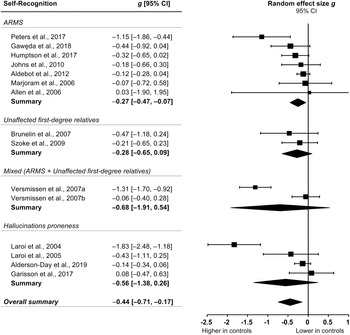
The present meta-analysis investigated self-recognition performance in populations with no full-blown psychotic symptoms represented across the continuum of psychosis (ARMS, hallucination-prone individuals and unaffected relatives). Overall, 15 studies were eligible for meta-analysis (Aldebot Sacks et al., Reference Aldebot Sacks, Weisman de Mamani and Garcia2012; Alderson-Day et al., Reference Alderson-Day, Smailes, Moffatt, Mitrenga, Moseley and Fernyhough2019; Allen et al., Reference Allen, Freeman, Johns and McGuire2006; Brunelin et al., Reference Brunelin, d'Amato, Brun, Bediou, Kallel, Senn and Saoud2007; Garrison et al., Reference Garrison, Moseley, Alderson-Day, Smailes, Fernyhough and Simons2017; Gawęda et al., Reference Gawęda, Li, Lavoie, Whitford, Moritz and Nelson2018; Humpston et al., Reference Humpston, Linden and Evans2017; Johns et al., Reference Johns, Allen, Valli, Winton-Brown, Broome, Woolley and McGuire2010; Larøi et al., Reference Larøi, Van der Linden and Marczewski2004, Reference Larøi, Collignon and Van der Linden2005; Marjoram et al., Reference Marjoram, Miller, McIntosh, Cunningham Owens, Johnstone and Lawrie2006; Peters et al., Reference Peters, Smeets, Giesbrecht, Jelicic and Merckelbach2007; Szöke et al., Reference Szöke, Méary, Ferchiou, Trandafir, Leboyer and Schürhoff2009; Versmissen et al., Reference Versmissen, Janssen, Johns, McGuire, Drukker, Campo and Krabbendam2007a, Reference Versmissen, Myin-Germeys, Janssen, Franck, Georgieff, Campo and Krabbendam2007b). Our analysis associated these populations with small-to-moderate but significant impairments in self-monitoring accuracy [g = −0.44 (−0.71 to −0.17), p = 0.002]. The overall summary effect is depicted in the Forest Plot (Fig. 2).
Forest Plot. Effect Size estimates of self-recognition accuracy. ARMS, At-Risk Mental State.

The Q-statistic revealed a significant heterogeneity between ES (QE p value <0.05). The amount of true ES variance was evaluated to τ 2 = 0.21. With a moderate degree of uncertainty, a large proportion of this variance reflected true heterogeneity [I 2 = 84.69% (67.48–94.49)]. The Baujat plot (online Supplementary Material S2) indicated that one study (Versmissen et al., Reference Versmissen, Janssen, Johns, McGuire, Drukker, Campo and Krabbendam2007a) mostly influenced the overall summary ES and contributed to its heterogeneity. After removing this outlier, the ES dropped to g = −0.35 (−0.59 to −0.11) but was still significant (p = 0.004).
Publication Bias
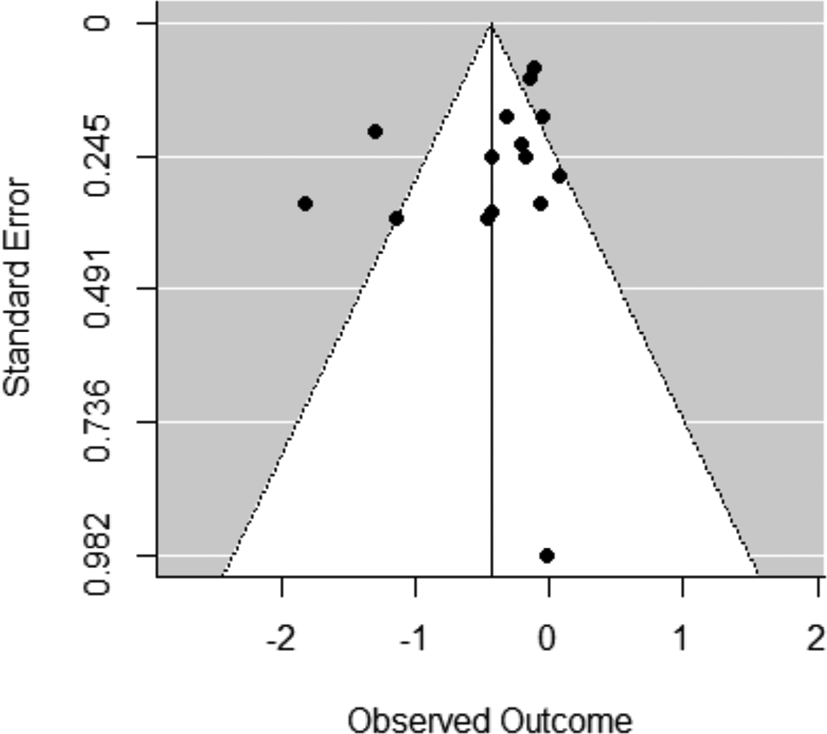
Visual inspection of the funnel Plot (Fig. 3) revealed a slight asymmetry, which was not significant according to the standard Rank Correlation Test (Kendall's τ = −0.36; p = 0.06). We also conducted an Egger's Regression Test that was not significant (z = −0.71; p = 0.47). Finally, a normal Q–Q plot did not identify any outlier study (online Supplementary Material S3).
Funnel Plot. Publication bias visualisation.

Moderators analysis
The high heterogeneity of the overall summary ES (I 2 = 84.69%) warranted the examination of potential moderators.
Meta-regression did not reveal any effect of age (β1 = −0.21, p = 0.63) and type of subclinical population (β1hallucination−prone = −0.53; β1unaffected first−degree relatives = −0.32; β1ARMS = −0.34; β1ARMS+unaffected first−degree relatives = −0.67, p = 0.07) on self-recognition accuracy. No significant effect of the quality of studies on self-recognition scores was observed (β1quality = −0.46; p = 0.72). The Wald-type test for subgroup analyses indicated that studies using a self-monitoring task (β1self−monitoring = −0.47; s.e. = 0.35) showed similar ES than studies using a source-monitoring task (β1source−monitoring = −0.42; s.e. = 0.38). The difference between the two summaries ES was not significant (z = −1.33; p = 0.89). Thus, as pictured in the boxplot (online Supplementary Material S4), self- and source-monitoring paradigms had a similar effect on the overall summary ES.
Given the high heterogeneity across studies and the absence of any significant effect from investigated moderators (age, type of subclinical group, quality of studies and type of task), a second subgroup analysis was carried out to compare between-group and correlation design subsets. Given that the experiment that mostly contributing to heterogeneity used a correlation design (Szöke et al., Reference Szöke, Méary, Ferchiou, Trandafir, Leboyer and Schürhoff2009) (online Supplementary Material S3), we suspected that type of study design may account as a significant moderator. The Wald-type test indicated that between-group (β1between−group = −0.54; s.e. = 0.191) showed larger negative ES than correlation studies (β1correlation = −0.15; s.e. = 0.06). The difference between the two ES was significant (z = −2.52; p = 0.04). As pictured in the boxplot (online Supplementary Material S4), the type of study design strongly influenced the overall summary ES, and its magnitude was mostly driven by between-groups studies.
Discussion
To the best of our knowledge, this is the first meta-analysis investigating self-recognition ability in populations with no full-blown psychotic symptoms represented across the continuum of psychosis. The main finding is that these individuals display significant self-recognition deficits compared to healthy controls, with a small-to-moderate magnitude effect size. The deficit was not influenced by age, type of population (ARMS, hallucination-prone individuals, unaffected first-degree relatives), or type of self-recognition paradigm (self-monitoring v. source-monitoring tasks).
Self-recognition deficits across the continuum of psychosis
Regarding the type of population, the deficit in the included subjects with an ARMS (here, APS and BLIPS) intimates that a failure in recognizing self-generated information is associated with attenuated psychotic symptoms. Additionally, the deficit observed in unaffected first-degree relatives suggests that self-recognition impairment may be associated with an increased risk of familial liability to psychosis, independently from the presence of psychotic symptoms. Finally, we replicated previous findings of self-recognition deficits in hallucination-prone individuals (Brookwell et al., Reference Brookwell, Bentall and Varese2013), which suggest that self-recognition deficit may also serve as a potential marker of risk for hallucinations. Regarding the type of self-recognition paradigm, we observed that the magnitude of the deficit was similar in both self-monitoring and source-monitoring tasks. Although source-monitoring tasks present a memory component missing in self-monitoring paradigms, this observation confirms that both experimental paradigms may index a common cognitive process that is affected in populations with no full-blown psychotic symptoms. By contrast, a previous meta-analysis (Brookwell et al., Reference Brookwell, Bentall and Varese2013) failed to associate hallucinatory experiences with self-recognition deficit within a subset of studies using a self-monitoring paradigm. Nevertheless, the negative result may be explained by the small number of included studies using a self-monitoring experimental paradigm (two studies out of 27).
More broadly, our findings are consistent with previous results demonstrating additional cognitive impairments in unaffected relatives of patients with schizophrenia (Faraone et al., Reference Faraone, Seidman, Kremen, Pepple, Lyons and Tsuang1995; Green, Nuechterlein, & Breitmeyer, Reference Green, Nuechterlein and Breitmeyer1997; Saoud et al., Reference Saoud, d'Amato, Gutknecht, Triboulet, Bertaud, Marie-Cardine and Rochet2000), hallucination-prone individuals (Alderson-Day et al., Reference Alderson-Day, Smailes, Moffatt, Mitrenga, Moseley and Fernyhough2019) and subjects with an ARMS (Eisenacher et al., Reference Eisenacher, Rausch, Ainser, Englisch, Becker, Mier and Zink2018; Ohmuro et al., Reference Ohmuro, Katsura, Obara, Kikuchi, Hamaie, Sakuma and Matsumoto2018). Since many studies have shown large self-recognition impairments in patients with schizophrenia (reviewed in Brookwell et al., Reference Brookwell, Bentall and Varese2013; Waters et al., Reference Waters, Woodward, Allen, Aleman and Sommer2012), the present analysis argues for a cognitive continuum regarding self-recognition abilities from non-clinical subjects to full-blown psychosis. As compared to the moderate-to-large self-recognition deficit described in patients with schizophrenia (ES = −0.73 in Waters et al., Reference Waters, Woodward, Allen, Aleman and Sommer2012), the present small-to-moderate effect (ES = −0.44) suggests this deficit to vary from less to more across non-clinical and clinical subjects. Future studies are warranted to directly compare self-recognition performances between patients with diagnosed schizophrenia and subjects with no full-blown psychotic symptoms represented across the continuum for psychosis.
Although self-recognition deficits have been associated with positive symptoms of schizophrenia, an inverse correlation has also been reported between source-monitoring errors and negative symptoms (Brébion, Gorman, Amador, Malaspina, & Sharif, Reference Brébion, Gorman, Amador, Malaspina and Sharif2002; Brébion, Ohlsen, Bressan, & David, Reference Brébion, Ohlsen, Bressan and David2012). However, investigating correlations between the severity of negative dimension and source-monitoring performances in first-degree relatives of patients with schizophrenia led to non-significant results (Szöke et al., Reference Szöke, Méary, Ferchiou, Trandafir, Leboyer and Schürhoff2009). Otherwise, this study did not find any correlation between positive dimension and source-monitoring scores. It would be fruitful to examine potential relationships between positive and negative dimensions and self-recognition scores in various subclinical and non-clinical populations represented across the continuum for psychosis.
Neurobiological substrates
Self-recognition deficits observed in individuals with an ARMS, hallucination-prone individuals and unaffected first-degree relatives suggest that these populations may share neural alterations with patients with diagnosed psychosis.
In healthy subjects, frontotemporal connectivity is thought to underpin self-recognition processes. On the one hand, activation of the prefrontal cortex (PFC) has been associated with correct attributions of internally produced information (Mitchell & Johnson, Reference Mitchell and Johnson2009; Sugimori, Mitchell, Raye, Greene, & Johnson, Reference Sugimori, Mitchell, Raye, Greene and Johnson2014). On the other hand, activation of the superior temporal gyrus (STG) has been associated with the perception of externally produced but not internally produced information (Allen et al., Reference Allen, Amaro, Fu, Williams, Brammer, Johns and McGuire2007; Simons, Davis, Gilbert, Frith, & Burgess, Reference Simons, Davis, Gilbert, Frith and Burgess2006; Sugimori et al., Reference Sugimori, Mitchell, Raye, Greene and Johnson2014). In patients with schizophrenia, the main hypothesis for the self-recognition deficit involves a defective prefrontal lobe activation that fails to inhibit the temporal lobe and lead, in turn, to an external misattribution of self-generated materials (Ford & Mathalon, Reference Ford and Mathalon2005; Frith, Reference Frith1996). The relationship between self-recognition deficits and frontotemporal functional disruption in patients with schizophrenia is supported by imaging studies demonstrating a significant association between auditory hallucinations, source-monitoring errors and STG hyperactivity (Jardri, Pouchet, Pins, & Thomas, Reference Jardri, Pouchet, Pins and Thomas2011; Sugimori et al., Reference Sugimori, Mitchell, Raye, Greene and Johnson2014). Furthermore, repeated sessions of non-invasive electrical brain stimulation applied over the STG and the PFC have been shown to induce a significant increase of source-monitoring performance, as well as a reduction of auditory hallucination in patients (Brunelin, et al., Reference Brunelin, Poulet, Bediou, Kallel, Dalery, D'amato and Saoud2006b; Mondino, Haesebaert, Poulet, Suaud-Chagny, & Brunelin, Reference Mondino, Haesebaert, Poulet, Suaud-Chagny and Brunelin2015).
Even it remains speculative, one can hypothesize that the significant self-recognition deficit in individuals with no full-blown psychosis is associated with the comparable frontotemporal functional alteration. However, at present, only one study assessed neurobiological correlates of source-monitoring deficit in ARMS. This study demonstrated activation in anterior PFC during source-monitoring but less activation in subjects with higher schizotypal traits (Lagioia et al., Reference Lagioia, Eliez, Schneider, Simons, Van der Linden and Debbané2011). Toward a better characterization of self-recognition processes, future studies are warranted to investigate the neural mechanisms associated in these individuals.
Limitations
Several limits should be acknowledged. First, our main outcome was the number of correct responses at self- and source-monitoring tasks. This did not allow investigating the directionality of the recognition bias, i.e. whether individuals misattribute internal information as external (externalization bias) or misattribute external information as internal (internalization bias). Consequently, while we reported a failure in self-recognition in ARMS, hallucination-prone individuals and unaffected first-degree relatives, we were not able to conclude if one bias over another is more specific to these populations. Additionally, since Brookwell et al. (Reference Brookwell, Bentall and Varese2013) concluded about a specific externalization bias in patients with schizophrenia and hallucination-prone subjects, our analysis involved scores indexing both misattribution biases, which may account for the small overall effect.
Second, the analyses reported a large heterogeneity in the aggregated analysis that was not explained by between-population (i.e. ARMS, hallucination-prone individuals, unaffected first-degree relatives) differences. Between-tasks analysis only showed a trend for a significant difference between self and source paradigms. However, the low number of studies included involved an imbalance across groups in the task used (e.g. there is no ‘hallucination–prone group’ with task ‘self’), which represents a potential bias to the negative results on between-populations and between-tasks differences. The analyses rather indicate a large amount of heterogeneity to be explained by the type of design used across studies (between-groups v. correlation designs). We observed that the magnitude of the deficit was mostly driven by between-groups studies. Thus, the inclusion of four correlations studies in the meta-analysis may represent a potential limitation. However, by assessing correlations between self-recognition measures and psychometric scale scores, these studies establish a more detailed description of the relationship between the psychometric parameter and the self-recognition deficit.
Third, two studies included medicated subclinical individuals (Gawęda et al., Reference Gawęda, Li, Lavoie, Whitford, Moritz and Nelson2018; Johns et al., Reference Johns, Allen, Valli, Winton-Brown, Broome, Woolley and McGuire2010) and three studies did not provide information on subjects' medication status (Aldebot Sacks et al., Reference Aldebot Sacks, Weisman de Mamani and Garcia2012; Versmissen et al., Reference Versmissen, Janssen, Johns, McGuire, Drukker, Campo and Krabbendam2007a, Reference Versmissen, Myin-Germeys, Janssen, Franck, Georgieff, Campo and Krabbendam2007b). The medication status seems particularly important since antipsychotic medication has been associated with improvement of self-recognition abilities in patients with schizophrenia (Keefe, Poe, McEvoy, & Vaughan, Reference Keefe, Poe, McEvoy and Vaughan2003). Further studies are required to investigate the effects of psychotropic medication on self-recognition performance.
Fourth, this meta-analysis included studies with different task designs including words, actions, drawings and voices items. This experimental diversity may participate in the large heterogeneity between effect-sizes. However, a previous meta-analysis revealing a significant self-recognition impairment in patients with schizophrenia included studies using a wide variety of paradigms, including action, words or speech recognition tasks (Waters et al., Reference Waters, Woodward, Allen, Aleman and Sommer2012). This indicates that the requirement to make a self-recognition judgment underscores the deficit, regardless of the experimental paradigm.
Finally, the inclusion of three different subgroups may represent a potential limitation in this study. Indeed, self-recognition seems significant for the single ARMS group, whereas the other groups display negative non-significant effect-sizes. Nevertheless, meta-regression showed a lack of significant effect of the type of subgroup, arguing for continuity between subgroups regarding self-recognition deficit.
Conclusion
Several populations with no full-blown psychotic symptoms represented across the continuum of psychosis display similar deficits for multiple self-recognition experimental paradigms. Future studies involving subclinical and non-clinical subjects across the continuum, patients with first-episode of psychosis and patients with schizophrenia are warranted to compare such deficit in different stages of the continuum. In the context of growing interest for early intervention, we recommend 2-years follow-up studies (Nelson, Yuen, & Yung, Reference Nelson, Yuen and Yung2011) to address whether early self-recognition deficit could predict potential transition to psychosis in subclinical and non-clinical populations. Furthermore, developing remediative approaches that specifically target self-recognition abilities might by relevant for these individuals. In addition, future studies may benefit from assessing directional source-recognition inversions scores to increase their statistical power and may also benefit from including drug-naïve subclinical individuals, which may provide more reliable measures of self-recognition performances. Finally, neuroimaging and neurostimulation studies are required to explore the neurobiological correlates of self-recognition deficit across multiple in populations with no full-blown psychotic symptoms represented across the continuum.
Supplementary material
The supplementary material for this article can be found at https://doi.org/10.1017/S003329172000152X.
Acknowledgements
We are particularly grateful to authors who replied to our queries and provide us with supplementary results when available.
This research did not receive any specific grant from funding agencies in the public, commercial, or not-for-profit sectors.
Conflict of interest
None of the authors has a financial interest in any organization or commercial product providing financial support for this research.