Introduction
Marfan syndrome is a multisystem autosomal dominant heritable connective tissue disorder mainly caused by mutations in the fibrillin-1 gene at 15q21.1. Reference Pepe, Giusti, Sticchi, Abbate, Gensini and Nistri1 Neonatal Marfan syndrome is rare and is associated with severe atrioventricular regurgitation. The poor prognosis is related to severe cardiac involvement due to abnormal mitral and/or tricuspid valve prolapse leading progressively to congestive heart failure. Its median survival age is 16.3 months. The present report describes a case of severe bilateral atrioventricular regurgitation in neonatal Marfan syndrome successfully treated by mitral and tricuspid valve replacement.
Case report
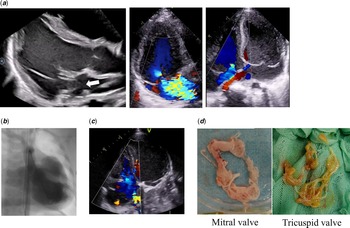
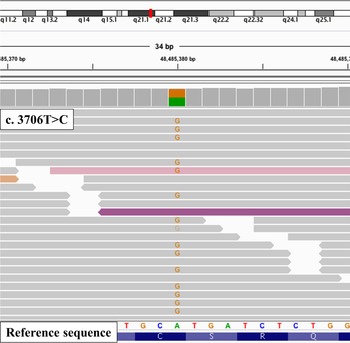
The patient was a male infant born at 38 weeks of gestation by vaginal delivery without any complications at birth. He had good weight gain and no abnormalities at his 1-month health check-up. He sometimes had persistent cough from around 3 months, and it was managed as an upper respiratory tract infection. He was found to have a heart murmur at his 3-months health check-up. At 4 months, he was 66.0 cm tall (90th percentile) and weighed 6.0 kg (10th percentile). He had corneal enlargement, sunken eyes, arachnodactyly, and a funnel chest. He had an unremarkable family history. He had cold extremities, poor feeding, and a grade 4/6 holosystolic murmur. He also had a tachycardia of 150 beats/minute. At 4 months, he underwent the first echocardiography, and it showed an enlarged left ventricular end-diastolic diameter of 34.5 mm (z-score: +4.2) with severe mitral regurgitation, which was associated with posterior mitral valve leaflet prolapse. Additionally, severe tricuspid regurgitation was associated with anterior and posterior leaflet prolapse of the tricuspid valve and enlargement of the aortic root (z-score: +3.8) (Fig 1a). The aortic root was increased for the body surface area, and the dilation was moderate (z-score > 3.1 and < 4). His brain natriuretic peptide level was 239 pg/ml. At 5 months, the cardiac angiography showed a left ventricular end-diastolic volume of 44.1 ml (250% of normal), MR sellers IV, and a Fick’s C.I. of 2.4 L/minute/m2 (Fig 1b). His heart failure was uncontrolled with enalapril maleate, furosemide, spironolactone, olprinone, and tolvaptan. At 6 months, he underwent mitral and tricuspid valvuloplasty. Because he was suspected to have neonatal Marfan syndrome, the genetic test was performed at 6 months. He was diagnosed with neonatal Marfan syndrome through fibrillin-1 gene genetic testing at 6 months. The genetic testing showed a heterozygous missense variant of c.3706T>C (p. Cys1236Arg) in exon 29 of chromosome 15 (Fig 2). Three weeks later, he had recurrent severe mitral regurgitation and enlargement of the left ventricular end-diastolic diameter (37.8 mm) (z-score: +5.1). He went into cardiac arrest due to cardiac shock, and his fractional shortening decreased (10.7%). He received percutaneous cardiopulmonary support followed by mitral valve replacement (SJM Regent, 21 mm) at 7 months. Subsequently, the mitral regurgitation improved and the fractional shortening increased (30.0%), but his central venous pressure remained high and his cardiac output low, which made the removal of the percutaneous cardiopulmonary support difficult. The Doppler peak velocity of tricuspid regurgitation was 1.9 m/second (pressure gradient 15 mmHg), and there was no exclusion of the ventricular septum, so he did not seem to have pulmonary hypertension. Echocardiography showed severe tricuspid valve regurgitation (vena contracta: 8.5 mm) with a dilated right atrium (Fig 1c). He was considered to have circulatory insufficiency due to residual severe tricuspid valve regurgitation. He underwent tricuspid valve replacement (ATS mitral, 20 mm) at 7 months, after which, percutaneous cardiopulmonary support was successfully discontinued. The histological examination revealed that both atrioventricular valves were slightly thickened with myxomatous degeneration, and Alcian blue staining was diffusely positive. No inflammatory cell infiltration or calcification was observed (Fig 1d). Three months after surgery, echocardiography showed an LVDd of 41.6 mm (z-score: +4.8) and decreased FS (21.6%). Cardiac MRI revealed no delayed contrast. Coronary angiography revealed no coronary stenosis. He was discharged 1 month after the administration of an angiotensin-converting enzyme inhibitor and beta-blocker for chronic heart failure.
( a ) Echocardiographic images show aortic root dilation, left ventricular dilation, posterior mitral prolapse (white arrow) and regurgitation, and tricuspid prolapse and regurgitation. ( b ) Cardiac angiography shows Sellers IV degree of mitral valve regurgitation. ( c ) Severe tricuspid regurgitation after mitral valve replacement. ( d ) Removed mitral (left) and tricuspid (right) valves after valve replacement. These valves are both slightly thickened, with myxomatous degeneration.

Next Generation Sequencing results that missense variant present in chromosome 15. The variant was determined to be FBN1: NM_000138, exon 29, c.3706T>C, p. Cys1236Arg.

Discussion
Most cases of neonatal Marfan syndrome arise from de novo mutations and are thought to be sporadic. Reference Strigl, Quagebeur and Gersony2–Reference Sutherell, Zarate and Tinkle5 The pathogenesis is known to be different from that of the common Marfan syndrome, in which 75% of patients found in adolescence and adulthood have a family history of the disease. Patients with neonatal Marfan syndrome often have typical facial characteristics, such as geriatric facial features and auricular deformities, as well as skeletal features, such as arachnodactyly and thoracic deformities. Reference Tognato, Perona and Aronica6 Valvuloplasty is performed for severe atrioventricular valve regurgitation in neonatal Marfan syndrome, but sometimes, mitral valve replacement during infancy and early childhood is necessary. Reference Strigl, Quagebeur and Gersony2 In the present case, severe tricuspid regurgitation after mitral valve replacement also required tricuspid valve replacement. There have been few cases of mitral and tricuspid valve replacement; for example, a patient with adult Austrian syndrome had remarkable improvement following bilateral atrioventricular valve replacement. Reference Kelly, Palmer, Manaktala and Magge7 Some cases of neonatal Marfan syndrome have been reported to have tricuspid regurgitation, Reference Strigl, Quagebeur and Gersony2 but there have been no reports of bilateral atrioventricular valve replacement in infants with neonatal Marfan syndrome. Tricuspid valve replacement in infants is associated with a high risk of thrombosis, Reference Liu, Qiao and Sun8 and mechanical valves are not usually used in infants and young children. However, if a diagnosis of neonatal Marfan syndrome complicated by severe bilateral atrioventricular regurgitation is made, infantile bilateral valve replacement should be considered as a treatment option because of the rapid progression of heart failure and poor life expectancy. However, in the present case, chronic heart failure developed after valve replacement. Ischemic cardiomyopathy was unlikely in the patient because of an intact coronary artery. We speculate that chronic heart failure developed because of severe heart failure before valve replacement. Reference Fan, Tang and Zhang9 This seems to show that determining whether valve replacement is necessary for treating an atrioventricular valve in neonatal Marfan syndrome as early as possible may be important to prevent postoperative heart failure.
Genetic variants in neonatal Marfan syndrome are mostly confined to exons 23–32 of fibrillin-1 gene. Reference Strigl, Quagebeur and Gersony2-Reference Sutherell, Zarate and Tinkle5 A previous report indicated that the type of mutation or the involvement of a modifier gene is important in addition to the location of the mutations in each exon for the severity of the phenotype. Reference Sutherell, Zarate and Tinkle5 The present case had a c.3706T>C (p. Cys1236Arg) heterozygous missense mutation of exon 29 in fibrillin-1 gene. A mutation in Cys1236 may have a significant structural effect because Cys1236 is a highly conserved amino acid in the calcium-binding epidermal growth factor-like domain, and disulphide binds to Cys1223. The same mutation has been previously reported in only one case with sagging skin, extended fingers and toes, joint contractures, small testicles, and inguinal hernia. Reference ter Heide, Schrander-Stumpel, Pals and Delhaas10 In that case, the cardiac disease was complicated by mitral and tricuspid regurgitation, and mitral valvuloplasty and valve replacement were performed at 6 and 8 months, respectively. The patient showed a similar phenotype and needed early mitral replacement, but did not require any intervention for the tricuspid regurgitation, as in the present case.
At present, 6 months after surgery, our patient has had no thrombotic event or prosthetic valve dysfunction. The present report is of a single case and has had only short-term follow-up after surgery; therefore, it is difficult to describe whether bilateral valve replacement in neonatal Marfan syndrome has a good prognosis in the long term. Careful continuous monitoring is essential.
Conclusion
In neonatal Marfan syndrome, early diagnosis is important because severe bilateral atrioventricular valve regurgitation may be present from infancy, and early valve replacement (sometimes double valve replacement) may need to be considered.
Acknowledgements
The authors appreciate Dr Yuko Morisaki, Department of Clinical Genetics, Sakakibara Memorial Hospital and Dr Junichi Hosokawa, Kazusa Genetic Laboratory for the genetic diagnosis of this case, Drs. Toshiro Ikeda and Yukiko Tasaki, Department of Obstetrics and Gynecology at Kagoshima University Hospital, for genetic counselling, and Drs. Yutaka Imoto, Yoshiya Shigehisa, and Yuuki Ogata, Department of Cardiac Surgery at Kagoshima University Hospital, for performing surgery. The authors also thank Ellen Knapp, PhD, from Edanz Group (https://en-author-services.edanzgroup.com/ac) and Editage (www.editage.com) for editing a draft of this manuscript. We thank our patient and his parents for their commitment and agreement for their inclusion in this case report. The case description is in accordance with the Declaration of Helsinki.
Author contribution
J.K. and K.U. designed the study. Y.K. provided critical revision and conceptual advice. All authors read and approved the final manuscript.
Financial support
This research received no specific grant from any funding agency, commercial, or not-for-profit sectors.
Conflicts of interest
None.
Ethical standards
Written informed consent was obtained.