Introduction
Rhododendron L. is one of the largest genera in the Ericaceae, with a wide distribution in North America, Europe, Asia and Australia. Taxonomic treatments by Chamberlain (Reference Chamberlain1982), Cullen (Reference Cullen1980), Mingyuan et al. (Reference Mingyuan, Ruizheng, Mingyou, Linzhen, Hanbi, Chamberlain, Wu, Raven and Hong2005) and many others mean species can be identified with relative ease. Rhododendron subsect. Falconera Sleumer can be distinguished from other subsections in Rhododendron subgen. Hymenanthes by the presence of cup-shaped hairs on the leaf undersurface. This subsection contains 10–12 species which are distinguished mainly by whether the petiole is winged or not, how fimbriate the cup-shaped hairs are, whether the leaf indumentum is agglutinated or not, the indumentum colour, the type of hairs on the ovary, the indumentum on the pedicel, and the colour of the corolla.
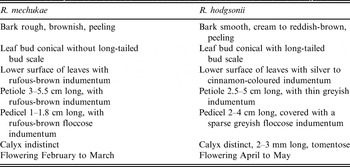
In February and May 2011, botanical explorations carried out in West Siang district of Arunachal Pradesh resulted in the collection of an interesting species of pink-flowered Rhododendron. It flowered in early February. This taxon shows similarities to Rhododendron subsect. Grandia Sleumer in its rough bark, many-flowered inflorescence, tubular or funnel-shaped corolla, short rachis, and indistinct calyx lobes, but its cup-shaped, compact, rufous-brown hairs on the lower surface of the leaf and distinct nectar pouches at the corolla base suggest it belongs to Rhododendron subsect. Falconera. In the West Siang collection the petioles are terete, the leaf indumentum is rufous-brown and the cup-shaped hairs are broad and not fimbriate at the apex. The eglandular pedicel and densely tomentose ovary show some resemblance to Rhododendron hodgsonii Hook.f. but it differs in the characters set out in Table 1. Thus it is here described as a new species.
A comparison between Rhododendron mechukae and R. hodgsonii

Species Description
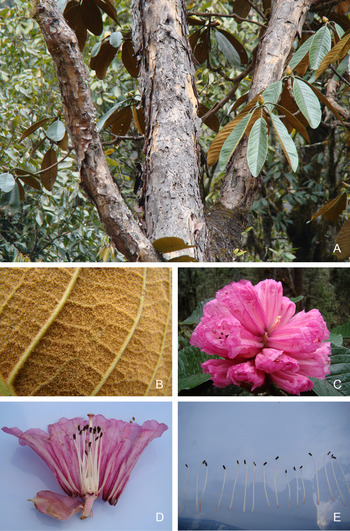
Rhododendron mechukae A.A.Mao & A.Paul, sp. nov.Fig. 1.
Fig. 1.Rhododendron mechukae A.A.Mao & A.Paul. A, branches, bark and leaves; B, lower surface of leaf; C, flowers; D, flower opened out to show stamens and pistil; E, stamens.

Similar to Rhododendron hodgsonii Hook.f., but differs in stem bark brown and not peeling off, leaf bud without long-tailed bud scale, leaf undersurface with rufous-brown indumentum, pedicel shorter (to 1.8 cm long vs. 2–4 cm) and earlier flowering (February to March vs. April to May). – Type: Arunachal Pradesh, Mechukha to Yourlung, West Siang, (28°39′53.7″N, 93°59′08.7″E), 2436 m, 3 iii 2011, A. Paul & S. Bharali s.n. (holo CAL; iso ARUN, NirjuliFootnote 1).

Tree 5–10 m tall. Stem bark rough, brownish, peeling; leaf buds conical without long-tailed bud scales. Petiole terete, 3–5.5 cm long, shallowly channelled above, wrinkled at the base, glabrescent. Leaf blade coriaceous, oblong-elliptic to oblanceolate, 20–30(–35) × 8–13.5(–15) cm, base cuneate, slightly asymmetric, apex rounded to subacute, mucronate, margin entire; adaxial surface glaucous, glabrous, lateral veins 20–24 pairs, impressed, not reaching the margin, abaxial surface with a rufous-brown indumentum; indumentum 2-layered, lower layer compact and upper layer of broad cup-shaped, non-fimbriate hairs, 0.5 mm long. Inflorescence terminal, 12–18-flowered; rachis 10–25 mm long; pedicel 10–18 mm long, terete, with floccose, rufous-brown indumentum; bracts oblong, 3–4.5 × 1.2–2.5 cm, acute, membranous, villous on outer surface, apical margin hyaline. Calyx indistinct. Corolla tubular-campanulate, pink, magenta to purple, with dark reddish basal blotch, corolla tube 4–4.5 cm long, lobes 8, broadly orbicular, c.1.4 × 2 cm, margins wavy, apex emarginate. Stamens 16, unequal, 3–4.5 cm long, anther c.4 mm long; ovary oblong-lanceolate, ends rounded, 12–14 × 6–8 mm, tomentose; style 4–4.2 cm long, straight, stigma capitate. Capsule not seen.
Distribution. Only known from the type locality.
Habitat and ecology. Flowering: February–March. The plants grow in semi-dense temperate forest mixed with Rhododendron arboreum Sm., R. arizelum Balf.f. & Forrest, Taxus wallichiana Zucc., Pinus roxburghii Sarg. and other shrubby species. It is common but localised on hillsides in this area.
Etymology. The species is named after its type locality.
Conservation status. Critically Endangered CR B2ab(ii,iii,v). The total area of occupancy of this species is only around 5–10 km2 and the area is subject to timber extraction, greatly threatening the population.
Additional specimen studied. India. Arunachal Pradesh: Mechukha to Yourlung, West Siang, 2400 m, 25 ii 2010, A. Paul & S. Bharali 48 (Nirjuli).
Acknowledgements
The first two authors are grateful to the Director, Botanical Survey of India, Kolkata for providing necessary facilities to conduct the work. The authors are also grateful to Dr David Chamberlain, Royal Botanic Garden Edinburgh and Dr Keith Rushforth, Hampshire, UK for comments on the identity of the taxon.