Introduction
Despite major advances in the field over the last decades, it is still unclear how bilinguals control their two languages during word production. However, it is broadly accepted that bilingual speakers have both languages continuously co-activated. Words in the non-target language are activated even when words are being produced in the target language, and can interfere with production in the target language at the phonological and lexical levels (see De Groot, Reference De Groot2011, for a review). In this paper, based on the assumption of the co-activation of the two languages, we test new predictions regarding a special class of words, cognates, the members of which share both meaning and phonology across the two languages in a bilingual speaker.
Most prominent models of bilingual language production (e.g., Poulisse & Bongaerts, Reference Poulisse and Bongaerts1994) follow the general architecture and principles of spreading activation proposed in monolingual models of word production (e.g., Dell, Reference Dell1986). In a bilingual context, activation of concepts activates lexical units in both target and non-target languages. For example, in an English–Spanish bilingual production system, both lexical items table and mesa are activated upon seeing the picture of a table. Furthermore, several studies have shown that both lexical representations also activate their corresponding phonemes (see for instance Costa, Caramazza & Sebastian-Galles, Reference Costa, Caramazza and Sebastian-Galles2000; and Costa, Reference Costa, Kroll and de Groot2005; Kroll, Bobb & Wodniekca, Reference Kroll, Bobb and Wodniekca2006; Kroll, Bobb, Misra & Guo, Reference Kroll, Bobb, Misra and Guo2008 for reviews).
Many studies that aimed to explore the consequences of spreading activation within and between languages during language production have addressed this question by looking at how cognates are processed. Cognates are words that share similar meaning and form across languages (e.g., tomato in English; tomate in Spanish) while non-cognates are words that share meaning but not form (e.g., table in English; mesa in Spanish). Differences in processing speed and/or accuracy between cognates and non-cognates is classically called the cognate effect (Costa et al., Reference Costa, Caramazza and Sebastian-Galles2000). In most studies of isolated word production (e.g., picture naming), a facilitatory cognate effect has been reported; cognates are produced faster than non-cognates (Costa et al., Reference Costa, Caramazza and Sebastian-Galles2000; Costa, Santesteban & Cano, Reference Costa, Santesteban and Cano2005b; Sadat, Martin, Magnuson, Alario & Costa, Reference Sadat, Martin, Magnuson, Alario and Costa2016; Ivanova & Costa, Reference Ivanova and Costa2008). This cognate facilitation effect is usually explained by phonological pre-activation. While aiming to produce either a cognate or a non-cognate word leads to the activation of lexical items in both languages, only in the case of a cognate word do these lexical items map onto a shared subset of phonemes. The phonological units of a cognate word thus receive activation not only from the cognate word in the target language but also from its co-activated (phonologically similar) translation equivalent in the other language. This increased activation of cognate phonemes facilitates the production of a cognate compared to a non-cognate word (see Costa et al., Reference Costa, Santesteban and Cano2005b; Indefrey, Reference Indefrey2006).
Does phonological similarity systematically facilitate production?
As mentioned above, a facilitatory cognate effect has been attributed to phonological similarity between the translation equivalents for cognate words. In other words, cognates have a built-in phonologically similar neighbor which facilitates their production. This logic would hold if the effect of phonologically similar context on production was generally that of facilitation, but the empirical evidence does not support this pattern. While several studies have reported facilitation for items produced in phonologically similar conditions (Damian, Reference Damian2003; Nozari, Freund, Breining, Rapp & Gordon, Reference Nozari, Freund, Breining, Rapp and Gordon2016; Roelofs, Reference Roelofs1999; Wang, Shao, Chen & Schiller, Reference Wang, Shao, Chen and Schiller2018), robust facilitation is limited to conditions in which the majority of items share the same onset (e.g., bed, bone, bat). This type of onset-similarity facilitation has thus been attributed to strategic processes arising outside of the language production system (Meyer, Reference Meyer1991; O'Séaghdha & Frazer, Reference O'Séaghdha and Frazer2014). A series of previous studies also suggested that phonological similarity facilitates word production, by showing that words with a large phonological neighborhood density (i.e., words having many neighbors by substituting, adding or deleting one phoneme; Luce, Reference Luce1986) are processed faster than words with low neighborhood density (Vitevitch, Reference Vitevitch2002; Baus, Costa & Carreiras, Reference Baus, Costa and Carreiras2008; Chen & Mirman, Reference Chen and Mirman2012).
In contrast, several other studies on phonological neighborhood density (Newman & German, Reference Newman and German2005; Vitevitch & Stamer, Reference Vitevitch and Stamer2006), as well as a large-scale analysis (Sadat, Martin, Costa & Alario, Reference Sadat, Martin, Costa and Alario2014), reached the opposite conclusion: words with high neighborhood density are produced slower than words with low neighborhood density Footnote 1. Furthermore, studies that have manipulated phonological similarity in non-onset positions (which removes the opportunity for strategic planning) have reported inhibitory effects on production (Breining, Nozari & Rapp, Reference Breining, Nozari and Rapp2016, Reference Breining, Nozari and Rapp2018; Nozari et al., Reference Nozari, Freund, Breining, Rapp and Gordon2016). For example, Breining et al. (Reference Breining, Nozari and Rapp2016) designed a cyclic picture naming task in which segments overlapped unpredictably. To reduce strategic planning at play when segments overlap in initial position, they used target words with phonological overlap distributed across word positions (e.g., cat, mop, cap, map, mat, cot). In this situation, not only the net effect was inhibitory, but the analysis of a subset of stimuli that overlapped in onset (e.g., cat, cap, cot) showed an interference (and not a facilitation) effect. These results are a clear demonstration that onset overlap does not confer a pure advantage per se. This inhibition results naturally from feedback in the production system (Dell, Reference Dell1986; Nozari & Dell, Reference Nozari and Dell2009): imagine that pictures of cat and mat are to be named in random order. Upon seeing a picture of a cat, the lexical item cat and its phonology are activated. The activated phonemes then feed activation back to the lexical item cat, but also the other item mat that shares some of cat's phonology. Thus mat is now more activated, in turn sending stronger activation to its own onset /m/ which competes with the onset /k/ in cat. This competition interferes with the production of phonologically similar words (see Breining et al., Reference Breining, Nozari and Rapp2016; Reference Breining, Nozari and Rapp2018 for an incremental learning account of this interference). Note that when words are phonologically-dissimilar (e.g., cat, bed) feedback from the phonology of cat does not further activate the unrelated word bed, and does not increase its chance of activating its phonology to compete with cat as strongly as a phonologically-related word such as mat.
In short, when the opportunity for strategic preparation is removed, the net effect of phonological overlap within one language is inhibition rather than facilitation. If a similar logic is extended to cross-language activation of phonologically similar words (i.e., cognates), one would expect the cognate effect to be inhibitory. For instance, when an English–Spanish bilingual aims to name a picture of a tomato, activation at the phonological level will feed back to the lexical level, increasing the activation of tomato as well as tomate which would in turn activate its own phonology, some of which (e.g., the final vowel) would compete with the phonology of the target item, and would thus interfere with its production. But, as explained earlier, the cognate effect is that of facilitation and not interference. How do we resolve this discrepancy?
We propose two potential solutions to this. (1) The first solution is to assume that within- and cross-language principles of production are vastly different, and there is no reason to expect within-language effects to be observed across languages. We would thus concede that the effect of phonological similarity within a language is the opposite of the effect of cognates across languages. (2) The second solution is to question that the cognate effect is entirely facilitatory in nature. This view would maintain that similar principles govern the production of phonologically similar words within and across languages, cognate production being simply a generalization of the phonological similarity effect to bilingual production. This view makes a clear prediction: cognates must cause some level of interference in the production system.
While there are currently no reports of overt inhibitory effects for cognates, at the lexical/phonological levels and in a monolingual production mode, there are several reasons to believe that such interference may have been masked by countering facilitatory effects. First, even though the net effect of phonological similarity in monolingual production has been reported to be inhibitory (see the evidence above), an initial naming attempt can often benefit from the presence of a phonologically-related prime (Collins & Ellis, Reference Collins and Ellis1992; Ferrand, Segui & Grainger, Reference Ferrand, Segui and Grainger1996). Thus, to give interference its best chance, one must look at subsequent naming attempts after the word has already been pre-activated, and investigate whether repeated presentations eliminate or reverse cognate facilitation. This prediction finds support in switching experiments: When bilingual participants perform a picture naming task in which a cue indicates which language has to be used for each naming attempt, the switching cost (i.e., slower naming after language switching as compared to language repetition) is reduced when the to-be-produced items are cognates (cognates and non-cognates presented in separate blocks; Declerck, Koch & Philipp, Reference Declerck, Koch and Philipp2012; Li & Gollan, Reference Li and Gollan2018a). When the same items are repeatedly presented, this switch-facilitation effect for cognates is reduced or even reversed (Li & Gollan, Reference Li and Gollan2018a; see also Broersma, Carter & Acheson, Reference Broersma, Carter and Acheson2016), suggesting that repetition may play a key role in unmasking inhibitory effects of cognates Footnote 2.
A second argument in favor of potential interference effects in cognate production at the lexical/phonological levels comes from studies in phonetics. Interference cognate effects have been observed repeatedly at the phonetic level (i.e., actual production of a given phoneme), which leaves open the possibility of interference at earlier stages of processing during production. In fact, several studies on bilingual speech production have shown that phonetic realizations (i.e., actual production) of certain speech sounds are more influenced by the non-target language when embedded into cognate than non-cognate words (e.g., Flege & Munro, Reference Flege and Munro1994; Amengual, Reference Amengual2012; but see also Flege, Takagi & Mann, Reference Flege, Takagi and Mann1995; Flege, Frieda, Walley & Randazza, Reference Flege, Frieda, Walley and Randazza1998 for a lack of cognate effect in phonetic realization). For instance, Amengual (Reference Amengual2012) showed that Spanish–English bilinguals, producing cognate and non-cognate words in Spanish, produced the /t/ sound more “English-like” (i.e., with longer Voice Onset Time values) when embedded into cognates than non-cognates.
To summarize, many studies on cognates have revealed a facilitatory cognate effect. Hints of interference, however, do exist, but come from studies which entailed language-switching or code-switching (e.g., Acheson, Ganushchak, Christoffels & Hagoort, Reference Acheson, Ganushchak, Christoffels and Hagoort2012; Broersma et al., Reference Broersma, Carter and Acheson2016; Christoffels, Firk & Schiller, Reference Christoffels, Firk and Schiller2007; Li & Gollan, Reference Li and Gollan2018a, Reference Li and Gollan2018b; Muscalu & Smiley, Reference Muscalu and Smiley2018), or those that explored the cognate effect at the phonetic level (Flege & Munro, Reference Flege and Munro1994; Amengual, Reference Amengual2012). It thus remains to be seen whether cognates could also induce interference at the lexical/phonological levels during a task that does not evoke code-switching (e.g., by inserting items from the non-target language in a sentence), or language-switching (e.g., by requiring speakers to rapidly switch back and forth between their two languages). Furthermore, if cognate words can cause interference, then one way to reconcile the apparently contradictory results would be to assume that cognates might facilitate or inhibit production at different levels of processing. Indeed, previous studies suggest that interference and competition resolution between the two activated languages could arise at different levels involved in word retrieval (semantic, lexical, phonological, articulatory; Kroll et al., Reference Kroll, Bobb and Wodniekca2006; Dijkstra, Miwa, Brummelhuis & Baayen, Reference Dijkstra, Miwa, Brummelhuis and Baayen2010; Jacobs, Fricke & Kroll, Reference Jacobs, Fricke and Kroll2015). It is thus possible that cognates also induce facilitation or inhibition at the phonological and/or lexical levels (see Li & Gollan, Reference Li and Gollan2018a, Reference Li and Gollan2018b; Muscalu & Smiley, Reference Muscalu and Smiley2018 for tentative claims on the locus of facilitation/inhibition).
Current study
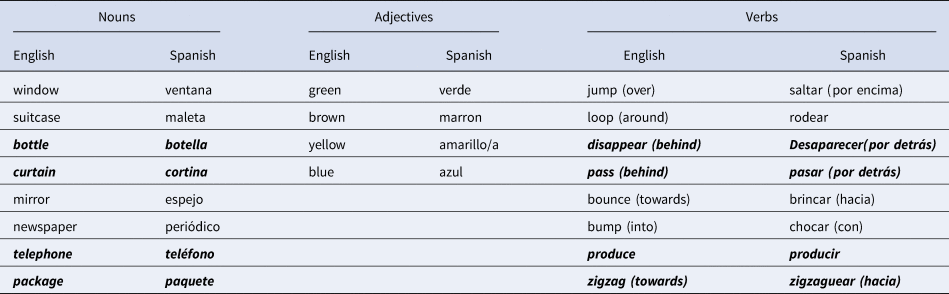
The main goal of the current study was to investigate whether cognates, due to their cross-language phonological overlap, elicit some degree of interference similar to phonologically overlapping words within the same language. We were particularly interested in cognate production in the context of sentences which, similar to everyday speech production, were constructed from meaning, and did not require rapid switching between the speaker's two languages. English–Spanish bilingual participants watched animated events and described them in real-time using ‘NP1-verb-NP2’ sentence structure (NP referring to noun-phrase), such as ‘The green suitcase loops around the blue window’, for event 1 in figure 1. Half of the nouns and verbs were cognates (e.g., bottle, botella; to pass, pasar) and the other half, non-cognates (e.g., mirror, espejo; to bump, chocar; see Table 1).
Linguistic material

The first four nouns (all feminine) were included in set 1 and the last four nouns (all masculine) were included in set 2. In each set, two words were English-Spanish cognates (in bold italic) and two were non-cognates. The first four verbs (in gray cells) were ambiguous and the last four verbs were unambiguous. In each category, two verbs were English-Spanish cognates (in bold italic) and two were non-cognates. Nouns, adjectives and verbs were matched in frequency and length in English and Spanish. Cognates and non-cognates were matched within-language for frequency and length.
We suspected that one of the reasons that cognate interference has not been uncovered in the past studies of picture naming may have been the low processing demands associated with naming single pictures in neurotypical adult speakers (Costa et al., Reference Costa, Caramazza and Sebastian-Galles2000; Sadat et al., Reference Sadat, Martin, Magnuson, Alario and Costa2016; Hoshino & Kroll, Reference Hoshino and Kroll2008; Poarch & Van Hell, Reference Poarch and Van Hell2012). We thus implemented two manipulations in our design to make the production of certain nouns and verbs more challenging compared to others, and to compare the effect of cognate status between the ‘easy’ and ‘difficult’ productions.
The difficulty in noun production was manipulated by using four thematically related nouns per block which had to be repeatedly produced in NP1 and NP2 positions in each sentence. In another paper using the same paradigm and data (Nozari, Martin & McCloskey, Reference Nozari, Martin and McCloskey2019), we have established that this manipulation caused semantic interference (i.e., slower naming responses for pictures that are semantically related versus unrelated; Belke, Meyer & Damian, Reference Belke, Meyer and Damian2005; Nozari et al., Reference Nozari, Freund, Breining, Rapp and Gordon2016; Schnur, Schwartz, Brecher & Hodgson, Reference Schnur, Schwartz, Brecher and Hodgson2006; Schnur, Schwartz, Kimberg, Hirshorn, Coslett & Thompson-Schill, Reference Schnur, Schwartz, Kimberg, Hirshorn, Coslett and Thompson-Schill2009) at the sentence level. In fact, we showed that when producing sentences with nouns in NP1 and NP2 being thematically related, participants tend to perform worse on NP2. In other words, production of the noun in NP1 interferes with the production of the related noun in NP2, and makes NP2 more error-prone. Prior studies have linked the resolution of competition in such cases to the areas in the prefrontal cortex directly involved in implementing inhibitory control (e.g., Schnur et al., Reference Schnur, Schwartz, Kimberg, Hirshorn, Coslett and Thompson-Schill2009).
To manipulate the difficulty of verb production, we used verbs associated with ambiguous vs. unambiguous events. Ambiguous events were those in which visual uncertainty had to be resolved before the proper verb could be selected for production. For instance, the “looping around” event was identical to the “jumping over” event, but continued past the 180 ° point to complete a full circle (see events 1 and 3 in figure 1). To produce the correct verb, participants must inhibit the urge to commit to a certain verb before the point of disambiguation. Previous work has shown that verb production associated with the ambiguous condition is particularly prone to errors, and is responsive to manipulations that help with the resolution of interference through augmenting inhibitory control, such as the anodal stimulation of the prefrontal cortex (Nozari, Arnold & Thompson-Schill, Reference Nozari, Arnold and Thompson-Schill2014).
The creation of the ‘difficult’ conditions (NP2 and ambiguous verbs) served the purpose of increasing control demands in order to uncover interference effects which may have been too small to detect in simple tasks. The logic was as follows: if cognates create competition in the production system, inhibitory control is required to suppress the activated competing representation. When the task is simple, inhibitory control can efficiently accomplish this with little detrimental effect. On the other hand, if other aspects of the task also require inhibitory control, as has been argued above for NP2 and ambiguous verbs, the allocation of limited control resources to the resolution of competition associated with semantic interference (NP2) and ambiguity resolution (ambiguous verbs) should take away from those resources resolving competition between cognates. As such, we would predict that cognates should show a disadvantage compared to non-cognates specifically under the difficult production situations on NP2 and ambiguous verbs.
The potential division of inhibitory resources between resolving within-language interference (semantic interference on NP2 and event ambiguity on ambiguous verbs) and between-language interference (interference presumably imposed by the co-activation of cognates) also provides a unique opportunity to investigate how the system prioritizes resource division in the face of competing within- and between-language demands for inhibitory control. If the errors generated during cognate production are mainly within-language errors, i.e., semantically related intrusions or the competing ambiguous verb, this would mean that the system must have prioritized keeping the non-target language from interfering over resolving within-language competition. On the other hand, if the generated errors are mainly between-language errors, i.e., translation equivalent intrusions, this would mean that the system must have prioritized resolving within-language interference.
To summarize, if under the circumstances created by this task the cognate effect continues to be pure facilitation, we would conclude that within-language dynamics that give rise to lexical/phonological interference do not apply across languages. On the other hand, evidence of interference in cognate production, especially for the ‘difficult’ conditions (NP2 and ambiguous verbs), would point to the extension of similar principles of lexical-to-phonological mapping within and across languages. Furthermore, analyses of error types can shed light on whether language control mechanisms prioritize resolving within- or between-language interference during production in a monolingual mode.
Methods
The data analyzed in this study is a subset of the dataset analyzed in Nozari et al. (Reference Nozari, Martin and McCloskey2019). In Nozari et al. (Reference Nozari, Martin and McCloskey2019), our goal was to investigate the role of control processes on error detection. To this end, we explored the link between error rates and proportion of corrected errors, as a function of the position in the noun phrase (NP) and in the sentence (NP1 versus NP2). The comparison made between English and Spanish in that article was solely to disentangle part of speech from position within the NP (i.e., adjective-noun in English vs. noun-adjective in Spanish). The study, however, was not about bilingualism or differential processing of cognates vs. non-cognates, which are the focus of the current study. As such, the scope of work including the research question, the analyses, and the conclusions are entirely different between the two studies.
Participants
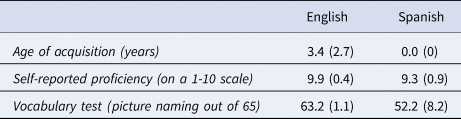
Twenty highly-proficient Spanish–English bilinguals (12 males; Mean age = 21 ±2 years) were recruited to take part in the study in exchange for payment. They were all native speakers of Spanish, who still used Spanish in their everyday exchanges, while living and working in an English–Speaking environment (Baltimore, Maryland, USA). Participants were all highly proficient in both languages, which they had acquired early in life. Despite an earlier age of acquisition for Spanish (t test: t(16)Footnote 3 = −5.22, p <.001), English was their dominant language as revealed by self-reported proficiency (t test: t(19) = −2.46, p = .024) and a vocabulary test (t test: t(19) = 6.19, p <.001; see Table 2). All participants gave their written informed consent before taking part in the study, which was approved by the Institutional Review Board of Johns Hopkins School of Medicine.
Linguistic profile of the participants

Averages reported in each row for English and Spanish, with standard deviations in parentheses.
Materials
The ‘Haunted Hotel’ paradigm consisted of 224 events to be described using a ‘NP1-verb-NP2’ sentence structure. NPs always consisted of a determiner, a noun and an adjective. Each event consisted of two colored objects involved in an action, e.g., a blue curtain passing behind a green package, that had to be described in English as ‘The blue curtain passes behind the green package’ or in Spanish as ‘La cortina azul pasa por detrás del paquete verde’. In total, the events included 8 possible objects, 4 possible colors and 8 possible actions (see Table 1).
The 224 events were divided into 4 blocks of 56. For half of the participants the order of the 4 blocks was ‘English–Spanish–Spanish–English’, while for the other half it was ‘Spanish–English–English–Spanish’. Of the eight objects, four appeared in blocks 1 and 2, and the other four in block 3 and 4. That means that half of the items were first primed and practiced in English before being produced in Spanish, and the other half were first primed and practiced in Spanish and then in English. Since there is asymmetry in language switching between L1 and L2 which may interact in complex ways with our desired effects, we analyzed only the blocks in which the objects were seen for the first time. Those blocks were also the ones not preceded by a naming block in the other language, meaning the non-switching blocks (i.e., blocks 1 and 3, each containing 56 events). Due to the counterbalanced assignment of lists to blocks, each set of four objects were seen equally often in English and Spanish blocks across all subjects.
The events were presented in PowerPoint slides with scripted timing for movements. Each block was divided into 14 slides, and each slide contained four events. The four events took place consecutively, with 1500 ms intervals, during the slide show and had to be described in real-time (Figure 1). Timing of the events was set with pilot testing, and was just long enough so that participants could finish the sentence if they described the event as it unfolded. They would, however, run out of time if they waited until the event finished before they started speaking. These timing parameters were chosen to encourage incremental planning, elicit slips of the tongue and reduce memory errors.
Example of a slide with four events unfolding automatically and sequentially.
Lines and arrows indicate the motion and direction respectively. Numbers indicate the order in which motion events take place. The position of the motion taking place first, second, third and last was arbitrary and randomized across slides. Note that the numbers of the events, the lines and the arrows have been added for clarity but were not displayed during the experiment. Event 1 = “loops around”; Event 2 = “bounces towards”; Event 3 = “jumps over”; Event 4 = “zigzags towards”.

All the nouns appeared with equal frequency in NP1 and NP2. Of the two sets of nouns (Table 1), the first set contained only feminine Spanish words, while the second set contained only masculine Spanish words. We thus made sure that event description was not made more difficult in Spanish than in English due to the additional required selection of the proper determiner (‘la’ for feminine and ‘el’ for masculine words). We also minimized increased complexity in Spanish by using, wherever possible, gender-invariant adjectives (‘verde’, ‘marron’ and ‘azul’; an exception was ‘amarillo’, spelled ‘amarilla’ following a feminine noun). Half of the nouns were English–Spanish cognates and half were non-cognates distributed equally over NP1 and NP2 positions. Half of the verbs were used in ambiguous (referred to as “ambiguous verbs”) and the other half in unambiguous (referred to as “unambiguous verbs”) events. The action in the ambiguous events resembled another action in the set up to a point, after which the event was disambiguated (see Table 1 for the list of ambiguous and unambiguous verbs). Half of the ambiguous verbs were English–Spanish cognates and half were non-cognates, and similarly for unambiguous verbs. The “passing behind” event was identical to the “disappearing behind” event, but exactly half of the action was completed after the point where the verb “disappear” would be appropriate. Similarly, the “looping around” event was identical to the “jumping over” event, but half of the action was completed past the point that “jump” was appropriate. In both cases, the action in the ambiguous events resembles another action in the set up to a point, after which the event is disambiguated, and which happens at the same time for both pairs of actions. Consequently, the cognate and non-cognate pairs of ambiguous verbs were controlled for visual complexity and time of disambiguation.
In total, each participant had to produce 112 nouns from each of the four categories (cognate/non-cognate x NP1/NP2; 448 nouns in total) and 56 verbs from each of the four categories (cognate/non-cognate x ambiguous/unambiguous; 224 verbs in total) for a total of 224 events (half of these productions, i.e., blocks 1 and 3, were considered in cognate analyses for the reasons explained earlier).
Procedure
Participants were told that they would be presented with scenes in which some objects would move and interact with one another. Their task would be to describe each animated scene to the confederate, under time pressure, by using a ‘NP1-verb-NP2’ sentence structure. At the beginning of the experiment, they were familiarized with the nouns, adjectives and verbs to be used, in English or in Spanish (always the language of the upcoming block). Then, they practiced describing each action until reaching fluency for each of the 8 possible actions. Finally, they practiced the actual task (four events to be described in a row under time pressure) with 2 slides that were not included in the real task. Practice was repeated if necessary. After familiarization, participants described visual scenes in each slide (four consecutive events). Each event lasted between 2 and 4 seconds and events were separated by a 1.5 second interval. Participants were instructed to move from one slide to the other at their own pace. Since the second set of blocks (blocks 3 and 4) contained a different pool of objects to be named, familiarization and training were repeated between blocks 2 and 3. The language used for familiarization was again the one of the upcoming block: thus, each participant received orientation and practice once in English and once in Spanish, each immediately before its corresponding block.
Error coding and statistical analysis
As the goal of this study was to investigate the modulation of the cognate effect by task difficulty, we focused on error rates and error types for nouns and verbs which had cognate and non-cognate counterparts (errors for determiners and adjectives will not be presented here). Each target word (noun or verb) was coded as a ‘correct production’ (if the word was produced correctly in the language of the block), a ‘miss’ (if the word was not produced at all) or an ‘error’ (described below).
For nouns, production errors were coded as follows. (1) Intrusions were errors in which the participant produced the translation equivalent instead of the target noun (e.g., producing ‘window’ instead of ‘ventana’). (2) Within-language substitutions were errors in which the participant produced another object name than the target (complete or partial production), with this other object coming from the list of 8 candidates in the task whether present in the current slide or not (e.g., producing ‘window’ instead of ‘bottle’). (3) Mispronunciations were incomplete productions of the target noun (e.g., producing ‘suit…’ instead of ‘suitcase’). There were no mispronunciations that were complete productions. (4) Alternative labels were productions of a synonym or the word ‘thing’ instead of the target (e.g., producing ‘box’ instead of ‘package’, ‘thing’ instead of ‘curtain’). (5) Noun/Adjective transpositions happened when participants pronounced the adjective (entirely or partially) before the noun. It happened only in Spanish (e.g., ‘la amari…’ instead of ‘la botella amarilla’).
For verbs, production errors were coded as follows. (1) Intrusions were errors in which the participant produced the translation equivalent instead of the target verb (e.g., producing ‘disappears’ instead of ‘desaparece’). (2) Competitor substitutions were errors in which the target ambiguous verb was replaced by its competitor [in ambiguity] (e.g., producing ‘passes’ instead of ‘disappears’ or vice versa). (3) Within-language substitutions were errors in which the participant produced another verb than the target (complete or partial production; e.g., producing ‘pa…’ or ‘passes’ instead of ‘jumps’). (4) Mispronunciations were incomplete productions of the target verb (e.g., producing ‘dis…’ instead of ‘disappears’). As for nouns, there were no mispronunciations that were complete productions.
For the accuracy analyses, all types of errors were aggregated to increase statistical power. Accuracy data were analyzed using the logistic version of generalized linear mixed models (Baayen, Davidson & Bates, Reference Baayen, Davidson and Bates2008). We included Language (English = −1 vs. Spanish = 1), NP position (NP1 = −1 vs. NP2 = 1), Cognate status (cognate = −1 vs. non-cognate = 1) and all the two-way interactions between these three factors as predictors in the analysis of nouns. We included Language (English = −1 vs. Spanish = 1), Ambiguity (unambiguous = −1 vs. ambiguous = 1), Cognate status (cognate = −1 vs. non-cognate = 1) and all the two-way interactions between these three factors as predictors in the analysis of verbs. Analyses were carried out using the lme4 package (Bates, Mächler, Bolker & Walker, Reference Bates, Mächler, Bolker and Walker2014). In fitting the models, we aimed for the maximal random effect structure the model could handle, in keeping with the recommendations of Barr, Levy, Scheepers and Tily (Reference Barr, Levy, Scheepers and Tily2013). Where this was not possible, it is stated in the ResultsFootnote 4.
Results and discussion
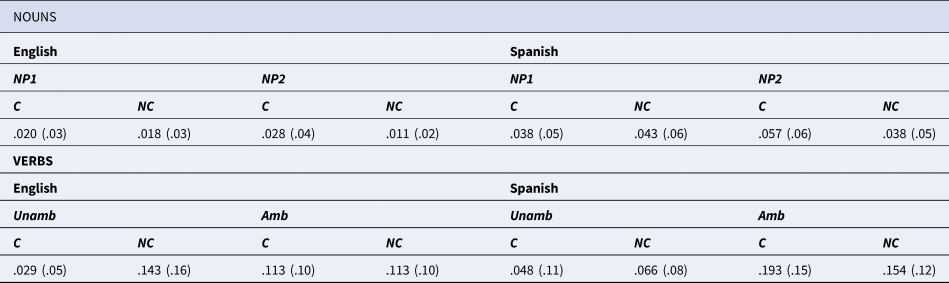
The miss rate was 0.63 ±.85% for sentence production in English and 2.36 ±4.84% in Spanish, and did not significantly vary across languages (t test: t(19) = 1.65, p = .12). The average error rates were calculated for nouns (3.1% in total; 138 errors out of 4460 productions) and for verbs (10.5%; 234 errors out of 2230 productions; see Table 3). The error rates obtained here were in the range expected for production studies conducted on proficient speakers (see for instance Nozari, Arnold & Thompson-Schill, Reference Nozari, Arnold and Thompson-Schill2014; Gollan, Stasenko, Li & Salmon, Reference Gollan, Stasenko, Li and Salmon2017; Li & Gollan, Reference Li and Gollan2018b, among others).
Average error rates for nouns and verbs by condition

Error rates and standard deviations (in parentheses) for nouns and verbs produced in English and Spanish. Nouns and verbs were cognates (C) and non-cognates (NC). Nouns were pronounced in first (NP1) and second (NP2) noun phrase of a sentence and verbs were ambiguous (Amb) or unambiguous (Unamb).
Before exploring the cognate effect for noun and verb processing, we performed a first set of analyses on the entire data set (the four experimental blocks) to check whether our ‘difficult’ conditions, i.e., NP2 and ambiguous verbs, indeed generated more errors over their corresponding baseline conditions, i.e., NP1 and unambiguous verbs. We ran a logistic multilevel mixed model for errors on nouns, including NP position as the fixed effect, and the random intercepts of subjects and items, as well as the random slope for NP position over subjects as the random effect structure. The main effect of NP position was significant (z = 2.613, p = .009), revealing that participants made more errors on NP2 (.031 ±.02) compared to NP1 (.025 ±.02) (as previously reported also in Nozari et al., Reference Nozari, Martin and McCloskey2019). We also ran a logistic multilevel mixed model for errors on verbs, including Ambiguity as the fixed effect, the random intercept of subjects and the random slope for Ambiguity over subjects as the random effect structure. The main effect of Ambiguity was significant (z = −4.187, p <.001), revealing that participants made more errors on the ambiguous (.130 ±.062) than the unambiguous verbs (.066 ±.060). In summary, the data confirmed that both NP2s and ambiguous verbs were more resource-demanding (i.e., error-prone) than their baseline counterparts, as we had hypothesized.
Cognate effects for noun and verb processing
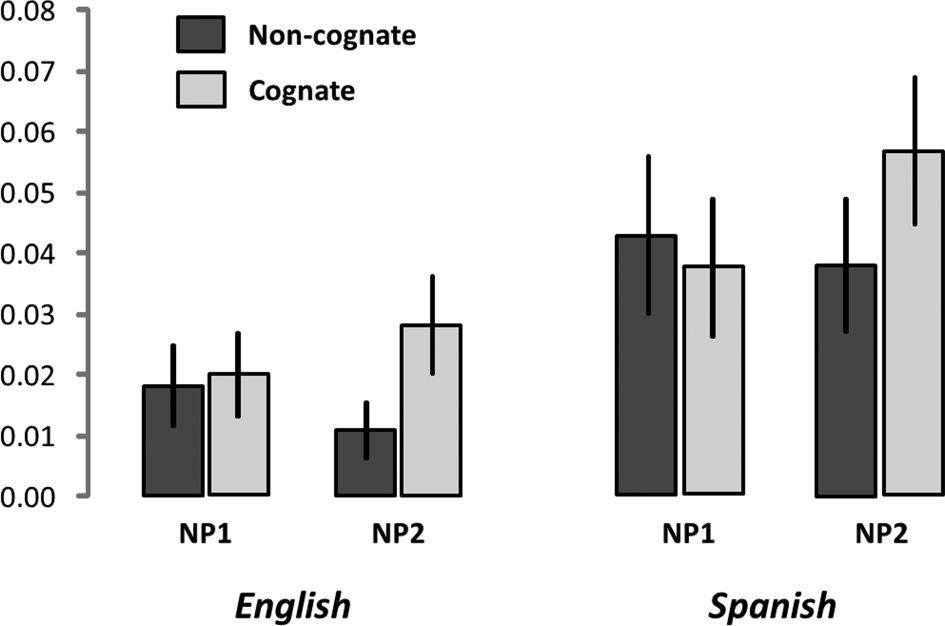
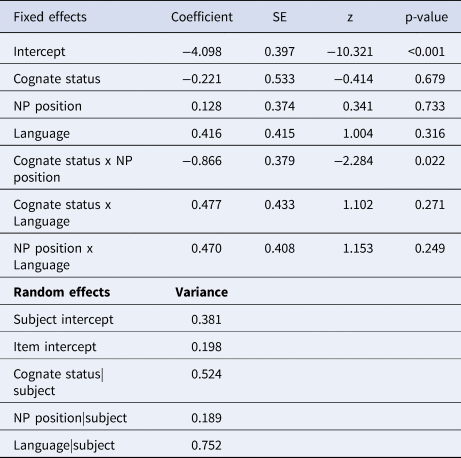
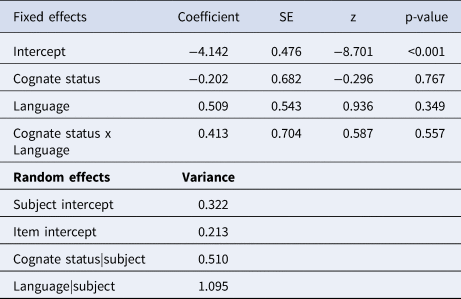
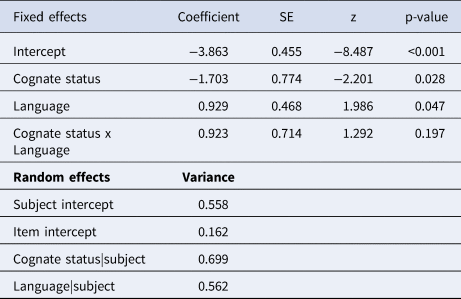
Figure 2 shows the error rates for the cognate and non-cognate nouns on NP1 and NP2 in English and Spanish (see also Table 3). The maximal converging model for errors with nouns included Cognate status, NP position and Language, as well as all two-way interactions between these three factors as the fixed effect structure. The random effect structure included the random intercepts of subjects and items, as well as the random slopes for Cognate status, NP position and Language over subjects. Table 4a shows the full details of this analysis. None of the main effects were significant, but there was a significant Cognate status x NP position interaction (z = −2.284, p = .022), suggesting different processing of cognate and non-cognate nouns for NP1 and NP2. To unpack this difference, we ran post-hoc analyses, which revealed that participants made more errors on cognates (.043 ±.05) than on non-cognates (.024 ±.04) when producing NP2 (z = −2.201, p = .028) but not NP1 (.029 ±.04 and .031 ±.05 for cognates and non-cognates respectively; z = −.296, p = .767; see Tables 4b and 4c for the details of the post hoc analyses). In these post-hoc analyses, there were also marginally more errors on NP2 in Spanish than English, but this effect did not interact with cognate status. The other effects did not reach significance. To summarize, the results showed comparable error rates on cognate and non-cognate words on the ‘easy’ NP1, but on the ‘difficult’ NP2, error rate was significantly higher on cognates compared to non-cognates.
Error rates in noun production
Error rates in production of non-cognates (dark grey) and cognates (light grey), for first (NP1) and second (NP2) noun-phrases in sentence, in English (Left panel) and Spanish (Right panel). Bars represent standard errors.

Results for the error analysis of nouns.

Results of the post-hoc model of error analysis for NP1.

Results for the post-hoc model of error analysis of NP2.

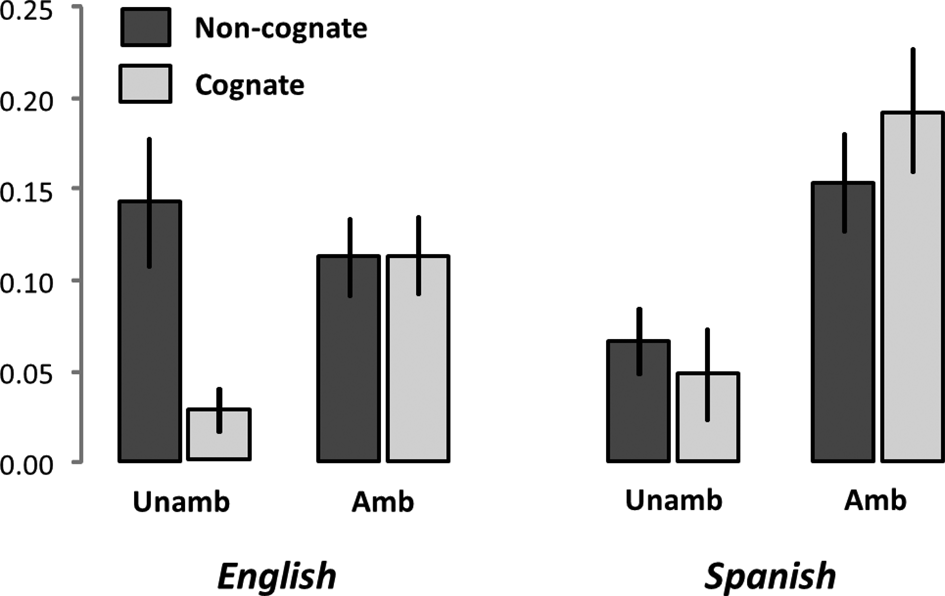
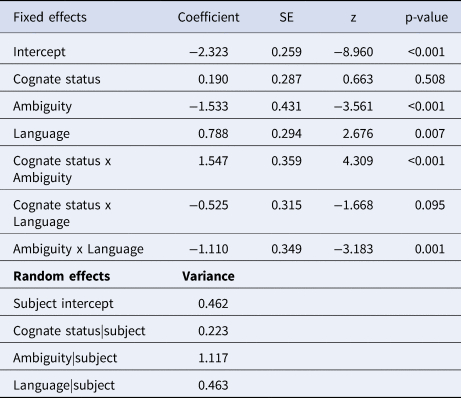
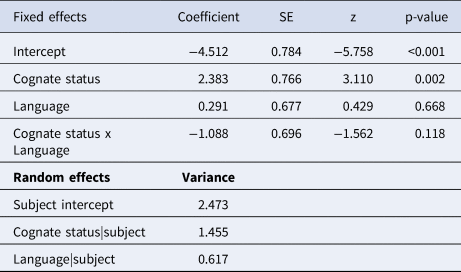
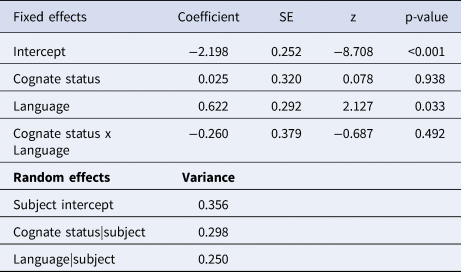
Figure 3 shows the error rates for the cognate and non-cognate verbs that were either ambiguous or unambiguous in English and Spanish (see also Table 3). The maximal converging model for errors with verbs included Cognate status, Ambiguity and Language, as well as all two-way interactions between these three factors as the fixed effect structure. The random effect structure included the random intercept of subjects, as well as the random slopes for Cognate status, Ambiguity and Language over subjects. Table 5a shows the full details of this analysis. There was a significant effect of ambiguity (z = −3.561, p < .001), as participants made more errors when producing ambiguous (.143 ±.12) relative to unambiguous verbs (.072 ±.11). There was also a significant effect of Language (z = 2.676, p = .007), as participants produced more errors in Spanish (.115 ±.13) than in English (.100 ±.11). There was no main effect of Cognate status (z = .663, p = .508) but, critically, we found a significant Cognate status x Ambiguity interaction (z = 4.309, p < .001). Similar to the analysis of nouns, this significant Cognate status x Ambiguity interaction implies that cognates and non-cognates are processed differently under difficult conditions. To unpack this difference, we ran post-hoc models, which revealed that participants made fewer errors on cognates (.038 ±.09) than on non-cognates (.105 ±.13) when producing unambiguous verbs (z = 3.110, p = .002), but this cognate facilitation effect disappeared for ambiguous verb production (.153 ±.13 and .133 ±.11 for cognates and non-cognates respectively; z = .078, p = .938; see Tables 5b and 5c for full details of the post-hoc analyses). Finally, we found a significant Ambiguity x Language interaction (z = −3.183, p = .001; see Table 5a), suggesting differences between the two languages in processing ambiguous and unambiguous verbs. Post-hoc models revealed that the difference stemmed from the processing of ambiguous verbs which were produced more accurately in English (.113 ±.09) as compared to Spanish (.174 ±.14; z = 2.127, p = .033) while the processing of unambiguous verbs was comparable between the two languages (.086 ±.13 and .057 ±.10 for English and Spanish respectively; z = .429, p = .668; see Tables 5b and 5c).
Error rates in verb production
Error rates in production of unambiguous (Unamb) and ambiguous verbs (Amb); verbs were non-cognates (dark grey) and cognates (light grey), in English (Left panel) and Spanish (Right panel). Bars represent standard errors.

Results for the error analysis of the verbs.

Results for the post-hoc model of error analysis of unambiguous verbs.

Results for the post-hoc model of error analysis of ambiguous verbs.

To summarize, the analysis of verbs, similar to nouns, revealed that cognates and non-cognates were processed differently when processing demands increased. However, the nature of the interaction was different in the case of nouns and verbs: for nouns, we found no difference between cognate and non-cognate processing for the (easier) NP1 and an overt interference effect on cognates for the (harder) NP2. For verbs, we found a facilitatory cognate effect for the (easier) unambiguous verbs, and no difference between cognates and non-cognates for the (harder) ambiguous verbs. The similarity between the two patterns is that, as processing demands increase, the cognate effect moves from facilitation towards interference.
Different error types
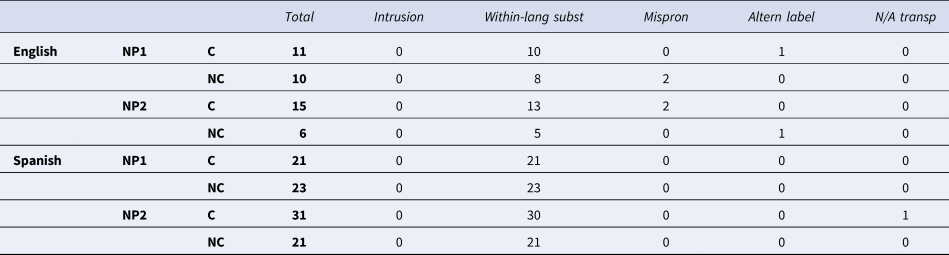
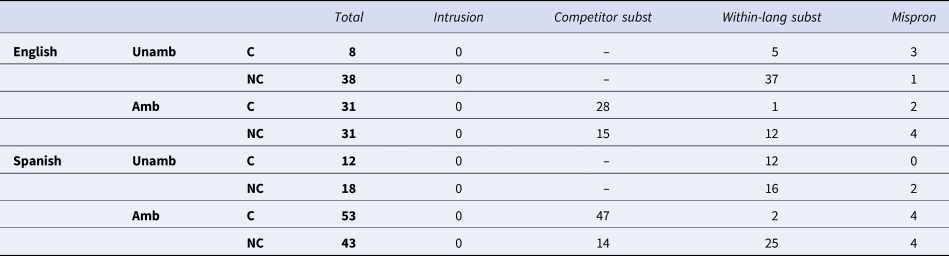
The number of errors of each type is reported in Table 6 for noun and in Table 7 for verb production. The main outcome of these results is that 94.9% of errors in noun production and 91.5% of errors in verb production were within-language substitutions. Strikingly, no cross-language intrusions were observed in any of the conditions.
Type and number of errors in noun production

Errors are reported for nouns produced in English and Spanish, in the first (NP1) and second (NP2) noun-phrase of a sentence, the target noun being a cognate (C) or a non-cognate (NC). Within-langu subst = within-language substitution; Mispron = mispronunciation; Altern label = alternative label; N/A transp = noun/adjective transposition. See text for the description of different error types.
Type and number of errors in verb production

Errors are reported for verbs produced in English and Spanish, in the ambiguous (Amb) and unambiguous (Unamb) conditions, the target verb being a cognate (C) or a non-cognate (NC). Competitor subst = competitor substitution; Within-langu subst = within-language substitution; Mispron = mispronunciation. See text for the description of different error types.
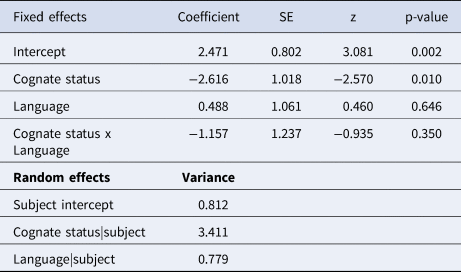
The most frequent type of error in noun production was producing an incorrect target noun from the list of 8 candidates. The most frequent type of error in verb production occurred in the ambiguous condition, in which the competitor of the ambiguous target verb was produced erroneously (e.g., ‘passes’ instead of ‘disappears’). Interestingly, this type of lack of control doubled when the target verb was a cognate rather than a non-cognate, confirming the finding of the verb analysis reported above. To confirm the effect of cognate status on the production of competitor substitutions, we divided the errors on ambiguous verbs into two categories (competitor substitution vs. all other error types), and constructed a model with Cognate status, Language and Cognate status x Language as the fixed effect structure. The random effect structure included the random intercepts of subjects, as well as the random slopes for Cognate status and Language over subjects. The Cognate effect was significant (z = −2.570, p = .010) but the Language effect and the Cognate status x Language interaction were not (see Table 8), showing that cognate status indeed increased the rate of competitor substitution errors during ambiguous verb production.
Results for the error analysis of the ambiguous verbs.

General discussion
The main goal of the present study was to further investigate language control in bilingual word production, and more specifically to explore whether cognates elicit interference during the production of sentences from meaning in a largely monolingual mode. Our main hypothesis was that, if similar principles that govern the production of phonologically related words within the same language also apply to the production of cognates (as semantic equivalents that also share phonology), the cognate production should be associated with at least some degree of interference at the lexical/phonological levels, relative to non-cognate production. We further reasoned that such interference should be most obvious under high processing load, i.e., the production of NP2s and ambiguous verbs in our design.
Our first critical finding was that, for both nouns and verbs, we observed a modulation of the cognate effect by processing difficulty (NP position and verb ambiguity) but in different ways. Cognate and non-cognate nouns elicited a similar number of errors on the (easy) NP1, but cognate nouns elicited significantly more errors on the (difficult) NP2, providing clear evidence that, under circumstances of increased interference, cognate status was detrimental to production (see also Muscalu & Smiley, Reference Muscalu and Smiley2018 for larger error rate on cognates in a translation typing task). For verbs, cognates elicited significantly fewer errors than non-cognates in the (easy) unambiguous condition, but the error rates were comparable between cognates and non-cognates in the (difficult) ambiguous condition. At first glance, the patterns of findings on nouns and verbs seem very different, but, in fact, the observed pattern on verbs is similar to that of nouns with a shifted baseline; for nouns, the easy (i.e., baseline) condition starts with no effect, and turns into overt cognate interference in the difficult condition. For verbs, the easy (i.e., baseline) condition starts with a facilitation, which disappears in the difficult condition. This means that in both conditions, a change from easy to difficult has been associated with a shift towards more cognate interference, albeit with different starting points for nouns and verbs. We did not anticipate the different baselines observed for nouns and verbs, but a likely explanation is that verb processing is inherently more difficult than noun processing (for reviews, see Mätzig, Druks, Masterson & Vigliocco, Reference Mätzig, Druks, Masterson and Vigliocco2009; Vigliocco, Vinson, Druks, Barber & Cappa, Reference Vigliocco, Vinson, Druks, Barber and Cappa2011), which may make verbs more susceptible to the facilitatory benefits of cognates (see below). However, a direct comparison of nouns against verbs was never a goal of the experiment: thus, the two sets of words also differed in other properties such as length and frequency, in addition to the fact that verbs must be planned with their related function words, e.g., [disappears] behind, [bumps] into, etc., all of which may contribute to the different baselines of noun vs. verbs observed here. Critically, however, in both cases, we observed the same trend of moving towards more cognate interference under increased processing demand.
An additional piece of evidence for the claim that cognates do consume inhibitory control resources during verb production is the strikingly different pattern of errors on cognate vs. non-cognate ambiguous verbs: errors on cognate verbs are almost exclusively competitor substitutions, while errors on non-cognate verbs are more evenly distributed between competitor substitution and other within-language errors. Recall that, by design, preventing competitor substitutions is directly dependent on inhibitory control: speakers must inhibit the urge of committing to a verb until the point of disambiguation. The dominance of these errors on cognate verbs and their greater prevalence on cognate vs. non-cognate verbs imply that cognate production consumes the inhibitory control resources that were otherwise to be allocated to the prevention of competitor substitutions. This, in turn, implies that cognates must induce some degree of interference through competition demanding of inhibitory control resources for its resolution. Collectively, these data provide the first evidence for cognate interference at the lexical/phonological levels in a spoken production task, in which participants produced sentences from meaning in a monolingual mode. We would like to point out, though, that the low number of items per condition is a limitation of the study, especially for verb comparisons for which a between-item comparison has been necessary. Thus, further research is needed to assess the generalization of the results to a larger set of items. Generalization to another population of bilinguals would also provide further support to the conclusions. The interference effect, reported here, is overtly observable on nouns with tighter controls and less obvious on verbs. Still, the general consistency in the pattern of moving from facilitation to interference from easy to difficult conditions for both nouns and verbs, which is aligned with our theoretical prediction, suggests that the results are capturing a consistent effect.
Another interesting finding of this study was that the errors produced on both cognate and non-cognate words were exclusively within-language errors (i.e., no intrusion errors from the other language). This pattern is in keeping with several past reports (Gollan, Schotter, Gomez, Murillo & Rayner, Reference Gollan, Schotter, Gomez, Murillo and Rayner2014; Gollan et al., Reference Gollan, Stasenko, Li and Salmon2017; Gollan & Goldrick, Reference Gollan and Goldrick2018). The simplest interpretation of this finding would be that there is no simultaneous co-activation of the non-target language during production in a monolingual mode. This interpretation, however, does not fit the results discussed earlier, which show clear effects of cognate status, i.e., the influence of the other language on the one currently in use. Moreover, although the task was a monolingual task that did not require frequent switching, the experimental environment was clearly bilingual, with all participants completing the third block after having received instructions in both languages, and having completed block 1 in a different language. It is thus difficult to argue that the experimental design discouraged language co-activation. The collective pattern of data is, instead, better aligned with a system in which (1) both languages are activated even during production in a monolingual mode, with representations from both languages actively competing for selection, and (2) separate mechanisms are at play for selectively allocating inhibitory control resources to the prevention of between- vs. within-language errors. In the current settings (i.e., monolingual context), the system prioritizes the prevention of between-language errors, in line with the task goal (i.e., “speak Spanish”).
Is the cognate effect facilitatory or inhibitory?
The demonstration of inhibitory cognate effects in the presence of increased processing demands reported in the current study does not negate, but complement, the prior reports on cognate facilitation. Note that a similar pattern of facilitatory/inhibitory cognate effects tends to emerge in the literature on language perception. In fact, despite the extensive literature on the facilitatory cognate effect in lexical decision tasks (e.g, Lemhöfer & Dijkstra, Reference Lemhöfer and Dijkstra2004), recent findings point to some inhibitory cognate effects in such tasks (orthographically non-identical cognate interference in an L1 lexical decision task; Lemhöfer, Huestegge & Mulder, Reference Lemhöfer, Huestegge and Mulder2018). A similar tension also exists in the literature regarding the effects of semantic and phonological similarity on producing words within the same language. Semantic similarity infamously induces both facilitation (see for instance Bloem, van den Boogaard & La Heij, Reference Bloem, van den Boogaard and La Heij2004; Rabovsky, Schad & Rahman, Reference Rabovsky, Schad and Rahman2016; Wheeldon & Monsell, Reference Wheeldon and Monsell1994) and interference (see, for instance, Belke et al., Reference Belke, Meyer and Damian2005; Costa, Alario & Caramazza, Reference Costa, Alario and Caramazza2005a; Howard, Nickels, Coltheart & Cole-Virtue, Reference Howard, Nickels, Coltheart and Cole-Virtue2006; Nozari et al., Reference Nozari, Freund, Breining, Rapp and Gordon2016; Schnur et al., Reference Schnur, Schwartz, Brecher and Hodgson2006, Reference Schnur, Schwartz, Kimberg, Hirshorn, Coslett and Thompson-Schill2009; Wheeldon & Monsell, Reference Wheeldon and Monsell1994). In some cases, facilitation and interference are even observed within the same task. For example, in cyclic blocked naming, semantic similarity between pictures first induces a transient facilitatory effect which switches to interference in later cycles (e.g., Schnur et al., Reference Schnur, Schwartz, Brecher and Hodgson2006; but see Navarrete, Del Prato, Peressotti & Mahon, Reference Navarrete, Del Prato, Peressotti and Mahon2014, for an alternative interpretation). Similarly, phonological similarity could facilitate (Damian, Reference Damian2003; Meyer, Reference Meyer1991; Roelofs, Reference Roelofs1999; Nozari et al., Reference Nozari, Freund, Breining, Rapp and Gordon2016; Wang et al., Reference Wang, Shao, Chen and Schiller2018) or interfere with production (Breining et al., Reference Breining, Nozari and Rapp2016, Reference Breining, Nozari and Rapp2018; Nozari et al., Reference Nozari, Freund, Breining, Rapp and Gordon2016). Finally, there is also recent evidence that phonological neighborhood density might have facilitatory and inhibitory effects on word production: Buz and Jaeger (Reference Buz and Jaeger2015) showed that higher density led to shorter speech onset times but longer articulatory durations.
Thus, conflicting facilitation and interference effects are the norm, rather than the exception, in the production of representations with overlap in semantic and/or phonological features. The net effect seems to depend on various factors. For example, the net effect of phonological overlap is facilitatory when there are opportunities for strategic response preparation, e.g., when the majority of words in a block share a common onset (e.g., O'Séaghdha & Frazer, Reference O'Séaghdha and Frazer2014) but not when such opportunities are removed, e.g., when the overlap is unpredictable (Breining et al., Reference Breining, Nozari and Rapp2016) or moved to non-onset segments (Nozari et al., Reference Nozari, Freund, Breining, Rapp and Gordon2016). More generally, before words are primed – for example, by repeated production – they often benefit from priming by a related word. Examples include the semantic facilitation observed in the first cycle of cyclic naming tasks described above (see also Nozari, Reference Nozari2019 for a discussion of facilitation and interference effects of semantically-related words in production), or the facilitated production of words with phonologically-related primes (Collins & Ellis, Reference Collins and Ellis1992; Ferrand et al., Reference Ferrand, Segui and Grainger1996). Interference effects generally arise during later production attempts when priming has reached its maximal effect.
Applying the conclusions derived from this rich body of work on within-language similarity effects to cross-language effects of similarity (best tested in cognate production) generates two predictions: (1) that cognates should induce both facilitation and interference effects in production, and (2) that interference should arise under specific circumstances; when similarity to the target has already strongly activated the competitor enough for easy selection, and when the resources required for resolving competition between different representations of the cognate word in the two languages are otherwise engaged. The current study, in conjunction with the past reports on cognate production, confirmed both of these predictions. The results add to the body of evidence in favor of cognate facilitation (Costa et al., Reference Costa, Caramazza and Sebastian-Galles2000; Costa et al., Reference Costa, Santesteban and Cano2005b; Sadat et al., Reference Sadat, Martin, Magnuson, Alario and Costa2016; Ivanova & Costa, Reference Ivanova and Costa2008) by showing that cognates were less error-prone than non-cognates for the (easy) unambiguous verb production. On the other hand, cognates not only lost their advantage for the (difficult) ambiguous verbs, but were twice as error-prone to the production of competitor errors as their non-cognate counterparts. Overt interference was found for cognate nouns in the NP2 position, which showed significantly higher error rates than their non-cognate counterparts. Importantly, in both cases, the interference effects emerged only in the difficult conditions which also required inhibitory control for the prevention of other error types. By adding to the need for inhibiting the translation-equivalent to the within-task demands associated with the production of ambiguous verbs and NP2s, cognate words were left with overall fewer inhibitory resources to resolve competition on all fronts, which caused their disadvantage compared to non-cognates in the difficult conditions.
These findings corroborate recent reports on cognate effects in language-switching picture naming, showing that cognate naming can elicit interference in addition to facilitation (Broersma et al., Reference Broersma, Carter and Acheson2016; Li & Gollan, Reference Li and Gollan2018a). They also support the only study (to the best of our knowledge) measuring not only speech onset times but also articulatory durations in cognate and non-cognate picture naming (Sadat et al., Reference Sadat, Martin, Alario and Costa2012). In this study, cognate words were named faster than non-cognates, together with a trend towards longer articulatory durations (see also Buz & Jaeger, Reference Buz and Jaeger2015, for a similar pattern). Similarly, in a translation typing task, cognates elicited shorter response latencies but longer execution latencies as compared to non-cognates (Muscalu & Smiley, Reference Muscalu and Smiley2018). Our results are also in line with a recent study in which Mandarin–English bilingual speakers were asked to read aloud mixed-language paragraphs (Li & Gollan, Reference Li and Gollan2018b). Each paragraph was written in Chinese or English, with a small number of code-switch words in the other language inserted in the text, as in “She sat on the 沙发 and read a book” where 沙发 is the Mandarin translation equivalent for sofa. Switch words were cognates or non-cognates. The authors showed that code-switch cognates elicited more intrusion errors (e.g., reading aloud sofa instead of 沙发 in the previous sentence) than non-cognates, pointing to increased interference caused by cognates in the context of reading (see also Gollan et al., Reference Gollan, Schotter, Gomez, Murillo and Rayner2014). Recently, Davis and colleagues (Davis, Bowman & Kaushanskaya, Reference Davis, Bowman and Kaushanskaya2018) showed that Spanish–English bilingual children reading texts in English made more reading errors when the text contained cognates than when it contained only non-cognates, revealing potential cognate interference in children reading in a monolingual context. Our results support the general conclusions of these studies and add to them by showing that cognate interference is not limited to reading or to situations which actively encourage code- and language-switching. Finally, our results are also in line with the similarity-based interference observed in memory tasks: in fact, we know that semantic and/or phonological similarity between memory traces has a detrimental effect on memory retrieval, which is often interpreted as response competition (e.g., Conrad, Reference Conrad1964; Henson, Reference Henson1998; Page & Norris, Reference Page and Norris1998; Oberauer & Lewandowsky, Reference Oberauer and Lewandowsky2008). The inhibitory effect of similarity (i.e., cognate status) observed in the present study is in line with this long line of research on memory retrieval.
Our results also help with the interpretation of the earlier results which had been deemed potentially contradictory. A prime example is a study of Acheson and colleagues (Reference Acheson, Ganushchak, Christoffels and Hagoort2012), which reported that, despite a facilitatory effect at the behavioral level (faster naming), cognates generate a larger error-related negativity (ERN) than non-cognates. One of the situations leading to the production of the ERN is a high-conflict situation, i.e., one in which multiple representations compete for selection (see Ullsperger, Fischer, Nigbur & Endrass, Reference Ullsperger, Fischer, Nigbur and Endrass2014 for a discussion of this and other causes of the ERN). Such high-conflict situations usually result in behavioral interference, not facilitation: hence, the seemingly contradictory nature of Acheson et al.'s (Reference Acheson, Ganushchak, Christoffels and Hagoort2012) findings. The current data suggest that the larger ERN for cognate vs. non-cognate production may very well indicate a competition that, due to the low processing demands of simple picture naming, was overshadowed by the counteracting facilitatory benefit of shared segments (cf. Zheng, Roelofs, Farquhar & Lemhöfer, Reference Zheng, Roelofs, Farquhar and Lemhöfer2018 for a failure to find a robust cognate effect on the correct-response negativity (CRN) component).
Finally, the suggested balance between facilitation and interference effects of cognates provides a natural explanation for studies in which significant cognate effects have not been systematically observed (e.g., Costa et al., Reference Costa, Caramazza and Sebastian-Galles2000; Ivanova & Costa, Reference Ivanova and Costa2008; Sadat, Martin, Alario & Costa, Reference Sadat, Martin, Alario and Costa2012). These null results may reflect the interaction between the facilitation and interference forces that are simultaneously at work during cognate production.
The locus of facilitation and interference effects in cognate production
The source of facilitation is clear; it is the activation of the shared phonological segments of cognates through two – instead of one – lexical representation. The locus of interference is less certain, and may be lexical, phonological, or both. The first possibility is that interference is purely lexical. This is explained in the framework of interactive models as follows: upon the activation of a word (e.g., tomato), its segments (e.g., /t/, /o/, etc.) send activation back not only to the word itself, but also to other words that share those segments, e.g., the Spanish–Equivalent tomate. Such feedback increases the activation level of the non-target item, e.g., tomate, compared to other items that do not share phonology with the target, and thus makes it a stronger competitor that needs to be inhibited. This leads to interference at the lexical level. If true, then cognate facilitation and interference happen at different levels in the production system (see Sadat et al., Reference Sadat, Martin, Costa and Alario2014, for a similar proposal for phonological neighborhood density effects within a language).
A second possibility is that interference arises at the same level as facilitation. Recall that the simultaneous activation of two lexical representations corresponding to the cognate jointly activates a subset of phonological representations that are shared between cognates. They do, however, also each activate their unique segments that are not shared, e.g., /o/ vs. /e/ in the tomato and tomate, respectively. The non-shared segments of the competitor are even more strongly activated in the presence of feedback, since the lexical item supporting them has received extra activation through feedback from the shared segments. We would thus have a dual effect simply at the level of phonology: shared segments provide facilitation, while non-shared segments compete for selection and elicit interference.
Breining and colleagues (Reference Breining, Nozari and Rapp2018) tested the predictions of an account with competition of the non-shared segments at the phonological level, as described above. They assumed that, in such a system, competition will trigger error-based mechanisms of incremental learning, leading to stronger connections between the lexical representations and the shared segments, but weaker connections between the lexical representations and non-shared segments. In keeping with the predictions, participants not only showed poorer learning of novel labels for objects when those labels were phonologically-overlapping, but also showed a pattern of facilitation/interference for the detection of phonological segments in a probe task, compatible with the described account: when asked to determine whether a letter did or did not belong in an object's label, participants were significantly faster in responding to the shared segments compared to the non-shared segments, showing differential processing of the two segment types at the level of segmental encoding.
Recently, preliminary EEG evidence from the second author's lab also suggests a locus of interference at the phonological level for phonologically-overlapping words (Pinet & Nozari, Reference Pinet and Nozari2018): single-subject ERP data in an individual with aphasia, SA, were compared when she named the same picture (e.g., cake) in the presence of an unrelated item (e.g., map), a semantically-related item (e.g., pie), or a rhyme-overlapping item (e.g., rake), for a total of 1440 trials. Despite comparable RTs in the semantic and rhyme-related conditions (both of which induced interference compared to the unrelated condition), the timeline and the topography of the two effects were different: a significant effect of semantic similarity was detectable as early as 250ms over the left central electrodes, while the effect of rhyme overlap showed up later, at 350 ms, over the occipito-parietal electrodes. Since semantic similarity is known to induce competition at the lexical level (e.g., Schnur et al., Reference Schnur, Schwartz, Brecher and Hodgson2006; Breining et al., Reference Breining, Nozari and Rapp2018), the later timeline of the effect of rhyme overlap with a different topography (which we have now replicated with two more individuals with aphasia) suggests an effect at a later processing stage, i.e., the level of segmental encoding.
Previous studies (e.g., Muscalu & Smiley, Reference Muscalu and Smiley2018) have taken the finding of faster response latencies and longer durations for typing in translation to imply that cognate facilitation and interference can be neatly localized to lexical and segmental levels, respectively. However, initiating production (reflected in response latencies) necessarily involves the encoding of at least the first segment; therefore some level of facilitation must also operate at the segmental level. Moreover, the approach of localizing facilitation and interference effects to different parts of the production system requires an assumption of modularity in the system that is problematic (Nozari & Pinet, Reference Nozari and Pinet2020).
In summary, the locus of interference for phonologically overlapping words in general, and cognate words in specific, could be either at the lexical or the phonological level or both. Some data support the involvement of phonological competition in generating this interference, but more data are required to fully underpin the locus (or the loci) of interference in producing phonologically-overlapping words, especially cognates.
General or selective control?
Our findings unequivocally showed an interaction between cognate status (i.e., between-language competition) and task difficulty induced by within-language competition. This interaction has two implications. (1) There is co-activation of both languages during sentence production in a monolingual mode, or there would be no cognate effects whatsoever (see De Groot, Reference De Groot2011, for a review of a contentious debate in this regard). (2) The inhibitory control resources available to resolve competition across languages and within a language are, at least to some extent, shared (otherwise there would be no interaction between cognate status and within-language manipulation of difficulty).
Shared inhibitory control resources, however, may be allocated either in a non-selective, or a selective manner. A non-selective allocation mode would mean that, as far as the need for control and its deployment goes, there is no difference between within- and between-language competition. Consequently, a mixture of within- and between-language errors should be observed, showing the random failures of control in resolving competition in one case vs. the other. This account would be aligned with proposals that lexical selection is only based on the activation level of a given word, whichever language it may come from (see Finkbeiner, Gollan & Caramazza, Reference Finkbeiner, Gollan and Caramazza2006; La Heij, Reference La Heij, Kroll and De Groot2005). The current data do not support this position. The errors we observed were exclusively within-language, even in the case of NP2 where cognates were clearly more error-prone.
A selective allocation mode, on the other hand, would predict that even though resolving competition both within and across languages taps into the same pool of resources, the system distinguishes between these two and can selectively allocate control resources towards one as opposed to the other. If the system prioritizes sticking to one language (aligned with the goal of production in monolingual situations), it can correspondingly prioritize suppressing between-language competition. This should lead to very few between-language intrusions, while the diversion of resources from resolving within-language competition leaves room for such errors to surface. Such a position is in line with the accounts that propose selective control mechanisms to suppress the non-target language (Abutalebi & Green, Reference Abutalebi and Green2007; Gollan et al., Reference Gollan, Schotter, Gomez, Murillo and Rayner2014; Green, Reference Green1998), and, more generally, accounts that posit selective control mechanisms for various aspects of production (Nozari et al., Reference Nozari, Freund, Breining, Rapp and Gordon2016). Our data support this view.
Note that the alternative hypothesis, i.e., that inhibitory control resources are primarily allocated to preventing errors from the most actively competing words, is not supported by our results. If that was the case, the system would have prioritized the prevention of within-language errors (within-language competitors being the most actively competing words in our design). This, in turn, would have led to at least some between-language errors, given that their prevention would not be prioritized. Further research should explore whether the system also prioritizes the prevention of between-language errors when the probability of within- and between-language errors is more balanced (or inversely unbalanced; between-language errors being the most likely to occur) and in other language production modes (e.g., bilingual mode).
In summary, the current results, together with the past findings, support a shared account of control resources for resolving competition for selection coming from within and between languages. However, they also point to mechanisms for selective allocation of such resources towards between-language competition resolution during production in a monolingual mode and under circumstances in which within-language competitor substitutions are highly likely to occur.
Conclusion
This study provides the first demonstration of cognate interference at the lexical/phonological levels in the production of sentences from concepts. Such interference closely mirrors the interference produced by phonologically-similar words within the same language, and thus points to similar production dynamics within and across languages. The interaction between cognate status and within-language task difficulty, together with the overwhelming dominance of within-language errors as opposed to other-language intrusions, further points to a system in which (a) both languages are simultaneously activated even during production in a monolingual mode, and (b) inhibitory control resources can be selectively deployed towards resolving between-language competition (at least when within-language competitor substitutions are highly likely to occur).
Acknowledgements
We thank Michael Freund and Nicholas McCloskey for their help with data collection. This work was supported in part by the Therapeutic Cognitive Neuroscience Fund endowed to the Cognitive Neurology division of the Neurology Department at Johns Hopkins University. C.D. Martin was supported by the Spanish Ministry of Economy and Competitiveness (SEV-2015-490; PSI2017-82941-P; Europa-Excelencia ERC2018-092833), the Basque Government (PIBA18-29), and the European Research Council (ERC-2018-COG-092833). N. Nozari was also supported by a NSF grant (NSF BCS-1949631).