
Introduction
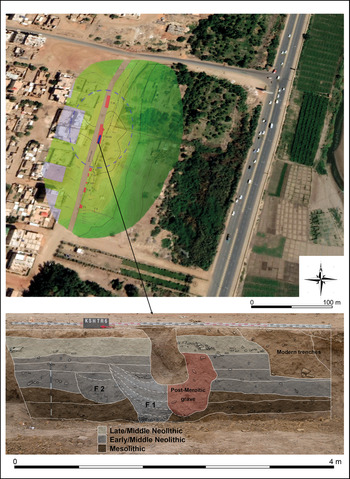
Relatively little is known about the diet and subsistence practices of Early and Middle Holocene communities in Central Sudan, with most available data coming from osteological assemblages or burial contexts. Sites with preserved stratigraphy are rare, but excavations at the Mesolithic–Neolithic settlement of Khor Shambat 1 (KSH1) in Omdurman, on the west bank of the Nile (Figure 1), provide a remarkable opportunity to investigate environmental and cultural changes over more than 3000 years, beginning from the turn of the eighth to the seventh millennium BC.
Top) Map of the KSH1 site; bottom) section of the profile with visible stratigraphy (figure by P. Wiktorowicz and M. Jórdeczka).

With an area of approximately 1.5ha, the site occupies a small hill at 385m asl. Cultural layers of silt and sand, exceeding 1.5m in depth (Figure 1), have yielded an abundance of archaeological materials. The full chronological sequence is preserved only in the central part of the site, where traces of Mesolithic settlement, including numerous structures and two adult male burials, lie beneath Neolithic layers, indicating intense settlement activity and a vast cemetery (Jórdeczka et al. Reference Jórdeczka, Chłodnicki, Sobkowiak-Tabaka and Stanaszek2020a, Reference Jórdeczka2020b).
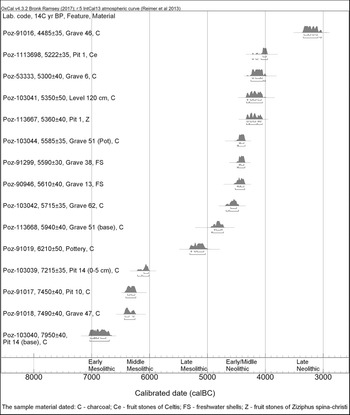
The first Early Mesolithic hunter-gatherers appear at KSH1 in the early seventh millennium BC (Figure 2), with more intense settlement activity during the Middle Mesolithic (late seventh millennium BC), followed by episodic Late Mesolithic horizons (late sixth millennium BC). The Neolithic activity begins in the first half of the fifth millennium BC, intensifying in the second half, and fading away in the fourth millennium BC.
Calibrated dates and 2σ range for the KSH1 site (dates calibrated in OxCal v4.3.2 using the IntCal13 atmospheric curve (Reimer et al. 2013; Bronk Ramsey Reference Bronk Ramsey2017).

The Mesolithic and Neolithic occupation at KSH1 corresponds to the African Humid Period (Gasse Reference Gasse2000; Kuper & Kröpelin Reference Kuper and Kröpelin2006; Drake et al. Reference Drake2018), when the climate in Sudan was characterised by high rainfall, frequent Nile floods, and seasonal lakes in deserts to the east and west of the Nile, allowing the expansion of savannah vegetation and Sahelian fauna. KSH1 was one of several locations along the Nile that provided extensive opportunities for hunting, gathering and fishing and, eventually, for cattle herding. Mesolithic and Neolithic groups would have exploited the open grasslands close to the river for food and other resources.
Archaeobotany
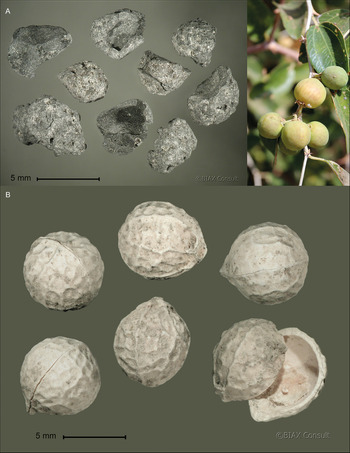
The archaeobotanical remains from Mesolithic and Neolithic contexts at KSH1 (Table S2 in the Online Supplementary Material (OSM)) include charred fruit stones of Ziziphus spina-christi (Christ's thorn jujube) (Figures 3 & S1f), likely a common woody element of the area's vegetation that was probably concentrated in the valley. The plum-like fruits would have been gathered for human consumption and the charred, often-crushed fruit stones suggest that they may have been processed. Present in both Mesolithic and Neolithic wood charcoal assemblages at KSH1, the tree is also likely to have been an important source of firewood. Charred and silicified fruit stones of edible Celtis—most likely Celtis integrifolia (African hackberry; Figure 3)—were recovered from Neolithic contexts. Regularly present at archaeological sites, Celtis was probably an important feature of the Holocene vegetation of Central Sudan. The charcoal assemblage also includes Acacia, also part of the woody vegetation at or near KSH1, and well represented in the Neolithic period, but only sporadically in the Mesolithic. The proximity of the site to the floodplain may account for the presence of Acacia seyal-A. nilotica, a species typically present on temporarily inundated areas in Central Sudan (cf. Barakat Reference Barakat1995). Also present in the assemblage are Grewia sp. and Balanites aegyptiaca (Desert date) (Table S2).
A) Ziziphus (probably Ziziphus spina-christi): left) charred fruit-stone remains from Feature 1, level 1.1–1.2m at KSH1 (photograph by L. Kubiak-Martens); right) the living plant near Al Khiday, White Nile, showing plum-like fruit (photograph by M. Jórdeczka); B) silicified fruit-stone remains of African hackberry (Celtis integrifolia) from Feature 1, level 0.7–0.9m (photograph by L. Kubiak-Martens).

Fauna
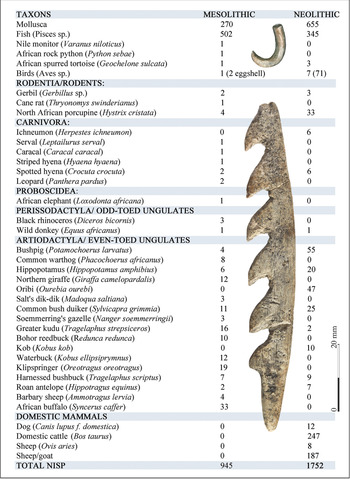
The Mesolithic faunal assemblage (Figure 4 and see the OSM) is dominated by fish, predominantly large catfish (Siluriformes), and molluscs. Reptile bones are rare and only isolated avian remains (mostly river birds) are present. Mammals are the most diverse group, with 26 species identified. The Bovidae family comprise 70 per cent of the remains (14 species; Figure 4). Suidae taxa include bushpig (Potamochoerus larvatus) and common warthog (Phacochoerus africanus), although only in small numbers (1.3 per cent). Many Mesolithic remains represent territorial and non-migratory species, such as warthog, bushpig, oribi (Ourebia ourebi), dik-dik (Madoqua saltiana), kob (Kobus kob) and klipspringer (Oreotragus oreotragus), whose natural biomes comprise shrubbery and woody savannah. The anatomical distribution of mammal remains indicates that carcasses of small- and medium-sized ruminants were transported to the settlement and processed locally. The high degree of bone fragmentation, representing various carcass parts, suggests specific processing methods that maximised the use of all edible body parts; for example, consumption of marrow from long bones was common. The diversity of species and carcass parts represented at KSH1 correlates with the sedentary nature of settlement at other Mesolithic Middle Nile sites (Chaix & Honegger Reference Chaix, Honegger, Kerner, Dann and Bangsgaard2014; Honegger & Williams Reference Honegger and Williams2015). Subsistence strategies at these sites involved intensive and comprehensive exploitation of the local environment, in keeping with the so-called ‘Broad Spectrum Revolution’ (e.g. Clark & Kandel Reference Clark and Kandel2013).
Faunal data for the Mesolithic and Neolithic periods at KSH1 by Number of Identified Specimens (NISP), along with images of a Neolithic hook (top) and Mesolithic harpoon (below) (photographs by M. Jórdeczka).

Animal remains from Neolithic contexts (Figure 4 and see the OSM) are dominated by domesticated ruminants, including cattle (Bos taurus), sheep (Ovis aries) and goat (Capra hircus). There are fewer hunted mammal species than in the Mesolithic. Bushpigs were commonly hunted, although ruminant species still dominate, with a preference for medium-sized antelopes. The osteological assemblage also suggests a change in fishing practices. Catfish continue to dominate, but they are more diverse in size, suggesting more shallow-water exploitation.
The Neolithic faunal assemblage suggests that beef was far more important than sheep or goat meat. The limited size of the assemblage precludes full reconstruction of an age-at-death profile, but mature animals (above four years of age) were preferentially slaughtered, suggesting that cattle and small ruminants were bred mostly for secondary products, such as milk (Balasse Reference Balasse2003; Gillis et al. Reference Gillis2013). All parts of the animals were used and bone shafts were broken to obtain marrow.
Lipid residue analysis
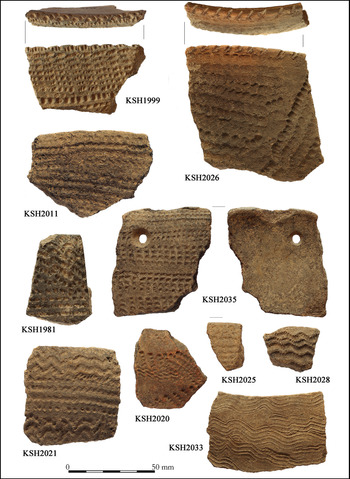
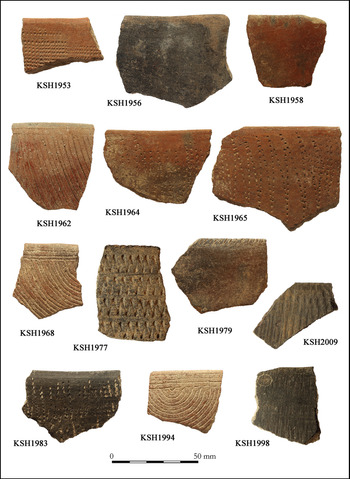
We performed lipid residue analysis using well-established protocols (see the OSM; Dudd & Evershed Reference Dudd and Evershed1998; Correa-Ascencio & Evershed Reference Correa-Ascencio and Evershed2014). Lipid biomarker analysis using gas chromatography–mass spectrometry (GC-MS) shows residues falling into two categories (Table S1). Extracts from 13 sherds (KSH003, KSH008, KSH1953, KSH1956, KSH1958, KSH1964, KSH1965, KSH1967, KSH1979, KSH1981, KSH1991, KSH1998 and KSH2033; Figures 5 & 6) include a series of long-chain fatty acids containing C20 to C26 carbon atoms (Figure 7a). These probably originate directly from animal fats incorporated via the ruminant animal's plant diet (Halmemies-Beauchet-Filleau et al. Reference Halmemies-Beauchet-Filleau2014).
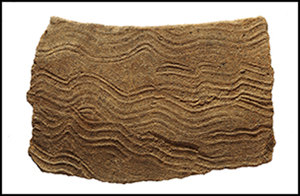
Mesolithic pottery samples from KSH1 containing lipid residues (photograph by M. Jórdeczka).

Neolithic pottery samples from KSH1 containing lipid residues (photograph by M. Jórdeczka).

Partial gas chromatograms of trimethylsilylated FAMEs showing: a) typical degraded animal fat lipid profile (KSH1964); (b–c) typical plant lipid profiles (KSH2035, Neolithic and KSH2028, Mesolithic). Red circles = n-alkanoic acids (fatty acids, FA); IS = internal standard, C34 n-tetratriacontane. Numbers denote carbon chain length (figure by J. Dunne).

The second category comprises lipid profiles that also contain distributions (generally in low abundance) of long-chain fatty acids (n=10), ranging from C20 to C30, often dominated by C26, displaying a strong even-over-odd predominance (i.e. higher abundances of even-numbered long-chain fatty acids) (Figure 7b–c). The n-alkanoic acids are generally found in higher plants as C16 to C36 homologues, with a strong even-over-odd predominance. Of these, the C22, C24, C26, C28 and C30 fatty acids originating from epicuticular (plant) waxes are indicative of a higher plant source (Eglinton & Hamilton Reference Eglinton and Hamilton1967). They are not, however, diagnostic of families of plants and are only a general indicator of plant processing.
Animal product lipid profiles
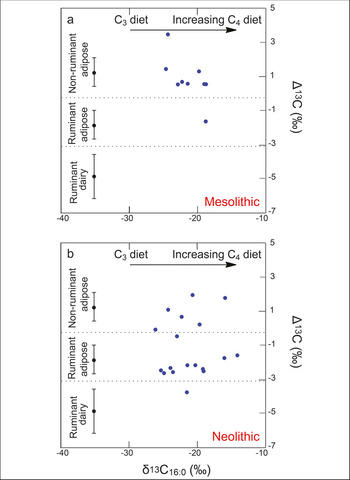
Thirty samples underwent gas chromatography–combustion–isotope ratio mass spectrometry (GC-C-IRMS) analyses (Table S1 and Figure 8) to determine the δ13C values of the major fatty acids, C16:0 and C18:0, and ascertain the source of the lipids extracted (Dunne et al. Reference Dunne2012). Lipid residue results show that KSH1959 (Neolithic) plots in the dairy region, with a Δ13C value of −3.8‰ (Figure 8). Vessels KSH002, KSH005, KSH008, KSH1953, KSH1958, KSH1962, KSH1964, KSH1965, KSH1968, KSH1977, KSH1979, KSH1998, KSH2021 and KSH2173 (Figures 5 and 6) plot within the ruminant carcass region, with Δ13C values of −2.1, −1.3, −2.0, −1.6, −2.6, −2.4, −2.6, −2.3, −2.2, −2.2, −2.5, −2.5, −1.7 and −1.8‰ (Figure 8), respectively—confirming they were used to process carcass products from domesticated cattle, sheep or goat. One of these, KSH2021 (Figure 5), is of Mesolithic origin, while the remainder (n = 14) are Neolithic. Two Neolithic vessels, KSH1967 and KSH1991, plot between the ruminant and non-ruminant regions, with Δ13C values of 0.2 and −0.5‰ (Figure 8).
Graphs showing Δ13C (δ13C18:0 – δ13C16:0) values from (a) Mesolithic and (b) Neolithic KSH1. Ranges shown here represent the mean ±1 s.d. of the Δ13C values for a global database comprising modern reference animal fats from the UK, Africa and elsewhere (Dudd & Evershed Reference Dudd and Evershed1998; Dunne et al. Reference Dunne2012) (figure by J. Dunne).

Potsherds KSH003, KSH1956, KSH1981, KSH1983, KSH1994, KSH1999, KSH2009, KSH2011, KSH2020, KSH2025, KSH2026, KSH2028 and KSH2033 (Figures 5 and 6) plot in the non-ruminant/plant region, with Δ13C values of 1.4, 1.9, 1.3, 1.8, 1.1, 1.4, 0.6, 3.4, 0.5, 0.6, 0.5, 0.5 and 0.5‰, respectively. Of the Mesolithic potsherds, eight (89 per cent) plot within the non-ruminant/plant region, compared with five (24 per cent) of the Neolithic sherds (Figure 8).
The δ13C16:0 values of the fatty acids (Table S1) extracted from the potsherds range from −25.3 to −14.1‰ (−11.2‰ difference) and the δ13C18:0 values range from −27.8 to −14.2‰ (−13.6‰ difference). These values are comparable with those from the Nile site of Kadero (Dunne et al. Reference Dunne2017), although there they clustered within two distinct groups, suggesting that the Kadero animals producing these fats consumed diets comprising mainly C3 or C4 plants. This is not the case at KSH1, where animals probably subsisted on a broad range of forages, from primarily C3 through to C4. Notably, the δ13C16:0 values from the Mesolithic period have a greater C3 influence than those from the Neolithic, suggesting wetter conditions in the earlier period.
Freshwater fish biomarkers
In common with other riverside Holocene sites in Sudan, fish remains—mostly catfish—are present in the Mesolithic and Neolithic layers at KSH1. These are generally very large in the Mesolithic (≥2m), but reduce in size during the Neolithic, from medium (≥0.3m) to small (≤0.3m). This change may reflect a transition from harpooning to net fishing, or the use of hook-and-line tackle, along with, possibly, alternative processing methods. Small fish cannot easily be roasted over fires and are difficult to sun-dry, but could, for example, have been salted (Maritan et al. Reference Maritan2018) or cooked in vessels. To assess this, fatty acid methyl esters from both phases were analysed by GC-MS in Selected Ion Monitoring mode to check for the presence of freshwater biomarkers, such as ω-(o-alkylphenyl) alkanoic acids and vicinal dihydroxy acids. Their presence would denote the processing of shellfish or crustaceans, fish, waterfowl and aquatic mammals (see Cramp & Evershed Reference Cramp, Evershed, Holland and Turekian2014). Notably, no aquatic biomarkers were detectable in the analysed potsherds, suggesting that fish were probably grilled on open fires rather than boiled in pots, although some aquatic input to the vessels cannot be discounted.
Plant processing
Several lipid profiles from KSH1 Mesolithic and Neolithic potsherds contain a series of even-numbered long-chain fatty acids, in distributions and concentrations typical of plant processing (Dunne et al. Reference Dunne2016), although there are no n-alkanes present. Samples from Mesolithic sherd KSH2028 (non-ruminant; Figure 8) and Neolithic sherd KSH1977 (ruminant; Figure 8) each contain long-chain fatty acids (C24, C26 and C28) in greater abundance than the C16 and C18 fatty acids. This suggests that the vessels were used to process mainly plants along with small amounts of animal meat, although care must be taken in their interpretation, as fatty acids which derive from plant processing can contribute more depleted δ13C values to the overall fatty acid signature of the C16:0 and C18:0 fatty acids.
Vessel KSH2035 (Figure 5), which plots in the non-ruminant/plant region, yielded a similar lipid profile to sherds KSH2028 and KSH1977 (Figure 7), except that it contains low concentrations of C16 and C18 fatty acids, with the C16 being too low to measure isotopically. The δ13C values of the C18, C20, C22, C24, C26 and C28 were −21.3, −21.8, −27.6, −28.6, −29.0 and −28.8‰, respectively (Figure 7). As noted above, this suggests a depletion in plant δ13C values, which are dominated by C3, in contrast to the C18:0 and C20:0 fatty acids. Vessel KSH2035 was probably used for plant processing. These fall within the known δ13C values for C3 plant lipids, from −32 to −20‰ (Boutton Reference Boutton, Coleman and Fry1991), suggesting that C3 plants were cooked in the vessels discussed. A further five Mesolithic vessels (KSH1999, KSH2011, KSH2020, KSH2021 and KSH2025; Figure 5) and two Neolithic vessels (KSH1962 and KSH1968; Figure 6) include minor abundances of long-chain fatty acids, which again indicate the addition of plants to meat, possibly to make stews. Mesolithic sherds with evidence for plant processing originate from non-ruminant (hunted) animals—probably warthog, bushpig or small reptiles—while the Neolithic sherds with plant lipids contain ruminant products from domesticates.
The combination of long-chain fatty acids and δ13C values in KSH2035 (Figure 5) strongly suggests the processing of predominantly C3 plant material (Dunne et al. Reference Dunne2016), probably fruits, leafy plants and/or wild grasses, which were possibly mixed with animal products. This confirms the importance of plant resources across the Mesolithic and Neolithic periods in Central Sudan. The most likely plant candidates processed in the vessels are Ziziphus spina-christi and Celtis integrifolia, both of which are C3 plants that dominate the archaeobotanical assemblage at KSH1. Charred and crushed Zizyphus fruit stones suggest that the plums were processed, as at other Early and Middle Holocene sites in Central and Northern Sudan and in Southern Egypt (Majid Reference Majid, Krzyżaniak and Kobusiewicz1989; Kubiak-Martens Reference Kubiak-Martens, Chłodnicki, Kobusiewicz and Kroeper2011; Beldados Reference Beldados2017), possibly to extract seed oil or, as Zizyphus is known for its medicinal properties, as a decoction (Saied et al. Reference Saied, Gebauer, Hammer and Buerkert2008). The identification of Celtis integrifolia at Mesolithic Khartoum Hospital, Garif town, Abu Darbien, Zakyab and Umm Direwiya, and the later sites of Kadero I and Esh Shaheinab (Arkell Reference Arkell1949; Krzyżaniak Reference Krzyżaniak1978; Majid Reference Majid, Krzyżaniak and Kobusiewicz1989), confirms its importance in the Holocene diet in Sudan.
Results from phytolith analyses (see the OSM, including Figure S2a–g) of sediment, grinding stones and macrolithic stone tools indicate that phytoliths derived from monocotyledonous plants and varied grasses (comprising at least 80 per cent or more of counted morphotypes). Grasses belong predominantly to the Panicoideae subfamily, diagnostic morphotypes deriving from the floral parts of these plants being particularly abundant. Spheroid echinates from the leaves of the Arecaceae family (palms) were present in many samples from KSH1 and have occasionally been recorded in other Mesolithic and Neolithic burial contexts in Central Sudan (Out et al. Reference Out2016). These may have been brought to the site unintentionally alongside the dominant grass assemblages. Their presence in settlement areas and association with ground-stone artefacts, however, could be related to matting and basketry, or the production of a range of domestic items, such as brooms, brushes and sieves that were possibly linked to grain cleaning activities (Portillo & Albert Reference Portillo and Albert2014). Archaeobotanical evidence from Mesolithic and Neolithic sites in Sudan suggests the exploitation of a wide range of wild taxa, including native panicoids such as Sorghum sp., Panicum sp. and Setaria sp. (Krzyżaniak Reference Krzyżaniak1991; Kubiak-Martens Reference Kubiak-Martens, Chłodnicki, Kobusiewicz and Kroeper2011; Out et al. Reference Out2016; Fuller & González Carretero Reference Fuller and Carratero2018; Fuller & Stevens Reference Fuller, Stevens, Mercuri, D'Andrea, Fornaciari and Höhn2018).
Phytolith analysis was conducted on dental calculus from individuals from one Mesolithic and three Neolithic graves at KSH1 (see the OSM). These results indicate the consumption of grasses, including panicoids (also found in the ground-stone assemblages), in addition to edible wild fruits. The phytolith and vegetable fibres, however, could equally derive from non-dietary activities, such as raw material processing, or oral hygiene (Radini et al. Reference Radini2017) or ritual activities.
Comparative analysis: faunal remains and organic residues
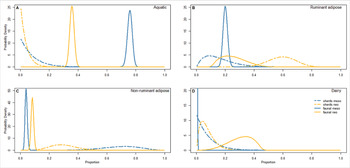
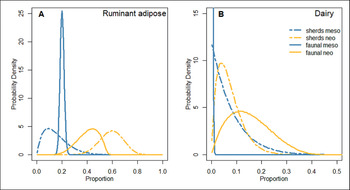
Comparison of two independent datasets related to animal exploitation strategies—pottery lipid residues and faunal remains—provide greater insight into the nature of faunal exploitation at KSH1 (see the OSM and Dunne et al. Reference Dunne2019). Figure 9 illustrates how all four animal resources (aquatic, ruminant adipose, non-ruminant adipose and dairy) are differentially represented in the faunal data and lipid profiles. The distributions associated with the faunal remains (solid blue and yellow lines) are typically very tight due to the large sample size. This compares with the lipid residues (dashed blue and yellow lines), which have a broader distribution due to small sample sizes. The absence of aquatic biomarkers in the pottery (Figure 9A) is striking, especially given the large number of fish bones at KSH1, and seems to be indicative of fish processing by air-drying or grilling, rather than boiling—a practise common across large parts of Holocene North Africa. Non-ruminant adipose fats (Figure 9C) also appear to have been differentially processed. During both the Neolithic (yellow line) and Mesolithic (blue line), non-ruminant adipose resources appear to have been selectively processed in pots, representing around 30 per cent of all lipid attributes during the Neolithic and up to 70 per cent during the Mesolithic—even though non-ruminants represent only 5–10 per cent of all faunal remains.
Proportion estimates for different animal resources, based on sampling the raw integer counts of lipid profiles and faunal counts from a Dirichlet distribution, and using a prior estimate that 75 per cent of domestic ruminant remains at KSH1 are from animals used for dairying. The four resource exploitations are: A) aquatic; B) ruminant adipose; C) non-ruminant adipose; D) dairy (figure by K. Manning).

Figure 9B shows some overlap in the estimated ruminant adipose, especially during the Mesolithic (blue lines). During the Neolithic period, the ruminant adipose fats are better represented in the pots than by the faunal remains (yellow lines), but this may be due to our prior estimate of the proportion of domestic ruminants being bred for milk (i.e. 75 per cent). If most domestic ruminants were kept for their secondary products, then there is little overlap between the estimates from the lipid profiles and faunal remains (Figure 9D), suggesting that dairy products were not processed in pots. If, however, we assume that the lipid profiles are an accurate proxy for the amount of dairying at KSH1, and that most domesticates were bred for meat, we can change the prior estimate of faunal remains that represent dairy to, say, 25 per cent, resulting in a much better fit between the lipid profiles and faunal remains (Figure 10B). This is illustrated in Figure 10, which shows an improved overlap in both resources during the Mesolithic and Neolithic (note that the faunal estimates for dairy animals during the Mesolithic is tightly constrained around zero, as we have large faunal samples and no domestic ruminant animals, whilst the estimates of dairy fats in pottery is distributed around zero due to the small sample sizes and non-zero probability).
Proportion estimates for ruminant adipose (A) and dairy (B) exploitation, based on sampling the raw integer counts of lipid profiles and faunal counts from a Dirichlet distribution, and using a prior estimate that 25 per cent of domestic ruminant remains at KSH1 are from animals used for dairying (figure by K. Manning).

Vessel types and use
A total of 39 Early and Middle Mesolithic sherds were analysed, with 10 sherds (26 per cent) yielding lipids (Figure 5; Table S1). Pots are made of clay tempered with an admixture of fine and medium sand, with occasional vessels being made of clay with admixtures of medium and coarse quartzite sand and mica. The walls are medium–thick (7–8mm) or thick (9–12mm or greater). Most (n = 31) are decorated with dotted, wavy lines, with the remainder having wavy lines (6) or basket-like impressions (1). There is also a single sherd of impressed dotted zigzag ware. Eight of the lipid-yielding sherds (Table S1) are decorated with dotted, wavy lines, whereas the remaining two are decorated with a wavy line (KSH2033; Figure 5) and dotted zigzag (KSH2035; Figure 5), respectively. Vessel wall thickness ranges from 8–11mm, and successfully reconstructed forms include slightly closed vessels with diameters of around 0.16–0.20m and open bowls from 0.20–0.25m in diameter. Both vessel types were used to process non-ruminant adipose, whereas the Mesolithic vessel (KSH2021; Figure 5) that was used to process ruminant products has a closed form (0.16m in diameter) and is decorated with a dotted, wavy line.
The rate of recovery of lipids from Neolithic pottery (n = 60) is greater, at 35 per cent (n = 21; Table S1). These vessels are made of Nile silt with an admixture of fine quartz sand and are occasionally covered with red slip on the outside. Vessels are thin-walled (4–6mm), slightly thicker (7–8mm) or exceptionally thick (10–12mm). Lipid profiles were identified in both closed vessels and open bowls, the latter with diameters from 0.17–0.25m. Neolithic pottery is more diversely decorated and includes fine ‘tableware’ with surfaces covered with red ochre (including ‘black topped’: Figure 6, KSH1958; ‘red polished’: Figure 6, KSH1979; and decoration of semi-circular incised panels: Figure 6, KSH1962, KSH1968 and KSH1994) and much coarser vessels, or ‘kitchenware’. These include undecorated (‘brown burnished’: Figure 6, KSH1956) vessels, together with those having impressed patterns, either rocker-stamped (‘dotted zigzag’: Figure 6, KSH1953, KSH1964, KSH1965 and KSH1983; ‘continuous zigzag’: Figure 6, KSH1977, KSH1998 and KSH2009; and triangles and dotted lines), or decorated with alternately pivoting stamps.
Lipids were identified in four undecorated vessels, 11 rocker-stamp decorated vessels (eight with a dotted zigzag, two with a plain zigzag and one with triangles and dots), one ‘black top’ vessel and five incised ware vessels. As is typical for Central Sudan, there appears to be no relationship between vessel decoration and the commodities processed, although lipids were not found in vessels decorated with alternately pivoting stamps in the form of parallel dotted lines, or on pottery decorated with rows of triangles or dots. The eight vessels decorated with alternately pivoting stamps (triangles and V-shapes) are grey burnished; they do not contain lipids, suggesting that they were used for storing water or other liquids, or possibly for processing low lipid-yielding foods. The vessel used to process dairy products is decorated with a dotted zigzag.
Discussion
There is a clear difference between the products processed in vessels from KSH1 during the Mesolithic and Neolithic periods. Mesolithic vessels were predominantly used to process non-ruminant animal products, albeit at low concentrations, with a small number possibly used for processing meat and plants together—the meat probably from the common warthog and bushpig found in the faunal assemblage, although some aquatic input cannot be discounted. One Mesolithic vessel was used to process ruminant carcass products probably from hunted wild ruminants, such as Salt's dik-dik, common bush duiker and greater kudu, as domesticates were not present at this time.
For the Neolithic period, lipid residue results indicate the dominance of ruminant carcass products: most likely domesticated cattle, sheep or goat. This is confirmed by the elevated presence of livestock faunal remains (approximately 67 per cent of the assemblage). While this percentage is significantly lower than at other Early Neolithic sites, such as Kadero (4600–3800 BC; Krzyżaniak Reference Krzyżaniak1991), the latter is located around 6.5km further from the Nile. Other sites, such as Nofalab, that are also closer to the river, have faunal assemblages comprising large quantities of fish and compositions of mammals similar to KSH1. Gautier & Van Neer (Reference Gautier, Neer, Chłodnicki, Kobusiewicz and Kroeper2011: 407) suggest that people on the west bank of the Nile may have relied less on cattle, having no access to the good grazing land found on the alluvial plain on the east bank, as seen at sites such as Kadero, where domesticates comprise 81 per cent of faunal remains. The presence at KSH1 of five vessels (24 per cent) used for non-ruminant processing, however, indicates continued exploitation of non-ruminant wild game on a limited scale. This contrasts with other sites in Sudan (e.g. Kadero), where faunal assemblages suggest a near complete reliance on livestock, although it should be noted that lipid residue results from Kadero confirm that approximately 33 per cent of vessels were used for non-ruminant processing, suggesting that hunting still played an important role (Dunne et al. Reference Dunne2017).
One lipid residue sample plots within the range for ‘dairy’, suggesting possible low-level exploitation of secondary products. This contrasts with Kadero, where nearly half of the vessels (47 per cent) were used to process dairy products. The KSH1 faunal assemblage suggests that cattle and small ruminants were bred for secondary products, such as milk. If, however, we assume that the lipid residues are an accurate proxy for the scale of dairying practised, then the revised estimate of 25 per cent used in the comparative analysis provides a good fit between the faunal representation and lipid profiles (Figure 10), offering a novel method for estimating the proportion of livestock that were used for dairying. Low incidences of dairy lipids in pots at KSH1 may have other explanations: some milk may have been drunk fresh, with only a portion being processed in pots to make products such as butter; or dairy products may have been processed in vessels made from perishable materials, such as wood or bark, or in eggshell containers, an example of which is found in Neolithic grave 15 at KSH1 (Jórdeczka et al. Reference Jórdeczka2020b: 154–56). These seemingly different subsistence strategies are notable, as both KSH1 and Kadero are Early Neolithic sites situated in similar locations (north of the convergence of the Blue Nile and the White Nile). Such differences suggest that these settled groups were flexible and resourceful, adapting their subsistence practices to maximise resource availability in an increasingly unpredictable environment.
The presence of lipids denoting plant processing (the long-chain fatty acid δ13C values), together with the phytolith evidence from grinding stones, confirms the importance of plants in both Mesolithic and Neolithic diets, probably along with significant input of grasses from the Panicoideae subfamily and fruits from Ziziphus spina-christi and Celtis integrifolia.
Conclusion
The well-preserved stratigraphy at the Early and Middle Holocene site of Khor Shambat provides a valuable opportunity to investigate 3000 years of environmental and cultural change in Central Sudan, beginning in the seventh millennium BC. Here, for the first time, we have combined zooarchaeological, palaeobotanical, phytolith and dental calculus studies, together with lipid residue analysis and comparisons of the faunal remains and organic residues. This approach provides a holistic overview of changing adaptation strategies, including hunting and consumption models, from Mesolithic hunter-gathering to Neolithic herding, with implications for the understanding of this transition across the broader region. Lipid and faunal data show a clear change from the hunting of small- to medium-sized game in the Mesolithic to the exploitation of domesticates—both for their carcasses and dairy products—in the Neolithic. Selective hunting of bushpigs and medium-sized antelopes continued, albeit at a lower level than in the Mesolithic. Plant resources were clearly important during both the Mesolithic and Neolithic periods, being processed in pots either as fruit or for their seed oil, and sometimes mixed with animal products. The results paint a unique picture of the natural environment and of human subsistence during the African Humid Period in Early to Middle Holocene Central Sudan, and, on a broader scale, demonstrate the wider potential of multidisciplinary studies in investigating ancient human lifeways globally.
Acknowledgements
Ian Bull and Alison Kuhl are thanked for technical help and Borys Banecki for sample analysis. We are also grateful to the NCAM and the State of Khartoum. Thanks also to Alexa Höhn.
Funding statement
Multidisciplinary research at the KSH1 site was funded by a grant from the National Science Centre, Poland (grant 2015/17/D/HS3/01492). The authors thank the Leverhulme Trust (RPG-2016-115) for funding ‘Peopling the Green Sahara? A multi-proxy approach to reconstructing the ecological and demographic history of the Saharan Holocene’, and NERC 771 (reference: CC010) and NEIF (www.isotopesuk.org) for funding and maintenance of the instruments used for this work.
Supplementary material
To view supplementary material for this article, please visit https://doi.org/10.15184/aqy.2021.141