Introduction
The tragic events at the 2013 Boston Marathon increased the attention on planning for mass-gathering events. According to the World Health Organization (WHO), a mass gathering is defined as an organized or unplanned event where “the number of people attending is sufficient to strain the planning and response resources of the community, state, or nation hosting the event.” 1 Although mass-gathering events, such as marathons, involve significant preplanning, especially in heavily-populated cities, organizers of such events face challenges caused by unexpected incidents and communication/coordination failures. An acute incident is any abrupt occurrence that has the potential to impact significantly a mass of people at an event. Such incidents may not escalate to large-scale disasters, but the recent catastrophic bombing during the 2013 Boston Marathon highlighted the ongoing need to extrapolate lessons learned from a wide variety of scenarios, as they can be valuable for disaster planning and preparedness.
Disruptions due to unexpected incidents have occurred in several recent marathons. A breakdown in communication between race officials at the 2005 Quad Cities Marathon and the Iowa Interstate Railroad Company forced some runners to wait for passing freight trains before finishing the race. 2 The 2008 London Marathon involved a reroute around the 13-mile mark due to a potential gas leak. 3 A bomb scare near the finish line of the 2010 Pittsburgh Marathon and Half Marathon caused a brief delay because the police were unable to reroute the course. 4 As a result of Hurricane Sandy, officials for the 2012 ING New York City Marathon cancelled that race. 5
The approach to race preparation, planning, and real-time response has evolved in recent years.Reference Jaslow, Yancey and Milsten 6 - Reference Hartman, Williamson and Sojka 19 For example, in 2007, Chicago Event Management (CEM, organizers of the Chicago Marathon) cancelled the event midrace due to extreme weather conditions, where temperatures escalated to 31°C with high humidity. This decision required communication to those on the course (eg, runners, police officers, spectators, and medical aid station captains). However, there was confusion regarding the message communicated to “cancel the race.”Reference McCarthy, Chiampas, Malik, Cole, Linderman and Adams 20 In response to these challenges, Chicago Marathon organizers established the Chicago Model (CM), which integrates organizational structure, information systems, and communication to enhance planning, preparation, and real-time response for mass-gathering events.
Since 2008, race officials have implemented the CM at Shamrock Shuffles and Chicago Marathons. The Bank of America Shamrock Shuffle 8 K (Shamrock Shuffle) is an annual Chicago road race with approximately 60,000 spectators. 21 It is considered the world's largest road race for that distance. 22 The race starts and finishes in Chicago's Grant Park, with a route that tours the downtown area. The race includes first time, charity, and elite runners, with more than 90% of participants from Chicago and surrounding suburbs. 22 In 2013, 33,285 runners finished the race. 23 The number of spectators often significantly exceeds the number of participant runners.
This case report describes the current operating approach, referred to as the Chicago Model, for the Chicago Marathon and the Shamrock Shuffle, and illustrates how this approach facilitated the response to an acute incident at the 2013 Shamrock Shuffle. Further, the insights from the incident are extended to planning of mass-gathering events generally and the role the CM can play for disaster preparedness for mass-participation events.
Report
The Chicago Model
Planning and execution stages of mass-gathering events, such as marathons, involve various challenges. Race organizers of the Chicago Marathon designed the CM to organize and operate such events more effectively; and to facilitate more flexible and dynamic responses in changing environments. The CM encompasses all agencies and resources involved in a mass-gathering event. The purpose of the CM is to create an environment where all agencies contribute to preplanning and execution, agreeing to their responsibilities in such a chaotic environment and achieving a shared mental model of responsibilities and information requirements.Reference McCarthy, Chiampas, Malik, Cole, Linderman and Adams 20 , Reference Stout, Cannon-Bowers, Salas and Milanovich 24 The CM has three key components described in detail in this section: organizational structure, information systems, and communication.
Organizational Structure
The CM uses the Incident Command System (ICS) to bring together a multitude of stakeholders integral to planning and running the event. The ICS is a top-down structure that has a predesignated chain of command with one incident commander to maintain a line of authority.Reference McCarthy, Chiampas, Malik, Cole, Linderman and Adams 20 Incident command systems, including the National Incident Management System (NIMS), are designed management approaches to incidents and large-scale disasters. This organizational structure enables coordinated planning and preparedness activities. This form of preparedness includes devising corresponding action plans for a wide range of potential scenarios. The ICS facilitates the potential planned execution of such actions among a large number of agencies (police and fire departments, the American Red Cross of Greater Chicago, the Office of Emergency Management and Communications (OEMC), the mayor's office of special events and marathon teams such as event weather update team, event medical information team and course management team).Reference Chiampas and Jaworski 25 The CM also includes a physical structure on site for each event where the agencies share the same physical environment (Forward Command); this serves as the headquarters for communication and resource allocation.Reference Chiampas and Jaworski 25 Being in the same physical environment enables more dynamic communications and improves relationships among different agencies, which accelerates the decision-making process.
Information Systems
The information systems of the CM ensure clear and timely flow of information, which allows decision makers to manage the event. Throughout the event, several agencies are responsible for collecting information from the course route and monitoring that data using information systems within Forward Command. Although there are a few different information systems, the organization within the CM system allows for collective information sharing in the physical, shared command space where dynamic decision making occurs.
The medical tracking system allows key stakeholders to monitor health care services and respond to needs in the field. For instance, the leaders in Forward Command can follow the state of all medical tents with this tracking system, which gives information regarding the runners arriving at those tents. The information system also provides surveillance for potential public health events. Meteorological data are collected on site in 15-minute intervals to predict and prepare for weather-related emergencies. The city's video surveillance system monitors for suspicious incidents on the course to provide early warning. The components of the information system coalesce in Forward Command where CM members can identify acute events, communicate for timely coordination of response, and make time-dependent decisions to mitigate negative outcomes.
Communication
The communication component is tightly tethered to information systems and organizational structure. The key to effective communication is creating physical and virtual spaces that bring information and people together, particularly engaging key people in leadership positions and building trust. Successful communication relies on an organizational structure that enables coordinated activities, ie, ICS. The information system provides infrastructure to communicate and the organizational structure provides guidelines on who should communicate with whom. In order to implement existing plans effectively and respond to incidents quickly, all agencies must know their responsibilities and should be able to work in collaboration with minimal communication. The CM brings together the leaders of all involved agencies to achieve this level of communication successfully under these conditions. Without fast and clear information flow regarding incidents, it is challenging for agencies to devise rapid responses. For this reason, Forward Command becomes the center of information during the entire event. For instance, all calls to the published emergency number for the Chicago Marathon and any 911 calls related to that event are forwarded to the Forward Command telemetry system, where a private ambulance company is responsible for handling those calls.
There are several important benefits to using this structure for the CM. The communication requirement among various agencies is minimal in the sense that it is more streamlined, efficient, and timely; resulting in a reduced number of duplicated tasks. This allows the agencies to focus more on the decision-making process rather than repeating the same procedures independently due to lack of communication. In case of an unexpected incident, all agencies decide and act together; so the responses are generated quickly and the agencies do not become confused about their responsibilities.
Incident: 2013 Bank of America Shamrock Shuffle
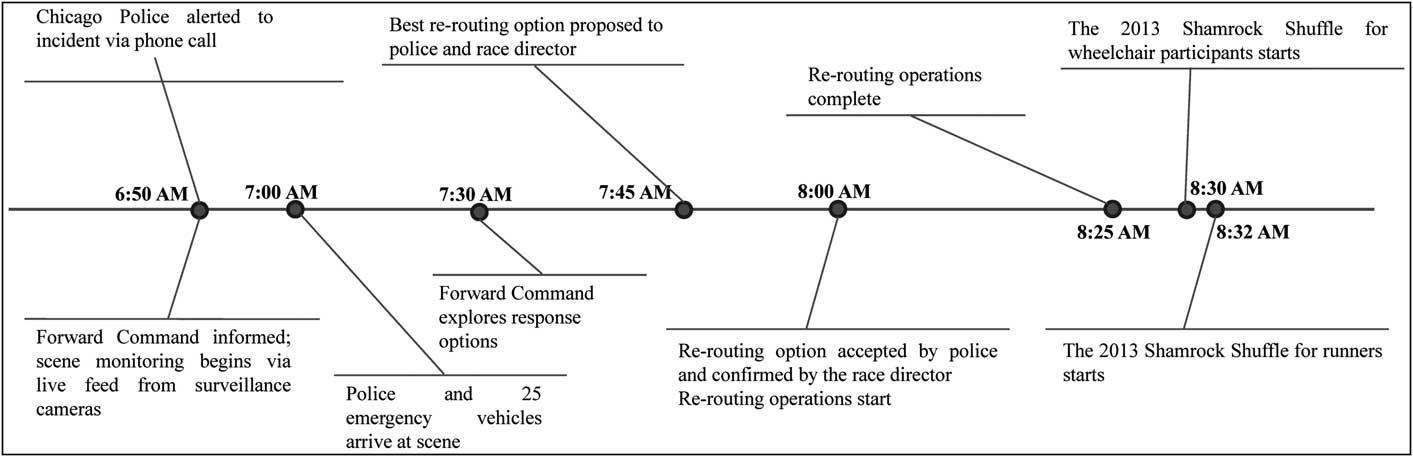
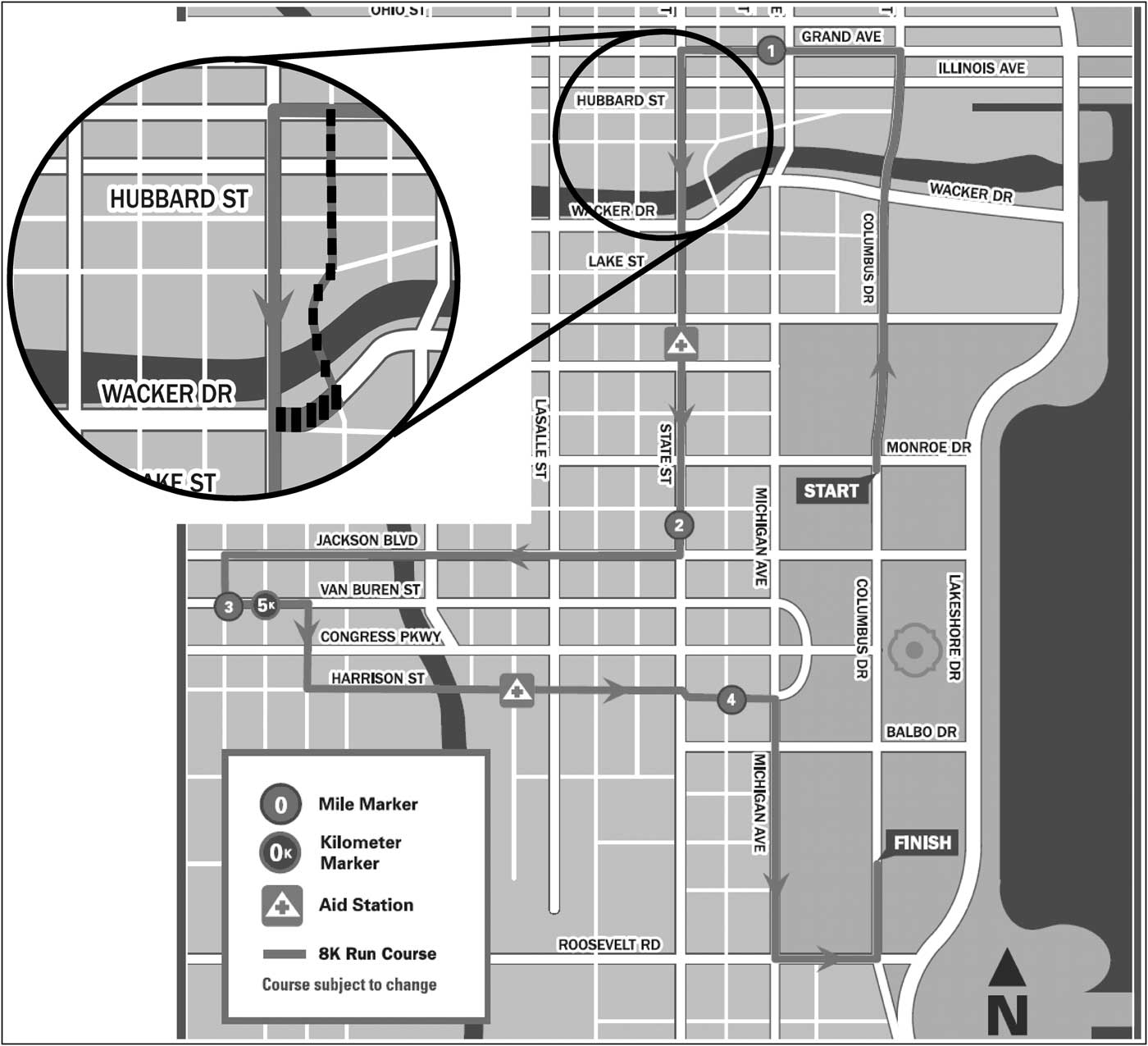
Using the CM approach, organizers of the 2013 Shamrock Shuffle responded to an acute incident 100 minutes prior to the scheduled start. Figure 1 presents a detailed timeline of the events, from the initial alert to the start of the race. The incident was first identified when the Chicago Police received a call at 6:50 am that a man was threatening to jump off the bridge at State Street. 26 This bridge is located approximately one mile into the course, as shown in Figure 2.
Timeline of the Incident in the 2013 Shamrock Shuffle

Course Route for 2013 Shamrock Shuffle Including Reroute 28

Forward Command was notified immediately, and began monitoring the situation via live feeds from the surveillance cameras at the scene. Equipment crews were directed to stay away from the area. The organizational structure of the CM facilitated rapid assessment of the incident. Key agencies in Forward Command, including the OEMC, Chicago Police Department, the Chicago Fire Department, CEM, Traffic Management Authority, and Public Information Officer, monitored the event simultaneously and participated in the decision-making process for the incident. The agencies involved in the decision-making process were able to devise response options quickly and assess impacts of these options with similar speed through direct communication with other necessary agencies. Response options included delaying the race until resolution at the bridge, rerouting to avoid the bridge, or keeping the original race route and start times in anticipation of a quick resolution at the bridge. Options were evaluated in terms of impact to the course and race participants (ie, changes to course distance, utilization of existing teams on course, and changes to aid station and mile marker access). Additionally, for the rerouting options, the decision makers considered the time needed to move resources, such as street closure barricades and cones, parked vehicles, and course marshals. The best rerouting option was proposed at approximately 7:45 am and was accepted by the police and confirmed by the race director around 8:00 am since the incident on the bridge had not been resolved by that time. Figure 2 presents the course route for the 2013 Shamrock Shuffle with the reroute (shown in dashed lines in the inset). All agencies communicated with their staffs regarding rerouting actions to be taken immediately. The 2013 Shamrock Shuffle started at 8:30 am for wheelchair participants and at 8:32 am for runners, representing a 2-minute delay from the original scheduled times.
The course reroute successfully mitigated possible negative outcomes of the incident on the State Street Bridge: a minimal number of vehicles were moved and participants largely were unaffected due to the minor delay. Twenty of the 30 vehicles parked along the new route (Wabash Street) were towed to a street on the original route (State Street). The remaining 10 cars were not blocking the course, and thus not deemed critical. The reroute maintained a course with existing aid stations and mile markers, eliminating the need to relocate health services and mile markers.
The delay was only two minutes. Limiting the delay was critical given the numerous disadvantages of delays: (1) temperatures can rise throughout the morning, thus impacting the number and severity of medical incidents from a later start; (2) city roads are closed only for a set interval and must reopen even if the start of the race is delayed; (3) runner anxiety can increase with delayed starts. Additionally, when an incident that potentially could cancel the race, such as a weather disaster, occurs, race organizers must consider that some runners still will run the original race course or a route with a similar distance. Sometimes such routes may not have the resources, including water and medical aid stations, of the cancelled event, which may impact safety and result in more incidents than if the event were still held. This was one consideration of officials of the 2007 Boston Marathon who almost cancelled that race due to weather. 27
Using the CM at the 2013 Shamrock Shuffle enabled key stakeholders and decision makers to identify the incident quickly, gain situational awareness to inform decision making, reach a decision quickly, and effectively communicate that decision to related parties. Maintaining the health and wellbeing of both the runners and the public at large factored in to the decisions. The organizational structure maintained a cohesive group of decision makers from the City of Chicago, Chicago Event planning, and other key stakeholders to make real-time decisions. Rapid communication assisted the evaluation and execution of the rerouting decision. The information system provided key situational awareness.
Summary of the Key Conclusions From the Incident

Discussion and Conclusions
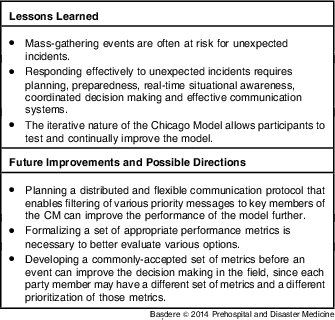
Mass-gathering events are prone to not only incidents as described in this case report but also to manmade or natural disasters. This case report of the 2013 Shamrock Shuffle incident is an example of how the CM can be used to respond efficiently and effectively. Table 1 summarizes the key conclusions from the incident. The CM, with its established organization structure, communication, and information systems, enabled good situational awareness, and led to good decision making and effective communications. The rerouting of the race course while maintaining key and crucial aid stations caused a 2-minute delay to the event start time, with likely minimal impact to the runners and the public.
Importantly, the Chicago Model is successful because it is an iterative process. Each iteration begins with an established organization structure of an ICS where roles and responsibilities are explicitly accepted. Dynamic information systems provide the necessary data for situation awareness and communication systems, allowing those in the organizational structure to respond actively in a timely manner. Each implementation of the CM, either at the Shamrock Shuffle or the Chicago Marathon, represents an iteration, continually allowing participants to test and improve the model. The iterative nature of the CM provides a valuable framework for continual updating of disaster preparedness plans, strengthening the ICS, enhancing information systems that provide situational awareness, and making communication systems more resilient to shocks often seen in disasters.
One area of ongoing improvement in the CM communications systems is planning further for a more distributed and flexible communication protocol that not only informs a large group of stakeholders in the CM (eg, event teams such as the weather update team, medical information team, and course management team, as well as external groups such as police and fire departments, the American Red Cross of Greater Chicago, and the OEMC), but also helps filter various priority messages to key members of the CM.
Information communication technologies have the potential to facilitate more widespread and potentially efficient communication systems to a large community in real time. This is often seen with the integration of mobile technology with voice communications, short messaging service (SMS), and even with social networking and Web 2.0 platforms. At the same time, the opportunity to integrate broad communication systems also can create information overload, where high priority and relevant information has the potential to be lost in the “sea of noise” or when recipients of mass communications are unclear about which messages entail immediate action.
Further determining and instituting of protocols for members in the CM to share either private or sensitive information during a dynamic incident is an iterative process. During the Shamrock Shuffle, members of the CM team awaited confirmation of the start time from trusted and key decision makers in the organizational structure. Despite both radio and mobile communications, there were minor delays in communicating the adjusted start time from the Forward Command to those at the start line. In the future, plans and protocols which further create a structured closed loop of communication between key decision makers in the ICS and organizational structure may continue to improve the real-time communications system and mitigate any confusion or delay during a future incident. Separate radio channels or a specialized group SMS communication system are options for communication channels of this type, and can be considered by the CM members during the planning phases before the next event.
Critical to the successful response to the incident at the 2013 Shamrock Shuffle was a rapid evaluation of proposed options. Formalizing a set of performance metrics with which leaders can evaluate options is a valuable next step in this work, both in the preplanning phase when robust event plans that can be adapted quickly to meet changing needs are desirable, and during the event when decision makers must rapidly choose a response to minimize negative outcomes. In the Shamrock Shuffle, key metrics included the deviation from scheduled start time, disruption to runners (eg, ensuring access to health services and mile markers on the course), disruption to the public (eg, minimizing vehicles moved and ensuring access to medical resources to meet the needs of the public), and ease of implementation. Again, the collective decision-making processes established in the CM are essential, as each party may have a different set of metrics and a different prioritization of metrics. Developing a commonly accepted set of metrics before an event can significantly improve decision making in the field. The described incident in this case report shows the necessity of comprehensive planning systems in planning and execution stages of mass gatherings, specifically mass sporting events. Systems, such as CM, can fill this gap by creating common mental models between different agencies about their respective roles and responsibilities in the presence of unexpected events. Since the agencies are able to participate and contribute in a more flexible and iterative way over time, these systems evolve according to the changing needs of mass gatherings, likely creating more realistic and effective mental models. The incident described at the 2013 Shamrock Shuffle is an example of how collaborators using the Chicago Model were able to respond effectively to an unexpected event, providing both high-quality participant and public safety and better mass sporting event experience. These mental models can help agencies to determine their potential roles and responsibilities in more general settings such as disasters.
Acknowledgements
The authors thank Mike Nishi (General Manager for the Shamrock Shuffle and the Chicago Marathon), Thomas Sivak (Manager of Emergency Response for the Shamrock Shuffle and the Chicago Marathon) and David Waskowski (Operations and Course Route Manager for the Shamrock Shuffle and the Chicago Marathon) for their clarifications about the timing of the incident and comments about the Chicago Model.