The prosodic systems of the languages of the world are highly diverse (e.g., Fitzpatrick, Reference Fitzpatrick2000; Gussenhoven, Reference Gussenhoven2004; Hirst & Di Cristo, Reference Hirst and Di Cristo1998; Jun, 2005a; van der Hulst, Reference van der Hulst1999): Languages differ in their use of phonetic parameters such as pitch, duration, and loudness for various communicative functions. In intonation languages, for instance, speakers use pitch movements and accents in utterances for marking different speech acts and attitudes, whereas in tone languages, speakers use pitch height and pitch movements for differentiating the meaning of words. By the same token, there are languages that use accents for marking particular syllables in a word or words in an utterance as more prominent, whereas other languages do not seem to use prosodic means for this purpose at all.
Given the observed prosodic diversity across the languages of the world, it is to be expected that speakers of more than one language will exhibit crosslinguistic influence between the prosodic systems of their languages in their speech. In fact, recent investigations have suggested that language learners seem to create mixed prosodic systems in their second language (L2). For example, Gut (Reference Gut2005) reported that the English spoken by first language (L1) speakers of Hausa, Igbo, and Yoruba, which are tone languages, shows properties of both an intonation and a tone language: Its pitch inventory is reduced in comparison to British English, and the domain of pitch appears to be the word, with high pitch being triggered by stress. Similar mixing of two prosodic systems has been found in the English spoken by Chinese speakers in Singapore: Lim (Reference Lim2009) demonstrated that the L1 Chinese speakers in her study use elements of tone as well as intonation in their spoken English.
The present article is concerned with Malaysian speakers of English. Malaysia is a multilingual country in which 137 different languages are spoken. In the public school system, children can attend Malay, Chinese (Mandarin), and Tamil medium schools, and the proliferation of private and international schools means that Malaysians can attend English medium primary and secondary schools as well. When the country gained independence in 1957, Malay was given national language status and began replacing English as the language of public administration, as provided for in Article 152 of the Federal Constitution and the National Language Act 1963/1967. Today, English continues to be used in the business domain and is widely used in both print and social media. The present study focuses on English spoken by Malaysians with Malay as their L1. The aim of this study is to explore potential crosslinguistic influence of the prosodic systems of these speakers. To this end, one function of prosody—namely the marking of information structure—will be investigated. The next section introduces the concept of information structure, describes how it is marked prosodically in English, and discusses studies on the prosodic marking of information structure in English as a L2. The subsequent sections present our study, in which we investigate how information structure is marked both in English produced by L1 Malay speakers and in Malay, and the discussion of our results.
PROSODIC MARKING OF INFORMATION STRUCTURE
The term information structure was first proposed by Halliday (Reference Halliday1967), who defined it as a level of organization in an utterance that is independent of its syntactic structure. Information structure refers to the linear ordering of informational units within an utterance as well as to the internal structure of an information unit of an utterance, in which utterance elements are marked according to their discourse anchoring. Halliday (Reference Halliday1967) distinguishes between new and given elements of utterances. Every information unit has as its center the information focus, which “indicates what new information is being contributed” (p. 202). Whereas new information is presented by the speaker as not recoverable from the previous discourse or as contrary to some predicted or stated alternative, given information is treated by the speaker as recoverable from the preceding discourse or as shared knowledge. This is illustrated in example (1), in which the information focus (represented via capitalization) lies on newspaper, which represents new information in the discourse, and I’m reading the is given information.
-
(1) A: What are you reading?
-
B: I’m reading the NEWSPAPER.
The notion of givenness has been reinterpreted as a cognitive category of information status by researchers like Chafe (Reference Chafe and Li1976), who proposed that the information in discourse is packaged according to the beliefs of the speaker about the hearer’s present knowledge. The information status of a discourse element is claimed to reflect what the speaker assumes to be present in the listener’s consciousness at the time of the utterance, and three degrees of activation status are postulated: (a) New discourse elements are activated in the listener’s mind from a previously inactive state, (b) accessible or inferable discourse elements are assumed to be activated from a previously semiactive state, and (c) given discourse elements are already active in the listener’s mind at the time of the utterance.
Languages differ as to which linguistic means are used for marking information focus and givenness. Many of the languages that have been investigated so far seem to employ extra pitch height, larger pitch movement, extra intensity, and longer duration for marking focus on new information (e.g., Hirst & Di Cristo, Reference Hirst and Di Cristo1998). In English, discourse elements that are focused typically receive a high pitch accent on the stressed syllable (e.g., Brown, Reference Brown, Cutler and Ladd1983; Ito, Speer, & Beckman, 2004; Pierrehumbert & Hirschberg, Reference Pierrehumbert, Hirschberg, Cohen, Morgan and Pollack1990), which is transcribed as H* in the Tones and Break Indices (ToBI) transcription system for intonation (Silverman et al., Reference Silverman, Beckman, Pitrelli, Ostendorf, Wightman, Pierrehumbert, Hirschberg and Hess1992). In contrast, given discourse elements rarely receive a pitch accent and are usually deaccentuated. For example, Brown (Reference Brown, Cutler and Ladd1983) found that English speakers produced 87% of all new information with a pitch accent. Similarly, inferable information was marked by a pitch accent in 79% of all cases, whereas only 4% of given elements were produced with pitch accents. Thus, a high pitch accent (H*) typically would be produced on the syllable news in newspaper as it is produced by speaker B in example (2), whereas the discourse elements I’m reading would not receive any accent.
-
(2) A: What are you reading?
-
B: I’m reading the news paper.
H*
Fowler and Housum (Reference Fowler and Housum1987) and Lam and Watson (Reference Lam and Watson2010) found that given elements in English tend to be produced with significantly shorter durations than new discourse elements. Moreover, both repetition and predictability influence the prosodic marking of the discourse element, with repeated and expected words having a significantly lower mean intensity than nonrepeated and unexpected discourse elements (Lam & Watson, Reference Lam and Watson2010). Similarly, in German, narrow focus is marked by a high pitch accent and longer duration, whereas given information is marked prosodically with a low prenuclear pitch accent (Féry & Kügler, Reference Féry and Kügler2008). Likewise, listeners prefer given information to be deaccented and new information to be accented (Baumann & Hadelich, Reference Baumann, Hadelich, Solé, Recasens and Romero2003).
In other languages, information structure does not appear to be marked systematically by prosody. Vallduví (Reference Vallduví1992), for example, divides languages into plastic ones, in which information status tends to be marked by pitch accents and intonation, and nonplastic ones, in which it is marked by word order. This is supported by Swerts (Reference Swerts2007) and Swerts, Krahmer, and Avesani (Reference Swerts, Krahmer and Avesani2002), who found that, within noun phrases (NPs) that consisted of a noun and an adjective, such as a green ball, Italian and Romanian speakers do not mark given information by deaccentuation. Instead, they produce a pitch accent on both words regardless of their information status. Moreover, Jun (2005b) proposed the term edge-prominence languages for languages that use boundary tones for focusing. In these languages, information structure is often conveyed by word order, and focusing is achieved by changes in the pitch level of phrase tones (e.g., Karlsson, House, Svantesson, & Tayanin, Reference Karlsson, House, Svantesson, Tayanin and Hess2010, on Kammu; Patil et al., Reference Patil, Kentner, Gollrad, Kügler, Féry and Vasishth2008, on Hindi).
Various studies have shown that nonnative speakers of English employ different prosodic strategies than native speakers to mark information structure: Nonnative English speakers seem to produce accents on sentence elements regardless of whether they represent focused or given information. Grosser (Reference Grosser, James and Leather1997) found for Austrian pupils learning English that given utterance elements received a pitch accent in 45–90% of all cases. For example, the reply to Is anybody absent today? was produced as Nobody is \absent, with a falling pitch accent on absent. Similarly, nonnative English speakers’ failure to deaccent given information in about 42% of all cases was reported by Gut (Reference Gut2009) in a corpus-based study involving 27 speakers from various L1 backgrounds. In general, learners appear to have a tendency to locate the main pitch accent on the last word of an utterance regardless of its information status or word class. Ramírez Verdugo (2002), who investigated 20 Spanish learners of English reading short conversational texts, also found that they often place the main accent on the last lexical item of an utterance. In tag questions, they produce the main accent on the pronoun instead of the auxiliary.
Moreover, pitch height and pitch movement are used differently by nonnative speakers for marking information structure. Wennerstrom (Reference Wennerstrom1994) compared the pitch height of new and given words in a text passage and a picture-description task in native and nonnative English. Whereas English native speakers produce higher pitch on the new information than the given information, nonnative speakers do not make this distinction. Equally, in spontaneous lectures, Mandarin Chinese speakers of English produce considerably less difference in pitch height between new and given items compared to native speakers of English, with two speakers not producing any difference in pitch height at all (Wennerstrom, Reference Wennerstrom1998). Moreover, Ramírez Verdugo (2002) observed that, whereas English native speakers mark new information with a fall and given information with a low rise, Spanish nonnative speakers of English do not mark the difference in information status intonationally, and they produce a fall in both cases. Furthermore, the pitch movement on the nucleus is smaller for the nonnative speakers.
One unresolved question in this field is whether the nonnative speakers’ productions exhibit crosslinguistic influence. To date, only a few studies have compared the prosodic correlates of information structure in the nonnative speakers’ L1 with their L2 productions. One such study is Swerts and Zerbian (Reference Swerts and Zerbian2010), which found L1 influence in less advanced speakers of English with Zulu as their L1. Swerts and Zerbian elicited adjective + noun sequences such as red cow in which the adjective and noun variously represented new and given information; the participants produced these sequences both in their L1 Zulu and in their L2 English. They found that in Zulu the speakers did not mark the information structure systematically by accents. In English, the less proficient speakers showed the same pattern, whereas the proficient speakers tended to use accents for new elements and deaccentuation for given ones. O’Brien and Gut (Reference O’Brien, Gut, Dziubalska-Kołaczyk, Wrembel and Kul2010), by contrast, found no conclusive evidence for L1 influence in the prosodic marking of information structure and focus in the speech of advanced German learners of English. Other researchers have simply speculated on a L1 influence on the placement of accents in a L2 (e.g., Gut, Reference Gut, Leather and James2000; Juffs, Reference Juffs1990). For example, Trofimovich and Baker (Reference Trofimovich and Baker2006) found that Korean speakers of English produced a delayed pitch peak on new information in English in a sentence-repetition task; they assumed this was influenced by the pitch alignment patterns of their L1 Korean, which is an edge-prominence language.
It is the aim of this study to provide further evidence for possible crosslinguistic influence in the area of prosodic marking of information structure. To this end, the prosodic correlates of focus and givenness will be investigated both in Malay and in the English produced by native speakers of Malay. Malay (Bahasa Melayu) belongs to the Austronesian language family and is spoken in Malaysia, Indonesia, Singapore, Brunei, and East Timor. Standard Malay, which is based on the Johor-Riau Malay dialect, is a prestige dialect that is widely used in the mass media and school. Previous research on Malay prosody is contradictory with respect to the presence of stress. Some authors (e.g., Kassin, Reference Kassin2000) describe Malay word stress rules: For example, disyllabic and polysyllabic words are said to have stress on the penultimate syllable, unless this syllable contains a schwa, in which case stress is shifted to the final syllable. In polysyllabic words, the antepenultimate syllable is said to be stressed. Other authors claim that Malay does not have stress (Maris, Reference Maris1980; Mohd. Don, 1996; Mohd. Don, Knowles, & Yong, 2008; Zahid, 2009), which has also been suggested for the varieties of Malay spoken in Indonesia (e.g., Gil, Reference Gil, Riehl and Savella2003, Reference Gil, Lee, Gordon and Büring2006; Tadmor, 1999) and Brunei (Clynes & Deterding, Reference Clynes and Deterding2011). Moreover, Wan Ahmad (2012) found that, although there is a tendency to lengthen the final vowel in words produced in isolation, which may be perceived as the presence of lexical stress, this phenomenon was not found in words produced in connected speech.
Previous research seems to be contradictory on the question of whether Malay can be classified as a nonplastic as opposed to a plastic language (Vallduví, Reference Vallduví1992). According to Mohd. Don (Reference Mohd. Don1996), in Malay spontaneous speech, speakers tend to insert demonstrative pronouns and particles like lah to mark new information, rather than using prosodic information like pitch accent and duration. For example, in the utterance Saya-lah yang akan pergi ke Kuala Lumpur “It is I who will be going to Kuala Lumpur,” the particle lah is used as a focus marker (Xu, Reference Xu, Dong and Kim2003, p. 7). In example (3), taken from Mohd. Don (1996, p. 256), the demonstrative pronoun ’ni (short for ini “this”) preceding the adjective marks new or contrastive information:
-
(3) A: Jalan tak jam ya Doktor? “The road isn’t congested is it, Doctor?”
-
B: Nampak pagi ’ ni bagus. “Looks good this morning.”
However, Gil (Reference Gil, Lee, Gordon and Büring2006) states that, for some varieties of Malay spoken in Indonesia, focus is realized by durational cues as well as pitch prominence. To the best of our knowledge, however, no systematic empirical studies to date have been carried out on the relationship between information structure and prosody in Malay.
METHOD
Participants and Procedure
The data were collected in two separate studies. In the first study, 10 Malay speakers of English read aloud a 179-word story (see Appendix A). Three of the speakers were male and 7 female; their mean age was 18.8 years. All of them were doing a Foundation in Science program (equivalent to a preuniversity course like A levels in the United Kingdom) at the University of Malaya. All of them spoke Malay at home, and only two speakers said they also spoke some English at home with their siblings. Seven of them first learned English when they went to preschool at the age of 5, and two learned it when they went to primary school at the age of 7. One of the speakers said that she learned English at home from her mother at the age of 4. All of them went to Malay medium primary schools and national secondary schools in which the medium of instruction was English for mathematics and science subjects like biology, physics, and chemistry. Likewise, their Foundation program at the University of Malaya is taught in English. Thus, all of them had been listening, speaking, reading, and writing in English for their science subjects at the secondary school and preuniversity level. However, outside the academic domain, the speakers mostly used Malay. Five students indicated that they at least sometimes used English with their university mates and lecturers and at social gatherings. In contrast, the other five students said that they seldom or never used English in these contexts. Up to the time the study was conducted, the speakers’ contact with native speakers of English was minimal, as they went to national schools and were doing the Foundation program, which is solely for Malays and indigenous people.
Participants of the second study were 10 Malay speakers (5 male, 5 female) with a mean age of 22.3 (due to a 2-year gap between the first and the second study, the speakers of the first study were not available anymore). They were recorded reading out a 152-word story in Standard Malay (see Appendix B). There was no dialectal influence on their speech, as none of them had any regional Malay dialect as their L1. Both groups of participants were recorded in a quiet room at the University of Malaya in Kuala Lumpur. They were given the story to read through before the recording, for which they could take as much time as they wanted.
Data and Analysis
Each story contained six words that occurred at least twice. On their first occurrence, these words were counted as new information. When they occurred again in the following sentence, they were considered given information. For example, in the sentences provided in example (4), the first occurrences of Samantha and Mandy were counted as new information, whereas Samantha and Mandy in the second sentence constituted given information:
-
(4) Samantha went to Penang, and Mandy went to London for Christmas. While Samantha went by minibus, Mandy had to fly.
Following Atterer and Ladd’s (Reference Atterer and Ladd2004) methodology, the test words contained a syllable with a short vowel that is preceded and followed by a sonorant consonant (either a nasal or a /l/). In the English text, these were stressed syllables preceded by one or two unstressed syllables and followed by one or two unstressed syllables. Due to the unresolved status of stress in Malay, this criterion did not apply in the Malay text. In total, six word pairs, or 12 syllables, were analyzed for each participant.
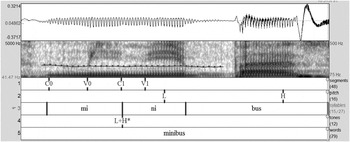
The test syllables in the story readings were analyzed acoustically. The following measurements were taken: (a) duration of the syllable, (b) beginning of the onset consonant (marked as C0), (c) beginning of the vowel (marked as V0), (d) beginning of the consonant in the following syllable (C1), (e) beginning of the vowel in the following syllable (V1), (f) beginning (L) and end (H) of rise, if a rise was produced. All measurements were made in Praat (Boersma & Weenink, Reference Boersma and Weenink2011). The methodology is illustrated in Figure 1. The beginning of the onset consonant /m/ of the syllable /mɪ/ in the word minibus, which can be seen from the formant pattern in the spectrogram, is marked as C0; the beginning of the vowel /ɪ/, which can again be seen in the formant structure in the spectrogram, is marked as V0; accordingly, the beginning of the consonant /n/ in the following syllable is marked as C1, and the beginning of the vowel /ɪ/ in the following syllable is marked as V1. The exact duration of the test syllable /mɪ/, which stretches from C0 to C1, is displayed by Praat. The beginning and the end of the rising pitch movement, which is displayed as the dotted line in the spectrogram window, are marked as L and H respectively. Their exact pitch height is calculated and displayed by Praat in Hz. These values were then converted into semitones to allow cross-participant comparisons. It can be seen in Figure 1 that the pitch peak is reached in the syllable following the test syllable, which is a consistent feature of Malay English (see Results section).
Measurements of C0, V0, C1, V1, L, H, and the duration of the syllable as well as the transcription of the pitch accent on minibus in the phrase “while Samantha(G) went by minibus(N)” produced by a L1 Malay speaker of English.

Additionally, the type of pitch accent on each test syllable was determined auditorily and transcribed. For this, ToBI symbols (Silverman et al., Reference Silverman, Beckman, Pitrelli, Ostendorf, Wightman, Pierrehumbert, Hirschberg and Hess1992) were used; however, this does not imply that the pitch movements that were produced have a phonological status. All measurements were first carried out by the first author and checked by the second author. The few cases of disagreement were discussed and resolved.
RESULTS
Study 1: Pitch Accents on New and Given Information
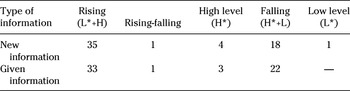
Table 1 summarizes the types of pitch accent that were produced by the 10 L1 Malay speakers of English on the six words with new information status and the six words with given information status in the reading passages. Two words in each condition had to be excluded from analysis because two of the speakers produced the word eleven with stress on the first syllable.
Types of pitch accents produced on new and given information by the 10 L1 Malay speakers of English

In both conditions, the speakers produced rising pitch accents in most cases, whereas falling and low-level pitch accents were very rare. On given information, twice as many high-level tones were produced as on new information, but this difference was not significant, according to Fisher’s exact test (two-tailed): p = .15. A pairwise comparison of the six word pairs showed that in the vast majority of cases (41 out of 58) each speaker produced exactly the same pitch accent on the word, when it occurred both as new and as given information.
Duration of the Stressed Syllable
When comparing the duration of the stressed syllable in new and given information, a significant shortening of the syllable in given information was found for the syllable /mɛn/ that occurred in the two test words Samantha and Mandy, t(19) = 4.15, p < .001; d = 0.82 (see Table 2). It should be noted that in Malaysian English, /e/ and /æ/ are not contrasted. Thus, the vowels in the stressed syllable in both words Samantha and Mandy were produced closer to /ɛ/ (see Pillai, Mohd. Don, Knowles, & Tang, 2010). For the syllables /mɪ/ (in minimal and mineral), /mʌ/ (Mummy), and /lɛ/ (eleven), by contrast, no difference in duration was found between new and given information.
Average duration (in ms, standard deviation in parentheses) of the syllables /mɛn / (in Samantha and Mandy), /mɪ / (in minimal and mineral ), /mʌ / (in Mummy), and /lɛ / (in eleven) on new and given information produced by the 10 L1 Malay speakers of English

Rise
In the 32 cases in which the Malay speakers of English produced a rise on a test word in both the new and the given condition, the extent of the rise was measured in milliseconds, and the steepness (H-L; see Figure 1) was calculated in semitones. Table 3 shows that the rise was significantly longer on new information than on given information, t(31) = 2.04, p < .001; d = 0.37. However, in terms of steepness, there was no difference between the rises produced in both conditions. Thus, although speakers took longer to reach the highest point of the rise on new information, the relative difference in pitch height that was produced was not larger than on given information, t(31) = 0.29, p = .77; d = 0.03.
Mean extent of the rise on new and given information (standard deviation in parentheses) and steepness of the rise (in semitones) by the 10 L1 Malay speakers of English

Pitch Peak Alignment
Table 4 shows the alignment of the pitch peak (i.e., the position of the highest point of the rise in relation to the segments in the syllable). In the 32 new-given word pairs on which rises were produced in both cases, the pitch peak on average tended to be reached later on new information (an average of 44.59 ms after the beginning of the vowel in the unstressed syllable, e.g., on -my in Mummy) than on given information (an average of 35.98 ms after). However, a paired t test revealed that this difference was not significant, t(31) = 1.19, p = .24; d = 0.22, and variation among speakers was very high.
Pitch peak (H) in relation to the beginning of the vowel (V1) in the following unstressed syllable in new and given information (mean values in ms, standard deviation in parentheses) by the 10 L1 Malay speakers of English

Summary and Discussion of Study 1
The 10 L1 Malay speakers of English appear to use only one systematic prosodic strategy of differentiating new and given information: The rising pitch movement is stretched over a longer period of time on new than on given information (see Table 3). By contrast, the rise has the same steepness and reaches the peak at the same point in relation to the segments of the syllable in both conditions. Similarly, there is no difference in the type of pitch accent produced on new and given information, and durational differences were found in only one of four different syllable types. This syllable type may even be considered a special case: The words Samantha and Mandy occurred in a juxtaposed construction in the given condition (see Appendix A), and it might be possible that this had some secondary prosodic effect.
The results suggest that the L1 Malay speakers of English do not use the same prosodic means of marking new and given information as native speakers of English. Although duration was found as a significant difference between new and given words in native English (e.g., Fowler & Housum, Reference Fowler and Housum1987; Lam & Watson, Reference Lam and Watson2010; although Lam & Watson measured the duration of the entire word), it does not seem to play the same role in the English of the L1 Malay speakers. Moreover, the Malay speakers of English mark textually given information mostly with rising and high pitch accents, whereas given elements in native English have been found to have low pitch accents or no pitch accent at all (e.g., Brown, Reference Brown, Cutler and Ladd1983; Pierrehumbert & Hirschberg, Reference Pierrehumbert, Hirschberg, Cohen, Morgan and Pollack1990). Additionally, the pitch peak of the rises is reached much later in the speech of the L1 Malay speakers of English compared to native speakers of (British) English. In native English, the pitch peak of a rise on new information is aligned with the beginning of the vowel in the following unstressed syllable (labeled V1 in our study). For example, Atterer and Ladd (2004, p. 190) report a mean value of −3.6 ms for six speakers of British English with a range from −29.6 to 27.1 ms, whereas the Malay speakers of English in our study had a mean value of 44.59 ms (ranging from −9.6 to 182.3 ms). It is the object of the second study to investigate whether these prosodic differences can be traced back to L1 influence.
Study 2: Pitch Accents on New and Given Information
Table 5 shows the types of pitch accent that were produced by the 10 speakers of Malay on the six words with new information status and the six words with given information status in the reading passage. One new word had to be excluded from analysis because of faulty sound quality. In both conditions, the words were produced with a rise about twice as often as with a falling pitch movement. However, this difference was not significant, according to Fisher’s exact test (two-tailed): p = 1.00. Other types of pitch movement were rare. No difference at all existed between new and given words in terms of pitch movement.
Types of pitch accents produced on new and given information by the 10 Malay speakers

Duration of the Target Syllable
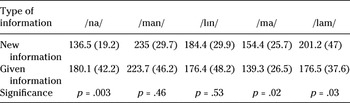
Table 6 shows that there was a significant difference in duration between new and given information for the syllable /na/, t(9) = 3.98, p = .003; d = 1.33. However, the Malay speakers systematically produced /na/ in the name Nana longer when it constituted textually given information, which could have been an effect of phrase-final lengthening (see Mohd. Don et al., 2008); the word Nana precedes the conjunction dan “and.” Significant differences were also found between the average new and given information durations for the syllables /ma/, t(19) = 2.51, p = .02; d = 0.57, and /lam/, t(9) = 2.54, p = .03; d = 0.58.
Average duration (in ms, standard deviation in parentheses) of the syllables /na/ (in Nana), /man/ (in mandi), /lɪn/ (in lintah), /ma/ (in Mala and malam), and /lam/ (in lampu) on new and given information produced by the 10 Malay speakers

Rise
In 24 cases, a Malay speaker produced a rising pitch movement on both words of a new-given word pair. The extent of the rises in milliseconds as well as the steepness of the rise in semitones in both conditions is illustrated in Table 7. The Malay speakers produced a significantly shorter rise on given information, t(23) = 2.14, p = .04; d = 0.38. There was no difference in the steepness of the rise.
Mean extent of the rise on new and given information (standard deviation in parentheses) and steepness of the rise on new and given information produced by the 10 Malay speakers

Pitch Peak Alignment
Table 8 shows that, on average, the pitch peak occurred a little later on words that functioned as new compared to given information. However, this difference was not significant.
Pitch peak ( H ) in relation to the beginning of the vowel (V1) in the following unstressed syllable in new and given information (mean values in ms, standard deviation in parentheses) by the 10 Malay speakers

GENERAL DISCUSSION
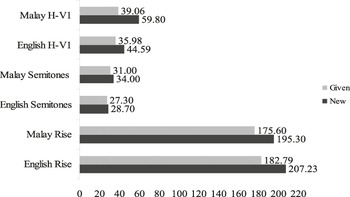
The results show that the prosodic patterns found in the Malay data are largely similar to those found in the L2 English data produced by L1 speakers of Malay. In both sets of data, there is generally no difference between the type of pitch accent used in pairs of given and new information (see Tables 1 and 5) nor do most of the syllables differ in duration across new and given information (Tables 2 and 6). In cases in which a rising accent was produced, there tended to be a significantly larger rise on new information but no difference in steepness between new and given information in both sets of data (Tables 3 and 7). Furthermore, the pitch peak was reached after the unstressed vowel (marked as V1 in Figure 1) on both new and given information in both the L2 English and Malay data (Tables 4 and 8). Figure 2 compares the L1 Malay speakers’ English data and the Malay data. It illustrates not only that there are similar patterns in the realization of rising pitch patterns and their alignment with the segments of the syllable across new and given information but also that the actual phonetic realization is very similar. Rises in Malay and Malay L2 English have the same average extent, steepness, and alignment.
The prosodic marking of new and given information in English and Malay by L1 speakers of Malay (the values for semitones are multiplied by 10 for better visibility).

Can this be interpreted as evidence for L1 influence? Previous research has shown that crosslinguistic influence can take on a wide variety of forms, ranging from direct transfer of structures from one of a speaker’s languages onto another to indirect influence resulting in avoidance and preference patterns in a L2 (e.g., see Gass, Reference Gass, Ritchie and Bhatia1996, and Odlin, Reference Odlin, Doughty and Long2003, for overviews). In the area of phonology, one common type of crosslinguistic influence seems to be the production of mixed structures. For example, Flege (Reference Flege1987) found that L1 French speakers of English produced /t/ with voice onset time values that were intermediate between those of native French and native English. Similarly, Baker and Trofimovich (Reference Baker and Trofimovich2005) showed that L1 Korean speakers of English produce vowels in their L2 that have acoustic properties of both Korean and English. By the same token, prosodic merging has been observed in the use of both pitch and tone by L1 Hausa, Igbo, and Yoruba speakers of English (Gut, Reference Gut2005) as well as by Singaporean Chinese speakers of English (Lim, Reference Lim2009) and in the realization of pitch peak alignment of L1 Dutch speakers of Greek (Mennen, Reference Mennen2004).
Our data, at least with regard to the duration of syllables in new and given words, the phonetic realization of the rise, and the alignment of its peak, do not suggest prosodic mixing. Rather, speakers appear to directly transfer the phonetic realizations of their L1 onto their L2. This is in line with Trofimovich and Baker’s (Reference Trofimovich and Baker2006) findings on the pitch peak alignment of L1 Korean speakers of English. However, neither their study nor ours compared the pitch peak alignment in the same speaker using his or her L2 and L1. Yet Mennen (Reference Mennen2004) found that Dutch-Greek bilinguals used different phonetic realizations in their L1 compared to Dutch native speakers who did not speak any Greek. Thus, it is possible that the pitch peak alignment in Malay shown by the Malay speakers in our study was influenced by their knowledge of English and, accordingly, does represent hybrid values. This question could only be resolved by analyzing the speech of Malay speakers who do not speak and are not exposed to English (who may, however, be quite difficult to find).
It is, nevertheless, clear that crosslinguistic influence alone cannot explain the L1 Malay speakers’ patterns of prosodically marking new and given information in English. First, in Malay, a greater amount of falls were produced than in the English of Malay speakers. Therefore, speakers did seem to alter some prosodic features in their speech when speaking their L2 English. Second, the differences in prosodic marking of information structure in the English produced by the L1 Malay speakers were comparable to native English speech; that is, the tendency not to deaccentuate given information and the alignment of the pitch peak of a rise after the beginning of the vowel in the following unstressed syllable are similar to what has been found in the speech of many L2 speakers of English (e.g. Gut, Reference Gut2009; O’Brien & Gut, Reference O’Brien, Gut, Dziubalska-Kołaczyk, Wrembel and Kul2010; Ramírez Verdugo, 2002; Swerts & Zerbian, Reference Swerts and Zerbian2010; Wennerstrom, Reference Wennerstrom1994). These patterns are also common across L2 varieties of English such as Singapore English (Low, Reference Low2006). Thus, it is possible that the lack of prosodic distinction between new and given information constitutes a general feature of L2 speech that might reflect a universal tendency (see also Gut, Pillai, & Mohd. Don, 2013). Whether this is indeed the case and what the reasons for this may be need to be explored in further studies.
Another aspect to consider is the kind of exposure the Malay speakers have to English. As explained in the Method section, they tend to have very little contact with native American or British English speakers and usually receive their teaching of English from Malaysians. With the English spoken by Malaysians as their main model, a comparison with native speaker prosodic characteristics may appear somewhat artificial, which is why we did not record the reading passage with native English speakers. Although it is perhaps less surprising to find influence of Malay prosody in the English produced by Malay speakers in Malaysia, what needs to be explained is why their English prosody differs at least in some respects from their Malay prosody. Whether this observation can be explained by L2 effects, as suggested by Major (Reference Major2001), would have to be tested using a wider range of phonological features.
Our results are based on only one speaking style that does not allow speakers to make use of anything other than prosodic means of marking information structure. We acknowledge that the use of a read text in a context in which there are no listeners or audience may affect the way that new and given information is marked prosodically. Thus, it is not yet possible to conclude that L1 Malay speakers of English do not use prosody for marking new and given information. As it has been suggested that Malay uses demonstrative nouns and particles to mark new information (Mohd. Don, Reference Mohd. Don1996), further research should examine if this occurs in the spontaneously produced English speech of Malay speakers and whether these syntactic and lexical means are correlated with specific prosodic patterns.
APPENDIX A ENGLISH STORY CONTAINING SIX WORDS (STRESSED SYLLABLE UNDERLINED) AS NEW (N) AND GIVEN (G) INFORMATION EACH
Who had a nicer Christmas break?
Samantha(N) went to Penang and Mandy(N) went to London for Christmas. While Samantha(G) went by minibus(N), Mandy(G) had to fly. On her flight there was a four-hour delay, but Samantha’s minibus(G) arrived with only minimal delay. Samantha’s hotel room was on the eleventh(N) floor, while Mandy’s hotel didn’t even have eleven(G) floors. Mandy was able to drink tap water but Samantha only drank mineral(N) water from a bottle. The supply of mineral(G) water was fairly limited though. Both girls sent postcards to their families at home and Mandy even rang her Mummy(N) on the phone. Samantha thought that the minimum charge for a call to her Mummy(G) was too high. Both enjoyed the beauty of the cities, admired palaces, parks, a lot of monuments and fountains and went shopping to their heart’s content. When coming back, Samantha said that she had taken a break at a minimal cost and with maximum value. However, Mandy said that she’d always prefer to go to London than to Penang for a break. What would you choose?
Appendix B MALAY STORY CONTAINING SIX WORDS (TEST SYLLABLE UNDERLINED) AS NEW (N) AND GIVEN (G) INFORMATION EACH
Pada hujung minggu yang lepas, kelas Nana(N) telah mengadakan aktiviti perkhemahan di sebuah perkampungan Orang Asli. Aktiviti tersebut membuatkan Nana(G) dan kawan-kawannya sangat teruja untuk menyertainya. Setibanya di sana, mereka disambut dengan baik sekali. Pada waktu petang, mereka meluangkan masa untuk mandi(N) di kawasan air terjun yang berdekatan. Mereka mandi(G) dengan begitu seronok sekali. Tiba-tiba, mereka terdengar suatu jeritan. Seorang rakan Nana telah digigit lintah(N) yang sangat besar. Guru pengiring mereka, Cikgu Mala(N) telah mencabut dan membuang lintah(G) tersebut. Pada sebelah malam(N) pula, memandangkan kampung tersebut tiada bekalan elektrik, mereka terpaksa menggunakan lampu(N) suluh sebagai sumber cahaya. Nana berasa agak gembira kerana kebetulan dia membawa sebuah lampu(G) suluh bersama. Mereka juga dijamu dengan pelbagai makanan yang tidak pernah mereka lihat sebelum ini. Pada malam(G) itu juga, Cikgu Mala(G) telah memberikan beberapa cenderahati kepada Tok Batin kampung tersebut. Nana dan rakan-rakannya tidur dalam keletihan setelah melihat beberapa persembahan yang dipersembahkan pada malam itu.
English Translation
Last weekend, Nana’s(N) class went on a camping trip to an indigenous village. Nana(G) and her friends were very excited to be a part of that activity. When they arrived they were warmly greeted. In the evening they spent their time bathing at a nearby waterfall. They enjoyed themselves bathing there. Suddenly they heard a scream. One of Nana’s friends was bitten by a huge leech(N). Their teacher, Ms. Mala(N), pulled out the leech(G) and threw it away. At night(N), as the village did not have electricity, they had to use torch lights(N). Nana was happy as she had brought a torch light(G) [American English: flashlight] with her. They were served with all sorts of food which they had never seen before. During that night(G), Ms. Mala(G) also gave out some souvenirs to the head of the village. Nana and her friends slept out of sheer exhaustion after watching several performances that night.