Implications
Social influences during the early life affect the reproductive performance of rams. In this study, we show that rams artificially reared displayed less sexual behaviour as adults than rams reared by their mothers. Based on these results and considering that the greatest reproductive display of rams’ sexual behaviour is during their adulthood, the importance of continuous access to the mother during rearing on reproductive performance of adult rams is highlighted. The information of this study contributes to understand the origin of the variation of rams’ sexual behaviour and its potential impact on breeding.
Introduction
The social rearing environment of male lambs affects their sexual behaviour and physiological reproductive parameters. For example, lambs of high social rank have greater BW, scrotal circumference, are more precocious in semen production, and display more sexual behaviours at earlier ages than low social ranked lambs (Ungerfeld and González-Pensado, Reference Ungerfeld2008). However, most of those differences disappear when rams are 2 years old (Ungerfeld and Lacuesta, Reference Ungerfeld and González-Pensado2010). Continuous exposition of male lambs to oestrous ewes during the 1st months of their life induces an increase in testosterone concentrations and testicular size (Illius et al., Reference Illius, Hayes and Lamming1976). Rams that are reared in contact with females display greater sexual behaviour as adults than those reared in monosexual groups (Le Roux and Barnard, Reference Le Roux and Barnard1974; Zenchak and Anderson, Reference Zenchak and Anderson1980; Stellflug and Lewis, Reference Stellflug and Lewis2007). However, although it may be expected that the mother exerts the major influence (Lindsay, Reference Lindsay1996; Dwyer and Lawrence, Reference Dwyer2000), little is known about how the presence of the mother during rearing affects reproductive development and performance of rams as adults.
In rodents, males that were reared by more maternal mothers display greater sexual behaviour when they reached adulthood (Moore, Reference Moore1984; Birke and Sadler, Reference Birke and Sadler1987; Moore, Reference Moore1992). In the same direction, temporary separation from their mother during early postnatal development has a negative impact on sexual behaviour of male rats when adults (Rhees et al., Reference Rhees, Lephart and Eliason2001). However, unlike rodents, sheep are precocial and dams have a strong and selective bond with their lambs, established during the 1st and 2ndhours after birth, and which is long lasting (Nowak et al., Reference Nowak, Keller and Lévy2000 and Reference Nowak, Porter, Lévy, Orgeur and Schaal2011; Broad et al., Reference Broad, Curley and Keverne2006). Therefore, sheep are an excellent model to study if the mother–young relationship has similar consequences in a species with these characteristics. The bond of male lambs with their mothers is strong enough to determine rams’ sexual preferences: rams that were reared by goats prefer to mate female goats rather than ewes when adults (Kendrick et al., Reference Kendrick, Hinton and Atkins1998). Recently, we reported that lambs reared by their mothers have greater sexual performance towards oestrous ewes and an earlier development of other reproductive parameters than artificially reared lambs during their 1st months of life (Damián et al., Reference Damián, Hötzel, Banchero and Ungerfeld2015). However, considering that reproductive precocity is not necessarily related to maximum activity displayed when rams are adults (Ungerfeld and González-Pensado, Reference Ungerfeld2008; Ungerfeld and Lacuesta, Reference Ungerfeld and González-Pensado2010), long-term effects of mother rearing on sexual behaviour and physiological reproductive parameters of adult rams should be also determined. Therefore, the aim of this study was to determine if the absence of the mother during rearing has long-term effects on sexual behaviour and physiological reproductive parameters of adult rams. Considering that sexual behaviour and physiological reproductive parameters of rams are influenced by the breeding season, in this study we evaluated rams’ reproductive activity both, during the breeding and the non-breeding season.
Material and methods
Location, animals and management
All the experimental procedures were approved by the Comisión Honoraria de Experimentación Animal of the Universidad de la República (PI No. 25/10). The study was conducted at the Unidad Experimental de Ovinos, INIA La Estanzuela, Uruguay (34°19' S) with 27 Polwarth rams previously used by Damián et al. (Reference Damián, Beracochea, Hötzel, Banchero and Ungerfeld2013 and Reference Damián, Hötzel, Banchero and Ungerfeld2015).
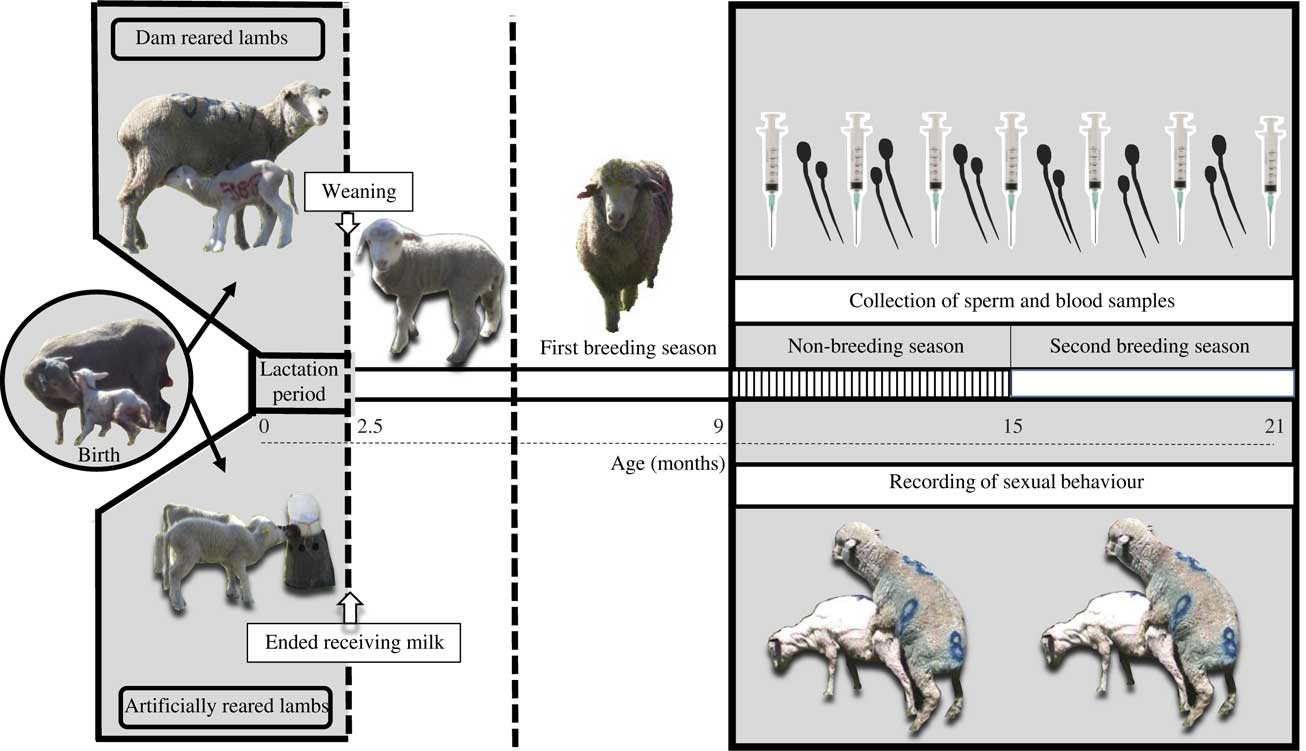
Before lambing, all the dams were handled in the same paddock and kept under the same conditions. Lambings were carefully recorded, and immediately after observing a new lamb, offspring was tagged, and both members of the dyad (mother and lamb) registered (Week 0). Rearing management was described by Damián et al. (Reference Damián, Beracochea, Hötzel, Banchero and Ungerfeld2013). Figure 1 shows a timeline of the study. In brief, single lambs were assigned to two experimental groups: (1) artificially reared lambs were separated from their dams 24 to 36 h after birth (group AR, n=14); (2) lambs reared by their dams remained with their dams until Week 10 (group DR, n=13). Ewes from the same flock were milked, and sheep milk was provided to AR lambs by artificial teats in a series of episodes as described by Damián et al. (Reference Damián, Beracochea, Hötzel, Banchero and Ungerfeld2013), equating to a similar total time length to natural suckling (Munro, Reference Munro1956; Gordon and Siegmann, Reference Gordon and Siegmann1991). Four adult ewes bearing their single lambs were kept with the AR group during the lactation period to avoid the potentially confusing effect of the absence of adult ewes in this group. All lambs received solid ration from the 3rd week of age, were grazed on improved pastures, and had free access to water. At Week 10, DR lambs were weaned, AR lambs no longer received milk, and the ewe-lamb dyads that remained with AR lambs were moved out. Both groups of rams remained separately allocated in the same paddock by an electric fence.
Timeline of the experimental protocol.

The present study covered the period that went from Week 42 (~10 months) to Week 90. Rams were weighed every 2 to 3 weeks, and were shorn on Week 45.
Blood samples and testosterone determination
Blood samples were collected every 2 weeks by jugular venipuncture. Samples were allowed to clot at room temperature, centrifuged (2500× g for 15 min), and stored at −20°C. Serum testosterone concentrations were measured in the Laboratorio de Técnicas Nucleares (Facultad de Veterinaria, Universidad de la República, Uruguay) by radioimmunoassay, using a solid phase kit (DPC; Siemens, Los Angeles, CA, USA). The detection limit of the assay was 0.17 nmol/l. The intra-assay and inter-assay CV were all below 8%.
Scrotal circumference, sperm collection and evaluation
Scrotal circumference was measured every 2 to 3 weeks, and a gonado-somatic index was calculated as scrotal circumference/BW. Semen was also collected on the same days with electroejaculation. Electrical stimulation was applied for intervals of 3 s and alternated with rest periods of similar duration until ejaculation. Semen volume, mass motility (scales 0 to 5), percentage of individual motile sperm and percentage of progressively motile sperm were determined according to Evans and Maxwell (Reference Evans and Maxwell1990). Sperm concentration was determined, and the total number of sperm in the ejaculate was calculated (sperm concentration×volume). The percentage of sperm with intact membrane was determined by the hypo-osmotic test (HOST: Jeyendran et al., Reference Jeyendran, Van der Ven, Perez-Pelaez, Crabo and Zaneveld1984). The percentage of morphologically abnormal sperm and the percentage of sperm with intact acrosomes were determined according to Barth and Oko (Reference Barth and Oko1989) and Pursel and Johnson (Reference Pursel and Johnson1974), respectively. The percentage of morphologically abnormal sperm, sperm with intact acrosomes and sperm with intact membrane were determined on 100 sperm.
Sexual behaviour
Sexual behaviour tests were performed every 2 to 3 weeks, on days when sperm collection did not take place. These rams were tested with oestrous ewes every 2 to 3 weeks commencing from age 13 weeks (Damián et al., Reference Damián, Hötzel, Banchero and Ungerfeld2015). Therefore in the current study these rams were experienced. Each test was performed in a 5×5 m pen using one ewe induced into oestrous with an hormonal treatment (5 or 6 days of intravaginal sponges impregnated with medroxi-progesterone acetate, and i.m. injections 1.5 mg of oestradiol benzoate every 12 h (Bioestrogen, Biogénesis Bagó, Buenos Aires, Argentina)). The number of ano-genital sniffings, lateral approaches, flehmen, mount attempts, mounts (without ejaculation) and matings (mounts with ejaculations) were recorded during 20 min. The lateral approaches were defined based on Banks (Reference Banks1964) as ram movement towards the ewe, with the body pointed in the same direction to that of the female; the ram gets in contact with the flank of the ewe, nudging, and one of its front legs extends, flexes quickly, as if kicking, whilst possibly making a series of low pitched vocalisations.
Definitions and statistical analysis
We analysed the data in two different periods according to females rut described in similar conditions (Pérez et al., Reference Pérez, López, Castrillejo, Bielli, Laborde, Gastel, Tagle, Queirolo, Franco, Forsberg and Rodriguez-Martinez1997; Pérez-Clariget et al., Reference Pérez-Clariget, Forsberg, López and Castrillejo1998; Ungerfeld, Reference Ungerfeld and Lacuesta2012): the non-breeding season was considered from 1 July to 31 December (Weeks 42 to 64), and the breeding season from 1 January until 30 June (Weeks 66 to 90). Body weight, scrotal circumference, gonado-somatic index, testosterone concentrations, sperm parameters and the frequency of each behavioural sexual event were compared between the two groups with an ANOVA for repeated measurements using the mixed model of SAS (2002; SAS Institute, Cary, NC, USA). The residues of all the seminal parameters were normalised with square root transformation before the statistical analysis. The statistical model considered the treatment (AR or DR), time (age in weeks) and the interaction between treatment and time as fixed effects, and the ram into each treatment as a random effect. Post hoc comparisons were performed with LSD. Data are presented non-transformed, as mean ± SEM.
Results
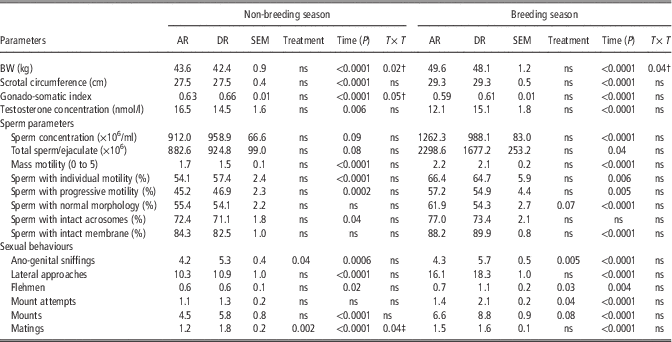
The mean values (±SEM) of all parameters of AR and DR rams and the main effects of treatment (AR v. DR), time and interaction between treatment and time are presented in Table 1.
Body weight, scrotal circumference, gonado-somatic index, testosterone concentration, sperm parameters and sexual behaviours (mean±SEM) of the rams artificially reared (AR) and rams reared with their mothers (DR) during the breeding and non-breeding season; effect of treatment (AR v. DR), time (weeks) and interaction between treatment and time (T×T).

Non-breeding season
Body weight, scrotal circumference, gonado-somatic index and testosterone concentration
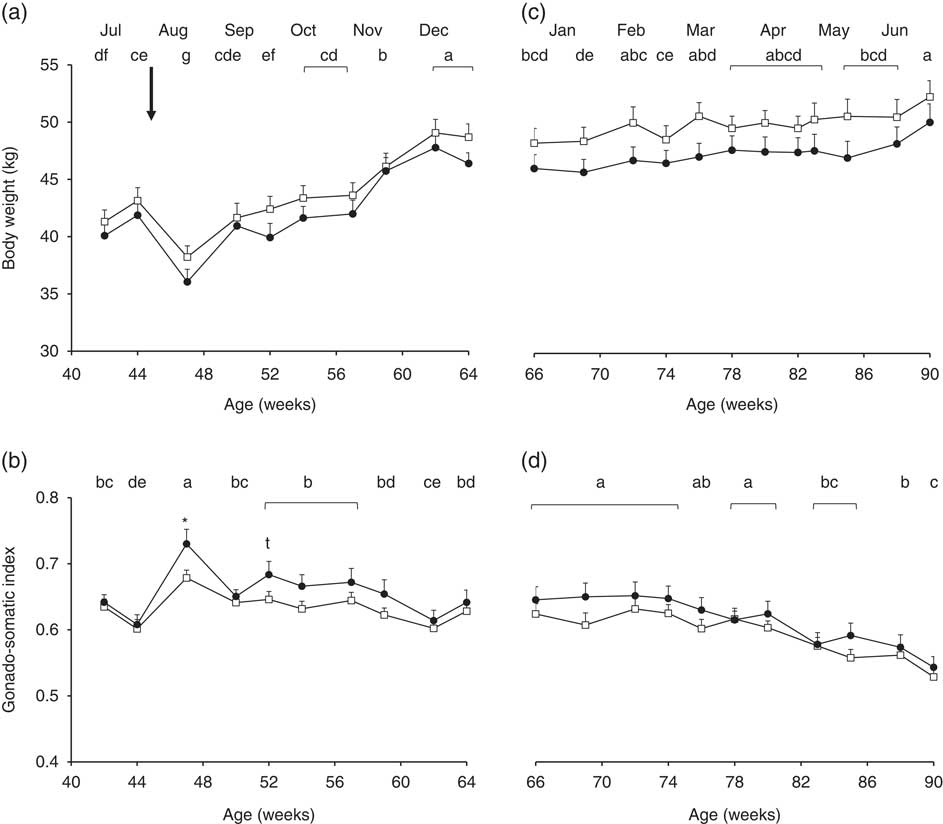
Scrotal circumference and testosterone concentrations were not affected by treatment, time or their interaction (Table 1). Nor did treatment affect BW or gonado-somatic index (Table 1). There was an interaction between treatment and time in BW (P=0.02; Figure 2a) and gonado-somatic index (P=0.05; Figure 2b) (Table 1): while BW decreased from Weeks 50 to 52 (P=0.04) and from Weeks 62 to 64 (P=0.002) in DR rams, it did not change in AR rams. The AR rams had smaller gonado-somatic index on Week 47 (P=0.02) and tended to have also a smaller index on Week 52 than DR rams (P=0.08). Time affected all these variables (Table 1). Body weight and gonado-somatic index reached their maximum values on Weeks 64 and 48, respectively (Figure 2a and b).
Body weight (a and c) and gonado-somatic index (b and d) during the non-breeding season (a to b) and during the breeding season (c to d) of rams that were artificially reared (-□-) or reared with their mothers (-●-). The arrow in (a) shows when the rams were shorn. a,b,c,d,e,fDifferent letters indicate significant differences between weeks (P<0.05). There was an interaction between treatment and time in BW during the non-breeding season (P=0.02) and during the breeding season (P=0.04). There was an interaction between treatment and time in gonado-somatic index during the non-breeding season (P=0.05). Differences between groups in the same week: * P<0.05; t tendency between groups in the same week (P=0.08).

Sperm parameters
There were no effect of treatment nor interaction between treatment and time in any sperm parameter (Table 1).
Sexual behaviour
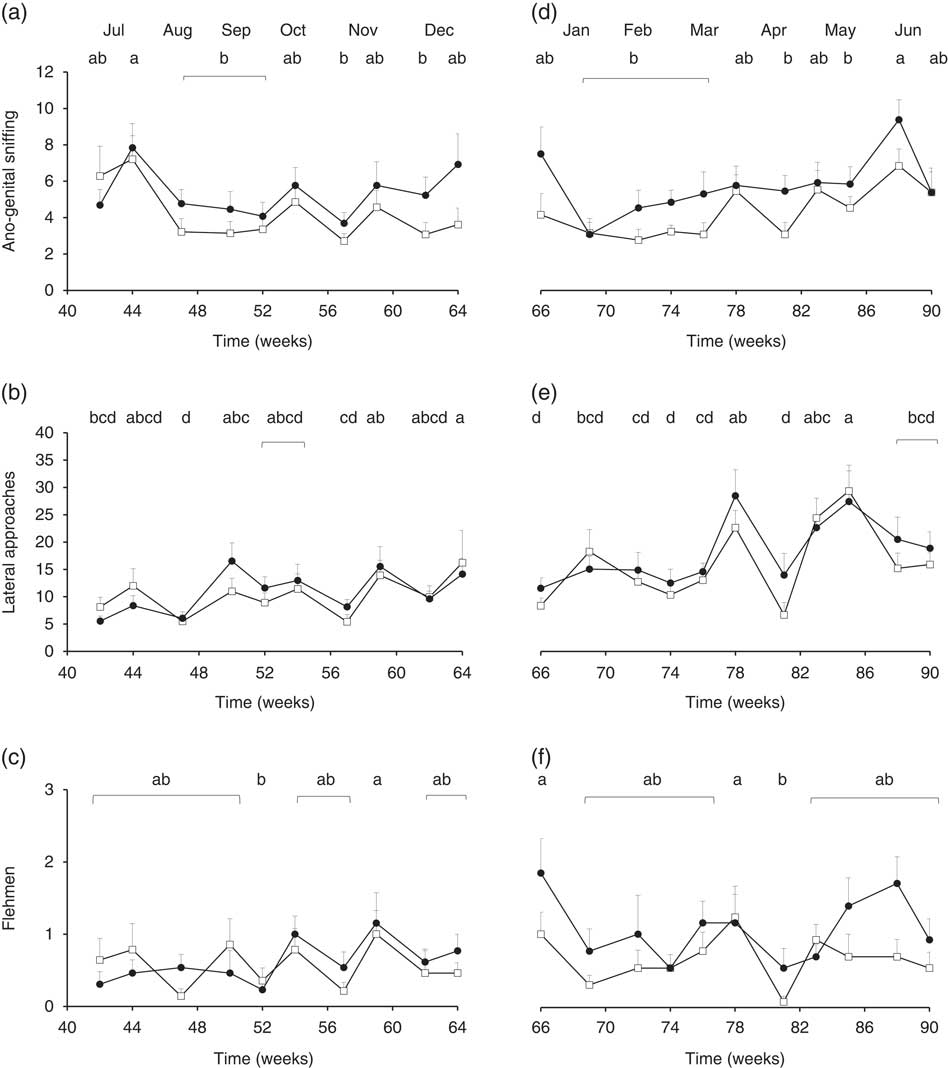
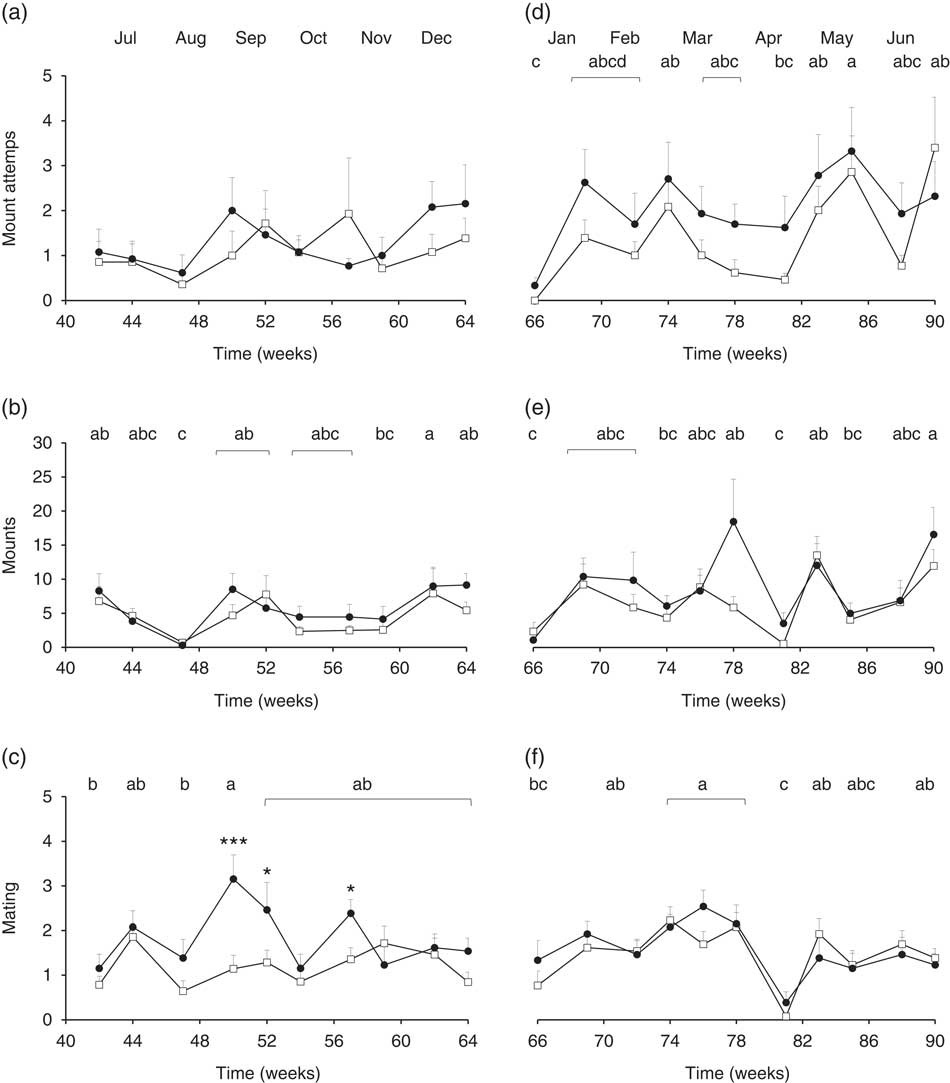
Rams artificially reared displayed fewer ano-genital sniffings (P=0.04; Figure 3a) and matings (P=0.002; Figure 4c) than DR rams (Table 1). There was an interaction between treatment and time on the frequency of matings (P=0.002; Table 1): AR rams mated with the ewes on fewer occasions than DR in Weeks 50, 52 and 57 (Figure 4c). The frequency of all sexual behaviours (with the exception of mount attempts) changed with time (Table 1, Figures 3a to c and 4a to c). The maximum frequencies of ano-genital sniffings, lateral approaches, flehmen, mounts and matings were recorded in Weeks 44, 64, 60, 62 and 50; respectively (Figures 3a to c and 4b to c).
Frequency of ano-genital sniffing (a and d), lateral approaches (b and e) and flehmen (c and f) during the non-breeding season (a to c) and during the breeding season (d to f) of rams that were artificially reared (-□-) or reared with their mothers (-●-). a,b,c,dDifferent letters indicate significant differences between weeks (P<0.05).

Frequency of mount attempts (a and d), mounts (b and e) and matings (c and f) during the non-breeding season (a to c) and during the breeding season (d to f) of rams that were artificially reared (-□-) or reared with their mothers (-●-). a,b,c,dDifferent letters indicate significant differences between weeks (P<0.05). There was an interaction between treatment and time in matings during the non-breeding season (P=0.04). Differences between groups in the same week: * P<0.05, ***P<0.001.

Breeding season
Body weight, scrotal circumference, gonado-somatic index and testosterone concentration
The type of rearing conditions had no effect on any of these variables (Table 1), and the only significant interaction between treatment and time was in BW (P=0.04; Table 1). Although BW increased from Weeks 69 to 72 (P=0.001) and from Weeks 85 to 88 (P=0.04) in DR, it did not change in AR rams (Figure 2c). However, in AR rams the BW decreased from Weeks 72 to 74 (P=0.004). On the other hand, it increased from Weeks 74 to 76 (P=0.0001) in AR but not in DR rams (Figure 2c). Body weight, scrotal circumference, gonado-somatic index and testosterone concentrations changed with time (Table 1). Body weight reached its maximum value at the end of the study, on Week 90 (Figure 2c) and gonado-somatic index decreased with time; and the lowest values were observed in the Week 90 (Figure 2d).
Sperm parameters
The treatments did not affect any sperm parameter (Table 1). There was no interaction between treatment and time in any sperm parameter (Table 1). The AR rams tended to have greater percentage of sperm with normal morphology than DR rams (P=0.067; Table 1).
Sexual behaviour
Rams reared artificially displayed fewer ano-genital sniffings (P=0.005; Figure 3d), flehmen (P=0.03; Figure 3f), mount attempts (P=0.04; Figure 4d), and tended to display less mounts (P=0.08; Figure 4e) than DR rams (Table 1). There was no interaction between treatment and time in any sexual behaviour, and all of them were affected by the time (P<0.01; Table 1, Figures 3d to f and 4d to f). The maximum values in ano-genital sniffings (Figure 3d), lateral approaches (Figure 3e), mount attempts (Figure 4d) and mounts (Figure 4e) were observed at the end of the breeding season, between Weeks 85 and 90. The greatest frequency of flehmen display was observed in Week 66, and the lowest on Week 80 (Figure 3f). The maximum frequency of matings was observed on Week 76, and the lowest on Week 80 (Figure 4f).
Discussion
This is the first study to report that the presence and bond of male lambs with their mothers during their early life has consequences on their sexual behaviour towards oestrus ewes when adults. More specifically, in this study we show that the absence of mother during rearing has negative and long-term effects on their adult sexual behaviour. Other sources of social influence were avoided by keeping AR rams with adult ewe-lamb dyads until they were 2.5 months old, the influence of milk and food were controlled by providing lambs with ewes’ milk in artificial teats and access to the same food. Contact of AR lambs with humans was the minimum necessary for them to learn to suckle the artificial teats during their 1st days of life (Damián et al., Reference Damián, Beracochea, Hötzel, Banchero and Ungerfeld2013). These results are consistent with those reported in rodents (Moore, Reference Moore1984; Birke and Sadler, Reference Birke and Sadler1987; Rhees et al., Reference Rhees, Lephart and Eliason2001), and expands the findings to a species in which rearing is usually shorter in relation to its lifespan. In rodents, maternal licking throughout the lactation process explains the positive effects on the sexual behaviour of adults (Moore, Reference Moore1984). However, as mother licking has a short and marginal role in the establishment of the ewe-lamb bond (Levy and Poindron, Reference Levy and Poindron1987; Vázquez et al., Reference Vázquez, Orihuela, Flores-Pérez and Aguirre2015), other signals from the mother could be central in male lamb sexual development. Considering that there is a great variability in sheep’ maternal behaviour (Nowak et al., Reference Nowak, Keller and Lévy2000; Dwyer, Reference Dwyer and Lawrence2014), and that the presence and contact with the mother during rearing affects the sexual behaviour of rams, we can hypothesise that the maternal ability of different ewes may influence their offspring’ breeding ability. Moreover, rams’ sexual behaviour varies greatly (Lindsay, Reference Lindsay1996; Katz, Reference Katz2008), having a strong influence on flock pregnancy rates (Matos and Thomas, Reference Matos and Thomas1992; Perkins et al., Reference Perkins, Fitzgerald and Price1992). Therefore, differences in the maternal behaviour during rearing may contribute to explain the variability in adult rams’ sexual behaviour and its possible impact on breeding.
The influence of the dam was more evident during the breeding than during the non-breeding season, despite the fact that more time had elapsed since early rearing. During the breeding season, when ewes normally cycle and come into oestrus, rams’ sperm quality increases, and thus, ewes can become pregnant. In summary, during this period the energy invested in the display of sexual behaviour is linked to greater reproductive success. Therefore, our results show the importance of mothering during rearing, as it directly influences sexual behaviour in adulthood of rams, contributing to reproductive success.
The rearing conditions did not affect any of the other reproductive parameters studied, such as testicular size, testosterone concentrations or sperm variables. Although there were some slight differences in testicular size before puberty (Damián et al., Reference Damián, Hötzel, Banchero and Ungerfeld2015), these disappeared when rams reached adulthood. This is in agreement with other cases where social interactions influence lambs reproductive behaviour. For example, rearing in contact with females promotes a greater display of sexual behaviour but has no effect on sperm parameters of rams (Le Roux and Barnard, Reference Le Roux and Barnard1974; Zenchak and Anderson, Reference Zenchak and Anderson1980). Similarly, maternal deprivation during the preweaning period of rats has no effect on sperm production in adulthood (Lau et al., Reference Lau, Klinefelter and Cameron1996). Differences in sexual behaviour, but not in serum testosterone concentrations were also observed in the same rams during the prepuberal development (Damián et al., Reference Damián, Hötzel, Banchero and Ungerfeld2015), as well as in other studies during lamb development (Ungerfeld and González-Pensado, Reference Ungerfeld2008), and in adult rams (Ungerfeld and Lacuesta, Reference Ungerfeld and González-Pensado2010). Although no differences were observed in serum testosterone concentrations between rams reared by their mothers and artificially reared rams, differences in sexual behaviour could be explained by sensitivity to testosterone or a differential activation of specific brain areas linked to sexual behaviour. Akbari et al. (Reference Akbari, Budin, Parada and Fleming2008) reported that artificially reared rats show lower neuronal activation in the medial preoptic area and in the ventromedial hypothalamus when exposed to an oestrous female than rats reared by their mothers. In rams, a wide range of the diencephalic and cortical structures, as well as the medial preoptic area are particularly important in motivational and consummatory sexual behaviours (Borja and Fabre-Nys, Reference Borja and Fabre-Nys2012). Therefore, it may be interesting to test if the sensitivity to testosterone in the medial preoptic area is involved in the differences of sexual behaviour observed between AR and DR rams
In conclusion, the absence of the mother during the rearing period negatively affected display of sexual behaviour towards oestrous ewes during rams’ adult life in both seasons. However, it did not affect testis size, testosterone secretion or sperm variables.
Acknowledgements
The authors are grateful to Carol Abelenda, Laura Morena, Guillermo Arotce and Conrado Rodríguez, for their help in animal management, and Damián González, Alberto Garcia, Sofía Moraes and Nestor Sanguinetti from the Unidad Experimental de Ovinos, INIA La Estanzuela, for taking care of the animals. The authors are grateful to Ch.E. Colin Rogers (Manchester, UK) for language revision. Financial support: Agencia Nacional de Investigación e Innovación (FCE2626-2009ANII). MJH was supported by CNPq, Brazil.