Acatastrophic disaster can cause a surge in health care needs. A variety of care is required in disaster settings, for example, to treat trauma and injury after an earthquake, drowning and hypothermia after floods, and chemical or radiation injuries after plant accidents. However, rescue activities are often hampered by severe infrastructural damage such as disruption of roads and collapse of bridges.
In such situations, local health facilities play a critical role in providing both urgent and routine health care. If their operations or buildings are damaged, the local health system will be severely disrupted, leaving residents in the area without health support.
Health care required in the aftermath of disasters is not limited to emergency care. The Consensus Statement by the American College of Chest Physicians Task Force describes that “supporting medically fragile patients in the community will mitigate their reliance on hospital-based resources during a disaster event.”Reference Christian, Devereaux and Dichter 1 For example, in wealthier countries with aging populations, large numbers of people take medication for chronic conditions. Because most of these medications are prescribed by local clinics, damage to clinic function by a disaster will disrupt routine dispensation of medications. A previous study showed that prescription of routine medication became a huge burden of rescue activity.Reference Ochi, Hodgson and Landeg 2 Therefore, maintaining the function of clinics, as well as that of hospitals, is a critical part of local disaster mitigation for health.Reference Miller and Arquilla 3
Despite this importance, damage to clinics in the aftermath of disasters has rarely been analyzed. Several possible reasons for this lack of data sharing exist: first, few notice the importance of assessment of clinic damage after a disaster; second, most clinics are privately owned and have had no incentive to share their damage data; third, there are so many clinics that even national governments cannot conduct full-scale surveillance targeting all clinics; and fourth, no tools to globally assess clinic damage are available.
Japan is one of the most disaster-prone countries in the world. The Japanese health care system adopts a universal health care insurance system, and almost all residents in Japan have health insurance. In addition, patients are free to select physicians or facilities of their choice and cannot be denied coverage. Therefore, in disaster settings, residents naturally consult the clinics or hospitals nearest their homes. This means that damage to nearby hospitals or clinics will reduce accessibility to health care.
On 2011, a huge earthquake of magnitude 9.0 followed by a huge tsunami that ran up to 41 meters from sea level struck the northeast coastal area in Japan. The Great East Japan Earthquake (GEJE) posed a huge challenge in the provision of health care. For example, 11 out of 380 hospitals in the affected area totally collapsed, and more than 80% experienced some degree of building damage. 4 Even though clinics were also assumed to have sustained massive damage, little information about this damage is currently available.
To assess this assumption as a future plan for nationwide disaster risk reduction, the National Institute of Public Health, supported by the Ministry of Health, Labour, and Welfare, has conducted a surveillance of clinic damage in the disaster area of the GEJE to identify risk factors with regard to building damage and functional damage. The present study summarized the surveillance outcome and delineates the vulnerabilities in local health care networks.
METHODS
This was a cross-sectional study using a paper-based questionnaire conducted from June 1 to July 1, 2011.
Target
The target included 728 clinics located in the coastal areas of 3 prefectures (Iwate, Miyagi, and Fukushima, Japan) that were affected by the 2011 GEJE and the following tsunami. The questionnaire was disseminated by postal mail with a return envelope in June 2011, 3 months after the GEJE.
Contents
To minimize the burden to the on-site facilities, which were still suffering from the damage resulting from the disaster, questions were limited to 5: 3 background questions (location, whether the clinic was public or private, and specialty) and 2 questions about damage (building damage and functional damage). Building damage was categorized as total collapse, partial collapse, and no or little damage on the basis of the rule established by the national government. Functional damage was categorized as stopped provision of care, limited care, and maintained usual care provision.
Geographical Data
The longitude and latitude of the center of each hospital were obtained from their addresses. Data on seismic intensity were obtained from the Japan Meteorological Agency. 5 Data on the coastline, boundaries, and population size at each local area were obtained from Digital Japan, 6 and data from the inundated areas were from the Sawada and Takeuchi laboratory. 7
Geographical Measures
All mapping and geographical analyses were performed by using ArcGIS software (v9c, Redlands, CA). Distance from the coastline to each hospital was calculated and reported in kilometers. To estimate seismic intensity at each hospital, data on seismic intensities at 320 separate points in the Tohoku area of 6 prefectures including Miyagi 5 were spatially interpolated by inverse distance weighting. The population size of each local area was used to estimate the impact of functional loss of hospitals by area.
Statistical Analysis
All analyses were undertaken by using STATA10 (v10; StataCorp LP, College Station, TX). To characterize the cross-sectional association between different types of damage and hospital operations, unadjusted and adjusted logistic regression analyses were conducted. Odds ratios (ORs) and corresponding 95% CIs or coefficiencies and P values were reported where applicable.
Ethical Considerations
The hospital questionnaire received approval from the National Institute of Public Health ethical committee, and respondents were required to return consent forms with the questionnaire.
RESULTS
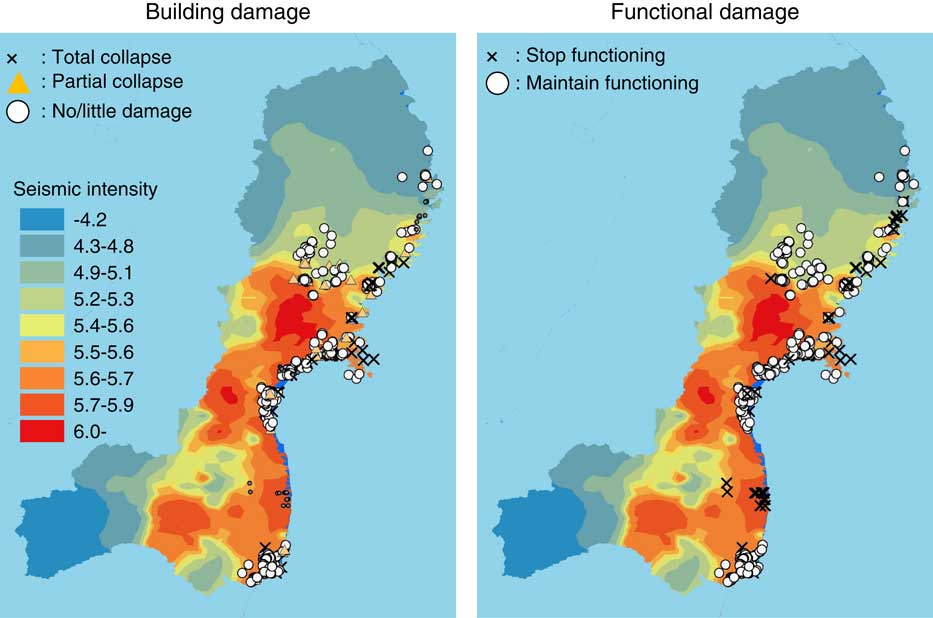
Answers were obtained from 680 clinics (response rate: 93%). With respect to building damage, 64 (9.4%) were totally collapsed and 112 (16%) were partially collapsed. As a result, 93 (14%) stopped provision of care and 28 (4.1%) limited their functions, eg, stopped accepting new patients. The distribution of the building and functional damage to the clinics is illustrated in Figure 1.
Distribution of Damage to 680 Clinics After the Great East Japan Earthquake.

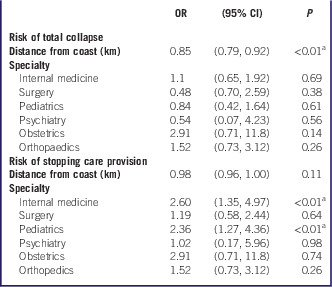
The risks of building damage (collapse) and functional damage (halted provision of care) were calculated by distance from the coast and by care specialty (Table 1). The risk of total collapse was inversely correlated with distance from the coast, but no correlation was observed with care specialty (Table 1). The risk of ceasing operation was significantly correlated with building damage. Even after building damage was controlled, clinics that specialized in internal medicine and pediatrics were at a significantly higher risk of ceasing operations after the disaster.
Risk of Building Damage and Functional Damage to Clinics According to Distance From the Coast and Specialty

a P<0.05.
DISCUSSION
To our knowledge, we believe that this is the first wide-scale surveillance that statistically analyzed clinic damage after a huge disaster, although there have been several reports on hospitalsReference Schultz, Koenig and Lewis 8 - Reference McIntosh, Mitrani-Reiser and Kirsch 10 and some reports on clinics in other media sources. 11 There were 2 major findings: (1) building damage was significantly and inversely correlated with distance from the coast, and (2) several specialties were correlated with functional damage, even after building damage was controlled.
The significant correlation between building damage and distance from the coast suggests that in the GEJE, building damage primarily occurred as a result of the tsunami rather than the earthquake. Therefore, the location of clinics as well as hospitals is a key planning consideration for future local disaster risk reduction.
Although building health facilities outside of hazardous areas is a preferable choice, it is not always practical, because the Japanese archipelago is covered with mountains and only 15% of its land, most of which is coastal, is useful for housing. Because mountainous areas have potential hazards such as landslides and volcanoes, natural hazards are essentially inevitable in every area. Thus, many people choose flat land in coastal areas, even when they know a tsunami hazard exists. Indeed, at the time of the GEJE, 600,000 residents were living in the area inundated by the tsunami. 12 Because accessibility is critical to proper functioning of clinics, they tend to be built in hazardous areas to maintain this accessibility for immobile residents.
This trade-off between geographical hazards and access to care is commonly observed in other Asian countries. For example, in Bangladesh, where 25% of the land is lower than 1 m from sea level, regular river floods affect 20% to 68% of the land. 13 In such countries with many natural hazards, accessibility to care during normal times and security of health facilities after a disaster need to be directly compared. In some cases, an alternative plan will be chosen, such as practical evacuation planning for medically fragile patients rather than disaster preparedness of each clinic, or plans to dispatch primary care assistant teams as soon as possible.
This study also revealed that clinics with internal medicine and pediatric specialties are at higher risk of ceasing operations in disasters. Nevertheless, previous reports suggest these 2 specialties are in high demand after disasters. For example, as the need for chronic care for conditions such as hypertension and diabetes increases,Reference Ochi, Murray and Hodgson 14 internal medicine is one of the most important specialties in disaster areas. With regard to pediatrics, after Hurricane Katrina in the United States, 21% of children at one shelter had at least one chronic disease,Reference Rodriguez, Tocco and Mallonee 15 which suggests increased needs in pediatrics. Therefore, dysfunction of these 2 specialties in disaster areas may have caused a huge burden on medical relief teams dispatched to the area.
To understand this mismatch between supply and demand of health care in the disaster aftermath in more depth, further research including health need analysis and hazard vulnerability assessment (HVA) for all kinds of disasters is required. Although there are a number of standardized tools for HVA, such as the Kaiser Permanent HVA Tool, 16 a tool of the US Department of Health and Human Services, 17 and the hospital safety index for medium- and small-sized hospitals of the Pan American Health Organization, 18 privately owned clinics are often ill-motivated to invest in such preparedness actions for unexpected disasters. First, this is because they often assume that it is only critical care and emergency care that is in need after a huge disaster. Second, small health facilities find it difficult to secure funds to invest in disaster preparedness. As their priority is day-to-day profitability rather than community health, they might prefer buying insurance instead of investing in equipment and supplies that may never be used.Reference Barbera, Yeatts and Macintyre 19 Therefore, some municipal interventions to bolster preparedness of clinics, such as funding programs for HVA, rewards for effective preparedness actions, and development of tangible preparedness guidance,Reference Barbera, Yeatts and Macintyre 19 might be required.
Our research also showed the importance of community-wide assessment. If such assessment is conducted sporadically by each facility, it might fall under a limited budget, which may thus hinder effective resource allocation at the community level. Furthermore, procedures to maintain continuity of operations should include not only that of clinics but also other essential services like inpatient and ambulatory clinical services. Therefore, assessment of other health care services and infrastructure support services (ie, utilities, information technology, and telecommunications) should be conducted in a comparative manner so that effective utilization and allocation of limited resources is possible.
This research had several limitations. First, to minimize the burden to on-site workers who were suffering from the disaster damage, only 5 questions were asked, and the validity of the questions was not tested. Second, the reliability of the responses was also not tested. Further research with tools with validity and reliability will be needed in the future.
In summary, the findings of this study revealed that clinics that are built in readily accessible locations and that provide care with high needs were more likely to get damaged by tsunamis. As clinics are often the frontline health facilities immediately after a disaster, local disaster plans need to include plans to reinforce disaster preparedness among clinics. To prevent exacerbation of chronic conditions, which may lead to morbidity and mortality in disaster areas, local governments may need to reinforce preparedness among the clinics that are assumed to be in high demand after a disaster. For future effective planning and resource allocation, community-wide HVA using a global standard will be helpful.
 23
 (2011
 )

 ].
 ].
 ■

 .