The analysis of current scientific evidence has identified the inanimate hospital environment surrounding the patient as an important source of pathogens causing healthcare-associated infections (HAIs).Reference Weber, Anderson and Rutala 1 , Reference Siegel, Rhinehart, Jackson and Chiarello 2 Compliance with hand-hygiene guidelines is the most essential intervention to interrupt the transmission pathways of nosocomial pathogens, but environmental cleaning is also very important. Nevertheless, even terminal cleaning often fails to eliminate important pathogens from environmental reservoirs.Reference Manian, Griesenauer and Senkel 3 Recently, additional approaches have been proposed such as the use of “self-disinfecting” surfaces created by coating with heavy metals.Reference Weber and Rutala 4
Laboratory studies have confirmed the bactericidal activity of copper against a variety of key nosocomial pathogens.Reference Souli, Galani and Plachouras 5 , 6 Copper-coated surfaces have been studied in a variety of hospital settings for their efficacy to reduce the microbial burdenReference Casey, Adams and Karpanen 7 – Reference Hinsa-Leasure, Nartey, Vaverka and Schmidt 13 and the rate of specific HAIs.Reference Salgado, Sepkowitz and John 14 – Reference Sifri, Burke and Enfield 16
The present study was designed to further investigate the efficacy of copper-coated surfaces to reduce environmental colonization in a very challenging setting, an intensive care unit (ICU) of a Greek hospital, where multidrug-resistant organisms (MDROs) are considered endemic.
METHODS
Setting
The study was conducted in compartments A and B of the ICU at University General Hospital Attikon, a 650-bed tertiary-care academic hospital in Athens, Greece. The ICU compartments (A and B) each contain 4 beds in a common area and 2 single-bed isolation rooms. Medical and nursing staff are dedicated to each compartment, but infection control and cleaning protocols are the same throughout the ICU. Admitted patients are routinely screened biweekly for MDRO colonization.Reference Koratzanis, Souli, Galani, Chryssouli, Armaganidis and Giamarellou 17
The preexisting cleaning protocol included the use of spray alcohol-based disinfectant (Bacillol AF, Hartmann, Germany) on horizontal and other surfaces and twice daily cleaning of floors with chlorine solution (1,000 ppm/L). For hand hygiene, alcohol-based hand-rub solution was used. Manual dispensers were located on the lower bed rails of each bed. The adherence of ICU personnel to hand-hygiene guidelines was routinely measured using published protocols. 18
Study Design
Phase 1: Preintervention
A preliminary laboratory study was conducted to validate the optimum sampling method for the acquisition and release of the maximum concentration of bacteria from the sampled surfaces. We compared the traditional swabbing method using a dry cotton swab according to the method described by Hedin et alReference Hedin, Rynbäck and Loré 19 using 2 sequential flocked nylon swabs (Copan Diagnostics, Corona, CA) for each sample and Difco Dey/Engley neutralizing broth (Becton Dickinson, Sparks, MD) as the sampling solution. We spread different inocula (103–108 cfu) of Staphylococcus aureus, Klebsiella pneumoniae, or Pseudomonas aeruginosa on commonly encountered surface materials and evaluated their recovery quantitatively. We then determined the microbial burden of various surfaces in our ICU to choose the items more heavily and consistently colonized for copper coating.
Phase 2 (a and b): Intervention
A comparative crossover intervention trial was conducted in ICU compartments A and B during 2 time periods. The 6 copper alloy-coated beds and accessories (ie, the upper, lower and side bed rails, the side table, the intravenous (i.v.) pole stands, the handles of the side cart and a cover for the manual antiseptic dispenser) were introduced into the ICU compartments as follows: During phase 2a (September 2011 to February 2012) in both compartments A and B, a copper-coated bed and accessories were placed next to a noncoated bed and accessories, which were used as controls. During phase 2b (May 2012 to January 2013), all copper-coated beds and accessories were placed in ICU compartment A, and all noncoated beds and accessories (controls) were placed in compartment B. Additionally, copper-alloy–coated handles in all nurse’s cupboards replaced regular handles in compartment A and were compared to the regular ones in compartment B. Patients were randomly assigned at admission by administrative personnel to any compartment and bed per availability. All copper-coated items were generously provided by the Hellenic Copper Development Institute (Athens, Greece).
The decision to evaluate copper-coated objects in 2 different arrangements was based on the advantages offered by each one. With the first arrangement (phase 2a), we were better able to control for healthcare personnel exposure, room conditions, and sharing the compartment with a heavily colonized/super spreader patient, as well as for potential bias due to the presence of copper surfaces in a single compartment (possibly influencing compliance with hand hygiene or cleaning protocols). With the second arrangement, we aimed to assess the importance of increasing the ratio of copper-coated surfaces in the patient’s vicinity. By comparing the controls, we were able to evaluate the possibility of a “halo effect” Reference Schmidt, Attaway and Sharpe 20 due to the presence of copper-coated items near uncoated surfaces.
During phase 2 (intervention), data describing the clinical characteristics of patients were extracted from medical files and anonymously recorded, including demographics, admission diagnosis, length of ICU stay, APACHE II score, and colonization or infection by MDROs.
The study was approved by the Ethics Committee of the University General Hospital Attikon.
Sampling Protocol
Sampling in phase 2a began 1 month after the introduction of copper-coated items in the ICU to allow personnel to become accustomed to the copper-containing fixtures. Sampling was performed at regular intervals during each study period and only during the morning shift, before the regular cleaning of the day. In July and August 2012, no sampling was performed due to shortage of personnel. Samples from coated and matched uncoated surfaces were collected on the same day and were similarly processed and monitored.
The sampling protocol of Hadin et alReference Hedin, Rynbäck and Loré 19 was applied throughout the study, with the aforementioned modifications. Results were expressed as colony-forming units (cfu) per 100 cm2. Gram-negative isolates and selected gram-positive isolates (S. aureus and enterococci) were submitted to strain typing and minimum inhibitory concentration (MIC) determination using the BD Phoenix automated system (Becton Dickinson). The lower limit of detection was 300 cfu/100 cm2 (equivalent to 1 colony per plate).
Throughout the study, we used the definitions for multidrug resistant (MDR) and extensively drug-resistant (XDR) bacteria proposed by Magiorakos et al.Reference Magiorakos, Srinivasan and Carey 21
Statistical Analysis
Distributions of continuous characteristics were presented as means with standard deviations (SDs) or medians with interquartile ranges (IQRs). Differences in colonization rates between copper and noncopper surfaces were analyzed using t tests or Wilcoxon rank sum tests if assumptions of normality were not met. Categorical data were presented as relative frequencies, and differences were analyzed using the χ2 test or Fisher’s exact test if observations per cell were ≤5. SPSS version 23 software (IBM, Armonk, NY) was utilized, and a level of P<.05 was considered statistically significant for any association.
RESULTS
Phase 1: Validation of Sampling Methodology
We confirmed that the recovery rate of traditional swabbing was very poor, allowing the recovery of viable colonies from an initial applied inoculum of ≥104 cfu, probably because bacteria were trapped within the cotton fibers. In contrast, using the sampling method of Hedin et al,Reference Hedin, Rynbäck and Loré 19 we could recover viable colonies from an initial applied inoculum of as low as 103 cfu (Supplementary Table S1).
Phase 1: Burden of Environmental Contamination Before the Intervention
The results of phase 1 are shown in Supplementary Table S2. Before any intervention, 121 of 130 (93.1%) samples taken from commonly touched items in the ICU were colonized at a mean number of 18,172 cfu/100 cm2. The microbial burden of the clinical environment in the preintervention phase 1 was>70 times higher than the commonly accepted value of 250 cfu/100 cm2.Reference Dancer 22
The most commonly isolated microorganisms were coagulase-negative staphylococci, followed by K. pneumoniae, S. aureus, P. aeruginosa, and Acinetobacter spp. The most heavily colonized items were the bed electronic remote controls, the ECG apparatus and defibrillators, the manual antiseptic dispensers, the side tables, the i.v. poles, and the bed rails. The latter 4 items were proposed for copper coating.
Phase 2 (a and b): Burden of Environmental Contamination During the Intervention
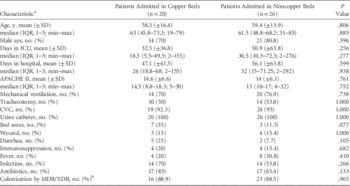
In total, 24 patients were admitted to ICU compartments A and B during phase 2a of the study (8 in copper-coated beds) and 22 during phase 2b (12 in copper-coated beds). Table 1 depicts the clinical characteristics of those patients. We specifically recorded risk factors for colonization and spreading of colonizing bacteria to the surrounding surfaces. Although there was no formal randomization of patients to each type of bed, there were no significant differences between the 2 groups.
Demographic and Clinical Characteristics of the Patients Admitted in Copper and Noncopper-Coated Beds During Phase 2 of the Study

NOTE. SD; standard deviation, IQR; interquartile range, CVC; central venous catheter, MDR; multidrug-resistant bacterium, XDR; extensively drug-resistant bacterium
a At study entry.
b Detected using the method described by Koratzanis et al.Reference Koratzanis, Souli, Galani, Chryssouli, Armaganidis and Giamarellou 17
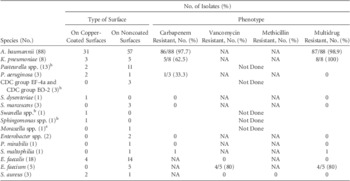
In total, 685 samples were collected during phase 2 (347 during phase 2a and 338 during phase 2b). Among them, 311 were derived from coated surfaces and 374 from uncoated controls, whereas 596 were derived from surfaces at the vicinity of the patient, and 89 were derived from the handles of nurse’s cupboards. The number of samples from coated surfaces was not equal to that from control surfaces due to the occasional movement of furniture as necessitated by patient care. Collectively, 444 samples (64.8%) revealed colonization: 128 (18.7%) with gram-negative bacteria, 23 (5.2%) with Enterococcus spp., and 3 (0.8%) with S. aureus (Table 2). The remaining samples revealed coagulase-negative staphylococci, streptococci, or gram-positive bacteria, which were not further characterized.
Bacterial Species Isolated During Phase 2 of the Study From Copper-Coated and Noncoated SurfacesFootnote a

NOTE. NA, not applicable; CDC, Centers for Disease Control and Prevention.
a Only gram-negative isolates, S. aureus, and Enterococcus spp. were further characterized.
b Susceptibility studies were not performed.
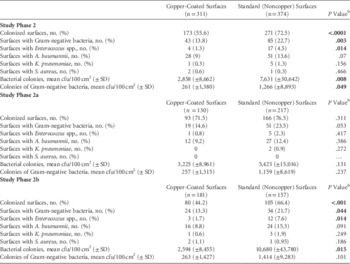
Table 3 depicts the number of colonized surfaces and the microbial burden in phase 2. During phase 2a, 259 of 347 (74.6%) samples grew any bacteria, 70 (20.2%) grew gram-negative bacteria, 6 (1.7%) grew Enterococcus spp., and none grew S. aureus. The mean number of bacterial colonies was 4,601 cfu/100 cm2, and the mean number of gram-negative colonies was 822 cfu/100 cm2. During phase 2b, 185 of 338 samples (54.7%) were positive for bacterial growth (P<.0001 vs phase 2a), 58 (17.2%) grew gram-negative bacteria (P=.33 vs phase 2a), 15 (4.4%) grew Enterococcus spp. (P=.046 vs phase 2a), and 3 (0.9%) grew S. aureus. The mean number of bacterial colonies was 6,350 cfu/100 cm2 (P=.33 vs phase 2a), and the mean number of gram-negative colonies was 798 cfu/100 cm2 (P=.96 vs phase 2a).
Numbers of Colonized Surfaces and Mean Numbers of Bacterial Colonies Recovered During Phase 2 (Intervention)Footnote a

NOTE. SD, standard deviation; cfu, colony-forming units.
a Results are shown separately for phase 2, 2a (copper-coated items in both ICU compartments), and 2b (copper-coated items in one ICU compartment).
b Statistically significant differences between copper-coated and control surfaces are shown in bold.
These results indicate that compared with noncoated controls, copper coating reduced the percentage of surfaces colonized with any bacteria by 16.9% (P<.0001), reduced the percentage of surfaces colonized with gram-negative organisms by 8.9% (P=.003), and reduced the percentage of surfaces colonized with enterococci by 3.2% (P=.014). This reduction was mainly driven by the effect of the arrangement of copper-coated beds and other items during phase 2b of the study. In this phase, when the ratio of copper-coated items near the patient increased, the percentage of surfaces colonized with any bacteria was reduced by 22.2% (P<.001), the percentage of surfaces colonized with gram-negative isolates was reduced by 8.4% (P=.044), and the percentage of surfaces colonized with enterococci was reduced by 5.9% (P=.014). Even before the regular manual surface disinfection of the day, the mean numbers of gram-negative colonies on copper-coated surfaces (during both phases 2a and 2b) were close to the lower proposed standard of 250 cfu/100 cm2.Reference Dancer 22
In phase 2a, 37.5% of copper-coated units (bed and/or accessories) were colonized by MDR gram-negative bacteria, compared with 80% of noncopper-coated units (P=.058). In phase 2b, the rates of colonization were 41% with copper-coated units and 70% with noncopper-coated units (P=.185), respectively. This trend was mainly driven by A. baumannii colonization, which was 37.5% with copper-coated units versus 81.3% with noncopper-coated units in phase 2a (P=.047) and 41.7% with copper-coated units versus 60% with noncopper-coated units (P=.067) in phase 2b.
DISCUSSION
In the present study, we evaluated the efficacy of copper-alloy coating to reduce the bioburden on environmental surfaces surrounding the patients in a Greek ICU. Even in a setting with endemic high antimicrobial resistance, copper-coating significantly reduced the percentage of colonized surfaces, the percentage of surfaces colonized by MDR gram-negative bacteria or enterococci, and the numbers of total viable bacterial colonies and of gram-negative colonies, specifically. This effect was more pronounced when the ratio of copper-coated surfaces around the patient was increased. The enhanced effect of copper-coated items in phase 2b was not influenced by variables such as better compliance with infection control and cleaning protocols. The level of compliance with hand hygiene decreased to 40% during phase 2b (from 75% in phase 2a), and standard manual disinfection procedures were regularly monitored and remained unchanged. Compliance to hand hygiene did not differ between compartments throughout the entire study period.
Interestingly, when the mean microbial burden in phase 1 was compared to that on noncopper control items in phase 2, a 42% reduction was noted, with decreases from 18,172 to 7,631 cfu/100 cm2 (5,425 in phase 2a and 10,680 cfu/100 cm2 in phase 2b) and on bed rails specifically from 19,460 to 4,919 cfu/100 cm2 (4,420 in phase 2a and 5,707 cfu/100 cm2 in phase 2b). Several independent and uncontrolled variables could have accounted for this effect; for example, the presence of copper items by itself could have reinforced better practices by the healthcare personnel. It is also possible, however, that the introduction of copper on some ICU surfaces may indeed have had a “halo effect,” decreasing the microbial burden in nearby noncopper surfaces.
The results of our study agree with the existing literature, which has demonstrated that copper-coated surfaces reduce bacterial load by 60%–70% and levels of vegetative bacteria by approximately 1- to 2-log10 cfu and that, unlike standard disinfection, a reduced bioburden was maintained for hours after standard cleaning.Reference Michels, Keevil, Saldago and Schmidt 23 In a randomized trial by Salgado et al,Reference Salgado, Sepkowitz and John 14 copper coating reduced the rate of HAIs and/or colonization by MRSA or VRE, but the effect on infection or colonization by MDR gram-negative bacteria was not addressed. Furthermore, in previous studies, the total microbial burden was reported (including nonpathogenic bacteria) without speciation of bacterial colonies.Reference Casey, Adams and Karpanen 7 – Reference Rai, Hirsch and Attaway 10 More recently, in a nonrandomized study in a neonatal ICU, the reduction of HAIs by the introduction of copper items was not statistically significant.Reference von Dessauer, Navarrete, Benadof, Benavente and Schmidt 15 However, the broad deployment of copper-composite hard surfaces and linens in a new hospital wing in Norfolk, Virginia, was associated with fewer HAIs, including C. difficile infections, in a population of acute-care patients.Reference Sifri, Burke and Enfield 16
Our study has several limitations. First, this is a single-institution study, so the results may not be applicable to other institutions with different infection control practices and MDRO profiles or with lower acquisition rates. Also, this study was not designed to detect a reduction in the rate of patient colonization or in the incidence of HAIs. There was no randomization to coated and uncoated beds; however, there were no statistically significant differences in a variety of clinical and demographic characteristics between the 2 groups of patients, including the comparable high rate of colonization with MDRO (89%). Finally, a cost-effectiveness analysis was not performed, but others have calculated that the time to recover the cost of copper installation in their ICU was <2 months.Reference Michels, Keevil, Saldago and Schmidt 23
Our study has several strengths, as well. This is the first study to evaluate the efficacy of copper in a setting highly endemic for MDR gram-negative bacteria where 89% of patients are already colonized by MDRO upon admission. A highly sensitive method was used for surface sampling, and quantitative cultures and speciation allowed the evaluation only of clinically important (potentially pathogenic) bacteria. The long duration of the study (17 months of intervention phase) provided evidence in favor of the persisting antimicrobial effect of copper coating over time. Regular measurements of compliance with hand hygiene and cleaning protocols throughout the study eliminated the influence of these variables on the results. Finally, 2 different types of arrangements of copper-coated surfaces were compared in a crossover design.
In conclusion, the introduction of copper-coated surfaces in a setting with endemic high antimicrobial resistance reduced the microbial burden, and the percentage of colonized surfaces surrounding the patient. The overall effect was more pronounced as the percentage of coated items increased.
ACKNOWLEDGMENT
We acknowledge the technical contributions of Dimitra Katsala, Panagiota Adamou, and Zoe Chryssouli.
Financial support: This study was supported by a grant from the Hellenic Copper Development Institute.
Potential conflicts of interest: M.S. has received a research grant from Achaogen. G.P. and A.A. received a grant from the Hellenic Copper Development Institute for this study. I.K. is currently an employee of Gilead Sciences Hellas. H.G. has received a research grant from Pfizer. All other authors have no conflicts to report relevant to this article.
SUPPLEMENTARY MATERIAL
To view supplementary material for this article, please visit https:/doi.org/10.1017/ice.2017.52