Implications
The effects of management and animal-based factors on daily gain, feed intake (FI) and feed efficiency of grower and finisher pigs were analysed. A number of factors were identified as having significant effects on these traits, including the effects of less well-established ones, such as the effects of grouping by gender on FI. Interactions between factors were also confirmed; for example, the interaction between bedding and feed lysine content on daily gain. The results may contribute towards the improvement of efficiency of pig systems through a better knowledge of the various factors that influence it.
Introduction
Feed efficiency is one of the major factors that defines the overall efficiency of pig systems (Gaines et al., Reference Gaines, Peterson and Mendoza2012). In grower and finisher pigs, feed costs can represent as much as 70% of the total production costs (Woyengo et al., Reference Woyengo, Beltranena and Zijlstra2014), and the efficiency with which feed is converted to pig meat underpins the pig industry’s ability to compete internationally. Therefore, finding effective ways to improve feed efficiency and consequentially reduce waste, is essential both on financial and food security grounds. As in most animal systems, inefficiencies associated with feed utilisation will arise from factors associated with the feed itself, the animal and the environment it is kept in (Emmans and Kyriazakis, Reference Emmans and Kyriazakis2001).
Although there is published information for the effects of some factors on feed efficiency, such as feed-related factors and ambient temperature (Lopez et al., Reference Lopez, Jesse, Becker and Ellersieck1991; Renaudeau et al., Reference Renaudeau, Gourdine and St-Pierre2011 and Reference Renaudeau, Collin, Yahav, de Basilio, Gourdine and Collier2012), there is a lack of information for some lesser known factors such as feeder and drinker type, as well as the effect of social stressors on performance (Wellock et al., Reference Wellock, Emmans and Kyriazakis2003b). Importantly, less is known about the interaction effects between several factors that may influence feed efficiency. This is despite the fact that there are great benefits to be had from the knowledge of such interactions, for example, whether the same pig genotype will perform similarly or differently in different environments (Brandt et al., Reference Brandt, Werner, Baulain, Brade and Weissmann2010). In the United Kingdom, for example, there is great interest in what animals to use and how to treat them in the two very different prevailing systems for growers and finishers (British Pig Executive (BPEX), 2009). This absence of information reflects the difficulty in making systems comparisons.
The better understanding of the effects of the environment, animal characteristics and nutrition on pig feed efficiency will provide useful insights to what housing and feeding system characteristics are likely to improve productivity and animal welfare. The aim of this study was to determine the separate and interactive effects of different factors, relating to pig environment, animal and feed characteristics, on the performance and feed efficiency of grower and finisher pigs; this was done by meta-analysis of scientific papers and industry-provided data.
Material and methods
Data collection
Information regarding the feed efficiency of grower and finisher pigs was collected from a number of studies published in peer-reviewed journals between 1987 and 2013. Production data from controlled, industry-based studies was also used in the same analysis; this was consistent with the methodology used by previous meta-analyses (Agostini et al., Reference Agostini, Fahey, Manzanilla, O'Doherty, de Blas and Gasa2013). This allowed for the inclusion of a greater number of treatments as well as incorporating multiple sources of data to increase reliability. The peer reviewed studies were gathered using a search engine (SCOPUS) with the terms (‘pig’ and ‘feed efficiency’) or (‘pig’ and ‘performance’). The literature cited was also checked to complete the information available. The dependent factors of interest were the average daily gain (ADG), FI and feed conversion ratio (FCR) of grower and finisher pigs (i.e. from 25 kg BW). Manuscripts using only piglets before the growing phase were disregarded and the same applied to papers using rare breeds. Furthermore, only papers from within Europe were taken into account due to differences between continents regarding several practices, including feed ingredients used.
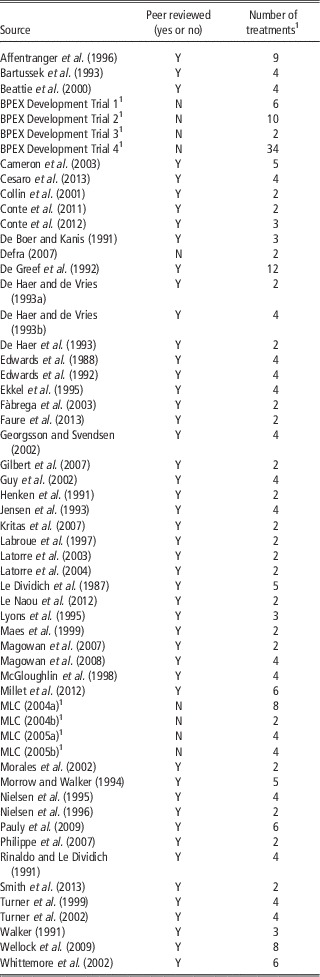
A database was built in Excel, where each individual observation in the database referred to the mean of a treatment group. A total of 152 publications were found, out of which 54 publications were useable (based on the exclusion criteria mentioned previously); these included 190 different useable treatments. In addition, four sets of unpublished data were used, giving 52 more entries leading to a total of 242 (Table 1). The information gathered included the dependent factors (ADG, FI, FCR) and information regarding the animal characteristics, housing, feed characteristics and feeder and drinker type was used as the independent factors.
Peer reviewed and non-peer reviewed data sources included in the meta-analysis with the number of treatments available per source

The factors chosen to be included as independent factors influencing ADG, FI and FCR were (i) animal characteristics: gender (entire male, female, castrated male or a combination of entire males/females or castrated males/females), genotype (discussed below) and stage of production (growers, finishers or a combination), (ii) group characteristics: group size (number of pigs), group composition (mixed or separate genders) and practice of mixing (yes or no), (iii) housing: country where the study was conducted (in EU), floor space allowance expressed in m2 per and metabolic BW, K (m2/BW0.667), floor type (solid, fully or partially slatted), the use of bedding (straw) (yes or no), ambient temperature (°C), lighting regime (hours of light per 24 h), building type (natural ventilation, mechanical ventilation, automatic control of natural ventilation and climate respiratory chambers) and season (spring/summer, autumn/winter or a combination of the two), (iv) presence of infection (yes or no), (v) feed characteristics: metabolisable energy (ME, MJ/kg), crude protein (CP, g/kg), crude fibre (CF, g/kg) and lysine (g/kg) content, the ratio of lysine: ME, the number of feeds fed throughout the study, feed allowance (ad libitum, restricted or a combination of the two) and feed form (pellet, crumble, liquid, expandate, meal or mash), (vi) feeder and drinker characteristics: feeder type (single, multi-space or trough), number of pigs per feeder, feeder space (cm2), water type (nipple, bowl or at feeder) and number of pigs per drinker.
For both dependent and independent factors, there was large variation in the number of observations available as not all manuscripts reported data for all factors. Data on as many factors as possible were collected, however, there were some cases where either no data were available or there were insufficient numbers to be included in the subsequent analysis (e.g. phosphorous and fat content of the diet). The articles chosen for analysis had to contain data on at least one of the dependent factors (FCR, FI or ADG), as well as most of the independent factors stated above, including at least one in every group, with the exception of the feed characteristics, information on which was not provided by all articles.
The stage of growth was defined as grower (25 to 50 kg), finisher (>50 kg) or a combination. Concerning genetics, the Large White (LW) and Landrace (L) pure breeds, and the Large White×Landrace (LW/L) crosses were grouped into the same category, in accordance with Averós et al. (Reference Averós, Brossard, Dourmad, de Greef, Edwards and Meunier-Salaun2012). This also included any Landrace/Large White×Meishan crosses. Duroc, Pietrain, Hampshire purebreds and their crosses with LW/L pigs were each placed in a separate category. An additional group was created to account for crosses between Duroc×Pietrain×LW/L. Other breeds were discarded from the analysis due to the low number of observations. The infectious environment was included in a binary form (yes or no presence of infectious challenge) due to the high variation in possible pathogens used. If not mentioned, a disease-free environment was assumed. Health challenges presented through non-routine vaccinations were also included as an ‘infectious’ challenge.
Feed energy content was converted to ME (MJ/kg fresh feed). If the results were present in DE these were converted to ME using the formula in Wellock et al. (Reference Wellock, Emmans and Kyriazakis2003a):
 $${\rm ME}={\rm DE}\,{\minus}\,{\rm 5}.{\rm 63}\,{\times}\,({\rm CP\ content}/{\rm 1}000),$$
where CP is in g/kg feed. When the results were presented as NE these were converted to ME by dividing by 0.75 (Noblet and van Milgen, Reference Noblet and van Milgen2004; Sauvant et al., Reference Sauvant, Schmidely, Daudin and St-Pierre2008). The CP, CF and lysine contents were all presented as g/kg fresh feed.
Statistical analysis
For continuous factors only, descriptive statistics (including normality tests) were completed using the UNIVARIATE procedure of SAS (SAS, version 9.2, Cary, NC, USA). Descriptive statistics for categorical factors (counts of each class) were performed using the FREQUENCY procedure of SAS 9.2. Correlations among independent factors were calculated using the CORR procedure of SAS and used to prevent confounding and multicolinearity in the multivariate models. When factors were correlated they were not used in the same model.
A separate analysis was run for each dependent variable (ADG, FI and FCR). The experiment was included as a random factor in all analyses. To begin with, a mixed model was run containing all main effects and interactions (Averós et al., Reference Averós, Brossard, Dourmad, De Greef, Edge, Edwards and Meunier-Salaun2010; Averós et al., Reference Averós, Brossard, Dourmad, de Greef, Edwards and Meunier-Salaun2012), but, as it failed to converge, alternative models were built (Averós et al., Reference Averós, Brossard, Dourmad, de Greef, Edwards and Meunier-Salaun2012; Agostini et al., Reference Agostini, Fahey, Manzanilla, O'Doherty, de Blas and Gasa2013).
Initially, the effect of each independent variable was analysed separately using the MIXED procedure of SAS. Factors that had P⩽0.25 were chosen for inclusion in the multivariate mixed model (Agostini et al., Reference Agostini, Fahey, Manzanilla, O'Doherty, de Blas and Gasa2013). Subsequently, the model was developed using a manual forward selection stepwise procedure with independent factors added in order of the number of cases (beginning with those factors, which were represented across all studies). All factors with <0.05 were retained in the final multivariate model. The model contained both linear and quadratic effects for continuous factors. Although it would have been beneficial to weight data, insufficient information was available in manuscripts to do this.
Finally, interactions between independent factors were analysed. In the case of factors that were already categorical, the number of categories within each factor was reduced on the basis of the univariate model output; in the case that categories within factors were not significant then these were pooled to create a binomial variable and the model was recalculated. The interactions were added onto the existing model individually; those that were significant were then added to the model together, remaining there if statistically significant (P<0.05). Data are reported as least square means.
Results
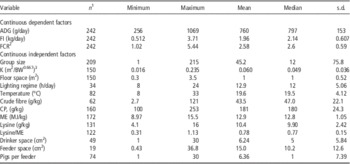
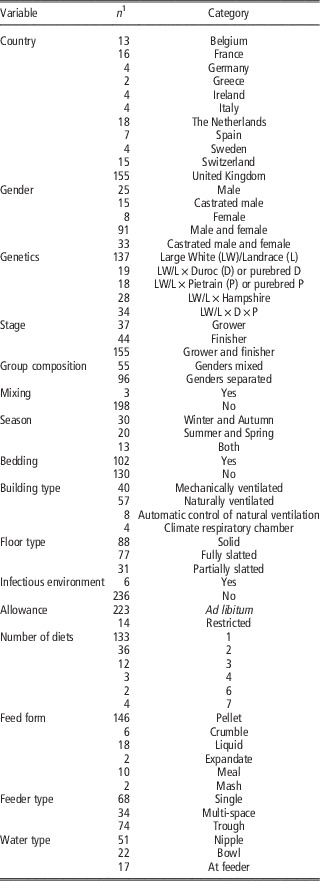
Descriptive statistics for continuous dependent and independent factors are shown in Table 2 and for categorical independent factors in Table 3.
Descriptive statistics for the continuous independent and dependent factors included in the meta-analysis

ADG=average daily gain; FI=feed intake; FCR=feed conversion ratio; ME=metabolisable energy.
1 Total number of observations available for analysis.
2 Calculated as the ADG divided by the FI.
3 K was the floor space allowance per unit of metabolic BW.
Descriptive statistics for the categorical factors included in the meta-analysis

1 Total number of observations available for analysis.
ADG
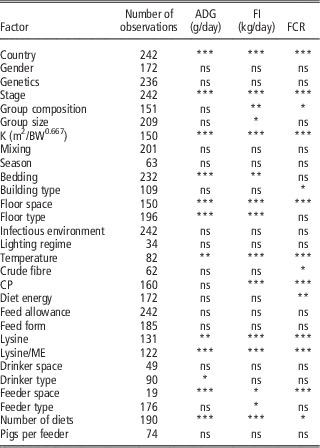
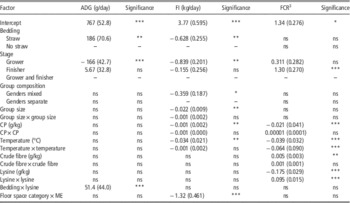
The average ADG was 760 g/day (s.d. 153), with a range of 256 to 1069 g/day. Univariate analysis found a number of factors were influencing the ADG of grower and finisher pigs (Table 4). These were the country (P<0.001), stage of growth (P<0.001), K (m2/BW0.667), bedding (P<0.001), floor space (P<0.001), floor type (P<0.001), ambient temperature (P<0.01), feed lysine content (P<0.01), lysine/ME (P<0.001), drinker type (P<0.05), feeder space (P<0.001) and number of diets fed (P<0.001). In the final multivariate model only stage of growth (P<0.001), bedding (P<0.01) and floor type (P<0.05) significantly influenced ADG. Since floor type and bedding were confounded as pigs kept on slatted or partially slatted floors did not have bedding, floor type was removed from the final model. One significant interaction was observed for ADG that of bedding×lysine (P<0.001).
The significance and number of observations (total n=242) of the factors influencing the ADG, the average daily FI and the FCR of pigs in the univariate model analysis

ADG=average daily gain; FI=feed intake; FCR=feed conversion ratio; ME=metabolisable energy; ns = non-statistically significant.
*P<0.05; **P<0.01; ***P<0.001.
The highest ADG was achieved by animals in the later stages of growth: finishers (833 g/day) and growers/finishers combined (829 g/day). These were significantly higher than the ADG of growers (661 g/day). The highest ADG was for animals housed with bedding (straw) compared with those without bedding (710 v. 605 g/day, P<0.001). The bedding×lysine interactions were due to pigs housed without bedding (straw) having higher ADG when fed a diet lower in lysine content; however, those with bedding had an increased ADG when fed a diet higher in lysine content (Table 5).
Parameter estimates (and standard errors) for the multivariate models quantifying the effect of the different factors on the performance factors (ADG, average daily FI and FCR) of grower and finisher pigsFootnote 1 , Footnote 2

ADG=average daily gain; FI=feed intake; FCR=feed conversion ratio; ME=metabolisable energy.
1 Factors with a P-value <0.05 were retained in the multivariate model.
2 ns=variable not statistically significant (P>0.05) and therefore removed from the multivariate mode.
3 Calculated as the gain: feed.
*P<0.05; **P<0.01; ***P<0.001.
FI
The average FI was 1.96 kg/day (s.d. 0.607), with a range of 0.512 to 3.71 kg/day. The univariate analysis found a number of factors were influencing the FI of grower and finisher pigs (Table 4). This included the country (P<0.001), stage of growth (P<0.001), group composition (P<0.01), group size (P<0.05), K (m2/BW0.667) (P<0.001), bedding (P<0.01), floor space (P<0.001), floor type (P<0.001), ambient temperature (P<0.001), feed crude protein (P<0.001), feed lysine (P<0.001), lysine/ME (P<0.001), feeder space (P<0.05), feeder type (P<0.05) and number of diets (P<0.001). In the final multivariate model stage of growth (P<0.01), bedding (P<0.01), group composition (P<0.05), group size (P<0.01), feed CP content (P<0.01) and ambient temperature (P<0.01) significantly influenced the FI of grower and finisher pigs. An interaction was found between floor space and feed energy content (P<0.001) for FI.
For stage of growth, the average daily FI was 2.37 kg/day for finishers, growers/finishers combined (2.08 kg/day) and growers (1.40 kg/day), all of which were significantly different from each other. Pigs housed with straw had a lower FI compared with those animals without bedding (1.44 v. 2.04 kg/day; P<0.01). Pigs separated by gender had a higher FI than those which were mixed (2.05 v. 1.65 kg/day; P<0.05). A negative linear relationship was found between the size of the group and the FI of pigs, with pigs kept in larger group sizes having a lower FI. Similarly, a negative linear relationship was found between the CP content of the feed and the FI, with a decreased FI at higher CP levels. Finally, a negative linear relationship was found between ambient temperature and the FI of pigs, with FI decreasing at higher ambient temperatures. An interaction was found between floor space and feed energy content (P<0.001) with animals provided with the least amount of floor space having a higher FI when given a feed with a lower ME content, which was in contrast to all other pigs, which showed a higher FI with increased ME content.
FCR
The average FCR was 2.58 (s.d. 0.590), with a range of 1.02 to 5.44. Univariate analysis found a number of factors were influencing the FCR of grower and finisher pigs (Table 4). These were the country (P<0.001), stage of growth (P<0.001), group composition (P<0.05), K (m2/BW0.667; P<0.001), building type (P<0.05), floor space (P<0.001), ambient temperature (P<0.001), CF (P<0.05), CP (P<0.001), diet energy (P<0.01), lysine (P<0.001), lysine/ME (P<0.001), feeder space (P<0.001) and number of diets (P<0.05). In the final multivariate model, only stage of growth (P<0.001), feed CP (P<0.001), CF (P<0.01) and lysine content (P<0.001) and ambient temperature (P<0.001) significantly influenced the FCR of pigs. No interactions were noted for FCR.
For stage of growth, finishers had the poorest FCR with an average of 2.45 kg/kg, differing significantly from the growers and finishers combined (2.21). There was a negative linear relationship between CP and FCR, with improved efficiency at higher CP feed content. In contrast, there was a positive linear relationship between CF and FCR, with lower CF feeds leading to an improved FCR. For lysine content of the feed, a negative linear relationship was observed with improved FCR at increased lysine levels. Finally, a negative linear relationship was found between the ambient temperature and the FCR of pigs, with an improvement in efficiency at higher ambient temperatures.
Discussion
The aim of this study was to determine through a meta-analysis the separate and interactive effects of different factors, relating to the environment, the feed and the animal, on the efficiency of grower and finisher pigs. Emphasis in this meta-analysis was given on factors that may influence the efficiency of EU- and UK-based pig systems and for this reason data originating from farm trials was also included. The UK pig systems have some particularities in relation to other EU pig systems, including feeding strategies and housing, such as the use of straw. As a result, this study confirmed the effect of several well-known factors, such as the importance of nutrition and stage of growth; however, it has also shown the effect of a number of potential interactions that should be considered, as well as the influence of some less-established factors.
The meta-analysis in the current study incorporated both univariate and multivariate analysis, with the former yielding a greater number of factors exerting significant effects. This is because the univariate model does not consider correlations between factors and, therefore, has less precise parameter estimates (O'Connell and McCoach, Reference O'Connell and McCoach2008). Similarly in experimental studies only a small number of factors may ever be considered, due to the limitations suggested above, and as a consequence such studies cannot fully answer which factors are affecting efficiency in grower and finisher pig systems.
This study confirmed a number of established factors, which influence feed efficiency. Among these, the stage of growth (i.e. grower or finisher) had a significant effect on all performance outputs, with finisher pigs consistently outperforming both growers in terms of ADG and FI, although they had the expected significantly poorer FCR. Ambient temperature was found to affect the performance of pigs, in particular the FI and FCR, confirming the outcomes of the meta-analysis performed by Renaudeau et al. (Reference Renaudeau, Gourdine and St-Pierre2011). However, while optimum efficiency was achieved with higher ambient temperatures, there was a decrease in FI as the ambient temperature increased. This would be expected as efficiency is maximised when pigs are kept in their thermoneutral zone. However, if this is exceeded, then a reduction in FI (Wellock et al., Reference Wellock, Emmans and Kyriazakis2003a) as well as non-feeding-related activities would occur (Giles, Reference Giles1992), both of which are essential mechanisms to regulate body temperature (Renaudeau et al., Reference Renaudeau, Collin, Yahav, de Basilio, Gourdine and Collier2012).
Although it could be expected that genetics would have a significant effect on the performance of grower and finisher pigs, there was no significant effect of genetics identified in this study. One possible explanation for the lack of observed effects is that the majority of pigs in the papers were Large White/Landrace crossbreeds and other pig genotypes were underrepresented. This could also account for the lack of an effect of other underrepresented modalities such as feed allowance, mixing and infectious environment and therefore the results in relation to these should be treated with caution.
In addition to the animal characteristics and the environment, feed characteristics also played a key role in affecting efficiency, in particular the CP, ME, lysine and CF content of the feed. High levels of CF were found to result in an increase in FCR, in agreement with previous work (Asmus et al., Reference Asmus, DeRouchey, Tokach, Dritz, Houser, Nelssen and Goodband2014). However, it is also important to consider that there was a high negative correlation between ME and CF, which may also explain this finding; the lower energy density of high CF diets necessitating a greater daily intake (Kyriazakis and Emmans, Reference Kyriazakis and Emmans1995). Improved feed efficiency, that is, lower FCR, was found for higher lysine and CP feed content, which is consistent with previous literature (Kyriazakis et al., Reference Kyriazakis, Emmans and Whittemore1991; Szabó et al., Reference Szabó, Jansman, Babinszky, Kanis and Verstegen2001). However, whether feed efficiency would be affected by feed CP content would depend on the basis the feed has been formulated; for example, one can lower the CP content of the feed, while maintaining the essential amino acid levels. There is an argument on whether animals, including pigs are able to regulate their intake depending on the amino acid or protein content in their feed, to the degree they are able to regulate feed energy content (van Milgen et al., Reference van Milgen, Valancogne, Dubois, Dourmad, Sève and Noblet2008). The outcomes of this meta-analysis suggest that as the CP in the feed decreased, FI increased, which supports the view that animals attempt to eat for the first limiting nutrient resource in their diet (Kyriazakis and Emmans, Reference Kyriazakis and Emmans1991; Kyriazakis et al., Reference Kyriazakis, Emmans and Whittemore1991). This is further supported by the fact that pigs on lower CP and lysine feeds were also less efficient and presumably fatter, especially in the majority of the studies used pigs had access to one feed throughout the experiment.
The use of bedding to enrich pig environment has been well studied, including its effect on behaviour, performance and welfare (de Jong et al., Reference de Jong, Ekkel, van de Burgwal, Lambooij, Korte, Ruis, Koolhaas and Blokhuis1998; Peeters et al., Reference Peeters, Driessen, Moons, Ödberg and Geers2006). The results presented here show that the presence of straw improved the ADG of pigs, but also decreased FI. The absence of any effect of straw on FCR may be due to the fact that for each model, it was not the same data analysed, as data were not always present for each independent variable. The effect of straw on ADG and FI is likely a combination of thermal and behavioural effects of the presence of straw on pigs. Provision of straw can increase the ambient temperature and raise the baseline body temperature of pigs (de Jong et al., Reference de Jong, Ekkel, van de Burgwal, Lambooij, Korte, Ruis, Koolhaas and Blokhuis1998); this is particularly important when pigs are housed in naturally ventilated buildings and are more susceptible to changes in weather. In addition, nibbling of pen mates and other ‘manipulative’ behaviour is reduced, which may be because pigs may gain more ‘satisfaction’ for exploring the straw rather than the pen (and other pigs; de Jong et al., Reference de Jong, Ekkel, van de Burgwal, Lambooij, Korte, Ruis, Koolhaas and Blokhuis1998). Although there was also a significant effect of floor type, this was likely due to confounding with bedding, as the majority of pigs kept on solid floors had straw bedding. The decrease in FI observed was likely due to pigs needing less energy to be diverted to thermoregulation (Wellock et al., Reference Wellock, Emmans and Kyriazakis2003a) and perhaps consuming some of the straw bedding (Tuyttens, Reference Tuyttens2005). This is further supported by the fact that the decreased FI had no effect on ADG as those with bedding performed better. However, others have found no such effect of bedding on FI (Averós et al., Reference Averós, Brossard, Dourmad, De Greef, Edge, Edwards and Meunier-Salaun2010).
Grouping pigs in larger social groups throughout the production cycle is common practice and can help to reduce housing costs as well as improve management (Turner et al., Reference Turner, Allcroft and Edwards2003). However, it is important to consider any potential negative effects of group size and currently the reported effects on welfare, performance and behaviour are mixed (Schmolke et al., Reference Schmolke, Li and Gonyou2003; Turner et al., Reference Turner, Allcroft and Edwards2003; Street and Gonyou, Reference Street and Gonyou2008). Specifically, increasing the group size of pigs may have a major effect on behaviour as the mixing of a large number of unfamiliar pigs can cause an unstable social hierarchy, which can lead to competition at the feeders and drinkers (Finn, Reference Finn2004). Performance may then be negatively impacted as energy is diverted to competitive behaviour (Finn, Reference Finn2004). In addition, grower pig feeding duration decreases in larger groups with limited feeders and although feed consumption rate increases there may be negative effects on FI (Hyun and Ellis, Reference Hyun and Ellis2002; Turner et al., Reference Turner, Allcroft and Edwards2003). In agreement with this, the FI of pigs was negatively affected by increasing group size. This suggests that either limited feed and/or increased competition between pen mates is affecting FI. Despite this negative trend, optimum group size is likely to vary between farms depending on buildings and feeding regimes, as it seems that reduction in performance is only observed when feed resources or floor space is inadequate and pigs are then overcrowded (Street and Gonyou, Reference Street and Gonyou2008). Allometric space allowance (expressed using K in m2/BW0.667) did not have a significant on FI in the multivariate model, suggesting that group size rather than space allowance was an important factor.
Differences in the growth rate, feed efficiency and nutrient requirements of gilts and barrows have led to the development of split-sex feeding and housing (Hill et al., Reference Hill, Baido, Cromwell, Mahan, Nelssen and Stein2007), in particular for growers and finishers when differences become apparent. Separating by sex and feeding customised diets can be profitable in terms of performance as well as preventing overfeeding of nutrients, which can be costly (de Lange et al., Reference de Lange, Piwarski and Gillis1994). In a continuous system, it also means an improvement in pen utiliation due to a reduction in BW variation and therefore emptying of pens in a timelier manner (Patience et al., Reference Patience, Gonyou, Lemay and Zijlstra1999). In the present study, an increase in FI was observed when genders were separated in comparison with when they were mixed. One possible explanation for this is that housing males and females together can result in increased social stress and competition, which can cause a decrease in FI. Specifically, uncastrated male pigs have been shown to have increased sexual behaviour and aggression in comparison with castrated males (Cronin et al., Reference Cronin, Dunshea, Butler, McCauley, Barnett and Hemsworth2003). As a large number of studies used in this meta-analysis originated from the United Kingdom and a greater proportion of male pigs were uncastrated, it could be hypothesised that the behaviour of male pigs in mixed sex housing may have a negative effect on FI. Especially, as the most aggressive behaviour of pigs occurs during feeding (Whittemore and Kyriazakis, Reference Whittemore and Kyriazakis2006), subordinate pigs displaced from feeding by aggressive males have a reduced FI (Schmidt et al., Reference Schmidt, Calabrese, Grodzycki, Paulick, Pearce, Rau and von Borell2011). In addition, due to differences in the ADG of male and female pigs, it is likely that male pigs will reach slaughter weight first. This means that if these pigs are removed and replaced, this will cause disruption of the social hierarchy, which is also likely to affect performance of the remaining pigs (Spoolder et al., Reference Spoolder, Edwards and Corning2000). It has been demonstrated, however, that housing pigs in mixed groups (entire males and female) can be beneficial with a reduction in injuries and mounting behaviour (Conte et al., Reference Conte, Boyle, Lawlor and O'Connell2010), although this may depend on the BW at which pigs are slaughtered as sexual behaviour may not have yet developed.
A number of novel interactions were identified in this study, one of which was the effect of bedding (straw) and feed lysine content on the ADG of pigs. Although the response to lysine was as expected when bedding was provided, increasing the lysine content of the feed resulted in a decrease in the ADG when bedding was not provided. This is probably because in the latter case more energy would be required to be directed towards maintenance requirements (thermoregulation); this is expected to affect the ratio of ME to digestible lysine available above maintenance and hence have negative effects on the efficiency of lysine use above maintenance (Kyriazakis and Emmans, Reference Kyriazakis and Emmans1992a and Reference Kyriazakis and Emmans1992b). This demonstrates the care that needs to be taken of ensuring an appropriate level of metabolisable energy to digestible lysine in the feed for the different environments the pig is kept in.
Similarly, an interaction was identified between floor space and feed energy content, suggesting that animals with the least amount of floor space given a low ME diet increased their FI, in contrast to pigs with increased floor space, which had a higher FI with increased ME. The effect of ME content on FI demonstrates the consequence of low ME levels on the intake of pigs (Kyriazakis and Emmans, Reference Kyriazakis and Emmans1995; Whittemore et al., Reference Whittemore, Kyriazakis, Tolkamp and Emmans2002); the only exception being the lower FI of pigs on higher ME level at the lowest space allowance. This probably reflects the increased competition at the feeder, which is absent when pigs are given access to bulky feeds (Whittemore et al., Reference Whittemore, Kyriazakis, Tolkamp and Emmans2002). It could also be interpreted as pigs with higher space allowance being more active and therefore have greater ME expenditure and their requirements are higher. However, the increase in the diet ME is insufficient to compensate for their increased requirements and thus FI is increased to compensate.
Conclusions
Overall, this study has confirmed the effect of several well-known factors on pig performance and efficiency, as well as some surprising results, which need to be investigated further, such as the interaction between floor space and feed ME content. In addition, the effects of some less-established factors were noted, such as group composition, which found a decrease in FI when pigs of different genders were housed together.
The results may contribute towards the improvement of the efficiency of pig systems by optimising environmental and nutritional strategies through better knowledge of the various factors that influence this.
Acknowledgements
This project was sponsored by BPEX a Division of the Agriculture and Horticulture Development Board.