Introduction
Because of direct implications for biological control, many studies have focused on the foraging behaviour and host selection of parasitoids, contributing to moulding our understanding of the process of how parasitoids search for and select their hosts (for reviews, see Godfray, Reference Godfray1994; Vinson, Reference Vinson1998). More recently, attention has been increasingly paid to the importance of food for adult parasitoids (Jervis et al., Reference Jervis, Kidd and Heimpel1996; Heimpel and Collier, Reference Heimpel and Collier1996; Lewis et al., Reference Lewis, Stapel, Cortesero and Takasu1998; Ueno, Reference Ueno1999; Jervis, Reference Jervis2005; Ho and Ueno, Reference Ho and Ueno2007; Bernstein and Jervis, Reference Bernstein, Jervis, Wajnberg, Bernstein and van Alphen2008). Growing evidence suggests that the availability of food for adults is an important determinant for effective biological control with parasitoids and predators (England and Evans, Reference England and Evans1997; Heimpel et al., Reference Heimpel, Rosenheim and Kattari1997; Stapel et al., Reference Stapel, Cortesero, De Moraes, Tumlinson and Lewis1997; Jacob and Evans, Reference Jacob and Evans2001; Berndt et al., Reference Berndt, Wratten and Hassan2003; Heimpel and Jervis, Reference Heimpel, Jervis, Wacker, van Rijn and Bruin2005; Lavandero et al., Reference Lavandero, Wratten, Shishehbor and Worner2005; Gurr et al., Reference Gurr, Scarratt, Jacometti, Wratten, Vincent, Goettel and Lazarovits2007).
Adult parasitoids must not only find hosts for oviposition but also locate food to meet their short-term nutritional needs (Jervis et al., Reference Jervis, Kidd and Heimpel1996; Sirot and Bernstein, Reference Sirot and Bernstein1996; Lewis et al., Reference Lewis, Stapel, Cortesero and Takasu1998; Wäckers et al., Reference Wäckers, van Rijn and van Bruin2005; Bernstein and Jervis, Reference Bernstein, Jervis, Wajnberg, Bernstein and van Alphen2008). They often depend on sources of simple carbohydrates, such as nectar and honeydew, which largely determine their longevity and fecundity (Elliott et al., Reference Elliott, Simmons and Sapio1987; Wäckers and Swaans, Reference Wäckers and Swaans1993; Jervis et al., Reference Jervis, Kidd, Fitton, Huddleston and Dawah1993; Idris and Grafius, Reference Idris and Grafius1996; Fadamiro and Heimpel, Reference Fadamiro and Heimpel2001; Harvey et al., Reference Harvey, Harvey and Thompson2001; Eliopoulos et al., Reference Eliopoulos, Harvey, Athanassiou and Stathas2003; Wäckers, Reference Wäckers2004; Heimpel and Jervis, Reference Heimpel, Jervis, Wacker, van Rijn and Bruin2005). The impact of parasitoids on pest populations will thus be weakened when sufficient food is not available in agricultural fields. Furthermore, parasitoids released for biological control will disperse to find food, and may not return to the original release sites.
Nectar and honeydew in the field are likely to be limited in time and space. In addition, adverse weather conditions may hinder food searching of parasitoids. Hence the capacity of a parasitoid to store nutrients gained from a food source should influence its reproductive success and hence the success of biological control. Nevertheless, the nutrition-storing capacity in parasitoids has rarely been investigated until recently (Fadamiro and Heimpel, Reference Fadamiro and Heimpel2001; Harvey et al., Reference Harvey, Harvey and Thompson2001; Siekmann et al., Reference Siekmann, Tenhumberg and Keller2001). In most of the studies, the effects of adult food on reproductive success of parasitoid are evaluated by allowing parasitoids unlimited access to food. However, the significance of nutrition-storing capacity cannot be assessed with such an approach.
Here, in the laboratory, we examine the importance of carbohydrates on the survivorship of a parasitoid that is a candidate of biological control agents of Liriomyza spp. (Diptera: Agromyzidae). Liriomyza trifolii (Burgess) and L. sativae Blanchard are serious pests of a variety of ornamental and vegetable crops in the world (Wardlow, Reference Wardlow, Hussey and Scopes1985; Spencer, Reference Spencer and Kahn1989; Liu et al., Reference Liu, Kang, Heinz and Trumble2009), including subtropical regions in many Asian countries (Arakaki and Kinjo, Reference Arakaki and Kinjo1998; Rauf et al., Reference Rauf, Shepard and Johnson2000; Tran et al., Reference Tran, Tran, Mai, Ueno and Takagi2007). Because of highly developed insecticide resistance, control of L. trifolii and L. sativae exclusively with insecticides is often difficult (Parrella et al., Reference Parrella, Keil and Morse1984; Wardlow, Reference Wardlow, Hussey and Scopes1985). Instead, biological control with parasitoids is a promising control method (Parrella et al., Reference Parrella, Jones and Christie1987; Ohno et al., Reference Ohno, Ohmori and Takemoto1999; Ozawa et al., Reference Ozawa, Saito and Ota1999, Reference Ozawa, Saito and Ota2001; Weintraub, Reference Weintraub2001; Liu et al., Reference Liu, Kang, Heinz and Trumble2009; Masetti et al., Reference Masetti, Lanzoni and Burgio2010).
So far, two commercialized parasitoid species, Diglyphus isaea (Walker) (Hymenoptera: Eulophidae) and Dacnusa sibirica Telenga (Hymenoptera: Braconidae), have been commonly used as augmentative biocontrol agents. More recently, Hemiptarsenus varicornis (Girault) (Hymenoptera: Eulophidae) has been discovered as a major parasitoid of L. trifolii in Japan (Saito et al., Reference Saito, Ozawa and Ikeda1997; Arakaki and Kinjo, Reference Arakaki and Kinjo1998; Ozawa et al., Reference Ozawa, Saito and Ota2001). Other species of Hemiptarsenus are recorded in Europe (Burgio et al., Reference Burgio, Lanzoni, Navone, Van Achterberg and Masetti2007). Hemiptarsenus varicornis is native to Japan, China, Vietnam, Indonesia, Australia and probably to other parts of East and South-East Asia (Konishi, Reference Konishi1998; Rauf et al., Reference Rauf, Shepard and Johnson2000; Prijono et al., Reference Prijono, Robinson, Rauf, Bjorksten and Hoffmann2005; Tran et al., Reference Tran, Tran, Mai, Ueno and Takagi2007; Wood et al., Reference Wood, Siekmann, Stephens, DeGraaf, La Salle and Glatz2010). Hemiptarsenus varicornis often increases its population in greenhouses and becomes predominant over D. isaea and D. sibirica that have been released to control L. trifolii (Ozawa et al., Reference Ozawa, Saito and Ota2001). Parasitism of L. trifolii by H. varicornis is high in subtropical regions (Arakaki and Kinjo, Reference Arakaki and Kinjo1998; Tran et al., Reference Tran, Tran, Mai, Ueno and Takagi2007; Wood et al., Reference Wood, Siekmann, Stephens, DeGraaf, La Salle and Glatz2010), and this parasitoid shows a high level of thermal tolerance (Hondo et al., Reference Hondo, Koike and Sugimoto2006), suggesting that H. varicornis is a promising biocontrol agent for controlling leafminers in subtropical regions.
Despite its potential as a promising biocontrol agent, many biological aspects of H. varicornis are not fully understood. Although diluted honey is used to maintain adults in culture, the overall importance of food for this parasitoid is one of the aspects of its life history that has not been assessed. Accordingly, we examined the effects of adult food on the longevity of male and female H. varicornis. Furthermore, we designed a simple method to assess the quantity of nutrient that male and female H. varicornis could store. On the basis of the results, we discuss the importance of adult food for H. varicornis reproductive success.
Materials and methods
Parasitoid and host
The life history of H. varicornis appears to be almost identical to D. isaea and D. begini (Ashmead) (Bordat et al., Reference Bordat, Coly and Roux-Olivera1995; Saito et al., Reference Saito, Ozawa and Ikeda1997; Thu and Ueno, Reference Thu and Ueno2002; Ho and Ueno, Reference Ho and Ueno2008). It is a polyphagous, multivoltine, solitary ectoparasitoid attacking L. sativae and L. bryoniae (Kaltenbach) (Saito et al., Reference Saito, Ozawa and Ikeda1997; Konishi, Reference Konishi1998). Hemiptarsenus varicornis females search target host larvae by tracking the mines (Ayabe and Ueno, Reference Ayabe and Ueno2004) and lay yolk-rich, anhydropic eggs on or near the host larvae. Hemiptarsenus varicornis develops mainly in the 2nd and 3rd instars of the host leafminers (Bordat et al., Reference Bordat, Coly and Roux-Olivera1995; Thu and Ueno, Reference Thu and Ueno2002).
Liriomyza trifolii used in this study originated from Fukuoka, Kyushu, Japan. The culture has been maintained for generations in the laboratory, by using kidney bean plants as the host plant. Hemiptarsenus varicornis originated from Shizuoka, Honshu, Japan (Saito et al., Reference Saito, Ozawa and Ikeda1997) and was reared on L. trifolii. Leafminers and parasitoids were mass-reared and maintained at 25 ± 1°C, 60–70% relative humidity under constant light in a rearing room.
General rearing procedure
Seeds of kidney beans were planted in plastic pots (7.5 cm in diameter). After 1 week of germination, a pan (32 × 44 × 6 cm) containing 24 potted kidney bean plants was placed on a large shelf covered with a fine-mesh nylon. Leafminer adults were released onto the shelf for oviposition. After a 24 h exposure for oviposition, the potted plants were removed from the shelf and were maintained at 25 ± 1°C until all leafminer larvae had matured. Leaves with mature larvae were cut off from the plants, and were placed on the shelf for adult leafminer emergence.
Hemiptarsenus varicornis was reared on larvae of L. trifolii. Kidney bean plants infested with large numbers of 2nd and 3rd instars of L. trifolii were placed in a transparent plastic box (20 × 20 × 35 cm), one side of which was covered with a fine-mesh nylon. Female parasitoids were then introduced into the box. Tissue paper saturated with a 30% honey solution was also placed in the box as a food source for female parasitoids. Female parasitoids were allowed to attack and parasitize leafminer larvae for 24 h. After 24 h of parasitism, plants with parasitized hosts were removed from the box, and were kept in the rearing room (25 ± 1°C, 24 h light) for 5–7 days. This procedure is sufficient to ensure that many host larvae are being parasitized. Leaves containing parasitized larvae were then cut off from the plants, and placed in a rearing plastic box (19 × 25 × 9 cm) for parasitoid emergence.
Adult food and longevity
Longevity of adult parasitoids was investigated under laboratory conditions at 25 ± 1°C under 16 h light: 8 h dark photoperiod. Newly emerged adults were placed individually in plastic containers (6.5 cm in diameter and 3.5 cm in height). Two sets of experiments were conducted. In the first experiment, male and female parasitoids were divided into two groups: one group was provided with aqueous honey solution (30% v/v honey: water) and the other group was provided with water only. Tissue paper saturated with diluted honey or water was attached on the inside of the plastic containers. The tissue paper in the container was replaced every day or every 2 days. Parasitoid mortality was recorded every day until all parasitoids had died. Thus in this experiment the effect of food on adult longevity was assessed. Overall, 25 females and 54 males were used in the experiment.
Resource-storing capacity
An additional experiment was conducted to assess the resource-storing capacity of male and female H. varicornis. During a pre-experimental period of 4 days, newly emerged adults were allowed to feed on aqueous honey solution (30% v/v honey: water) ad libitum, enabling them to store nutrients during this period. Provisioning of the honey solution was then interrupted, with only water given to the parasitoids thereafter. As a control, parasitoids continuously provided with 30% diluted honey were monitored until they died. Thus by comparing the longevity, we intended to study the potential of adult parasitoids to store nutrients and manage to survive under food deprivation. In this experiment, a total of 39 females and 78 males were used. Other experimental procedures were similar to the above longevity experiments.
Statistical analyses
Statistical analyses were made with the aid of JMP (SAS, 2005). Survival analyses were used to examine the effects of food provision and wasp sex on wasp longevity. Because we suspected both food provision and wasp size (and their interaction) as potential factors, we used a parametric procedure of the survival analysis, which applied Weibull distribution to the data, rather than non-parametric procedures using Kaplan–Meier survival analysis.
Results
Adult food and longevity
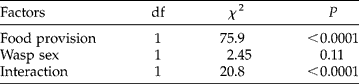
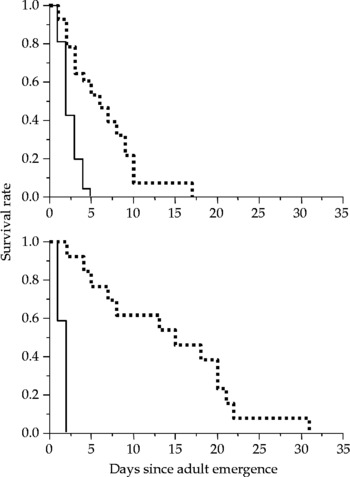
Longevity of adult H. varicornis was significantly increased by ingestion of diluted honey (Table 1). Most of the adults died within 2 days after emergence when only water had been provided (Fig. 1). The mean longevity ( ± SD) was 2.06 ± 0.62 and 1.58 ± 1.80 days for males and females, respectively. The survival analysis revealed that the difference was significant (χ2 = 7.80, P = 0.006). Provision of diluted honey increased the mean longevity in females from 1.58 ± 1.80 to 14.31 ± 1.74 days and in males from 2.06 ± 0.62 to 6.39 ± 0.60 days (Fig. 1). In the presence of diluted honey, females lived significantly longer than males (χ2 = 13.1, P = 0.0003). In addition, interaction between food provision and wasp sex was highly significant (Table 1), indicating that female H. varicornis benefited more by feeding on diluted honey than did male H. varicornis.
Effects of carbohydrate food on the longevity of male and female Hemiptarsenus varicornis +
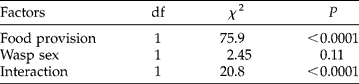
+ The model derived from a parametric survival analysis assuming Weibull distribution, and was highly significant (df = 3, χ2 = 108.0, P < 0.0001). When interaction was not included, wasp sex was significant (P = 0.043).
Survivorship curves for male (above) and female (below) Hemiptarsenus varicornis when fed diluted honey (dashed line) or water only (solid line) throughout their lifetime

Resource-storing capacity
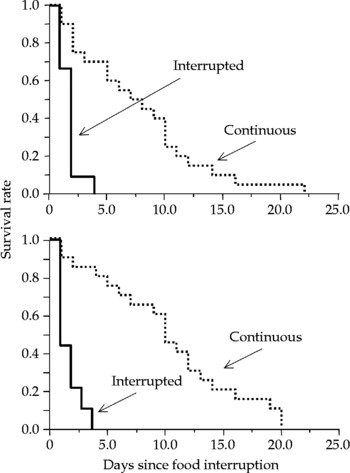
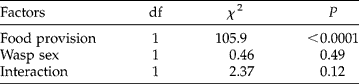
The ability of adult H. varicornis to store nutrients was poor. Adult male and female wasps reared for 4 days with honey solution died within 2 days after the provision of honey solution had ceased (Fig. 2). Males and females lived for 7.5 ± 5.4 and 10.1 ± 5.9 ( ± SD) days, respectively, when they had continuous access to diluted honey. However, they lived only 1.76 ± 0.94 and 1.58 ± 0.90 days, respectively, following the withholding of diluted honey (Fig. 2). Interruption of food greatly reduced the life expectancy of adults but there was no significant effect of wasp sex or interaction between the factors (Table 2).
Survivorship curves for male (above) and female (below) Hemiptarsenus varicornis when fed diluted honey for 4 days and water only during the remainder of their lives (solid line). The dashed lines indicate the control (continuous provision of diluted honey until death)

Longevity of male and female Hemiptarsenus varicornis as influenced by their nutrient-storing capacity+
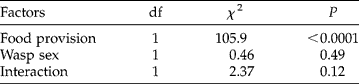
+ The model was highly significant (df = 3, χ2 = 116.3, P < 0.0001). When interaction was not included, wasp sex was not significant (P = 0.46).
Discussion
Adult food and longevity
The results of this study indicate that adults of H. varicornis rely on ingestion of sugar-rich foods for maintaining their metabolic activities. Both male and female H. varicornis died within 2 days after emergence when only water was available whereas their longevity was extended greatly when diluted honey was provided (Fig. 1). Because female parasitoids died shortly after emergence, it was impossible to examine the number of eggs female H. varicornis could lay (because of its synovigenic nature, the female requires at least 1 or 2 days to start oviposition). Honey is a suitable food source for many parasitoids; honey as a food supplement can increase the survival and reproductive lifetime (e.g. Morales-Ramos et al., Reference Morales-Ramos, Rojas and King1996; Harvey et al., Reference Harvey, Harvey and Thompson2001; Siekmann et al., Reference Siekmann, Tenhumberg and Keller2001). Similarly, sucrose would be a good source of food for H. varicornis.
The effect of honey ingestion on longevity was much greater in female than in male H. varicornis (Table 1). However, in the absence of appropriate food sources, female longevity was less than 2 days and nearly equal to male longevity (Fig. 1). The female H. varicornis thus benefits more by feeding on diluted honey than does the male. Adult lifetime of less than 2 days would be insufficient for successful reproduction, though the duration of longevity necessary for successful reproduction may be different between the sexes.
Resource-storing capacity
Food-deprived H. varicornis died within 2 days (Fig. 2). These results indicate that the parasitoid has a poor ability to survive if no food is available. This means that male and female H. varicornis have a limited capacity for storing food reserves, and need regular access to food throughout their lifespan. The present study suggests that sources of non-host food should always be available in the environment to maximize the reproductive success of H. varicornis.
The present result contrasts with the result obtained for the braconid Macrocentrus grandii Goidanich, a larval parasitoid of the European corn borer. Fadamiro and Heimpel (Reference Fadamiro and Heimpel2001) have shown that adult M. grandii has a relatively high capacity for storing nutrients and hence a constant supply of carbohydrate food is not necessary to achieve maximum survivorship. In another braconid wasp, Cotesia rebecula (Marshall), the storing capacity appears to be limited, and the wasp has to find food every day to avoid starvation (Siekmann et al., Reference Siekmann, Tenhumberg and Keller2001). Thus nutrition-storing capacity of parasitoids may vary from species to species; the importance of non-host food in biological control would depend on this capacity.
Adult food and biological control in greenhouses
In Japan, H. varicornis often increases its population in tomato greenhouses and becomes the predominant parasitoid of leafminers (Ozawa et al., Reference Ozawa, Saito and Ota2001). Therefore, this parasitoid is an ideal agent for controlling L. trifolii and other dipteran leafminers in greenhouses. However, the released H. varicornis will periodically search for non-host food sources though little is known about what kind of non-host food sources are appropriate for leafminer parasitoids in a greenhouse environment.
Although nectar is an important food source for many parasitoids (Jervis et al., Reference Jervis, Kidd and Heimpel1996; Jacob and Evans, Reference Jacob and Evans2001; Wäckers, Reference Wäckers2004; Heimpel and Jervis, Reference Heimpel, Jervis, Wacker, van Rijn and Bruin2005; Bernstein and Jervis, Reference Bernstein, Jervis, Wajnberg, Bernstein and van Alphen2008), it is unclear whether flowers of greenhouse crops could provide nectar. Provisional plants that secrete nectar via flowers, extrafloral nectar glands or trichomes may be better suited for providing nutrients to parasitoids in greenhouses (Olson and Nechols, Reference Olson and Nechols1995; Stapel et al., Reference Stapel, Cortesero, De Moraes, Tumlinson and Lewis1997). To date, the importance of such plant-derived food has not been evaluated for biological control of leafminers in greenhouses using parasitoids, but plant-derived materials are likely to be a food source. Thus more attention should be given to integrating plants with floral and extrafloral nectar in greenhouses when crops are not a source of non-host food.
Alternatively, honeydew provided by aphids or whiteflies may be a food source for leafminer parasitoids. A number of studies have indicated that aphid honeydew may be most important to parasitoids when flower nectar is not available (Elliott et al., Reference Elliott, Simmons and Sapio1987; Idoine and Ferro, Reference Idoine and Ferro1988; Stapel et al., Reference Stapel, Cortesero, De Moraes, Tumlinson and Lewis1997). If this is the case, complete suppression of aphids and whiteflies might result in decreased efficacy of leafminer parasitoids. Like dipteran leafminers, aphids and whiteflies are commonly serious pests in greenhouses. Hence the concurrent presence of aphids or whiteflies may determine the success of leafminer biocontrol, though this would be counterproductive from a grower's perspective. Thus the presence of homopteran pests at moderate densities may be favourable though this idea may not be acceptable for growers because of the rapid rate of population growth of these pests. Alternatively, non-pest homopterans could be reared on their respective host plants in greenhouses. Another practical approach to provide food for parasitoids is to plant flowering plants that provide nectar. In any case, the importance of food sources in greenhouses needs to be assessed in future studies.
Acknowledgements
We thank Dr A. Ozawa (Shizuoka Agricultural Experimental Station) and Dr E. Yano (National Agricultural Research Centre) for providing us with H. varicornis, and Dr K. Ohno (Miyazaki University) for the supply of L. trifolii. This work was supported by grants from the Ministry of Education, Sciences, Sports and Culture of Japan (no. 13760039 and 15208007). We also thank two anonymous reviewers for their helpful comments, which improved our manuscript.