I. INTRODUCTION
An interesting field in industrial measurement setups is measuring distances within a waveguide or structures with similar propagation conditions. Such systems can be used to observe the piston position of a hydraulic cylinder [Reference Ayhan, Scherr, Pauli and Zwick1] or to probe fluid levels within tanks [Reference Denicke, Armbrecht and Rolfes2] and should be capable of remote sensing due to the harsh environment, e.g. strong vibrations or corrosive media.
Alternative solutions to obtain the often required accuracies down to a few tens of micrometers' are laser-based systems, which come with the drawbacks of high costs and a short continuous measurement range. Another possibility is the use of frequency modulated continuous wave (FMCW) radar systems, but at the addressed application of waveguide measurements the problem of dispersion arises, and leads to challenging difficulties for FMCW-based systems [Reference Ayhan, Scherr, Pauli and Zwick1, Reference Pohl, Gerding, Will, Musch, Hausner and Schiek3, Reference Denicke, Armbrecht and Rolfes4]. A second problem with such systems is the required measurement time due to the time needed for the frequency ramp and the following calculations, leading to a measurement system with a high latency and low update rate, which can be critical within the often fast servo loops at industrial applications.
Therefore, the proposed system utilizes a low-cost Six-port-based radar, which analyses the phase to distinguish the distance. The major problem of such systems – the ambiguity – is eliminated using two discrete frequencies and the resulting beat phase between them. The possibilities and limits in measurement speed and accuracy of this dual tone approach will be explained by system simulations and an appropriate measurement setup using a 24 GHz ISM-band capable Six-port receiver system.
This publication is an extended version of [Reference Lindner, Barbon, Linz, Mann, Weigel and Koelpin5], presented at the 11th European Radar Conference in Rome, 2014. The extension comprises the study of several limitations of the system due to noisy oscillator, insufficient isolation within the front-end, and multiple targets.
II. THE SIX-PORT-BASED RADAR
Introduced to measure complex voltage ratios [Reference Hoer and Roe6] and as an alternative solution for power metering and vectorial network analysis [Reference Engen7] in the seventies, the Six-port network nowadays receives attention in the field of angle-of-arrival as well as distance and vibration measurement purposes [Reference Vinci, Lindner, Barbon, Weigel and Koelpin8–Reference Moldovan, Tatu, Gaman, Wu and Bosisio10]. This is due to the fact that the Six-port has shown a high phase linearity and accuracy in comparison to common mixer designs.
A) System concept
While commonly used FMCW-based radar system measure a beat frequency to distinguish the distance to the target, the proposed Six-port-based system evaluates the distance dependent phase of the reflected wave at the target. With this technique, there is no need for a time-consuming fast Fourier transformation (FFT), which leads to a fast responding, low-latency system. The drawback that only a single target can be tracked can often be neglected if there is only a single dominant reflection, as at the addressed applications.
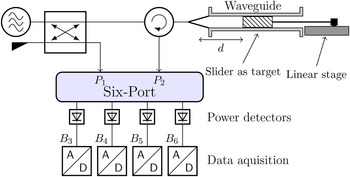
The sketch of the proposed radar system is shown in Fig. 1. A frequency-adjustable CW signal is fed into a coupler, where a small portion is fed as a phase reference into the first input port of the Six-port P 1. The remaining signal power is coupled to the waveguide structure, reflected by the target and guided to the Six-port's second input port P 2. A circulator is required to divide the received and transmitted signals, because they have to share the same waveguide feed.
Measurement setup for waveguide-based distance evaluation.

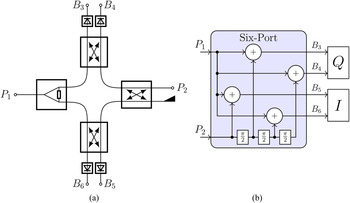
The core of the system, the Six-port interferometer, can be understood as a homodyne IQ-mixer with differential base band output signals B
3 to B
6, forming the base band signal
 $\underline z $
[Reference Vinci, Lindner, Barbon, Weigel and Koelpin8]:
 $$\underline z = \lpar B_5 - B_6 \rpar + j\lpar B_3 - B_4 \rpar .$$
This vector is generated by a cost-efficient and passive structure shown in Fig. 2(a). A Wilkinson power divider and three hybrid couplers superimpose the two input signals P
1 and P
2 with discrete phase shift of 0°, 90°, 180°, and 270°. The resulting interfered signals are converted to base band by diode power detectors forming the differential complex vector
 $\underline z $
. To clarify the phase relations, they are depicted in Fig. 2(b).
Implemented Six-port structure (a) and phase relations (b).

B) Distance calculation
In the context of a Six-port radar, the distance d of a target can be evaluated if the used transmission frequency f
RF
is known and the phase of the complex vector
 $\underline z $
has been determined:
 $$d = \Delta \sigma \cdot \displaystyle{c \over {2 \cdot 2\pi \cdot f_{RF} }}\quad \hbox{with}\; \Delta \sigma = \arg \lcub \underline z \rcub .$$
As in common interferometric approaches, the problem of ambiguity in phase arises, limiting the unambiguous measurement range to half of the wavelength of the used frequency. This ambiguity can be eliminated by measuring the phase difference (Δσ 1, Δσ 2) for two tones (f 1, f 2) with a spacing of f B between them as shown in [Reference Lindner, Barbon, Vinci, Mann, Weigel and Koelpin11]. Calculating the difference between the two phase responses, an absolute, coarse distance d coarse can be evaluated:
 $$d_{coarse} = \Delta \sigma _B \cdot \displaystyle{c \over {2 \cdot 2\pi \cdot f_B }}\quad \hbox{with}\; \Delta \sigma _B = \Delta \sigma _1 - \Delta \sigma _2 .$$
After the determination of this coarse distance information, the period of unambiguity is known and an additional high precision distance evaluation based on the two single tones can be done using (2) leading to a micrometer accuracy distance value, which is unambiguous within a range of d max :
 $$d_{max} = \displaystyle{c \over {2 \cdot f_B }} = \displaystyle{c \over {2 \cdot \lpar f_2 - f_1 \rpar }}.$$
C) Waveguide propagation related corrections
A problem arises if the measurement takes place in an enclosed system, e.g. to detect the position of a reflecting target within a waveguide, as the dispersion has to be considered. Due to the field propagation within a waveguide structure, the wavelength λ w of a transmitted signal within the waveguide depends on the cut-off frequency f c of the used mode and the free space wavelength λ 0 = c/f of the transmitted signal:
 $$\lambda _w = \lambda _0 \displaystyle{1 \over {\sqrt {1 - \lpar {f_c /f} \rpar ^2 } }}.$$
This equation can be simplified by assuming single mode transmission, e.g. by using a standardized waveguide within its specification. In this case λ w depends only on the geometrical width a of the used waveguide and λ 0:
 $$\lambda _w = \displaystyle{{\lambda _0 } \over {\sqrt {1 - \lpar {\lambda_0 /2a} \rpar ^2 } }}.$$
It is obvious that the wavelength λ w has a nonlinear relation to λ 0 for free space. Therefore, the beat frequency f B has to be calculated from the wavelengths of the single tones λ w1, λ w2 within the waveguide:
 $$f_{B\comma w} = \displaystyle{{\lambda _{w1} - \lambda _{w2} } \over {\lambda _{w1} \cdot \lambda _{w1} }} \cdot c.$$
Furthermore, the unambiguous distance measurement range inside the waveguide d max,w , which depends on f B,w is limited in this case to
 $$d_{max\comma w} = \displaystyle{c \over {2 \cdot f_{B\comma w} }}.$$
A few examples of possible unambiguous ranges at free space propagation as well as within the waveguide are provided in Table 1. While at the single tone setup the range is limited by the used RF wavelength, in the case of a dual tone system the unambiguity range can be calculated according (4) and within the waveguide setup according (8), respectively.
Unambiguous ranges for different frequency spacings with a center frequency of 24 GHz at free space propagation (no index) and waveguide conditions (index w).

III. SYSTEM LIMITATIONS
Although the proposed system shows benefits against the comparable solutions, it has to deal with several problems. Therefore, the influence of the radar coupler, the oscillator and noise will be discussed in the following.
A) Isolation of the radar coupler
Like in all radar-based systems, the isolation between the transmitted and received signal acts as a strong interferer in detection of the correct target position. A similar effect is caused by the often poor matching of the antenna, which also introduces a static reflection in the receive path superimposing the signal from the target. These effects can be reduced by using a bi-static setup with two antennas, but this is not feasible within the shown setup due to the waveguide-transition.
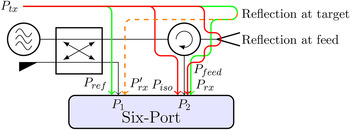
The main paths of transferred power within the system are depicted in Fig. 3. Besides the desired signals P ref and P rx at the Six-port there is also a strong static signal P iso caused by low directivity of the circulator and a second static signal P feed due to insufficient matching of the feeding structure. Both of these disturbing signals are even higher, if an additional LNA exists between the circulator and the Six-port's input P 2. The parasitic target reflection P′ rx can be neglected due to high dampening in this path. Secondary static targets or reflections due to the environment are also neglected for simplicity. Nevertheless, they behave like P feed , thus they can add to P feed , if it is necessary to consider them due to their high radar cross section.
Paths of RF power distribution.

However, as long as the static parasitic reflections do not depend on the target position, they will produce only a static complex offset
 $\underline z _o $
added to the target's signal
 $\underline z _T $
at the base band constellation diagram. The measured value will be in this case:
 $$\underline z ^{\prime} = \underline z _o +\underline z _T .$$
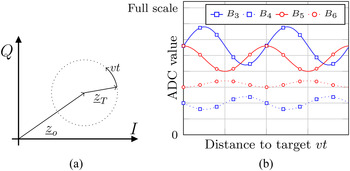
This behavior is shown in Fig. 4, where an offset effected signal from a moving target is plotted. The target is moving with a constant velocity v, forming a circle in the constellation diagram. To calculate the distance out of the phase, the offset vector
 $\underline z _o $
can be removed by a simple complex valued subtraction.
Complex IQ result (a) calculated from base band signals (b) with offsets due to isolation issues observing a moving target.

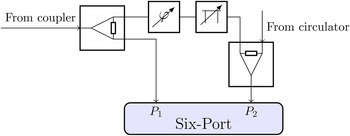
The offset vector can easily be measured and digitally compensated if the target moves more than half of the used wavelength, but the offset will significantly decrease the dynamic range of the digitization. Alternatively, this can be done analogously by adding a signal with an appropriate power and phase to the received signal at port P 2, which compensates the sum of P iso + P feed . Such systems can be implemented using a variable attenuator and phase shifter, depicted in Fig. 5, to compensate also a slow changing environmental clutter. But this implementation is difficult, because the regulation of phase and amplitude of the compensation signal has to be very accurate and stable. Therefore, the preferable way is to suppress this offset by a sophisticated RF design, e.g. to consider both the isolation issue and the antenna feed reflection to compensate for each other, or to use the static reflection as a bias signal for the detectors to equalize the gain imbalance within the Six-port junction. Simplified systems, e.g. [Reference Yang, Kim and Hong12] or [Reference Kim, Kim, Lee, Kho and Yook13], based on the same feed-forward idea are already studied and measured but only capable of compensating the isolation P iso .
Variable feed-forward compensation structure to reduce offsets.

B) Oscillator influences
For radar-based distance measurements, the phase noise of the used oscillator has to be considered. The resulting root mean square (RMS) error can be calculated, according to Parseval's theorem, by integrating the phase noise density spectrum in the used bandwidth. However, this result is only correct, if the transmitted and received signals are completely uncorrelated. Here, it can be shown [Reference Budge and Burt14] that there is a range correlation effect, which has a high-pass characteristic and suppresses the phase noise density more than 100 dB for low offset frequencies.
Considering this effect, the RMS phase error σ err can be calculated depending on the phase noise spectrum of the used oscillator, the distance to the target and the used base band bandwidth f bw :
 $$\sigma _{err} = \sqrt {\int_0^{f_{bw} } 2 \cdot \underbrace {{\cal L}\lpar f\rpar }_{{\rm Phase}\, {\rm noise}} \cdot \underbrace {4\mathop {\sin }\nolimits^2 \left({\displaystyle{{2d\Delta f} \over c}} \right)}_{{\rm Range}\, {\rm correlation}}\hbox{d}f} .$$
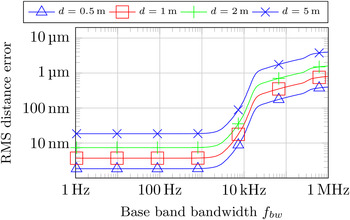
Figure 6 shows the evaluation of (10), mapped to a distance error, for different target distances over the used base band bandwidth. The underlying phase noise density originates from a phase-locked loop (PLL) stabilized 24 GHz Silicon Radar voltage controller oscillator measured with a Rohde & Schwarz FSUP26 spectrum analyzer at offset frequencies between 0.1 Hz and 1 MHz.
Distance error due to oscillator's phase noise depending on the used base band bandwidth.

Although the overall accuracy of the system is limited to the error in the single tones, the phase noise does not influence the performance of the system, as the error is below 1 µm at least for measurement distances of only a few meters.
However, the used frequencies have to be known precisely, otherwise there will be a significant error in the measurement. Nevertheless, the required accuracies can easily be achieved using a PLL stabilized oscillator with a stable quartz reference.
C) Limit of unambiguity solution
The shown equation can lead to the assumption that huge unambiguity ranges can easily be achieved by using two narrow spaced RF signals. However, for narrow frequency spacings between the two tones f B the slope of the transfer function ∂d/∂σ B becomes very flat and therefore susceptible for noise.
To clarify this circumstance, simulations were done to investigate the effect of noise at different frequency spacings. Therefore, white Gaussian noise was added to the signals before calculating the coarse distance information between the two signals. The error of this calculation has to be lower than a quarter of the larger single wavelength to distinguish the correct ambiguity range for the fine distance evaluation in a second step.
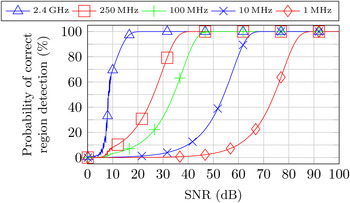
Figure 7 shows the simulation results of the system using different frequency spacings f B from 1 MHz to 2.4 GHz at different noise levels which are expressed by the signal-to-noise ratio (SNR). The graph shows the probability for an error lower than it is necessary for a correct determination of the unambiguous region. This probability should be nearly at 100% to develop a usable system. For a bandwidth of 250 MHz, as used in the proposed system achieving an unambiguous range of 50 cm, this means an overall SNR of lower than 40 dB. To achieve reliable measurements in ranges larger than 10 m, an SNR larger than 65 dB has to be reached. The results for the SNR values lower than 10 dB have to be ignored due to mathematical errors within the simulation environment.
Simulation results of the usability of the dual tone setup with the influence of additive white Gaussian noise.

The shown considerations are only based on noise effects. Additional errors caused for example by multiple target scenarios or non-linearities have to be taken into account separately. While non-linearity errors can be removed using a calibration, the system is not capable of observing multiple moving targets. However, if they are static, they introduce a removable static offset, described in the Section III-A).
IV. TIMING CONSIDERATIONS
The proposed system has the capability of very high measuring rates, as there is neither a time consuming algorithm, nor long acquisition times for an accurate FFT needed. The mainly time consuming parts for the Six-port radar are to settle the PLL between the frequency steps, to digitize the values, and to calculate the distance value from the phase responses. While the digitizing and calculations can be easily optimized by using fast CPUs, the PLL settling time is difficult to minimize.
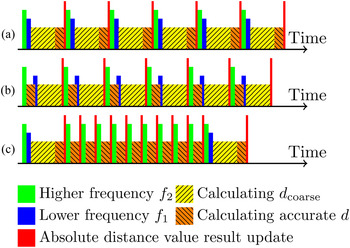
Nevertheless, this system is capable of high speed measurement value update rates. In Fig. 8 timing (a) shows the normal operation. At first, the two single phases are measured, later the coarse and the accurate fine evaluations are processed. This has the advantage of minimum latency between the two measurements. Therefore, there is no influence due to a moving target between the measurements, which would lead to an error in distance evaluation. In contrast, timing (b) offers a possibility to use the PLL settling time between the two frequencies to calculate the accurate but ambiguous distance, while the coarse distance is evaluated after measuring the second tone. This decreases the latency of the whole measurement procedure by removing idle times.
Different measurement timing strategies for the proposed system.

Surely, it is also possible to perform the coarse evaluation less frequently, as in timing (c), e.g. only when initializing the system, and following the phase jumps by remembering the old distance values. In measurement scenarios, as the one described here, where no mechanical target jumps are possible, this is the fastest way to determine the distance. In this case it is also possible to follow targets moving with a very high velocity without getting in trouble using the dual tone concept.
At this initial setup timing (a) is used, because the measurement latency is limited by the PC-based control anyway. In the next step, the controlling and processing will integrated into a microcontroller to measure the improvements between the different timing strategies.
V. MEASUREMENT RESULTS
For concept validation a measurement setup at 24 GHz was built and its results show the convincing performance of the system.
A) Measurement setup
An Agilent E8267D signal generator was used as synthesizer to obtain the two accurate frequencies f 1 and f 2. Nevertheless, other low cost synthesizer based systems have shown similar accuracies [Reference Mann, Lindner, Lurz, Barbon, Linz, Weigel and Koelpin15], revealing that there is no need for a highly stable source and proving the described phase noise influences. The target is positioned by a PiMicos linear stage, which can move 15 cm in steps of 0.5 µm. Due to its very precise optical encoder, the stage is also used as position reference for all shown measurements.
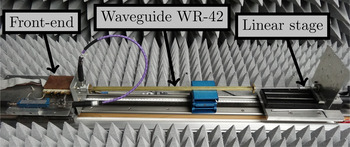
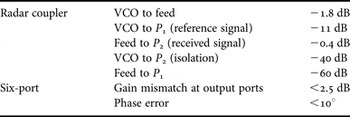
The Six-port front-end, whose main parameters are summarized in Table 2, is connected by a coaxial-to-waveguide adapter to the 24 GHz capable waveguide type WR-42 shown in Fig. 9. The used waveguide has a length of 1 m and the measurements were performed in the middle of the structure over the entire length of the stage of 15 cm to provide realistic results.
Measurement setup.

Measured parameters of the used front-end.

The data were acquired at a rate of 400 kSa/s after a 8th order Butterworth low pass filter with a cut-off frequency of 50 kHz. The digitized data are transferred to a PC, where the data processing is done with Matlab to simplify the development of the algorithms. In future, the whole calculations will be implemented within a micro-controller to achieve a low-cost, low-power and low-latency signal processing.
B) Measurement results
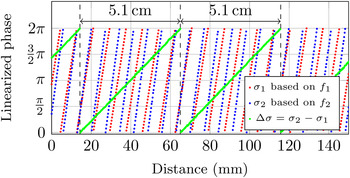
Figure 10 shows the linearized single phase and corresponding beat phase responses at 24 GHz with a spacing of 2.4 GHz. The shortened wavelength of the beat frequency, compared to the free space setup, is clearly visible. Two beat frequency periods are recognizable with a spacing of 5.1 cm corresponding to the value in Table 1.
Linearized phases for waveguide measurements at 24 GHz and a frequency spacing of f 1 − f 2 = 2.4 GHz.

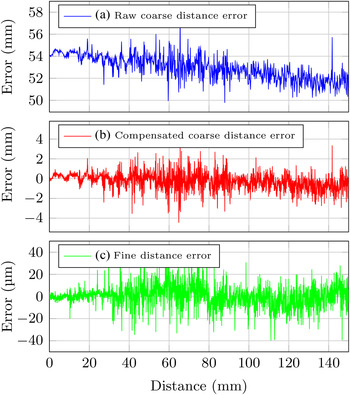
From these phase responses, it is possible to detect the ambiguity period of the phase measurement for a single frequency and thus to give an accurate distance information. The results are plotted in Fig. 11 for the first ambiguity period, i.e. the interval from about 15 to 65 mm. Due to the high accuracy of the system, the error calculated with respect to the reference system is directly shown. The first plot (a) shows the coarse distance evaluation results for the beat frequency without any compensation or offset correction. The small offset and gain error is compensated in the second plot (b), while in (c) the fine distance evaluation error of one of the single tones is displayed. This is calculated by searching for the correct period of ambiguity in the coarse distance and adding an appropriate offset to the distance evaluation based on a single tone as shown in [Reference Barbon, Vinci, Lindner, Weigel and Koelpin16]. The error is below ±25 µm exceeding the accuracy for FMCW, e.g. shown in [Reference Ayhan, Pauli, Kayser, Scherr and Zwick17], where a bandwidth of 1 GHz is used achieving a maximum error of 150 µm.
Waveguide-based distance measurements at a frequency spacing of 2.4 GHz within the first ambiguity period of the beat frequency.

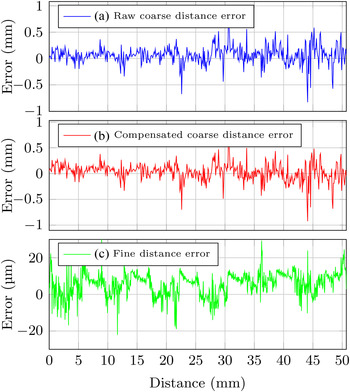
To provide an ISM conform and long range capable measurement, a second evaluation with a frequency spacing of only 250 MHz was done. According to Table 1 this leads to an unambiguous range of approximately 50 cm, although the measurement is limited by the stage to only 15 cm. The results are shown in Fig. 12. Caused by the smaller bandwidth, this measurement has significantly higher errors at the coarse distance detection. In (a) the raw coarse distance evaluation for the beat frequency can be observed. The offset error here is caused by the start position of the measurement, while the gain error can have different influences, e.g. an erroneous calculation of λ w .
Waveguide-based distance measurement with ISM conform bandwidth of 250 MHz.

Nevertheless, these linear errors can easily be removed and the resulting compensated coarse distance error in (b) is below a quarter of the value of the single tone wavelengths. Therefore, a fine distance evaluation based on the single phases is possible. The results of this evaluation are shown in Fig. 12(c). Here, the error is higher than for the first measurement, but still below ±40 µm over the whole distance range. The high noise, especially in the mid range, is probably caused by mechanical friction between the slider in the waveguide used as target and the wall of the waveguide, as the error is significantly lower at the beginning of the waveguide within the first distance values.
C) Statistical analysis
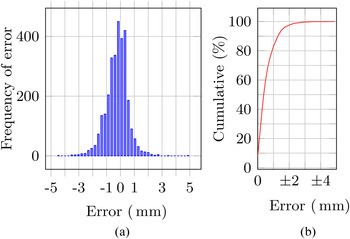
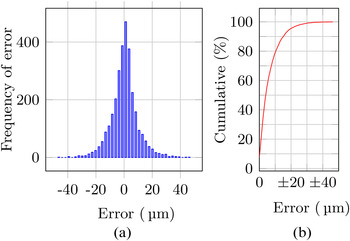
For a better comparison with other systems, Figs 13 and 14 show a statistical analysis of the coarse distance error and the overall error, respectively. In both plots (a) depicts a histogram of the achieved error, while (b) shows the cumulative histogram of the absolute value. To distinguish the region for the fine distance evaluation, an error lower than a quarter of the used RF wavelength has to be ensured. Here, this was achieved for more than 99.9% of all measurements. The slight mean error in Fig. 13(a) is due to an imperfect gain correction (see Fig. 12(b)), but it has no influence to the overall system accuracy as long as the error is below a quarter of the used RF wavelength, because the coarse distance is only used to detect the period of unambiguity.
Histogram of coarse distance detection (f B = 250 MHz).

Histogram of fine distance detection (f B = 250 MHz).

The statistical analysis of the fine distance evaluation is shown in Fig. 14. The cumulative frequency of measurements yielding an error lower then ±35 µm is more than 99.73%, i.e. within the 3σ range. More than 75% of the measurement errors are even lower than ±10 µm.
VI. CONCLUSION
In this publication a concept for high precision waveguide-based distance measurements has been presented. The system is based on an interferometric Six-port radar principle, whose unambiguity was realized by a dual tone approach. Measurements in the 24 GHz ISM band prove the theory and show the feasibility of the concept. The precise distance calculation within the waveguide setup shows an error of only ±35 µm (3σ) while providing an absolute, unambiguous measuring range of about 50 cm at an ISM conform frequency spacing of 250 MHz. Several points of limitations of the system were discussed, which establishes further opportunities to optimize the system's performance.
Using the proposed system, it is possible to achieve a low-cost and low-latency setup for measuring distances with micrometer accuracy at high update rates, e.g. for tank level monitoring or hydraulic piston control.
 Stefan Lindner was born in Kulmbach, Germany, in 1985. He received his diploma in Mechatronics in 2011 at the University of Erlangen-Nuremberg, Germany. Since 2012 he is with the Institute for Electronics Engineering, University of Erlangen-Nuremberg, Germany, conducting his Ph.D. studies on research topics related to innovative radar technology based on the six-port receiver. Primarily he is working with system simulation, baseband design as well as digital signal processing. He received the first Prize in Student Challenge at the European Microwave Week 2012 in Amsterdam. In 2013 he won the SEW-Eurodrive diploma prize for his diploma thesis.
 Francesco Barbon was born in Padova (Italy) in 1985. He successfully concluded in 2008 his Bachelor of Science in Telecommunications at the Department for Electronics and Informatics of the “Università degli Studi di Padova”. In 2011 he obtained his Master of Science in Telecommunications after his work conducted in the Institute for Electronics Engineering at the University of Erlangen-Nuremberg, Germany. At present, Francesco is working as a Research Assistant at the same institute on high-resolution industrial radar sensors based on the six-port interferometer technique.
 Sarah Linz received her B.Sc. and M.Sc. degrees in Electrical, Electronics and Communication Engineering from the Friedrich-Alexander-University Erlangen-Nuremberg, Erlangen, Germany, in 2010 and 2012, respectively. In 2013, she joined the Institute for Electronics Engineering, Friedrich-Alexander-University of Erlangen-Nuremberg, as a Research Assistant. Her research interests include RF and millimeter-wave circuits for high-precision displacement sensors and six-port technology. Mrs. Linz is student member of the German Association for Electrical, Electronic and Information Technologies (VDE) since 2008 and student member of the IEEE since 2013.
 Sebastian Mann was born in Nuremberg (Germany) in 1987. He received his diploma in Electrical Engineering in 2012 at the University of Erlangen-Nuremberg, Germany. Currently he is working as a research assistant at the Institute for Electronics Engineering, University of Erlangen-Nuremberg. His research interests are in the area of microwave circuits and components design. At present, he investigates on high precision 61 GHz radar sensors for industrial applications. Meanwhile he is also working on different industrial projects based on the six-port interferometer technique.
 Robert Weigel was born in Ebermannstadt, Germany, in 1956. He received his Dr.-Ing. and Dr.-Ing.habil. degrees in Electrical Engineering and Computer Science from the Munich University of Technology, Munich, Germany, in 1989 and 1992, respectively. From 1982 to 1988, he was a Research Engineer, from 1988 to 1994, a Senior Research Engineer, and from 1994 to 1996, a Professor of RF circuits and systems with the Munich University of Technology. In winter 1994/1995, he was a Guest Professor of SAW technology with the Vienna University of Technology, Vienna, Austria. From 1996 to 2002, he has been Director of the Institute for Communications and Information Engineering at the University of Linz, Austria. In 2000, he has been appointed a Professor for RF Engineering at the Tongji University in Shanghai, China. Since 2002 he is head of the Institute for Electronics Engineering at the University of Erlangen-Nuremberg, Germany.
 Alexander Koelpin received his diploma in Electrical Engineering in 2005 and his doctoral degree in 2010 both with the University of Erlangen-Nuremberg, Germany. Currently he is working toward his venia legendi. Since 2005 he is with the Institute for Electronics Engineering, Friedrich-Alexander University of Erlangen-Nuremberg, Germany, and since 2007 team leader Circuits, Systems and Hardware Test. His research interests are in the areas of microwave circuits and systems, wireless communication systems, local positioning, and six-port technology.