‘Yes to Europe, no to Maastricht!’ This statement, and many others like it, rose from the podiums of radical right and far left parties in the mid-1990s. While the radical right and far left may have had different reasons for opposing the Treaty on the European Union (the Maastricht Treaty), they both took up this position in opposition to what many scholars have dubbed a pro-integration consensus among mainstream political parties.Footnote 2 Meanwhile, in many member states of the EU, portions of the electorate were becoming increasingly concerned with the level of integration implied in successive EU treaties, while the mainstream parties were maintaining or increasing their support for integration, despite qualitative changes in its nature. When radical right or far left parties took up anti-integration positions, it appears that they met the demand in that share of the electorate for this policy position.Footnote 3 What is clear is that the share of the electorate voting for these parties, particularly the radical right, increased in a number of member states in the post-Maastricht era.
Can we link this increased public animosity towards the EU integration project to the increase in voting for anti-integration parties? If so, then perhaps we can speak of an ‘integration effect’ that had an impact on the fortunes of previously less-than-successful radical right and far left parties. In this article, I will examine the claim that these extremist political parties benefited electorally from the controversy associated with Maastricht Treaty provisions and the pro-integration consensus among mainstream parties.
In order to examine this claim, I present a theoretical model that explains how the integration effect would have transpired (Figure 1). The theoretical model integrates three alternative approaches to explaining extremist party success found in the existing comparative politics literature; these include demand-side, political opportunity space and supply-side explanations.Footnote 4 The examination of demand-side factors focuses on the changes brought about by the Maastricht Treaty, shifting the EU's policy authority from ‘low’ to ‘high’ politics and triggering an end to the ‘permissive consensus’. This probably increased electoral demand for an anti-integration alternative to the pro-integration mainstream parties.
The Integration Effect Model

This is followed by an examination of the political opportunity space in which radical right and far left parties operated; the positions of the mainstream parties on EU integration had an effect on the radical right and far left parties' abilities to capitalize on public discontent, and as such their positions are compared to radical right and far left party positions through a mapping of party positions on integration. Finally, the last step in the theoretical model incorporates supply-side explanations for extremist party success. If there was an opening in the political space for extremist parties to exploit, did they move to occupy it? The differences between positions taken up by these parties and the differences in their electoral successes will provide an interesting insight into the integration effect and extremist parties' abilities to take advantage of it.
I use matrices and political opportunity space maps to determine the plausibility of the theoretical model. I find that in more than a majority of the elections examined, radical right or far left parties increased their national vote in circumstances fitting the theoretical model: mainstream parties had converged on a pro-integration consensus, leaving an opening for radical right and far left parties. Under these circumstances the parties that successfully signalled their opposition to integration saw an increase in their vote shares, while radical right and far left parties that took pro-integration positions mostly saw a decrease in their vote share; this did depend, however, on an increased level of Euro-scepticism in the electorate. There are some exceptions to these trends; alternative explanations examined here include extremist party factions, mainstream party scandals and cultural considerations.
EXTREMIST PARTY SUCCESS: EXISTING EXPLANATIONS FOR VOTER AND PARTY BEHAVIOUR
A rich literature exists on the nature and electoral fortunes of European radical right parties. This literature proposes a number of reasonable explanations for the success of these parties, but contradictory findings plague the efforts to use any one approach to explain the success or failure of the radical right. These are typically described as demand-side and supply-side explanations.Footnote 5 Each of these explanations will be discussed briefly, with a summary of the findings of previous scholarly studies. These explanations prove essential to constructing the holistic theoretical model used in this research project. As such, reviewing this literature is also useful for the purposes of understanding the separate components of the model. While the explanations summarized here come from a literature that focuses on the radical right, these explanations are equally useful in attempting to understand the ways in which far left parties could gain ground in the post-Maastricht era. In many states, the far left's appeal bears a surprising resemblance to the radical right, particularly on issues such as concerns about employment and workers' rights, which both the radical right and far left tend to couch in terms of the rights of their citizens versus those of immigrants. Far left parties also often draw a connection between these job concerns, immigration and the EU. Thus, both types of party have the potential to benefit from a pro-EU mainstream party consensus and a public backlash against deeper integration; as a result, the model should be applicable to both types.
Demand-side hypotheses are typical of earlier academic work on the new radical right and are also the most typical explanations found on the ground in states where the radical right has popular support. Demand-side theses often focus on the effects of postindustrial society on certain elements of the electorate. The logic behind this hypothesis is that radical right parties are simply meeting the demand for an alternative party that can address the hazards of postindustrial society.Footnote 6 This line of argument indicates that support for the radical right should be found among the ‘losers’ of postindustrial society: those who have borne the brunt of ‘socioeconomic dislocation due to a structural change in production systems, the internationalization of economic competition, and the crisis of the welfare state’.Footnote 7 Variables examined include immigration, unemployment and a perceived threat to cultural homogeneity brought on by globalization. These elements are often included in the rhetoric of radical right and far left parties, providing substance to the idea that these parties may be benefiting from voters' concerns with economic dislocation or cultural heterogeneity. ‘Two million immigrants equals two million unemployed Frenchmen’ is a rallying cry for the French Front National (FN), and this sentiment finds an echo in many other radical right and far left parties.Footnote 8
A great deal of survey work has been dedicated to testing demand-side hypotheses. The support for this thesis has been mixed, however. While some find that high immigration rates are positively correlated with votes for the radical right,Footnote 9 others have found that there was no correlation between these variables.Footnote 10 Mixed results also appear for unemployment variables, with some studies finding support for a correlation between unemployment and radical right vote share,Footnote 11 while others find that the relationship is actually negative.Footnote 12 Finally, some have found support for the notion that the unemployment and immigration variables must interact in order to create support for the radical right.Footnote 13
Some recent literature regarding radical right parties has worked to address the supply side of the equation. There are a number of elements of supply-side explanations that are useful here. The most basic is the policy platform decision taken by radical right or far left parties.Footnote 14 In order to capitalize on discontent with integration, a radical right or far left party had to recognize the demand and respond to it. Where mainstream parties favoured deeper integration, and the economic, political and cultural ramifications that accompanied it, a space existed for the radical right or far left to present themselves as alternatives. Radical right and far left parties did this to varying degrees, and so this decision is not one that we should assume all radical right and far left parties adopted; rather, we must examine each party's position in a number of election years to see if it made use of this opportunity.
There are other supply-side factors that have a powerful impact on radical right party success. Radical right party dynamics and internal cohesion are variables that must be considered here. As Art has determined, radical right party success is often the result of the character of party activists: where activists are competent and either inherit a party structure or are capable of creating such an institutional structure and demonstrate some ideological flexibility, radical right parties are likely to be successful.Footnote 15 Activists have control over a number of variables that affect their success and failure: these include developing effective campaign strategies, offering appealing messages to the electorate and holding the party together against the destructive forces of factions.
Radical right parties often fracture into multiple parties, pulling support from one party into two or more, effectively splitting the vote and reducing the vote share that each party receives. This has two effects: first, it makes electoral system constraints particularly important – if the radical right vote is divided between two or more parties, the likelihood that any radical right party will gain seats in the legislature is diminished. This also has an effect on statistical analyses of radical right party success and failure, since the vote share for any one party decreases from one election to the next, not because voter behaviour has changed to the detriment of the radical right, but because the vote typically gained by the single radical right party is now split between the first party and its factious spin-off. This factionalism can be seen even in radical right parties that would generally be considered successful in Art's terms: witness the 1999 schism between the French Front National and the Mouvement National Républicain and the departure of Jorg Haider from the Freedom Party of Austria (FPÖ) to form the Alliance for the Future of Austria (BZÖ). While some radical right parties may survive such a split, especially if the split favours one party heavily over another (as was the case with the FN), as a rule a party that cannot stay intact is unlikely to meet Art's definition of success.
Supply-side explanations are useful for understanding how the behaviour of party activists affects the electoral fortunes of these parties. However, as Art clearly indicates, the demand for the anti-system message that these parties provide must exist. Otherwise, the anti-integration appeals of the radical right and far left will fall on deaf ears. I also argue that an understanding of the positions of mainstream parties and the openings available in the political opportunity space play a key role in the success of anti-integration parties. The theoretical model depicted in Figure 1 incorporates these elements and as such is more in line with recent developments in scholarship that examine the multiple variables that affect the fortunes of anti-integration parties.Footnote 16 These elements are discussed in turn in the next section.
The Maastricht Treaty and its implications for evolution of power from the nation and state to the supranational level created a demand in some parts of the electorate for anti-integration policies. At this point, mainstream parties had two options: to address the anti-integration sentiment in their platforms, or to neglect the issue and continue with a pro-integration line. Where mainstream parties addressed this demand, this political opportunity space was closed to extremist parties, and even those that addressed the issue were unlikely to draw enough votes from the mainstream to gain vote share. If mainstream parties neglected concerns about integration, space opened for radical right parties to own the issue. At this point, radical right parties had two choices: to pick up the anti-integration issue, or to neglect it. Those that neglected it were unlikely to benefit from Euroscepticism in the electorate, and were likely to be unsuccessful. Those that chose to address it should be successful with an effective anti-integration message, provided the party stayed intact.
THE END OF THE PERMISSIVE CONSENSUS
The early years of the European Community have been characterized as a time when European publics delegated authority to political elites in matters pertaining to European integration. This phenomenon has been dubbed ‘the permissive consensus’ by scholars engaged in the study of the EC and EU.Footnote 17 Opinion polls, such as the frequent Eurobarometer surveys, indicated that most Europeans either favoured EC integration or had no opinion on the endeavour.
During the initial years of the EC, steps towards integration were made, mostly in the economic realm, with the goal of breaking down trade barriers. More contentious issues of labour mobility and common policies outside the economic realm were discussed, but not practically implemented. This began to change in the 1980s, starting with the 1985 Single European Act and the 1992 Maastricht Treaty, which extended the competency of the EU into new domains of monetary, foreign and domestic policy. These changes seemed to indicate that significant sovereign power was being transferred from the state level to the supranational level of EU decision-making. This belief increased concern among individuals and some political parties that the sovereignty of the state and nation was under attack by supranational forces of integration.
Many scholars studying the EC's evolution argue that the Maastricht Treaty and subsequent integration measures presented a qualitatively different type of integration from that which had come before.Footnote 18 Accordingly, in the 1990s the existence of the permissive consensus came up for debate as major leaps forward in EC/EU integration led to increased anti-EU polling and even public action in treaty referendums and ratification battles.Footnote 19 What had appeared to be a compliant and elite-led public soon showed itself to be willing to counter efforts at deeper integration.Footnote 20
Radical right and far left parties were in an ideal position to address that share of the population that opposed the new level of integration proposed by Maastricht, whether those objections were economic or identity based. The parties' success in using these appeals, however, varied according to the conditions in the political opportunity space.
POLITICAL OPPORTUNITY SPACE ON THE INTEGRATION ISSUE
The concept of political opportunity space stems from works by Duverger and Downs.Footnote 21 We assume that policy preferences (and party and voter preferences) lie along a right–left continuum. Parties and voters can be located along this spectrum, and voters are most likely to choose the party that lies closest to their policy preferences. When parties take up a position on that spectrum they will necessarily neglect the policy preferences of voters occupying other locations in the policy space. The positioning of mainstream parties determines the amount of space available to other parties. The present research examines party positions on two dimensions: a left–right axis and a pro-integration/anti-integration one. This project begins from the standpoint of the position taken by Hix and Lord:
The strategic environment of party politics in the EU system has two fundamentally irreconcilable dimensions. First, the left–right dimension is an abstract summary of socioeconomic and political cleavages. Second, the integration–sovereignty dimension is a conflict about more or less European integration derived from deep social, cultural, national, and territorial traditions. Party politics in the EU is conducted within this two-dimensional space.Footnote 22
Though Lipset and Rokkan argue that party systems are relatively stable, there are circumstances under which a new party can gain ground in the system.Footnote 23 Downs indicates that ‘new parties are most likely to appear and survive when there is an opportunity for them to cut off a large part of the support of an older party by sprouting up between it and its former voters.’Footnote 24 Parties sense this opportunity when a change in the distribution of voters along the ideological scale presents an opening that current parties cannot fill quickly; higher than average anti-integration sentiment could potentially create such an opening.
How have parties in EU member states positioned themselves in this space? The mainstream right and left groups have generally moved towards a pro-integration consensus, while a number of radical right and far left parties have adopted anti-integration positions.Footnote 25 Two plausible explanations for radical right and far left party positions on integration exist, both of which are consistent with the approach in this article. First, these stances on integration are consistent with the ideologies held by these parties. Second, the parties could be engaging in ‘strategic competition’.
Radical right parties have two ideological objections to integration. First, radical right parties are anti-system in nature. An essential part of their ‘branding’ is their opposition to the mainstream parties in the state and the positions of those mainstream parties on key policies.Footnote 26 The EU as it exists today was shaped by the dominant parties in the system; thus the anti-system stance of the radical right requires that they object to the institution as currently structured. Second, the radical right is often more extreme than conservatives in its support for national sovereignty.Footnote 27 Along with this concern for national sovereignty is a very restricted (often ethno-linguistic) definition of the nation.Footnote 28 Delegating authority to a supranational institution and attempting to construct a ‘European identity’ challenge these core beliefs.
On the other end of the spectrum is the far left. Far left positions on integration generally stem from an ideological opposition to economic liberalism and the capitalist state.Footnote 29 The free trade and economic competition inherent in a trading bloc such as the EU creates a divide between the economic winners and losers in society. Given their traditional focus on the plight of the industrial worker and the need for economic and social equality, the far left has typically adopted an anti-integration stance.Footnote 30
An anti-integration position is not only consistent with these parties' ideologies, it also makes good sense strategically. Some scholars argue that there is a growing gap between elite and mass opinions on European integration. Elites are generally more in favour of integration than the average citizen is.Footnote 31 Since electoral systems can be sticky and thus difficult for a new party to enter, it is in the interest of a new party to take on a new issue that is important to the masses and unaddressed by mainstream parties and make it more salient, and by doing so shake up the system and redefine the boundaries of competition. They do this in the hope that they will distinguish themselves from the centre parties and pull more votes in their direction, a strategy Riker refers to as ‘heresthetic manipulation’.Footnote 32 The mainstream parties have no interest in introducing a new issue that could change the grounds of contention between parties and are likely to converge on a consensus in order to defuse the issue's disruptive potential.Footnote 33
Mainstream parties have generally acted according to type; however, there have been some mainstream parties that had the liberty to occupy the anti-integration space, either due to their particular ideology or the relatively low reputation costs of adopting such a stance. This is where the interesting data lie, and where some of the variation in success for anti-integration radical right and far left parties may be found. Most importantly, this variation allows us the leverage to see how variation in mainstream positions on integration helped or hurt the prospects of radical right and far left parties. This is the goal of the remaining sections of this article.
METHODS AND DATA
In the next pages, I will examine the fit between the expectations of the theoretical model and actual party and voter behaviour. In order to do this, I use two matrices: one for radical right parties and another for the far left. Most of the data for the matrices came from the Party Manifesto Research Group (PMRG) developed by Klingemann et al. and the Chapel Hill Center for European Studies.
In the PMRG dataset, a party's location on the left–right spectrum is based on a basket of policy preferences. Parties that emphasize issues such as strong defence, traditional morality and free enterprise in their manifestos are considered to be on the right. Those that emphasize government intervention, welfare and peaceful internationalism in their manifestos are considered to lie at the left end of the spectrum. Policy preferences considered ‘right’ receive a positive score; those considered ‘left’ receive a negative score.Footnote 34 This dataset allows one to determine which parties are ‘mainstream’ right and left and which are radical right/far left; it also includes electoral data that are used in the matrices.
The Chapel Hill dataset uses expert surveys to determine the positioning of parties vis-à-vis integration.Footnote 35 Experts were asked to rank a party's position on a scale from 1 (strongly opposed to integration) to 7 (strong support for integration). The experts' scores are averaged to determine the overall party score.
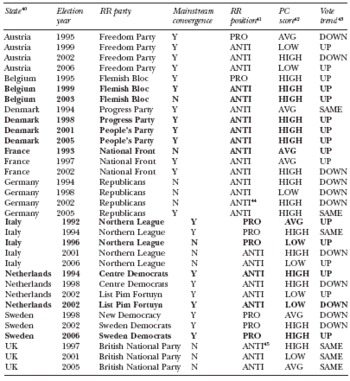
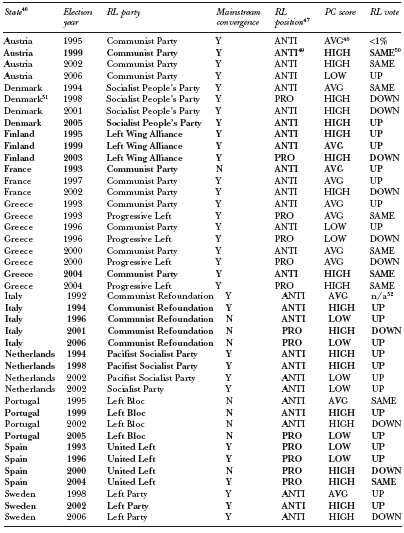
The matrices (Tables 1 and 2) were used to make any behaviour counter to the expectations of the theoretical model more apparent. Each of the variables discussed in the theoretical model is measured and then converted into a binomial variable. The variables included in the matrices are: mainstream party convergence (in the column labelled ‘convergence’), party position (‘RR position’ or ‘RL position’), party vote trend from one election to another (‘RR vote trend’ or ‘RL vote trend’) and permissive consensus score trend (‘PC score’).
Radical Right Position and Vote Matrix

Note: Bold indicates cases that deviate from the theoretical model.
Far Left Position and Vote Matrix

Note: Bold indicates cases that deviate from the theoretical model.
The data were coded as follows. In order to examine the change in the dependent variable (vote percentage for radical right and far left parties in national legislative elections) from the pre- to post-Maastricht era, I chose include all national legislative elections held in the member states from 1992 to 2006 (2006 was chosen as the end date since the Chapel Hill data terminate in this year). The first election chosen (not included in the table) was the one closest to, but before 1992. The first election was used as a baseline vote for these parties, and from this point forward I registered whether the vote increased in subsequent elections. If the percentage of the vote going to a radical right or far left party in a given election increased from the previous election results, the ‘vote trend’ variable was coded ‘up’ for that year. If the vote in a given election was lower than that of the previous election, it was coded ‘down’ for that year.Footnote 36
The analysis here makes use of national legislative election results, not European Parliament results. This choice is based on two rationales: first, I am more interested in studying the impact of European integration on domestic politics and parties – this is most likely to be captured in national elections rather than in European elections. Second, explanations for voter behaviour in European elections are highly contested in the scholarly literature. Scholars view these either as second-order elections based on voter appraisals of domestic government performance, or as indicators of public sentiment vis-à-vis European integration.Footnote 37
From this point forward, I determined whether mainstream party convergence on a pro-integration consensus existed in a given state. The Chapel Hill survey scores for the mainstream right and mainstream left parties were compared in each state. Parties included as mainstream right include those coded as ‘Christian Democratic’ and ‘Conservative’ in the PMRG dataset. Parties included as mainstream left are those coded in the PMRG data as ‘Social Democratic’. The most and least favourable Chapel Hill scores held by those parties considered mainstream right and mainstream left in a given state were subtracted, to arrive at a ‘gap’ score for that state. In some cases, this involved more than two mainstream parties; this is why it was necessary to find the highest and lowest scores, rather than simply subtracting between one mainstream right and one mainstream left party. This process was repeated for all EU member states. Then, the gap scores in each state were averaged to arrive at an EU average gap. Based on this EU average, the level of mainstream convergence in a given state is determined. If a state's mainstream parties had a larger gap than the EU average, it was coded as no convergence (‘no’). If a state's mainstream parties had a smaller gap than the EU average, it was coded as convergence (‘yes’).
The radical right and far left parties' positions were coded as either anti-integration or pro-integration. This was determined using the Chapel Hill data – where a party scored lower than 3.5 (the mid-point score in the Chapel Hill data) it was coded as anti-integration. Where a party scored higher than 3.5, it was coded as pro-integration.
Finally, I have included a variable that gauges whether a state's population was more or less enthusiastic about the EU during a particular election. This is based on the Eurobarometer survey results for that state in that election year. For each election included in the tables, I determined whether the permissive consensus score for that state (the combined percentage of the population indicating that their state's EU membership was ‘good’ or ‘neither good nor bad’) was higher or lower during that election year than the state's overall average from 1990 to 2006.Footnote 38 This allows us to see where demand for an anti-integration party may have been higher or lower from one election to the next.
When analysing these data together, there are a number of scenarios that match with the expectations of the model. Before going forward, these pathways are clarified here.
For a radical right or far left party to gain vote share, they may follow one of the following paths:
Mainstream convergence (YES) – RR/RL position (ANTI) – PC score (LOW)
Mainstream convergence (YES) – RR/RL position (PRO) – PC score (HIGH)
In the first scenario, the radical right or far left party is addressing a need for an anti-integration position that is not met by the mainstream parties. This is the most straightforward path for increasing vote share with an anti-integration platform, as depicted by the theoretical model. However, it is also possible (and not inconsistent with the model) that a very Euro-enthusiast population may vote for a pro-integration radical right or far left party, so this possibility is included as the second possible scenario leading to success.
For a radical right or far left party to lose vote share, they may follow one of these paths:
Mainstream convergence (YES) – RR/RL position (PRO) – PC score (LOW)
Mainstream convergence (NO) – RR/RL position (any) – PC score (LOW)
Mainstream convergence (NO) – RR/RL position (any) – PC score (HIGH)
In the third scenario, there is a need in the population for an anti-integration party, but the radical right or far left party fail to attend to it, and so these parties are not expected to gain vote share. In the fourth and fifth scenarios, the political opportunity space is closed due to divergence between the mainstream parties. As such, the position that they take on the integration issue is unlikely to have any effect on their vote share. Where the public is very Euro-enthusiastic and mainstream divergence exists, perhaps the radical right or far left could benefit from a pro-integration position. However, this seems unlikely as at least one mainstream party would have adopted a pro-integration stance, probably closing the pro-integration area of the opportunity space.
The findings below are the result of analysis of political opportunity space maps (included in the AppendixFootnote 39 ) and study of the relationships found in the matrices. This type of analysis was chosen due to the medium-n nature of this research; the number of elections in the timeframe of interest and the need to match these up with Chapel Hill surveys does not generate enough data points to make a statistical analysis fully reliable (especially once we start looking for change in the national vote, as this further limits the number of observations by one election per state). Statistical analysis is also less than ideal because of the reasons discussed in the Alternative Explanations section below. In a number of cases, radical right or far left parties lost vote share for reasons that are exogenous to the theoretical model and had little to do with voter behaviour; instead, parties self-destructed and lost vote share as a result of their internal failings. With a statistical model, including these observations is necessary (because of the small-n involved), but this also makes it appear that the theoretical model is performing poorly when in fact the explanation lies with a variable outside its scope. At the same time, it would be prohibitive to attempt case study methods for the 14 states examined here. However, by looking at these 14 states together, we are able to discover interesting cross-national similarities and differences that make this research project somewhat different from the small-n and large-n studies that currently exist on this topic.
ANALYSIS
A number of trends become apparent when we compare vote percentages gained by radical right and far left parties and the political opportunity space across EU member states. First, there is evidence of a pro-integration consensus among the mainstream left and mainstream right in most states seen both in the political opportunity space maps in the Appendix and in the matrices in Tables 1 and 2, validating the findings of the research discussed elsewhere in this article. Also, the data support a general conclusion that anti-integration parties increased their vote shares in the late 1990s and early 2000s, under the conditions outlined in the model. The analysis begins with the use of the matrices to detect anomalous cases; cases that deviate from the expectations of the theoretical model are indicated in bold text in the matrices. The political opportunity space maps are then used to understand the causes for deviation from the model. These maps make it possible for us to examine the fine details of parties' relative positions and movements over time; these movements allow us to explain a number of situations where the theoretical model does in fact hold, but does not appear to do so due to the limitations of the dichotomies used in the matrices. Combined, the matrices and maps also guide us towards key cases that allow for the examination of alternative explanations and cross-national commonalities that could otherwise go unnoticed.
Using the matrices, we see that most of the cases examined here fit the expectations of the theoretical model. The model appears to fit the experience of radical right parties better than that of the far left; whereas 70 per cent of the radical right cases fit the model, only approximately 50 per cent of the far left cases did so. In many of the cases we see that where a mainstream consensus existed, extremist parties that took an anti-integration position increased their share of the vote, provided that there was sufficient public demand (as reflected in higher or lower than average permissive consensus scores). Where there was no mainstream consensus, extremist parties often did not increase their vote share whether they adopted an anti-EU or pro-EU position, as either position was already taken by a mainstream party and thus the space was closed.
In the following discussion, a number of cases are discussed in more detail; this allows us to understand the elements of the model in concrete terms. In most cases, events clearly matched the expectations of the model, as is illustrated below with the use of the case of the United Kingdom (UK). In others a closer analysis of the political opportunity space maps in the context of a given state and time period is necessary to see the fit with the model (Italy and Spain are useful examples here). Finally, some of the cases demonstrate the impact of variables outside the theoretical model here – cultural explanations and internal party dynamics surface in some of these cases and provide support for alternative arguments found in the radical right and party politics literatures.
Effects of the political opportunity space. In certain elections, extremist parties adopted an anti-integration position that should have gained them votes; instead, they found themselves in a closed opportunity space dominated by an anti-integration mainstream party. This was apparent in the United Kingdom and Italy. The UK's radical right party – the British National Party (BNP) – is anti-integration, and the British public is quite Eurosceptic, and as such we would expect that this should have helped increase the BNP vote share in the late 1990s. This did not happen, however, because of the position of the mainstream right Conservative Party. The Conservatives are well-recognized as Eurosceptics; the party does not stray into the pro-integration half of the political opportunity space. In other words, the Conservatives already ‘own’ the anti-integration space, and have owned that space for a very long time.Footnote 53
In Italy, the Socialists and Christian Democrats were relatively pro-integration but Berlusconi's right Forza Italia (FI) was lukewarm. The party's lowest score on integration occurred in 1996, the very time when anti-integration sentiment was highest in Italy. The anti-integration share of the electorate could turn to the FI. This effectively closed off the anti-integration space from use by the radical right Lega Nord (LN) and the far left Communist Refoundation Party (RC). The LN's choice of an anti-integration position in the 2000s was also poorly timed – the Italian electorate was back to its high levels of approval of the EU (with permissive consensus numbers in the high 80s and low 90s) by the time they adopted an anti-EU position. A number of other explanations for the fortunes of the Italian radical right and far left will also be addressed below.
In one case, the political opportunity space allowed for a weakly pro-integration party to gain votes even with an electorate that was showing lower than normal approval for the EU. Spain's far left United Left (IU) scores as pro-integration throughout this time period, and there is a clear mainstream consensus on integration. Nonetheless, the IU increased its vote share in 1996. The IU also lost vote share in 2000, again with a pro-integration position (more in keeping with what we might expect). Closer analysis explains this result: the lowest integration scores for the IU actually occurred in 1996 and 2000 – in both cases the party's score was close to the cut-off for an anti-integration party (the cut-off is 3.5 and the IU's scores were 3.84 and 3.66, respectively). The Spanish electorate was at its most Eurosceptic in the mid-1990s (with permissive consensus scores in the mid- to high 70s), and the IU was the only party that approached an anti-integration position. As such, it would be expected that anti-integration voters would turn to the IU as their only option. In 2000, the Spanish electorate was back to their normal high levels of approval for integration (in the high 80s), and thus the IU's relatively low score on integration probably hurt them at the polls with a Euro-enthusiast public.
Finally, the most open political opportunity space will not help a radical right or far left party if the electorate is very pro-EU. The matrix makes some contradictory trends in which the Netherlands stand out. In the 2002 elections, the radical right List Pim Fortuyn (LPF) performed well with a mildly anti-integration position and mainstream consensus. However, in 1998, the radical right Centre Democrats (CD) lost votes with a more anti-integration position and similar political opportunity space. What explains this difference? It is likely that the answer hinges on the shifts in public sentiment vis-à-vis integration that occurred in 2002. It is important to note that the Netherlands is the most pro-EU population in West Europe (permissive consensus scores hover at around 90 per cent); the share of the electorate that one could grab with a strong anti-EU position is limited. In 1998, the permissive consensus score was even higher than usual (91 per cent, where the average is 90 per cent), while in 2002 it was lower than average (88 per cent). Also, the LPF's more ambiguous position on the EU (see the Netherlands opportunity space map in the Appendix) was probably more palatable than the vehemently anti-integration one of the CD. A supply-side explanation is also readily available: scholars have attributed some of the LPF's early success in 2002 to the charisma of Pim Fortuyn himself.Footnote 54 In Table 1, the subsequent election (also held in 2002) appears as a deviant case – the success of the LPF during the first election was not repeated in the second, despite a lower than average permissive consensus score in the Dutch population. The explanation for this deviant case is exogenous to the model – the death of Pim Fortuyn led to disarray in the party, and this damaged the LPF's performance at the polls. At the time that the party was in disarray, the far left Pacifist Socialist Party (PSP) provided an established alternative for those with anti-integration opinions and objections to the radical right aspects of the LPF's platform.
Alternative Explanations: Parties as Their Own Worst Enemy
Extremist party faction. Two elections that follow the expectations of the theoretical model nonetheless provide a useful insight into internal party dynamics. In the Austrian and French elections in 2002, party splits led to decreased vote share for the radical right parties involved. Though the mainstream parties maintained their pro-integration consensus and the radical right Austrian FPÖ took an anti-integration stance, the FPÖ gained fewer votes than it had won in earlier elections. According to the model, this can be interpreted as the result of a higher than average permissive consensus score in both of these states in 2002. However, there is also another simple explanation: in both cases, the vote was split between two radical right parties. In 2001, Jörg Haider (former leader of the FPÖ) broke away and started a new party, the BZÖ. Predictably, the party faithful split their vote between the two parties in the next election. In the 2002 elections, the French FN lost part of its vote share under the same conditions. The FN fractured in two in 1998, when FN member Bruno Megrét split to start his own radical right party, the Mouvement National Républicain (MNR).
Party inconsistency. Portugal presents an interesting case here. The mainstream right Popular Party (CDS/PP) swings widely on the issue of integration – in 1996 it qualified as Eurosceptic, in 2002 it was borderline, and in 1988 and 2006 it was clearly pro-integration, so the existence of a mainstream consensus varies from year to year. In the years where there was no mainstream consensus, it is hard to say whether an anti-integration position helped or hurt the far left. The far left Unified Democratic Coalition Party (CDU) is consistently anti-integration but has not always benefited electorally in the ways that the theoretical model would anticipate. Meanwhile, the other far left party, the PSR/BE has vacillated between anti- and pro-integration positions, with modest gains in the vote in elections throughout the time period studied here. This raises an interesting question: does inconsistency in mainstream party position on integration make it difficult for voters to vote based on this criteria?
Mainstream party scandal. Sometimes an extremist party's greatest opportunity is a mainstream party. When mainstream parties are rocked by scandal, the desire of the public to punish the mainstream by lodging a protest vote may lead to rapid increases in the radical right and/or far left's share of the national vote. This line of explanation is essential to understanding the cases of Austria (1999) and Italy (1996). While the Austrian case fits the theoretical model, the sheer size of the electorate that voted for the FPÖ (nearly 27 per cent) reflects deeper electoral issues than a simple objection to the EU.Footnote 55 Likewise, the erratic party system dynamics in Italy in the 1990s and early 2000s require this type of explanation.
In the 1999 Austrian election, the FPÖ benefited from (and played no small part in generating) public disgust with the long-term government practice of ‘proporz’. In basic terms, this was a patronage system through which the ruling coalition parties (usually the Austrian People's Party or ÖVP and the Socialist Party or SPÖ) would share the spoils of government jobs. This system came under public scrutiny in the late 1990s and was a boon to the FPÖ in its ‘anti-system’ appeals to the wider population. The sheer frustration of the electorate with the behaviour of mainstream parties, and their hoarding of public resources, allowed the FPÖ to appeal to voters with anti-mainstream party sentiments who otherwise did not agree with the FPÖ's culturalist appeals.Footnote 56
The Italian mainstream suffered the same fate, but to an even greater extent. Italy's party system had been dominated by the Christian Democrats (DC), who held their difficult coalition governments together largely through a massive system of patronage. In the 1980s, the DC and the Socialists (PSI) were deeply enmeshed in this system.Footnote 57 At the same time, the Italian economy was sinking deeper into debt, and the EU became increasingly concerned that Italy would never qualify for the single currency.Footnote 58 By 1994, the Italian public became frustrated with the economic mismanagement of the mainstream, and the DC and PSI became dead parties as many of their members were caught up in the ‘bribesville’ (tangetopoli) scandals. This put the political opportunity space into a state of flux, which benefited the radical right and far left considerably, but for reasons that are beyond this model. The LN and RC vacillated between pro- and anti-integration positions in a number of elections (this is very apparent in the map in the Appendix) but nonetheless continued to gain more votes in the elections held in 1994, 1996 and 2006 (for the RC), and 1992, 1996 and 2006 (for LN). A review of the Italian legislative elections of the late 1990s and early 2000s indicates that the highest vote-winners in those elections were three right parties: Berlusconi's FI, the far right LN and the Alleanza Nazionale (AN). As such, one can only explain so much of Italy's recent politics through the use of a political opportunity space map or the theoretical model used here.
Culture: Aversion to Extremist Parties?
The final case that bears close examination is Germany. Even though German voters demonstrated the same decrease in support for integration from 1996 to 2002 that we see in other EU member states, we do not see a corresponding increase in voting for the anti-integration radical right. The radical right Republikaner Party and the far left Communist Party have had little success, despite their anti-integration positions at key points in time when anti-integration sentiment in the population increased.
The explanation for this voting behaviour is best addressed by means other than those expressed in the theoretical model used here. As some have argued, the German case may be unique in its public wariness of parties that espouse nationalist sentiments.Footnote 59 It is possible that the normative concerns of the public, referred to by Art as its ‘culture of contrition’, can overwhelm the desire to vote for an anti-integration party, particularly when that party's objections to integration are put in terms of German nationalism.
A similar dynamic seems to be working against the radical right in Ireland, Portugal and Spain, and the far left in Austria, Belgium, Germany and Ireland. Where these parties exist, they gain less than 1 per cent of the national vote. In other cases, they do not exist at all. The explanation for this phenomenon seems to be outside the realm of the theoretical model presented here and worthy of further study.
Euroscepticism and the Fate of Single-issue Eurosceptic Parties
Scholars studying Euroscepticism have found that Euroscepticism, isolated from its related elements such as immigration, national sovereignty and economic concerns, is insufficient to gain voter approval.Footnote 60 The research conducted here reinforces that finding, by locating the single-issue parties in the political opportunity space and evaluating their electoral performance relative to the radical right and far left parties in their states. The radical right and far left parties have platforms that address these concerns as part of a complete package that includes Euroscepticism, and this does indeed seem to make a difference in electoral outcomes. While a number of single-issue Eurosceptic parties have gained notoriety for their performance in EU elections, their performance in national elections is uniformly poor. The political opportunity space maps in the Appendix illustrate the challenge faced by these parties.
In the maps, I have included those parties that have successfully gained representation in the European Parliament and have joined Eurosceptic political groups – either the Union for a Europe of Nations or the Independence/Democracy group.Footnote 61 The parties include the Finnish True Finns, the British UK Independence Party (UKIP), the French Movement for France (MPF), the Dutch Christian Union (CU-SGP), the Swedish June List and the Greek Popular Orthodox Rally (LAOS). The True Finns and LAOS have improved their performance in the most recent elections (not covered in this dataset), but it is important to note that these are also considered genuine radical right parties.Footnote 62
The anti-integration single-issue parties in the United Kingdom, France and the Netherlands are trying to break into a very crowded opportunity space. UKIP is sharing the anti-integration/right quadrant with the mainstream Conservatives and the radical right BNP, and earned only 2.2 per cent of the national vote in the 2005 election. The MPF is likewise crowded out by two radical right parties, the FN and the MNR, both of which gained more votes in the 2002 elections than did the MPF. The French Communist Party is also anti-integration. In short, Eurosceptic French voters have many parties to choose from, some of which are far more established than the MPF. Finally, the CU-SGP faces a difficult challenge in the Netherlands. As discussed previously, the percentage of voters with anti-integration inclinations in the Netherlands is limited. While the CU-SGP demonstrates from anti-integration tendencies, it does not take a strongly anti-integration position, choosing instead a middle position. Faced with the charismatic Pim Fortuyn and anti-integration Pacifist Socialist Party, the CU-SPG found itself left behind, gaining only 2.13 per cent of the vote, as opposed to the 17 per cent gained by the LPF and the 5.9 per cent gained by the PSP in 2002.
Conclusion
The theoretical model depicted here marries the insights of a number of scholars studying radical right and far left party performance and provides a structure for understanding the effects of political opportunity space (in this case, on the issue of integration) on the fortunes of extremist parties. As the EU has deepened its level of integration, states have been expected to cooperate and surrender policy flexibility and sovereignty in an increasing number of contentious policy areas. Previously compliant publics have begun to voice concerns with the increased integration, while mainstream parties have generally converged on pro-integration positions. Where mainstream parties behaved in this way, extremist parties found an opening in the political opportunity space. Those parties that seized that open space increased their vote share, provided that the population was sufficiently Eurosceptic at the time of the election. The analysis conducted in this article provides support for the plausibility of this model.
Meanwhile, this research project has raised a number of questions for future consideration. The first point that emerges is the question of party consistency on a given issue; we take it for granted that parties will be consistent from one election to the next on any given issue. This is borne out in most member states, but the parties that diverge from this expected behaviour (such as the Portuguese CDS/PP) warrant further study. What causes this erratic behaviour on the issue of integration? What effect does this have on the ability of voters to make informed decisions at the ballot box? Can we use a concept such as political opportunity space to understand voter choice in this kind of fluctuating system?
In addition, the paucity of radical right parties in the late developer states of Ireland, Portugal and Spain and the inability of the far left to gain any ground in Austria, Belgium, Germany and Ireland bears further examination. What explains this pattern? Is it a cultural aversion to extremist parties? Is it largely the result of political institutions in the state (consociationalism in the first three, and the legacy of a plurality system in Ireland)?
In the end, extremist parties, both right and left, appear to have benefited from public concern about integration. The question now is where this trend is going. Will European populations become more anti-integration, or will they be socialized into the post-Maastricht EU and return to a permissive consensus? If anti-integration sentiment increases, will the radical right, far left and single-issue parties continue to be the only opponents to integration, or will we see a movement of the mainstream right away from the pro-integration consensus? One thing is certain: integration does ‘matter’, and its effects will keep researchers occupied for the foreseeable future.
SUPPORTING INFORMATION
Additional supporting information may be found in the online version of this article: http://onlinelibrary.wiley.com/doi/10.1111/j.1477-7053.2012.01374.x/suppinfo.
Appendix: Political Opportunity Space Maps
Please note: Wiley-Blackwell are not responsible for the content or functionality of any supporting materials supplied by the author. Any queries (other than missing material) should be directed to the author of the article).