Introduction
At the beginning of his essay on approaches to perception in landscape archaeology, Robert Johnston (1998, 54) contrasts two versions of the same scene: a small group of prehistoric roundhouses located high on a mountainside in north-east England. On one hand, the houses can be perceived in a ‘hostile landscape’; on the other, they are nestled in ‘a comfortable and agreeable landscape’. The difference in interpretation is simple: the first scene is observed on a cold, foggy winter's morning, and the second in the warmth of a clear summer afternoon (ibid., 54). Christopher Tilley notes a similar effect when responding to Tim Ingold's (2005, 128) comments on The materiality of stone, stating that ‘weather alters the landscape so people perceive these landscapes differently’. These brief observations represent two of the few examples where archaeological discourse has engaged the role of weather. It is, however, a weather that is merely the backdrop to human action – something that acts on the land, that contextualizes experience and archaeological observations, but does not require investigation. Even when Tilley (2008, 272; Ingold 2005, 128) suggests that an archaeology of weather might be developed, the weather is conceived as a separate sphere of research, isolated from the rest of the landscape.
In contrast to weather, climate has received growing attention within archaeology over the last two decades. A review of the index of the recently published Handbook of landscape archaeology reveals 20 references for ‘climate’, with many more for associated topics such as climate reconstruction, climate change and climatic impacts on human populations (David and Thomas 2010). Looking up ‘weather’, one is greeted by numerous references to weathering, but none for weather itself. The archaeologists’ appreciation of the longue durée and the perceived limitations of archaeological data sets have driven an interpretive emphasis on long-term, broad-scale impacts (Bailey 2008). This agenda has been supported by the discovery of a wide array of proxies for palaeoclimate reconstruction that are, for the most part, poorly suited to high-resolution studies of weather (Bell and Walker 2005). Consequently, climate, defined by Lamb (1972, 5) as ‘the sum total of the weather experienced at a place in the course of a year and over the years’, is how weather is currently expressed within archaeology. There are problems, however, with relating changes in culture and society to understandings of past climates. This article uses a case study from 18th-century Cumbria to explore whether it might be more helpful to focus instead on weather and how it is integrated into people's daily lives and senses of place.
Climates of the past
By privileging climate over weather, it is thought that archaeologists are equipped with the perspective necessary to discuss cogently the impact of long-term environmental change on human societies (Mitchell 2008; Rowland 2010b). This perception has been fuelled by a research agenda that has, in response to contemporary concerns of global environmental change, increasingly placed climate at the centre of archaeological interpretations. However, problems of scale and of chronological resolution mean that correlating climate changes observed in proxies with environmental or cultural impacts observed in the archaeological record remains a complicated process (Bell and Walker 2005, 52; Baillie 1991). This problem is especially pertinent when archaeologists look to undisturbed environmental records from off-site locations in order to contextualize on-site stratigraphies. Consequently, archaeologists have looked to the environmental sciences of palaeoclimatology, palaeo-ecology and environmental archaeology to seek more refined correlations between proxy data sets and the material record (Peiser, Palmer and Bailey 1998; Sherratt 1997; Ryan and Pitman 2000; Bogaard and Whitehouse 2010; Rowland 2010a).
Perhaps as a result of the emphasis on scientific reconstruction of past environments, many archaeologists’ attempts to explain correlations between climatic and social narratives have taken the form of simple causal mechanisms. Changes in climate have often been thought to constrain or enable economic activity during periods of widespread social upheaval (Weiss et al. 1993; Peiser, Palmer and Bailey 1998; Sherratt 1997; Ryan and Pitman 2000; see Coombes and Barber 2005). In such examples, ‘appeal to human intentionality and rational choice . . . reveals only proximate causes of behaviour, while the ultimate cause lies in . . . selective forces’ (Ingold 2000, 33, original emphasis). This simplistic method of reconciling social and environmental narratives is at odds with the work of a growing number of scholars. Richard Tipping (2002, 10), for example, has been vocal in resisting what he describes as ‘the recent trend to explain socio-economic change throughout the world by new forms of environmental catastrophism’. Yet despite this recent critique, many of the problems encountered when exploring the climate–society relationship were identified more than 30 years ago.
There is a great body of scholarship, reaching back to the original critiques of environmental determinism, that debates whether human history has been influenced by changes in the climate and how best to explore those changes. Influential scholars such as Le Roy Ladurie (1972), Braudel (1972) and Lamb (1972; 1966; 1977) have all discussed the issues to varying degrees, and there was an explosion of interest in the subject during the late 1970s and early 1980s. At that time, Robert McGhee (1981, 163) warned against correlative approaches, arguing that it was a ‘facile’ assumption that simply because two events occurred at approximately the same time they should be related. These researchers also understood the limitations of catastrophism, calling for research that moved away from bridging climatic and social chronologies using ever more complicated models of causation and ever more refined concepts of ‘harm’. They wanted to focus instead on the range of possibilities of human response, and how these vary in relation to the human experience of climate (De Vries 1980; Rabb 1980). This initiated a trajectory of research that sought to better integrate social and climatic narratives. Meanwhile, in archaeology, scholars like Karl Butzer (1972; 1982) were working to present a more ecological understanding of how people related to the natural environment.
In the 1990s, a combination of these academic traditions inspired the growing historical ecology movement to look more closely at the human experience of climate. Its proponents were directly influenced by political concerns over humanity's role in radically altering the natural environment. They aimed, therefore, to create a more balanced understanding of how social relations developed, responded to and affected environmental change (Crumley 1994). As a result, historical ecology has developed to offer a quasi-ecological approach to human history that incorporates ‘globally relevant archaeology, ethnohistory, ethnography, and related disciplines’ (ibid., 7) under a rubric which emphasizes diversity, heterarchy and complex spatial analysis. Although ecological issues of adaptation, resilience and ecosystem thresholds come to the fore, a people-centred perspective is maintained: ecological concepts are only used with the caveat that neo-Malthusian approaches, and the expansionist critiques that followed, can explore only socially unmediated relations between humans and nature (Patterson 1994, 226–27). In a search for a scale of study that enables the integration of social and ecological concepts, the historical ecologists define landscapes as ‘the material manifestation of the relation between humans and the environment’ (Crumley 1994, 6).
This development of ecological perspectives on human–environment relationships has been highly influential within archaeology (Redman and Kinzig 2003; Nelson et al. 2006; Kirch 2007; McGovern et al. 2007). In contrast to previous dependencies on rational economics and simplistic mechanisms of causation, scholars now recognize that human perception guides people's actions in relation to environmental change. ‘Widely used terms such as “stability,” “change,” “variability,” “normal,” or “degradation” only have meaning within defined scales of analysis’ (McIntosh, Tainter and McIntosh 2000, 12) – scales that are relevant to human experience. The vigorous critique of the systems modelling that took place in archaeology during the 1960s and 1970s has been addressed by a new generation of model-builders (Hodder 1991). They employ complex modelling techniques that include a recognition of non-linear dynamics, self-organization, criticality and resilience (Van der Leeuw and McGlade 1997; Gunn and Folan 2000; Redman and Kinzig 2003; Kirch 2007; Wilkinson et al. 2007). Some are explicitly ‘agent-based’, focusing on the choices that past people would have faced (Wilkinson et al. 2007). The result is a more theoretically informed method, in which sophisticated models better accommodate the dynamism of human agency. Elsewhere, palaeo-ecologists have begun to tackle some of the problems of disparate data sets and poorly defined chronologies that have tended to preclude more sophisticated interpretations (Davies and Watson 2007; Schulting 2010). The objective is a level of spatial and temporal analysis in which the changes experienced, recognized and responded to by past communities are apprehended (McIntosh, Tainter and McIntosh 2000).
Climates of the present
Methodological improvements have occurred in combination with theoretical advances. The concept of social memory, for example, is derived in part from anthropological studies of the Mande of West Africa (McIntosh 2000). It describes how communities can store information about past climates and successful responses to change within their own world view and social perceptions of the landscape. When tackling immediate problems, this information can be actively accessed and sorted in the search for appropriate responses (McIntosh, Tainter and McIntosh 2000, 25). In application, this is an attempt to address the problem of intentional action, juxtaposed against the limits of human perception and experience. It is a model that explicitly demonstrates how a society's attitudes and reactions to changing climates are culturally conditioned through experience and the transmitted experiences of ancestors. In this respect, the concept of climate has evolved from being something that defines, yet is isolated from, human action, to something that is integral to social formation.
This integration between people and climate has been explored further in anthropology (Strauss and Orlove 2003b; Hsu and Low 2007; Crate and Nuttall 2009), where topics range from farmers’ perceptions of climate variability (West and Vásquez-León 2003) and the ways in which social relations engender differing degrees of resilience in the face of climate change (Green 2008), to exploring our cognitive understanding and sensual perception of weather (Ingold 2007; 2011). Like many other disciplines, anthropology has found itself influenced by the growing public concern with environmental issues and, specifically, global environmental change. Consequently, there is a strong desire to produce research that is of direct relevance in characterizing and responding to global problems (Crate and Nuttall 2009). So whilst anthropologists have recognized the importance of the idea of weather, an interpretative emphasis on the long-term aggregations of climate has been maintained (Strauss and Orlove 2003a). It is clear, however, that in this respect anthropologists feel constrained by the narrow temporal focus of their studies (Peterson and Broad 2008, 78). As Roncoli, Crane and Orlove (2008, 104) state, ‘the multiscale and long-range nature of climate change is leading anthropologists to field settings that do not always lend themselves to approaches familiar to anthropologists, particularly those that hinge on personal interactions and sustained observations of everyday life’.
A role for weather
This has created a curious situation in which historical studies are looking to anthropological studies to explore the social and cultural dimension of climate change, while anthropology is looking the other way, desiring a longer-term view on human action. Meanwhile, Robert van de Noort (2011, 1046–47) has recently argued that following the developments outlined above, ‘different theoretical strands in archaeology are not in opposition when it comes to explaining the diverse connections between climate, environment, landscape and people’. Yet, when historical ecologists regard the concept of landscape as central to the study of human–environment relations, in the realm of past climate studies, landscape archaeologists continue to outsource this work to their colleagues in the environmental sciences (Bogaard and Whitehouse 2010). Modelling has been revolutionized in recent years, but even the most complex models still fail to fully account for ‘the great richness, variability and specificity of cultural production’ (Hodder 1991, 34). The concept of social memory locates human response to environmental changes within culturally embedded frameworks for action. However, the emphasis is on how environmental knowledge is coded and transmitted across generations. There is little discussion of how the lived experiences of people and communities cause that knowledge to be recalled and acted upon. In short, although developments in ‘climate-change archaeology’ have been significant over recent years, there remain a number of problems (Van de Noort 2011). Archaeologists and researchers from other disciplines still struggle to move between the social and scientific, the long and the short term, the lived experience of individuals and broader narratives of societal change. There is still a question whether we, as archaeologists, can ever reconcile our diverse data sets and imprecise chronologies with detailed studies of how humans encountered the climate changes of the past.
I would argue that, to start tackling these issues, we need think less about climate and more about weather. After all, if, as historical ecologists suggest, the landscape is the ‘material manifestation’ (Crumley 1994, 6) of human–environment relationships, we should think about how this manifestation takes shape. That is not in the aggregated abstractions of climate and climate change, but in the immediate experiences of weather. Tim Ingold (2005; 2007; 2011) has, for example, often been keen to emphasize the importance of weather, arguing that landscapes should be seen as ‘weather-worlds’. Rather than being impervious to its action, the land responds in countless ways to the weather's myriad expressions as the medium in which we live. Conversely, the land, with its juxtaposition with the sea and its extension into the sky, helps define those myriad expressions into prevailing weather conditions. ‘The more one reads into the land’, writes Ingold (2007, S33), ‘the more difficult it becomes to ascertain with certainty where the substance ends and the medium begins’. When viewed like this, it serves no purpose to distinguish between land and the weather: the two are enmeshed in constant flux. Jan Golinski (2003, 18) has argued that the British sense of weather, ‘its peculiarities and regularities, and its providential role in the life of the nation’, was central to national identity during the Enlightenment. Golinski is not alone in pointing out this cultural connection between weather and location (Ingold and Kurttila 2000; Rantala, Valtonen and Markuksela 2011). It seems the weather in which one stands can be as much responsible for generating a sense and use of place as the ground on which one stands. It is a conception of nature that does not separate out people, weather and land into discrete spheres; they are all bound up in a singular sense of the natural environment, that of the landscape.
‘Weather continues very favourable’
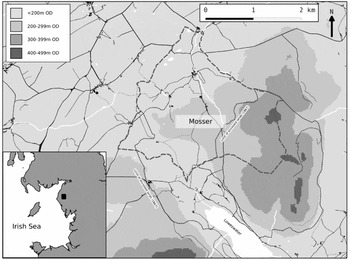
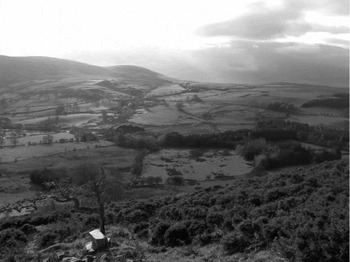
My research in a small township called Mosser on the north-western edge of the Lake District has sought to build on the idea that the experience of climate is embedded in cultural practice by establishing ways of thinking about the weather as an aspect of landscape in archaeology (figures 1 and 2). The project involved comparing and integrating three distinct narratives of change, derived from a number of different methods and scales of analysis, within a single landscape study. The results of more traditional environmental studies and archaeological landscape survey were compared and integrated with the first-hand experience of weather, as recorded in two 18th-century diaries. As well as containing detailed, predominantly non-instrumental, descriptions of weather, the diaries provide useful commentary as to its effects on farming routines and the general populace. The first, the diary of Isaac Fletcher, studiously transcribed and compiled by Angus Winchester (1994), is from within the Mosser area and runs from 1756 to 1781. There is an almost daily record of the weather, and places and events can be linked to the features, boundaries and historical processes observed as part of a traditional field- and desk-based landscape survey. The second, Elihu Robinson's, consisting of unpublished documents held in the Library of the Religious Society of Friends (RSS Box R3), runs from 1779 to 1806. It contains a weekly or monthly summary of weather, and though from just outside the Mosser township, extends the weather record into the turbulent years of the late 18th century – a time of war, soaring food prices and widespread change across the landscape.
The location of Mosser and its surrounds. Original data: © Crown Copyright/database right 2011. An Ordnance Survey/EDINA supplied service.

The landscape of Mosser. Looking east towards Sosgill from Bramley Seat.

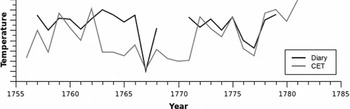
Comparing weathers A first step was to see whether the weather recorded in the diaries correlated with well-known instrumental records, such as the Central England Temperatures (CET) series (Parker, Legg and Folland 1992) and the England and Wales Precipitation (EWP) series (Alexander and Jones 2000). Although these series do not focus on Mosser or Cumbria, they are recognized as two of the world's most accurate and longest-running weather records. Both have been found to be useful in describing and comparing trends across areas well beyond their original bounds (Jones and Hulme 1997; Croxton et al. 2006). Using methods more commonly applied in historical climatology (cf. Pfister et al. 1999; Brázdil et al. 2005), I was able to place the diarists’ qualitative, descriptive statements about weather on quantitative ordinal scales, which in some instances closely tracked trends in the instrumental series (figure 3). On the whole, though, I found only a few statistical correlations between data sets. The possible reasons for this are too numerous to mention in detail here, but range from differing weather patterns in Cumbria compared to the rest of the country, or weaknesses in the method for translating qualitative to quantitative data, to problems in the constitution of the scientific series themselves. In contrast to many archaeological studies, I was able to access a highly detailed and well-respected instrumental series, but even at this level of resolution the results show that we cannot assume a direct correspondence between the scientific measure of weather and the experience on the ground. There is a relationship but it is a qualified one. It raises a question: how can archaeologists draw upon proxy records, with all their flaws, to produce accurate portrayals of past climates, if we can only tenuously do so using high-resolution data from the recent past?
A quantitative reconstruction of summer (June–July–August) temperature trends from Isaac Fletcher's diary (Winchester 1994) compared with seasonal averages compiled from the CET (Parker, Legg and Folland 1992). There is good correlation between data sets, particularly from 1773 onwards.

Landscape change Mirroring the kinds of problem encountered in late 1970s and early 1980s, it was also a struggle to ascertain whether social and economic processes could be linked to the changing weather (De Vries 1980). There were a number of changes to the Cumbrian farming regime occurring in the late 18th century that were worth investigating in this respect (Bailey and Culley 1794; Dilley 1991). In particular, one of the most discussed issues is the enclosure of common lands and the decline of common rights. Much has been written about the widespread parliamentary enclosures post-1801 (Elliott 1959; Whyte 2003). However, Robert Dilley (1991) argues that, prior to this, enclosure by private agreement may well have played a significant role in the consolidation and extension of farm holdings. On the ground, a walkover survey of the parish undertaken as part of the project revealed a significant number of former boundaries, but Isaac Fletcher's diary can provide details of the enclosure process in action. Angus Winchester (1994, xix) notes how Fletcher's ‘evident skill as a land surveyor’ led him to direct the enclosure of a number of fields, including nearby Toddell Pasture in 1775. Within Mosser itself, Fletcher records an unsuccessful attempt by the inhabitants to buy the Mosser Commons from the Earl of Egremont in 1758/59. Nevertheless, Mosser Moss was successfully divided and enclosed in 1772–73, and Fletcher also notes agreements regarding the division of Mossergate Outfield and Pasture from 1757–59.
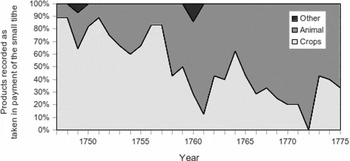
There are numerous potential causes that could have driven this process of consolidation and extension. Perhaps the most convincing explanation lies partly in the rapid urbanization of north-west Cumberland. During the late 18th century, Whitehaven had grown to become the second-biggest port in the country, and other urban centres were growing at Workington, Maryport, Carlisle, Cockermouth and Keswick (Hughes 1965; Bouch and Jones 1961). This, combined with an improving transport and communication network, linked the Lake District with increasing urban demand for meat and dairy products (Dilley 1991, 128). An analysis of small tithe records in Mosser as part of my research seems to indicate a growing role for animal products from c.1747–75 (figure 4, Wh DFCF/1/116), and this would have been supported by a doubling of the price of beef and mutton in Carlisle during the last 30 years of the 18th century (Searle 1983, 126). Similarly, G. Elliott (1973, 72) argues that
a rise in the price of corn during the second half of the 18th century, growing specialisation in agriculture, increased returns from improved land, the accumulation of capital and the willingness to invest it in land, and the expansion of industry all contributed to the increase in enclosing activity.
Food prices and the overall profitability of farming were, of course, affected by a wide range of factors beyond increasing urban demand (Jones 1964). These include damages to trade during the wars in America and Europe, as well as variations in seasonal supply. Taken as a whole, there is a range of complex socio-economic processes that might have brought about farming regime and landscape change. As farmers sought to satisfy urban demand and maximize profits, common rights were eschewed in favour of greater control over landholdings. As in many archaeological narratives, this is a characterization of the past where weather and climate are either forgotten or ignored.
The change over time in types of product taken from Quaker households in Mosser as payment for the small tithe (Wh DFCF/1/116). Animal products appear to become increasingly important from 1747 to 1775.

A climate-informed interpretation Despite this emphasis on socio-economic factors in the documentary histories, it is also possible to apply a climate-informed interpretation to this process. In the traditional parlance of climate–society relationships, we might expect changing weather conditions to impact farms and farming practices (Parry 1978) most significantly. According to the CET, the period from 1750 to 1774 is characterized by relatively stable annual temperatures, with a run of particularly warm years around 1760 (Parker, Legg and Folland 1992). The period from 1775 to 1799 is more variable, with a period of warmth around 1780 quickly descending into a run of cold years. The flurry of land enclosures in the late 1750s correlates well with the period of warm, stable weather and good harvests. It could be that the steady harvests of the 1750s allowed farmers to focus on improving their farms. As well as dividing land held in common, a process of improvement can also be seen on Isaac Fletcher's farms with the construction of a new byre and stable. Conversely, Mosser Moss, an area of low-lying boggy ground, was divided, drained and converted to pasture after a run of poor, rain-affected harvests in the 1770s, at the start of the period of more variable weather. It is possible that this is an example of how upland communities could be resilient in the face of climate change (Tipping 2002). It would have enabled Isaac Fletcher to maintain both his livestock herds and cereal harvests in the face of climatic adversity by turning his better-drained pasture into arable land. This is hinted at in the diary, as two fields are cultivated for the first time soon after the division of the Moss.
At the very least, we are thus able to explain widespread landscape change in late 18th-century Cumberland in two ways: either as a result of climatic influence or as purely a socio-economic process. Even if we are to assume that both explanations played a role, we have no means of deducing the relative influence of each. What is clear, however, is that there is no simple deterministic relationship. A wide range of factors, from trade relations to farm diversification, could have affected how people respond to the effects of bad weather (Tipping 2002, 21; Dugmore, Keller and McGovern 2007).
Isaac Fletcher's diary allows us to examine the period in unparalleled detail, yet this brings us no closer to a climatic-cause-and-social-effect model – an approach often derided, and yet so often used in past archaeological studies (Coombes and Barber 2005; Tipping 2002). This is not surprising: other studies are revealing increasingly diverse and complex relationships between climate, society and economy, operating across a variety of spatial and temporal scales (Dugmore, Keller and McGovern 2007). Yet many would argue that the scale of analysis in this study is too detailed, that the true climate ‘signal’ is obscured by the ‘noise’ of day-to-day weather. Nevertheless, that begs the question, how much do we have to smudge things before noise morphs into signal? Abstractions of the climate–society relationship have tended to yield unsatisfying results, in which the individual is either blurred out of focus or, worse, forgotten altogether (Sherratt 1997; Peiser, Palmer and Bailey 1998; Ryan and Pitman 2000; Rowland 2010a). Perhaps we need to take a more positive view. Despite the potential flaws in the analysis, it is clear that at certain times, and for certain conditions, the weather experienced by these people does bear some relation to our own instrumental records. These records, and others like them, have often been used to calibrate other palaeoclimatic proxies – ones that allow us to delve back into the deeper past (Jones, Osborn and Briffa 2001; Brázdil et al. 2005; Baker, Proctor and Barnes 2002; Charman 2007). As such, weather, as experienced by individuals, can, to a certain extent, be related to long-term climatic changes observed in proxy records. More to the point, I think there are advantages to thinking about the weather and how it was experienced by individuals.
Attitudes to weather Whilst Isaac Fletcher's diary is written as a rather dry record of events, Elihu Robinson intersperses his own record with more personal, reflective commentaries. Using these, we can begin to access how people at the time perceived the weather and its relation to world events. Some of the comments are useful on a practical level. For example, Robinson laments that ‘many of our expectations “in disappointment end”’ when an otherwise good hay harvest was ruined by heavy showers – implying that only a short spell of bad weather at the wrong time can have a serious impact on the year's yield. Moreover, a number of comments reflect on poor conditions for sheep and lambs, stressing the importance of livestock and a vulnerability to poor weather that extends beyond crop harvests. The entries also provide insights on the range of other effects the weather was deemed to have: ‘such sudden changes [in the weather] seem very unfavourable to health! Hath been a sickly time (I suppose) through ye Nation, but not very mortal’. In times of distress, Robinson can attribute bad events to divine retribution for national indiscretions – ‘Do we not merit punishment as well as the surrounding Nations?’ – and mirroring comments to be found in contemporary newspapers, like the Cumberland Pacquet, Robinson displays a penchant for exaggeration when describing the seasons. All too often a year, season or harvest might be described as the best, worst, ‘back most’ (latest), or ‘most forward’ (earliest) in memory. The likelihood of this being true is diminished by the number of times it is claimed, but they are comments that do well in reflecting the hopes, fears and perceptions of people when the weather was becoming noticeably more erratic towards the end of the 18th century.
The overall impression one gets from these two diaries is not of some overarching climatic force, subtly or unsubtly controlling historical processes. Mirroring the historical ecologists’ concept of heterarchy, there is a meshwork of interrelated and unranked processes (Crumley 1994, 12). The climate and how it is experienced, as weather, is just one part of this whole. We can no more ignore its influence than we can proclaim its dominance. The very diaries themselves, as diligent records of weather written side-by-side with summaries of farming activity, are testament to how embedded a sense of weather was in daily lives. Both Isaac Fletcher and Elihu Robinson make use of new technology in order to try to understand the weather better. On one occasion, Robinson remarks that he was ‘particularly cheated out of getting 2 or more cart loads of oats by dependence on ye barometer’. For the diarists, this was a time in which Enlightenment ideals of scientific knowledge collided with folklore and superstitions of divine intervention (Golinski 2003). For us, the way this confluence of ideas played out in the recording of daily lives helps us think about what changing weather actually meant to people in the past, and how that relates to the scientific reconstructions of climate and climate change. From this, we can see that the role of weather cannot just be reduced to single events or long-term climatic trends. It was felt, experienced and responded to on a day-to-day basis. Nothing is straightforward, cause and effect are almost entirely intractable, and yet there is nothing to dismiss the notion that weather, like the land itself, held an intimate significance for people's sense and use of place.
Constructing weather-worlds
So how do we begin to think about weather in archaeologies of the more distant past? How do we begin to create weather-worlds from landscapes (Ingold 2011)? What are the challenges? One of the biggest problems, of course, is in the reconstruction of past climates. Palaeoclimatologists are good at describing past climates in terms of deviations from the recent mean, or otherwise in the most general terms. But as far back as 1967, Robert Raikes (1967, 10) asked, ‘what do people mean when they write of wetter, drier, warmer, more genial, and all the rest of the comparative adjectives that are used so profusely?’ Surely if we are to work at human scales, and with advancements in proxy studies and climatic modelling, we should strive towards a more comprehensive overview of what past weather was like, and how it might have changed over time. These are not easy questions, and we will find no concrete answers – but that is nothing new in archaeology. To achieve this goal, archaeologists will have to work much more closely with environmental scientists, and therein lies a potential barrier in itself (McIntosh, Tainter and McIntosh 2000, 7–9), but one that is already being tackled by people like Richard Tipping (2002), Arlene Rosen (2007), Schibler and Jacomet (2010), Althea Davies and Fiona Watson (2007), and others.
As for relating climate to society, it is clear across the discipline that the simplistic notion of climatic cause and social effect no longer holds water (Van de Noort 2011). Whilst this has been an oft-recanted observation, it has commonly been assumed that it is the historical nature of climate–society studies that has limited our inferences (cf. Bailey 2008, 14; Schulting 2010). However, this and other studies have shown that it does not matter how ‘complete’ your data set is; reducing social processes to environmental prime movers is always fraught with difficulty. Indeed, as was demonstrated when I tried to look at how weather affected the day-to-day running of society, the problem was not lack of detail, but too much detail.
Landscape archaeologists need to completely rethink how to approach the idea of climate. It is counterproductive to separate landscape from climatic and social processes: they are all bound up together. This builds upon the historical ecologists’ concept of heterarchy (Crumley 1994). Different arbitrarily defined spheres of non-linear processes have influences over one another (McGlade and Van der Leeuw 1997). However, the categorization of such spheres causes us to labour heavily on problems of cause and effect that are all but intractable. We should abandon the notion that scales of analysis create insurmountable barriers. Climate is integral to landscape, and weather is how that integration is expressed and experienced on a daily basis. The recent reinvigoration of interest in the idea of time perspectivism emphasizes the temporal nature of the archaeological record: ‘increasing the distance between the observer and what is observed not only creates distortions that require correction but also places particulars in a wider perspective that can introduce new understandings and perception of new relationships’ (Bailey 2008, 15). So although we can accept the difficulties of moving between scales in a methodological sense, that should not necessitate a theoretical division that separates out history into a focus on arbitrarily defined and independently constituted scales of action. Deep structuring processes, such as climate change, are only made relevant in the lived temporality of human lives. Isaac Fletcher and Elihu Robinson were not concerned with overarching trends, but with how their activities were affected from one day, and one season, to the next. This, however, does not mean that the people of the past were divorced from or unaffected by processes that were operating on levels beyond their direct understanding.
The concept of social memory is seen as a way of moving between actions occurring at a societal level and supra-generational processes of change; but by giving primacy to the role of societies, the individual is forced into the background. In the deeper past, without the detail of first-hand observation or historical documents, this scale of working is understandable. Yet even at this level, appeals to social memory have been vague and unsatisfying (Evans 2003; Tipping 2002). Although some have argued against striving too hard to see what is not directly observable, and that we should be content with examining the broader scales of sociocultural evolution (Dean 2000), this study shows such thinking to be flawed. Fletcher and Robinson's daily weather tribulations both form and are formed by long-term narratives of change. Our attempts to reconstruct the material conditions of past action should be focused on the context of individual experience (Harding 2005). Through this perspective we can begin to generate interpretations based upon ethnographic and phenomenological analogy that do not run the risk of one-size-fits-all caricature (Thomas 2004, 239–42).
Conclusion
The problems associated with examining the relationships between societies and the climates in which they live have long been understood. Indeed, they have changed very little since they were first outlined in the late 1970s and early 1980s. A number of recent developments have helped archaeologists move away from broad-scale deterministic narratives or sociocultural explanations that ignore the role of climate altogether. My study of Mosser reflects this, showing how a traditional climatic-cause-and-social-effect model would be problematic in almost any context. Yet the diaries show that an understanding of the weather is bound deeply into people's lives, their cosmologies and their senses and uses of the landscape. Despite advances in both theory and practice, archaeological approaches often still fail to recognize that it is through weather that changes in climate are expressed, and that weather is intimately bound up in the landscape of a place. I have attempted to stake out some of the key problems and potential solutions in transforming our conceptual emphasis on climate and society to one based on landscape and the lived experience of weather. Landscape archaeologists have long outsourced the study of climate to their colleagues working in environmental science. Of course, environmental science is critical to the reconstruction of past climates and landscapes, but landscape archaeologists can bring to bear complementary social, experiential and inhabited perspectives. Through these, we can begin to think less about climate as a prime mover, and more about weather as a material condition of the landscape – one that is embedded in social and cultural formation, and thus as much open to archaeological investigation as any other aspect of the past.
Acknowledgements
This research was undertaken as part of an AHRC-funded doctoral programme at the Department of Archaeology, University of Sheffield, supervised by Robert Johnston. I thank the staff at the Religious Society of Friends Library and Cumbria Archives Service for their kind help. I am grateful to the intrepid volunteers who assisted me in the field, often under uniquely challenging weather conditions, and particularly R. Eldridge, M. Huggon, N.M. Roth, G. Corbett, A. McCabe and R. Johnston. I also extend my gratitude to N.M. Roth, A. Bestwick, R. Johnston, J. Barrett, two anonymous reviewers and the editors of Archaeological dialogues, who provided valuable and insightful comments on earlier drafts of this paper. The final acknowledgement must go to A. Winchester, who directed me to the diary of Elihu Robinson.