INTRODUCTION
Research in sociophonetics has demonstrated that native speakers (NS) can detect and produce fine-grained, subphonemic variations in pronunciation that serve to index social identities (Foulkes & Docherty, Reference Foulkes and Docherty2006). For instance, the gender of children as young as five years old can be detected from their speech, even though boys and girls of that age should have the same fundamental frequency (Sachs, Lieberman, & Erikson, Reference Sachs, Lieberman, Erickson, Shuy and Fasold1973). The fact that speakers adjust their performances according to implicit social norms entails that they acquire, store, and process detailed representations in which social information and phonetic categories are linked (Foulkes, Scobbie, & Watt, Reference Foulkes, Scobbie, Watt, Hardcastle, Laver and Gibbon2010; Johnson, Reference Johnson, Johnson and Mullennix1997; Pierrehumbert, Reference Pierrehumbert2002).
Advanced L2 speakers have also been shown to manifest some types of phonological stylistic variation that NS engage in, at least with regard to broadly defined sociolinguistic variables, such as the variable use of liaison, and the deletion of /l/ in subject pronouns in French (Dewaele, Reference Dewaele2004; Howard, Reference Howard2004, Reference Howard2013; Regan & Ní Chasaide, Reference Regan and Ní Chasaide2010; Thomas Reference Thomas2004). Such studies have converged on the finding that L2 learners are likely to overuse formal variants unless they enjoy the benefit of intensive, informal contact with NS. The present study aims to contribute to this body of work by focusing on a feature that has not received attention in the L2 sociolinguistic literature of French and, crucially, one that allows for probing variation in a phonetically detailed way. While learners have been observed to show variation when they are to choose between a more formal and a less formal variant, we do not yet know whether they are capable of producing fine-grained sociophonetic variation in the same way and to the same degree as NS do in response to shifts in style. The purpose of this article is to investigate the sociophonetic productions of experienced L2 speakers in comparison to a sample population of NS.
We investigate whether French NS and experienced L2 users of French show similar patterns of variation with respect to phrase-final vowel devoicing (PFVD). This variable was chosen for several reasons. First, as university teachers of French in an anglophone setting, we have observed the use of PFVD among L2 speakers even though it is never explicitly taught. This invites an investigation of the rates in which experienced L2 users devoice phrase-final vowels relative to NS. Second, devoicing occurs on a continuum––a vowel can be more or less devoiced––and this variability allows us to probe the degree to which the phenomenon is present in native and L2 speech. Finally, the socioindexical correlates of PFVD appear to vary (Dalola Reference Dalola2014; Fagyal & Moisset, Reference Fagyal and Moisset1999; Smith, Reference Smith2002, Reference Smith2003), so the variable has not achieved the status of a stereotype (Labov, Reference Labov1972), which means that it is unlikely that L2 speakers actively avoid or overuse PFVD because the identities or stances that it might signal are not obvious to listeners.
The organization of this article is as follows: In section one, we situate this study within the literature devoted to variation in L2 pronunciation. In particular, we motivate our research focus on L2 sociophonetic competence as a necessary bridge between the themes of phonetic variation in L2 speech research and of sociolinguistic competence in second language acquisition. The variable of interest in this study, PFVD, is detailed in section two, as a precursor to a description of our methodology in section 3. The results of the study are revealed and discussed in section four, and we return to the implication of this study for the notion of sociolinguistic competence in the conclusion.
VARIATION IN L2 PRONUNCIATION AND THE ASSESSMENT OF COMPETENCIES
There are two broad strands of empirical research in the literature devoted to L2 phonetic/phonological variation. Each is devised to assess a different competency from among the abilities that comprise effective communication among L2 users (Canale & Swain, Reference Canale and Swain1980). On the one hand, researchers in an arena that we call L2 speech, following the tradition of Flege (Reference Flege and Strange1995) and colleagues, focus primarily on linguistic competence as determined by the development of phonetic accuracy, usually at the level of sound categorization. On the other hand, scholars of L2 sociolinguistics analyze the manifestation of sociolinguistic competence among L2 users; that is, the knowledge of how variation maps to socially meaningful categories. These approaches differ in their goals, in their methods, and in how they define linguistic variation in the sound system of a language.
One of the main goals of scholars of L2 speech is to assess the linguistic, cognitive, and individual factors that contribute to the probability that a speaker will manifest a foreign accent or nonnative perception (Best, Reference Best and Strange1995; Flege, Munro, & McKay, Reference Flege, Munro and MacKay1995; interalia). This is done primarily using experimental paradigms, conducted in a laboratory. The linguistic focus of the research on L2 speech production is on phonetic accuracy, on whether nonnative or bilingual speakers create categories of speech sounds that overlap with or diverge from the categories that monolingual NS create. Accuracy in L2 speech is measured using acoustic properties: duration, F0, intensity, and spectral composition, each of which is defined continuously. Phonetic variation along a continuum holds pride of place within this tradition, but only in so far as it allows researchers to gauge the degree to which the categories of L2 users fall within the range of those of NS or to which they diverge from them.
In contrast, scholars of L2 sociolinguistics analyze how learners use variation to perform different social identities, alignments, or stances in their L2 (see the overview in Edwards, Reference Edwards and Hansen2008). Investigators have examined L2 variants as cues to social and ethnic identities or as markers of stylistic variation (Adamson & Regan, Reference Adamson and Regan1991; Beebe, Reference Beebe1980; Beebe & Zuengler, Reference Beebe, Zuengler, Wolfson and Judd1983). In this arena, variables are not limited to properties that mark a nonnative accent, as they are in L2 speech approaches, but include those that are also exploited by NS for sociostylistic functions. With few exceptions (Carter, Reference Carter2005), pronunciation variables that have been studied within quantitative paradigms have been defined categorically; that is, they are categorized binarily as deletion or expression. This limits the scope of investigation of socially structured variation in phonology to features that are clearly discernible by ear. For French, for instance, this has meant that the majority of sociolinguistic studies of L2 pronunciation address well-known binary alternations between formal and informal registers, including l-deletion, schwa deletion, and liaison (Howard, Reference Howard2004, Reference Howard2013; Nadasdi, Mougeon, & Rehner, Reference Nadasdi, Mougeon and Rehner2005; Rehner & Mougeon, Reference Rehner and Mougeon1999, Reference Rehner and Mougeon2003; Sax, Reference Sax2003). Stylistic variation may be the fulcrum of sociolinguistic studies of L2 but, in contrast to the L2 speech paradigm, the variables have been grossly defined at the phonetic level.
Sociophonetic Competence
In our view, a closer articulation between the two strands of research on L2 speech may be warranted. If social and phonetic information are learned, stored, and processed together, then it is not clear that the two types of competencies explored in these different research programs can or should be disaggregated. Phonetic accuracy, the predicted variable of L2 speech studies, is dynamic and shifts according to the sociopragmatic and indexical context of the utterance, and is partially dependent on the speaker’s prior experiences, expectations, and audiences (Niedzielski, Reference Niedzielski, Preston and Niedzielski2010). From the phonetic viewpoint, the targets constantly shift as speakers interact with different audiences and/or enact different styles. And linguistic variation, the dependent variable of L2 sociolinguistics, is rarely categorical in the phonological domain, even in the cases in which it should be most expected to be, such as segmental deletion for French schwa/zero alternations, as illustrated by Fougeron and Steriade (Reference Fougeron and Steriade1997). This implies that L2 pronunciation variation needs to be defined as continuous rather than discrete because shifts in register, for instance, can correlate with more or less of a property, rather than simply with its presence or absence.
A sociophonetic approach subsumes the methodologies of experimental L2 speech and the social dimensions of the L2 sociolinguistic paradigms. The theoretical approach that we subscribe to is that of Exemplar Theory (Johnson, Reference Johnson, Johnson and Mullennix1997; Pierrehumbert, Reference Pierrehumbert2002) whereby lexical representations are phonetically detailed and include indexical information that accumulates with increased interaction with a diversity of interlocutors in different discourse contexts. We hypothesize that L2 acquirers, like NS, build representations in which social and phonetic information are stored together and that granular socially structured variation can be reflected in their pronunciation (Foulkes & Hay, Reference Foulkes, Hay, MacWhinney and O’Grady2015). However, irrespective of the conditions under which they acquired the L2, the indexical experience of most L2 learners with a socially diverse set of interlocutors and interactions will not be as rich as that of NS and this, we predict, will be reflected in productions in which they are cued to produce words under different styles. Sociophonetic methods allow us to explore whether L2 users use style-based variation in response to the same factors as NS and, if so, the degree to which they can be observed to do so relative to NS.
PHRASE FINAL DEVOICING IN FRENCH
The focus of our inquiry, PFVD, is one of a collection of phonetic properties that occur at the right edge of a phrasal boundary in French, underlying the salience of phrase finality (Barnes, Reference Barnes2006; Smith, Reference Smith2002). For instance, the right edge of an intonational phrase in French coincides with phonological prominence, realized by increased duration and intensity on the final full syllable of the phrase (Jun & Fougeron, Reference Jun, Fougeron and Botinis2000). It is also in this position that tonal movements occur to distinguish the pragmatic meanings of an utterance. The alignment and slopes of these F0 movements have been linked to socioindexical meanings, for instance to signal the vernacular of urban Parisian youth (Fagyal, Reference Fagyal2003, Reference Fagyal2005; Stewart, Reference Stewart2012). Schwa-tagging, or the pronunciation or insertion of a word-final, posttonic schwa, as in bonjour[ǝ] or Yvett[ǝ] also occurs in prepausal position and has been seen, variously, to index a faubourien accent (Léon, Reference Léon1973) or the speech of educated, young Parisian females (Armstrong & Unsworth, Reference Armstrong and Unsworth1999; Hansen, Reference Hansen2001). It may be that phonetic variants of words that are keyed to phrase final position are more readily discernible to listeners than words embedded within a prosodic phrase because final position is interactionally important, playing a crucial role in turn-taking (Ogden, Reference Ogden2006).
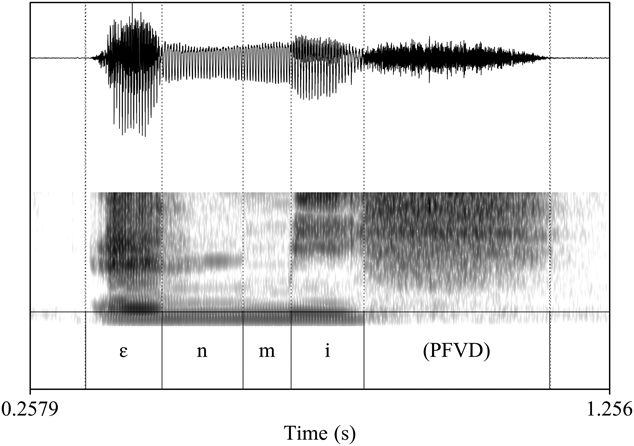
PFVD was described for the first time in the literature by Fónagy (1989, p. 247) as a “sharp whistle that occurs phrase-finally and corresponds to the final vowel of the phrase.” Devoicing that produces a whistling sound rather than merely aspiration through the cessation of glottal pulsing cannot be tied to diminished subglottal pressure at the end of a phrase, but appears instead to be a type of active devoicing in which a speaker introduces a downstream noise source onto a vowel (Ladefoged & Maddieson, Reference Ladefoged and Maddieson1996). PFVD in French appears to be under the active control of the speaker. On the spectrogram, PFVD takes on the physical appearance of a period of intense high-frequency energy between 2–4 kHz (akin to a fricative) following the presence of a steady-state vowel. See Figure 1 where the devoiced portion of the word ennemi [Ɛnmi] “enemy” is delineated on the text grid by the label (PFVD).
Phrase-final vowel devoicing (PFVD) on the spectrogram, word: ennemi ‘enemy’.

In his impressionistic description of PFVD, Fónagy (1989, p. 247) cites the phenomenon as occurring after both mid and high vowels, for example, [ø]: les deux_ch, Footnote 1 [e]: le té_ch, [y]: je t’ai vu_ch, or [u]: le tout_x, as an absolute marker of the end of a discourse unit. Subsequent experimental studies found it to be most prevalent in phrase-final low tones after the high vowels [i], [u], and particularly [y] (Fagyal & Moisset, Reference Fagyal and Moisset1999; Martin, Reference Martin2004; Smith, Reference Smith2003). Smith (Reference Smith2002) investigated the effect of sentence type on the realization of vowel devoicing and found that the ends of statements favored devoicing more than the ends of partial, echo, or inverted questions, but this finding was only significant for three of five test speakers who exhibited final vowel devoicing. This suggests that sentence type (declarative vs. interrogative) is a more pertinent factor in conditioning vowel devoicing than intonation, which falls at the end of both declaratives and partial interrogatives.
Task type appears to have an effect on the occurrence of PFVD, which indicates that it may be conditioned, in part, by a speaker’s perception of the formality of the task. Fagyal and Moisset (Reference Fagyal and Moisset1999) examined recordings of conversations among friends and compared their rates of devoicing to when they read short texts. They found the phenomenon to be more prevalent in read speech than in free conversation, but such results were skewed by the low quality of the recording of the conversational data, which could have confounded final devoiced segments with background noise. Other studies (Martin, Reference Martin2004; Smith, Reference Smith2003), however, have corroborated the finding that rates of PFVD are increased in read speech relative to more natural interaction. Smith (Reference Smith2003) points out that the controlled speech typical of the laboratory setting is both useful and problematic: It allows the researcher to maximize the ideal phonological conditions for observing particular speech phenomenon, yet when controlling only for linguistic context, researchers may not include the particular lexical items that best exemplify a given speaker’s habitual behavior, and instead use nonce words or rare words that are unattested in colloquial speech. Usage might be more important in accounting for variables of this type (Bybee, Reference Bybee, Bybee and Hopper2001a, Reference Bybee2001b; Pierrehumbert, Reference Pierrehumbert2002). For example, it is well known that the use of an ingressive airstream mechanism in French is constrained to the lemma for the word “yes”: oui, or its more colloquial allomorph ouais. A usage-based approach would hold that through the exposure to repeated repetitions, a listener comes to store the ingressive variants of these items along with the social information about the contexts in which they would be used in contrast to the egressive ones.
In a recent study on PFVD, Smith (Reference Smith2006) used recordings of telephone conversations between ten Parisian female strangers speaking spontaneously to complete a map task. She not only found higher overall rates of devoicing than were found in Fagyal and Moisset (Reference Fagyal and Moisset1999), but she found them in a greater set of phonological contexts, including high, mid, low, and even nasalized vowels. An increase in overall rate and phonological contexts, she argued, is exactly what would be expected if the phenomenon had become associated with a particular stylistic context (i.e., clear speech with a stranger), in addition to its original prosodic context. A finding of note is that the word oui was realized with a devoiced vowel not only word-finally, as would be predicted by the phonological context, but also phrase-medially. This observation provides evidence for exemplar-based models. Dalola (Reference Dalola2015) corroborated this finding at a more general level, finding that the higher the lexical frequency, the more likely a word was to exhibit a devoiced vowel.
With regard to the sociodemographic predictors of PFVD, previous research has focused primarily on the contributions of gender and age. Although Fónagy (Reference Fónagy1989) does not comment explicitly on gender, each of the three examples he provides come from the speech of females. Fagyal and Moisset (Reference Fagyal and Moisset1999), who sampled the speech of four male and six female participants, found that the women tended to devoice more than men in their sample. Smith (Reference Smith2002) included speakers of both sexes in her sampling, but her study was not designed to test for such an effect. In Smith (Reference Smith2006) she eliminates the effect of gender altogether by sampling only women. Note that if females do devoice more than men, then gathering observations from a single gender category can over- or underestimate the overall rates of devoicing in a sample. This might, for instance, account for the observed increase in rates of devoicing in Smith’s telephone study.
All of Fónagy’s (Reference Fónagy1989) female speakers were 35 years old or younger, and were described as jeune “young” and fillette “young girl,” although he never explicitly discussed age as a potential conditioning factor for PFVD. No significant differences attributable to age were found by Fagyal and Moisset (Reference Fagyal and Moisset1999), whose sample population was divided into three different groups: 61–85 years, 55–60 years, and 16–35 years of age. Such findings inspired Smith (2002: 148) to exclude age as a factor in her experiment design, even though her subjects’ ages ranged from “graduate students in their mid-20’s [to] middle-aged university professors.” All the women in Smith’s (Reference Smith2006) telephone study are described as undergraduate but no definitive age range is specified for them.
Stylistic Variables
In her recent work, Smith (Reference Smith2006) suggests that stylistic context as well as phonological context contributes to variation in PFVD. There are various performance and interactional variables that potentially affect what we can pretheoretically refer to as style. In our study, we operationalize style using several variables that potentially affect PFVD. We test the type of task the speaker is engaged in as a reflection of attention paid to speech (word list or role play), following Labov (Reference Labov1972); we test register as the type of speech favored for a given performance (formal or informal) and the speech rate employed in its performance (slow or conversational).
A shift in task from reading to role playing does not necessarily entail a change in formality, as word lists and reading passages can range from the highly vernacular to the hyperliterate/hyperstylized, and can be performed with different degrees of formality, depending on the content of the passage and words selected. Thus, in the present study, we attempt to manipulate register (formal/informal) independently of task, though they do covary to some degree in this study, a fact that we confront when we fit our statistical models. Finally, we consider speech rate as part of the constellation of factors that make up style. In fact, speech rate is known to affect vowel devoicing (Myers, Reference Myers2005); in Kinyarwanda, more of the portion of a final vowel is devoiced in faster speech, where vowels are shorter than in slower speech. Speech rate may also covary with task and register but its effect cannot be discounted and, as such, is included here.
Dependent Variables
We study L1 and L2 French speakers’ production of PFVD in terms of two different parameters: (a) the number of devoicing occurrences in a set of potential target items and (b) the degree of devoicing exhibited by the target vowel. Given the findings of previous work on PFVD, we restrict our focus to phrase-final, statement-final instances of the French high vowels /i,y,u/, even though devoicing has been attested, albeit at lower rates and to lesser degrees, in the mid, low, and nasal vowel series. Limiting the vowel series under investigation to just the high vowel series in frequent lexical items allows us to investigate the phenomenon under its most robust conditions. Here, we follow earlier studies and examine the quality of the vowel in PFVD and the position of the target items in the prompt (phrase final vs. nonphrase final) as linguistic factors. The quality of the final vowel and phrasal position have been consistently identified in the literature as the fundamental conditioning factors for devoicing in French and we include them here. We do not strictly control for word frequency (some of the words are surnames) but we did exclude the token oui “yes” from our materials, given its idiosyncratic behavior with respect to airflow and laryngeal properties.
To test Smith’s (Reference Smith2006) claim that vowel devoicing is associated with a particular stylistic context, we manipulate task, register, and speech rate in order to measure the effect of these variables. To do this, we call on Bell’s (Reference Bell1984) notion of referee design, in which speakers are prompted to shift their style to address an absent reference group that is described to them by an experimental cue. The experimental design includes two speakers groups: L1 French speakers and experienced L2 French speakers, as described in the following text.
METHODS
Participants
Twenty-four participants, ranging from 21 to 70 years of age, were recruited through snowball sampling. They were placed into two groups according to their dominant language, French or English, depending upon their national background and language of education. Each group comprised 12 participants, balanced for sex (6 males, 6 females). One group consisted of L1 French speakers who were born, raised, and educated in France; grew up in a French-speaking household; and were not native in any other language. They ranged in age from 21 to 70 (m = 39). Although L1 French speakers, members of this group were bilingual in English and living in the United States (range: 4 months–38 years; m = 32.4 months) at the time of the study, as long-term residents working as French-language professionals, for example, teachers, translators, journalists, or short-term residents visiting as university exchange students. In both groups, speakers maintained regular contact with speakers in France through familial, academic, and/or professional contacts. A second group comprised experienced L2 French speakers who were born in the United States, educated in American English, and were not native in any other language. Speakers in this group ranged in age from 23 to 63 (m = 36.6). The high proficiency L2 French speakers were experienced, late language learners, characterized by using the French language on a daily basis in their profession. They were university teachers of French, having earned or being en route to an advanced degree in French, and having spent one or more years living abroad in France (range: 12–37 months; m = 16.8). All participants from both groups were recorded in a university phonetics laboratory. The participants were not paid for their participation.
Stimuli
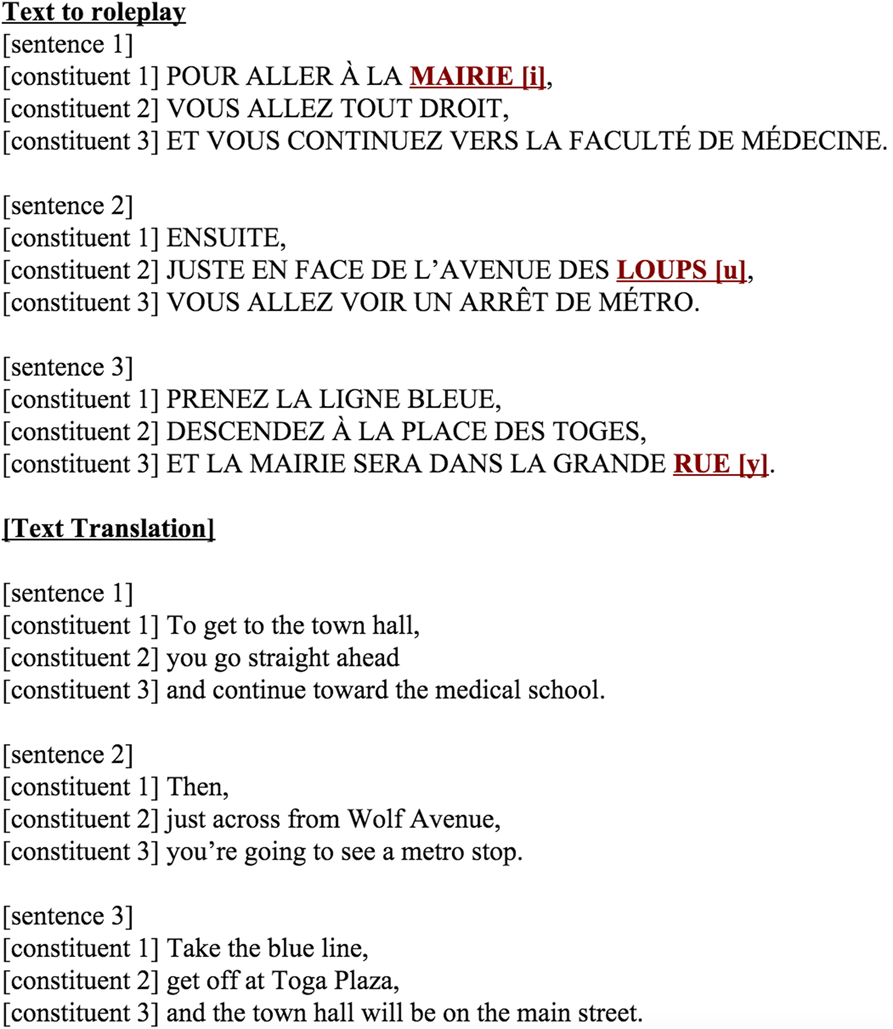
The stimuli consisted of four role-playing passages, each composed of three full sentences containing three constituents; each constituent corresponded to a groupe rythmique “rhythmic group,” or breath group, in French, and is defined as a coherent syntactico-semantic unit that contains only one (final) prominent syllable (see Figure 2).
Example roleplaying passage with constituents marked (target: formal, slow speech).
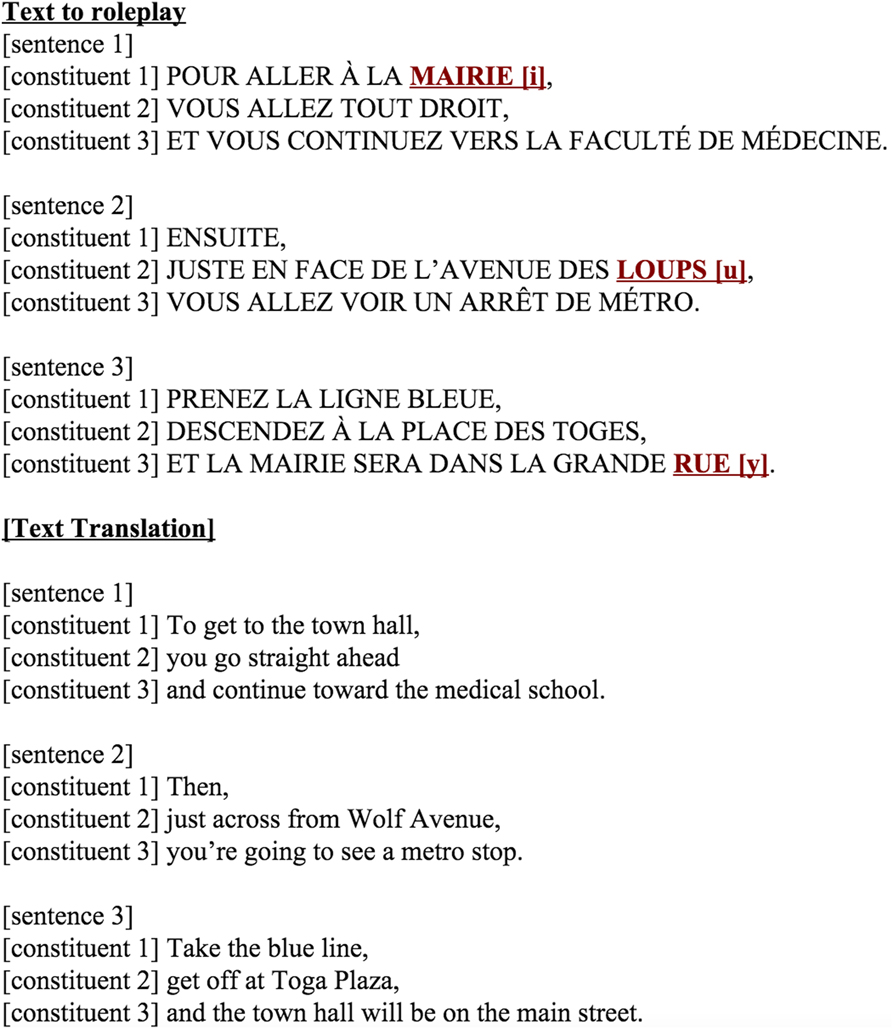
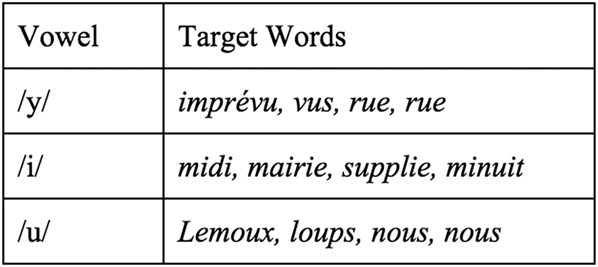
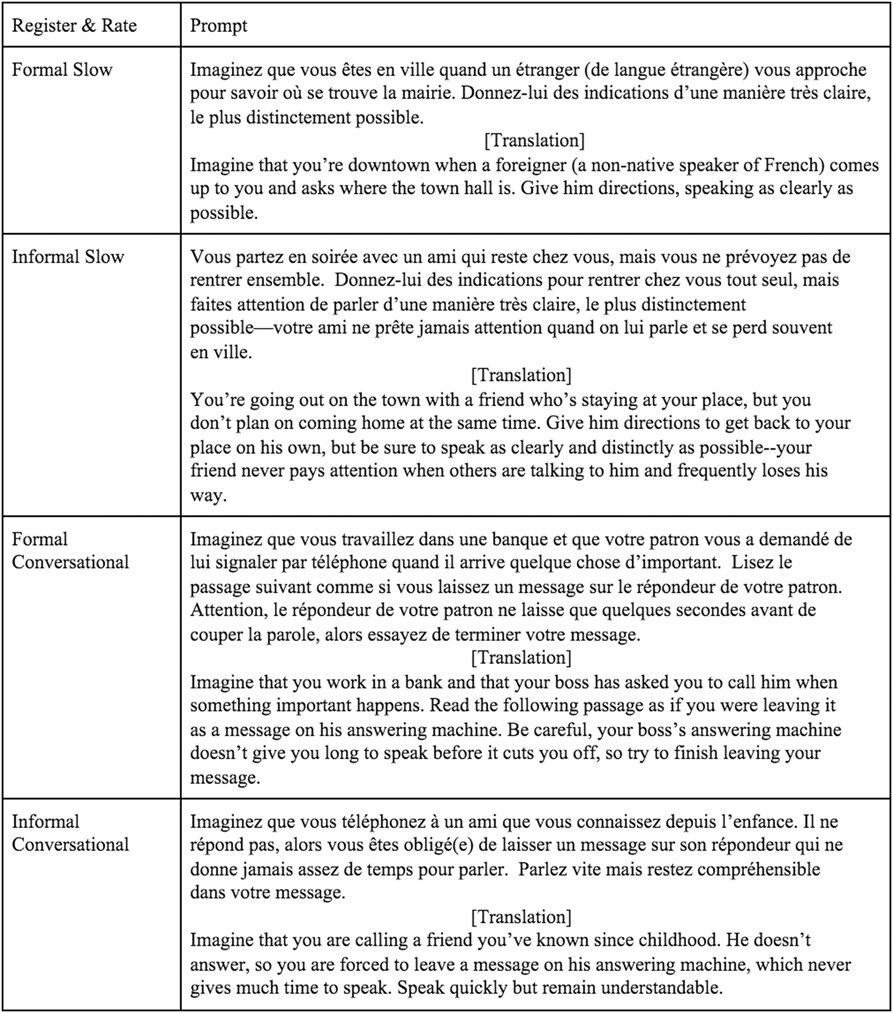
Rhythmic groups were overtly marked in the sentences by commas. In general, the right edge of nonfinal breath groups is marked by rising intonation, while the right edge of the utterance final constituent of a declarative is marked by a low tone (Jun & Fougeron, Reference Jun and Fougeron1995). In each sentence, there was one target word containing French [i], [y], or [u] in final position in the breath group. The passages were manipulated in terms of the register (formal or informal) and rate of speech (slow or conversational) to be projected. Role-played speech was employed as a means of eliciting target words in speech that is more natural than reading a word list. An example passage is provided in Figure 2, with the target items shown underlined and in bold. The target items were also presented to participants in a word list with fillers to be read in isolation. The full list of target items and prompts can be found in Figures 3 and 4.
Target words.

Full list of prompts.

We attempted to elicit register and speech rate in two ways. First, the lexico-pragmatic contents of the role-playing passage were manipulated to vary between quotidian language used among friends versus more formal language used between socially distant conversation partners. For instance, passages that prompted the participants to address their interlocutor with the second-person familiar, tu, to use expressive salutations such as hé or coucou or to read well-established orthographic conventions for expressing orality, such as steuplaît (s’il te plaît “if you please”) were designed to elicit informal speech. Passages to be performed using more formal styles invariably required the socially distant second person, vous, combined with a neutral vocabulary and written in conventional orthography. The second method used to elicit variation in register and rate was to introduce each passage with a scenario that was meant to cue the participants about their relationship to their imagined interlocutor and the rate of the delivery that they were to use.
Procedure
The task was presented using PowerPoint on a desktop computer. Each role play was introduced with a scenario slide that established the formality and speech rate of the scenario, as shown in the examples in Figure 4. The subsequent slide then presented the text the participants were to perform. Participants were given as much time as they desired to look over the text before acting it out aloud two times in succession. In the case of a reading or speaking error, they were instructed to restart from the beginning of the sentence where the error had occurred. The task was self-paced and participants were allowed to ask questions about the details of the scenario at any point. Following the four role-playing texts, participants read aloud a word list visualized on two consecutive slides at a speed deemed “normal” for them. The speech samples were recorded in a soundproof booth using a head-mounted microphone and a solid-state digital recorder (Marantz PMD660). The researcher was the same for all experimental sessions and was the only person other than the participant present during the experiment. Because the task involved role playing, an activity that engaged some participants more than others, the researchers only made use of recordings where participants were fully engaged and not simply reading (this resulted in the exclusion of two participants).
Measurements
The recordings were digitized (44 kHz, 16 bit), downsampled, and edited in Praat for subsequent analysis (Boersma & Weenik, Reference Boersma and Weenik2013). The final vowels in the target items were measured from the spectrographic and time displays for overall duration in milliseconds, starting at the onset of voicing in the vowel and ending at the end of the formant structure of the vowel. The onset and offset of clear energy in the second formant served as a reference, along with the waveform, to determine the edges of the vowel. In cases in which a devoiced portion of the vowel was present as formant structure, it was counted in the overall measurement of vowel length.
Each of the vowels was then inspected for the presence of PFVD, the duration of which was measured in seconds, starting at the loss of a voicing bar in the spectrogram and continuing to the end of the formant structure of the vowel. This value was then divided by the overall vowel length obtained in the first set of measurements to yield a measure of percentage of vowel devoiced. In situations in which there was no devoiced portion, a zero reading was noted, but the lack of PFVD was excluded from the proportional averages in the analysis, so as not to underrepresent the length of PFVD when it occurred.
Because we were operating on the hypothesis that PFVD is not only phonologically, socially, and pragmatically conditioned, but also variable across individuals, we used a mixed model for our analysis, where the intercept for participant was random to avoid Type I errors, or rejecting the null hypothesis when it is true, due to the behavior of an individual participant (Baayen, Davidson, & Bates, Reference Baayen, Davidson and Bates2008). All other factors, aside from participant, were modeled as fixed effects because we assumed they would vary similarly from one participant to the next. Occurrences of vowel devoicing from the role playing and word list tasks were submitted to a logistic mixed-model regression, with speaker group and gender as between-group factors, and task, register, rate, vowel, and location in paragraph Footnote 2 (whether the target word occurs in the first, second, or third sentence of the role-playing passage) as within-subject variables.
Measures of vowel length and length of devoicing from the role playing and word list tasks were submitted to a linear mixed-model regression with speaker group and gender as between-group factors, and task, register, rate, and vowel and location in paragraph Footnote 3 as the within-subjects variables. All statistical analyses were computed using glmer () and lmer () in the statistical tool R (R Core Team, 2007).
Hypotheses
Number of Devoicing Occurrences.
Because PFVD appears to be socially conditioned and is not automatic, we expected that L1 French speakers will devoice more frequently than L2 French speakers, who may not have as much firsthand experience in the L1 speech community. Previous studies on PFVD informed our expectation that L1 French females will devoice more frequently than L1 French males, but we did not know if L2 French females and males would show the same patterns. We surmised that the word list that requires the most attention to speech will exhibit more instances of devoicing than the more conversational role plays. Similarly, previous studies would predict that passages read as formal speech will exhibit more instances of devoicing than those read as more informal speech. Because the variable has been found overwhelmingly to be a marker of phrase-finality in French and in other languages, we expected PFVD to occur more often in target words in the final sentence of the role plays than those in sentences in non-paragraph-final positions. We have no reason to predict that one high vowel should devoice any more or less than any other, so we posit that there will be a similar number of devoicing instances across all the high vowels.
Degree of Devoicing.
We have no reason to expect there to be any differences among speaker group, gender, level of formality, or vowel with regard to the degree of devoicing of affected vowels. However, we may expect speech rate to affect the degree of vowel devoicing, as Myers (Reference Myers2005) shows that shorter vowels in Kinyarwanda exhibited a greater percentage of devoicing than did longer ones. If the same pattern were to hold in French, we might expect a greater percentage of the vowel duration to be devoiced in fast speech, where the vowels are shorter, than in slow speech.
RESULTS
Number of Devoicing Occurrences
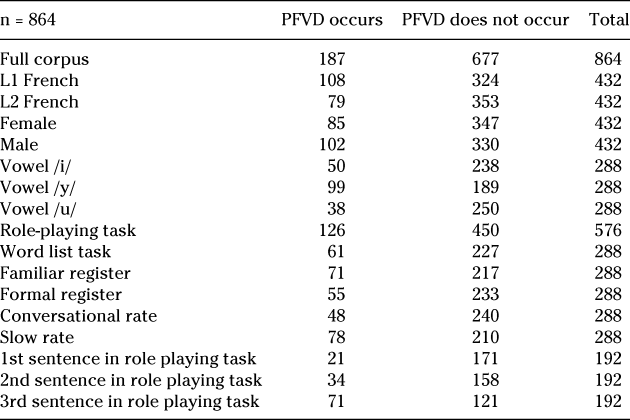
To model the occurrence of devoicing, we fit logistic models with task as an independent variable separately from models with register, rate, and location in paragraph. This was done because the participants were not prompted to read the word list according to different levels of formality (register) or speed (rate), and because the location in paragraph is inapplicable for a word list. A contingency table illustrating the number of devoicing occurrences in various conditions is shown in Table 1. No instances of devoicing were discarded. In the discussion of inferential statistics, we report on the results of the task model first and then for the Register, Rate, and Location (RRL) model.
Contingency table of devoicing occurrences

Task Model.
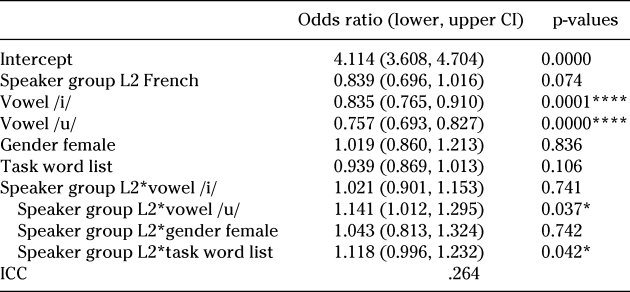
The full model for the frequency of PFVD is pictured in Table 2.
Logistic mixed-model for frequency of PFVD (task model)

Note. *= p < .05, ** = p < .01, *** = p < .001, **** = p < .0001.
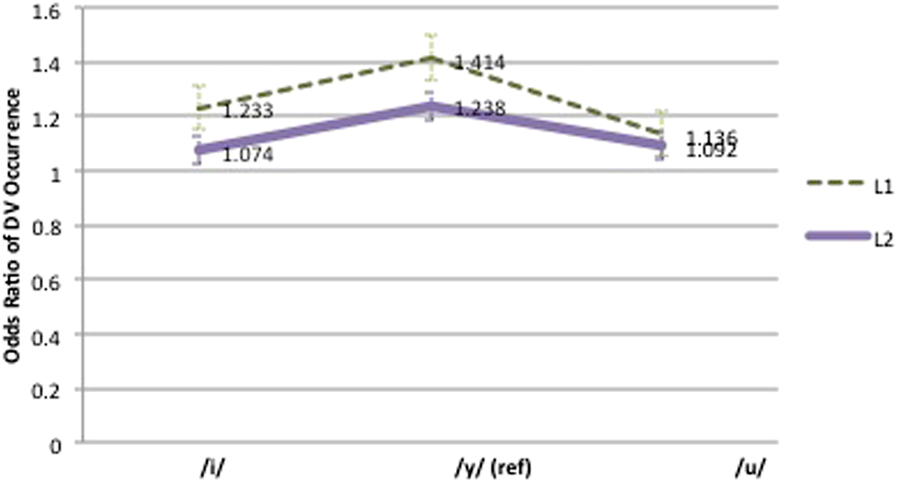
The dependent variable is binary occurrence of devoicing. There was a main effect for the factor, vowel, such that vowel /i/ was 16.5% less likely to be devoiced and /u/ was 25% less likely to be devoiced than the reference vowel in the model, /y/. These main effects were further clarified by a significant interaction with speaker group, as visualized in Figure 5 as the difference between the odds ratios of PFVD production of each vowel by each speaker group, compared to the value of the reference vowel, /y/ (the intercept). As shown, the difference between the occurrence of devoicing in the vowel /u/ and the reference vowel /y/ is more pronounced for L1 speakers than for L2 speakers, as is evidenced by the variable difference in the odds ratios for each category (L1∆ = 0.278; L2∆ = 0.146). This indicates that both L1 and L2 speakers are sensitive to changes in vowel type when devoicing, but that they show varying degrees of sensitivity to the different vowels. The longer error bars for the L1 data reveal a larger degree of individual variation in the group than is observed in the L2 data.
Odds ratios of devoicing occurrence by vowel type (T Occurrence Model) with 95% CI.

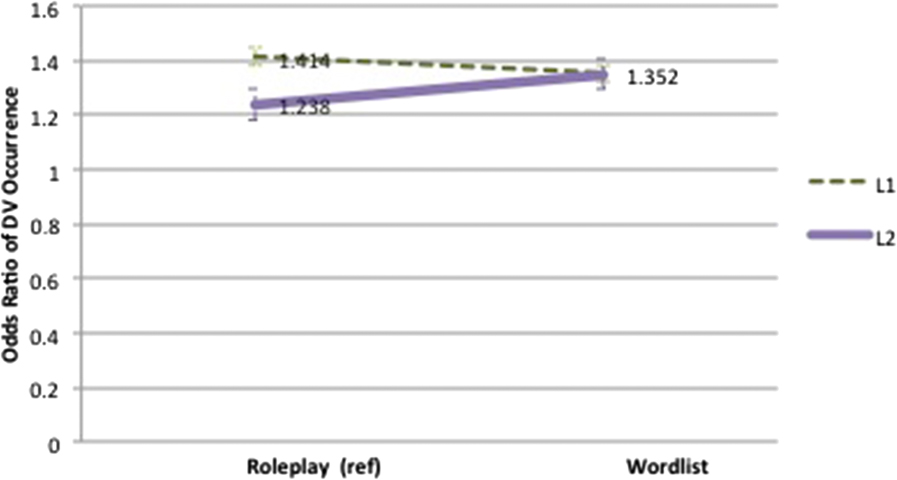
The model revealed no other main effects, although it did detect a significant interaction between speaker group and task type. In Figure 6, the difference between the number of vowels devoiced between role plays and word lists is more pronounced for L2 speakers than for L1 speakers, as is evidenced by the variable difference in odds ratios for each category (L1∆ = 0.062; L2∆ = 0.111). This indicates that both L1 and L2 speakers are sensitive to the change in task type when devoicing, but show varying degrees of sensitivity to the different types. The longer error bars for the L2 data reveal a larger degree of individual variation in the group than is observed in the L1 data.
Odds ratios of devoicing occurrence by Task Type (T Occurrence Model) with 95% CI.

An ICC value estimating the percentage of variation that could be accounted for by the random effect of participant was 26%, suggesting marginal variation among the participants.
Register, Rate, and Location Model.
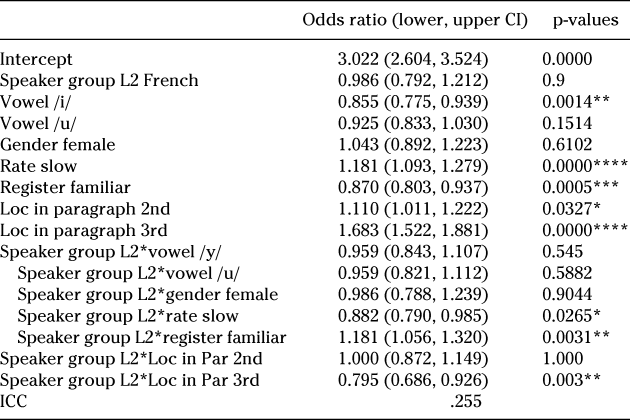
A second model examined the effects of RRL on whether or not a vowel is subject to PFVD. The full model is listed in Table 3, where the dependent variable remains the binary occurrence of devoicing.
Logistic mixed-model for frequency of PFVD (RRL occurrence model)

Note. *= p < .05, ** = p < .01, *** = p < .001, **** = p < .0001.
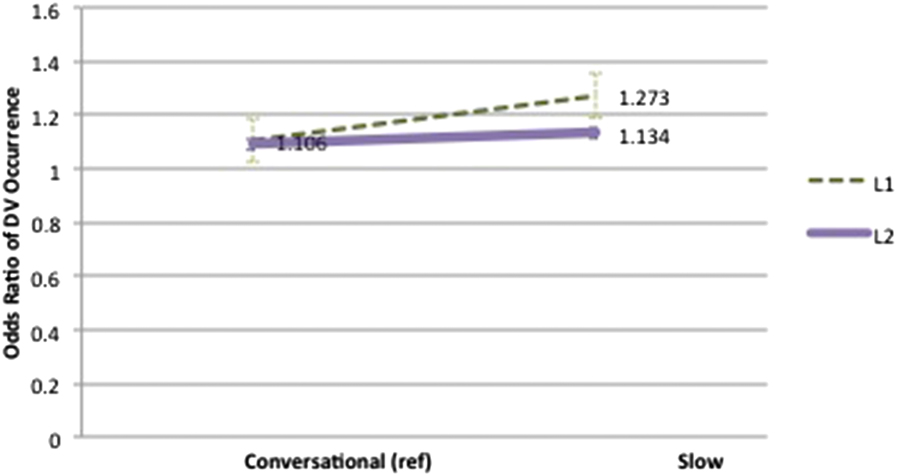
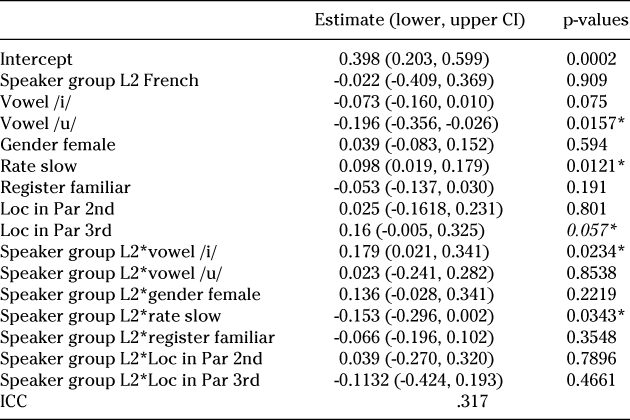
The model revealed a main effect for vowel type, such that /i/ was 14.5% less likely to be devoiced than the reference vowel /y/. There were no significant interactions involving any level of the variable for vowels. There was a main effect for speech rate, such that slow speech was 1.18 times more likely to be devoiced than conversational speech. This main effect was further clarified by a significant interaction with speaker group, as shown in Figure 7. In this interaction, the occurrence of devoicing between conversational and slow speech is more pronounced for L1 speakers than for L2 speakers, as can be seen in the variable difference in odds ratios across categories (L1∆ = 0.167; L2∆ = 0.042). This indicates that both L1 and L2 speakers are sensitive to changes in speech rate when applying devoicing, but that they show different degrees of sensitivity. The longer error bars for the L1 data reveal a larger degree of individual variation in the group than is observed in the L2 data.
Odds ratios of devoicing occurrence by speech rate (RRL Occurrence Model) with 95% CI.

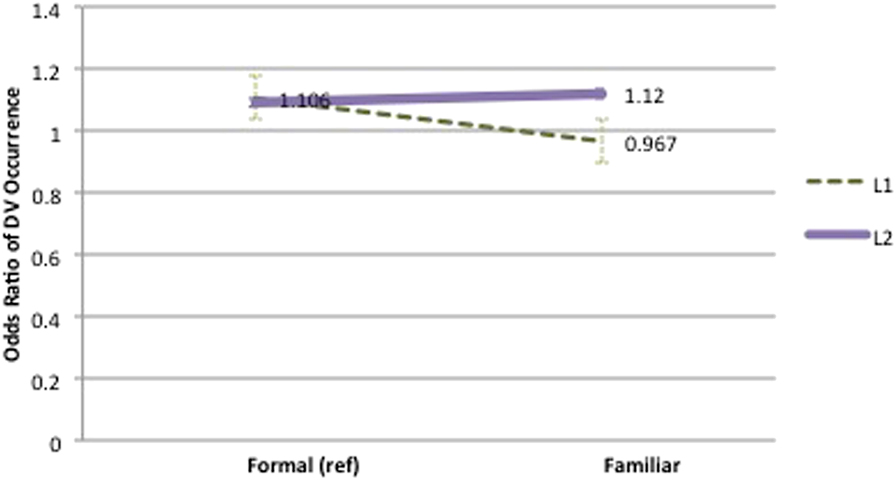
A main effect for register was also found on the rate of devoicing; familiar speech was 13% less likely to exhibit devoicing than formal speech. An interaction between speaker group and register (Figure 8) shows that the rate of devoicing between formal and familiar speech was more pronounced for L1 speakers, as is seen in the variable difference in odds ratios across categories (L1∆ = 0.139; L2∆ = 0.028). This indicates that only L1 speakers exhibit significant sensitivity to changes to register when producing PFVD, while L2 speakers do not. The longer error bars for the L1 data reveal a larger degree of individual variation in the group than is observed in the L2 data.
Odds ratios of devoicing occurrence by register (RRL Occurrence Model) with 95% CI.

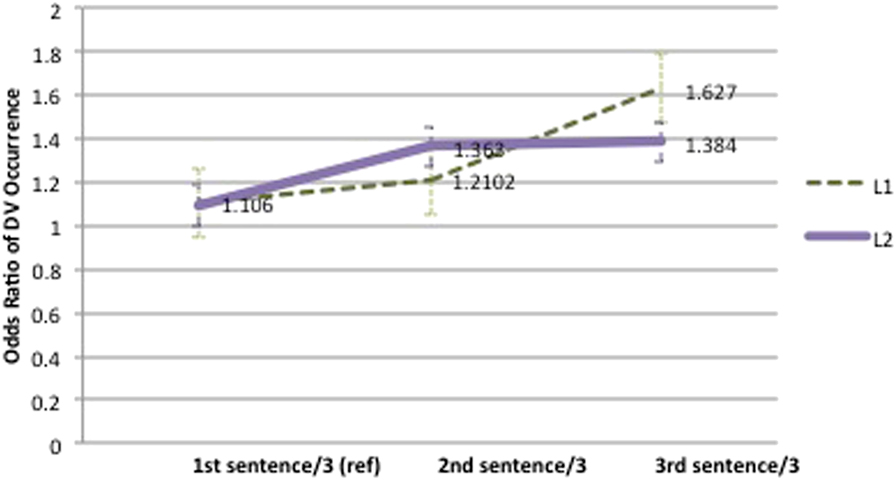
A main effect for location in paragraph was also found. In paragraphs composed of three sentences, the sentences in second position were 1.11 times more likely to exhibit devoicing than sentences in first position, while those in third position were 1.68 times more likely. A significant interaction emerged between speaker group and location in paragraph (see Figure 9), in which L1 speakers made a three-way distinction in devoicing rates, producing significantly higher rates for each successive position in the paragraph, while L2 speakers only produced a two-way distinction: 1st position versus 2nd and 3rd. The longer error bars for the L1 data again reveal a larger degree of individual variation than in L2. An ICC again suggested marginal variation among the participants (26%).
Odds ratios of devoicing occurrence by location (RRL Occurrence Model) with 95% CI.

Best-Fitting Model for PFVD Occurrence.
An ANOVA was run to determine the best fit in predicting the rate of vowel devoicing between the Task (T) and RRL models. The fit statistics of AIC and BIC Footnote 4 both revealed the fit of the RRL model to be significantly better (RRL Model: 455.49 (AIC), 516.48 (BIC) vs. T model: 828.44 (AIC) vs. 885.58 (BIC), p > .001). This suggests that the variation observed in the production rates of PFVD by L1 and L2 French speakers are better accounted for by a model that targets variability in RLL than one that targets variability in task type only.
Degree of Devoicing
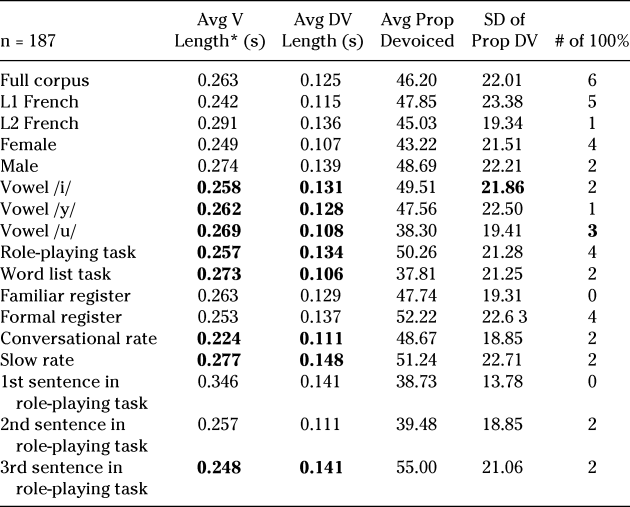
To model the length of devoicing, we fit linear models with task as an independent variable separately from models with RRL. A summary table illustrating the average length of devoicing in various conditions is shown in Table 4. Data points with no devoicing, for example, 0%, are excluded in the values reported in Table 4; all lengths of measured devoicing are included.
Summary of proportion devoiced

Note. *This is a measure of overall V length: voiced vowel portion + any devoiced portion.
Task Model.
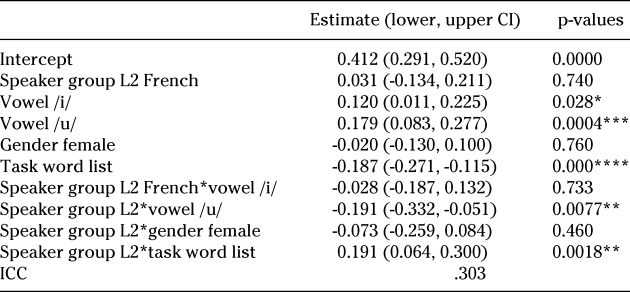
The full linear regression model for the degree of PFVD is pictured in Table 5 where the dependent variable is a continuous variable (i.e., percent of vowel devoiced).
Linear mixed-model for degree of PFVD (task model)

Note. *= p < .05, ** = p < .01, *** = p < .001, **** = p < .0001.
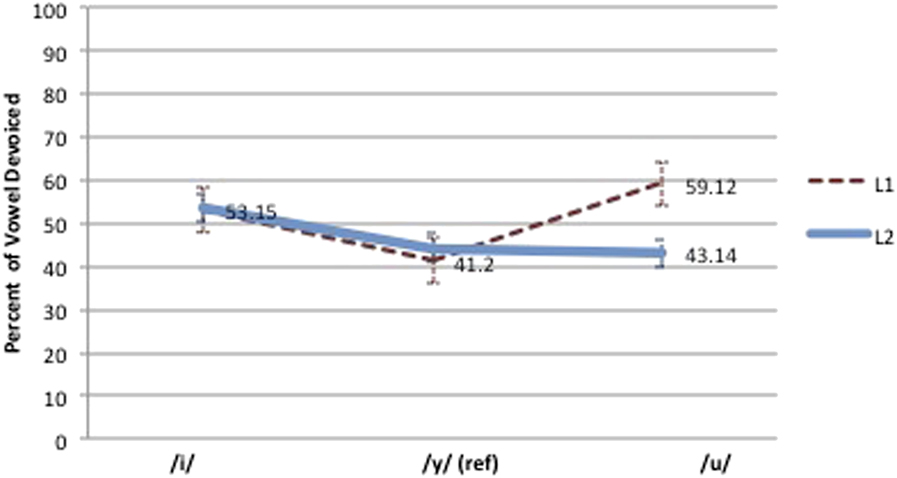
The model found a main effect for vowel, such that the devoicing in /i/ was 12% longer and in /u/ was 18% longer than the devoicing in the reference vowel, /y/. A comparison of overall raw vowel duration and raw devoicing duration (see Table 4) reveals that these main effects are caused by shorter overall vowels and longer periods of devoicing in the case of /i/ and a high number of vowels that were 100% devoiced in the case of /u/. There was a significant interaction between speaker group and vowel (see Figure 10). L1 and L2 speakers devoiced all vowels to similar degrees except for /u/, which L1 speakers had a tendency to realize with PFVD that was approximately 15% longer than L2 speakers. This indicates a three-way degree of voicing distinction for L1 speakers—/y/ was devoiced the least, followed by /i/ and then /u/—and a two-way distinction for L2 speakers—/i/ is devoiced more than /y/ and /u/. The longer error bars for the L1 data reveal a larger degree of individual variation than for L2.
Percent of vowel devoiced by vowel type (T Duration Model) with 95% CI.

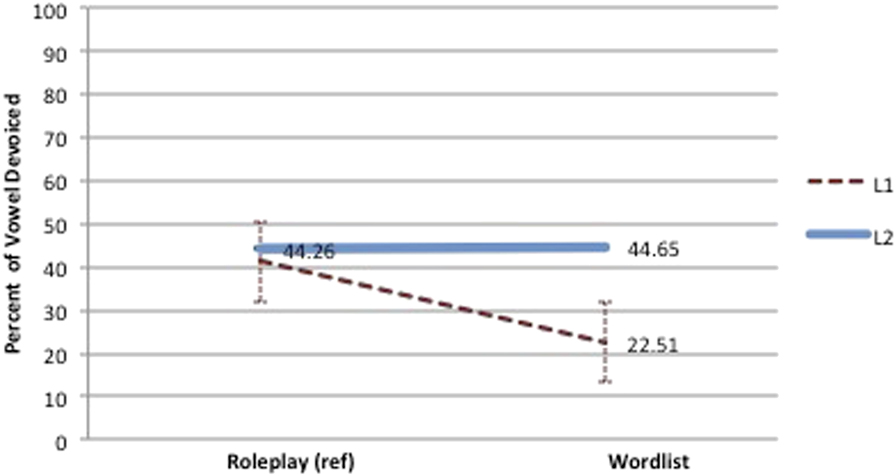
There was also a main effect for task on the degree of devoicing, whereby vowels produced in words in the word list condition were devoiced to an 18.7% lesser degree than those produced in role plays. A comparison of overall raw vowel duration and raw devoicing duration (see Table 4) reveals that this main effect is caused by both shorter overall vowels in the role-playing task and longer periods of devoicing. A significant main effect between speaker group and task (see Figure 11) revealed that whereas L1 speakers produced vowels with significantly longer PFVD in role plays than in word lists, L2 speakers made no distinction in devoicing lengths across the two tasks. The presence of error bars for the L1 data reveal individual variation that was not attested in the L2. An ICC estimated that the percentage of variation accounted for by the random effect of participant was 30%.
Percent of vowel devoiced by task type (T Duration Model) with 95% CI.

Register, Rate, and Location Model.
A RRL model was fitted to the dataset to examine the effects of these three factors on the degree of PFVD in the role-playing data only. The full model is given in Table 6, where the dependent variable remains the gradient percent of vowel devoiced.
Linear mixed-model for degree of PFVD (RRL duration model)

Note. *= p < .05, **= p <.01, ***= p <.001, ****= p <.0001.
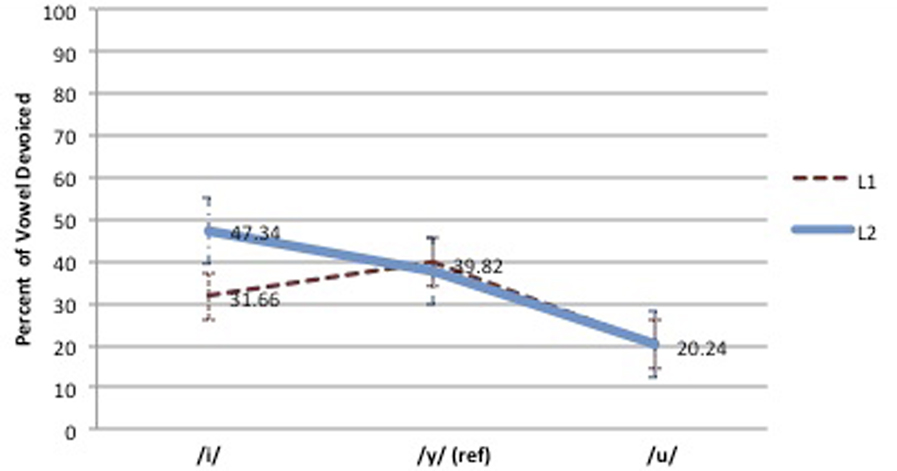
A main effect for vowel was found, such that /i/ was devoiced to a 7.3% lesser degree and /u/ was devoiced to a 19.6% lesser degree than the reference vowel /y/. A comparison of overall raw vowel duration and raw devoicing duration (see Table 4) reveals that these main effects are caused by a higher degree of variability in devoicing length (i.e., a larger standard deviation) in the case of /i/, and longer overall vowels and shorter periods of devoicing in the case of /u/. A significant interaction between speaker group and vowel was found (see Figure 12), which revealed two behaviors: an L1 tendency to devoice /i/ approximately 10% less than reference vowel /y/ and an L2 tendency to devoice /i/ approximately 10% more than /y/. The longer error bars for the L2 data reveal a larger degree of individual variation in the group than is observed for L1.
Percent of vowel devoiced by vowel type (RRL Duration Model) with 95% CI.

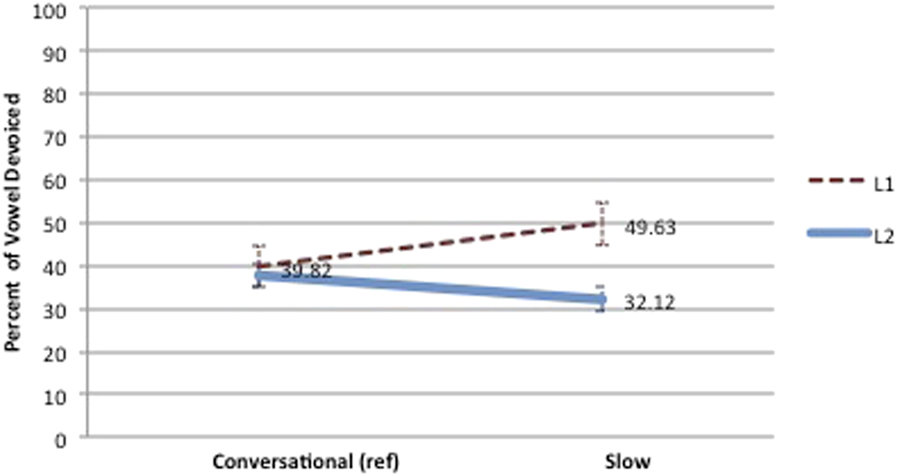
A main effect for speech rate was found, where vowels realized in slow speech were devoiced 9.8% longer than in conversational speech. A comparison of overall raw vowel duration and raw devoicing duration (see Table 4) reveals that this main effect is caused uniquely by longer periods of devoicing in slow speech, and not also shorter overall vowels. A significant interaction between speaker group and speech rate showed that L1 speakers tend to devoice vowels about 10% longer in slow speech, whereas L2 speakers tend to devoice them nearly 10% less, as seen in Figure 13. Again, we see longer error bars for the L1 data than for the L2.
Percent of by vowel devoiced by speech rate (RRL Duration Model) with 95% CI.

There was also a trending main effect for location (p = .057), such that devoiced vowels produced in the third of three sentences were devoiced 16% longer than those in the first and second sentences. A comparison of overall raw vowel duration and raw devoicing duration (see Table 4) reveals that this main effect is caused by both shorter overall vowels in the third sentence of the task and longer periods of devoicing. There was no significant interaction with speaker group, suggesting degree of devoicing behavior was consistent across both groups. An ICC was estimate that the percentage of variation accounted for by the random effect of participant was 32%.
Best-Fitting Model for Degree of Devoicing.
An ANOVA was run to determine the best fit. Both revealed the fit of the RRL model to be better than the T model, however, not at a statistically significant level (RRL model: -88.600 (AIC), -49.827 (BIC) vs. T model: -71.759 (AIC) vs. -20.706 (BIC), p > .05). Despite the lack of significance, the ANOVA results lend more evidence to the previous finding that suggested differences observed in the degree of PFVD production in L1 and L2 French speakers are better accounted for by a model targeting RRL.
DISCUSSION
Rate of Devoicing
The findings demonstrate that there were no demographic factors contributing to the production rates of PFVD. That is, neither gender nor speaker group were significant factors in the probability that devoicing would occur phrase finally. That gender has no effect on PFVD runs contra previous work on this variable, including that of Fagyal and Moisset (Reference Fagyal and Moisset1999), who attest the variable at higher rates among females. The current findings support those of Dalola (Reference Dalola2014) who found there to be no gender effects in either the production or perception of PFVD. It is possible that the disparity in findings with regard to gender is due to the use of different inferential statistics to model PFVD. Mixed models, treating speaker as a random term, may yield different results than those with only fixed effects as arguments.
That L1 and L2 speakers produce PFVD at roughly the same rates runs contra to our hypothesis that L1 speakers would show higher overall rates of devoicing. The speaker groups do, however, show different sensitivities in the rate of devoicing according to task type. Whereas L1 speakers produced a greater number of PFVD instances in role plays than in word lists, L2 speakers exhibited the opposite behavior, producing a greater number of PFVD instances in word lists. This observation can be interpreted in support of Dalola (Reference Dalola2014), who hypothesized that L2 speakers view PFVD mostly as a reflex of formality and, as such, produce it more in situations where more attention is paid to their speech, that is, word lists. By contrast, the findings show that the L1 speakers, who did not perform differently between the word list and the role-playing tasks, did adjust their rates of devoicing according to rate and register with the role plays, producing more incidences of PFVD at the slow speech rate and in the formal register than at a faster rate and in a less formal register. This might indicate that the speakers in the L1 group are more adept at adjusting for differences in style conditioned by referee design than the L2 group, who responded more to changes in style that are defined by completely different tasks (reciting a word list vs. role-play reading). Alternatively, the L1 group might be simply more comfortable performing different referee-designed styles in role playing than the L2 group is. It bears noting that both groups show elevated rates of PFVD in contexts that appear to elicit more careful speech, even if they differ in when such style is called upon.
Beyond the pragmatics of the task, the linguistic factors of vowel type and sentence location in paragraph of the target lexical item contributed significantly to variation in the rate of PFVD and in similar ways between groups. L1 speakers revealed a three-way distinction in the devoicing rates among the series of high vowels in French, with /y/ devoicing most often, followed by /i/ and then /u/. L2 speakers manifested a reduced, two-way distinction, where /y/ is devoiced significantly more often than /i/ and /u/, which are devoiced at the same rates. This partially corroborates the findings of Dalola (Reference Dalola2015) who found /y/ to be the most often devoiced of the high vowels. That /i/ would be found to devoice significantly more often than /u/ is supported by Fagyal and Moisset (Reference Fagyal and Moisset1999). L1 and L2 speakers alike preferred to apply devoicing in the third sentence of the paragraph more often than in the earlier sentences. There was a minor difference between groups, in that the L1 speakers showed a progressively greater rate of PFVD production from the first to the third sentence of the role play, while L2 speakers showed no significant difference in the devoicing rate between the second and third sentences. Overall, the L1 and L2 groups performed very similarly with regard to the linguistic constraints that condition the occurrence of PFVD. They differed mainly on their sensitivity to, on the one hand, word list versus role-play reading and, on the other, changes in speech rate and register formality as prompted by the pragmatics of the role-play scenarios.
Degree of Devoicing
As was the case with the rate of devoicing, there were no demographic factors affecting the degree of devoicing. However, relative to the rate of devoicing, the results with regard to the duration of the manifested devoicing paint a more complex picture because the groups differed considerably along linguistic as well as stylistic dimensions. The results of the statistical models differed depending on how style was operationalized, as either task (word list vs. role play) or as speech rate/register. In each case, the L1 and the L2 groups manifested significant differences in the degree to which they devoiced the high vowels, with the L2 group preferring longer devoiced portions in /i/ and the L1 group in one or the other of the rounded vowels. So, while both groups tended to apply PFVD more often to /y/ than to the other vowels, the L2 group tended to produce the longest devoiced durations in the vowel /i/, while the L1 speakers produced the longest devoiced durations in either /y/ or /u/. The raw duration lengths revealed the different factors contributing to this variable behavior: Even though all three vowels exhibited similar overall lengths, /u/ reported a much lower average devoicing length and proportion devoiced than the others, while /i/ reported a high degree of variability.
The groups also showed different sensitivities to changes in style. L1 speakers showed longer devoiced portions of vowels in the role plays than in the word lists, while L2 speakers showed no difference between tasks. This partially supports Myers’s (Reference Myers2005) finding that final vowels exhibit a longer degree of devoicing in faster speech where they are shorter: In this case, however, the vowels didn’t only exhibit a longer degree of devoicing because they were shorter, but also because the devoiced portions produced in the role plays were significantly longer than those in the word lists. In slow speech, where the raw vowel durations were longer than in conversational contexts, the devoiced portions were found to be longer for L1 speakers but shorter for L2 speakers. In this case, both raw vowel duration and devoicing duration increased in tandem for L1 speakers, but not for L2s.
Taken together, these results suggest that L1 speakers, unlike L2 speakers, tend to produce PFVD more often and with longer voiceless durations in slow speech contexts than elsewhere. The fact that L1 speakers tend to produce the same rate of voiceless vowels in a word list task as they do in role plays, but that they lengthen the devoiced durations of the vowels only in (slow speech) role plays suggests that they enhance or attenuate the degree of PFVD as a function of audience. It becomes an empirical question whether there is a threshold at which these differences in the degree of devoicing become meaningful to listeners, or if they are instead attuning to a certain raw durational threshold of devoicing, rather than to the particular proportion of the vowel that is devoiced.
CONCLUSION
The data from this study have investigated PFVD in Metropolitan French among L1 and L2 speakers in terms of number of times that speakers are observed to devoice a phrase-final high vowel and the percentage of the vowel that is devoiced. Our goal was to assess whether experienced L2 speakers use style-based variation in response to the same factors as NS. Our results reveal that experienced L2 French speakers do deploy PFVD. They tend to match the rate of devoicing of the L1 speakers in this study fairly closely, but the rate is conditioned by different factors in the two groups. The L2 speakers in this study also differed from the NS in the degree to which their vowels were devoiced. This suggests that the experienced anglophone L2 French speakers under study here have acquired the reflex to devoice phrase-final vowels, but that they do not match the degree to which the phenomenon is employed by their native counterparts.
The groups were observed to respond quite differently to shifts in style, which has potential implications for future work in this domain. When the context was manipulated by the role-play prompts that simulated changes in audience design, the L1 speakers responded accordingly, showing higher rates and enhanced degrees of devoicing in pragmatic contexts that favored either slower or more formal speech or both. The L2 speakers appeared to view the pragmatics of PFVD differently, devoicing more often in the word list than in the role play and responding very little to pragmatic shifts called for within the role-play task. This finding potentially illustrates that L2 speakers may have decreased sensitivity to audience with regard to the subphonemic, gradient indexical properties of speech. This may arise from their different attunement to sociophonetic detail and to their relatively limited experience in the L1 speech community in accommodating different types of audiences in different pragmatic contexts. They may lack exposure to sufficient exemplars of PFVD in various pragmatic contexts to be able to gauge the appropriate rate and degree of PFVD favored for a particular interaction, and/or they may lack experience in using the different rates and degrees of PFVD.
The fact that L2 speakers devoice more often in the word list than in the role plays still invites an explanation. This does mark a shift under the original sociolinguistic definition of style as attention paid to speech. One possibility is that L2 speakers view the word list task as an exercise in enunciation and that they resort to PFVD for this purpose. This would mean that they do not employ greater devoicing as either a style-initiating device in French for the enactment of identities or stances or as a reactive form of “clear” style used when the listener is presumed to have perceptual difficulties (Bradlow and Bent, Reference Bradlow and Bent2002). Instead, they reserve it for a potentially hyperarticulated reading style where no particular audience other than the researcher is presumed.
While language experience likely accounts for some of the variation observed in this experiment, we cannot ignore the fact that there might be a task effect in this study; L2 speakers may be less comfortable than NS in performing role plays that require them to use various rates and registers on cue in a foreign language. Further research in more natural communicative contexts might help shed light on this question. An additional consideration is that experienced L2 speakers might not aim to be authentically native, but may prefer to remain more formal, and less colloquial, in their L2 speech as a safeguard against overdoing PFVD and thereby risking ridicule (Piller, Reference Piller2002).
This study adds to the literature on acquisition by demonstrating that advanced L2 speakers use phonetically gradient PFVD and at similar rates to NS. The finding that their use of the variable appears to be subject to different stylistic constraints from those that favor PFVD in NS invites future research so that we have a better understanding of how L1 and L2 perceive its association with socioindexical and pragmatic features.