Introduction
By the ninth century, around two centuries after the Muslim conquest, Persian poetry had embraced the quantitative metrical system of Arabic poetry known as ʿarūḍ. In order fully to adjust to the non-Semitic features of the Persian language, however, some degree of adaptation was required of the strict rules of Arabic prosody. On this basis, the Persians even innovated new patterns unknown to traditional Arabic poetry. As several scholars have argued, the poetic heritage of the pre-Islamic Iranian past may well have played a part.Footnote 1
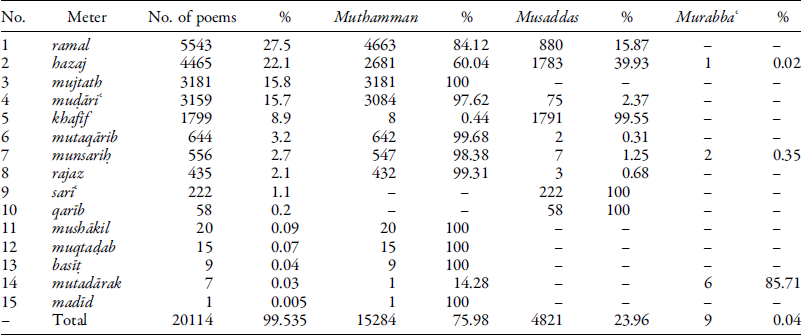
Historically, one distinctive feature of the Persian use of ʿarūḍ is a marked preference for “eightfold” meters, or meters composed of eight feet. In other words, Persian poets have always favored those meters traditionally referred to as muthamman.Footnote 2 Two studies have established this fact. A recent article shows that 57 percent of the meters used by early Persian poets are eightfold.Footnote 3 Elwell-Sutton’s famous 1976 study The Persian Metres relied on a broader corpus. In his book, the scholar examined a wide pool of verses chosen “at random”Footnote 4 throughout the ages, from the earliest Persian verses known up to modern times, with the exception of free verse.Footnote 5 In a total of 20,155 verses surveyed, the scholar identified eighty-seven verse models deriving from fifteen meters. Table 1 reproduces Elwell-Sutton’s findings, which are more representative of the long term.Footnote 6
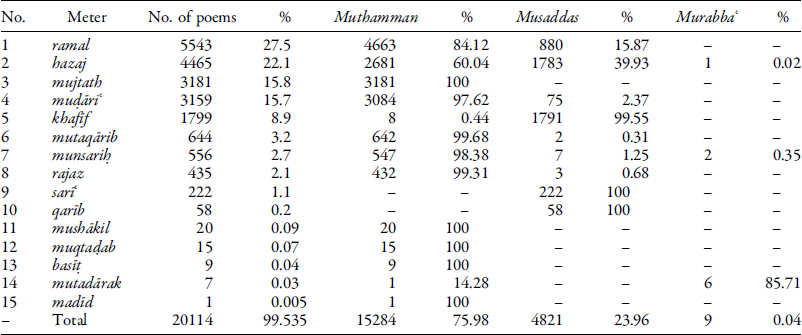
Source: Adapted from Elwell-Sutton, Persian Metres, 145.
With these figures, the Persian predilection for eightfold meters is not only confirmed; it is proven to have strengthened over time. There is, in fact, little room for doubt: over 75 percent of the verses surveyed by Elwell-Sutton are eightfold.
Yet the table allows us to draw a second obvious conclusion: despite the Persians’ blatant preference for eightfold meters, two meters, namely sarīʿ and qarīb, have been used in Persian exclusively in sixfold form. The phenomenon is all the more striking as qarīb is unknown to Arabic poetry and is used only in Persian.
Once it has been established, the Persian partiality for muthamman meters raises three questions: why did the Persians favor eightfold meters over sixfold and fourfold meters? How did they produce them, when the original base model was not composed of eight feet? Finally, why were the sarīʿ and the qarīb meters never used by Persian poets in eightfold form?
In the following, I do not tackle the thorny question of why the Persians, early on, favored muthamman meters in their poems. We need only consider this inclination a fact. The present article addresses the second and third questions only. In what follows, I examine the procedure by which Persian eightfold meters came to be produced. I argue that, to create their muthamman meters, the Persians resorted to a specific procedure that I call “reduplication.” I argue that this procedure was inspired by the structure of the Arabic eightfold base meters. Consequently, I show that, due to a structural incompatibility, the sarīʿ and qarīb meters did not lend themselves to the reduplication process, which is why they were never used in eightfold form in Persian poetry. I conclude my study with a review of the recent scholarship on the role of pre-Islamic Iranian poetry in shaping classical Persian prosody. Recent classifications of the Persian meters seem to confirm my insights; others focus on the development of select classical meters from a pre-Islamic pattern, yet without addressing the phenomenon of reduplication in the shaping of eightfold meters as a whole.
Reduplication: A Persian Notion of Eightfold Meters
In what follows, I appeal to a new method to compare the meters in the Arabic and in the Persian traditions to demonstrate that reduplication was decisive in shaping classical Persian eightfold meters. To do so, I first need to define the three following notions.
-
1. The actual meter is the meter as it is actually used in poetry. In other words, it is a verse model effectively attested in at least one poem: the meter that one will determine by scanning a verse. As I said earlier, in his survey of Persian poetry, Elwell-Sutton identified eighty-seven verse models, that is, eighty-seven actual meters. The three following eightfold meters, for instance, are all actual meters:
-
(a) mafʿūlu fāʿilātu mafāʿīlu fāʿilun (- - ᴗ/- ᴗ - ᴗ/ᴗ- - ᴗ/- ᴗ -);Footnote 7
-
(b) mufāʿilun faʿilātun mufāʿilun faʿlun (ᴗ - ᴗ -/ᴗ ᴗ - -/ᴗ - ᴗ -/- -);
-
(c) mafāʿīlun mafāʿīlun mafāʿīlun faʿūlun (ᴗ - - -/ᴗ - - -/ᴗ - - -/ᴗ - -).Footnote 8
The reduplication process under discussion in this article is not to be sought at the level of “actual meters,” but in the “base meters.”
-
-
2. The base meter is an abstract model, a general formula used to identify the basic feet and scheme from which the actual meters are derived, either by means of “intact” or “altered”Footnote 9 derivation.Footnote 10 To all actual hazaj meters in eightfold form, for instance, there corresponds only one eightfold hazaj “base meter.” As a result, every actual meter is named after the derivation(s) undergone by, or variations imposed on, that base meter. The base meters for the three examples given above (in a, b, and c) are the following:
-
(a) mafāʿīlun fāʿilātun mafāʿīlun fāʿilātun (ᴗ - - -/- ᴗ - -/ᴗ - - -/- ᴗ - -);Footnote 11
-
(b) mustafʿilun fāʿilātun mustafʿilun fāʿilātun (- - ᴗ -/- ᴗ - -/- - ᴗ -/- ᴗ - -);Footnote 12
-
(c) mafāʿīlun mafāʿīlun mafāʿīlun mafāʿīlun (ᴗ - - -/ᴗ - - -/ᴗ - - -/ᴗ - - -).Footnote 13
The reduplication process I am concerned with here applies solely at this basic level. These base meters are an abstract representation founded on the effective use of the meters, unlike the theoretical representations devised by al-Khalīl.
-
-
3. The Khalīlian base meter. Tradition traces the theoretical foundations of Arabic prosody back to al-Khalīl b. Aḥmad al-Farāhīdī, the illustrious Basran grammarian of the eighth century. Al-Khalīl devised an ingenious representation in the form of circles to account for the basic formulae of Arabic meters, classify them, and assess their structural relationship to one another.Footnote 14 With all its formal perfection, however, the Khalīlian theory is partly inadequate to account for the full range of meters actually in use in Arabic poetry. Indeed, the Khalīlian theory generates regularly sound meters that are in fact nonexistentFootnote 15 in the Arabic poetic tradition, and the base meters generated by this theory do not always reflect the actual meters in use among Arabic poets. The Khalīlian base meter for hazaj, for instance, contains three feet per hemistich; in reality, however, the Arab poets only ever used the hazaj with two feet per hemistich.Footnote 16 As regards Persian prosody, therefore, the deficiency of Khalīlian theory becomes all the more apparent for the numerous adaptations and innovations brought about by the Persian poets.
These three notions having been explained, we may now proceed to compare the structure of the base meters in the Arabic and in the Persian traditions. For data on the classical Persian poetic practice, I rely on the observations made by the pre-modern scholars of prosody, which largely remain in force.Footnote 17 As for the Arabic practice, Georges Bohas and Bruno Paoli have provided a detailed account of the sixteen base meters as they were used in classical Arabic poetry.Footnote 18
The Khalīlian system was already fully articulated in the eighth century, while Persian prosody becomes quantitative by the ninth century. Given the chronological order of succession, one may well wonder whether a connection could be established between the Persian use of eightfold meters and the Khalīlian theory. To try to answer this question, I have integrated in my discussion the Khalīlian base meters as they appear in his circles, and al-Khalīl’s theory.
Drawing from the fifteen meters shown in Table 1, I first discuss nine meters that are in use in Arabic and Persian poetry: mujtath, muqtaḍab, muḍāriʿ, madīd, munsariḥ, khafīf, hazaj, rajaz, and ramal. At a later stage, I further consider the mutadārak, the mutaqārib, and the basīṭ, which are the three other meters in both languages. At this stage, I leave aside the three remaining meters, the sarīʿ and the qarīb being used as sixfold meters only and the mushākil being a purely Persian meter unattested in Arabic.
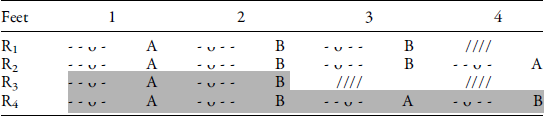
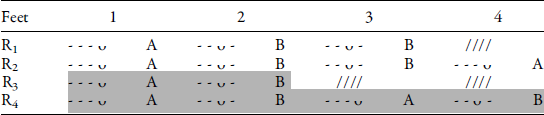
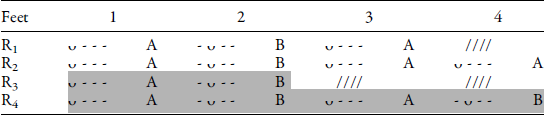
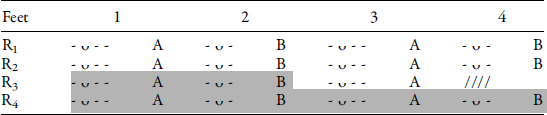
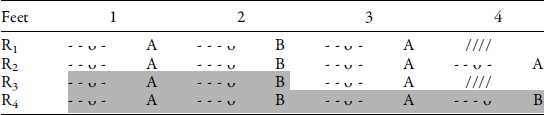
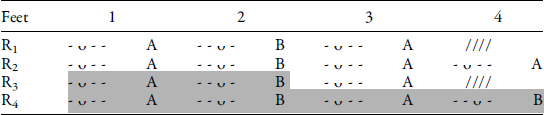
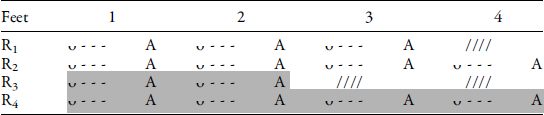
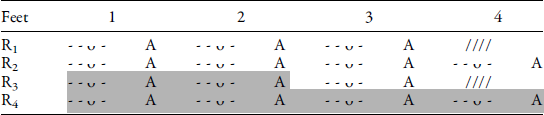
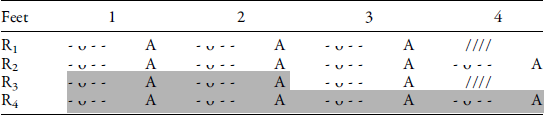
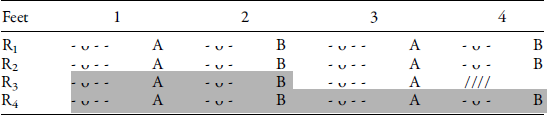
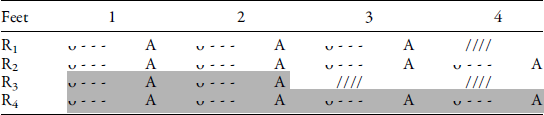
My comparison requires nine tables—one per meter—,each one displaying the four associated base meters, always listed in this order:
R1: the Khalīlian base meter;Footnote 19
R2: R1 in eightfold form;Footnote 20
R3: the base meter evidenced in classical Arabic poetry;
R4: the eightfold base meter evidenced in classical Persian poetry.
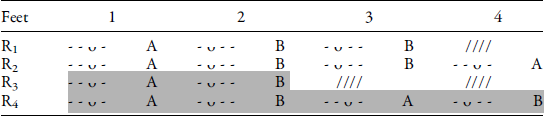
I shall start out with an assessment of compoundFootnote 21 meters:Footnote 22 mujtath, muqtaḍab and muḍāriʿ (Tables 2–4). In Arabic, these appear in fourfold form, whereas in Persian they are almost always found in eightfold form. In following tables, each meter appears with its constituent feet (A and B), and comes with a series of four formulas displayed in short and long syllables.
For all three meters, a comparison of the shaded formulas in rows 3 and 4 call for a single conclusion: the eightfold base meter evidenced in Persian is exactly two times the fourfold version attested in Arabic. The pattern for the Arabic fourfold base meter being AB, its doubled version, ABAB, is identical in length and order to the eightfold Persian base meter.
Let us extend the comparison to the meters madīd, munsariḥ, and khafīf (Tables 5–7), which, in ancient Arabic poetry, were almost always (for the first two) or preferentially (for the last) used in sixfold form.Footnote 23
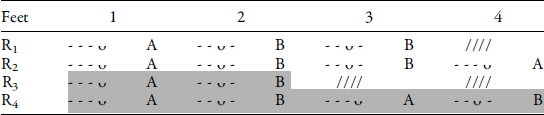
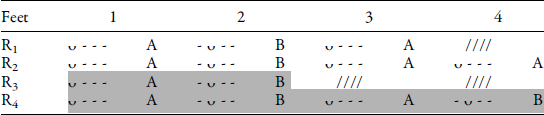
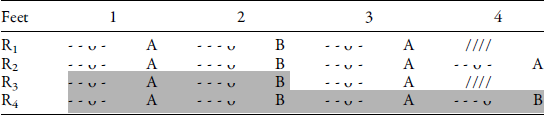
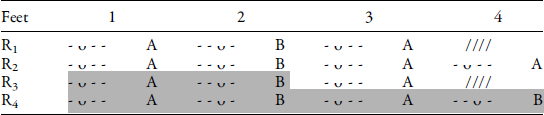
Again, reduplication is substantiated: in each case, the ABAB pattern of the Persian eightfold base meter corresponds to twice the two first feet AB in the ABA pattern of the Arabic sixfold meter. In other words, the pattern for the Persian eightfold meters is a reduplication of their Arabic fourfold counterpart, whether or not the latter is actually attested in poetry.
This observation is confirmed by a survey of the three simple meters that make up a good half of the classical Persian poetic corpus (see Table 1): hazaj, rajaz and ramal (Tables 8–10). Here too, the Persian pattern AAAA equals two times the first two feet of the Arabic equivalent AA or AAA.
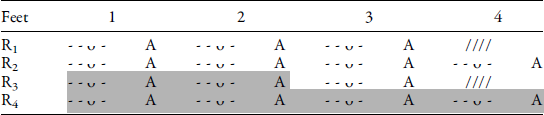
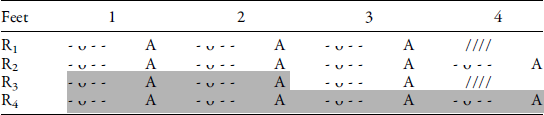
At this point, it can reasonably be assumed that the muthamman base meters in use among the Persian poets are a reduplication of the two first feet of their Arabic counterpart. In other words, the Persians devised their actual eightfold meters in such a way that their base forms carry out a clear reduplication of the existing (or possible) Arabic fourfold meter.
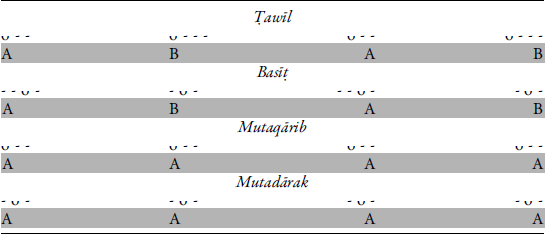
Now, it is only natural to wonder: why did the Persians devise their muthamman meters in this way? I believe that the answer to this question should be sought in the structure of the Arabic eightfold meters. Recent studies have shown that, out of the sixteen meters, four were actually used in eightfold form in Arabic poetry: the ṭawīl, the mutaqārib, the mutadārak, and the basīṭ.Footnote 24 In fact, the first two are exclusively found in eightfold formFootnote 25 in ancient Arabic poetry. As for the basīṭ, although it also appears in sixfold form, the eightfold form was clearly favored by Arabic poets.Footnote 26 To understand this point better, let us take a closer look at the pattern of the eightfold base of these meters (Table 11).
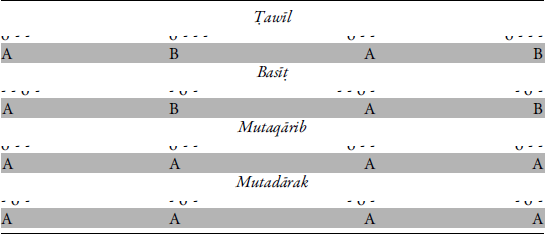
In eightfold form, these meters follow either an ABAB or an AAAA pattern, as seen above in the Persian eightfold meters. We know for a fact that many early Persian poets still had a good command of the Arabic language, to the point that a number of them composed poetry in both languages.Footnote 27 With this in mind, it is not unreasonable to believe that the patterns for the Arabic eightfold ṭawīl and basīṭ, which number among the most popular Arabic meters,Footnote 28 provided ready models for the Persians to develop their own. According to Table 1, out of these four meters, the mutaqārib is the most frequently used in Persian; the basīṭ and the mutadārak are rare; and the ṭawīl is unattested. Yet when they do appear in Persian, they are exclusively used in eightfoldFootnote 29 form and retain in their basic structure the pattern of their Arabic counterpart.Footnote 30 Therefore, it would seem that reduplication allowed the Persians to generate all other eightfold meters in accordance with one or another existing Arabic eightfold base form scheme: ABAB or AAAA.
As regards the role of the Khalīlian circles in shaping the Persian eightfold meters, consider, for instance, the five compound meters: muḍāriʿ, mujtath, muqtaḍab, munsariḥ, and khafīf. If the Persian eightfold base meters corresponded to the hypothetical forms represented in the Khalīlian circles, they would display the following patterns: ABAA, ABBA. In fact, no existing base meter conforms to these patterns, whether in Arabic or in Persian. This leads me to believe that the Persians likely modeled their muthamman meters after the Arabic poetic practice, rather than after the Khalīlian theory.
No reduplication, no eightfold meter
The statistics provided in Table 1 show that, of the fifteen meters in use in classical Persian poetry, the basīṭ, the mujtath, the muqtaḍab, and the mushākil appear exclusively in eightfold form. Others, like the hazaj, the munsariḥ, the mutaqārib, the muḍāriʿ, the rajaz, and the ramal, are also predominantly used in eightfold form. Even the khafīf and the mutadārak, more frequently used in their six- or fourfold variant, are attested in eightfold form. The sarīʿ and the qarīb are the only meters never to be found in eightfold form in classical Persian poetry.Footnote 31 Both meters relate to the fourth Khalīlian circle. The sarīʿ is well attested in ancient Arabic poetry.Footnote 32 The qarīb, however, generated by the Khalīlian theory and called munsarid, is ignored (muhmal) by the ancient Arab poets.Footnote 33 Both meters are attested in the early Persian poetic corpus of the ninth and tenth century.Footnote 34 Therefore, one could ask, if the Persians developed such an exclusive taste for eightfold forms, how can one explain that these two meters, sarīʿ and qarīb, never appear in muthamman form? The absence of an eightfold qarīb may seem all the more striking since this meter was only used in Persian poetry, being unknown to the Arabic poetic tradition.Footnote 35
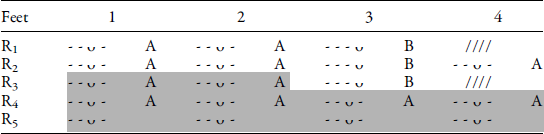
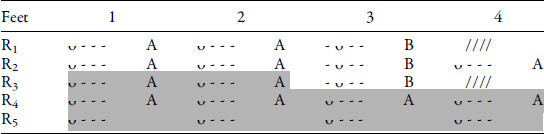
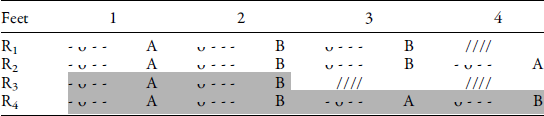
At this stage, the theory of reduplication fleshed out in the previous pages may well provide an answer. Let us consider, in Tables 12 and 13, the two meters sarīʿ and qarīb in both their theoretical and attested forms. We shall compare them, on the one hand, to the hypothetical eightfold forms deduced from the Khalīlian theory and, on the other hand, to the no less hypothetical eightfold form that would ensue if the reduplication process were to apply:
R1: the Khalīlian base meter;
R2: R1 in eightfold form;
R3: the base meter evidenced in Arabic (for the sarīʿ) or Persian (for the qarīb) poetry;
R4: the hypothetical eightfold base meter construed out of R3 by reduplication;
R5: the eightfold base meters of rajaz (for the sarīʿ) and hazaj (for the qarīb) evidenced in Persian.
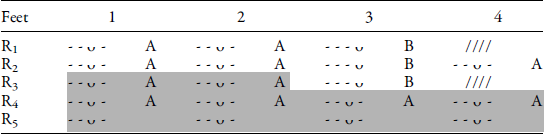
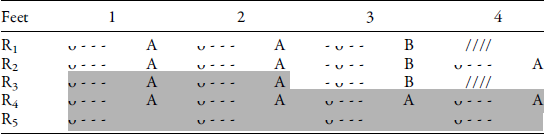
As I have shown earlier, the pattern for Persian eightfold meters is two times that of their Arabic fourfold counterparts. This account remains valid whether or not the Arabic fourfold is actually attested in poetry. In fact, only the first two feet of the Arabic meter are involved in the reduplication process. Keeping this rule in mind, one distinctive feature of the sarīʿ and the qarīb makes them unfit to generate suitable eightfold variants. In both cases, reduplication of the first two feet of the meter results in the pattern of another existing meter: the rajaz and the hazaj. This can easily be explained: the sarīʿ differs from the rajaz by one foot only, which comes in third position and is thus excluded from the reduplication process. The same holds true of the qarīb with respect to the hazaj.Footnote 36
Reduplication, symmetry, and actual meters
An obvious consequence of the reduplication process is that the Persian eightfold base meters display, just like their Arabic counterparts, one of two symmetrical patterns: AAAA and ABAB. Only under certain conditions does this symmetry, specific to the base meters, also come to appear at the level of the actual meters.
It is only natural that an actual simple eightfold meter should display the same AAAA pattern when it is derived from its base meter in intact (sālim) form. Just like the hazaj base meter (ᴗ - - -/ᴗ - - -/ᴗ - - -/ᴗ - - -), the actual meter hazaj muthamman sālim, mafāʿīlun mafāʿīlun mafāʿīlun mafāʿīlun, for instance, numbers four (ᴗ - - -) feet per hemistich.
An actual meter, be it simple or compound, may also display a symmetrical pattern when the alterations of its base form apply symmetrically to both hemistichs. In the ramal muthamman mashkūl, faʿilātu fāʿilātun faʿilātu fāʿilātun (ᴗ ᴗ - ᴗ/- ᴗ - -/ᴗ ᴗ - ᴗ/- ᴗ - -),Footnote 37 for instance, the alteration shakl Footnote 38 affects at once the first and the third foot in the meter, thus preserving symmetry. In the same way, the rajaz muthamman maṭwī makhbūn, muftaʿilun mufāʿilun muftaʿilun mufāʿilun (- ᴗ ᴗ -/ᴗ - ᴗ -/- ᴗ ᴗ -/ᴗ - ᴗ -),Footnote 39 affected by both khabn and ṭayy,Footnote 40 is symmetrical.
Yet the symmetry apparent in these two actual meters does not correspond to the reduplication scheme to obtain in their base meter. In these two actual ramal and rajaz meters, scansion reveals a symmetrical ABAB order in the feet. Their base meters, by contrast, both display an AAAA scheme. In other words, the symmetrical pattern of an actual meter does not necessarily reflect the scheme of its base meter, which stems from reduplication.
In fact, actual Persian meters only seldom display such symmetry, because the alterations to their base meter usually apply asymmetrically. One simple example is the asymmetrical ABCD pattern of the actual meter muḍāriʿ muthamman akhrab makfūf maḥdhūf (- - ᴗ/- ᴗ - ᴗ/ᴗ - - ᴗ/- ᴗ -),Footnote 41 where the muḍāriʿ base meter displays the regular ABAB pattern (ᴗ - - -/- ᴗ - -/ᴗ - - -/- ᴗ - -). It should be added that the same holds true for classical Arabic poetry where, for instance, no attested instance of eightfold basīṭ lends itself to division into two equal segments.Footnote 42 For this reason, to ascertain the reduplicated pattern of any actual meter, one should exclusively refer to its base meter.
Persian prosody, as we have seen, does not merely replicate its Arabic model. The Persian poets did not favor the same meters as the Arab poets. Meters that were only rarely used in Arabic could become very popular in Persian. As several scholars have argued, though sources may be scarce and their interpretation challenging, pre-Islamic Iranian poetry likely played a role in shaping classical Persian prosody. In what follows, I show that discussions of these particular features of Persian prosody do not weaken my hypothesis, and that my theory of reduplication remains valid.
Persian-prone meters and reduplication
In my discussion of the qarīb and the mushākil, I referred to both meters as being specific to Persian usage since, although generated by the Khalīlian theory, their actual use is confined to Persian while Arabic poetry ignores them. As regards the three compound meters with which they were compared, the mujtath, the muqtaḍab, and the muḍāriʿ, Paoli claims that they are not attested in ancient Arabic poetry. They appear in the eighth century in the fourth Khalīlian circle and are only scarcely found in usage in Arabic thereafter, and exclusively in fourfold form.Footnote 43
On the Persian side, the muqtaḍab was not in use among the early Persian poets of the ninth and tenth centuries;Footnote 44 only at a later date is the meter registered in usage, with a grand total of only fifteen occurrences, which amounts to the very low rate of 0.07 percent of the entire Persian poetic corpus surveyed by Elwell-Sutton (see Table 1). On the other hand, the popularity of the mujtath and the muḍāriʿ is undeniable: together, they amount to 25 percent of the early Persian verses of the ninth and tenth centuries.Footnote 45 They even score a better record over time, with 31 percent of the entire Persian poetic corpus (see Table 1). For this reason, I refer to them as Persian-prone meters.
Paoli exposes two hypotheses to account for this phenomenon. The first is that these Persian-prone meters may have been at first a creation of the Arab prosodists, or even of al-Khalīl himself, triggering occasional usage thereafter among the Arab poets.Footnote 46 If this is the case, one may wonder whether the idea of an Arabic influence is still pertinent to understanding the development of those Persian eightfold meters so rarely found in Arabic, such as the mujtath, the muqtaḍab, and the muḍāriʿ.
My contention is that the theory of reduplication remains valid even for those Persian-prone meters with no to little record in Arabic. In other words, one may perfectly envisage that, once familiar with the reduplication at play in Arabic eightfold meters, the Persian poets retained the procedure in mind and applied it even to such meters as were rare or nonexistent in Arabic.
In this respect, the case of one Persian-prone meter, the mushākil, also known as akhīr, is significant. This meter is not an invention of the Persians. Known to the Arabs under the name muṭṭarid, it is one of the meters generated by the Khalīlian circles which remained altogether nonexistent in the Arabic poetic tradition.Footnote 47 The meter, let it be said, was no more successful with the early Persian poets of the ninth and tenth centuries.Footnote 48 In the thirteenth century, Tūsī still deemed it muhmal and unworthy of illustrating with an attested example.Footnote 49 Around the same time, however, the scholar of prosody Shams-e Qeys considered the meter to be “of recent use” (mustaḥdath), no doubt because he found no attested example among the ancient Arab poets. He is perhaps the only specialist to claim that “a few rhymesters composed some verses on this meter in Arabic,” yet without identifying them further. To illustrate the fourfold and eightfold mushākil, Shams-e Qeys further provides a few anonymous verses, likely of his own composition.Footnote 50 Table 1 attests to twenty poems written by Persian poets on the mushākil meter, all in eightfold form. It is likely that the only attested usages of this meter were in fact triggered by the Persian prosodists’ own contrived examples. Table 14 exposes the patterns of the base meter of the mushākil. R1, R2, and R4 retain the same value as previously. The fourfold form given in R3 reflects Shams-e Qeys’ description, in the absence of evidence for its use in Arabic poetry.Footnote 51
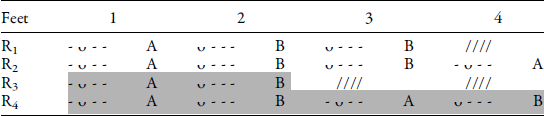
In this case, again, the Persian eightfold base meter follows a pattern, ABAB, corresponding to that of ancient Arabic eightfold meters. What this table reveals is that, even with a meter entirely unattested in Arabic, the Persian poets opted for a base meter respectful of the pattern of ancient Arabic eightfold meters. If this held true for a meter unattested in Arabic, why could it not hold true also for Persian-prone meters, particularly the mujtath and the muḍāriʿ, which are rare but attested in Arabic?
Paoli’s second hypothesis is that one or more of these Persian-prone meters, especially the muḍāriʿ, might relate to pre-Islamic Iranian origins. This hypothesis is supported by the mutual influence between early Arabic and Persian poetry, at once in forms, techniques, and themes. What is more, the earliest known Arabic verses composed in muḍāriʿ and mujtath meters are by Abū Nuwas, who was of Persian stock.Footnote 52 This hypothesis seems never to have been explored further by scholars; therefore it is tempting to credit Paoli for this suggestion. This point further encourages me to test my theory of reduplication against the findings of historical prosody, and the study of the relationships between classical Persian prosody and pre-Islamic heritage.
Reduplication and the rubāʿī meter
Classical scholars of prosody identify the actual rubāʿī meter (- - ᴗ/ᴗ - - ᴗ/ᴗ - - ᴗ/ᴗ -) as a derivation from the base meter of the eightfold hazaj affected by three alterations: xarb, kaff, and jabb.Footnote 53 This means that the base rubāʿī meter displays reduplication in the AAAA pattern common to all other actual eightfold hazaj meters.
The actual rubāʿī meter with its twelve varietiesFootnote 54 is specific to Persian, and it is generally believed that neither the poetic form nor its meter were known to the Arabs before they appeared in Persian around the ninth century.Footnote 55 As a consequence, some scholars have argued, the rubāʿī should be read and scanned differently than the other poetic meters: it should be reconnected to its origins, beyond the Khalīlian theory and the Arabic poetic tradition, in Iranian pre-Islamic poetry.Footnote 56 In what follows, I proceed to a brief review of the major scholarship produced along these lines, to show that they either confirm my theory of reduplication or deny the eightfold form of the rubāʿī meter, therefore settling the issue outside the scope of this article.
Friedrich Rückert divides the rubāʿī meter into six feet (three feet per hemistich), with an initial five-syllable foot followed by two four-syllable feet: (- - ᴗᴗ -/- ᴗᴗ -/- ᴗᴗ -). This view later met with the support of Bogdanov and Finn Thiesen.Footnote 57 Indeed, if this scansion could be proven and admitted by all, the rubāʿī meter would be considered a sixfold meter and fall outside of the scope of my reduplication theory.
Several scholars, however, reject the analysis of the rubāʿī meter as a sixfold form. Masʿūd Farzād, who devises a classification of Persian meters entirely independent from its Arabic counterpart, does away with the classical notion of a base meter altogether. He examines actual meters exclusively and divides them in two groups: “whole meters” with the “standard size,” and “curtailed” meters. The latter, he claims, derive from “whole meters” after one or more syllables have been suppressed at the beginning, at the end, or both. As a result, his scansion for most actual Persian meters departs, at times radically, from the classical analysis. Farzād further adduced two rules: (1) every foot should end in a long syllable; (2) feet should be arranged as symmetrically as possible. It is only natural, therefore, if Farzād rejects the classical scansion of the rubāʿī meter: it is far from displaying the desired symmetry, and the first foot (- - ᴗ) ends in a short syllable. On the same basis, Farzād rejects the interpretation of the rubāʿī as a sixfold meter, arguing that none of the thirteen-syllable meters in Persian is sixfold, and that none of the sixfold meters containing five-syllable feet displays a 5/4/4 pattern. Instead, Farzād suggests the (-/- ᴗᴗ -//- ᴗᴗ -/- ᴗᴗ -) arrangement derived from the “parent” or “standard” meter: (- ᴗᴗ -/- ᴗᴗ -//- ᴗᴗ -/- ᴗᴗ -).Footnote 58 As is apparent, this pattern displays the AAAA reduplicated scheme. This is no exception in Farzād’s classification since all “whole” and “parent” meters related to it likewise display an ABAB or AAAA structure.Footnote 59 Particularly significant here is Farzād’s use of the term “parent” applied to “whole” meters, suggestive of a chronology, as though the “curtailed” meters had been created out of the former, and after them. This would suggest that the Persian poets appealed to reduplicated bases to create their eightfold “parent” meters. However, Farzād’s rule to end all feet with a long syllable is linguistically unjustifiedFootnote 60 and disturbs the clear connections between the meters that tradition makes apparent. The traditional account, for instance, illustrates the structural connections between meter 1 and 2 (rubāʿī) (Table 15):

Classical prosody considers them to be derived from the same eightfold hazaj base meter after identical alterations are applied to all except the last foot. Consequently, the first is called hazaj muthamman axrab makfūf maḥdhūf and the second hazaj muthamman axrab makfūf majbūb.Footnote 61 In Farzād’s classification, however, these two meters seem disconnected, and presented as stemming from two entirely different “parent” meters: (ᴗᴗ --/ᴗᴗ --//ᴗᴗ --/ᴗᴗ --) for meter 1 and (- ᴗᴗ -/- ᴗᴗ -//- ᴗᴗ -/- ᴗᴗ -) for meter 2.Footnote 62 One weakness in Farzād’s classification is his insistence on showcasing Persian prosody as entirely independent from the Arabic metrical system.
Among the scholarly discussions of the pre-Islamic origins of the rubāʿī meter, Gilbert Lazard’s is no doubt the most elaborate. In the very first article of his series devoted to Iranian versification, EVLIA,Footnote 63 Lazard claims that classical “theoreticians associate [the rubāʿī meter] artificially with hazaj.”Footnote 64 He starts by criticizing the attribution of the couplet “Āhū-ye kūhī dar dasht chegūne davadā / Yār nadārad bī yār chegūne ravadā”Footnote 65 to Abū Hafs Soghdi for lack, he argues, of decisive evidence. Lazard holds that the couplet cannot be read along the rules of classical Persian quantitative prosody; it must be a remainder from an earlier age, a vestige of the pre-Islamic tradition. Comparing the line to a Tadjik folk couplet discovered by the orientalist I. S. Braginskij, Lazard identifies the rhythmic pattern mirrored in the syntactic structure of the couplet: the line, he claims, is divided into two sections of 5 (2/3) and 8 (2/3/3) syllables, as follows: Āhū- / ye kūhī // dar dasht / chegūne / davadā (2 / 3 // 2 / 3 / 3 → 5 // 8). In this pattern, the caesura after the fifth syllable stands for a major syntactic boundary that comes at the end of a word, if not of a sentence. Noticing a similar (5//8) syntactic partition in several rubāʿīs by Rūdakī, one of the earliest known contributors to the genre, Lazard suggests that the rubāʿī meter as such should be scanned after this model: (- - / ᴗᴗ - // - ᴗ / ᴗ - -/ ᴗᴗ -).Footnote 66 Were such a structure be accepted, the meter could not be considered eightfold and would therefore fall outside of the scope of my reduplication theory.Footnote 67
However, a closer reading reveals the limits of Lazard’s contention, and its status as a working hypothesis. First of all, Lazard’s pattern does not apply to all—or even to most—Persian rubāʿīs. Lazard readily admits that, in the rubāʿī, the syntactic caesura dividing the hemistich into one five-syllable and one eight-syllable sections is all but compulsory for the genre. What is more, according to Lazard’s own survey, only one-third of Rūdakī’s rubāʿīs satisfy this (5//8) scheme.Footnote 68 Instead, the classical definition of the rubāʿī still accounts for every possible Persian rubāʿī.Footnote 69
Lazard’s hypothesis of a (5//8) structure for the archaic rubāʿī meter met with uneven success among the prosodists. Abolhasan Najafī deems Lazard’s supposition irrelevant since Āhū-ye kūhī does not qualify for the quantitative rubāʿī meter in the first place. Najafī himself is of the opinion that the rubāʿī meter is not related to the hazaj. He refers the rubāʿī meter to a couplet of the seventh century attributed to Yazīd Ibn Mufarrigh, Āb ast-o nabīz ast / ʿEsārāt-e zabīb ast.Footnote 70 Najafī believes that the rubāʿī meter was shaped by the metrical conjunction of the two hemistichs: Āb ast-o nabīz ast ʿesārāt-e zabīb ast (- - ᴗᴗ - - ᴗᴗ - - ᴗᴗ - -). He defines (- - ᴗᴗ) as the base foot of the rubāʿī and identifies its base meter as follows: (- - ᴗᴗ/- - ᴗᴗ/- - ᴗᴗ/- - ᴗᴗ). According to Najafī, if the actual rubāʿī meter finds its two final short syllables missing, it is because the “music of Persian poetry”Footnote 71 does not allow for such a syllabic combination (two short syllables) at the end of the hemistich. Table 16 illustrates the eightfold base meter of the rubāʿī in agreement with Najafī’s claim.

No one would dare deny the fact that the Persian poets adopted quantitative prosody under the influence of Arabic poetry. I was able to show earlier that the Persians likewise retained a reduplicated pattern even for their own eightfold base meters unattested in Arabic. With this in mind, and in line with Najafī’s contention, one may go so far as to surmise that, inspired by the ABAB and AAAA schemes of the ancient Arabic base meters, early Persian poets created the rubāʿī meter in such a way as to display in its base form the same “reduplicated” scheme.
Reduplication and pre-Islamic poetry
In his EVLIA series, Lazard furthered his investigations of possible connections between classical Persian metrical schemes and the prosody of pre-Islamic, accentual Iranian poetry. To anchor his investigations more deeply, Lazard claims that the phonetic structure of modern Persian does not differ substantially from that of Middle Persian, and that the “natural rhythms” in both languages should have been the same.Footnote 72 He studies the rhythmical structure of a Baluchi folk epic,Footnote 73 and of chosen Parthian and Middle Persian poems to establish their “structural formulae” and connect them with one or another actual Persian meter.Footnote 74
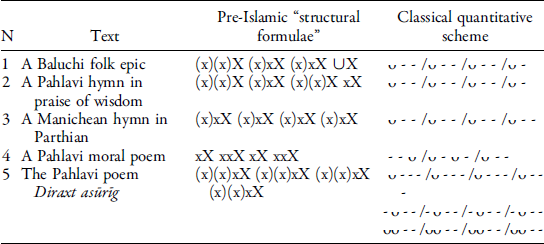
According to Émile Benveniste, the ingenuity of the Persians consisted in their adapting their pre-Islamic prosody to the quantitative Arabic model.Footnote 75 On these grounds, Lazard argues that the “structural formulae” he discovers may lie at the core of several quantitative Persian meters after adoption of, and adaptation to, the Arabic quantitative system. Table 17 displays both the pre-Islamic accentual schemes determined by Lazard and what he believes could be their actual quantitative counterpart.Footnote 76
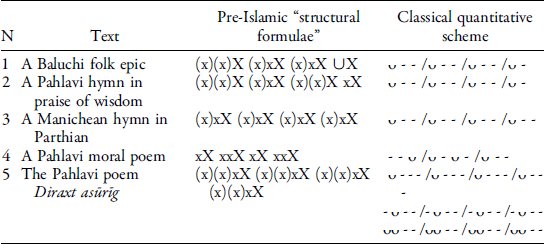
As I wrote earlier, the structure of eightfold Arabic meters in ABAB and AAAA inspired the Persian poets as they shaped their own favorite eightfold meters. At first sight, Lazard’s third and fifth “structural formulae” display a simple AAAA structure. Yet his studies do not provide a frame or overview of how the Persians structured their eightfold meters.Footnote 77
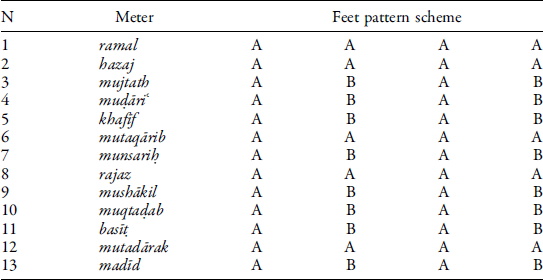
Table 18 summarizes all thirteen meters surveyed by Elwell-Sutton as are attested in Persian in eightfold form as well as in their feet pattern scheme.
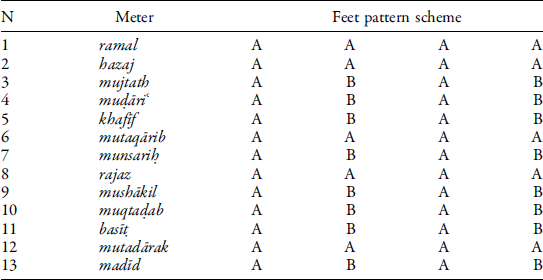
It is obvious that, out of thirteen meters, eight display the ABAB scheme not included in Lazard’s formulae. What is more, two of the five simple meters in AAAA base form, the mutadārak and the rajaz, cannot have been generated by Lazard’s “structural formulae,” since both meters include in their base feet a short syllable that does not correspond to the optional syllable of pre-Islamic structures.Footnote 78 No other study establishes further possible connection between these ten eightfold meters and pre-Islamic poetry—which confirms that Arabic prosody was indeed the dominant factor in shaping Persian eightfold meters.
In Persian prosody, the quantitative schemes in row 1, 2, and 3 of Table 17 are all actual meters derived from a single mutaqārib base form: (ᴗ - - /ᴗ - - /ᴗ - - /ᴗ - -). The idea that the Persian poets could have modeled their epic meter after their own pre-Islamic poetry exclusively might be tenable were this meter unattested in the ancient Arabic tradition. Yet, according to Paoli, the eightfold mutaqārib was well attested in ancient Arabic poetry, in both intact and curtailed form. What is more, the mutaqārib is the only simple meter used in ancient Arabic poetry exclusively in eightfold form.Footnote 79 There is no evidence that the Arabic meter was in fact adapted from an earlier Persian variant of the epic meter. All things considered, therefore, and given the overwhelming effect of Arabic poetry on the Iranian peoples between the seventh and the ninth century,Footnote 80 it would seem difficult to argue that the Persian poets designed their eightfold quantitative mutaqārib after their old epic rhythmic structure regardless of the fact that the same metric pattern was already in use in Arabic poetry.
As regards the fifth pre-Islamic rhythmic scheme in Table 17, my analysis slightly departs from Lazard’s. I believe that, unlike the other poems analyzed, the four-feet structure of Diraxt asūrīg cannot be equated with the classical Persian hemistich. The four-feet verses of the Baluchi epic rhyme with one another and are not divided into hemistichs.Footnote 81 The same configuration is evidenced in the two Pahlavi poems. In the first one, besides the absence of a caesura, the rhyming verses form couplets.Footnote 82 As for the Manichean hymn, although its verses are divided by a caesura into hemistichs not bound together by rhyme, it is organized in couplets, as is customary in Parthian poetry.Footnote 83 Therefore, all these poems display at least one structural feature that allows for the full pre-Islamic verse to be compared with the classical Persian hemistich, since they behave in similar fashion. Only in Diraxt asūrīg are the verses clearly divided in hemistichs without rhyming with one another, and without forming a couplet.Footnote 84 As a result, the full verse cannot be understood as an equivalent of the classical quantitative hemistich.Footnote 85 In this case, the sole rhythmic element comparable to the classical Persian hemistich is the Pahlavi hemistich, (x)(x)xX (x)(x)xX. If it were adapted to the quantitative system, this pattern would generate fourfold, not eightfold verses.
One certainly cannot disavow the importance of pre-Islamic poetry in the rise of classical Persian prosody. As has been shown throughout these pages, however, given the blatant ascendancy of the Arabic model on the reduplication process, one may surmise that, though they retained some pre-Islamic features in their eightfold meters, the Persian poets did not merely adopt from the Arabs the principle of quantity; they also ensured that the newly minted meter corresponded, in its new quantitative base structure, to one or another extant Arabic eightfold base pattern.
Conclusion
One obvious distinction between Arabic prosody and its Persian counterpart is the latter’s clear preference for eightfold meters. Most of the meters used by classical Persian poets in eightfold form were not eightfold in Arabic, and thus required some reframing. To do so, no matter the initial meter, whether or not it was attested in ancient Arabic poetry, initially generated by the Khalīlian theory and later favored by Persian poets, or even launched by an individual Persian prosodist, the Persians crafted their eightfold meter in such a way as to display in its base form a reduplication of the two first feet in its original pattern. Why did they proceed in this way? It is likely that, in a time when bilingualism still prevailed, the Persian poets noticed in the base form of the extant Arabic meters the ABAB and AAAA schemes which appeared to stem from a reduplication of their initial AB and AA pattern. In so doing, the Persians likely followed the Arabic poetic practice, rather than the Khalīlian theory.
Still, such compound meters as sarīʿ and qarīb did not allow for an eightfold form. Indeed, their original base form AAB differs from rajaz and hazaj only by foot B, which lies beyond the limit of two feet affected by the reduplication process.
Those scholars who pleaded in favor of the pre-Islamic origins of the rubāʿī mainly sought to single out the meter by contending its traditional identification as an eightfold hazaj. To do so, they either excluded it from the reduplication process by treating it as a sixfold meter, or ended up defining for their purpose a new reduplicated AAAA base form.
As regards the remaining Persian meters, the studies on pre-Islamic prosody carried out by Gilbert Lazard fail to provide a comprehensive understanding of the ways in which quantitative eightfold meters were devised by the Persians poets.